Fly Atlas Classic Salmon The Infallible
The Infallible
sign in or join free to save flies to your bench.
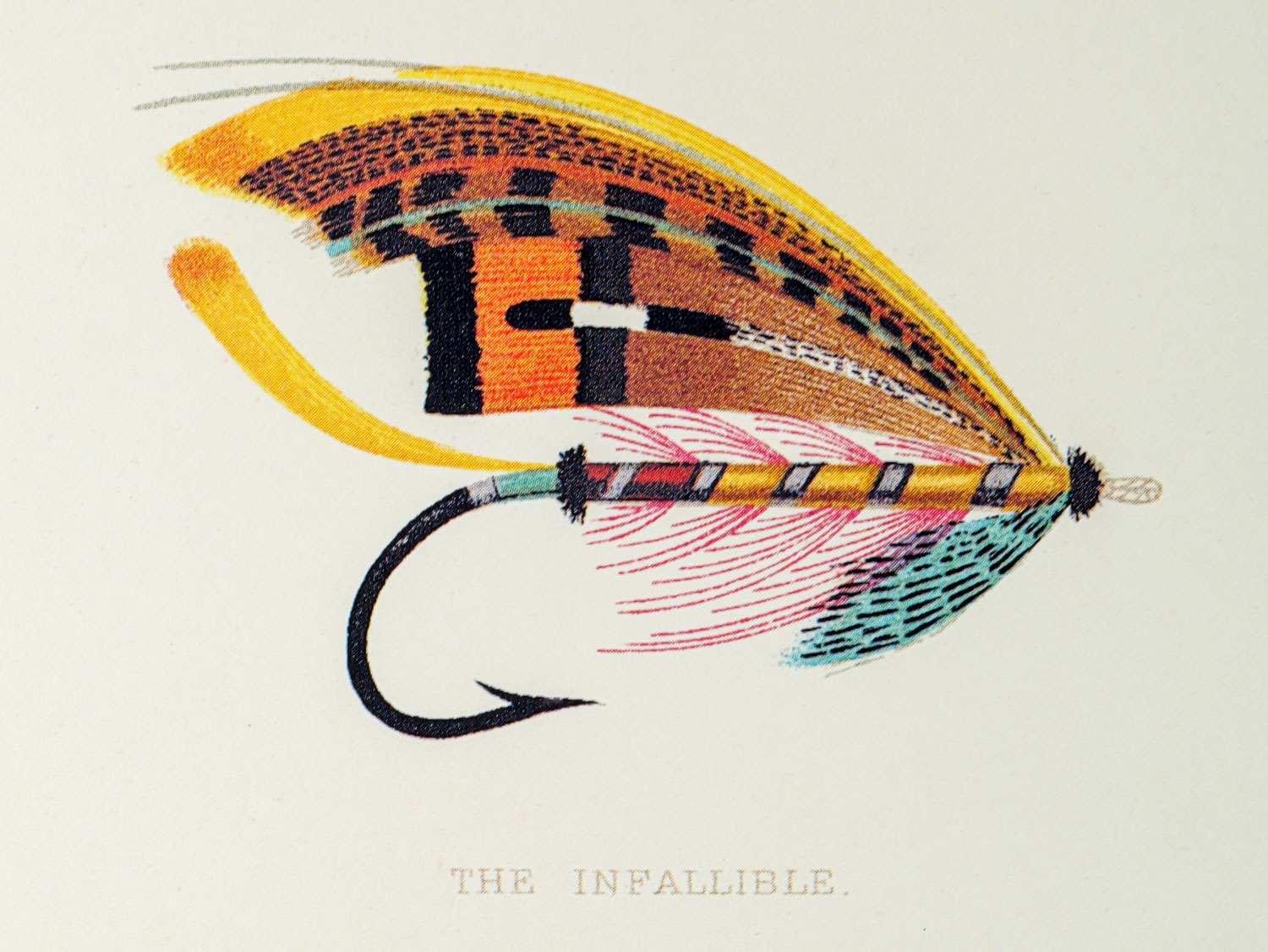
The dressing · tail → head
sign in or join free to use “with my substitutes”, which reads the materials you have recorded — “all substitutes” works for everyone.
Adds a short colored or metallic band and establishes the rear transition of the fly.
Proportion: Short and crisp. In many full-dress flies it should remain a small accent rather than a body section.
Common error: Uneven floss; exposed underbody; excessive length; abrupt diameter change into the body.
Balances the wing and body, adds color and motion, and establishes the fly's rear silhouette.
Proportion: Usually modest and proportional to the hook; a crest tail should follow the hook curve and not kick sharply upward.
Common error: Tail too long; crest twisted off center; excessive materials; tail angle fighting the hook bend.
Provides a narrow visual break and hides transitions between tag, tail, and body.
Proportion: Usually only a few tight turns; narrow enough to read as punctuation, not another body section.
Common error: Oversized butt; fuzzy fibers trapped under body; leaving a diameter step.
Carries the dominant color/texture of the pattern and supports ribbing and body hackle.
Proportion: Occupies most of the usable shank while leaving sufficient room at the front for wing, throat, horns, topping, and a compact head.
Common error: Body too thick; uneven taper; poor floss coverage; crowding the head; losing planned section boundaries.
Segments the body visually, reinforces fragile body materials, and often anchors/paces the body hackle.
Proportion: Evenly spaced turns are more important than an exact count; 4–6 visible turns is a common practical target on many full-dress bodies.
Common error: Uneven spacing; rib slipping into valleys in dubbing; inconsistent angle; rib crushing hackle.
Adds movement, silhouette, color, and segmentation.
Proportion: Fiber length should suit hook scale and pattern style. Keep turns synchronized with ribbing when the recipe ties the two together.
Common error: Hackle too dense; fibers trapped by rib; starting at wrong body point; taper inconsistent.
Adds a concentrated veil of hackle fibers below the wing and balances the body hackle.
Proportion: Should complement the wing and body rather than hide the hook. Length varies by style; keep it balanced to the hook gap and wing.
Common error: Too long or dense; fibers distributed around the hook when a throat/beard was intended; blocking the wing tie-in.
Primary visual structure of the fly; establishes profile, color pattern, and much of the pattern identity.
Proportion: Length and height vary by school and pattern. As a practical guide, keep the wing balanced to the hook and tail and leave a clean, compact head.
Common error: Wing too tall/long; poor left-right symmetry; fibers rolling around hook; excessive material; wing collapse.
Adds distinctive color/pattern to the wing sides and broadens the visual profile.
Proportion: Usually shorter or visually subordinate to the full wing; pair carefully.
Common error: Sides too large; mismatched pair; placed so high they read as cheeks.
Adds long linear accents and color, especially on elaborate full-dress flies.
Proportion: Sparse—often only one or a few fibers per side. Keep them aligned with the wing and only slightly beyond it when appropriate.
Common error: Too many fibers; horns splay widely; grossly overlong; unequal sides.
Secures all front components and visually terminates the dressing.
Proportion: As small and neat as construction allows while fully securing the fly.
Common error: Crowded eye; oversized head; exposed thread steps; weak finish; varnish flooding materials.
Adds a short colored or metallic band and establishes the rear transition of the fly.
Proportion: Short and crisp. In many full-dress flies it should remain a small accent rather than a body section.
Common error: Uneven floss; exposed underbody; excessive length; abrupt diameter change into the body.
Balances the wing and body, adds color and motion, and establishes the fly's rear silhouette.
Proportion: Usually modest and proportional to the hook; a crest tail should follow the hook curve and not kick sharply upward.
Common error: Tail too long; crest twisted off center; excessive materials; tail angle fighting the hook bend.
Provides a narrow visual break and hides transitions between tag, tail, and body.
Proportion: Usually only a few tight turns; narrow enough to read as punctuation, not another body section.
Common error: Oversized butt; fuzzy fibers trapped under body; leaving a diameter step.
Click a numbered marker on the plate, or a row here, for purpose, proportion and the common errors.
| Component | The Infallible (George M. Kelson, 1895) base text |
|---|---|
| TAG | Silver twist and light blue silk. |
| TAIL | A topping. |
| BUTT | Black herl. |
| BODY | Four turns of claret silk, followed by dark yellow silk. |
| RIBS | Silver tinsel (broad). |
| HACKLE | Claret hackle, from claret silk. |
| THROAT | Jay. |
| WINGS | Two tippets (back to back) capped with Golden Pheasant tail, Bustard, Peacock wing; red, and blue Macaw, and a topping. |
| SIDES | A narrow strip of Summer Duck. |
| HORNS | Blue Macaw. |
| HEAD | Black herl. A well-known old standard. Kills well on the Bundrowes and Blackwater; an excellent low-water fly on the Shannon and a general favourite throughout Scotland and Wales. |
| TAG | Gold twist. |
| TAIL | A topping. |
| BUTT | Black herl. |
Dashed terms carry a logged conflict — hover to read the verdict.
| Material | Used for | Status | Substitute |
|---|---|---|---|
| Cock hackle | HACKLE | — | Hen hackle |
| Flat tinsel | RIBS | — | — |
| Golden pheasant | WINGS | — | — |
| Golden pheasant crest | TAIL | — | — |
| Jay | THROAT | — | Guinea fowl (gallina) |
| Macaw | HORNS | — | Dyed goose or swan wing |
| Ostrich herl | BUTT, HEAD | — | — |
| Silk floss | TAG | — | — |
| Twist | TAG | — | — |
| Tying thread (silk) | BODY | — | — |
| Wood duck (summer duck) | SIDES | — | — |
Every material links to its own page — background, the flies that call for it, substitutes and merchants.
No tying sequence has been written for this fly yet. The dressing above is the record; the steps are still to come.
Nothing has been written about this fly’s history yet.
No member has shared a photograph of this fly yet.
sign in or join free to share your tie. Photographs are reviewed before publishing.