Fly Atlas Classic Salmon Feather-Wing Britannia
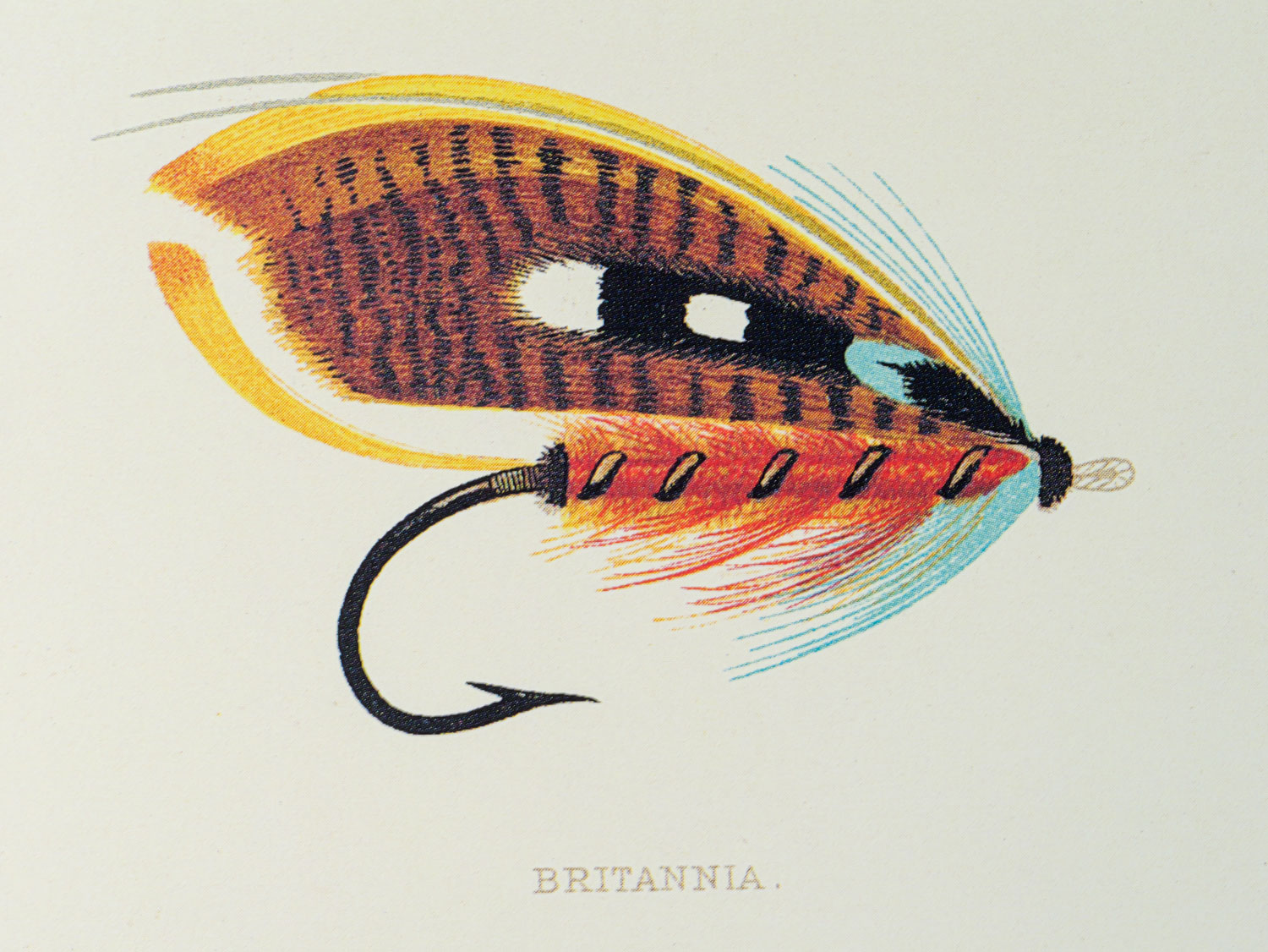
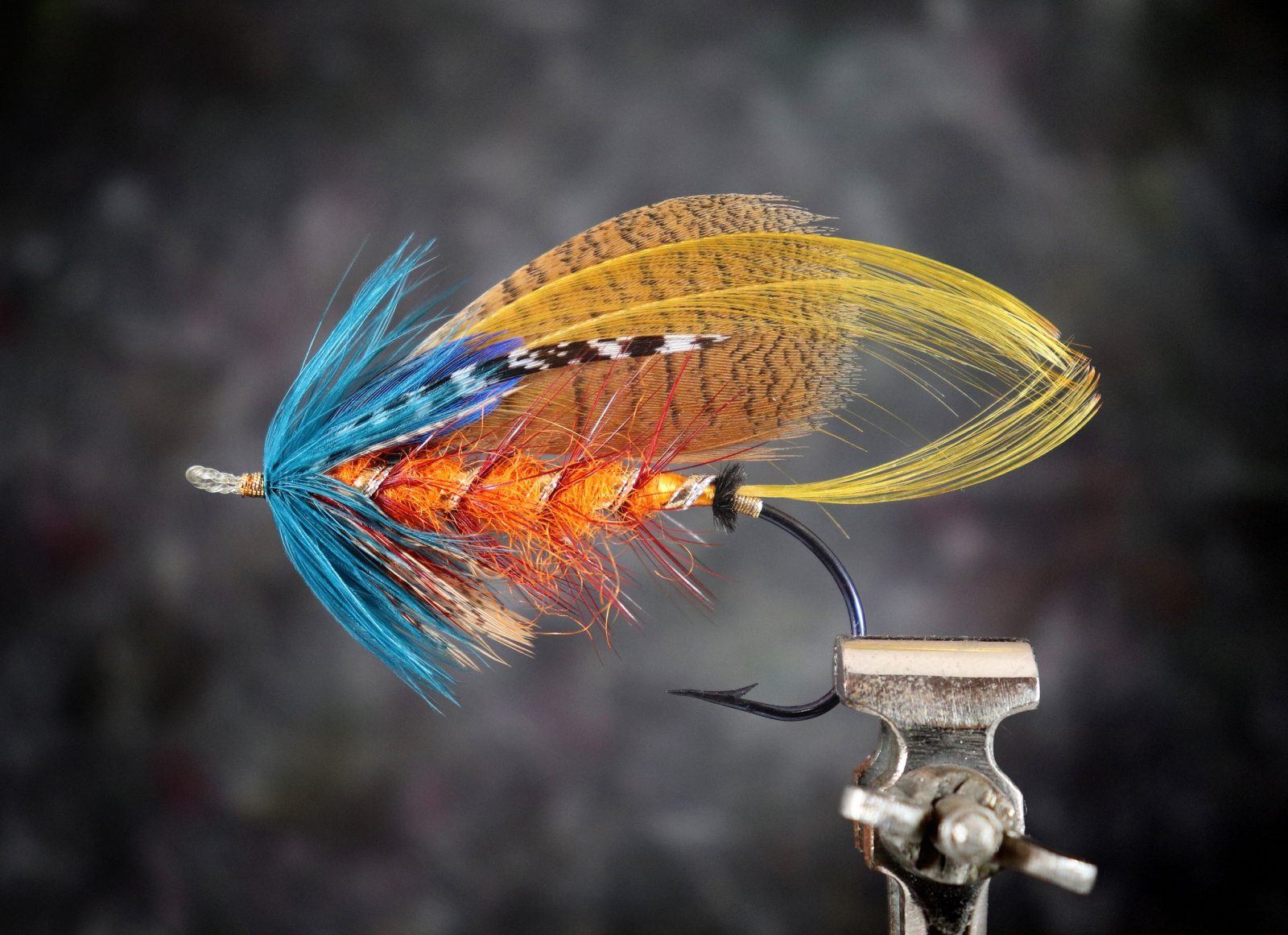
Britannia
Feather-Wing familysign in or join free to save flies to your bench.
The dressing · tail → head
sign in or join free to use “with my substitutes”, which reads the materials you have recorded — “all substitutes” works for everyone.
Adds a short colored or metallic band and establishes the rear transition of the fly.
Proportion: Short and crisp. In many full-dress flies it should remain a small accent rather than a body section.
Common error: Uneven floss; exposed underbody; excessive length; abrupt diameter change into the body.
Balances the wing and body, adds color and motion, and establishes the fly's rear silhouette.
Proportion: Usually modest and proportional to the hook; a crest tail should follow the hook curve and not kick sharply upward.
Common error: Tail too long; crest twisted off center; excessive materials; tail angle fighting the hook bend.
Provides a narrow visual break and hides transitions between tag, tail, and body.
Proportion: Usually only a few tight turns; narrow enough to read as punctuation, not another body section.
Common error: Oversized butt; fuzzy fibers trapped under body; leaving a diameter step.
Carries the dominant color/texture of the pattern and supports ribbing and body hackle.
Proportion: Occupies most of the usable shank while leaving sufficient room at the front for wing, throat, horns, topping, and a compact head.
Common error: Body too thick; uneven taper; poor floss coverage; crowding the head; losing planned section boundaries.
Segments the body visually, reinforces fragile body materials, and often anchors/paces the body hackle.
Proportion: Evenly spaced turns are more important than an exact count; 4–6 visible turns is a common practical target on many full-dress bodies.
Common error: Uneven spacing; rib slipping into valleys in dubbing; inconsistent angle; rib crushing hackle.
Primary visual structure of the fly; establishes profile, color pattern, and much of the pattern identity.
Proportion: Length and height vary by school and pattern. As a practical guide, keep the wing balanced to the hook and tail and leave a clean, compact head.
Common error: Wing too tall/long; poor left-right symmetry; fibers rolling around hook; excessive material; wing collapse.
Adds distinctive color/pattern to the wing sides and broadens the visual profile.
Proportion: Usually shorter or visually subordinate to the full wing; pair carefully.
Common error: Sides too large; mismatched pair; placed so high they read as cheeks.
Adds a concentrated spot of color or pattern and often identifies the dressing.
Proportion: Smaller than sides and carefully centered; should accent, not cover, the wing.
Common error: Cheeks too large; unequal placement; set too far back; confused with sides.
Adds long linear accents and color, especially on elaborate full-dress flies.
Proportion: Sparse—often only one or a few fibers per side. Keep them aligned with the wing and only slightly beyond it when appropriate.
Common error: Too many fibers; horns splay widely; grossly overlong; unequal sides.
Secures all front components and visually terminates the dressing.
Proportion: As small and neat as construction allows while fully securing the fly.
Common error: Crowded eye; oversized head; exposed thread steps; weak finish; varnish flooding materials.
Click a numbered marker on the plate, or a row here, for purpose, proportion and the common errors.
| Component | Britannia (George M. Kelson, 1895) base text |
|---|---|
| TAG | Gold twist (plenty). |
| TAIL | A topping. |
| BUTT | Black herl. |
| BODY | Red-orange Seal's fur. |
| RIBS | Gold tinsel. |
| WINGS | Shovel duck and a topping. |
| SIDES | Jungle. |
| CHEEKS | Chatterer. |
| HORNS | Blue Macaw. |
| HEAD | Dark blue hackle. |
Dashed terms carry a logged conflict — hover to read the verdict.
| Material | Used for | Status | Substitute |
|---|---|---|---|
| Blue chatterer | CHEEKS | — | — |
| Cock hackle | HEAD | — | Hen hackle |
| Flat tinsel | RIBS | — | — |
| Golden pheasant | TAIL | — | — |
| Golden pheasant crest | WINGS | — | — |
| Jungle cock | SIDES | — | — |
| Macaw | HORNS | — | Dyed goose or swan wing |
| Ostrich herl | BUTT | — | — |
| Seal fur | BODY | — | — |
| Twist | TAG | — | — |
Every material links to its own page — background, the flies that call for it, substitutes and merchants.
No tying sequence has been written for this fly yet. The dressing above is the record; the steps are still to come.
The Britannia is a Victorian salmon fly that was already well established before George M. Kelson included it in The Salmon Fly in 1895. An earlier dressing appeared in Edward Fitzgibbon’s The Book of the Salmon in 1850, where “Ephemera” praised it as a large general-purpose pattern for high water slightly discoloured by a recent flood. Francis Francis published another version in A Book on Angling in 1867.
Kelson attributed the Britannia to John Bernard, but later research by fly-fishing historians Andrew Herd and Hermann Dietrich-Troeltsch identifies it as a pattern associated with the Irish-born fly dresser William Blacker. “Kelson’s Britannia” is therefore best understood as Kelson’s recorded dressing of an older pattern rather than a fly of his own invention. Distinguished by its Shoveler-duck feather wing, several golden-pheasant toppings and warm orange, red and purple coloring, the Britannia is a striking example of mid-19th-century salmon-fly design.
Source note: The principal sources are George M. Kelson’s The Salmon Fly (1895), Edward Fitzgibbon’s The Book of the Salmon (1850), Francis Francis’s A Book on Angling (1867), and “The Bird with the Golden Cape” by Andrew Herd and Hermann Dietrich-Troeltsch in The American Fly Fisher.
No member has shared a photograph of this fly yet.
sign in or join free to share your tie. Photographs are reviewed before publishing.
The Feather-Wing family
variants and relatives — same architecture, different dress