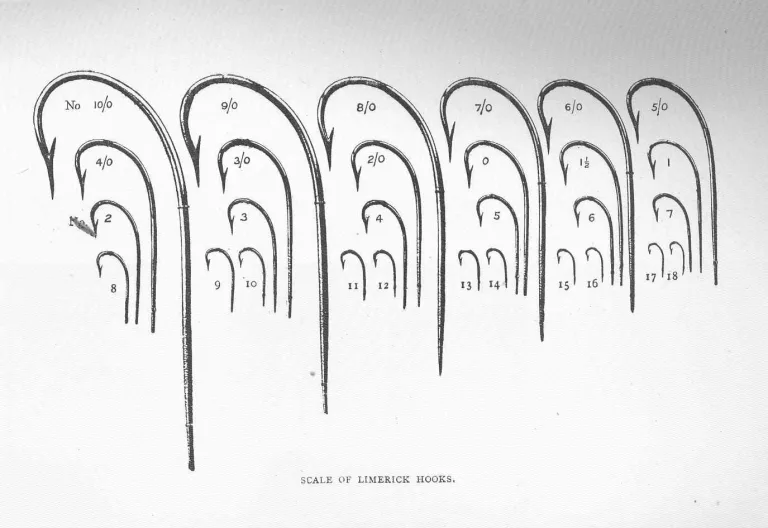
Most of the hooks ever made were never sold to an angler. They went by the barrel to fishing ports, to be baited by the thousand on longlines, jigged on handlines from dories, or set on eel lines in estuaries, and they were used up and thrown away. The sport-fishing hook, with its named bends and its printed wraps, is a small and well-documented corner of the trade; the commercial hook is the trade itself, and it is where Mustad made its money. This article is about those hooks: what they were for, how they differ from the hooks in the fly box, and why they are worth collecting.
Duhamel’s plates
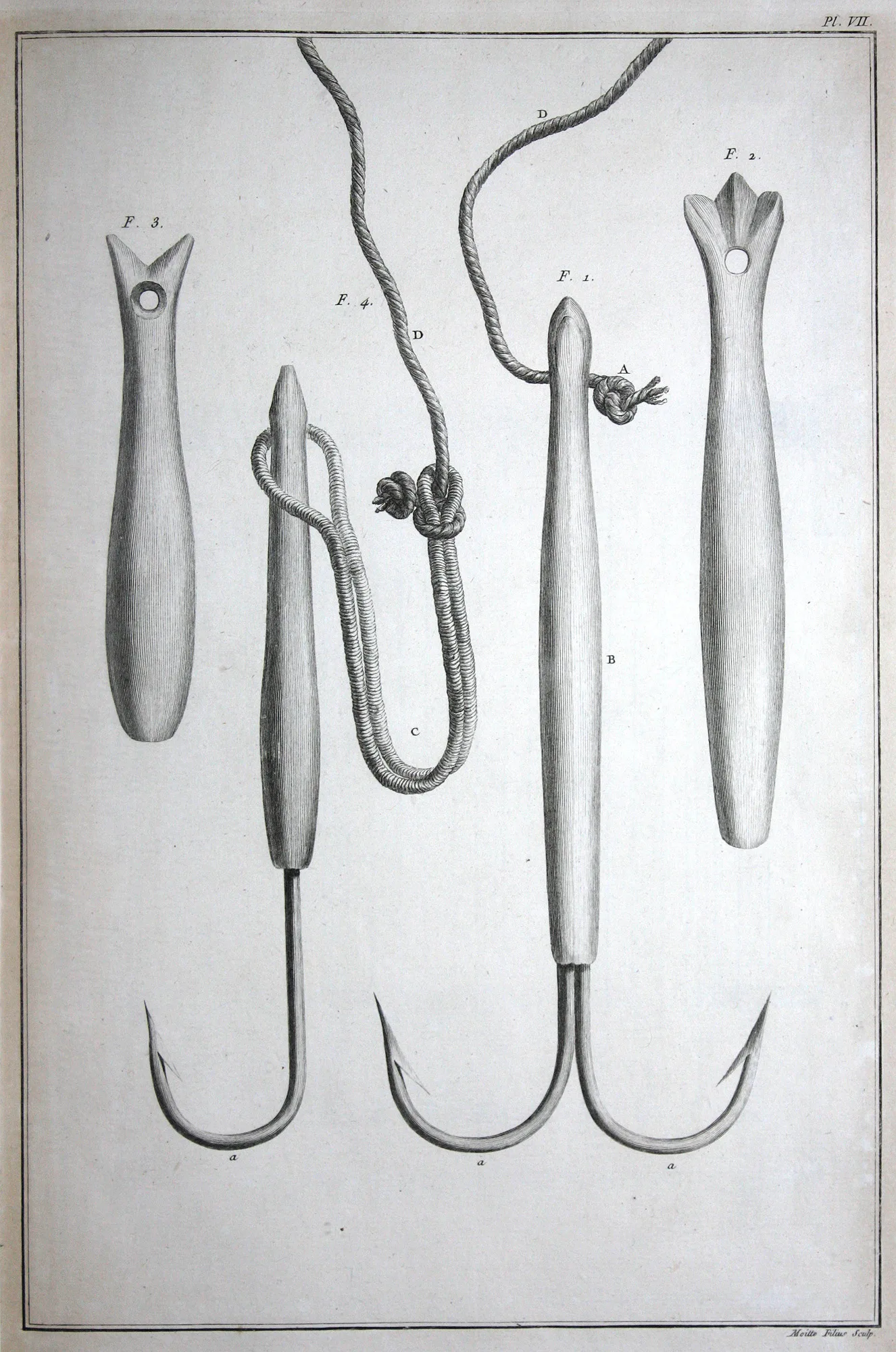
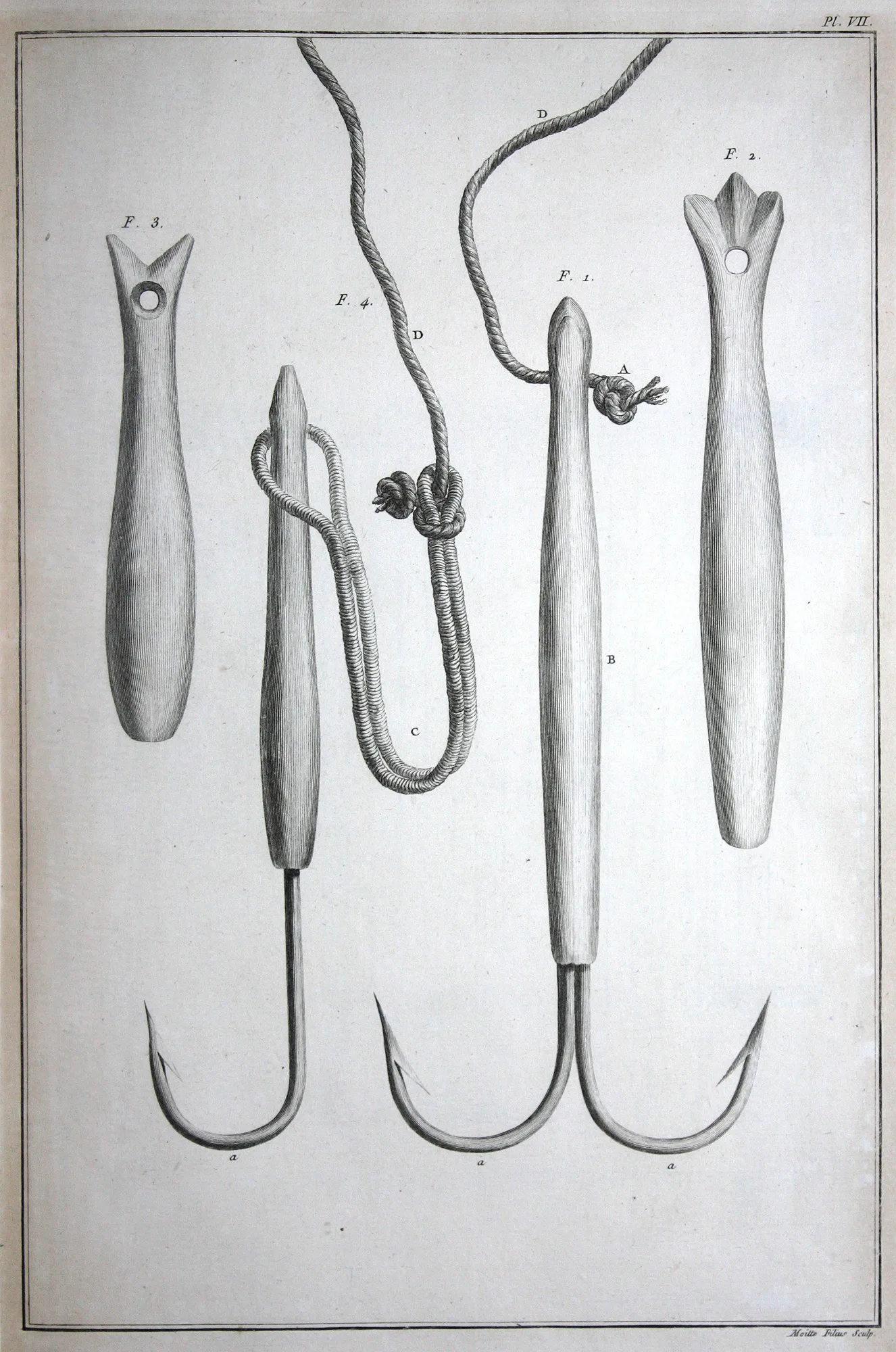
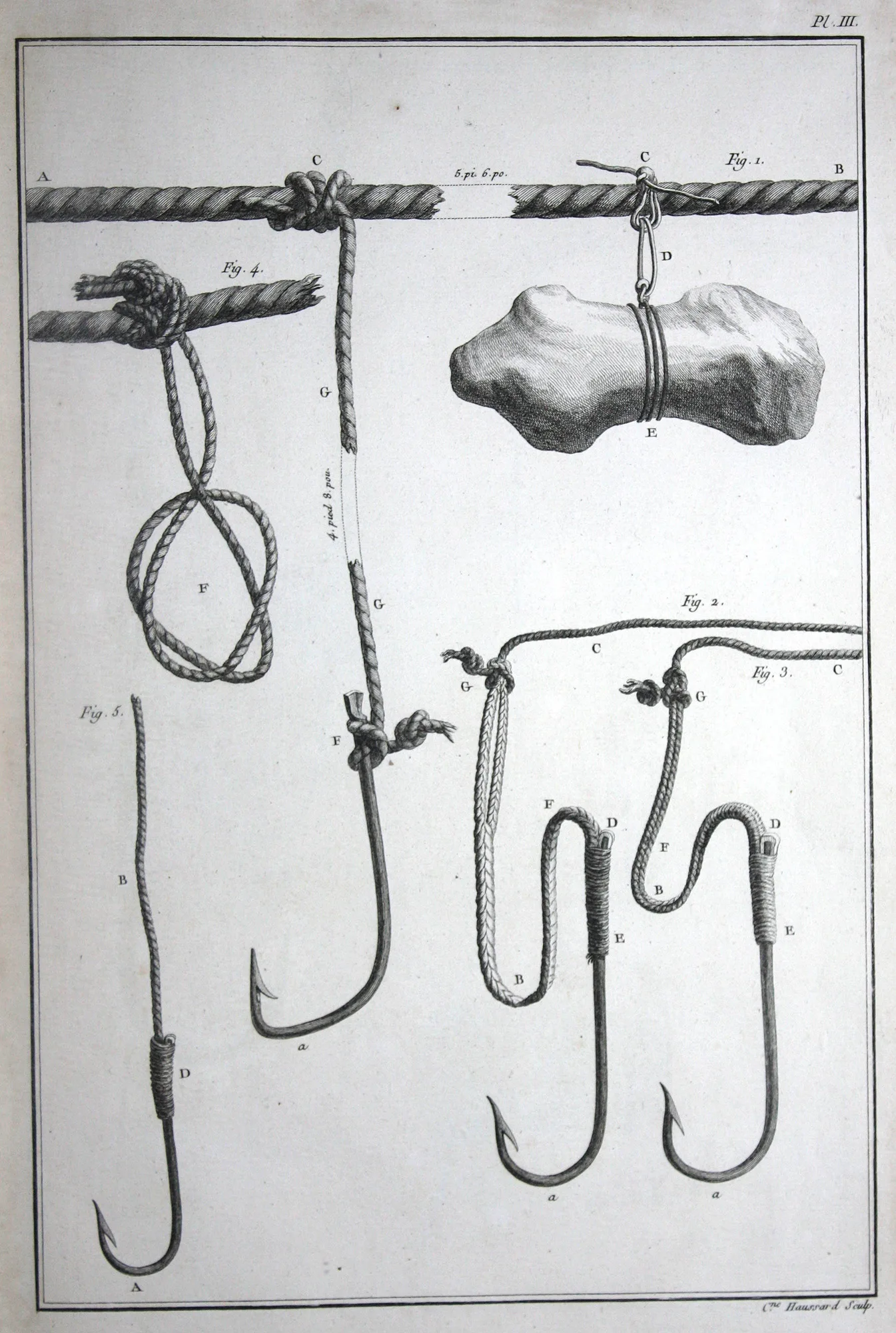
The first systematic record of commercial hooks is French. Henri-Louis Duhamel du Monceau’s Traité général des pesches, published in parts from 1769, set out to describe every fishery of France and its neighbours, and its opening plates are of hooks: hooks for cod and rays, hooks for eels and mackerel, hooks with lead lures, hooks on whipped snells and knotted cords. They are the earliest engineering drawings of fishing tackle, and two things stand out. The hooks are already specialised by fishery, and the rigging, the snell, the whipping, the lead, is drawn as carefully as the hook, because to a commercial fisherman the hook is one part of a system.
The cod hook
Cod were the great hook fishery of the North Atlantic for five hundred years, and the cod hook is the archetype of the commercial hook: large, in heavy wire, with a plain round or Kirby-type bend, a strong barb, a flattened or ringed end, and a tinned finish against salt water. Two ways of fishing it produced two forms. The handline jig, with a hook or pair of hooks cast into a lead body shaped like a small fish, was worked up and down from a boat and needed no bait; Duhamel draws it, Newfoundland called it a jigger, and Norway a pilk. The baited longline, a groundline with hundreds or thousands of short snoods each carrying a hook, was set and hauled, and its hooks were smaller, uniform and bought by the thousand.
Longlining is the reason Mustad grew. The Norwegian coastal fisheries used longlines on an enormous scale, and a factory in Gjøvik that could make a uniform tinned hook by machine for a fraction of the hand-made price had its home market on its doorstep. From Norway the same hooks went to Iceland, the Faroes, Newfoundland and New England, where the Grand Banks dory fishermen baited “tub trawls” of several hundred hooks apiece, and the Mustad catalogue numbers for these sea hooks run into the thousands of variants.
Eel, mackerel and the rest
Each fishery had its hook. Eel hooks are long in the shank, so the fish cannot bite through the snood, and often have a slight sneck. Mackerel hooks are small, light and bright, fished in gangs on feathers or on a “spinner” from a moving boat. Halibut and ling hooks are huge. Greenland shark hooks, on chain, are forged iron the size of a hand. Whiting and haddock hooks are fine-wire. Tuna hooks, for the pole-and-line fisheries, are barbless so that the fish can be flicked off. There are hooks for octopus, for crab pots, for squid. None of these appear in an angling catalogue, and most were sold in plain paper or wooden boxes with a stencil.
How commercial hooks differ
Set a commercial hook beside a sport hook of the same size and the differences are obvious. The wire is heavier, because the hook will be hauled by machine or by a man in oilskins and not played on a rod. The finish is tinned or, later, galvanised or stainless, never bronzed. The eye is a ring, often large, for a snood of tarred cotton or nylon rather than gut. The point is shorter and more robust, and on modern hooks is often a “knife edge” or bent-in point designed to hold rather than to penetrate on a strike. The barb is substantial. And the hook is uniform: a longline hook has to sit in an automatic baiter or a hauler, and variation is a fault.
The circle hook, which has its own article on this site, is the commercial hook’s best-known contribution to sport fishing. The Mustad tuna circle was a longline hook first, and the sport patterns are adaptations.
The automatic line
The last chapter is mechanisation of the fishery itself. Baiting a longline by hand is slow, and from the 1970s Mustad developed the Autoline system, which baits, sets, hauls and cleans the hooks by machine aboard the vessel. The hooks for an automatic system are a component, designed for the machine as much as for the fish, and they are the least romantic and most numerous hooks made today. A collector who wants a complete picture of the twentieth century should have a few.
Collecting the trade hook
Commercial hooks are the cheapest antique hooks there are, because nobody has collected them. They turn up in fishing-port house clearances and chandlers’ back rooms in wooden boxes of a thousand, still tinned bright, with a stencilled Mustad number and a port of destination. The boxes are the thing: a Mustad box marked for Lisbon or St. John’s or Ålesund, with the quality number and the count, is a document of the export trade that no angling packet can match, and the language of the label dates it. Loose sea hooks are much harder to place, though the reference’s Mustad section includes a number of tinned sea patterns, and the compare tool works as well on a 10/0 cod hook as on a size 16 dry fly.
One caution. Old sea hooks may be cadmium plated, particularly post-war American ones, and the dull grey plating should be handled with washed hands and kept away from children. Tinned hooks are safe; they just rust.
Why it matters
The commercial hook is the reason the sport hook exists in its modern form. The machines were built for cod hooks; the finishes were developed for salt water; the factories that made the 94840 by the million were paid for by longline hooks. A reference that documents only the hooks anglers bought is documenting the froth on a very large wave, and the sea hooks in the catalogue are there to keep that in view.
Source and further reading
Henri-Louis Duhamel du Monceau, Traité général des pesches (1769–82), digitised by UBC Library. George Brown Goode, The Fisheries and Fishery Industries of the United States (1884–87), for the New England longline and handline fisheries. Terje Paulsberg, Mustad: Fish Hooks for the World (2007). Mustad Autoline’s published company history.
Image note: Both plates are public domain reproductions from Wikimedia Commons, via UBC Library, and are credited in their captions.