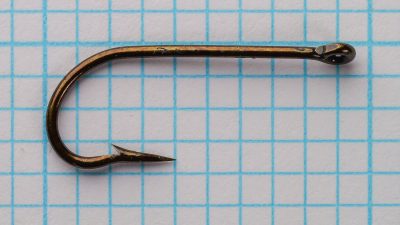
Musthav is an obscure vintage fish-hook brand known primarily through surviving hook boxes rather than through catalogs, advertisements, or a documented company history. Unlike major manufacturers such as Mustad, Allcock, Pflueger, or Milward, no substantial corporate record for a company named Musthav has yet been identified. Surviving packaging, however, provides important clues to what the brand was and how its hooks were marketed.
Known Musthav boxes were produced for the export tackle trade and surviving examples have been identified as Made in Japan. One surviving assorted-hook box is cataloged in the modern secondary market as Japanese-made, confirming that Musthav was not a Norwegian Mustad product despite the striking similarity between the two names and their packaging.
A deliberate resemblance to Mustad
The most distinctive feature of Musthav packaging is its close visual relationship to the famous Mustad Key Brand.
O. Mustad & Son had been selling hooks internationally under the Key Brand identity by at least the 1920s. A surviving circa-1925 English-language Mustad catalog is titled Mustad Key Brand Fish Hooks, demonstrating that the branding was already well established in the export market by that date.
Mustad continued to promote Key Brand aggressively. A 1932 American advertisement described “Genuine Mustad Key Brand Fish Hooks,” while Mustad later registered the MUSTAD KEY BRAND BEAK HOOKS trademark in the United States, claiming first use in 1939 and receiving registration in 1941.
The Musthav box follows this visual formula remarkably closely. It carries:
- the name MUSTHAV in large arched lettering;
- the words KEY BRAND prominently beneath it;
- green key devices in the upper corners;
- strong red, blue, green, and cream printing;
- a prominent quantity designation;
- traditional hook terminology such as Ringed, Filed Point, and Fishhooks;
- and a central pictorial trademark, in Musthav’s case a green seahorse.
The name itself—MUSTHAV—is also visually and phonetically close to MUSTAD. Taken together, these features strongly suggest that the brand was intentionally positioned to benefit from anglers’ familiarity with Mustad’s internationally recognized Key Brand packaging.
There is presently no evidence that Musthav was associated with O. Mustad & Son.
Japanese manufacture
Musthav appears instead to belong to the large Japanese hook-manufacturing and export industry that supplied inexpensive fishing tackle to overseas markets during the twentieth century.
Japan had a substantial independent hook-making tradition long before the Second World War. Maruto, for example, traces its hook manufacturing to 1892, while Gamakatsu began producing hooks in 1955 and was initially one of numerous comparatively small Japanese hook manufacturers. Gamakatsu’s history records a transition from hand production in the 1950s to increasingly mechanized manufacture during the 1960s and 1970s.
Musthav fits comfortably within this environment of Japanese manufacturers and export houses producing hooks for both domestic and overseas consumption. What remains unknown is the actual factory behind the Musthav name. Musthav may have been a distributor’s brand, export trademark, or private-label line rather than the name of the factory that physically manufactured the hooks.
That distinction is important. Japanese hook factories commonly possessed the capability to manufacture hooks for brands other than their own, and the name appearing prominently on a retail box does not necessarily identify the factory responsible for production.
Dating Musthav hooks
The precise production dates of Musthav hooks have not yet been established.
The packaging clearly belongs to the period after Mustad’s Key Brand identity had become internationally recognizable, and the known Japanese origin makes a mid-twentieth-century date a reasonable working estimate. A cautious provisional range would be approximately the 1940s through the 1960s, with the postwar 1950s–1960s period perhaps the strongest possibility.
This dating should presently be regarded as an inference from packaging, manufacturing context, and branding rather than a catalog-confirmed date.
Additional boxes carrying importer information, Japanese addresses, distributor names, patent numbers, or country-of-origin markings may eventually narrow the range considerably.
The X138B assortment
The illustrated Musthav box is marked:
100 ASSORTED
HIGHEST QUALITY
RINGED – FILED POINT – FISHHOOKS
X138B
Rather than identifying one hook pattern and size, the box contained an assortment of one hundred ring-eyed hooks. “Filed point” refers to a mechanically sharpened or ground hook point, terminology commonly encountered on traditional hook packaging before chemically sharpened points became widespread.
The designation X138B appears to be a Musthav stock or assortment number. No corresponding Musthav catalog has yet been located that explains the numbering system.
The use of an assortment box also suggests that Musthav was marketed toward the general angler and hardware or sporting-goods trade rather than exclusively toward specialized fly tiers or commercial fishermen. A single inexpensive package could provide several useful hook sizes without the customer purchasing separate boxes.
Collecting significance
Musthav hooks are much less commonly encountered today than Mustad Key Brand boxes, but rarity should not automatically be equated with high monetary value. A currently offered vintage Musthav assortment box containing roughly sixty hooks was advertised for only about fourteen dollars, suggesting that the brand remains relatively unknown to the general tackle-collecting market.
Historically, however, the packaging is more interesting than its modest market value might suggest.
Musthav provides an unusually clear example of the influence that established European hook brands exerted on twentieth-century export tackle. The combination of the Musthav name, Key Brand wording, corner keys, bold multicolor label and traditional hook terminology shows how recognizable Mustad’s branding had become—and how manufacturers or exporters in competing markets attempted to communicate comparable quality to anglers.
For collectors of fishing-hook packaging, Japanese tackle, or Mustad-related material, a complete Musthav box therefore occupies an interesting niche: it documents not simply another hook brand, but the international competition and brand imitation that accompanied the growth of the mass-market fishing-tackle industry.