
Dai-Riki
Dai-Riki
- Founded
- —
- Documented entries
- 1Catalog records
- Categories
- 4By application
Dai-Riki occupies an unusual place in the history of modern fly-tying hooks. Although commonly treated as a hook manufacturer, the surviving evidence suggests that Dai-Riki was more accurately a brand and importing program closely associated with Dan Bailey’s Fly Shop in Livingston, Montana, rather than an independent hook-making company whose own factory and corporate history can be readily documented.
For several decades, Dai-Riki became familiar to American fly tiers as a broad, dependable and comparatively affordable line of hooks. Its connection with one of the most influential fly shops in the American West helped give the brand a presence far greater than its relatively obscure manufacturing history might suggest.
Origins of the Dai-Riki Name
The name Dai-Riki is Japanese and translates approximately as “great strength.” A United States trademark filing for DAI-RIKI later gave the same translation. The surviving documentary record also suggests that the name was associated with fishing products before it became best known for fly hooks.
One particularly revealing early source is a manuscript by noted angling writer Datus Proper discussing Dai-Riki tippet material. Proper credited Dan Bailey’s of Livingston with importing and distributing the monofilament throughout the United States. He also remarked on the difficulty of identifying its actual Japanese manufacturer, an important clue to the way the Dai-Riki business operated: the American brand and distributor were much more visible than the overseas producer.
This makes Dai-Riki somewhat different from companies such as Mustad, Tiemco or Gamakatsu, whose names were directly associated with manufacturing enterprises. With Dai-Riki, the brand appears to have been the constant while production was contracted overseas.
Dan Bailey’s and the Hook Line
Dan Bailey established his celebrated Livingston fly-fishing business in 1938. Following his death in 1982, his son John Bailey took over the company and continued its extensive mail-order and fly-fishing business.
The federal trademark record provides an important chronological anchor for Dai-Riki. The DAI-RIKI mark covering fishing lines and hooks claimed a first-use date of January 15, 1985. The trademark was formally filed in 1999 under the Dan Bailey name and registered in 2000.
That date places the recognizable Dai-Riki hook business firmly within the period when John Bailey was operating Dan Bailey’s Fly Shop.
Rather than attempting to create an entirely new system of hook forms, Dai-Riki developed a practical range covering the familiar needs of fly tiers: dry flies, wet flies, nymphs, emergers, streamers, terrestrials, salmon and steelhead flies, and other specialized patterns. The line became sufficiently established that Dai-Riki model numbers routinely appeared beside Mustad, Tiemco, Daiichi, Gamakatsu and other major brands in hook-conversion charts.
Overseas Manufacture
The precise manufacturing history of Dai-Riki is less straightforward than the history of its American distribution.
Early references to the Dai-Riki name have a Japanese connection, particularly the imported monofilament sold through Dan Bailey’s. That evidence, however, should not automatically be interpreted to mean that every Dai-Riki hook was manufactured in Japan.
Later Dai-Riki hook packaging is explicitly marked Made in Korea, and Korean manufacture is also independently recalled by fly shops and anglers familiar with the original Dan Bailey product line. The safest historical interpretation is therefore that Dai-Riki was an American-controlled import brand whose products were sourced from Asian manufacturers, with Korean production firmly documented for the later hook era.
The identity of the actual Korean factory has not been conclusively established in the surviving material examined to date. For that reason, Dai-Riki should not be presented as though it were itself a Korean factory in the same sense that Mustad or Gamakatsu were identifiable manufacturing companies. The evidence supports Korean manufacture for the hooks, but not a separate Dai-Riki manufacturing company located there.
Reputation Among Fly Tiers
Dai-Riki found an especially useful position in the fly-tying market between inexpensive generic hooks and the more expensive premium Japanese brands.
Its appeal rested on a combination of familiar hook proportions, a broad selection of styles and sizes, generally good strength and sharpness, and competitive pricing. For commercial tiers and anglers who tied large numbers of flies, that combination could be particularly attractive.
Over time the Dai-Riki numbers themselves became part of the working vocabulary of American fly tying. Published fly patterns, tying manuals, club newsletters and conversion charts regularly specified Dai-Riki alongside better-known brands. Even after the hooks became difficult to obtain, tiers continued to use the old Dai-Riki numbers when discussing equivalent hooks from other makers.
This widespread use is perhaps the best measure of the brand’s importance. Dai-Riki never possessed the industrial history of Mustad or the technological reputation cultivated by some Japanese manufacturers, but it became a familiar workhorse brand on American tying benches.
Discontinuation
By the late 2010s, supplies of Dai-Riki hooks were disappearing. Anglers were reporting difficulty replacing favorite models by early 2019, and during that year the line was widely reported as discontinued.
The original federal DAI-RIKI trademark registration was ultimately cancelled in November 2021 after its registration and renewal requirements were no longer maintained.
This period coincided with a broader transition at Dan Bailey’s itself. John Bailey sold the Livingston business in 2020, ending the Bailey family’s direct ownership after more than eighty years.
For several years Dai-Riki effectively became a legacy hook brand. Old stock remained in fly shops and private inventories, while discontinued models continued to appear in fly-tying recipes and hook-comparison tables.
Revival by FishUSA
Dai-Riki’s disappearance did not prove permanent.
In November 2024, Pennsylvania fishing retailer FishUSA, Inc. filed a new federal trademark application for DAI-RIKI covering fishing hooks. FishUSA subsequently brought the line back to market in 2025, describing the project as a revival of the former Dan Bailey–distributed brand.
The new trademark lists commercial use beginning May 31, 2025 and was federally registered on November 18, 2025. As a result, Dai-Riki is once again an active fishing-hook brand rather than simply a discontinued name encountered in older fly-tying literature and collections.
FishUSA has retained the familiar Dai-Riki identity and many of the traditional model designations, deliberately linking the revived line with the hooks remembered by earlier generations of fly tiers.
Dai-Riki’s Place in Hook History
Dai-Riki is best understood not as a traditional vertically integrated hook manufacturer, but as a successful example of the imported private-brand model that became increasingly important in the American fly-fishing trade during the late twentieth century.
Its historical center was Livingston, Montana, and Dan Bailey’s Fly Shop rather than an independently documented Dai-Riki factory in Asia. Overseas manufacturers supplied the products, while Bailey’s selected, imported, marketed and distributed them under the Dai-Riki name.
That arrangement did little to diminish the brand’s influence. Dai-Riki hooks became common on American tying benches, appeared extensively in published fly dressings and established model numbers that remain recognizable to experienced tiers.
The history therefore spans three distinct periods: the Dan Bailey import and distribution era, the disappearance of the original line around the end of the 2010s, and the modern FishUSA revival beginning in 2025.
For collectors, older Dai-Riki packaging is particularly useful because changes in packaging, country-of-origin markings and distributor information may eventually help establish a more precise chronology of the brand’s manufacturing history. Until additional catalogs or business records emerge, however, Dai-Riki is most accurately described as a Dan Bailey-associated American fly-fishing brand whose hooks were contract-manufactured overseas, with Korean manufacture clearly documented during its later original-production period.
Catalog by application
Complete index
1 entry
| Model | Name | Specification | Application | Era | Collectability | |
|---|---|---|---|---|---|---|
|
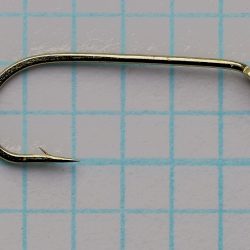
300 | Dry Fly Hook | RoundStd1XLBronzed | Dry Wet Nymph | — |