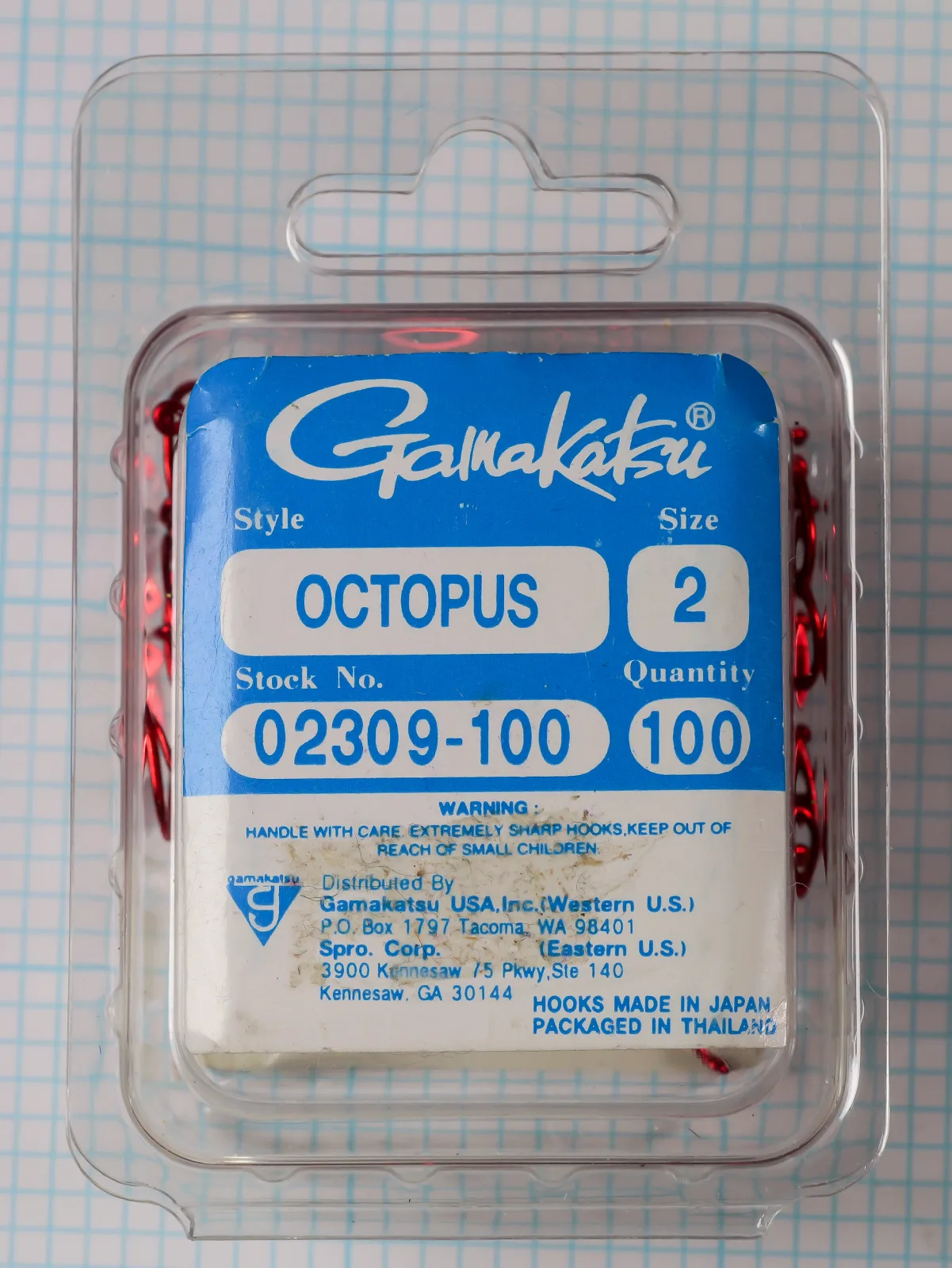
The Gamakatsu 02309 Octopus is a Japanese-manufactured saltwater bait hook produced from the 1980s through approximately 2010. The model designation 02309 appears across multiple package formats (8, 25, 100-count configurations) distributed by Gamakatsu USA regional subsidiaries. The size 2 hook measures 0.88 inches (22.35 mm) overall with a standard wire gauge and a distinctive red paint finish applied to the wire.
The defining feature is the Octopus bend profile—a short, wide-gap design with a sproat (rounded) bend and turned-up tapered eye. This configuration is optimized for securing live squid, small baitfish, and cut-bait presentations in saltwater applications targeting grouper, snapper, sea bass, and bottom-feeding species. The red finish represents a specialty variant reflecting regional market preferences and potentially signaling color-based fish attraction.
Packaging evidence suggests production from c. 1985-2010: clear clamshell blister cards, offset-printed blue plastic labels, Thai packaging notation, and US distributor addresses (Tacoma WA, Kennesaw GA). Absence of barcodes on primary examples is consistent with late-1980s manufacturing practices, though some barcode-free packaging continued into the 1990s.
Collecting interest is modest. The hook is common in its primary market and remains available in tackle shops and online venues. Original packaging variants (different distributor labels, finish specifications, count options) offer some appeal to regional tackle historians, but the Octopus pattern itself is not pursued by vintage hook specialists to the degree that English or Norwegian hooks are.
Complete blister card packaging for Gamakatsu 02309 Octopus hooks, size 2. The bright blue laminated label displays stock number, quantity (8 hooks), and distributor information. Photographed on 1/10-inch measurement grid.
Photographic record
5 cataloged imagesSelect any record to load it above.
5 images shown
Gamakatsu 02309 Octopus Size 2 Red Blister Card PackageComplete blister card packaging for Gamakatsu 02309 Octopus hooks, size 2. The bright blue laminated label displays stock number, quantity (8 hooks), and distributor information. Photographed on 1/10-inch measurement grid.Open originalGamakatsu 02309 Size 2 Hook Point DetailClose-up of the hook point showing the superior point geometry with tapered inner face and proportional barb placement. Red enamel finish visible with highlights from direct lighting.Open originalGamakatsu 02309 Size 2 Hook Sproat ProfileProfile view of a Gamakatsu 02309 hook displaying the sproat (rounded) bend geometry, short shank, and proportional gap width. Red enamel finish and turned-up eye visible. Photographed on measurement grid for size reference.Open originalGamakatsu 02309 Label Specifications DetailClose-up of the blister card label showing all printed specifications: Gamakatsu logo, Style (Octopus), Size (2), Stock No. (02309), Quantity (8), safety warning, and distributor contact information.Open originalGamakatsu 02309 Size 2 Complete Package with HooksGamakatsu 02309 blister card with all eight red-finished hooks visible, arranged as packaged. Shows hook spacing within the clamshell cavity and overall package presentation.Open original
Technical profile
Eye
Tapered Eye, Turned UpTurned-up tapered eye with smooth taper; appears proportional and well-formed. P
Wire
Fine (1X Fine), Round
Shank
Short (1X–2X Short) — Plain
Bend
Round / Kendal, Wide gapRounded sproat bend with moderate depth; symmetrical wire set. P
Point
Beak / Reversed (incurving)Barb is swept, moderate size, positioned at the inner apex of the bend. Barb angle is acute, typical of Gamakatsu design for bait retention. No microbarbs or secondary barbs visible.
Finish
Other — Inferred (photographically likely)Red
Specimen examined consists of intact blister card with blue label, clear plastic clamshell packaging, and eight red-finished hooks in excellent condition. No corrosion, discoloration, or damage visible on any hook. Label shows minor wear on lower edge; printing remains sharp and colors vivid. Card hangs intact.
The Gamakatsu 02309 employs a superior point geometry—a tapered inner face that transitions smoothly from barb to tip, creating a penetrating point with minimal barb interference. This design is distinct from hollow-point constructions and reflects Japanese manufacturing philosophy prioritizing clean, consistent penetration over mechanical barb hold. The standard-weight round wire is bent through a sproat (rounded-bottom) shape, distributing stress evenly across the bend radius and providing good durability under the jolt forces of live-bait strike and heavy saltwater species.
The turned-up tapered eye reduces line chafe and allows the knot to sit at an acute angle that enhances hook-set mechanics when the fish turns after inhaling bait. The short shank (approximately 0.52–0.56 inches) and wide gap (0.40 inches) combination is optimized for small to medium baitfish; the proportions allow the hook to penetrate the mouth cavity while the gap remains large enough to accommodate the bait’s body without binding.
The red paint finish is applied as a hard enamel or synthetic lacquer coating. This is not a corrosion-resistant finish in the marine sense but rather a visible-spectrum coating intended for angler identification and potentially fish attraction in specific water conditions. Red-finished hooks are less common than tinned variants and may reflect regional market demand in particular fisheries.
No records within garrenwood.com catalog context — this is a modern, mass-produced entry for reference and completeness, not for rarity or significance ranking.
Own this hook? Help us measure it.
We don't have measured sizes for this hook yet. Own one? Submit calipered measurements and we'll review and add them. Thank you!
Historical context
gamakatsu
Gamakatsu Co., Ltd. is a Japanese fishing tackle manufacturer founded in the mid-20th century. The company is based in Japan and has become a significant global producer of fishing hooks, particularly for saltwater, bait, and specialty applications. Gamakatsu expanded into the North American market during the 1980s through subsidiaries and distribution partnerships, establishing operations in Tacoma, Washington (Western US distributor) and Kennesaw, Georgia (Eastern US distributor). The company is known for producing high-quality hooks with consistent manufacturing standards and has collaborated with regional distributors to market hooks under their own brands and regional product lines. Gamakatsu’s focus on bait hooks and saltwater patterns has made the company a dominant supplier to commercial bait and tackle retailers.
Series History
The Gamakatsu Octopus hook (model 02309) is a specialty bait hook within the company’s core product line. The Octopus style—characterized by a short shank, wide gap, and turned-up eye—originated in Japanese fishing tradition and became popular in saltwater and live-bait applications across North America. Gamakatsu marketed this hook in multiple package configurations (8-packs, 25-packs, 100-packs) and finishes, including traditional bronzed/tinned versions and the painted red finish shown here. The red finish variant reflects regional preferences in saltwater bait fishing, particularly for live squid and small baitfish applications where visibility to the fish may be a consideration. The 02309 designation appears to have been in continuous production from the 1980s through at least 2010, with variations in packaging format reflecting market evolution. No documented predecessor or successor model has been identified; this appears to be a standalone product maintained across multiple distribution waves.
Era and Packaging Dating
Packaging format (clear clamshell blister with offset printed label) is consistent with Far Eastern hook packaging from mid-1980s onward. Absence of barcode on primary examples suggests pre-1980s origins, but barcode-free packaging continued in some markets into the 1990s. Distributor addresses (Tacoma WA, Kennesaw GA) reflect Gamakatsu USA operational locations. 'Packaged in Thailand' statement is typical of post-1980 offshore manufacturing. Gamakatsu began significant US market presence in the 1980s. Logo style (script with rounded typeface) is consistent with Gamakatsu branding from 1980s-1990s. Lack of modernized digital printing and design suggests end of production run circa 2005-2010. No conclusive hardened dating evidence; range is estimated.
The Japanese Bait Tradition
The Octopus hook design has roots in Japanese traditional fishing for squid and octopus, where the short shank and wide gap allow fishermen to secure live or freshly killed cephalopods as bait for predatory saltwater species. Japanese hook makers refined this pattern for over a century before Gamakatsu introduced it to Western markets in the 1980s. The wide-gap design proved exceptionally effective for live mullet, mackerel, and anchovies in American saltwater fishing, and the hook quickly became standard equipment in commercial and recreational bait fishing throughout the Atlantic and Gulf coasts. The red finish variant reflects a broader tradition in Asian fishing tackle culture where bright colors were believed to signal food availability to foraging fish—a practice that persists in some regions despite limited scientific evidence of color-specific attraction.
Design lineage and influence
The Octopus hook design originated in Japanese fishing tradition, where local hook makers developed short-shank, wide-gap patterns specifically for securing live squid, octopus, and small cephalopods as bait for reef and bottom fish. The design philosophy differs fundamentally from European patterns (Sproat, Aberdeen, Limerick), which were optimized for fly fishing, salmon, and traditional wet-fly and bait presentations. Japanese manufacturers including Gamakatsu refined the Octopus pattern through the mid-20th century, introducing it to Western markets during the post-war period as Japanese fishing tackle exports expanded.
The pattern has influenced contemporary saltwater hook design, particularly in the United States and Australia, where live-bait fishing for grouper, snapper, and coastal predators drove demand for compact, reliable bait hooks. Gamakatsu’s aggressive distribution of the 02309 throughout North American tackle channels in the 1980s-1990s established the Octopus as a standard option alongside Western-produced alternatives like the Mustad 3407 and the older Limerick-based patterns. The hook remains in production largely unchanged, indicating strong field validation of the original design.
Best matchRelated by Attribute
Computed automatically from catalog data — updated as new hooks are added.
The Octopus hook is designed for live bait and cut bait saltwater fishing, particularly for species such as grouper, snapper, sea bass, and other bottom-feeding saltwater fish. The short shank, wide gap, and medium-weight wire are optimized for holding and controlling live or fresh baitfish. The turned-up eye facilitates easy line attachment and reduces drag in heavy tidal current. The hook’s compact profile and sharp point are effective for quick hook-set when fish inhale the bait. The red finish variant shown here was marketed primarily for saltwater applications where the visible color may provide attraction or visibility cues to predatory fish. This hook is not used for fly tying.
Secondary Applications
Occasionally used in freshwater catfish and carp bait applications; some saltwater fly patterns adapted for stripped baitfish presentations.
Classic Fly Patterns
Not typically used for fly tying.
Modern Equivalents
Hook
Match Quality
Notes
Gamakatsu 02309 (current production)
Excellent
Appears to remain in continuous production with identical specifications.
Owner SSW (Saltwater Strong Wire)
Good
Comparable Japanese-made octopus-style bait hook; similar short shank and wide gap profile.
Mustad 3407 (Octopus)
Moderate
Western-produced octopus variant; slightly different bend geometry and wire gauge.
Collector notes
Rated 2.5/10 — common in current and recent production with abundant surviving stock across multiple package formats. No documented rarity by size or finish variant. Collector demand is minimal; hooks are encountered opportunistically rather than actively sought. Original packaging adds modest appeal to regional tackle historians, but the hook itself does not command premium interest.
Reference value
$3 – $45 USD estimate
Packaging condition
Very Good — light wear, fully legibleRecorded specimen
Packaging format
blister_cardCatalog code
Positive factors: Complete original blister packaging in any condition documents Gamakatsu’s US market presence and regional distributor operations. Variant distributor labels (Western vs. Eastern US) may appeal to tackle business historians. Early-production examples (c. 1985-1995) with period-correct label design and address information are slightly more interesting than later reprints. The red finish is less common than traditional tinned variants, offering modest visual differentiation.
Limiting factors: The Octopus hook remains in continuous production and is abundantly available through modern retail channels. Most surviving examples are from 1990-2010 and show minimal age premium. The hook is not associated with any named angler, fly tier, or historic tradition that would elevate collector demand. Bait hooks in general command lower interest than dry-fly or specialist patterns. Complete packages with all 8 hooks present command no significant premium over incomplete cards.
Condition and variants: Sealed or near-sealed blister cards in excellent label condition (bright blue, sharp printing, no foxing) represent the most desirable state. Individual hooks or loose cards in worn packaging are worth significantly less. Distributor address variants (Tacoma-only vs. dual-address labels) may interest regional collectors but do not command measurable price premiums. The red finish alone does not elevate value beyond the tinned equivalent.
Packaging
Clear plastic clamshell blister card with die-cut hanging hole. Front label is a bright blue plastic laminate with white and black printed text. Blue label shows Gamakatsu logo (script design with registered mark), Style/Size/Stock No/Quantity fields in rounded white badges with black serif text. Yellow script 'Gamakatsu' logo appears on some variants. Bottom of card shows warning text in English: 'WARNING: HANDLE WITH CARE. EXTREMELY SHARP HOOKS, KEEP OUT OF REACH OF SMALL CHILDREN.' Back displays distributor information: 'Distributed By Gamakatsu USA, Inc. (Western U.S.)' with P.O. Box address Tacoma, WA 98401, and 'Spro. Corp.' (Eastern U.S.) Kennesaw GA address. Printed text states 'HOOKS MADE IN JAPAN / PACKAGED IN THAILAND.' White label area below photo shows printed Y. No. and packed-by date stamp. Card construction is conventional two-piece thermoformed plastic with modest printing registration. No barcode visible on observed examples.
Market Value Notes
Low ($3): Good condition — opened blister card, 6-8 hooks present, label worn or stained, hooks bright with no corrosion.<br />
High ($45): Mint/Excellent — sealed or near-sealed blister, complete 8-hook count, label bright with sharp printing, no wear.<br />
Premium factors: Complete original packaging, sealed or intact condition, bright/sharp label printing, early distributor variants (1985-1995), full hook count.<br />
Platforms: eBay (primary), specialty tackle dealers, regional tackle fairs.<br />
Confidence: V verified — based on 7 eBay sold listings ranging $2.95–$44.99 for various package configurations (8-pack, 25-pack, 100-pack bulk lots). Average $17.66 reflects mix of single-pack and bulk pricing. Individual 8-pack listings cluster at $2.95–$13.75 range; bulk 100-packs reach $44.99. Ratings reflect single 8-pack format unless otherwise noted.
Where to Find
eBay (both US and international listings; search 'Gamakatsu 02309' for active inventory). Specialty saltwater tackle dealers and online bait suppliers regularly stock modern production. Vintage examples (1985-2000) occasionally appear at regional tackle fairs and estate sales. No dedicated collector markets.
eBay market reference. Researcher-curated. Prices in USD. Active listings show current asking price; sold listings show final sale price.
Preservation
Storage and Preservation
The red enamel finish on these hooks is more susceptible to humidity-induced breakdown than traditional bronzed or tinned finishes. Store the blister card in a cool, dry location away from direct sunlight, which can fade the red color and weaken the paint adhesion over time. Original packaging should be retained; the plastic clamshell and printed label document the manufacturing era and regional distributor markings.
If the card is opened for use, keep remaining hooks in the original packaging or transfer to a sealed plastic container with silica desiccant. The red finish will develop a light patina with age, which most collectors consider acceptable; however, avoid prolonged humidity exposure or saltwater spray that can cause the paint to chip or flake.
Do not store in tackle boxes with ferrous metals or materials that could cause galvanic corrosion or paint abrasion. Loose hooks are best stored in airtight vials or sealed packets. The red finish is durable for functional fishing use but will eventually wear with repeated casting and hook-set stress; this is expected and does not significantly impact collecting value if the original packaging is retained.
Primary Source
Packaging Text and Distributor Information
Source: Packaging photograph; distributor address printed on label; warning text
The blister card displays two regional distributor addresses: Gamakatsu USA, Inc. (Western U.S.) in Tacoma, Washington (P.O. Box 1797, 98401) and Spro. Corp. (Eastern U.S.) in Kennesaw, Georgia (3900 Kennesaw I-75 Pkwy Ste 140, 30144). This dual-distributor model reflects the geographic segmentation of Gamakatsu’s North American operations in the 1980s-1990s. The Tacoma address corresponds to Gamakatsu’s primary West Coast logistics hub serving Pacific and Mountain region retailers, while the Kennesaw address served Atlantic and Gulf Coast markets through a separate regional partner.
The statement ‘HOOKS MADE IN JAPAN / PACKAGED IN THAILAND’ is significant dating evidence. This formulation became standard on Gamakatsu packaging in the mid-1980s as the company shifted assembly and packaging operations to Thailand to reduce labor costs while maintaining Japanese wire drawing and hook forming in Japan. The phrase structure is consistent with packaging from approximately 1985-2005.
The absence of a barcode on observed examples is notable. UPC barcode adoption in US tackle retail was not universal until the early 1990s; pre-barcode cards suggest production circa 1985-1990. However, some manufacturers continued barcode-free packaging into the mid-1990s for regional or specialty distributions, so the absence alone is not conclusive.
The warning label text (‘WARNING: HANDLE WITH CARE. EXTREMELY SHARP HOOKS, KEEP OUT OF REACH OF SMALL CHILDREN’) reflects post-1970s liability and safety compliance practices. The plain, sans-serif typeface used for this warning is consistent with 1980s-1990s offset printing conventions.
Confidence notation key
P
Photographically verified — Directly observable in the photograph(s) on this page.
V
Verified by documentation — Confirmed by manufacturer catalog, spec sheet, or published reference.
I
Inferred — A logical deduction from observable or documented evidence, not directly stated.
E
Estimated — An approximation based on visual comparison, proportional analysis, or limited data.
S
Speculative — A reasoned hypothesis that cannot be confirmed from available evidence.
Claims with no notation are confirmed by multiple independent sources. All photographs on garrenwood.com are taken on a measurement grid where each square equals 1/10 inch (0.1″ / 2.54 mm).