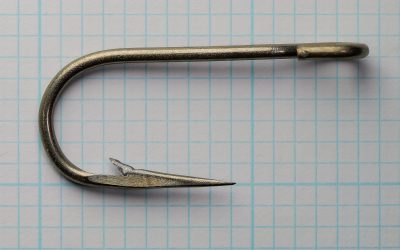
The International Nickel Company, better known for much of its history simply as Inco, was not primarily a fishing-hook manufacturer. It was one of the twentieth century’s most important producers of nickel and nickel alloys. Its connection with fishing tackle came through Duranickel, a high-strength, corrosion-resistant nickel alloy that found a specialized but memorable use in fish hooks and other fishing-tackle components.
International Nickel was formed in 1902 through the consolidation of several nickel interests, most importantly the Canadian Copper Company, which controlled major nickel-copper deposits around Sudbury, Ontario, and the Orford Copper Company, whose New Jersey works possessed important nickel-refining technology. The combination placed mining, smelting, refining and marketing under increasingly unified control and helped make Inco one of the dominant forces in the international nickel industry. Canadian refining expanded with the opening of the Port Colborne refinery in 1918, and in 1928 the company combined with its major rival, the Mond Nickel Company. For much of the twentieth century Inco was among the world’s leading nickel producers.
From Industrial Nickel to Duranickel
Inco’s significance extended well beyond the production of raw nickel. Its metallurgical research produced or commercialized a succession of specialized alloys whose names became familiar throughout industry, including Monel, Inconel, Incoloy, Permanickel and Duranickel.
The material ultimately sold as Duranickel began as an Inco heat-treatable nickel known as “Z” Nickel. An improved version was introduced in 1945, and in 1949 Inco renamed the alloy Duranickel. The Duranickel trademark was filed in the United States in 1948 and registered in 1949 for an age-hardenable, corrosion-resistant, high-nickel alloy. Contemporary technical references describe it as approximately 93–94 percent nickel with aluminum as its principal alloying addition. Heat treatment gave it considerably greater strength than ordinary commercially pure nickel while retaining excellent resistance to corrosion.
Those properties made Duranickel particularly useful for springs, diaphragms, pump components, instruments and other objects that needed both strength and corrosion resistance. Significantly for fishing-tackle history, metallurgical texts specifically list fish hooks and fishing-tackle parts among Duranickel’s applications. This makes Duranickel hooks something more interesting than ordinary steel hooks with a nickel-colored finish: the name referred to the alloy itself rather than simply a plating or decorative treatment.
Lew Morrison and Silver Horde
One of the clearest surviving examples of Duranickel’s use in fishing tackle is associated with Lew Morrison and Silver Horde Fishing Supplies of Washington.
Lew and Gladys Morrison established Silver Horde in the Pacific Northwest in 1948. Morrison had experience in both commercial fishing and the Seattle waterfront fish industry before developing a molded salmon trolling plug for the commercial fleet. His early plugs were assembled and painted by Lew and Gladys at their Washington property, and the business quickly developed a following among commercial salmon trollers from California through British Columbia and Alaska. The Silver Horde name was in use by 1949 and eventually became one of the best-known names in Pacific Coast salmon trolling tackle.
Surviving packaging provides evidence that Morrison also marketed Duranickel fish hooks. One box is boldly marked:
DURANICKEL — Lew Morrison’s Silver Horde — Hollow Ground — Forged Fish Hooks — Needle Point — Guaranteed Rust Proof
At the bottom of the box appears the important statement “Duranickel — Trade Name of International Nickel Company, Inc.”, followed by Morrison’s Lynnwood, Washington address and telephone number.
This wording is significant. It identifies Duranickel as an International Nickel Company trade name while identifying Lew Morrison’s Silver Horde with the finished fishing product. On the evidence presently available, the safest interpretation is that Inco supplied or licensed the proprietary Duranickel alloy, while Morrison or a contract hook maker produced and/or marketed the finished hooks. There is presently insufficient evidence to say that International Nickel itself operated a fishing-hook manufacturing line.
Dating the Morrison Duranickel Hooks
The surviving Morrison packaging can be placed within a relatively useful historical window. The Duranickel name was adopted around 1949, while Silver Horde had been established the previous year. Lew Morrison remained involved with the company until his death in the spring of 1962.
The Lynnwood box uses the old telephone exchange PR 8-2640 and carries no ZIP Code, both consistent with packaging from the 1950s or very early 1960s. Taken together, these features suggest that surviving boxes bearing the prominent “Lew Morrison’s Silver Horde” identification most likely date from approximately the 1950s to early 1960s, although a dated Silver Horde catalog or price list would be required to establish a narrower production range.
Duranickel hooks did not disappear immediately with Morrison. They became associated particularly with the Pacific Coast salmon-trolling trade. A California Department of Fish and Game study conducted during the 1984 salmon season, for example, records the use of single Duranickel salmon trolling hooks of the Miller brand, in sizes from approximately 3/0 through 6/0. Their continued appearance decades after the introduction of the alloy demonstrates that Duranickel became an established material in specialized commercial and sport salmon tackle rather than merely a short-lived marketing experiment.
Collecting Significance
For hook collectors, Duranickel hooks occupy an unusual position at the intersection of tackle history and twentieth-century metallurgy. Unlike the traditional Redditch, Norwegian, Japanese and American hook firms whose reputations were built primarily around hook manufacture, the International Nickel Company entered the story through the material from which the hook was made.
Surviving Lew Morrison packages are particularly interesting because they connect three important historical threads: the growth of Inco’s advanced nickel-alloy program, the postwar development of corrosion-resistant fishing tackle, and the commercial salmon-trolling industry of the Pacific Northwest.
The wording on original boxes should therefore be interpreted carefully. Duranickel is an Inco alloy and trademark, not conclusively the name of the company that physically manufactured the hook. Until factory records, invoices or contemporary catalogs identify the actual hook-producing plant, International Nickel Company is best described as the alloy developer and trademark owner, with Lew Morrison’s Silver Horde documented as a marketer of finished Duranickel hooks.
Later History
International Nickel continued expanding its mining and alloy businesses through the twentieth century. In 1976 the corporate name was shortened to Inco Limited. The Brazilian mining company Companhia Vale do Rio Doce—now Vale—acquired control of Inco in 2006 and completed the acquisition in 2007. The historic Inco nickel operations subsequently became part of Vale’s global base-metals business.
Although Inco disappeared as an independent corporate name, Duranickel remains an important example of the company’s influence outside heavy industry. In the fishing world, the surviving hooks and Morrison packaging preserve a small but fascinating chapter in which aerospace- and industrial-era nickel metallurgy found its way onto the lines of Pacific Coast salmon fishermen.