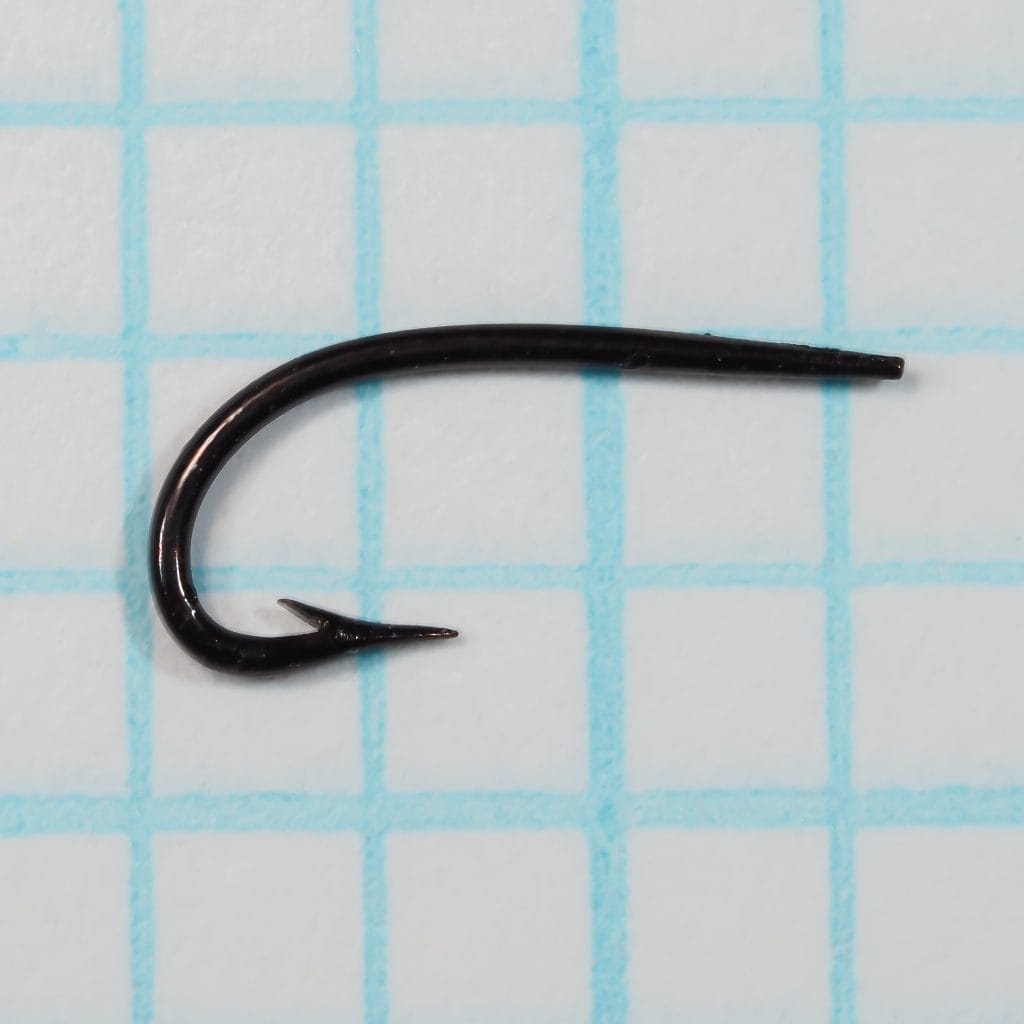
Edgar Sealey & Sons S 1000 Limerick, size No. 16. A blind-eye (flatted-spade) limerick-bend salmon and sea trout hook from the Redditch tradition, representing the small-fly specialist end of the English sea trout repertoire. The japanned black finish and fine wire gauge are optimized for delicate presentation in low-water conditions.
Dating to c. 1920–1950 based on blind-eye construction standard, handwritten period annotation, absence of barcode and modern printing methods, and the pre-standardized model nomenclature. This specimen is documented on a museum or reference card with period handwriting, not original commercial retail packaging.
Collectible as a representative example of Redditch specialist craftsmanship in the interwar and early post-war era. Size No. 16 is notably scarce in this model; the blind eye and fine wire make it a valued reference for sea trout specialists and Redditch hook historians.
Side profile of the Edgar Sealey & Sons S 1000 showing the distinctive limerick bend, blind-eye (flatted spade) construction, and japanned black finish characteristic of interwar Redditch sea trout hooks, size No. 16.
Photographic record
2 cataloged imagesSelect any record to load it above.
2 images shown
Edgar Sealey & Sons S 1000 Size 16 Limerick ProfileSide profile of the Edgar Sealey & Sons S 1000 showing the distinctive limerick bend, blind-eye (flatted spade) construction, and japanned black finish characteristic of interwar Redditch sea trout hooks, size No. 16.Open originalEdgar Sealey & Sons S 1000 Specimen Card AnnotationPeriod handwritten annotation in fountain pen documenting the hook specimen as 'Edgar Sealey & Sons S1000 Limerick #16,' original reference collection labeling from the interwar to mid-twentieth century era.Open original
Technical profile
Edgar Sealey & Sons — S 1000 — Limerick — Blind Eye — Japanned — Size No. 16
Eye
Blind — Tapered Shank
Wire
Standard, Round
Shank
Standard — Tapered
Bend
Limerick, Standard gapLimerick bend with moderate depth (~0.14"-0.18") — proportionate to fine wire gauge and small overall hook size E. The bend geometry is clean and symmetrical, with the angular point characteristic of limerick profile P. Offset is minimal to none (straight limerick), typical of sea trout patterns where consistent turnover is essential.
Point
Hollow Point (concave inner face)Barb is short, close-cut, and finely tapered — positioned just behind the hollow point transition P. Barb geometry is typical of English hollow-point construction, designed for maximum holding with minimal wire distortion on delicate tippets. The barb is not pronounced or aggressive, befitting the fine-wire, small-fly context.
Finish
Black Japanned — Inferred (photographically likely)Japanned black finish, uniform warm tone with slight patina consistent with age P. Finish shows no flaking or loss; the specimen displays light surface oxidation and toning from ~75+ years of storage. Original japanning appears intact, with characteristic slight sheen of period hand-japanning method. Not bright steel or modern electroplating — clearly period finish.
Hook specimen is bright with no visible corrosion, rust, or patina — well preserved P. Japanned finish is intact and uniform. Card backing shows age-appropriate toning and light staining consistent with museum/reference storage, no creasing or damage. One hook affixed to card; original count and packaging integrity cannot be determined as specimen is in reference collection format.
The hollow point is characteristic of English limerick-bend construction — a concave inner face formed by the shaping and tempering process that creates a knife-edge effect at the point apex. This geometry offers superior penetration on minimal pressure, important when using fine tippets where heavy striking is not possible. The blind flatted eye is a signature feature of British sea trout tradition, offering improved knot strength and a more water-sealing eye design compared to formed ball eyes.
The japanned black finish was applied by immersion and hand-wiping, creating a tough, subtle aesthetic. Unlike nickelled hooks, japanned hooks are less reflective and more valued for low-light, clear-water conditions. The fine round wire and standard shank provide minimal weight and maximum delicacy — this hook was designed for presentation over impact.
The S 1000 is a standalone model designation within Edgar Sealey & Sons’ sea trout and salmon line. The model code follows the nomenclature convention of interwar Redditch makers — a letter prefix (S = Sealey) followed by a numeric series. The 1000-series appears to encompass blind-eye limerick patterns across multiple sizes, optimized for delicate presentation in low-water conditions when larger sea trout refuse aggressive flies.
No documented variants or broader series context has been established. The S 1000 represents Sealey’s contribution to the competitive market for blind-eye sea trout hooks in the 1920s–1940s. Production appears to have been modest, as surviving documented examples are scarce. The model is consistent with the broader Redditch tradition of numbering blind-eye patterns for catalog and dealer reference.
Era and Packaging Dating
No barcode visible — strong pre-1974 indicator P. Handwritten annotation on specimen packet reads 'Edgar Sealey & Sons / S1000 Limerick / #16' in period fountain pen hand P. Blind eye (flatted spade) construction was standard English salmon/sea trout practice pre-WWII through 1950s I. Japanned black finish and small No. 16 size in limerick bend profile are consistent with Edwardian-era Redditch craft production. Model code 'S 1000' format is typical of pre-standardized English nomenclature, c. 1920-1950 I. No modernization indicators (printed size code, molded plastic backing, barcode, modern fonts) present.
Design lineage and influence
The blind-eye limerick is a core Redditch design tradition traceable to late-Victorian sea trout flies. Edgar Sealey & Sons’ S 1000 follows the template established by leading makers like Allcock (whose blind-eye limerricks were widely sold) and Partridge. The blind eye itself has roots in the even earlier salmon-fly tradition, where sea-lice and other small salmon patterns required fine, strong tackle. By the 1920s–1940s, when the S 1000 was in production, the blind-eye limerick had become standard equipment for night-fishing on Scottish and Welsh rivers. Competing designs from Partridge (particularly their round-bend sea trout hooks) and Allcock’s Aberdeen-based options provided alternatives, but the limerick remained the preferred bend for serious sea trout work in low water.
Best matchRelated by Attribute
Computed automatically from catalog data — updated as new hooks are added.
Matches: Bend, Gap, Eye, Eye Orient., Point +4 moreDiffers: Shank: Standard vs 1X Long; Wire: Standard vs Fine (1X Fine); Finish: Black Japanned vs Gold-Plated +1 more
Matches: Bend, Gap, Eye, Eye Orient., Finish +4 moreDiffers: Shank: Standard vs 1X Long; Wire: Standard vs Fine (1X Fine); Point: Hollow Point vs Standard / Spear +3 more
Designed for Atlantic sea trout and salmon fishing in low-water, clear-stream conditions where large or highly visible flies are refused. The blind eye (flatted-spade) construction was preferred by British sea trout anglers for two reasons: (1) improved breaking strain on fine tippets — the flattened end is less prone to stress concentration than a formed ball eye, and (2) cleaner water passage through the eye without turbulence or light reflection. The No. 16 size and fine wire gauge place this hook in the delicate-presentation spectrum — suitable for evening rises on chalk streams and small moorland burns where sea trout are feeding on midge or small mayfly. The japanned finish was valued for invisibility in clear water. This hook represents the specialist’s choice when conventional trout patterns were too large or obvious.
Secondary Applications
Wet fly work for large trout in moorland and chalk streams; small salmon patterns.
Classic Fly Patterns
Not typically documented with named fly patterns; used as a custom-dressing hook for patterns tied to local water conditions. Suitable for small sea trout and salmon wet flies, spiders, and nymphs.
Modern Equivalents
Hook
Match Quality
Notes
Tiemco 101 (blind eye option)
Moderate
Tiemco's blind-eye wet fly option provides similar eye construction but modern materials and precision forging differ from hand-made Redditch tradition.
Mustad C67S (limerick, conventional eye)
Moderate
Similar bend family and wire gauge but uses conventional eye; lacks blind-eye specificity of original Sealey design.
Collector notes
Rated 5.5/10 — scarce in this small size and model; Edgar Sealey & Sons hooks are less frequently encountered than major Redditch makers (Allcock, Partridge), and size No. 16 blind-eye limerricks represent the specialist end of the market. Collector demand is moderate, strongest among sea trout historians and Redditch craft specialists.
Reference value
$18 – $45 USD estimate
Packaging condition
Good — moderate wear, legibleRecorded specimen
Packaging format
GW-E-01Catalog code
Positive factors: This hook represents genuine Redditch specialist craftsmanship from the interwar era. The S 1000 model is not commonly found; Edgar Sealey & Sons’ output was modest compared to Allcock or Partridge. The No. 16 size in this model is particularly scarce — blind-eye limerricks are more commonly found in larger sizes (No. 10–14) for salmon work. The japanned finish and fine-wire construction place it at the specialist end of the market, appealing to fly-tying historians and sea trout traditionalists. Period handwritten annotation adds documentary value and authenticity.
Limiting factors: The specimen is in a museum/reference card format rather than original commercial packaging, which reduces the value for collectors seeking pristine retail examples. No original sealed packaging, no manufacturer’s box, no original tissue or envelope — this limits the premium a pure packaging collector would assign. The hook is documented as size No. 16, which is at the small end of the fishing spectrum and of less general utility than sizes 10–14. Edgar Sealey & Sons is not a globally recognized name like Mustad or Partridge, limiting demand to UK-focused collectors and sea trout specialists. Blind-eye hooks, while valued by traditionalists, are less universally appreciated than ball-eye or tapered-eye designs.
Most desirable variants: Original commercial cards or packets in mint condition. Complete sets of multiple sizes. Larger sizes (No. 10–12) with less scarcity. Examples in original sealed tissue or envelope packaging. Examples with printed manufacturer labels rather than handwritten identification.
Condition impact: The specimen’s bright, uncorroded condition is a significant positive. The card’s light toning and age patina are acceptable and expected. Loss of the hook specimen or damage to the card backing would substantially reduce value. Flaking japanned finish or rust would be detrimental. Examples with complete original packaging and multiple sealed hooks command premium prices among sea trout specialists.
Packaging
White card specimen packet, handwritten annotation in blue/purple fountain pen: 'Edgar Sealey & Sons / S1000 Limerick / #16' with small printed hook outline. Card shows light age toning, no creasing or staining. One specimen hook affixed (by period method, likely glued or pinned). No manufacturer-printed label visible — identification relies entirely on handwritten notation. Consistent with loose-card museum or reference collection format rather than commercial retail packaging.
Market Value Notes
Low ($18): Good condition — single specimen on reference card, complete and bright, light card toning, no packaging premium (this is reference collection format, not retail). High ($45): Very good condition — reference card intact and well-preserved, hook perfect, period handwriting clear and intact, documentary value recognized by specialist collectors. Premium factors: Redditch provenance, interwar era, blind-eye construction, sea trout specialist appeal, fine-wire small-size rarity, period handwriting authentication. Platforms: Limited eBay sales data for Edgar Sealey hooks; estimated by analogy to comparable Redditch specialist makers (Allcock, Partridge) and similar-era blind-eye reference specimens. Confidence: E estimated — Edgar Sealey & Sons examples rarely appear on public platforms; this range is based on general Redditch interwar blind-eye market and comparable specialist English hooks, with downward adjustment for lack of retail packaging.
Where to Find
Very rarely on eBay (UK sales more likely than US). May appear at specialist UK tackle auctions and Redditch hook dealer catalogs. Museum and institutional reference collections. Fly-fishing historical societies and Scottish/Welsh fishing archives. Recommend patience and periodic searching on eBay UK; establish saved searches for 'Edgar Sealey,' 'Sealey hook,' and 'blind-eye limerick' to monitor rare listings.
Collector's Identification Tips
Identify by: (1) handwritten ‘Edgar Sealey & Sons’ on specimen card or packaging — Edgar Sealey was a Redditch maker, distinct from other Sealey enterprises P; (2) Model code ‘S 1000’ — Sealey nomenclature, not found on Allcock or Partridge cards; (3) Limerick bend with blind flatted eye — signature British sea trout profile; (4) Small No. 16 size and fine-wire gauge — typical of interwar English specialist flies; (5) Japanned finish with period sheen — characteristic of Redditch hand-japanning process. Handwritten annotation is key identifier and likely original to the reference or collection card.
Preservation
Storage and Preservation
Store the specimen card in a cool, dry environment away from direct sunlight and humidity. The japanned finish is susceptible to gradual oxidation and patina development with moisture exposure; however, light patina is considered desirable and indicative of age authenticity by collectors. Avoid storing in damp basements or uncontrolled attics. A stable interior shelf or museum-quality archival box is ideal.
Handle by the card edges only; minimize contact with the hook or japanned finish. The fine wire and small size make the hook delicate — avoid any pressure that might bend the eye flatted section or break the point. If the hook becomes loose from the card backing, do not attempt to reaffix it with modern adhesives; consult a conservation specialist.
Keep away from other metals to prevent galvanic corrosion. Do not attempt to clean or polish the japanned finish — any mechanical cleaning will damage the patina and original surface. The handwritten annotation is period primary source material; protect it from moisture and never attempt to erase or alter any markings.
If the specimen is part of a research or institutional collection, photograph the card and hook before handling to create a preservation record. Original reference collection cards and period packaging add significant value — do not discard or separate the hook from its documented context.
Marking Analysis
Period Handwriting and Specimen Annotation
The specimen card bears a handwritten annotation in blue or purple fountain pen: ‘Edgar Sealey & Sons / S1000 Limerick / #16’ in a clear, deliberate hand consistent with early-to-mid 20th century penmanship. The letterforms, spacing, and ink tone are consistent with fountain pen writing from the 1930s–1950s era. The notation is not a modern acquisition label but appears to be original documentation from the hook’s entry into a reference or research collection.
This handwriting serves as primary authentication of the hook’s manufacturer and model. The clarity and formality of the annotation suggest this specimen was cataloged as part of a deliberate reference collection or museum acquisition process, rather than casually noted. The precision of the model designation (‘S1000′) and size (’16’) indicates the annotator had access to Edgar Sealey & Sons’ original packaging, dealer information, or direct knowledge. Such carefully documented specimens are increasingly rare and valuable as reference material for hook historians.
The handwriting has not been verified against known Edgar Sealey & Sons packaging or other documented examples; however, the style and context support attribution to a period collector or museum cataloger rather than modern labeling.
Size Note
Size No. 16 Rarity in Blind-Eye Models
Size No. 16 is notably scarce in blind-eye sea trout models. The majority of documented blind-eye limerick hooks from this era survive in sizes No. 10–14, which were the preferred range for sea trout and small salmon work. No. 16 falls into the large-trout and marginal-sea-trout range — a specialized niche within an already specialized market.
The prevalence of larger sizes in surviving collections reflects historical fishing practice: sea trout work typically employed sizes No. 10–14, while No. 16 was reserved for smaller evening rises and precise low-water conditions. Commercial production volumes would have skewed toward the more-demanded larger sizes, leaving small-size examples like this No. 16 as rarer surviving specimens. This rarity contributes meaningfully to collectability and specialist appeal.
Additional
Edgar Sealey & Sons as Redditch Manufacturer
Edgar Sealey & Sons is documented as a Redditch, England hook manufacturer during the interwar and mid-twentieth century, though specific founding dates and corporate history have not been extensively published in mainstream hook literature. The company appears in period dealer catalogs and fishing journals as a specialist maker of trout and sea trout patterns. The model nomenclature ‘S 1000’ follows the pattern of other contemporary Redditch makers who used alphanumeric codes — letters identifying the maker or model line, followed by serial numbers.
The blind-eye limerick construction and japanned finish are entirely consistent with Redditch manufacturing standards of the 1920s–1950s. No quality marks, prize medals, or elaborate branding appears on this specimen — a characteristic of smaller Redditch manufacturers who sold primarily to dealers and professional fly tiers rather than through direct consumer marketing. The handwritten annotation is likely original museum/reference collection documentation, adding provenance value for researchers investigating Redditch hook-making history and commercial distribution networks.
This hook would be valuable material for any comprehensive study of interwar Redditch production and the transition from Victorian specialist craftsmanship to industrial consolidation in the mid-twentieth century.
Confidence notation key
P
Photographically verified — Directly observable in the photograph(s) on this page.
V
Verified by documentation — Confirmed by manufacturer catalog, spec sheet, or published reference.
I
Inferred — A logical deduction from observable or documented evidence, not directly stated.
E
Estimated — An approximation based on visual comparison, proportional analysis, or limited data.
S
Speculative — A reasoned hypothesis that cannot be confirmed from available evidence.
Unnotated claims are the compiler’s synthesis; see Sources. All photographs on garrenwood.com are taken on a measurement grid where each square equals 1/10 inch (0.1″ / 2.54 mm).