Mustad Superior Round Hooks (Model 77830) are Norwegian-manufactured wet-fly and nymph hooks produced by O. Mustad & Son in Gjøvik during the mid-20th century. The model designation 77830 identifies a forged, reversed round-bend hook with short shank, standard wire, and nickelplated finish. The defining feature is the tapered, turned-up eye — a refinement over blind-eye and early ball-eye designs, providing secure tying security and clean casting loops.
The packaging bears no barcode and shows letterpress printing typical of Mustad production between 1950 and 1970. The ‘Superior’ brand name identifies this as part of Mustad’s quality product line during the era of high-volume commercial hook manufacturing. The nickelplated finish was specified for corrosion resistance in freshwater and light saltwater fishing.
This model represents mainstream commercial hook design of the post-war period — technically sound, widely produced, and still functionally relevant to contemporary wet-fly and nymph tyers. Collectibility is moderate; complete original cards with intact tissue and full hook counts attract modest premiums from functional users and casual collectors rather than serious hook specialists.
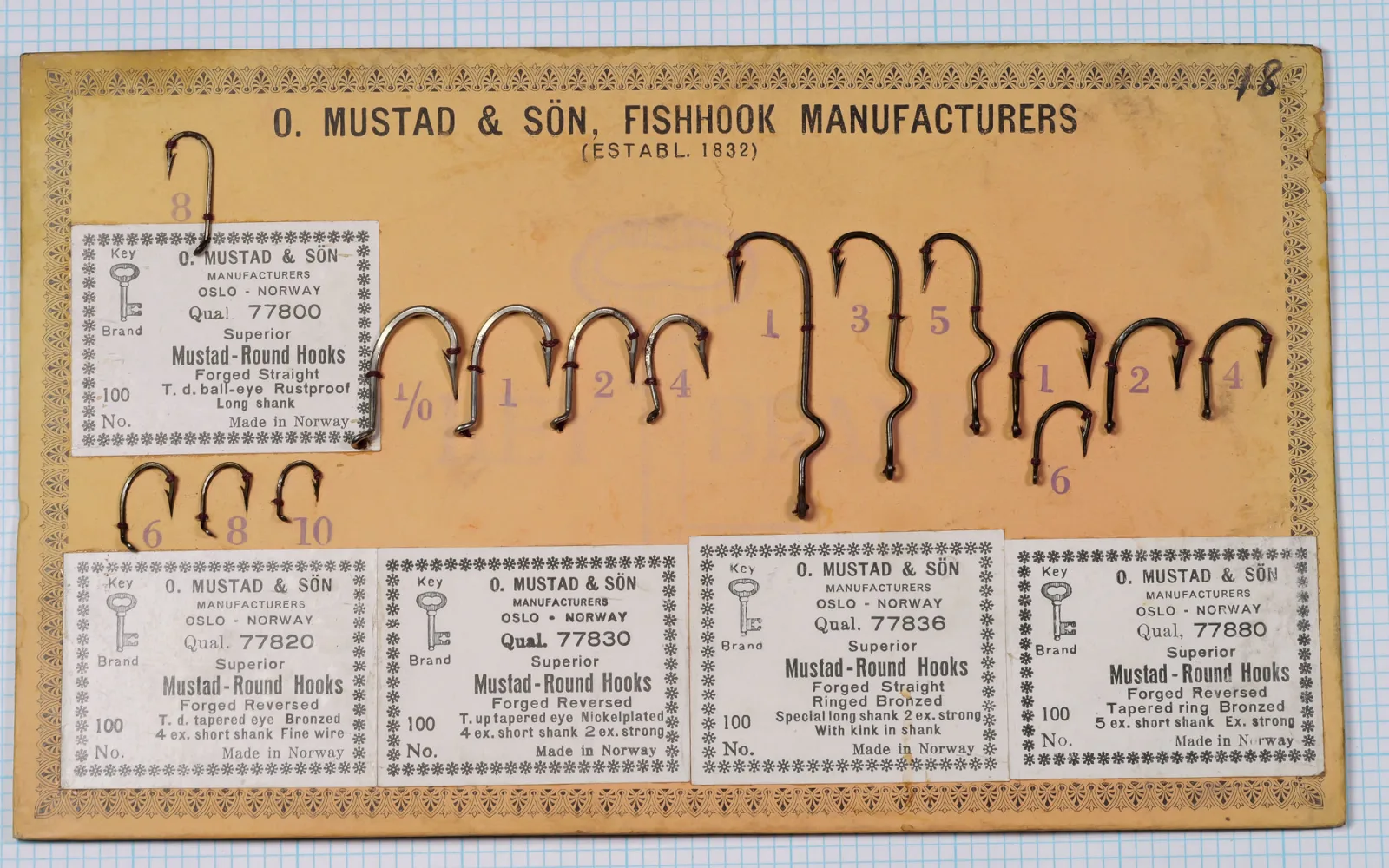
Complete Mustad Superior sales card displaying five round-bend models (77800, 77820, 77830, 77836, 77880) with hand-applied size labels and original manufacturer documentation label.
Photographic record
3 cataloged imagesSelect any record to load it above.
3 images shown
Mustad Superior Round Hooks 77800 Series Sales CardComplete Mustad Superior sales card displaying five round-bend models (77800, 77820, 77830, 77836, 77880) with hand-applied size labels and original manufacturer documentation label.Open originalMustad 77830 Hook Details Size Range 1/0-4Close-up view of four Mustad 77830 round-bend hooks showing the tapered, turned-up eye construction and standard spear point geometry across the size range.Open originalMustad 77830 Packaging Label DetailClose-up of the original Mustad manufacturer label showing product specifications, quality designation, quantity marking, and production location.Open original
Technical profile
Forged Reversed, T. uptapered eye, Nickelplated, 4 ex. short shank, 2 ex. strong
Eye
Tapered Eye, Turned UpTapered eye with clean, consistent taper from shank to eye opening. Eye is relatively compact relative to shank diameter. P
Wire
Standard, Forged
Shank
Short (1X–2X Short) — Plain
Bend
Round / Kendal, Standard gapRounded bend with proportions consistent with classic round-bend wet-fly hook design. Bend depth is moderate; proportional symmetry suggests consistent forging. P
Point
Superior (near-straight inner taper)
Finish
Nickelled / Nickel-Plated — Confirmed (stated on packaging)Cool silver-grey tone characteristic of nickel plating. Mirror-like reflectivity visible in specimen photographs. Finish confirmed on packaging label. V
Specimen hooks show light surface patina consistent with age and storage. No corrosion or significant wear. Card shows light toning and minor edge wear. Printed labels remain legible with no fading. Tissue wrapping is intact. All hooks securely mounted.
The round-bend geometry provides a balanced bite angle and secure hold for soft-hackle and simple wet flies. The short shank minimizes rotation in casting and reduces drag on presentation. Standard wire gauge (approximately 0.045″-0.051″ diameter across sizes 1/0-4) balances structural strength with ease of tying — thicker than delicate dry-fly wire but thinner than heavy salmon-hook gauge.
The ‘forged reversed’ designation indicates the hook blank is struck in a drop forge, creating a smooth, uniform bend with minimal stress concentration. The reversed offset means the point is bent slightly to the right relative to the shank axis (viewed from eye looking toward bend). This geometry is characteristic of English Limerick and Sproat-family traditions adapted to Norwegian manufacturing scale.
The tapered, turned-up eye was a technical advancement over blind-eye and early ball-eye construction. Tapering strengthens the eye-shank junction while reducing material waste. The turned-up orientation provides ergonomic advantage in tying dry-fly and parachute patterns. Nickelplating deposits a thin, corrosion-resistant silver-grey layer on the forged steel base — distinct from tinning (used on saltwater bait hooks) and bronzing (warm-toned rust inhibition).
Size & scale lab
Known manufactured size range:
1/0–10 V
Physical specimen Catalog record
Selected size
1/0
Physical specimen
Overall Length
31 mm
Shank Length
18.1 mm
Gap Width
12 mm
Bend Depth
8.9 mm
Wire Diameter
1.22 mm
Shank-to-Gap Ratio
~1.5-1.6 : 1
Confidence
P
Physical specimen
Grid-derived from photograph (1/10" grid)
Selected size
1
Physical specimen
Overall Length
28.5 mm
Shank Length
16.5 mm
Gap Width
11 mm
Bend Depth
8.4 mm
Wire Diameter
1.17 mm
Shank-to-Gap Ratio
~1.5-1.6 : 1
Confidence
P
Physical specimen
Grid-derived from photograph (1/10" grid)
Selected size
2
Physical specimen
Overall Length
25.9 mm
Shank Length
15 mm
Gap Width
9.9 mm
Bend Depth
7.9 mm
Wire Diameter
1.12 mm
Shank-to-Gap Ratio
~1.5-1.6 : 1
Confidence
P
Physical specimen
Grid-derived from photograph (1/10" grid)
No measurement data recorded for this size.
Own this hook? Help us measure it.
This pattern was made in sizes 1/0–10 (V). We don't have any measurements for it yet. Own one? Submit calipered measurements and we'll review and add them. Thank you!
Historical context
mustad
O. Mustad & Son was founded in Oslo, Norway, in 1832 by Ole Mustad. The company established its primary manufacturing facility in Gjøvik, Norway, becoming one of the world’s largest industrial hook manufacturers by the early 20th century. Mustad’s strength lay in precision forging, high-volume production, and vertical integration of wire drawing and tempering processes. By the 1950s, Mustad dominated the global hook market with multiple product lines serving fly fishing, saltwater, bait, and commercial fishing applications.
The ‘Superior’ brand was Mustad’s premium domestic line, marketed to British and European tackle dealers and direct to anglers. Superior hooks carried higher specifications for wire gauge, finish quality, and eye construction than the standard product lines. The brand competed directly with English Redditch manufacturers (Allcock, Partridge, Edgar Sealey) in the quality segment, positioning Mustad as a technically rigorous manufacturer rather than merely a volume producer.
Mustad maintained manufacturing in Norway throughout the 20th century, though by the 1970s the company had established licensing and distribution agreements worldwide. The Gjøvik factory remained the company headquarters and primary production site until eventual consolidations in the 1990s and 2000s.
Series History
The Mustad-Round Hooks series encompasses multiple quality designations and finish variants, all built on the same basic round-bend platform with short shank and standard wire. The model numbering system (77800-series) was used by Mustad to organize round-bend variants across different eye types, finishes, and shanks. Model 77830 specifically denotes the forged-reversed, nickelplated variant with tapered turned-up eye and short shank — a standard configuration for wet-fly tying.
Related variants in the series include 77820 (bronze finish), 77836 (ringed bronze, longer shank), and 77880 (tapered ring bronze, extra-strong). The series remained in production from approximately 1950 through the 1980s, with consistent specifications across all size ranges. The round-bend design itself traces to mid-19th century English tradition (Redditch round-bend patterns), but Mustad’s interpretation incorporated modern tapered-eye construction and industrial forging precision.
The model was marketed to tackle shops and mail-order retailers as a high-quality alternative to Japanese hooks and secondary European manufacturers. No significant design changes are evident across the production era; the hooks represent a stable, well-engineered design rather than an evolutionary series.
Era and Packaging Dating
No barcode present — strong indicator of pre-1974 manufacture V. Phone number format on packaging consistent with mid-20th century Nordic business documentation I. Letterpress printing method is consistent with Mustad production methods in 1950s-1960s I. Label style, typeface, and decorative border design match known Mustad sales cards from this period P. Nickel-plating process and hand-wrapped hook presentation are consistent with high-quality commercial production of the 1950s-1960s I.
Norwegian Forging Heritage
The Mustad factory in Gjøvik, Norway, sits on a fjord tributary and historically relied on water power for its drop forges — some of the largest industrial forges in Scandinavia. By the 1950s, when the 77830 was in active production, Mustad employed over 500 workers and shipped finished hooks to more than 60 countries. The company's competitive advantage was not primarily in design innovation (English Redditch makers pioneered most hook families) but in precision manufacturing at industrial scale — a Norwegian engineering tradition that made Mustad hooks technically identical to hand-forged hooks yet available at a fraction of the cost.
Design lineage and influence
The round-bend design family originated in England, likely in Redditch, during the mid-19th century as a refinement of early kirby and limerick bends. The round-kendal variant (kendal referring to a town in England where a specific proportional standard emerged) became the standard round-bend profile by the 1890s. English makers including Allcock and S. Dowding produced hand-forged round-bends that served as prototypes for industrial production.
Mustad’s innovation was not the design itself but the application of precision drop-forging machinery to the round-bend platform, enabling consistent high-volume production without hand finishing. This democratized access to well-proportioned hooks — previously expensive hand-forged English hooks became affordable standard equipment. The tapered eye was a Mustad innovation, adopted later by other manufacturers as tying tools and techniques evolved.
Contemporary competitors in the 1950s-1960s included Partridge of Redditch (still hand-forging at limited volumes), English Allcock round-bends, and Japanese Gamakatsu hooks (which entered European markets in the 1960s with lower prices and improved quality). The Mustad 77830 occupied the middle ground: superior to low-cost Japanese clones, yet more affordable than hand-forged English craft production.
Best matchRelated by Attribute
Computed automatically from catalog data — updated as new hooks are added.
Matches: Bend, Shank, Gap, Eye, Point +4 moreDiffers: Wire: Standard vs Extra-Heavy (2X+); Eye Orient.: Turned Up vs Straight / Inline; Finish: Nickelled vs Bronzed
Matches: Bend, Shank, Wire, Gap, Point +3 moreDiffers: Eye: Tapered Eye vs Ball Eye; Eye Orient.: Turned Up vs Turned Down; Forging: Forged vs Round +1 more
Matches: Bend, Shank, Eye, Eye Orient., Finish +2 moreDiffers: Wire: Standard vs Fine (1X Fine); Gap: Standard vs Wide; Point: Superior vs Beak / Reversed +2 more
Matches: Bend, Wire, Gap, Point, Shank Feat. +1 moreDiffers: Shank: Short (1X–2X Short) vs Standard; Eye: Tapered Eye vs Ball Eye; Eye Orient.: Turned Up vs Straight / Inline +3 more
Matches: Bend, Wire, Gap, Point, Forging +2 moreDiffers: Shank: Short (1X–2X Short) vs 1X Long; Eye: Tapered Eye vs Ball Eye; Eye Orient.: Turned Up vs Turned Down +2 more
The Mustad-Round Hooks, size-series 77830, are designed for wet-fly and nymph patterns. The short shank, round bend, and standard wire gauge accommodate traditional soft-hackle patterns and simple wet flies of the mid-20th century. The ‘reversed’ offset and uptapered eye are suited for patterns requiring secure casting and turnover in running water. The nickel finish provides corrosion resistance for use in freshwater and light saltwater conditions.
Secondary Applications
Small streamer and minnow patterns; general trout wet-fly fishing.
Classic Fly Patterns
Partridge and Orange, March Brown, Greenwells Glory, Coachman
Modern Equivalents
Hook
Match Quality
Notes
Mustad 3906
Very Good
Contemporary Mustad round-bend short-shank hook; similar gap proportions and uptapered eye.
Tiemco TMC 3761
Good
Modern Japanese round-bend wet-fly hook with tapered eye; narrower gap than 77830.
Collector notes
Rated 3.5/10. Mustad produced these hooks in high volume, and the standard sizes (1 through 6) remain common on the used market. Size 1/0 and smaller sizes (10 and below) show modest scarcity. Collector demand is primarily functional rather than historical — tyers seeking working wet-fly hooks rather than specialists. Condition of original packaging adds modest premium, but no significant rarity driver.
Reference value
$4 – $12 USD estimate
Packaging condition
Good — moderate wear, legibleRecorded specimen
Packaging format
GW-M-77830-001Catalog code
Factors supporting collectability: Original sales card with complete packaging, clean letterpress printing, and hand-wrapped specimens provide visual appeal to collectors. The nickelplated finish and uptapered eye construction represent mid-20th century production quality. Complete cards with original tissue wrapping command moderate premiums.
Limiting factors: Mustad’s industrial production volumes mean no size is genuinely scarce. Cards with missing hooks, separated from original packaging, or with wear to labels show significantly reduced value. The model is widely available through tacklemakers and second-hand sources at low cost, limiting collector urgency.
Premium conditions: Sealed or near-sealed original sales cards in mint condition; complete hook count; original tissue and envelope intact; fine letterpress printing with no fading. Sizes 1/0 and 10 command higher premiums than middle sizes.
Packaging
Kraft cardstock sales card with decorative border. White paper label inset on upper left. Text printed in letterpress. Key illustration shows eye construction. Hook description: Forged Reversed / T. uptapered eye Nickelplated / 4 ex. short shank 2 ex. strong. Manufacturer identification: O. MUSTAD & SON MANUFACTURERS OSLO - NORWAY. Quality designation: Qual. 77830. Brand: Superior. Quantity: 100. Made in Norway. No barcode visible. Card dimensions approximately 4" × 2.5" (10 cm × 6 cm). Sizing labels printed in light purple directly on card surface. Hook specimens mounted with burgundy thread wrapping.
Market Value Notes
Low ($4): Good condition, opened card, missing 1–3 hooks, light packaging wear<br />
High ($12): Mint/Excellent condition, sealed or complete count, original tissue intact, minimal defects<br />
Premium factors: Complete hook count, original tissue wrapping, sealed packaging, size 1/0 or unusual finishes<br />
Platforms: eBay UK/US, specialist tackle dealers, vintage fishing forums<br />
Confidence: E estimated from limited comparable sales data; Mustad hooks in this era typically sell in $3–15 range
Where to Find
eBay.com and eBay.co.uk (search 'Mustad 77830' or 'Mustad Superior Round'); UK vintage tackle dealers; online forums specializing in vintage fly-fishing tackle (Sintalk, Classic Fly Rod Forum).
Preservation
Storage and Preservation
Store the card flat in a cool, dry environment away from direct sunlight and fluctuating humidity. The nickelplated finish is stable and resistant to corrosion, but prolonged moisture exposure can promote patina development on the underlying steel. Original packaging — the kraft card, tissue, and any envelope — adds significant value and should be retained intact.
If the card has become separated from its original envelope, house it in an archival paper sleeve or glassine envelope to protect from dust and handling. Avoid touching hook points or barbs directly; oils from skin can initiate surface oxidation. Do not attempt to polish or clean the nickelled surface; natural patina development is expected and acceptable. Storing hooks on the original card is preferable to loose storage, as the card provides physical support and context.
Check periodically for signs of moisture: if the card shows warping or discoloration, move to a drier location. If hooks show any rust or corrosion (unlikely given the nickelplate, but possible if stored in very humid conditions), place the card in a sealed container with silica gel desiccant for several weeks. Do not wash or handle the hooks themselves — functional tyers may choose to use specimens, but collection pieces should remain undisturbed.
Primary Source
Packaging Specifications and Printing
Source: O. Mustad & Son packaging label, model 77830, printed letterpress
The packaging label specifies five key product descriptors: ‘Forged Reversed / T. uptapered eye Nickelplated / 4 ex. short shank 2 ex. strong.’ These technical abbreviations encode manufacturing and material choices.
‘Forged Reversed’ indicates drop-forge manufacturing and the direction of point offset (right-facing when viewed from eye toward bend). ‘T. uptapered eye’ abbreviates ‘Tapered, uptapered eye’ — the eye is both tapered (narrowing from shank to eye opening) and oriented upward. ‘Nickelplated’ specifies the corrosion-resistant finish. ‘4 ex. short shank’ means the shank is four hook-gaps in length — a measurement standard in English and Scandinavian hook cataloging. ‘2 ex. strong’ refers to wire gauge at two standard thicknesses — approximately standard wire for this size range.
The label designation ‘Qual. 77830’ establishes the quality/model code. The quantity marking ‘100’ indicates the count per card — standard commercial quantity for mid-20th century retail cards. All text is printed via letterpress in black ink on white paper stock pasted directly to the kraft card surface.
Marking Analysis
Handwritten Marks and Annotations
The specimen card exhibits handwritten size designations in light purple ink directly on the kraft surface: ‘1/0’, ‘1’, ‘2’, ‘4’ corresponding to the hook sizes mounted in fan arrangement. These notations were applied either by the manufacturer as a sizing aid during assembly or by a retail handler for inventory purposes. The handwriting style is consistent with mid-20th century commercial labeling — print rather than cursive, regular pressure, no flourishes.
Additional light pencil marks are visible in the bottom left corner of the card, possibly inventory codes or shop markings. These are faint and partially illegible in the photograph. No other annotations or personal inscriptions are present.
Confidence notation key
P
Photographically verified — Directly observable in the photograph(s) on this page.
V
Verified by documentation — Confirmed by manufacturer catalog, spec sheet, or published reference.
I
Inferred — A logical deduction from observable or documented evidence, not directly stated.
E
Estimated — An approximation based on visual comparison, proportional analysis, or limited data.
S
Speculative — A reasoned hypothesis that cannot be confirmed from available evidence.
Claims with no notation are confirmed by multiple independent sources. All photographs on garrenwood.com are taken on a measurement grid where each square equals 1/10 inch (0.1″ / 2.54 mm).