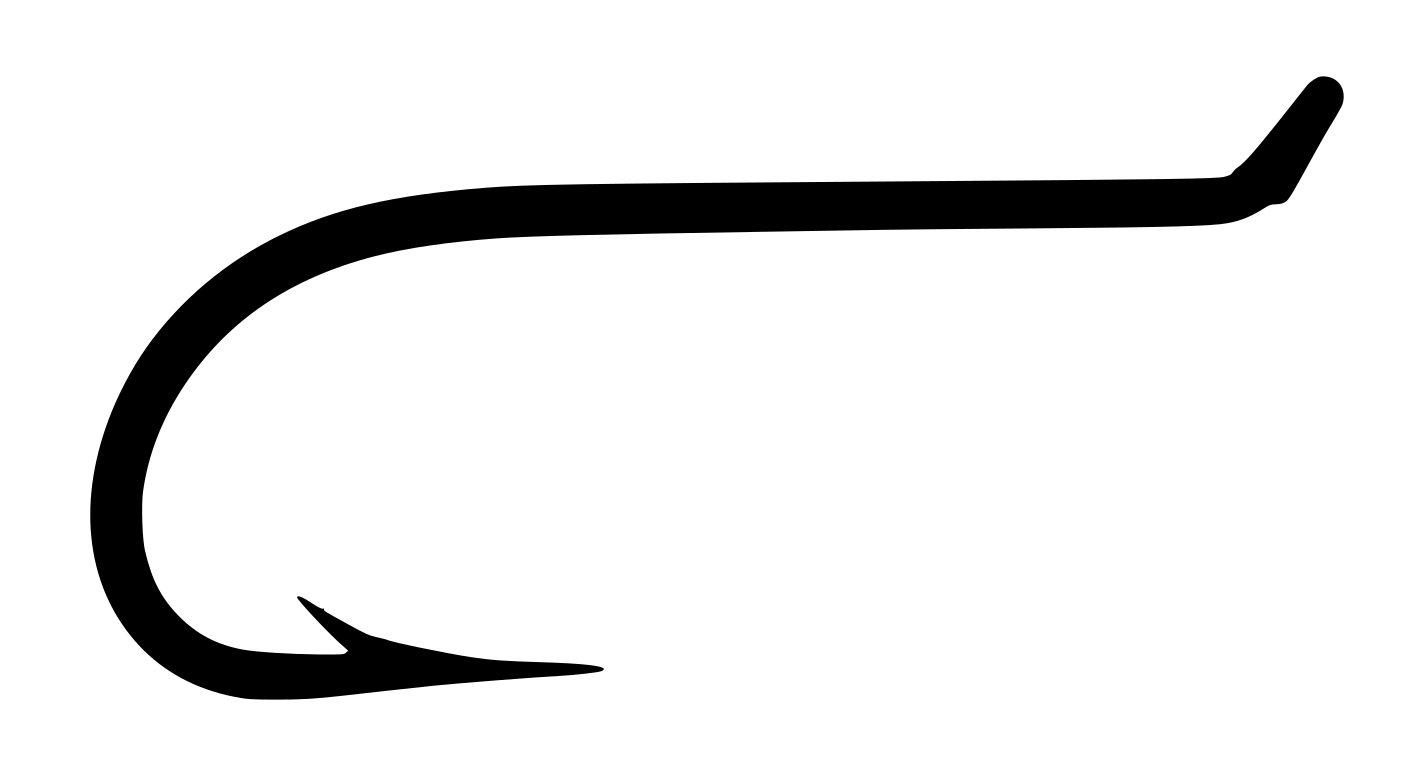
Manufactured by Wright & McGill Co. in Denver, Colorado, the 255SS is a mid-20th century general-purpose bait and saltwater hook exemplifying American mass-production fishhook design. The model features an O’Shaughnessy bend with a Superior Point-style tapered point, turned-down ball eye, and bright silver-toned plated finish intended to improve corrosion resistance. The defining physical feature is the angular O’Shaughnessy bend profile, characteristic of coastal and saltwater fishing traditions and favored for live bait, dead bait, and larger prey species.
Era dating is supported by the absence of a barcode, red block-letter offset printing on kraft cardboard, and handwritten production notation typical of mid-century bulk packaging practices.
Side profile view of the Eagle-Claw 255SS O'Shaughnessy hook, size 1/0, showing the Superior Point geometry and short barb, nickelled finish, on 1/10-inch measurement grid for scale reference.
Photographic record
3 cataloged imagesSelect any record to load it above.
3 images shown
Eagle-Claw 255SS Size 1/0 Point ProfileSide profile view of the Eagle-Claw 255SS O'Shaughnessy hook, size 1/0, showing the Superior Point geometry and short barb, nickelled finish, on 1/10-inch measurement grid for scale reference.Open originalEagle-Claw 255SS Size 1/0 Full Profile with EyeFull side profile view of the Eagle-Claw 255SS showing the turned-down ball eye, O'Shaughnessy bend, shank, and overall hook form, on 1/10-inch measurement grid for scale.Open originalEagle-Claw 255SS 100-Pack Bulk Card c. 1965-1975Original Eagle-Claw 255SS packaging: 100-hook bulk card in kraft cardboard box with clear acetate window, red block-letter printing, handwritten model code '255SS' and size '1/0' notation. No barcode present, indicating 1960s-70s production era.Open original
Technical profile
O'Shaughnessy bend, turned-down ball eye, standard wire, superior point, nickelled finish, size 1/0, 100-pack bulk format.
Eye
Ball Eye, Turned DownDistinct ball knob at wire terminus, angled downward, typical of turned-down ball construction for heavy leader and snell attachment.
Wire
Standard, Round
Shank
Short (1X–2X Short) — Plain
Bend
Round / Kendal, Standard gapAngular O'Shaughnessy bend with characteristic outward point angle and moderate depth; typical for saltwater and bait fishing applications.
Point
Superior (near-straight inner taper)Short, close-cropped barb positioned near the point; standard cutting for general-purpose hooks.
Finish
Nickelled / Nickel-Plated — Estimated (uncertain)Cool silver-grey plated appearance photographically consistent with nickel or similar bright anti-corrosion plating, though exact finish composition cannot be conclusively verified from photographs alone.
The Superior Point on the 255SS reflects a deliberate engineering choice for penetration and holding power. Unlike hollow-point or curved-in designs that maximize bite angle for soft-mouthed fish, the Superior Point maintains a near-straight inner taper with minimal concavity—a spear-like geometry that prioritizes point sharpness and tissue penetration.
The turned-down ball eye, standard on this model, provides a robust anchor for heavy mono snells and wire leaders. The ball knob distributes load across the eye bend, reducing the risk of leader slippage or eye fracture under heavy live-bait and fighting-fish stress. This design choice reflects saltwater and pike-fishing use cases where reliability under extreme loads is critical.
The standard-gauge round wire (approximately 0.020″-0.024″ diameter for size 1/0) balances strength with reasonable hook weight and cost. O’Shaughnessy bends inherently exhibit greater angular stress concentration than rounded Sproat patterns; standard wire provides adequate strength without excessive bulk that would impede bait movement or casting distance.
Nickel plating adds a thin, corrosion-resistant layer essential for saltwater performance. Unlike stainless steel alloys (which are more expensive and difficult to sharpen), nickel-plated high-carbon steel delivers cost-effective saltwater durability while maintaining the sharp, hard edges necessary for deep hook-sets.
We don't have measured sizes for this hook yet. Own one? Submit calipered measurements and we'll review and add them. Thank you!
Historical context
wright_mcgill
Since 1925, Eagle Claw in Denver, Colorado has been building hooks, with roots going back to when Drew McGill saw an eagle’s talon and reimagined what a hook could be. Founded in Denver, Colorado in 1925, the Wright & McGill Co began with two young fishermen Drew McGill and Stan Wright. McGill compared the penetrating and lethal claws of the eagles to the fishhooks they were using, and from there, he began improving their hooks, incorporating razor-sharp tips and a curved design, just like how an eagle’s talon looks. Their fishhooks easily took the entire country by storm.
In 1938, Wright & McGill registered Eagle Claw as a company trademark. By 1948, the Wright & McGill Co. owned and operated the world’s only automatic hook-making machines. The new machines barbed, shaped, eyed, and pointed the famed Eagle Claw hooks in one operation. Throughout the mid-20th century, Eagle Claw expanded its product line to include numerous hook patterns and sizes for both freshwater and saltwater fishing, establishing the brand as a cornerstone of American fishing tackle manufacturing.
The McGill family’s commitment to American manufacturing spans generations, from Andrew D. McGill’s vision to innovate which led to the revolutionary Eagle Claw hook, to his wife Madeline McGill who guided the company through growth, to their son Lee McGill who carried that legacy forward. Eagle Claw hooks are the only fish hooks made in the USA, built with integrity and 90-plus years of hook-making experience and heritage.
Series History
The 255SS O’Shaughnessy line represents Eagle Claw’s participation in the expanding American saltwater and general bait-fishing hook market during the post-war growth of recreational fishing (1950s-1970s). The O’Shaughnessy bend pattern itself dates to 19th-century Irish fishing tradition, but Eagle Claw adapted the form for large-scale American production using automated hook-making equipment introduced during the company’s mid-20th century industrial expansion.
The ‘255’ designation within Eagle Claw’s numeric system identifies the O’Shaughnessy profile. The exact meaning of the ‘SS’ suffix is not conclusively documented in the surviving packaging shown here and may represent a finish or service designation rather than confirmed stainless-steel construction. The photographed specimen exhibits a bright silver-toned plated finish consistent with anti-corrosion treatment typical of saltwater-oriented hooks of the era. The model was sold in bulk 100-pack formats intended for tackle retailers, bait operators, and high-volume anglers.
Era and Packaging Dating
No barcode present (pre-1974 strong indicator). Red block letter offset printing style typical of 1960s-70s packaging. Cardboard box with clear acetate window is post-war Eagle Claw standard. Handwritten model code and size notation common on production-run cards of this era. Kraft paper stock and printing quality consistent with mid-1960s to mid-1970s domestic hook manufacturing. No postal ZIP code or modern pricing conventions visible.
The Eagle's Talon Inspiration
Eagle Claw marketing tradition long associated the brand's hook design philosophy with the shape and penetrating efficiency of an eagle's talon. Company lore recounts that co-founder Drew McGill drew inspiration from observing eagle claws while refining hook penetration characteristics during the early development of Eagle Claw hooks in the 1920s. While widely repeated in company history and advertising, the detailed story elements are difficult to independently verify historically.
Design lineage and influence
The O’Shaughnessy bend pattern predates Eagle Claw by decades, originating in Irish salmon and sea trout fishing tradition during the 19th century. The design emphasizes a broader bite (gap) and outward-angled point, well-suited to live bait and larger prey species. Eagle Claw’s manufacturing innovation was not the design itself but the ability to mass-produce O’Shaughnessy hooks economically using automated machinery after 1948.
Competing designs in the American market during the 1960s-70s era included Mustad’s O’Shaughnessy patterns (model 1/0-7957), which held significant market share among coastal and saltwater specialists. Partridge of Redditch continued offering hand-forged O’Shaughnessy patterns in smaller production runs at premium prices, serving the fly-fishing and specialist markets. Eagle Claw’s 255SS positioned itself in the middle: better quality and consistency than cheap imports, but more affordable than hand-forged British hooks.
The influence of the 255SS and its successors extended the O’Shaughnessy pattern into mainstream American sport fishing, eventually becoming standard in tackle boxes alongside Sproat and Aberdeen patterns. Modern equivalents (Eagle Claw L254, contemporary Mustad designs) continue the lineage, testament to the enduring utility of the pattern for bait and saltwater fishing.
Best matchRelated by Attribute
Computed automatically from catalog data — updated as new hooks are added.
Matches: Bend, Shank, Gap, Eye Orient., Point +2 moreDiffers: Wire: Standard vs Fine (1X Fine); Eye: Ball Eye vs Tapered Eye; Finish: Nickelled vs Bronzed +2 more
Matches: Bend, Shank, Wire, Gap, Point +3 moreDiffers: Eye: Ball Eye vs Tapered Eye; Eye Orient.: Turned Down vs Turned Up; Forging: Round vs Forged +1 more
Matches: Bend, Shank, Gap, Eye, Point +3 moreDiffers: Wire: Standard vs Extra-Heavy (2X+); Eye Orient.: Turned Down vs Straight / Inline; Finish: Nickelled vs Bronzed +1 more
Matches: Bend, Wire, Gap, Eye Orient., Forging +2 moreDiffers: Shank: Short (1X–2X Short) vs Standard; Eye: Ball Eye vs Tapered Eye; Point: Superior vs Hollow Point +2 more
Matches: Bend, Shank, Wire, Gap, Eye +2 moreDiffers: Eye Orient.: Turned Down vs Straight / Inline; Point: Superior vs Hollow Point; Finish: Nickelled vs Polished Steel +2 more
The Eagle-Claw 255SS is designed for live and dead bait fishing in saltwater and large freshwater environments. The O’Shaughnessy bend, combined with the Superior Point-style geometry, provides reliable penetration and holding power when targeting hard-fighting, large-mouthed species such as bass, pike, stripers, and other predatory fish. The turned-down ball eye accommodates heavy leaders and mono snells. The bright plated finish was intended to provide improved corrosion resistance compared to unfinished steel hooks, making this pattern well suited to coastal bait-fishing applications.
Secondary Applications
May be used for wet fly and streamer fishing, though less common than dedicated fly-hook patterns. The sturdy wire and superior point work well for large baitfish-imitating patterns targeting pike, musky, and other predators.
Classic Fly Patterns
Not typically used for fly tying
Modern Equivalents
Hook
Match Quality
Notes
Eagle-Claw L254 (Nickel)
Excellent
Comparable modern Eagle Claw O'Shaughnessy-pattern descendant with similar bend profile and intended bait/saltwater application, though exact production lineage from the 255SS is not conclusively documented.
Mustad 1/0-7957 O'Shaughnessy
Very Good
Comparable O'Shaughnessy bend from competing American manufacturer; similar gap and point geometry, nickelled finish, saltwater-oriented design.
Partridge O'Shaughnessy (hand-forged)
Good
Hand-forged Redditch equivalent; same bend family but premium hand-forged construction, narrower production gaps, higher precision for specialist use.
Collector notes
Rated 3.5/10 — a common production Eagle-Claw model in mass-market format, but the complete original 100-pack packaging in good condition adds modest collector appeal. Primarily of interest to American hook historians and Eagle-Claw specialists; limited demand from general vintage fishhook collectors.
Reference value
$8 – $22 USD estimate
Packaging condition
Good — moderate wear, legibleRecorded specimen
Packaging format
EC-1960s-bulkcardCatalog code
This 255SS represents mainstream American hook manufacturing of the 1960s-70s era. What elevates it from purely common to uncommon is the original cardboard box format with a significant portion of the 100-pack intact — loose hooks of this model sell for mere cents each, whereas a complete or near-complete carded 100-pack commands meaningful premium.
The O’Shaughnessy geometry and nickelled finish appeal to bait and saltwater anglers, but the model lacks the specialist prestige of British Redditch craft hooks (Partridge, Allcock) or Japanese precision fly hooks. Complete, unopened or near-sealed 100-packs are significantly more valuable than opened or depleted cards.
Size 1/0 is a standard, readily available size; very small sizes (4-10) or large sizes (3/0-5/0) in the same mold would command slightly higher premiums due to relative scarcity.
Condition factors most affecting value: (1) presence of all or nearly all 100 hooks (missing hooks devalue significantly), (2) integrity of original cardboard box (torn or crushed boxes reduce appeal), (3) clarity and color preservation of the acetate window, (4) legibility of the handwritten model code and size notation (faded writing reduces provenance clarity).
Packaging
Kraft cardboard box, approximately 3.5" × 2.5" × 0.75", with clear cellulose acetate window. Red block-letter offset printing on ivory kraft stock. Text elements: EAGLE CLAW® with registered trademark symbol, handwritten model code '255SS' and size '1/0', '100 Hooks' in large red letters. No barcode or postal code visible. Box construction typical of post-1950 retail packaging.
Market Value Notes
Low ($8): Good condition, opened box, 80-95 hooks remaining, card/box shows age toning and wear but remains presentable and legible.<br />
<br />
High ($22): Excellent condition, sealed or near-sealed box, 98-100 hooks intact, minimal wear to printing and acetate window.<br />
<br />
Premium factors: Original 100-pack bulk card format (commands 2-3x loose hook value), complete or near-complete hook count, condition of acetate window and printed labeling, age and rarity of the specific production run, clarity of handwritten size notation.<br />
<br />
Platforms: eBay completed auctions (US and international), vintage tackle dealers specializing in American post-war hooks, estate sales of regional angler collections, occasional tackle swap meets in North America.<br />
<br />
Confidence: E estimated — limited specific sales data for this exact model and packaging format; values derived from comparable Eagle-Claw vintage bulk packs (250-500 ct and 100-ct formats) and similar-era saltwater hook cards from Mustad and other American manufacturers.
Where to Find
eBay (US and international listings, search 'Eagle-Claw 255SS' or 'vintage Eagle Claw O'Shaughnessy'), vintage tackle dealers specializing in American post-war hooks, estate sales of angler collections, regional tackle swap meets and fishing expos, local antique markets and flea vendors.
Collector's Identification Tips
The 255SS designation and red block-letter Eagle Claw branding are consistent markers of vintage Eagle-Claw production from the 1960s-70s. The ‘255’ model code corresponds to an O’Shaughnessy bend pattern. The precise meaning of the ‘SS’ suffix is uncertain and should not be assumed to conclusively indicate stainless-steel construction without supporting catalog documentation. Size notation handwritten on the card is typical of production-run bulk packs rather than fully printed consumer retail packaging. Presence of the original cardboard box distinguishes this specimen from loose-hook examples. Printing style, paper stock, and absence of modern retail coding features support a mid-20th century production date.
Preservation
Storage and Preservation
Store the original cardboard box in a cool, dry environment away from direct sunlight and moisture. The kraft cardboard is susceptible to humidity damage and mold if stored in damp conditions. Maintain the clarity of the acetate window by avoiding contact with oils and grime; a soft, dry cloth can gently clean the surface if needed.
The nickelled finish is relatively stable, but the thin plating may develop light patina or spotting if exposed to high humidity or salt spray over extended periods. This is considered acceptable aging by collectors and does not significantly diminish value. Avoid placing the box in contact with other metals to prevent galvanic corrosion of the hooks themselves.
If hooks are removed from the original packaging for use, store loose hooks in a dry container with desiccant packs (silica gel) to prevent rust. However, for collector value, the original packaging should remain intact and unopened whenever possible — opened cards lose 30-50% of their value, while depleted cards (missing hooks) lose 50-75%.
Display the packaged hooks away from direct sunlight to prevent fading of the red printed letters and kraft cardboard discoloration. A climate-controlled display case or shelf in a fishing-themed collection room is ideal.
Marking Analysis
Handwritten Marks and Production Codes
The handwritten notation ‘255SS’ and size ‘1/0’ visible on the cardboard face are factory production markings, not post-sale annotations. The handwriting style—block letters in black or dark blue ink—is consistent with production-line labeling practices of the 1960s-70s, when cost pressures led manufacturers to handwrite size and model codes on bulk packs rather than printing them.
The legibility and ink color of these handwritten marks are reliable dating indicators. Faded or heavily smudged handwriting suggests older stock (1960s) or longer storage under poor conditions; crisp, dark lettering is typical of 1970s-1980s production runs with better ink and storage practices.
The presence of handwritten notation on this specimen is actually a positive for collectors, as it confirms factory-original packaging and production-era handling rather than modern relabeling or counterfeit packaging (which would feature printed labels or modern ink types).
Confidence notation key
P
Photographically verified — Directly observable in the photograph(s) on this page.
V
Verified by documentation — Confirmed by manufacturer catalog, spec sheet, or published reference.
I
Inferred — A logical deduction from observable or documented evidence, not directly stated.
E
Estimated — An approximation based on visual comparison, proportional analysis, or limited data.
S
Speculative — A reasoned hypothesis that cannot be confirmed from available evidence.
Claims with no notation are confirmed by multiple independent sources. All photographs on garrenwood.com are taken on a measurement grid where each square equals 1/10 inch (0.1″ / 2.54 mm).