
Harrison's (Richard Harrison & Co.)
- Founded
- 1865edditch, England
- Documented entries
- 5Catalog records
- Categories
- 4By application
- Era range
- 1885–19255 dated entries
Richard Harrison was born around 1808 in Carlisle, Cumberland, and arrived in the Redditch area before 1839 — most likely as a commercial traveler, a connection he maintained through a long-running agency for the Star Fire and Life Insurance Company. In 1840, a Richard Harrison was listed among fifty-seven Redditch needle manufacturers who signed a memorandum presented to the House of Commons Board of Trade. Coulthart By 1851 the census recorded him simply as a “fish hook maker and traveler in the needle trade,” and by 1855 he was formally listed as a “fish hook and tackle maker” operating on Fish Hill.
During the period from 1851 to 1861 the family moved from the Retreat in Redditch to Prospect Hill, where the Harrison family most likely became acquainted with their wealthy neighbors, the Bartleet family. Coulthart By 1861 Harrison was listed as a fish hook and fishing tackle manufacturer on Prospect Hill. The business grew substantially through the early 1860s: by 1865 Harrison had attained a high degree of success and now had a large needle and fish hook factory known as Metropolitan Works located on Hewell Road on the east side of the railroad tracks near the intersection with Clive Road. Coulthart Prior to 1866 he had also achieved the status of Esquire and moved his family to a large estate named The Cedars on Hewell Road near the factory. The firm operated under the name Richard Harrison & Co., documented in trade directories as needle and fish hook manufacturers at the Metropolitan Works until at least 1873.
The firm produced a catalog of utilitarian and premium hooks serving both the coarse fishing and fly fishing markets. Documented patterns include the Celebrated Dublin Limerick (bronzed, tapered), the O’Shaughnessy Dublin (japanned, tapered), the Spring Steel Carlisle, and the Round Bent hook — all reflecting the full breadth of Victorian angling demand from trout wet flies to heavy bait fishing. The Spring Steel designation was a meaningful quality indicator, signaling that the wire had been drawn and tempered specifically for resilience under the sudden shock load of a striking fish rather than the brittleness that plagued cheaper, poorly-tempered hooks of the era.
Around 1876 the firm was reorganized when Arthur Greame Bartleet became a partner, renaming the business R. Harrison, Bartleet & Co. Coulthart Richard Harrison died in 1880 at his residence The Elms in Alvechurch, his estate valued under £7,000. The partnership era that followed — and the Bartleet family’s stewardship of the Metropolitan Works until the 1902 sale to Henry Milward & Sons — is documented separately under Harrison & Bartleet’s Hooks.
- 1808
- Richard Harrison born in Carlisle, Cumberland
- 1839
- Harrison arrives in Redditch; begins commercial traveling
- 1840
- Listed among 57 Redditch needle manufacturers petitioning the House of Commons
- 1851
- Census: "fish hook maker and traveler in the needle trade," 3 Retreat, Redditch
- 1855
- Listed as "fish hook and tackle maker" on Fish Hill; still Star Life Office agent
- 1861
- Fish hook and fishing tackle manufacturer on Prospect Hill; family neighbors with the Bartleets
- 1865
- Richard Harrison & Co. formally established at Metropolitan Works, Hewell Road
- 1873
- Silver Medal, Berlin Exhibition; last confirmed directory listing as solo firm
- 1876
- Arthur Greame Bartleet joins as partner; firm renamed R. Harrison, Bartleet & Co.
- 1880
- Richard Harrison dies at The Elms, Alvechurch, age ~72; estate under £7,000
Catalog by application
Complete index
5 entries
| Model | Name | Specification | Application | Era | Collectability | |
|---|---|---|---|---|---|---|
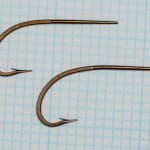
|
2989 | Celebrated O'Shaughnessy Dublin Limerick Hooks | O'ShaughnessyFineBronzed | Salmon Sea trout Bait | c. 1900-1920 | |
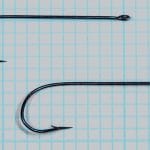
|
2996 | Spring Steel Carlisle Hooks | XFSpecBlued | Bait | c. 1925-1945 | |
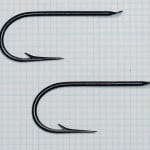
|
3781 | Harrison's Genuine Kendal Round Bent Hook — Quality 3781 | RoundHeavyBlued | Salmon Sea trout Bait | c. 1890s-1920s | |
| Celebrated Dublin Limerick | Harrison Celebrated Dublin Limerick Hook | DublinFineJapanned | Salmon Sea trout | c. 1885–1920 | ||
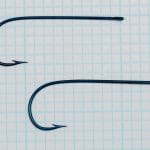
|
Not printed | Spring Steel Carlisle Hook | XF2XLBlued | Bait | c. 1890-1920 |