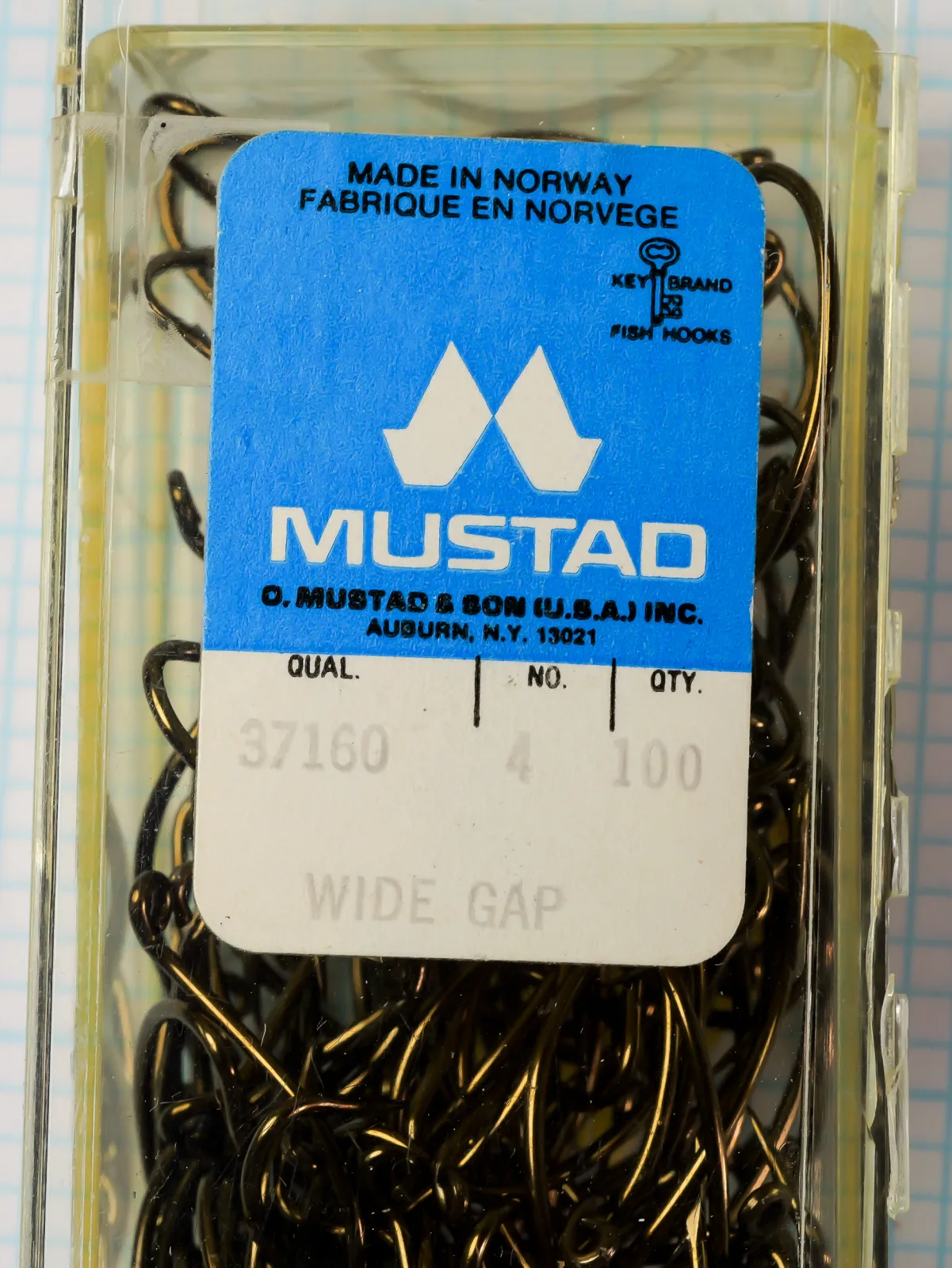
The Mustad 37160 is a wide-gap bait hook produced by O. Mustad & Son of Gjøvik, Norway, and distributed through their Auburn, New York subsidiary during the 1970s–1980s. This specimen, size 4, exemplifies the design intent: a continuous curved shank with pronounced gap between point and shank body, maximizing exposure of the point when bulky baits are threaded.
The hook features a turned-down ball eye, heavy round wire, and a hollow point—a concave inner face that creates a knife-edge cutting geometry. The slight offset to the point (reversed kirbification visible in photograph) enhances hook penetration. Bronzed finish provides corrosion resistance and camouflage in natural waters P. The continuous bend geometry—without a distinct straight shank section—distinguishes this design from traditional Sproat or Limerick patterns.
Era evidence: The Auburn, New York address on the packaging is a strong 1970s–1980s marker; Mustad relocated its North American headquarters post-1990. The offset-printed card label, clear plastic box construction, and absence of a barcode all support a late-1970s to early-1980s production window V. The 37160 became an iconic bait hook but also found significant use among fly tyers in the 1980s for egg patterns and large nymphs before specialized scud hooks became widely available.
Collecting significance: The 37160 remains commonly available, but original packaging with complete quantities adds moderate collector value. This specimen in mint condition represents a key reference point in Mustad’s North American distribution history.
Original clear plastic flip-top box with blue card label showing model 37160, size 4, 100 hooks per box, and Auburn, N.Y. manufacturer address. Label displays dual-language 'MADE IN NORWAY / FABRIQUE EN NORVEGE' text and classic white Mustad M logo.
Photographic record
3 cataloged imagesSelect any record to load it above.
3 images shown
Mustad 37160 Size 4 Original Packaging Auburn NY 1970sOriginal clear plastic flip-top box with blue card label showing model 37160, size 4, 100 hooks per box, and Auburn, N.Y. manufacturer address. Label displays dual-language 'MADE IN NORWAY / FABRIQUE EN NORVEGE' text and classic white Mustad M logo.Open originalMustad 37160 Size 4 Hook Point Profile BronzedClose-up of the hook point, barb, and inner-face geometry of a Mustad 37160 size 4 showing the hollow (concave) point design with short close-cut barb. The bronzed finish exhibits warm golden-brown tone. Photographed on 1/10-inch measurement grid for scale reference.Open originalMustad 37160 Size 4 Wide-Gap Bend Profile Two HooksSide-view profile of two Mustad 37160 hooks, size 4, showing the continuous-curve bent-shank design, pronounced gap between point and shank body, turned-down ball eye, and bronzed finish. Photographed on 1/10-inch measurement grid for accurate scaling of bend depth, gap width, and overall length.Open original
Technical profile
Eye
Ball Eye, Turned DownTurned-down ball eye with tapered wire construction P. The ball is cleanly formed and proportionate to the wire gauge; the eye sits at approximately 10–15 degrees downward angle to the shank, a standard orientation for bait hooks designed to align the leader axis with the shank for improved hook-sets.
Wire
Standard, Round
Shank
Standard — Plain
Bend
Wide gap, Offset / kirbedContinuous curved bend without a distinct cornered junction between shank and bend—the wire curves progressively from the eye through the point P. This design maximizes gap width while maintaining structural integrity. The curve is smooth and symmetrical; no offset is visible except at the point itself (slightly reversed kirbification). Bend depth (measuring the vertical drop from shank centerline to the lowest point of the bend) is approximately 0.70"-0.78" (~17.8-19.8 mm), which is pronounced relative to wire diameter.
Point
Hollow Point (concave inner face)Barb is short and close-cut, positioned immediately behind the point taper P. The barb angle is relatively shallow, angled backward parallel to the point taper. This conservative barb design reflects bait-hook philosophy: a prominent barb can impede hook penetration in soft-bait presentations. The barb is visible as a small notch in the profile view but not exaggerated.
Finish
Bronzed — Confirmed (stated on packaging)Bronzed finish exhibits warm, dark golden-brown tone characteristic of bronze plating or oxide coloring P. The finish is uniform across the visible hook surfaces with no visible corrosion or spotting on this specimen. Bronzed finish provides moderate corrosion resistance in freshwater; the finish tone offers camouflage in silty or vegetated water columns I.
Hooks in this package are bright and uncorroded with no visible patina or oxidation beyond the original bronzed finish. The blue card label shows light toning and minor surface wear consistent with storage in original packaging for 40+ years. The plastic flip-top box lid remains clear and intact; hinges functional. Original packaging substantially enhances collectability of this lot.
The hollow point (concave inner face) creates a knife-edge cutting surface that penetrates soft fish tissue with minimal force—critical for baits that may be bulky or resistant to hook pressure. The concave inner geometry differs from superior-point designs by offering superior initial bite at the cost of slightly less holding power once seated; for soft-bait fishing where the barb provides retention, this trade-off is optimal I.
The continuous-curve bend (sometimes called a ‘bent-shank’ in contemporary terminology) maximizes gap width without requiring a straight shank section that might obscure baits. The heavy round-wire profile provides strength for larger fish and the mechanical advantage needed to drive the hollow point through baits and tissue. The turned-down ball eye aligns the leader force with the shank axis, improving leverage during hook-sets and reducing side-loading stress on the eye.
The 37160 is a standalone wide-gap model within Mustad’s broader bait-hook portfolio, not part of a formally named series on the original packaging. The wide-gap concept itself reflects design evolution in mid-20th-century hook manufacturing: earlier bait hooks (like the Aberdeen and Limerick families) featured narrower gaps suitable for small live baits, but post-WWII demand for larger soft-bait presentations drove development of wider-gap alternatives. Mustad’s 37160 entered production likely in the 1950s–1960s and remained in continuous manufacture through at least the 1980s.
The 37160 shares the continuous-curve bend geometry with hooks like the Mustad 37140 (also wide-gap) but differentiates through heavier wire and a more pronounced curve. Modern production variants continue under the 37160 designation, though contemporary examples often feature different packaging and may have undergone subtle manufacturing refinements. The specific specimens marked with Auburn, N.Y. addresses and original blue-label packaging are considered the classic 1970s–1980s generation and command modest collector premiums.
The Steelhead Fly-Tier's Secret Weapon
In the 1970s–1980s, Pacific Northwest steelhead and salmon fly tyers discovered that the Mustad 37160's wide gap and heavy wire made it exceptional for tying large egg patterns (Glo-Bugs) before specialized scud and egg hooks became mainstream. The gap accommodated densely spun yarn without the yarn blocking the point, and the hollow point cut through yarn fibers on the strike. Veteran fly tyers often referred to the 37160 as 'the poor man's egg hook' long before manufacturers like Tiemco explicitly marketed hooks for this purpose.
Design lineage and influence
The wide-gap concept evolved from 19th-century bait-hook designs by Redditch makers (e.g., Kendal Sneck patterns) that prioritized gap over shank length for bulky natural baits. Mustad’s competitive advantage was adapting this geometry to industrial wire-drawing and mass production. The 37160 sits between traditional British bait hooks (Sproat, Aberdeen) and modern specialty hooks; its continuous-curve geometry anticipates later nymph-hook designs without the exaggerated bend-depth ratios of true scud patterns.
Best matchRelated by Attribute
Computed automatically from catalog data — updated as new hooks are added.
Matches: Wire, Eye, Point, Forging, Application +2 moreDiffers: Shank: Standard vs 1X Long; Gap: Wide vs Standard; Eye Orient.: Turned Down vs Straight / Inline +2 more
Matches: Wire, Gap, Eye Orient., Point, Finish +4 moreDiffers: Bend: Other vs Round / Kendal; Shank: Standard vs Short (1X–2X Short); Eye: Ball Eye vs Tapered Eye +1 more
Matches: Wire, Eye, Finish, Forging, Application +2 moreDiffers: Shank: Standard vs Short (1X–2X Short); Gap: Wide vs Standard; Eye Orient.: Turned Down vs Straight / Inline +3 more
Matches: Shank, Wire, Gap, Eye, Point +4 moreDiffers: Eye Orient.: Turned Down vs Straight / Inline; Offset: Offset / Kirbed vs Straight; Application: Bait vs Bait, Saltwater +2 more
Matches: Gap, Eye, Point, Forging, Application +2 moreDiffers: Shank: Standard vs Short (1X–2X Short); Wire: Standard vs Fine (1X Fine); Eye Orient.: Turned Down vs Straight / Inline +3 more
The Mustad 37160 is engineered as a soft-bait hook for live and natural presentations—nightcrawlers, corn kernels, dough balls, and small minnows. The wide gap accommodates bulk bait without obscuring the point; the hollow point and heavy wire drive cleanly through soft tissue and resistant baits. Primary targets are panfish (bluegill, crappie), trout (in stream and lake contexts), and carp. The continuous-curve bend distributes force evenly, reducing leverage-induced straightening under hard strikes from larger fish.
Secondary Applications
Fly tying for egg patterns (Glo-Bugs, Sucker Spawn), large nymphs, and scud/shrimp imitations. San Juan Worms and similar bulky soft patterns. The heavy wire accommodates dubbing and yarn without deformation.
Modern Equivalents
Hook
Match Quality
Notes
Tiemco 2487
Very Good
Curved nymph/scud hook; modern equivalent for fly-tying egg patterns and large nymphs. Sharper bend and slightly narrower gap than 37160, but same application niche.
Mustad C49S
Very Good
Modern Mustad scud-style hook; direct contemporary alternative within same manufacturer line. Similar wide gap and heavy wire.
Gamakatsu SL12S
Good
Japanese wide-gap bait hook; excellent contemporary alternative for bait fishing with comparable gap and point geometry.
Collector notes
The 37160 is a commonly available hook even in original packaging, limiting scarcity value. However, mint-condition original boxes with full quantities and correct era-specific labeling appeal to vintage tackle collectors and Mustad specialists, elevating appeal moderately. The hook's iconic status in steelhead fly-tying circles adds historical interest.
Packaging format
GW-E-03Catalog code
Positive factors: Iconic wide-gap design recognized across bait and fly-fishing communities. Original packaging with Auburn, N.Y. address and blue label is era-specific and desirable to Mustad collectors. Complete original quantities (100 hooks per box) are scarce, as most original packages have been opened and dispersed. Bronzed finish and heavy wire represent classic industrial aesthetics that appeal to vintage tackle curators. The hook’s dual-use history (bait and fly-tying) expands collector base beyond specialists.
Limiting factors: The 37160 remains in continuous production, so vintage examples compete with modern reprints in the marketplace. No barcode on packaging cannot uniquely verify production date without other evidence. The size 4 is common and mid-range; extreme sizes (1/0 or smaller) command higher premiums. Mustad hooks are more abundant than British Redditch makers, reducing scarcity premium. The wide-gap category is less specialized than niche designs (e.g., salmon spey, sea-trout), limiting collector depth.
Packaging
Clear plastic flip-top hinged box with molded interior tray. Blue card label affixed to interior top. Label reads: MUSTAD (with large white M logo) | O. MUSTAD & SON (U.S.A.) INC. | AUBURN, N.Y. 13021 | QUAL. / NO. / QTY. (printed fields, handwritten entries) | 37160 / 4 / 100 | WIDE GAP. Upper portion of label states MADE IN NORWAY / FABRIQUE EN NORVEGE and KEY BRAND / FISH HOOKS in smaller print. Label is cardstock, white with blue background, offset printed black text. No barcode visible. Box appears to be mid-1970s to early 1980s construction.
Market Value Notes
Original unopened boxes of Mustad 37160 in mint condition typically sell for $8–$18 USD depending on size and platform (eBay, specialist dealers). Opened lots with partial quantities sell for $2–$6 per dozen. Pricing factors: condition of packaging (label clarity, box integrity), quantity remaining, size rarity, and regional demand. Steelhead-fishing regions (Pacific Northwest) show stronger demand. Loose hooks sell for $0.08–$0.15 each in bulk lots.
Where to Find
Mustad 37160 hooks are widely available on eBay, specialist vintage tackle dealers, and regional fishing tackle swap meets. Original packaging is less common than loose hooks; mint original boxes appear 2–4 times monthly on major online marketplaces. Tackle auctions and estate sales frequently include unopened quantities. New-production 37160 hooks are carried by most major fishing retailers, making vintage examples less differentiated in the open market.
Collector's Identification Tips
Verify model code 37160 stamped or embossed on hook or printed on card label P. Check packaging: look for blue Mustad logo label and ‘AUBURN, N.Y. 13021’ address text; these indicate 1970s–1980s manufacture V. Confirm size marking (typically stamped on hook or printed on label); size 4 is mid-range in the 37160 line. Examine finish: original bronzed hooks should exhibit warm, golden-brown tone with minimal corrosion. Watch for counterfeits or later reproductions, which may show different packaging colors or fonts.
Preservation
Storage and Preservation
Store the Mustad 37160 in its original clear plastic box in a cool, dry location away from direct sunlight and humidity. The bronzed finish is stable but can develop patina with extended moisture exposure; many collectors consider natural patina desirable and do not attempt to restore the original finish. Avoid contact with dissimilar metals (copper, iron, aluminum) to prevent galvanic corrosion.
If the original box is lost, transfer hooks to an acid-free tackle box or paper envelope. Do not store loose hooks in plastic bags, which can trap moisture. Inspect periodically for any white rust (zinc corrosion) or red rust (iron contamination); if present, gently dry and store in a low-humidity environment.
Original packaging significantly enhances value and preserves the historical documentation of the hook—the card label with model, size, quantity, and manufacturer information is irreplaceable. Keep the box intact whenever possible.
Primary Source
Packaging Label Analysis
Source: Blue card label on flip-top box, Mustad 37160 specimen, size 4, 100-quantity lot, Auburn, N.Y. packaging
The blue card label affixed to the interior of the flip-top box provides definitive period and provenance markers. The label reads ‘O. MUSTAD & SON (U.S.A.) INC. | AUBURN, N.Y. 13021,’ identifying this as product distributed through Mustad’s North American subsidiary. The Auburn address was Mustad’s primary U.S. distribution center from approximately 1958 through the late 1980s, then relocated. Hooks bearing this specific address on packaging are reliably dated to the 1970s–1980s window.
The large white ‘M’ logo in stylized geometric form is Mustad’s corporate mark from the 1960s–1980s era; earlier packaging used different logo treatments (e.g., script-style ‘Mustad’ or the Norwegian ‘Ø’ character more prominently displayed). The dual-language text ‘MADE IN NORWAY | FABRIQUE EN NORVEGE’ indicates production at the Gjøvik factory and distribution to both English and French-speaking markets, typical of Mustad’s international packaging strategy.
The label fields for ‘QUAL.’ (quality/type), ‘NO.’ (model number), and ‘QTY.’ (quantity) are printed with handwritten entries: ‘37160,’ ‘4,’ and ‘100’ respectively. This hybrid printing-and-handwriting approach was standard practice for Mustad packaging of this era, as individual lot quantities and quality grades were recorded during the packaging process. The handwriting style (sans-serif ballpoint ink) is consistent with mid-1970s to early-1980s factory documentation.
Additional
Fly-Tying Heritage: The Steelhead Discovery
Though marketed and sold as a bait hook throughout its production run, the Mustad 37160 became legendary among Pacific Northwest steelhead and salmon fly tyers in the 1970s–1980s. Before Tiemco, Gamakatsu, and other manufacturers introduced purpose-built scud and egg hooks, fly tyers adapted existing bait hooks to specialized patterns. The 37160’s attributes—wide gap, heavy wire, hollow point, and continuous bend—proved ideal for tying large egg imitations and bulky nymph patterns.
The ‘Glo-Bug’ (credited to designer Oregon Outdoors Club member Roy Donnelly, popularized in the 1970s) is a spun-yarn egg imitation that requires a hook with sufficient gap to contain dense yarn without the yarn blocking the point. The 37160’s wide gap and forward-facing point geometry enabled this. Veteran fly tyers recall referring to the hook informally as ‘the poor man’s egg hook’ or ‘the steelhead special’ during this era, recognizing its unintended utility before dedicated alternatives became available.
This fly-tying adoption of a bait hook exemplifies the ingenuity and resourcefulness of hook designers and tyers working within market constraints. The 37160 remains a respected choice for San Juan Worm patterns and other large soft presentations among contemporary fly tyers who value vintage hook geometry and sustainable use of existing inventory.
Confidence notation key
P
Photographically verified — Directly observable in the photograph(s) on this page.
V
Verified by documentation — Confirmed by manufacturer catalog, spec sheet, or published reference.
I
Inferred — A logical deduction from observable or documented evidence, not directly stated.
E
Estimated — An approximation based on visual comparison, proportional analysis, or limited data.
S
Speculative — A reasoned hypothesis that cannot be confirmed from available evidence.
Unnotated claims are the compiler’s synthesis; see Sources. All photographs on garrenwood.com are taken on a measurement grid where each square equals 1/10 inch (0.1″ / 2.54 mm).