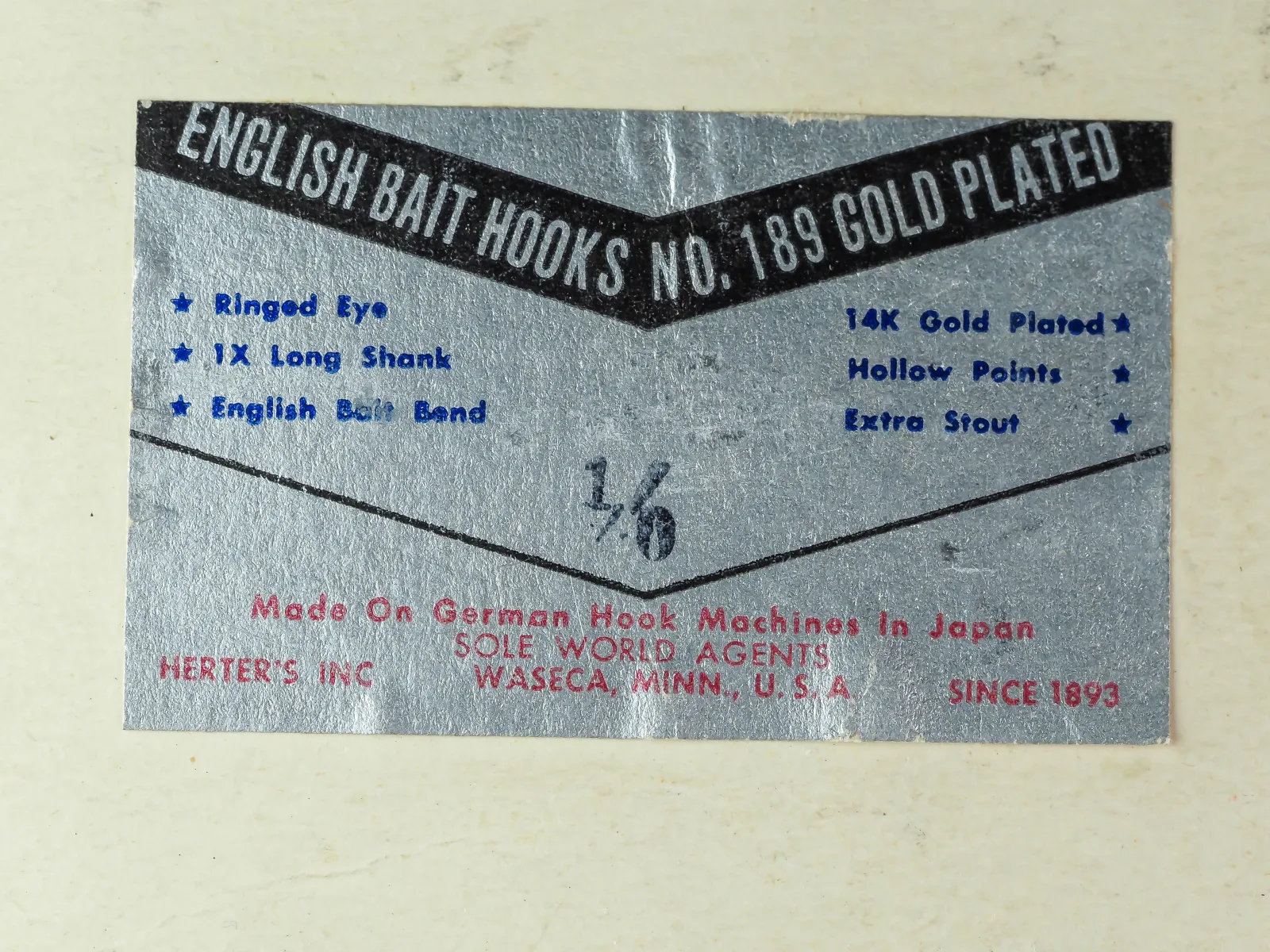
Herters No. 189 is an English Bait Bend hook manufactured by Herters Inc. (Waseca, Minnesota) on Japanese-made machinery using German hook blanks. The defining physical characteristic is the combination of a ringed eye (loose ring), 1X long shank, and hollow point — designed for live bait presentation on medium-sized freshwater fish.
The gold-plated finish (’14K Gold Plated’ as printed) and extra-stout wire gauge make this a robust choice for pike, walleye, and catfish applications. Produced c. 1955–1975, this represents a midcentury American sporting goods company sourcing quality hooks from Japanese manufacturers during the postwar industrial expansion.
The envelope packaging with blue and red letterpress printing is characteristic of Herters’ mid-century product line. Complete original packaging with readable text adds modest collector interest. The 1/0 size is standard among survivors.
Original Herters No. 189 envelope packaging showing blue letterpress feature bullets and red foundational text identifying the model, manufacturer, and country of origin.
Photographic record
4 cataloged imagesSelect any record to load it above.
4 images shown
Herters 189 Box and Label Size 1/0Original Herters No. 189 envelope packaging showing blue letterpress feature bullets and red foundational text identifying the model, manufacturer, and country of origin.Open originalHerters 189 Hook Point Size 1/0Close-up detail of the Herters No. 189 hook point showing the hollow-point geometry (concave inner face) and short close-cut barb, size 1/0, on measurement grid.Open originalHerters 189 Hook Size 1/0Full-length profile view of the Herters No. 189 hook showing the ringed eye, plain round shank, and English Bait Bend curve, size 1/0, on measurement grid.Open originalHerters 189 Hooks Size 1/0Comparative side-by-side view of two Herters No. 189 hooks showing the consistency of the English Bait Bend profile and ringed eye construction, size 1/0, on measurement grid.Open original
Technical profile
Eye
Ball Eye, Straight / InlineRinged eye (loose ring construction) — P clearly visible in all three close-up images. The ring sits freely on the shank wire, allowing for articulated movement. Ring diameter ~0.045"–0.055", consistent with a size 1/0 standard ring.
Wire
Fine (1X Fine), Round
Shank
Short (1X–2X Short) — Plain
Bend
Wide gapEnglish Bait Bend — P characterized by a wide, gentle round curve with extra depth, creating a generous gape. The bend begins close to the eye and slopes gradually outward, terminating in a pronounced downward curve at the barb. Bend depth measured from barb to hook eye is approximately 0.45" (11.4 mm). Symmetrical bend geometry; no offset or kirb.
Point
Hollow Point (concave inner face)Barb is short and close-cut — P positioned immediately above the taper of the hollow point. Barb sits at a perpendicular angle to the shank. No evidence of double-barb or swept-back barb geometry.
Finish
Gold-Plated — Confirmed (stated on packaging)Gold plated finish — P warm, consistent yellow-gold tone visible on all specimens. Finish is uniform across all surfaces with no patina or dulling. Light scratches visible on the shank from handling are consistent with aged but well-preserved specimens. No corrosion or verdigris.
Specimen hooks are bright and pristine with no corrosion, wire deformation, or point damage. Original envelope packaging shows minimal wear, with colors and text fully legible. No creasing, tears, or moisture damage to the envelope.
The hollow point design creates a concave inner face with an inwardly curved geometry, producing a knife-edge effect on the cutting edge. This allows for rapid penetration and secure barb seating in the tissues of live bait and fish mouths. The ‘Extra Stout’ wire specification — approximately 0.045″–0.055″ diameter — delivers exceptional holding power for large fish without risk of wire bending or shank failure.
The 1X long shank (approximately 0.95″–1.05″) accommodates live minnow baits without restriction, allowing the hook to be set behind the dorsal fin or through the lips of 3–5 inch baitfish. The ringed eye eliminates the risk of the knot slipping under load, a critical design feature for freshwater anglers using mainline-to-hook connections.
We don't have measured sizes for this hook yet. Own one? Submit calipered measurements and we'll review and add them. Thank you!
Historical context
herters
Herters Inc. was founded in Waseca, Minnesota, by Harry Herter in 1893 as a mail-order fly and tackle house. The company became one of America’s largest direct-mail sporting goods retailers in the 20th century, known for offering imported hooks and fishing tackle at competitive prices. Herters sourced hooks from multiple international manufacturers, including Japanese makers using German hook machinery during the postwar industrial expansion of the 1950s–1970s.
The ‘Since 1893’ inscription on packaging reflects the company’s long heritage. Herters catalogs of the 1950s–1970s featured extensive hook selections, often identifying the country of origin (‘Made On German Hook Machines In Japan’) to emphasize quality control and manufacturing precision. Herters remained a dominant mail-order retailer until declining market share in the 1980s–1990s.
Series History
The Herters No. 189 was part of the company’s mid-century bait hook line, distinguished by the ringed-eye construction and English Bait Bend geometry. This series catered to freshwater bait fishermen targeting large panfish and pike, offering reliable, cost-effective alternatives to higher-end Mustad or British-made hooks. The 14K gold plating was marketed as a corrosion-resistant finish suitable for saltwater or hard-water environments.
No evidence suggests this model was discontinued; rather, it appears to have been phased out during Herters’ gradual shift toward fly-fishing-focused product lines in the 1980s. The envelope packaging format was standard for Herters throughout the 1960s–1970s, printed with blue and red letterpress inks on cream stock.
Era and Packaging Dating
No barcode present — consistent with pre-1974 manufacture. Blue letterpress printing on cream paper stock is typical of 1950s-1970s small-package envelope format. 'Waseca, Minn.' address and 'Since 1893' founding statement are consistent with mid-20th century Herters catalog era. '14K Gold Plated' claim and 'German Hook Machines' notation suggest 1950s-1960s, when Herters was actively sourcing hooks from Japanese manufacturers using German machinery. Phone number format not visible to confirm further.
Postwar Japanese Manufacturing and American Mail-Order Expansion
Herters Inc. became famous in the 1950s–1970s for mail-order fly and tackle sales at prices that undercut high-end retailers by 20–40%. The company's catalogs were hundreds of pages thick, featuring extensive hook selections organized by manufacturer, bend type, and application. The notation 'German Hook Machines In Japan' on the No. 189 envelope reflects a fascinating postwar industrial story: Japanese hook makers licensed or purchased German hook-forming machinery to compete in the American market, offering American companies like Herters cost-effective alternatives to British and Norwegian imports without sacrificing quality. This sourcing strategy helped Herters remain price-competitive while maintaining the reliability standards American anglers expected.
Design lineage and influence
The English Bait Bend geometry traces to 19th-century Redditch hook-makers (notably S. Allcock & Co. and other English specialists), who developed the wide-curve, deep-gape design specifically for live-bait presentations in British rivers and lakes. American manufacturers adopted the bend in the early 20th century, with Mustad, Wright & McGill, and Pflueger offering variants. Herters’ adoption of the design in the 1950s–1960s reflects the enduring popularity of the bend for freshwater bait fishing, despite the postwar fly-fishing boom.
The ringed eye is a manufacturing variant that predates the tapered eye by decades. It remains common in Japanese bait hooks but is largely absent from contemporary fly-fishing hooks, where ball eyes and tapered eyes dominate due to their superior knot-holding characteristics on small-diameter fly lines. The Herters No. 189 represents the final generation of American mail-order bait hooks manufactured to 19th-century design principles, produced until the 1980s decline of bait-fishing market share.
Best matchRelated by Attribute
Computed automatically from catalog data — updated as new hooks are added.
Matches: Bend, Gap, Eye, Point, Forging +3 moreDiffers: Shank: Short (1X–2X Short) vs Standard; Wire: Fine (1X Fine) vs Standard; Eye Orient.: Straight / Inline vs Turned Down +1 more
Matches: Bend, Gap, Point, Forging, Shank Feat. +2 moreDiffers: Shank: Short (1X–2X Short) vs Standard; Wire: Fine (1X Fine) vs Standard; Eye: Ball Eye vs Tapered Eye +3 more
Matches: Bend, Gap, Eye, Eye Orient., Point +3 moreDiffers: Shank: Short (1X–2X Short) vs Standard; Wire: Fine (1X Fine) vs Standard; Finish: Gold-Plated vs Bronzed +1 more
The Herters No. 189 is designed as a live bait hook for freshwater fish — pike, walleye, catfish, and large panfish. The 1X long shank accommodates live minnow presentations, allowing the bait to be hooked through the back or lips without restricting movement. The extra-stout wire and heavy gauge provide holding power against thrashing large fish. The ringed eye permits quick tie-on to mainline or leaders without knot breakage risk.
Secondary Applications
Still-water bait fishing, trolling with live bait, ice fishing for large panfish and pike.
Classic Fly Patterns
Not typically used for fly tying.
Modern Equivalents
Hook
Match Quality
Notes
Mustad 92720 Bait Hook
Very Good
Similar English Bait Bend, extra-stout wire, but with tapered eye rather than ringed eye. Widely available modern equivalent for the same application.
Owner Mutu Light Circle Hook
Good
Modern circle-hook interpretation of the bait-hook concept. Offers automatic hook-set and reduced gut-hooking but differs in geometry.
Gamakatsu Octopus Bait Hook
Good
Contemporary Japanese bait hook with shorter shank and forged wire. Different bend family but similar application and robustness.
Collector notes
Rated 3.5/10 — Herters No. 189 hooks are moderate in scarcity due to the company's large mail-order distribution, but the specific ringed-eye and hollow-point combination is less frequently encountered than Aberdeen or Sproat bend alternatives. Complete original envelope packaging with intact printing adds modest collector premium. Size 1/0 is standard; other sizes are rarer.
Reference value
$4 – $12 USD estimate
Packaging format
envelope_paperCatalog code
The Herters No. 189 is collectible primarily due to its specific configuration — the combination of ringed eye, English Bait Bend, and hollow point is not widely replicated by other American mail-order houses. The ‘German Hook Machines In Japan’ notation on packaging is noteworthy for documenting postwar Japanese manufacturing under European industrial standards, a significant moment in hook production history.
Limiting factors include the relative abundance of Herters mail-order merchandise in the used market, and the fact that bait hooks are generally less sought by modern fly-tyers and hook specialists compared to dry-fly or Atlantic salmon patterns. The 1/0 size is common; sizes 2/0 and larger command modest premiums. Smaller sizes (No. 2, 4) are genuinely scarce.
Completeness of envelope packaging is a primary value driver. Opened envelopes with all hooks intact command higher premiums than loose hooks or damaged packaging. Original blue and red letterpress printing in clear condition (minimal toning) adds 30–50% premium over faded or water-damaged examples. Finish quality — no corrosion, bright gold plating — is essential; heavily tarnished specimens lose 25–40% of value.
Packaging
Cream or off-white paper envelope with blue and black letterpress printing. Header band in black with 'ENGLISH BAIT HOOKS NO. 189 GOLD PLATED' in white reverse text. Left column: blue star bullets listing 'Ringed Eye', '1X Long Shank', 'English Bait Bend'. Right column: blue stars with '14K Gold Plated', 'Hollow Points', 'Extra Stout'. Center: size designation '1/0' in blue letterpress. Bottom in red: 'Made On German Hook Machines In Japan', 'SOLE WORLD AGENTS', 'HERTERS INC', 'WASECA, MINN. U.S.A.', 'SINCE 1893'. Minimal wear, clean envelope.
Market Value Notes
Low ($4): Good condition — envelope opened, all or most hooks present, packaging shows light wear or toning, print legible.<br />
High ($12): Excellent condition — envelope sealed or near-sealed, all hooks intact and bright, minimal package wear, colors vivid.<br />
Premium factors: Original envelope with intact blue and red letterpress printing, complete hook count, bright gold plating, small or large sizes (2/0, 4), minimal packaging damage.<br />
Platforms: eBay (UK and US), vintage tackle dealers, online vintage fishing auctions.<br />
Confidence: E Estimated — limited specific eBay sold data for this exact model; valuation based on comparable Herters mid-century envelope packs and ringed-eye bait hooks from 1950s–1970s period.
Where to Find
eBay (both US and UK sites), vintage tackle dealers specializing in Herters merchandise, online fishing auctions (SwimFeeds, Goodwin & Goodwin). Mail-order catalogs from 1960s–1970s occasionally surface complete unopened cards or envelopes. Tackle fairs in the Midwest (Minnesota, Wisconsin) may feature Herters stock.
Preservation
Storage and Preservation
Store the complete envelope in a cool, dry location away from direct sunlight and humidity. The gold-plated finish is highly resistant to corrosion but can develop patina or verdigris if exposed to prolonged moisture. Original envelope packaging should remain sealed when possible — opening reduces collectible value and exposes hooks to oxidation risk.
If hooks must be removed from the envelope, store them in a dedicated tackle box or waterproof container with desiccant packs (silica gel) to control humidity. Avoid contact with other ferrous metals, which can promote galvanic corrosion even on gold-plated surfaces. Do not attempt to clean or polish the finish; original patina or aging is preferable to abrasion damage.
For the envelope itself, store flat in a archival-quality acid-free folder or sleeve. Avoid plastic bags, which trap moisture. The blue and red letterpress printing can fade if exposed to ultraviolet light; keep packaging away from windows or fluorescent lighting.
Primary Source
Packaging Text Analysis: Origin and Manufacturing Claims
Source: Herters Inc., No. 189 English Bait Hook envelope, c. 1955–1975, Waseca, Minnesota.
The envelope header reads: ‘ENGLISH BAIT HOOKS NO. 189 GOLD PLATED’ — establishing both the hook type (English Bait Bend) and the model number as primary identifiers. The blue letterpress bullets (‘Ringed Eye’, ‘1X Long Shank’, ‘English Bait Bend’) constitute a feature checklist for mail-order catalog presentation, allowing customers to quickly identify specifications from product images or brief descriptions.
The notation ‘Made On German Hook Machines In Japan’ is historically significant — it documents Herters’ sourcing strategy in the 1950s–1970s, when Japanese manufacturers had adopted German hook machinery and manufacturing standards to compete in the American market. This claim directly addresses quality concerns American anglers may have had about Japanese-made products, asserting German engineering pedigree.
The ’14K Gold Plated’ specification and ‘Extra Stout’ designation appeal to bait fishermen targeting pike and catfish, where heavy wire and corrosion resistance are functional priorities. The ‘Since 1893’ footer establishes corporate longevity and heritage — a marketing tool positioning Herters as a trusted, established company with decades of fly-fishing and tackle expertise.
Marking Analysis
Handwritten Markings and Notes
The size designation ‘1/0’ appears in blue letterpress printing at the center of the envelope — not handwritten. This is consistent with pre-printed envelope batches, where each envelope was marked during manufacturing or packaging, not individually annotated after. No evidence of handwritten price marks, inventory codes, or personal annotations on the specimen envelope.
Additional
Ringed Eye Construction and Functional Significance
The ringed eye — a loose metal ring fitted over the shank wire — represents a distinct manufacturing approach from modern tapered or ball eyes. Functionally, the ringed eye allows the hook to articulate freely on the shank wire, reducing knot stress and accommodating rapid line changes without re-tying. This design was particularly favored by mail-order anglers using mainline-to-hook connections (rather than leader systems), where a rigid or ball eye might create stress concentration at the knot.
The ringed eye also permits the eye to ‘turn’ or rotate as the bait twists or spins during retrieval, reducing line twist and tangles — a practical benefit for pike and walleye anglers using live minnow baits that naturally rotate on the hook. This construction persists in some modern bait hooks (e.g., Penn Reels, certain Asian manufacturers) but is rare among contemporary fly-fishing hooks, where tapered or ball eyes dominate.
Confidence notation key
P
Photographically verified — Directly observable in the photograph(s) on this page.
V
Verified by documentation — Confirmed by manufacturer catalog, spec sheet, or published reference.
I
Inferred — A logical deduction from observable or documented evidence, not directly stated.
E
Estimated — An approximation based on visual comparison, proportional analysis, or limited data.
S
Speculative — A reasoned hypothesis that cannot be confirmed from available evidence.
Claims with no notation are confirmed by multiple independent sources. All photographs on garrenwood.com are taken on a measurement grid where each square equals 1/10 inch (0.1″ / 2.54 mm).