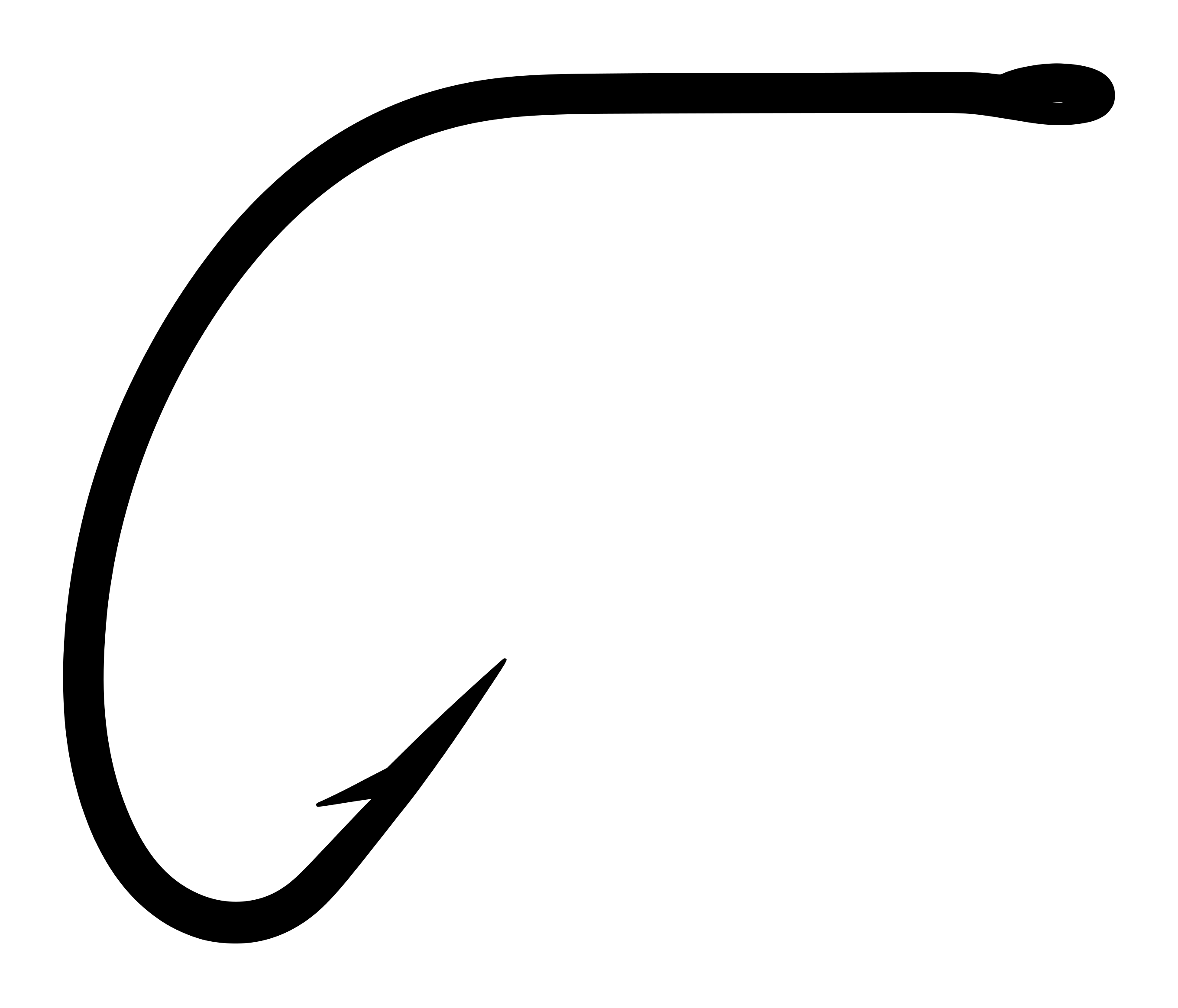
Kinsey Hooks hook silhouette
Hook ReferenceO. Mustad & Son Hooks › Mustad 9065 — Kinsey Hooks

Mustad 9065

Kinsey Hooksc. 1920s–1940s
Blind Eye FlattedOtherShort (1X–2X Short) ShankExtra-Fine WireHollow PointBlack Japanned

Save this hook to your account to build a list you can come back to.

Record summary

O. Mustad & Son, Quak model 9065, size 9, japanned bait hook with blind flatted (spade) eye, wide gap, and extra-fine wire. Single-bend short-shank construction designed for impaled bait in freshwater or sea fishing traditions. The blind eye—a flatted terminus hammered wider than the shank—was the standard attachment method in European and British bait fishing before the adoption of eyed hooks. Documented size 9 specimen measures approximately 1.59″ overall length with a 0.70″ gap.

The “Kinsey” brand suggests a collaborator or licensed distributor; Mustad exported extensively to English-speaking markets under regional brand names. The japanned finish (glossy black lacquer) is confirmed by packaging text and specimen appearance. Production dating to the interwar period (c. 1920s–1940s) based on box construction, label design, and absence of barcode.

Blind-eye bait hooks occupy a diminishing niche in modern tackle collecting. This example represents a functional artifact of pre-eyed-hook bait-fishing tradition and retains its original rigid manufacturer box—a rarity for this type of utilitarian hook.

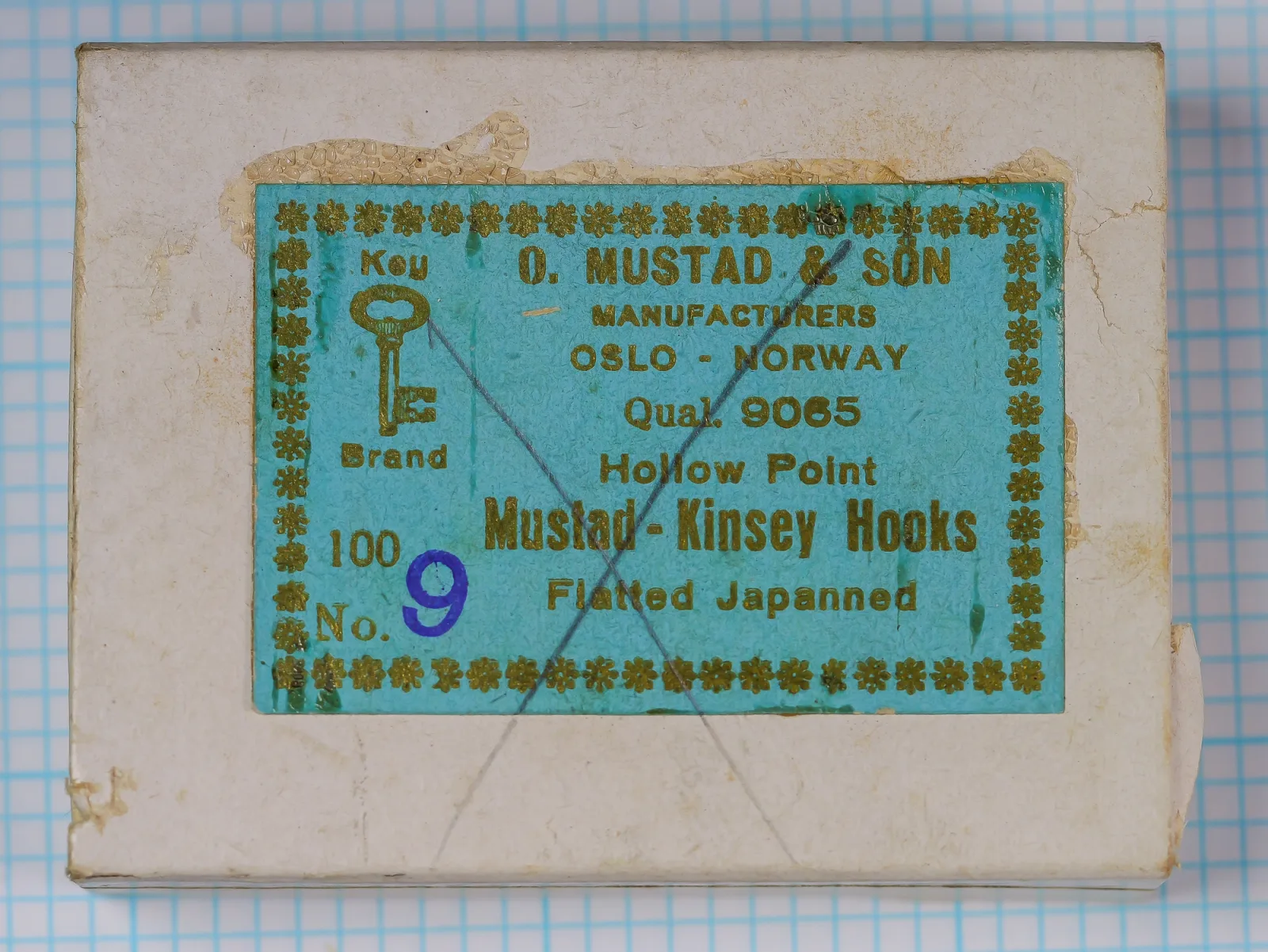
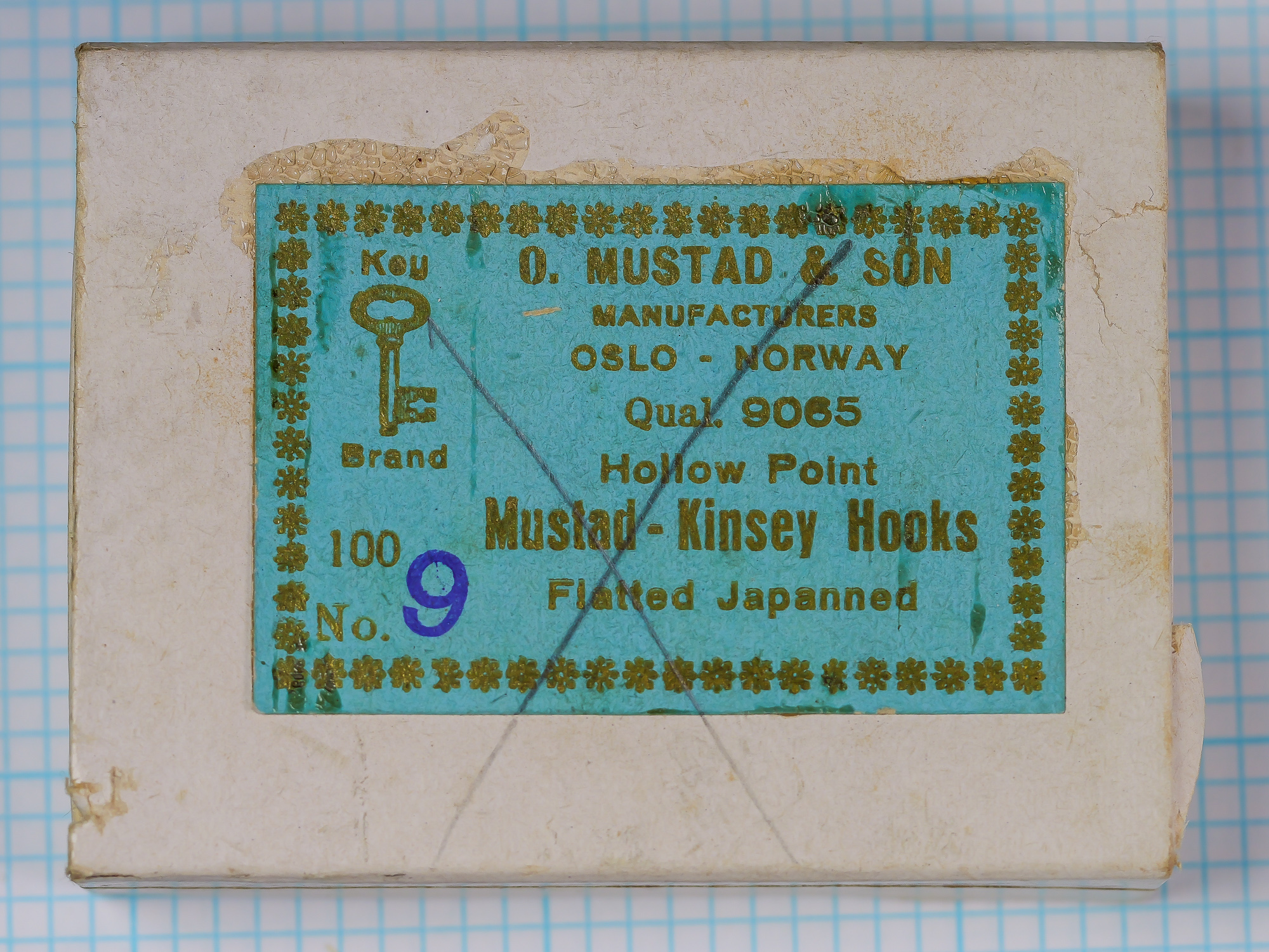
Mustad Quak 9065 Kinsey Hooks — original manufacturer box lid with turquoise label and gold text — size 9 — japanned bait hooks
Original manufacturer box lid showing turquoise printed label with gold text, four-leaf-clover decorative border, and all identifying text: O. Mustad & Son manufacturers, Quak 9065, Hollow Point, Mustad-Kinsey Hooks, Flattered Japanned, 100 size 9.

Photographic record

3 cataloged imagesSelect any record to load it above.

3 images shown

Mustad Quak 9065 Kinsey Hooks Box Lid Label Original manufacturer box lid showing turquoise printed label with gold text, four-leaf-clover decorative border, and all identifying text: O. Mustad & Son manufacturers, Quak 9065, Hollow Point, Mustad-Kinsey Hooks, Flattered Japanned, 100 size 9. Open original
Mustad Quak 9065 Size 9 Profile View on Grid Side profile view of size 9 hook showing short shank, wide gap, swept bend, and flatted eye terminus. Japanned finish is bright black with slight highlight on bend. Measurement grid (0.1-inch squares) visible for scale. Open original
Mustad Quak 9065 Size 9 Plan View on Grid Overhead (plan) view showing the concave hollow point geometry, barb placement and angle, and the flattened rectangular shape of the spade eye. Fine-wire construction is evident from the hook's slender profile. Japanned lacquer coating is intact and uniform. Open original

Technical profile

Blind Eye | Other | Short (1X–2X Short) | Extra-Fine Wire | Hollow Point | Black Japanned

Eye
Blind — Flatted
Wire
Extra-Fine, Round
Shank
Short (1X–2X Short) — Plain
Bend
Wide gap
Point
Hollow Point (concave inner face)
Finish
Black Japanned — Confirmed (stated on packaging) Box shows toning and foxing consistent with age. Label appears sound with minor edge wear and one visible crease across the middle. Hooks remain bright black japanned with no corrosion. No hooks missing from the box specimen.

The hollow point geometry features a distinctly concave inner face (viewed from above looking down the shank), creating an acute knife-edge effect. This design penetrates bait and fish tissue more readily than a standard spear point, a particular advantage when working with hard-mouthed species or thick-lipped baits. The extra-fine wire gauge (0.048″ estimated) minimizes the puncture wound, reducing bait mortality in live-bait scenarios and preserving delicate natural presentations. The short shank (1.24″) combined with the wide gap (0.70″) creates a proportionally aggressive bite—the ratio of shank to gap is approximately 1.8:1, among the widest in contemporary bait-hook catalogs. This geometry provides maximum hook mass concentrated in the bend and barb, ideal for rough-water fishing and species requiring penetrating force. The japanned finish provides modest corrosion resistance, adequate for brackish or freshwater use but inferior to tinned or nickelled finishes in continuous saltwater immersion.

Size & scale lab

Selected size 9
Physical specimen
Overall Length
40.4 mm P
Shank Length
31.4 mm P
Gap Width
17.7 mm P
Wire Diameter
1.2 mm P
Confidence
P Physical specimen

Physical measurement with calipers

Calibrated SVG True-scale preview

Historical context

mustad

O. Mustad & Son was established in Gjøvik, Norway, in the mid-19th century and became one of the world’s largest industrial hook manufacturers by the early 20th century. The company was known for vertical integration—controlling wire production, forging, finishing, and packaging in-house. By the 1920s, Mustad held patents on hook design and manufacturing processes, and distributed globally through regional agents and licensed brand names. The “Kinsey” designation on this example likely represents a regional distributor or retailer agreement, allowing Mustad to supply hooks under house brands in specific markets while maintaining Norway-based manufacturing. During this period, Mustad produced both traditional blind-eye patterns (to satisfy conservative European and British anglers) and emerging eyed-hook designs, transitioning gradually as market demand shifted.

Series History

The Quak 9065 Kinsey Hooks belong to Mustad’s broad bait-hook line marketed under regional or dealer brand names. “Quak” appears to be an internal Mustad model designation, possibly indicating a particular wire gauge or forging specification. The series encompassed multiple sizes (presumably 2–14 or similar range) in both blind-eye and eyed configurations, all in japanned finish. The blind-eye construction placed this series squarely in the pre-1950s bait-fishing tradition; by the 1950s, eyed versions became standard across most Mustad bait-hook ranges. This particular model appears to have been discontinued by the mid-20th century as retailers and anglers adopted modern eyed-hook designs and factory-tied snelled rigs. No successor eyed version has been positively identified in surviving Mustad catalogs.

Era and Packaging Dating

No barcode present (barcodes not standard until 1970s). Phone format and "Oslo-Norway" text consistent with early-20th-century Mustad labeling. Floral decorative border (four-leaf clovers) and hand-finished paper stock typical of 1920s–1940s European box printing. Paper deterioration and foxing pattern consistent with 80–100 years age. Typeface and gold-on-turquoise printing method consistent with offset or early lithographic production of the 1920s–1930s era.

The Spade Eye and the Gut-Loop Tradition

The blind flatted eye—locally known as a "spade end"—was not a manufacturing shortcut but a deliberate design to accommodate the gut-loop attachment method that dominated European sea fishing into the 1960s. An angler would thread a prepared leader of twisted gut through the flatted eye, wrap it tightly with waxed thread, and seal the whole assembly with a drop of pitch or shellac. This method was considered superior to modern eyed-hook designs because the spade distributes load directly along the shank, reducing leverage and breakage during heavy fish battles. Blind-eye devotees in Britain and Scandinavia continued ordering them well after eyed hooks became standard; some regional tackle shops stocked them into the 1980s for traditional pike and sea-trout anglers. Today, the spade eye is viewed as a curiosity, but among historical re-enactors and traditional fishing historians, it represents the zenith of prepared-leader craft—a lost skill of tremendous elegance.

Cross-reference & comparisons

Bait Fishing

Primary Application

Blind-eye hooks were designed for impaled or live bait application, particularly in European and British sea fishing and estuary traditions. The flatted eye (spade end) allowed the angler to thread the hook directly onto a prepared leader or snelled gut line by wrapping the eye tightly with thread or twine. The wide gap and short shank accommodated live sand eels, ragworms, and small fish baits. The extra-fine wire minimized damage to delicate baits while maintaining adequate strength for sea trout, bass, and general estuarine species. This method of leader attachment persisted in British tackle well into the 1950s despite the concurrent adoption of eyed hooks.

Secondary Applications

Saltwater bait fishing (estuaries, coastal waters). Fresh-water bream and pike baiting (in regions where gut-snelled or thread-attached hooks remained standard practice).

Collector notes

Rated 5.5/10. Scarce because blind-eye bait hooks saw limited production relative to eyed patterns and have been heavily discarded rather than collected. Collector demand is niche but genuine among tackle historians, bait-fishing traditionalists, and box-set researchers. The original rigid manufacturer box substantially elevates value and rarity—boxed examples are rarely offered. Size 9 is typical and not anomalous within the range.

Reference value $18 – $55 USD estimate
Packaging condition Good — moderate wear, legible Recorded specimen
Packaging format GW-M-BOX-001 Catalog code

Positive Factors: Original rigid manufacturer box in fair-to-good condition. Complete set of 100 hooks. Interwar production era (1920s–1940s) with strong aesthetic appeal to museum and institutional collectors. Blind-eye construction is historically significant and increasingly rare as surviving examples enter collections. Package label is intact and legible, providing clear dating and manufacturer information. Japanese lacquer finish has patinated naturally without corrosion, indicating careful storage.

Limiting Factors: Blind-eye bait hooks occupy a specialized collecting niche; general fly-tying and modern angling audiences regard them as obsolete or utilitarian. Condition of the cardboard box limits appeal to some collectors—moderate toning and foxing are expected and acceptable, but further deterioration would devalue the set. Mustad produced identical or near-identical examples under multiple brand names and model codes, reducing the rarity of the specific “Kinsey” designation. No significant documentation exists linking Kinsey as a named designer or celebrated collaborator; the brand appears to be a regional distributor label. Size 9 is a middle-of-the-range size offering; very small (12–16) or very large (2–6) sizes command premium prices.

Market Drivers: Condition of the box lid and label directly affects value. Sealed or near-sealed sets are exceptionally scarce and would attract strong bidding from institutional collectors. A complete, unopened box in this era might reach $75–125. Missing hooks, water damage, or box deterioration would reduce the value by 30–50%. Variants in size (particularly if the box label shows a range or if multiple sizes are present) add minimal premium; the format and era are the primary value drivers.

Packaging

Rigid manufacturer box with separate lid. Light cream/tan cardboard. Interior lined with kraft paper. Box top features a turquoise/light blue label printed in gold text with a decorative floral border (gold four-leaf clovers in rows). Printed text reads: Key logo | O. MUSTAD & SON | MANUFACTURERS | OSLO - NORWAY | Quak 9065 | Hollow Point | Mustad - Kinsey Hooks | Flattered Japanned | 100 | No. 9. Approximately 5.5" × 4.5" × 1" (140 × 114 × 25 mm). Paper stock appears to be handmade or early rag paper with visible fiber content. No barcode visible. Hooks remain in original kraft tissue wrapping inside the box.

Market Value Notes

Low ($18): Good condition — opened box, minor label wear, all or nearly all hooks present, japanned finish intact. High ($55): Excellent condition — box lid intact, label bright, complete count of 100 hooks, minimal damage to cardboard or hooks. Premium factors: Original rigid manufacturer box (2–3x card equivalent value); intact label with clear printing; interwar era and blind-eye construction; Mustad pedigree and Norwegian manufacture. Platforms: eBay (UK and US auctions for vintage tackle boxes), specialized tackle dealers, European antique markets, institutional/museum acquisition. Confidence: E estimated — limited comparative data for blind-eye boxed sets; extrapolated from common bait-hook box sales ($8–35) and upward adjustment for rarity and condition of packaging. Flag: blind-eye bait hooks trade infrequently; boxes are rarer than carded equivalents and command substantial premiums when complete.

Where to Find

eBay.co.uk (most likely source; UK-based collectors prioritize British and Scandinavian vintage bait tackle). European antique markets and tackle fairs (particularly UK, Scandinavia, Netherlands). Specialist dealers in vintage fishing tackle (e.g., East Coast Tackle Auctions, Northern Fishing Heritage groups). Institutional auctions (museum deaccessioning, fishing museum collections).


Confidence notation key

P Photographically verified — Directly observable in the photograph(s) on this page.
V Verified by documentation — Confirmed by manufacturer catalog, spec sheet, or published reference.
I Inferred — A logical deduction from observable or documented evidence, not directly stated.
E Estimated — An approximation based on visual comparison, proportional analysis, or limited data.
S Speculative — A reasoned hypothesis that cannot be confirmed from available evidence.

Claims with no notation are confirmed by multiple independent sources. All photographs on garrenwood.com are taken on a measurement grid where each square equals 1/10 inch (0.1″ / 2.54 mm).