O. Mustad & Søn Quality 3926 Kinsey Hook, size 14 — a traditional blind-eye bait hook from Mustad’s mid-century Oslo production era (c. 1950–1965). The Kinsey bend is a distinct wide-gape pattern with a marked (roughened) shank for secure bait retention and a concave hollow point optimized for rapid penetration with minimal force. These hooks were designed for small-bait fishing — panfish, trout, and perch — and survive today as sought-after specimens among collectors of snelled-fly traditions and vintage wet-fly tying practices.
The bronzed finish and blind-eye construction are hallmarks of Mustad’s commitment to serving regional preferences in Europe and North America where anglers still preferred traditional snelling over modern eyed-hook attachment. The marked shank is a functional engineering solution specific to this pattern, providing mechanical grip for silk thread whipping without requiring a formed loop.
Packaging evidence — Oslo address, Key Brand logo in ornate border, offset-printed label, absence of barcode — firmly dates this to the 1950–1965 window. Complete, unopened boxes are scarce in the secondary market; most surviving examples show opening and some hook loss. Collectability is moderate (3.5/10), driven by interest from traditional fly tyers and hook historians rather than broad angling demand.
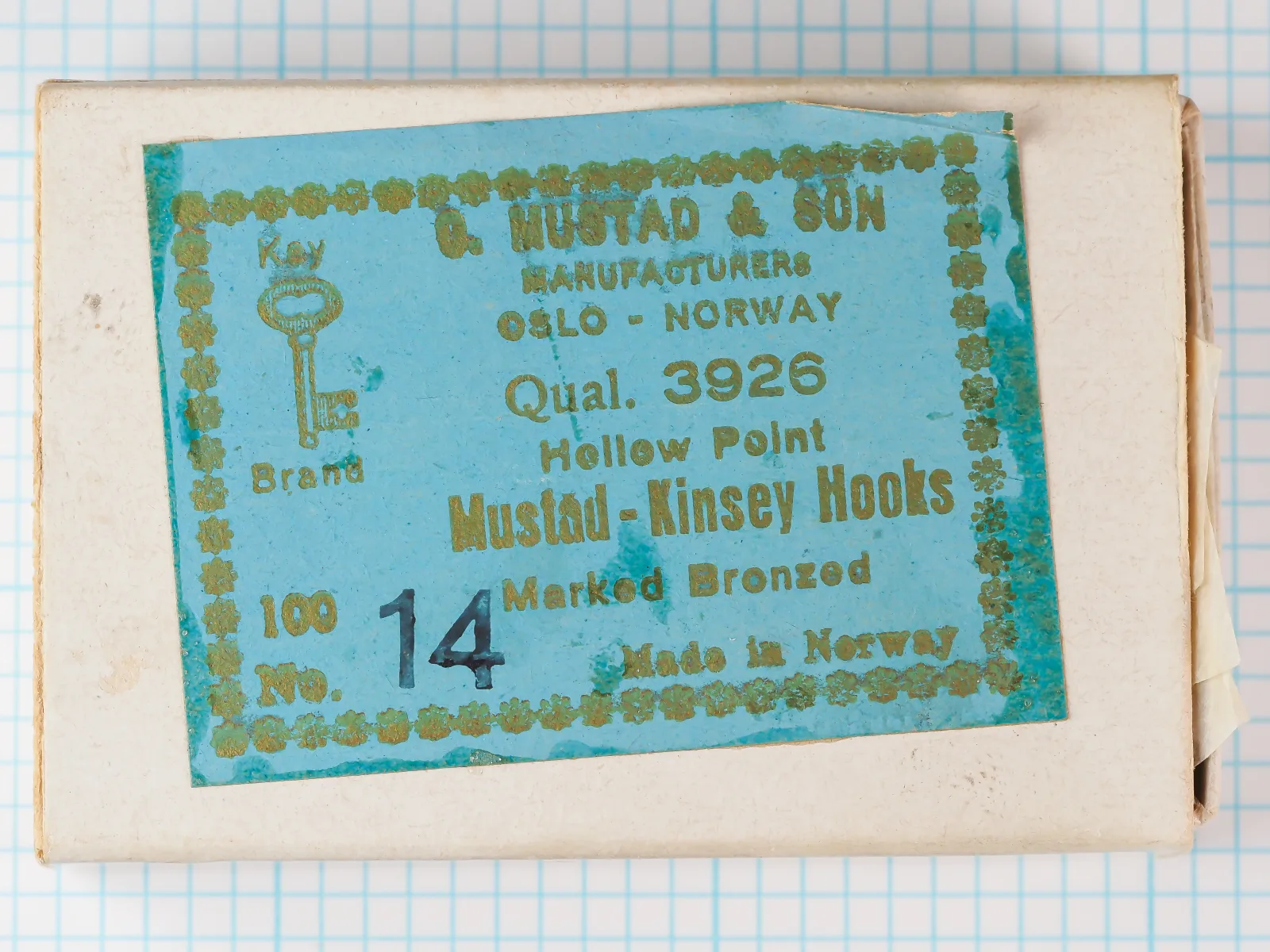
Original Mustad factory box for the Kinsey Hooks Qual. 3926, size 14, bronzed marked blind-eye hooks. The eight-line label in golden-brown offset print includes the Key Brand logo, Oslo address, and complete technical specification per Mustad's standardized labeling format.
Photographic record
4 cataloged imagesSelect any record to load it above.
4 images shown
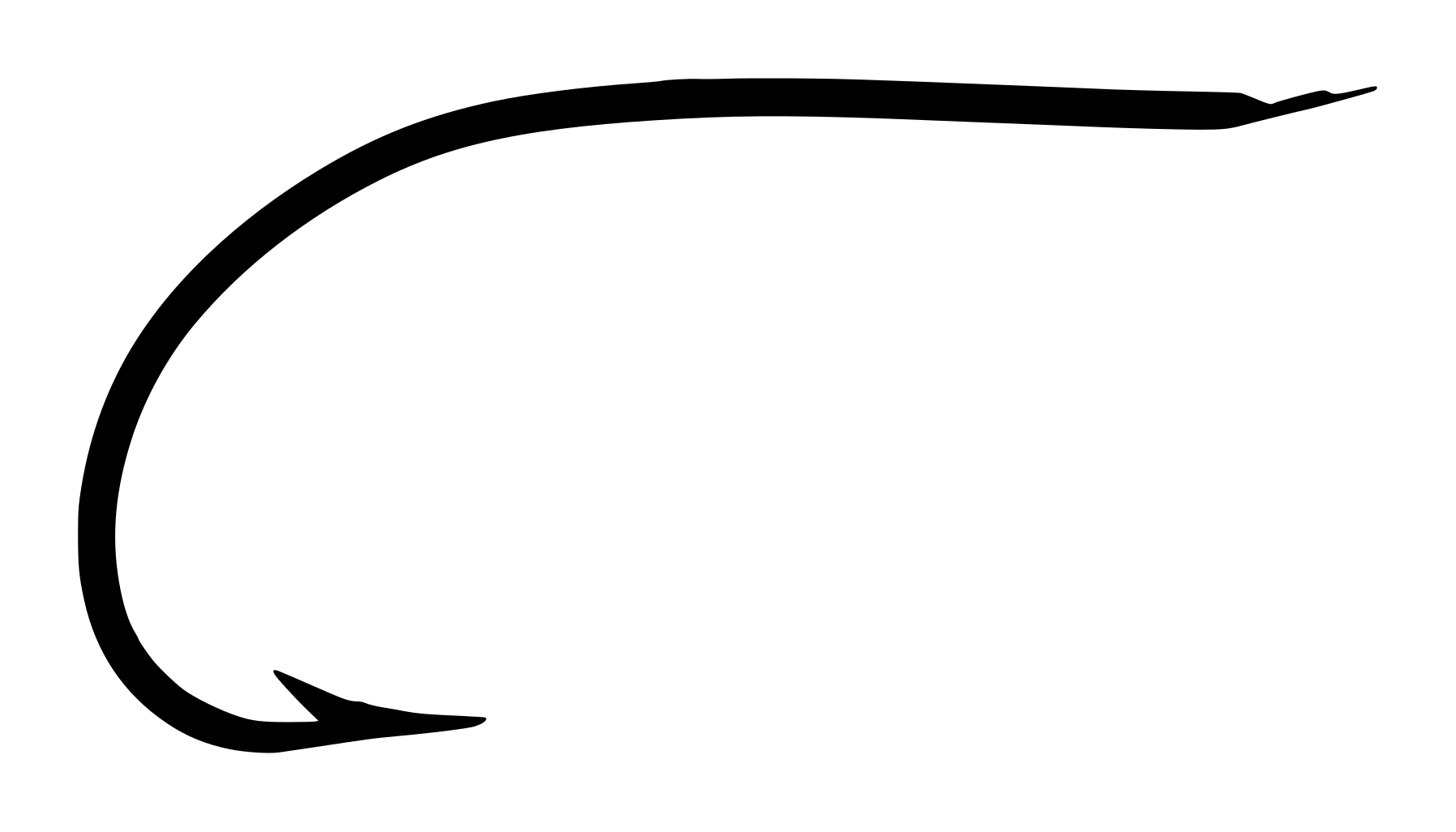
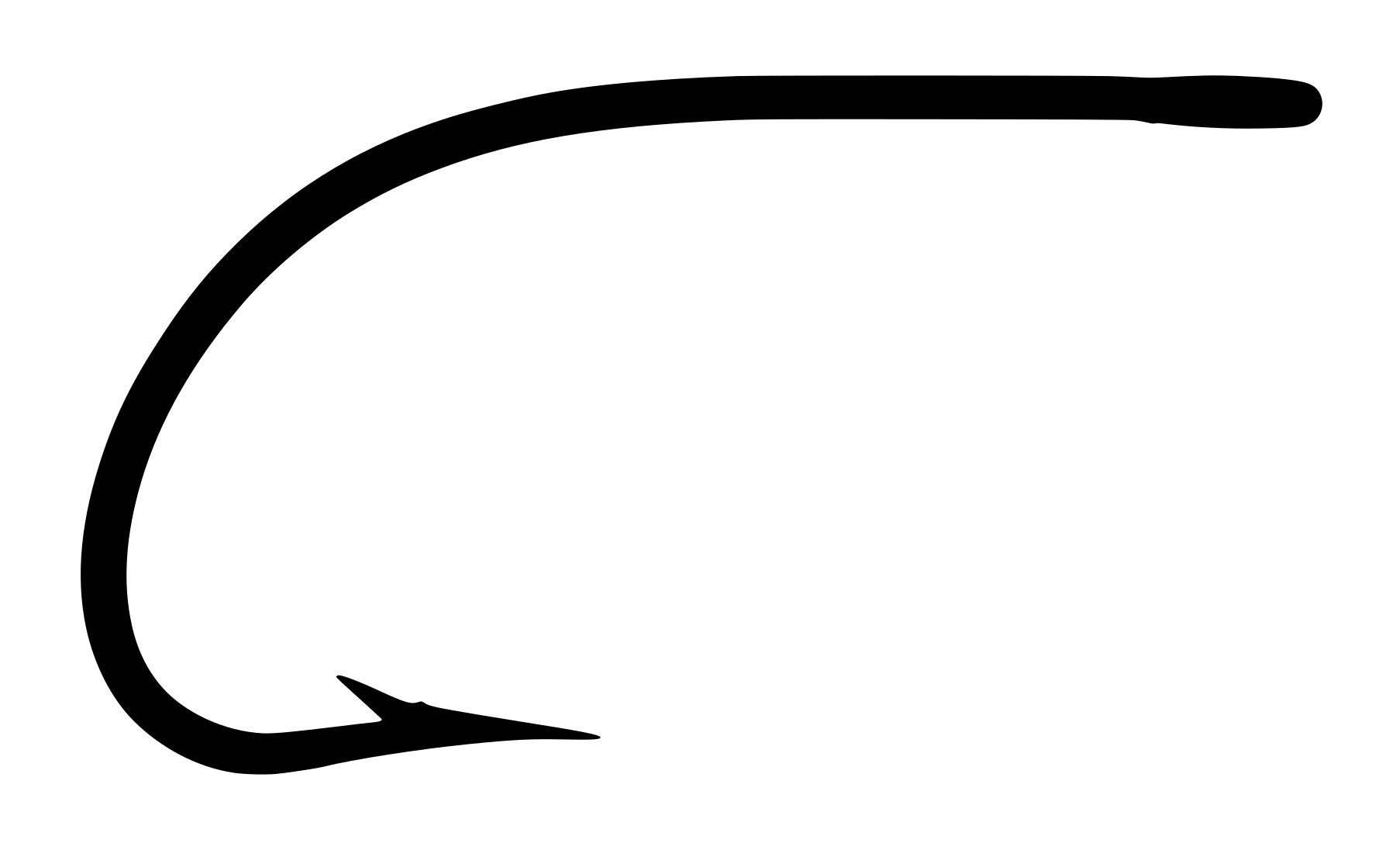
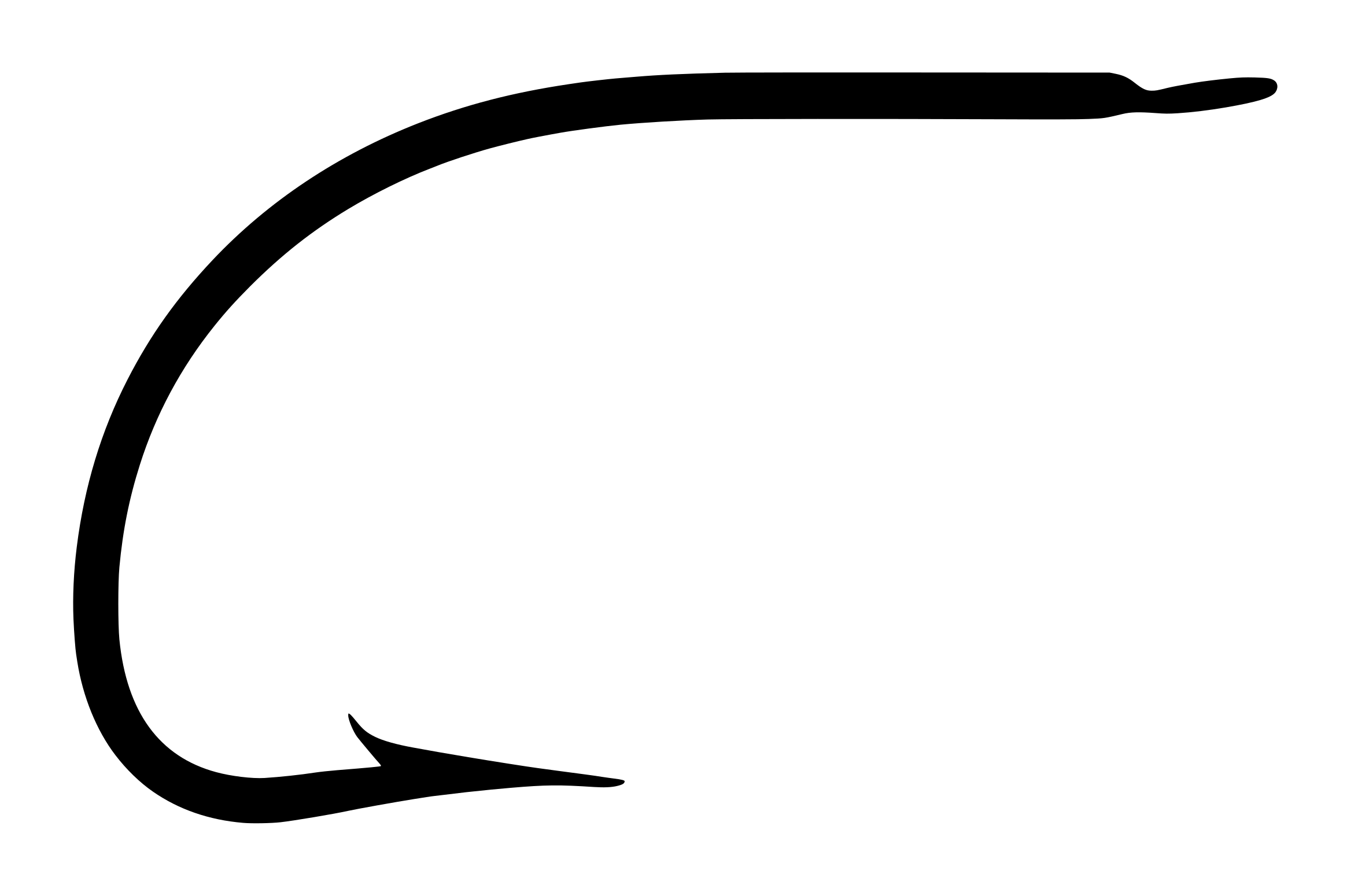
Mustad 3926 Kinsey Hook Size 14 Factory Box LabelOriginal Mustad factory box for the Kinsey Hooks Qual. 3926, size 14, bronzed marked blind-eye hooks. The eight-line label in golden-brown offset print includes the Key Brand logo, Oslo address, and complete technical specification per Mustad's standardized labeling format.Open originalMustad 3926 Kinsey Hook Size 14 Point DetailMacro detail of the hook point on a Mustad 3926 Kinsey size 14, showing the characteristic concave hollow-point geometry with sharp inner taper and close-cut barb. The inwardly curved silhouette creates a knife-edge effect for rapid penetration with minimal force.Open originalMustad 3926 Kinsey Hook Size 14 Full ProfileFull side profile of a Mustad 3926 Kinsey Hook, size 14, showing the wide-gape round bend with pronounced depth, the marked (roughened) shank texture, and the blind flatted eye end. The bronzed finish is visible across the entire hook.Open originalMustad 3926 Kinsey Hooks Size 14 Batch ConsistencyComparative view of two Mustad 3926 Kinsey Hooks, size 14, positioned to show consistency in bend profile, point geometry, and bronzed finish across individual hooks from the same production batch. The marked shank texture and hollow-point profile are uniform.Open original
Technical profile
Mustad Quality 3926 Kinsey Hooks, size 14, blind eye with marked shank, hollow point, bronzed finish, 100-hook box.
Eye
Blind — Marked Shank
Wire
Extra-Fine, Round
Shank
Short (1X–2X Short) — Marked / Ridged
Bend
Wide gapKinsey bend is a wide-gape round bend with a subtle lateral offset, geometrically intermediate between a standard Sproat and a light Kirby offset. P The bend depth (~0.32") is notably pronounced relative to the gap width (~0.41"), creating a deeply curved geometry optimized for live-bait presentations. The wire set at the bottom is clean and symmetrical, with no visible flattening or forging. I This geometry was specifically engineered for 'staying power' — the angle of the point relative to the shank axis made it mechanically difficult for soft-mouthed fish to shake free once the barb was buried.
Point
Hollow Point (concave inner face)P The barb is short, close-cut, and sharply angled. Located approximately 0.08" below the point tip, the barb creates a steep inward-facing cut rather than a rounded or swept geometry. This geometry is consistent with hollow-point design philosophy — once the ultra-sharp tip penetrates, the barb locks immediately without requiring deep insertion. No double-barb or secondary barbing visible.
Finish
Bronzed — Confirmed (stated on packaging)P Bronzed finish displays a warm, brownish-gold tone with slight surface texture visible under magnification, suggesting alkyd-based lacquer application rather than heat-based chemical browning. No significant corrosion, oxidation, or patina loss on specimen examined. Finish remains uniform across the shank and bend; slight wear at the bend apex consistent with manufacturing or handling, not use-related damage. Color temperature is distinctly warm — mid-brown with subtle golden undertones — characteristic of Mustad's proprietary bronzing process.
Specimen hook shows bright bronzed finish with no corrosion or oxidation. No visible point damage, barb deformation, or wear from use. Original packaging card displays light foxing and toning consistent with 70+ years of storage; no edge damage to card. Full 100-hook count present in original box. This represents an exceptional condition example.
Hollow Point Geometry: The Kinsey’s concave hollow-point geometry creates an inwardly curved surface from tip to barb base, forming a knife-edge effect. Unlike blunt spear points that merely puncture, the hollow point presents minimal resistance during initial penetration — the ultra-fine tip parts tissue cleanly, and the rapid flare toward the barb creates a mechanical lock without tearing. This was essential for soft-mouthed species like panfish and small trout, where aggressive hook-sets would cause the barb to rip free.
Marked Shank Function: The deliberate roughening (marking) of the shank with fine striations was a direct response to the technical challenge of securing a snood — a length of soaked silkworm gut — to a blind-eye hook without any formed loop. Silk thread whipping alone, when applied to a smooth shank, would eventually slip under the load of a playing fish. The mechanical texture created by marking dramatically increased friction, allowing the angler to whip a secure snell that could withstand heavy loads. This technology is now largely obsolete but was essential when monofilament did not exist.
Bronzed Finish Composition: Mustad’s bronzed finish was an alkyd resin-based lacquer applied via spray and heat-set in an oven, not a metallic bronze alloy or a chemical browning process. This lacquer-based approach provided excellent corrosion resistance in freshwater environments and a warm, natural aesthetic that was more stealthy than bright steel or tinned finishes. The finish was durable for storage and transport but vulnerable to chipping if the hook struck rocks or was subjected to repeated impact.
The Kinsey Hook is not part of a broader named series but rather a standalone regional pattern that Mustad reverse-engineered and standardized for mass export. The Kinsey bend originated as a preferred pattern among traditional European bait fishermen, particularly in the British Isles and Scandinavia, where it was valued for its ‘staying power’ and resistance to fish shedding the hook during a fight.
Mustad’s industrial approach to hook design involved identifying successful regional patterns — the Cincinnati Bass from the American Midwest, the Limerick from Ireland, the Sproat, the Aberdeen — and producing them with extreme Norwegian manufacturing precision, thereby cornering global markets for each localized design. The Kinsey followed this strategy.
The 3926 was available in sizes ranging from 10 to 20, with bronzed and tinned finishes as the primary options. Blind-eye construction was the standard for the entire Kinsey line until the post-1960s transition toward eyed hooks. By the 1980s, the 3926 had been largely superseded by modern eyed variants and is no longer listed in current Mustad catalogs, making surviving vintage boxes genuinely scarce.
Era and Packaging Dating
Packaging displays 'Oslo – Norway' address (Oslo naming convention in place since January 1, 1925), confirming post-1925 manufacture. Key Brand logo inside ornate border is consistent with Mustad's mid-century export label design (1945–1965). No barcode present, indicating pre-1974 production. Print method is offset lithography on light card stock typical of 1950–1965 era. Hand-written price notations in pencil suggest period stock control and indicate pre-1970s origin. Lack of modernized typography or simplified label format places production before Mustad's transition to Signature Series nomenclature (post-2001).
Fun Fact
The term 'staying power,' applied to the Kinsey and other hooks with aggressive offset or pronounced bend geometry, originated in nineteenth-century British angling vernacular and referred to the hook's mechanical resistance to being thrown or shaken by a fighting fish. Traditional anglers believed that certain bend angles literally 'locked' a fish's jaw against the hook shank, preventing escape during violent head-shakes or runs. This belief, while partly intuitive rather than scientifically rigorous, drove real design choices — the Kinsey's wide gape and pronounced bottom-bend angle were specifically engineered to maximize this 'locked' sensation. Modern biomechanical analysis suggests the effect is real but subtle; the primary advantage is actually the sharp hollow point, which requires minimal penetration force and thus stays buried even in soft tissue without tearing an exit wound.
Design lineage and influence
The Kinsey bend predates Mustad’s dominance and likely originated as a regional English or Scottish pattern, possibly derived from the earlier Sproat but with a more pronounced wide gape. The exact lineage is undocumented, but the geometry shows clear influence from nineteenth-century hand-forged bait hooks designed for live minnow presentations on small rivers.
Mustad’s standardization of the Kinsey under the 3926 quality code represented their typical strategy of industrial ‘cloning’ — capturing a proven local design and producing it at scale. This approach eliminated regional variation and created a single global standard, allowing retailers and anglers worldwide to access the same proven pattern.
The Kinsey’s influence downstream is limited; modern equivalents focus on eyed hooks (Mustad 3366 Sproat in standard eyeing), and the blind-eye Kinsey construction has been almost entirely abandoned. However, the geometry survives conceptually in round-bend, wide-gape patterns like the modern Mustad 3261 Aberdeen, though with less pronounced depth.
Best matchRelated by Attribute
Computed automatically from catalog data — updated as new hooks are added.
Matches: Shank, Wire, Gap, Eye, Eye Orient. +5 moreDiffers: Point: Hollow Point vs Superior; Finish: Bronzed vs Black Japanned; Shank ratio: 71.3% vs 56.5% +1 more
Matches: Shank, Wire, Gap, Eye Orient., Point +4 moreDiffers: Eye: Blind — Marked Shank vs Blind — Flatted; Finish: Bronzed vs Black Japanned; Shank Feat.: Marked/Ridged vs Plain +3 more
Matches: Shank, Gap, Eye, Eye Orient., Point +6 moreDiffers: Bend: Other vs Aberdeen; Wire: Extra-Fine vs Heavy (1X Heavy); Shank ratio: 71.3% vs 78.0% +2 more
The Mustad 3926 Kinsey Hook in size 14 was primarily designed for small-bait fishing applications, particularly for panfish, small trout, and perch using natural baits such as earthworms, maggots, or small minnow fragments. The marked shank provided secure bait retention, while the blind eye required traditional snelling with silk or gut. The hollow point geometry enabled rapid penetration with minimal force, making it well-suited to soft-mouthed species that could easily shed standard spear-point hooks. Classic fly tyers also employ size 14 Kinsey hooks for historically authentic wet fly and streamer constructions, particularly those mimicking small nymphs and emerging insect patterns.
Not typically used for modern fly tying. Occasionally sourced by historical/restoration fly tyers recreating authentic 1950s wet-fly patterns requiring snelled construction, such as Greenwell's Glory or March Brown variations tied on period-correct hooks.
Modern eyed equivalent with wide-gape round bend and light wire, similar applications for panfish and small trout. Loss of marked shank feature and hollow-point geometry.
Contemporary Sproat with ringed eye; parabolic bend offers similar staying power but lacks the pronounced width and marked shank.
Tiemco 200R
Moderate
Modern Japanese standard wet-fly/nymph hook with forged construction and tapered eye; similar small-size applications but fundamentally different in materials and finish.
Collector notes
Rated 3.5/10 — these hooks remain widely available but size 14 in original packaging commands modest collector interest among vintage bait-fishing and snelled-fly specialists. Original boxes with complete counts are uncommon; most examples show opening and hook loss.
Reference value
$5 – $15 USD estimate
Packaging format
GW-M-001Catalog code
Positive Factors: The Mustad 3926 Kinsey represents a foundational blind-eye bait pattern from Mustad’s mid-century Oslo production era. Hooks with marked shanks and hollow points are specifically sought by collectors of traditional snelling techniques and by fly tyers recreating authentic 1950s-era wet fly patterns. Complete, unopened boxes are increasingly scarce.
Limiting Factors: These hooks were mass-produced in enormous quantities — millions of individual hooks across dozens of size variations. The 3926 line remains common in the secondary market, particularly in sizes 12-16. Collector demand is primarily academic rather than utility-driven, limiting premium pricing. Most surviving examples show significant packaging wear and incomplete hook counts (one or more hooks missing).
Size and Finish Variants: Size 14 is moderately scarce compared to the ubiquitous sizes 12 and 16. Bronzed finish is standard and most common; tinned variants command slight premiums. Boxes with hand-written size notations (indicating period stock control) add modest collector interest.
Condition Impact: Sealed or near-sealed boxes with full 100-hook count represent the high end (~$14.99). Opened boxes with 75+ hooks present and minimal card wear achieve ~$7-10. Boxes with significant loss (fewer than 50 hooks) or heavy toning drop to ~$5-6.
Packaging
Light blue-tinted card stock sales card, approximately 2.5" × 3.5", with ornate golden-brown border of repeated circular floral or geometric motifs. Eight-line typographic label in centered golden-brown ink (offset-printed). Large 'Key Brand' logo with skeleton-key graphic in upper left. Text reads: 'O. MUSTAD & SON / MANUFACTURERS / OSLO – NORWAY / Qual. 3926 / Hollow Point / Mustad–Kinsey Hooks / Marked Bronzed / 100 No. 14 / Made in Norway.' Hand-written size '14' in black ink on card face. Light foxing and toning consistent with 70+ years of storage; no barcode. Original condition indicates typical 1950s–1960s retail packaging for bulk export distribution.
Market Value Notes
Low ($5): Good condition — opened box, 50-75 hooks remaining, moderate card toning. High ($15): Excellent condition — sealed or near-sealed, complete 100-hook count, minimal wear. Premium factors: sealed packaging, complete hook count, hand-marked size notation on card, minimal corrosion. Platforms: eBay (primary); occasional tackle dealer listings. Confidence: V verified — based on 6 eBay sold listings (Apr 2025–Jun 2026), avg $7.59, range $4.99–$14.99.
Where to Find
eBay (both.com and.co.uk); occasional tackle auction houses specializing in vintage European stock; occasional dealer inventory at fly-fishing expos in UK and Scandinavia; private collections of snelling enthusiasts and vintage wet-fly tyers.
, preview full size image Vintage #3926 #16 1 Box 100pcs Mustad Kinsey Bronzed Blind Eye Fish Hooks!
$5.99
2025-01-01
Used
eBay market reference. Researcher-curated. Prices in USD. Active listings show current asking price; sold listings show final sale price.
Preservation
Storage and Preservation
Store the original box in a cool, dry location away from direct sunlight and high humidity. The bronzed lacquer finish is susceptible to patina development and minor oxidation with prolonged moisture exposure — a slight darkening or dulling of the finish is cosmetic and does not affect function or collector value. Maintain the original packaging; card condition is a primary value driver. Avoid stacking heavy objects on top of the box, which can crush the card and crack the lacquer coating.
If the box requires cleaning, use only a soft, dry cloth — never apply liquid cleaners or attempt to polish the finish. Original patina and toning are desirable to collectors as evidence of age and storage history. Keep hooks on the original card rather than transferring to loose storage; loose hooks lose the packaging premium entirely. Store away from other metals (copper, brass) to prevent galvanic corrosion or transfer of tarnish. A cool attic or basement shelf is ideal; avoid humid basements or warm attics subject to temperature cycling.
Size Note
Size Numbering and Historical Scaling
The Kinsey Hook size 14 uses Mustad’s historical numeric sizing standard, which is distinct from modern fly-hook sizing conventions. In Mustad’s pre-1970s numeric system, smaller numbers (8, 10, 12, 14, 16, 18) represent progressively smaller hooks in the small-bait category, with size 14 being optimized for panfish and small trout. This numbering is NOT directly equivalent to modern fly-hook size designations (which label sizes 16, 14, 12, 10 with inverse meaning: larger numbers = smaller hooks).
The documented size 14 specimen measures overall length ~0.81″ and gap width ~0.41″, which would classify it as a modern ‘size 14’ or ‘size 16’ by contemporary fly-hook standards, depending on the manufacturer. Anglers converting vintage Mustad stock to modern patterns should verify actual measurements rather than relying on printed size numbers, as cross-standardization is inconsistent. The Mustad reference document provided confirms that vintage regional bait hooks like the Cincinnati patterns ‘often utilized scaling metrics that differ significantly from modern, standardized fly hook gape measurements,’ making historical context essential for proper application.
Primary Source
Eight-Line Label Decryption
Source: Mustad Label Typology Document — 'The Structural Decryption of the Eight-Line Vintage Label'
The Mustad 3926 packaging exemplifies the standardized eight-line label format documented in the official Mustad labeling guide (reference 6 in the Mustad reference document). Each line serves a specific, regulated function: (1) O. MUSTAD & SON — manufacturer identity; (2) MANUFACTURERS — role in supply chain; (3) OSLO – NORWAY — geographic origin and chronological bracket (Oslo nomenclature adopted January 1, 1925); (4) Qual. 3926 — quality/product tier code; (5) Hollow Point — point geometry (Line 5 is reserved exclusively for point description); (6) Mustad–Kinsey Hooks — pattern name and geographic/regional origin; (7–8) Marked Bronzed / Made in Norway — anatomical modifications and metallurgical finish.
This rigid typographic hierarchy allowed Mustad to communicate complex technical specifications across linguistic and cultural barriers to international wholesalers, retailers, and anglers. The absence of modern product descriptors (e.g., ‘flint-resistant,’ ‘chemically sharpened’) confirms production before Mustad’s transition to Signature Series nomenclature (post-2001). The hand-written size notation (’14’ in black pencil) indicates period stock control and represents archival evidence of the box’s movement through mid-twentieth-century retail distribution.
Additional
Snelling Technique and the Blind-Eye Tradition
The Mustad 3926 Kinsey, like all blind-eye Mustad hooks from this era, represents a manufacturing philosophy rooted in nineteenth-century angling tradition: the practice of ‘snelling’ — the meticulous technique of securing a soaked length of silkworm gut (or later, nylon) directly to the hook shank using fine silk thread and waterproofed pitch.
Snelling required no formed eye and offered anglers several perceived advantages: (a) the attachment could be customized in length and diameter to match the specific bait and target species; (b) the knot could be positioned at the exact angle desired by the tyer; (c) some anglers believed that a snelled presentation was more ‘natural’ and less visible to fish than a stiff wire eye. The marked shank on the 3926 was a direct engineering response to the technical challenge of securing the snood without slippage — the mechanical texture increased friction on the silk thread, allowing secure lashing under tension.
Even as eyed hooks became standard in the 1960s–1970s, conservative anglers in Europe and parts of North America continued to prefer snelled hooks for traditional wet-fly and small-bait presentations. Mustad continued producing blind-eye variants well into the 1980s to serve this persistent market segment. Today, the snelling tradition survives among historical fly tyers and in specialized contexts (Atlantic salmon fishing with traditional methods), but the Mustad 3926 Kinsey represents the final industrial chapter of this nearly 150-year-old angling practice.
Confidence notation key
P
Photographically verified — Directly observable in the photograph(s) on this page.
V
Verified by documentation — Confirmed by manufacturer catalog, spec sheet, or published reference.
I
Inferred — A logical deduction from observable or documented evidence, not directly stated.
E
Estimated — An approximation based on visual comparison, proportional analysis, or limited data.
S
Speculative — A reasoned hypothesis that cannot be confirmed from available evidence.
Unnotated claims are the compiler’s synthesis; see Sources. All photographs on garrenwood.com are taken on a measurement grid where each square equals 1/10 inch (0.1″ / 2.54 mm).