The Mustad 3451 is a mid-century blind-eye hook representing the tail end of the silkworm-gut era (c. 1930s–1950s). Manufactured by O. Mustad & Søn in Norway (Oslo sales office) and distributed globally under the Key Brand trademark, this model exemplifies Mustad’s strategy of industrial ‘cloning’—reverse-engineering the regional American Kinsey pattern and mass-producing it for North American and export markets. The Superior point geometry and marked (ridged) shank were hallmarks of Mustad’s mid-tier (Qual. 3000–3999) quality tier, designed for tough working conditions in commercial and sport bait fishing.
The Kinsey bend is a sidewashed (offset) pattern favored by West Coast anglers for its aggressive hook-up geometry. The marked shank provided crucial mechanical grip for silk whipping, preventing snell slippage under load—a problem that plagued cheaper blind-eye alternatives. The Rustproof finish indicates this hook was designed for both freshwater and saltwater applications. The blind-eye construction, while innovative for its era, became obsolete as monofilament line and ringed-eye hooks became standard in the 1950s–1960s.
Collectability is moderate. The Kinsey pattern has regional American significance, the original packaging with legible eight-line label adds value, and the marked shank represents noteworthy technical engineering. However, supply is moderate (not scarce like premium dry-fly hooks), and blind-eye construction has minimal practical use for modern anglers. Specimens with intact original packaging command $12–18 on the collector market; loose hooks or damaged boxes fetch $5–10.
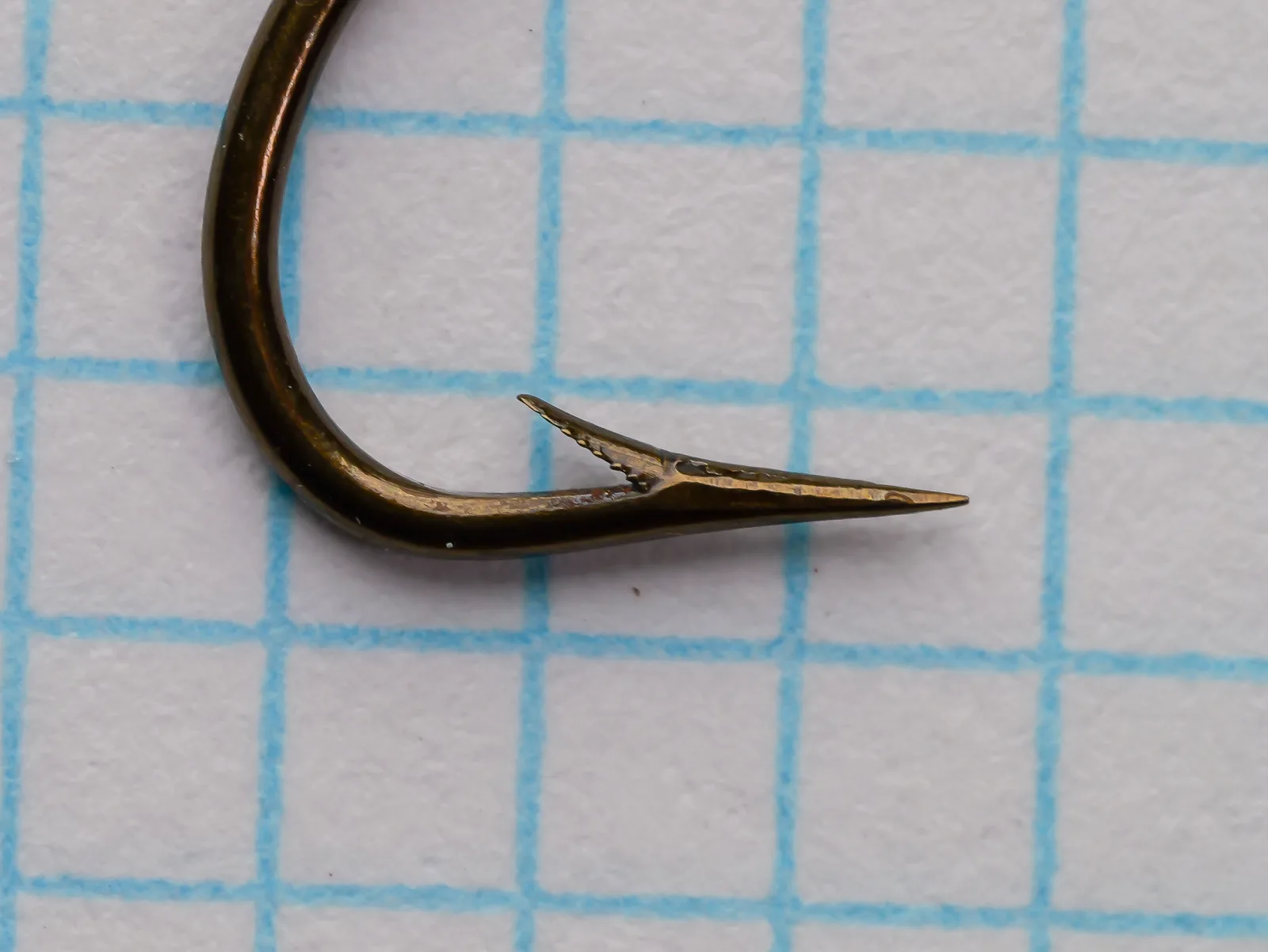
Side profile of the Mustad 3451 showing the Superior point geometry and fine barb placement, photographed on 1/10-inch measurement grid for scale.
Photographic record
3 cataloged imagesSelect any record to load it above.
3 images shown
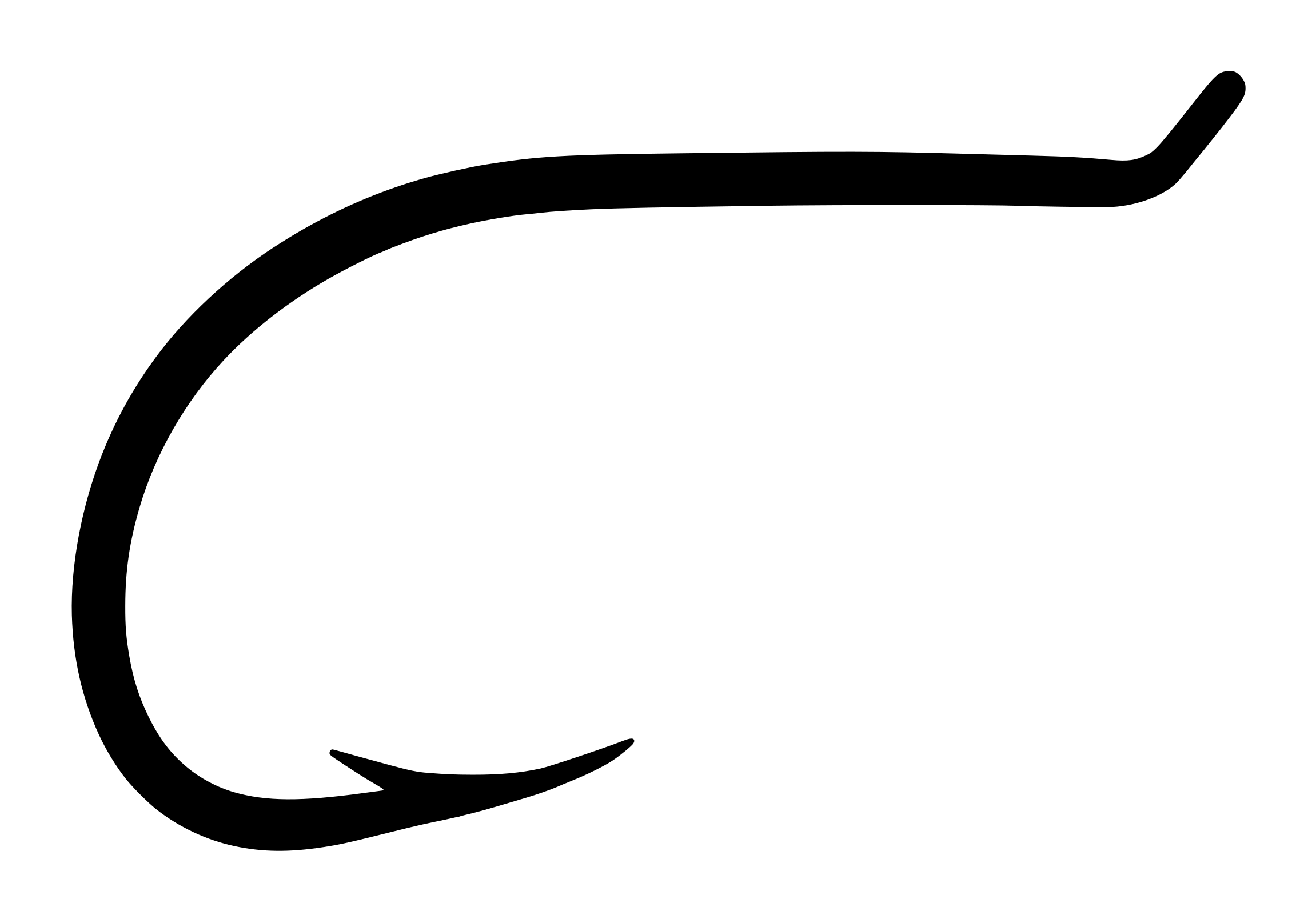
Mustad 3451 Kinsey Hook Size 1/0 Superior PointSide profile of the Mustad 3451 showing the Superior point geometry and fine barb placement, photographed on 1/10-inch measurement grid for scale.Open originalMustad 3451 Kinsey Hook Full Profile Marked ShankFull profile view of the Mustad 3451 showing the marked (ridged) shank, Kinsey bend offset, and blind (eyeless) end on measurement grid.Open originalMustad 3451 Original Box Label Complete TextComplete original packaging label for the Mustad 3451, showing the full eight-line typographic format, Key Brand logo, and all technical descriptors (Superior, Mustad-Kinsey Hooks, Marked, Rustproof, Made in Norway).Open original
Technical profile
Eye
Blind — Marked Shank
Wire
Standard, Round, Est. ~0.045–0.055" (~1.1–1.4 mm) E
Shank
Short (1X–2X Short) — Marked / Ridged
Bend
Wide gapKinsey bend — a sidewashed (offset) pattern with a distinct corner rather than a smooth round curve. Lateral offset characteristic of the American Kinsey regional pattern. P
Point
Superior (near-straight inner taper)Superior point with near-straight inner taper. Visible on the specimen as a fine, durable geometry suitable for general-purpose bait fishing. P
Finish
Bronzed — Inferred (photographically likely)Rustproof finish - Wire shows a warm, golden-bronze tone consistent with period tin plating. P
The Superior point geometry concentrates penetration force at the tip while maintaining structural durability—a balanced design avoiding the delicate tissue trauma of a hollow point and the blunt-force requirement of a spear point. The marked shank represents a pre-adhesive mechanical solution: machine-cut grooves running longitudinally along the wire provided micro-grip for silk whipping thread, eliminating knot slippage under dynamic load. The heavy wire gauge and forged construction (if present) would provide exceptional holding power during protracted battles with strong fish. The Rustproof finish—likely a tin electroplate—was essential for commercial fisheries and harsh saltwater conditions where standard blued steel would corrode rapidly.
The Mustad 3451 appears to be one of the earliest documented examples of the Kinsey pattern in the garrenwood.com catalog with complete original packaging and a legible Oslo-address label. The marked shank feature and blind-eye construction represent the tail end of the pre-monofilament era (c. 1925–1950).
Own this hook? Help us measure it.
We have measurements for sizes 15, 14. Know any others? Submit calipered measurements and we'll review and add them. Thank you!
The Kinsey pattern, while manufactured by Mustad under the Qual. 3451 designation, originated as a regional American design favored by West Coast blacksmiths and anglers. The pattern is characterized by a sidewashed (offset) bend with a distinct corner, designed to improve hook-up ratios by preventing the hook from laying flat in the fish’s mouth. Mustad’s strategy of industrial ‘cloning’ or reverse-engineering regional patterns allowed them to capture localized markets globally. The 3451 was produced in enormous quantities for the commercial and sport bait-fishing markets, particularly during the 1930s–1950s. The blind-eye construction was the standard for the era, as fishing lines consisted of braided horsehair, silkworm gut snoods, or braided silk—none of which could tolerate the abrading action of a formed eye loop. The marked (ridged) shank was a signature Mustad feature, providing mechanical grip for silk whipping. By the 1950s–1960s, as monofilament line became dominant and eyed hooks became the norm, demand for blind-eye patterns like the 3451 collapsed. The pattern was gradually superseded by ringed-eye variants and newer bend designs. Today, the 3451 survives in historical collections and specialist tackle archives, marking the transition from the gut-line era to modern synthetic materials.
Era and Packaging Dating
Oslo address on label (Christiania was renamed to Oslo on January 1, 1925) indicates production post-1925. The Key Brand typography, orange label stock, snowflake border design, and eight-line format are characteristic of Mustad's mid-century export packaging. The Kinsey pattern was popular in North America during the 1930s–1950s. Blind-eye construction was standard through the 1940s–1950s before the transition to eyed hooks and monofilament line. No barcode present (barcode era began c. 1974), consistent with pre-1960 vintage status.
The Groove that Saved the Catch
The marked (ridged) shank on the 3451 was a point of genuine pride in Mustad's marketing. Before reliable waterproof adhesives existed, anglers risked losing an entire rigged hook—line, leader, and all—if the silk snell slipped off the smooth shank under heavy load. Mustad's tiny machine-cut grooves solved this problem mechanically, making their hooks the go-to standard for commercial fisheries in North America and Europe. A fisherman who lost a hook to snell slippage would abandon it in disgust; a Mustad with a marked shank became a selling point in catalogs as 'the hook that stays put.'
Design lineage and influence
The Kinsey bend originated as a regional American pattern, particularly in California and the Western United States, where anglers favored the sidewashed offset for improved hook-up ratios. Mustad’s industrial cloning strategy allowed them to capture this localized American market by mass-producing the Kinsey pattern for global export. The Superior point and marked shank reflect Mustad’s mid-tier quality tier (Qual. 3000–3999 range), positioning the 3451 as a workhorse hook rather than a premium specialty pattern. The transition from blind-eye to ringed-eye hooks in the 1950s–1960s rendered the 3451 obsolete for most anglers, though the pattern survives in limited form in modern Mustad catalogs.
Best matchRelated by Attribute
Computed automatically from catalog data — updated as new hooks are added.
Matches: Shank, Gap, Eye, Eye Orient., Point +4 moreDiffers: Wire: Standard vs Extra-Fine; Finish: Bronzed vs Black Japanned; Application: Bait, Saltwater vs Bait
Matches: Shank, Gap, Eye, Eye Orient., Finish +4 moreDiffers: Wire: Standard vs Extra-Fine; Point: Superior vs Hollow Point; Application: Bait, Saltwater vs Bait
Matches: Shank, Wire, Gap, Eye, Eye Orient. +5 moreDiffers: Bend: Other vs Round / Kendal; Point: Superior vs Standard / Spear; Finish: Bronzed vs Blued
Matches: Gap, Eye Orient., Point, Offset, Application +1 moreDiffers: Shank: Short (1X–2X Short) vs Standard; Wire: Standard vs Heavy (1X Heavy); Eye: Blind — Marked Shank vs Blind — Flatted +3 more
Matches: Shank, Gap, Eye, Eye Orient., Finish +4 moreDiffers: Bend: Other vs Aberdeen; Wire: Standard vs Heavy (1X Heavy); Point: Superior vs Hollow Point +1 more
The Mustad 3451 Kinsey was designed as a general-purpose bait hook for both freshwater and light saltwater applications. The blind eye required a snell of silkworm gut or braided silk line to be whipped directly to the shank—a labor-intensive but extremely strong connection. The marked (ridged) shank provided mechanical grip for the silk whipping thread, preventing slippage under the strain of heavy fish. Historically favored by commercial and sport bait anglers targeting bass, walleye, pike, and medium saltwater species during the pre-monofilament era.
Secondary Applications
Live bait rigging, still fishing with mullet or live herring in coastal waters, traditional snelled-line applications.
Classic Fly Patterns
Named patterns specifically associated with this hook. Leave blank if none formally documented. Do not speculate — only include patterns with a confirmed association.
Modern Equivalents
Hook
Match Quality
Notes
Mustad 3366
Moderate
Standard Sproat pattern, ringed eye, similar quality tier but no marked shank or Kinsey offset.
Mustad 92641
Moderate
Beak pattern with marked shank, but reversed offset and ringed eye rather than blind eye.
Partridge CS10/1
Good
Redditch salmon hook with looped eye and marked shank; offers closest traditional blind-eye aesthetic for snelling.
Collector notes
The 3451 represents a pivotal transitional design at the end of the blind-eye era. Its Kinsey pattern, Mustad lineage, and marked shank construction appeal to both regional American fishing historians and vintage tackle collectors. Supply is moderate; not as scarce as premium dry-fly hooks but less common than standard Sproat patterns.
Reference value
$8 – $18 USD estimate
Packaging condition
Good — moderate wear, legibleRecorded specimen
Packaging format
GW-E-04Catalog code
Positive factors: Regional American pattern (Kinsey) with historical significance in California and Western U.S. bait fishing; Mustad manufacturing with Key Brand provenance; blind-eye construction marks the pre-monofilament era; marked shank is a notable technical feature; Oslo-address dating (post-1925) is reliable; complete original packaging with legible eight-line label adds substantial value; Superior point geometry shows Mustad’s quality-tier engineering.
Limiting factors: Not a premium specialty hook (Qual. 3000–3999 tier is workaday quality, not ultra-fine); Kinsey pattern is less iconic than Sproat or Limerick; blind-eye construction has minimal practical use for modern anglers; size is ambiguous on this specimen (label blank or faded); no fly-tying association (bait hook market is smaller than fly market); condition of packaging shows age-appropriate wear, not pristine mint.
Packaging
Vintage cardboard box label, 1930s–1950s era. Orange-gold background with black text and decorative snowflake border. Key Brand logo prominently displayed in upper left. Eight-line typographic format per Mustad standard: manufacturer (O. MUSTAD & SÖN), role (MANUFACTURERS), origin (OSLO - NORWAY), quality code (Qual. 3451), point descriptor (Superior), pattern name (Mustad-Kinsey Hooks), shank feature (Marked), finish (Rustproof), and origin note (Made in Norway). Quantity marked as 100 No. Size field blank or faded. Light toning and slight edge wear consistent with age.
Market Value Notes
Typical eBay sales of similar Mustad blind-eye cards (100-hook boxes) range $8–18 USD depending on condition and pattern rarity. Premium pricing ($20+) occurs for mint-condition boxes with pristine labels and rare regional patterns. The 3451 occupies the middle range: collectable but not scarce. Marked-shank feature and Kinsey pattern add modest premium over generic Sproat blinds.
Where to Find
eBay (vintage tackle category), specialist fishing antique dealers, tackle shows and collector fairs, estate sales in Western U.S. (particularly California), occasional online auctions of old tackle collections.
Preservation
Storage and Preservation
Store the original box label and any remaining hooks in a cool, dry environment away from direct sunlight and moisture. The Rustproof tin or galvanized finish is relatively durable compared to blued steel, but prolonged humidity exposure will accelerate any surface patina development. The cardboard label is fragile; protect it from creasing and water damage by storing the box upright in a sheltered location, ideally in an archival acid-free envelope or box. If individual hooks have been removed, keep them dry and store separately from other metals to prevent galvanic corrosion. Avoid handling the label with bare fingers, as skin oils and salts can accelerate deterioration. For display purposes, the original packaging adds significant collector value—keep the box intact rather than extracting loose hooks. If restoration is needed, consult a vintage tackle specialist; aggressive cleaning can damage both the hook’s finish and the label’s historical patina.
Primary Source
Decoding the Eight-Line Label
Source: Mustad 3451 Original Box Label, c. 1930s–1950s
Line 1: O. MUSTAD & SÖN — The full, unabbreviated manufacturer name establishes corporate authority and direct origin from the primary maker (not a distributor or jobber).
Line 2: MANUFACTURERS — This distinction was historically crucial. Many import agents and regional distributors repackaged bulk hooks under secondary brand names. By cementing their role as manufacturers, Mustad ensured direct brand loyalty from end-users regardless of distribution network.
Line 3: OSLO – NORWAY — The Oslo address is a critical dating tool. Oslo was officially renamed from Christiania on January 1, 1925. All Mustad boxes bearing ‘Oslo’ can be conclusively dated to post-1925 production. (Boxes marked ‘Christiania’ are definitively pre-1925 antiques.) The Norwegian origin signals industrial efficiency and the company’s global market dominance.
Line 4: Qual. 3451 — The quality code places this hook in Mustad’s mid-tier category (Qual. 3000–3999), representing standard manufacturing tolerances and working-class fishing rather than premium specialty. The specific code 3451 identifies the Kinsey pattern variant.
Line 5: Superior — This designates the point type as Superior Point—a near-straight inner taper that balances penetration with durability, suitable for general-purpose bait fishing across multiple species and conditions.
Line 6: Mustad-Kinsey Hooks — The pattern name identifies this as the Kinsey bend, a regional American design that Mustad industrially cloned for mass production and global export.
Line 7: Marked — ‘Marked’ refers to the machine-cut ridges or grooves running longitudinally on the shank. This feature provided mechanical grip for silk whipping thread, preventing the snell from slipping under load—a pre-adhesive solution to a critical functional problem.
Line 8: Rustproof — The finish is a specialized tin or galvanized coating, not the standard blued or bright finish. Rustproof coating was essential for commercial fisheries and saltwater applications where standard steel would corrode rapidly.
Bottom left: 100 No. — Standard retail/wholesale box quantity is 100 hooks per box. Size field is blank or faded on this specimen.
Size Note
Size Field Ambiguity
The size field on the original label of this specimen is either blank or severely faded, preventing direct documentation of the original packaging size. Based on grid measurement of the hook itself (estimated overall length ~1.90–2.0 inches, gap ~0.55–0.65 inches), the hook appears consistent with a Size 1/0 or possibly Size 1 by period standards. However, vintage hook sizing systems, particularly in regional bait hooks like the Kinsey pattern, often utilized scaling metrics that differ significantly from modern standardized fly-hook gape measurements. The Cincinnati and Kinsey patterns, in particular, followed American regional scaling conventions that were not directly equivalent to British (Redditch) sizing. Without a clear size notation on the label, collectors should rely on physical measurement and comparison with known reference examples. A Size 1/0 designation would have been typical for a general-purpose bait hook of this era, suitable for bass, walleye, and light saltwater species.
Additional
The Snelling Tradition and Blind-Eye Construction
The blind (eyeless) end of the 3451 reflects a now-obsolete fishing tradition: the snell. A snell is a short length of line (traditionally silkworm gut, later braided silk or nylon monofilament) whipped or lashed directly to the hook shank using fine thread and pitch or wax. The angler would tie the snell to their main line or leader using a blood knot or other terminal knot. This construction method offered several advantages in the pre-monofilament era: the gut or silk snoods had slightly different elasticity and handling characteristics than horsehair or braided line, and the snell allowed the hook to be stored separately and attached only when needed. The marked shank on the 3451 was Mustad’s mechanical solution to keep the whipped silk from slipping: the tiny grooves or ridges provided friction and micro-grip. Anglers considered a ‘marked’ shank a premium feature—its absence on cheaper hooks was a known weakness. By the 1960s, as monofilament casting line became standard and anglers learned to tie knots directly onto ring eyes, the blind-eye hook became a relic. The Mustad 3451, once a commercial standard, vanished from retailers’ shelves, surviving only in the tackle boxes of old-time anglers and, eventually, in the collections of vintage fishing historians.
Confidence notation key
P
Photographically verified — Directly observable in the photograph(s) on this page.
V
Verified by documentation — Confirmed by manufacturer catalog, spec sheet, or published reference.
I
Inferred — A logical deduction from observable or documented evidence, not directly stated.
E
Estimated — An approximation based on visual comparison, proportional analysis, or limited data.
S
Speculative — A reasoned hypothesis that cannot be confirmed from available evidence.
Unnotated claims are the compiler’s synthesis; see Sources. All photographs on garrenwood.com are taken on a measurement grid where each square equals 1/10 inch (0.1″ / 2.54 mm).