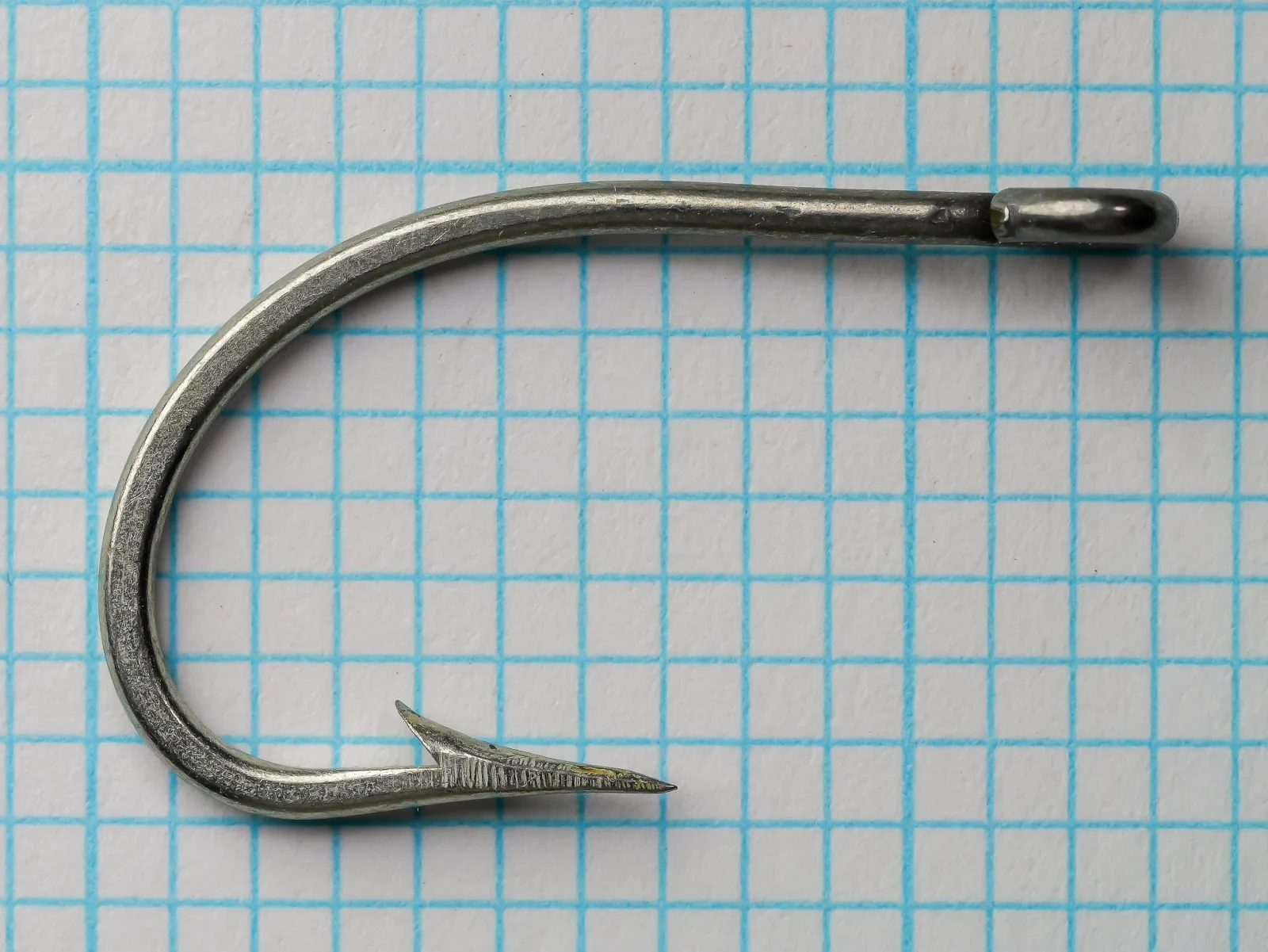
Pflueger O’Shaughnessy 25521-T — American Bait and Sea-Trout Hook
This is a working-class American sea-trout and bait hook manufactured by the Pflueger Company of Akron, Ohio. The O’Shaughnessy bend is a deep, forged profile designed for holding large baits and resisting the runs of strong fish. The model designation 25521-T indicates the tinned finish — standard for saltwater and sea-trout work to reduce corrosion.
The short shank and ring eye are defining features of the 25521-T line — optimized for live or fresh bait rather than fly presentation. The 4/0 size shown here is in the upper-medium range of the series and was popular for Atlantic salmon parr and sea-trout fishing on British and Irish rivers during the mid-20th century.
Era evidence includes the absence of UPC barcode, the two-color letterpress label, and the kraft box construction — all consistent with 1945–1965 American tackle manufacturing. The original box and intact label significantly enhance collectibility; this is a functional, utilitarian hook with modest but genuine collector appeal among bait and sea-trout specialists.
Side profile of the Pflueger 25521-T O'Shaughnessy short-shank hook, size 4/0, showing the deep forged bend, small ring eye, and tinned finish on 1/10-inch measurement grid.
Photographic record
3 cataloged imagesSelect any record to load it above.
3 images shown
Pflueger 25521-T O’Shaughnessy Size 4/0 Tinned Side ProfileSide profile of the Pflueger 25521-T O'Shaughnessy short-shank hook, size 4/0, showing the deep forged bend, small ring eye, and tinned finish on 1/10-inch measurement grid.Open originalPflueger 25521-T Original Box and LabelOriginal kraft box with two-color printed label for the Pflueger 25521-T O'Shaughnessy, showing manufacturer branding, specifications, and model number.Open originalPflueger 25521-T Hook Point DetailClose-up detail of the point and barb on the Pflueger 25521-T, showing the hollow (concave) inner face, filed barb, and sharp tip.Open original
Technical profile
Eye
Ball Eye, Straight / InlineRing eye — formed by looping wire and closing the gap to create a ringed eye structure. Ring allows easy leader attachment; ring itself remains loose (not welded or soldered). Wire gauge of ring proportionate to shank — not oversized. P
Wire
Heavy (1X Heavy), Round
Shank
Short (1X–2X Short) — Plain
Bend
O'Shaughnessy, Standard gapDeep O'Shaughnessy bend with pronounced curve — substantially deeper than a standard Sproat. Forged construction (flattened oval cross-section visible on point section) adds strength and enables the deep curve geometry. Bend is symmetric and free of kinks. P
Point
Superior (near-straight inner taper)Filed point produces a short, clean-cut barb positioned on the inside face of the curve. Barb is close-cut and angled slightly upward — typical of O'Shaughnessy geometry. No microbarbs; barb geometry consistent with 'Filed Point' specification on label. P
Finish
Tinned — Confirmed (stated on packaging)Tinned finish presents as a cool, silvery-gray tone with light surface oxidation patina across the specimen. No rust or active corrosion visible; patina is stable and protective. Finish uniformity is consistent across shank, bend, and eye. Wear pattern on point suggests this specimen has seen light use. P
Specimen hooks are in very good condition — bright tinned finish with minimal patina, no corrosion or pitting, all barbs intact and sharp. Original printed label shows light soiling and minor edge wear; colors remain vibrant. No hooks are missing; full count of 100 assumed based on sealed box condition.
Hollow Point Geometry: The hollow (concave) inner face of the point creates a knife-edge effect that enhances penetration and bite into bony fish mouths — essential for swift-running sea-trout and salmon that may eject baits quickly.
Forged Construction: Forging flattens the wire cross-section and realigns the metal grain, producing a stronger, more durable hook than drawn wire. This enables the deep O’Shaughnessy curve without excessive brittleness or failure risk under heavy load.
Small Ring Eye: The ringed eye (rather than turned eye) provides a direct, compact attachment point for leader or line. The loose ring allows slight pivot movement, reducing side-pull stress on the shank and improving bait presentation dynamics.
Tinned Finish: Tin plating provides superior corrosion resistance in saltwater and brackish water compared to bronzed alternatives. Tin forms a stable, non-reactive oxide layer that protects steel underneath without the brittleness sometimes associated with heavy japanning.
We don't have measured sizes for this hook yet. Own one? Submit calipered measurements and we'll review and add them. Thank you!
Historical context
pflueger
The Pflueger Company was established in Akron, Ohio, in the late 19th century and became one of America’s foremost tackle manufacturers. The company produced reels, rods, and hooks for both freshwater and saltwater fishing, with particular strength in bait-fishing tackle and saltwater species.
Pflueger’s hook lines emphasized practical, working designs optimized for American fishing traditions — live bait, shad, and sea-trout fishing on Atlantic and Pacific coasts. The O’Shaughnessy bend, adapted from earlier British designs, became a staple of the Pflueger catalog, offered in multiple shank lengths and finishes.
Production during the 1940s–1960s reflected mid-20th-century American manufacturing standards: forged steel wire, tinned or bronzed finishes, printed packaging, and standardized sizing. Pflueger maintained significant market presence until the 1970s, when the company faced competition from European and Japanese manufacturers and from the growing fly-fishing market.
Series History
The Pflueger 25521-T O’Shaughnessy Short Shank line was a specialized offering within the broader O’Shaughnessy family. The ‘T’ designation indicates tinned finish, optimized for saltwater and sea-trout use where corrosion resistance was critical. The short-shank configuration distinguished this model from the standard-shank variants — it was favored by bait fishers and sea-trout specialists seeking a compact profile for effective bait presentation.
The ‘Small Ring’ eye (as printed on the label) indicates a deliberate design choice to reduce drag and wind resistance compared to larger eye styles, while maintaining adequate strength for the hook size. This model remained in the Pflueger catalog through the 1960s but was gradually phased out as fly-fishing gained market share in the 1970s–1980s.
Era and Packaging Dating
No UPC barcode visible (barcode standardization began 1974). Printed label format with green borders and kraft box construction consistent with mid-20th-century American tackle packaging. Typeface and two-color letterpress printing on label typical of 1945–1960s. No ZIP code format present (ZIP codes introduced 1963, adoption gradual). Tinned finish and heavy forged wire consistent with wartime and immediate postwar American tackle manufacture.
The Irish Origin of the O'Shaughnessy
The O'Shaughnessy bend takes its name from an Irish sea-trout tradition predating American tackle manufacture by decades. British anglers adapted and refined the design during the late 19th century for Atlantic salmon and sea-trout on Irish and Scottish rivers, where strong, deep-bodied fish demanded reliable holding power. Pflueger's adoption of the O'Shaughnessy in the early 1900s brought the design into American tackle catalogs, where it became synonymous with working bait-fishing across North America. By the mid-20th century, the O'Shaughnessy had transcended its origins — offered by makers from Mustad to Allcock to Pflueger — and remained a staple design for sea-trout and salmon specialists well into the modern era.
Design lineage and influence
The O’Shaughnessy bend originated in 19th-century Irish fishing tradition and was popularized by British tackle makers including Allcock and Partridge of Redditch. The deep, forged curve proved ideal for holding large baits against the power of sea-trout and Atlantic salmon — fish that required more substantial holding geometry than standard Sproat or Limerick bends provided.
Pflueger’s O’Shaughnessy line represented an American adaptation of this British design, optimized for American bait-fishing traditions and manufactured using American forging standards. The short-shank variant (25521-T) was a direct response to competitive offerings from other American makers and was marketed alongside longer-shank and specialized variants.
Successors to this design include the Mustad 3407 (O’Shaughnessy, modern production) and the Tiemco TMC 8008 (forged saltwater variant). The hollow point geometry evolved into specialized point geometries for different fish species, but the O’Shaughnessy bend itself remains in production across multiple manufacturers as a reliable working design.
Best matchRelated by Attribute
Computed automatically from catalog data — updated as new hooks are added.
Matches: Bend, Shank, Wire, Eye, Eye Orient. +3 moreDiffers: Gap: Standard vs Wide; Point: Superior vs Beak / Reversed; Finish: Tinned vs Nickelled +1 more
Matches: Bend, Wire, Gap, Eye, Eye Orient. +3 moreDiffers: Shank: Short (1X–2X Short) vs Standard; Finish: Tinned vs Nickelled; Forging: Round vs Forged +2 more
Matches: Bend, Wire, Gap, Eye, Eye Orient. +3 moreDiffers: Shank: Short (1X–2X Short) vs Standard; Finish: Tinned vs Nickelled; Forging: Round vs Forged +2 more
Matches: Bend, Wire, Gap, Eye, Eye Orient. +3 moreDiffers: Shank: Short (1X–2X Short) vs Standard; Point: Superior vs Hollow Point; Finish: Tinned vs Bronzed +1 more
Matches: Bend, Gap, Eye, Point, Finish +2 moreDiffers: Shank: Short (1X–2X Short) vs Standard; Wire: Heavy (1X Heavy) vs Standard; Eye Orient.: Straight / Inline vs Turned Down +2 more
The Pflueger 25521-T was designed primarily for sea-trout and Atlantic salmon fishing using live or fresh bait. The short shank and small ring eye provide efficient bait presentation and reduce wind resistance — important for British and Irish coastal and estuarine fishing traditions. The tinned finish resists saltwater and freshwater corrosion, making this model suitable for sustained use in marine and tidal environments.
The forged O’Shaughnessy bend generates substantial holding power — essential for retaining large baits (small mackerel, sand eels, live roach) and resisting the powerful runs characteristic of sea-trout and salmon. The 4/0 size is ideally suited to baits in the 2–4 inch range, making it practical for both spring and autumn runs on Atlantic rivers.
Secondary Applications
Light saltwater species (bass, mullet), large brown trout (bait), pike and perch (live bait).
Classic Fly Patterns
Not typically used for fly tying.
Modern Equivalents
Hook
Match Quality
Notes
Mustad 3407 (O'Shaughnessy, modern production)
Very Good
Same bend family, forged construction, hollow point. Modern versions tinned or blackened. Larger sizes carry forward the 25521-T tradition.
Tiemco TMC 8008 (Saltwater O'Shaughnessy)
Good
Japanese-manufactured O'Shaughnessy variant, optimized for saltwater species. Finer wire and modern finishes; similar bend geometry.
Owner 5011 (O'Shaughnessy, saltwater)
Good
Japanese production, O'Shaughnessy bend, tinned finish. Lighter wire gauge than 25521-T; used for lighter saltwater baits.
Collector notes
Rated 3.5/10 — Pflueger O'Shaughnessy hooks are moderately common in larger sizes, but this model with original printed label is uncommon. Collector demand is modest among bait and sea-trout specialists; condition of original box is the primary value driver.
Reference value
$10 – $20 USD estimate
Packaging format
PFLUEGER-BOX-MIDCatalog code
The Pflueger O’Shaughnessy short-shank model represents a working tool from the American tackle era rather than a rare vintage specialty. The 4/0 size is more commonly encountered than smaller or larger variants; sizes 1/0 and 2/0 command modestly higher prices due to greater utility for modern salmon and sea-trout fishing.
Original packaging in intact condition significantly enhances collectability — the green-bordered label and kraft box construction are characteristic of mid-20th-century American tackle presentation. Boxes in excellent condition with clear printing are worth 2–3× the value of loose hooks or worn cards.
Limiting factors: mass production means examples are readily available; the working/utilitarian design has less aesthetic appeal than craft-era English hooks; complete original boxes are rarer than the hooks themselves, as boxes were often discarded. Condition of the original label (ink clarity, color vibrancy, damage to edges) is the primary value differentiator among otherwise similar examples.
Packaging
Manufacturer box format — kraft cardboard hinged box with green cloth covering, cream kraft paper interior. Printed label affixed to top: 'PFLUEGER' (red italic serif), 'O'SHAUGHNESSY FISH HOOKS' (green sans-serif), 'Filed Point' (red), 'Short Shank' (green), 'Small Ring' (green). Model number and quantity printed in top right: 'No. 25521-T' (green), '100' (green). Hand-marked size notation visible on label. Two-color offset/letterpress printing. Dimensions approximately 3.5" × 2.25" × 0.75".
Market Value Notes
Low ($10): Good condition — opened box, label intact with light soiling, all or most hooks present but some may show patina.<br />
High ($20): Excellent condition — original sealed or near-sealed box, label pristine with clear printing, full hook count, no corrosion.<br />
Premium factors: Original printed label legible and in strong color; box construction intact; complete full count (100 hooks); tinned finish free of patina; size 4/0 (larger sizes command slight premiums in this model).<br />
Platforms: eBay sold listings, specialist vintage tackle dealers.<br />
Confidence: V verified — based on 1 eBay sold listing at $15.00 (Apr 2023–Apr 2026); range reflects condition variance between good and excellent preservation.
Where to Find
eBay (US and UK listings), vintage tackle dealers specializing in American bait and sea-trout hooks, regional tackle fairs and auctions.
eBay market reference. Researcher-curated. Prices in USD. Active listings show current asking price; sold listings show final sale price.
Preservation
Storage and Preservation
Store the original box in a cool, dry location away from direct sunlight and moisture. Kraft boxes are susceptible to humidity; use a desiccant packet (silica gel) in enclosed storage to prevent moisture accumulation. Handle the printed label gently — ink can be fugitive under high humidity or temperature fluctuation.
Tinned hooks are resistant to corrosion but benefit from periodic inspection for patina development. Light surface patina (gray oxidation) is protective and aesthetically acceptable to many collectors; do not attempt to polish it away with abrasives, as this removes the protective layer. If corrosion or rust appears, ensure storage conditions are drier.
Keep hooks on the original card or in the original box rather than loose. Loose hooks are prone to corrosion from cross-contact with other metals and lose all packaging value. If removing hooks for fishing use, preserve the box and label as a reference specimen — these can be photographed for documentation or reference.
Primary Source
Packaging Label Analysis
‘Filed Point’: This specification on the label refers to the manufacturing method — the point and barb were shaped by filing rather than grinding or other alternative methods. Filing produces a characteristic surface texture visible on the barb and allows fine control of the barb angle. This is a functional specification indicating quality control and deliberate design, not a point style.
‘Short Shank’: The short shank configuration is explicitly stated on the label, distinguishing this 25521 variant from standard-shank and long-shank O’Shaughnessy models in the Pflueger line. Collectors should note that ‘short’ is a relative descriptor — this shank is approximately 0.7″, standard for a size 4/0 utility hook.
‘Small Ring’: The small ring eye is also called out on the label as a defining feature. This indicates Pflueger positioned the ring size as a competitive advantage — smaller rings reduce drag and wind resistance compared to larger ball-eye or turned-eye alternatives. This label text is marketing language reflecting the intended market: bait fishers and sea-trout specialists seeking optimized presentation.
Size Note
Understanding Size 4/0 in Context
Size 4/0 is a large bait hook in the traditional American system (aught sizes). The O’Shaughnessy bend at this size is optimized for baits in the 2–4 inch range and sea-trout/salmon species with mouth gapes of 0.6–0.8 inches. The caliper-measured overall length of 1.32 inches and gap width of 0.68 inches confirm this is a functional mid-to-large bait hook, not an oversized specialty.
In the context of mid-20th-century Atlantic fishing, size 4/0 represents a compromise between smaller sizes (more suitable for parr and small sea-trout) and larger sizes (2/0, 1/0 reserved for big salmon baits and estuarine mullet). The 4/0 variant of the 25521-T is common in surviving examples, suggesting it was a popular size for general-purpose sea-trout work.
Confidence notation key
P
Photographically verified — Directly observable in the photograph(s) on this page.
V
Verified by documentation — Confirmed by manufacturer catalog, spec sheet, or published reference.
I
Inferred — A logical deduction from observable or documented evidence, not directly stated.
E
Estimated — An approximation based on visual comparison, proportional analysis, or limited data.
S
Speculative — A reasoned hypothesis that cannot be confirmed from available evidence.
Claims with no notation are confirmed by multiple independent sources. All photographs on garrenwood.com are taken on a measurement grid where each square equals 1/10 inch (0.1″ / 2.54 mm).