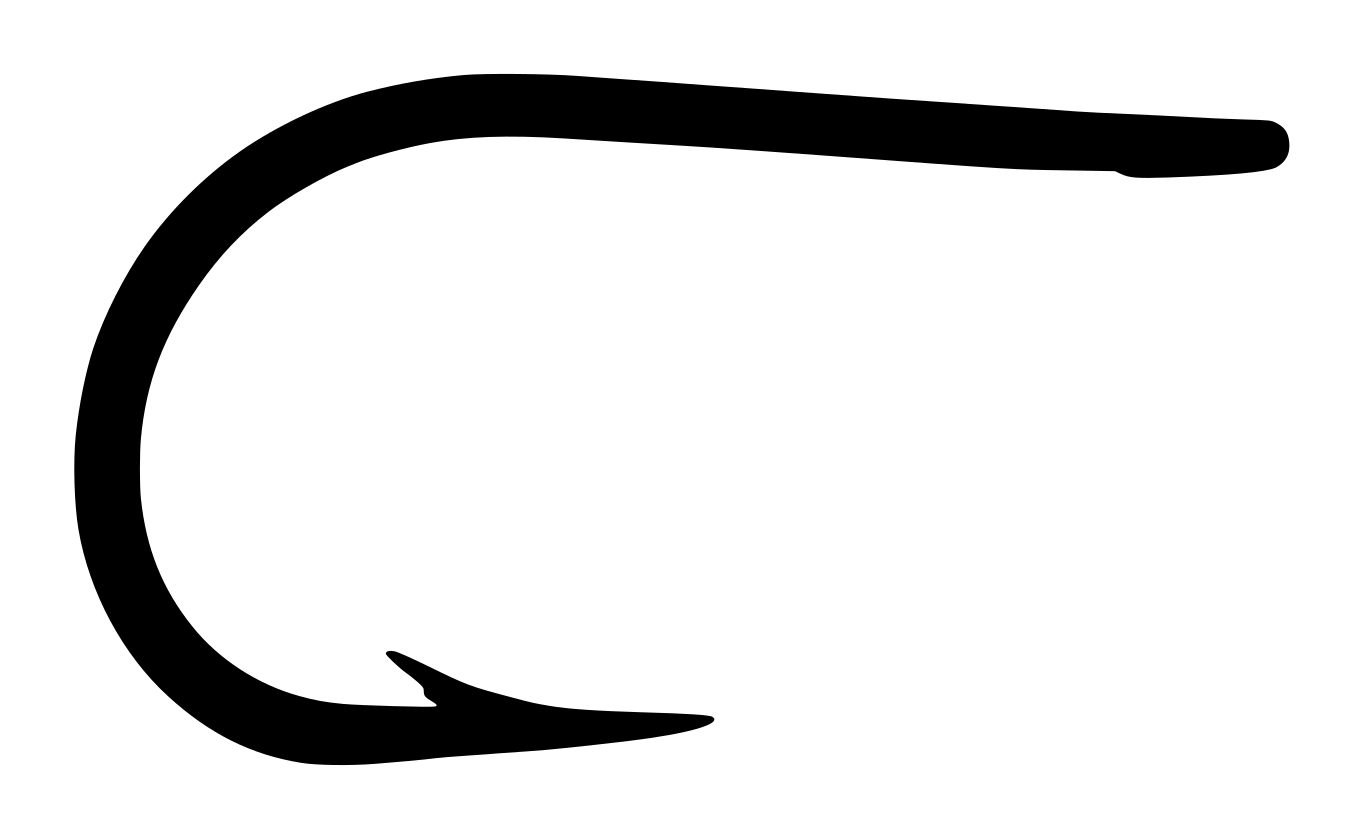
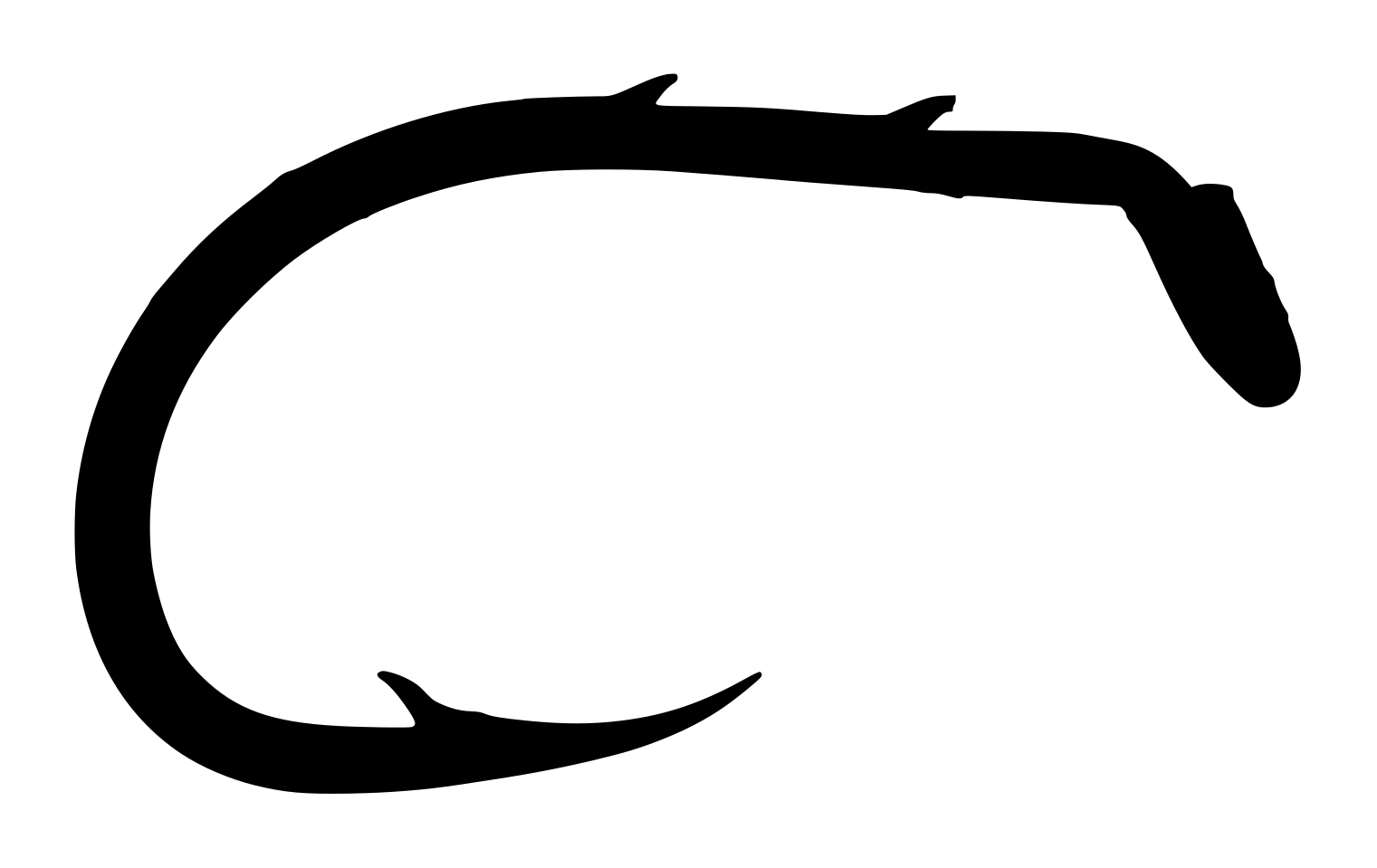
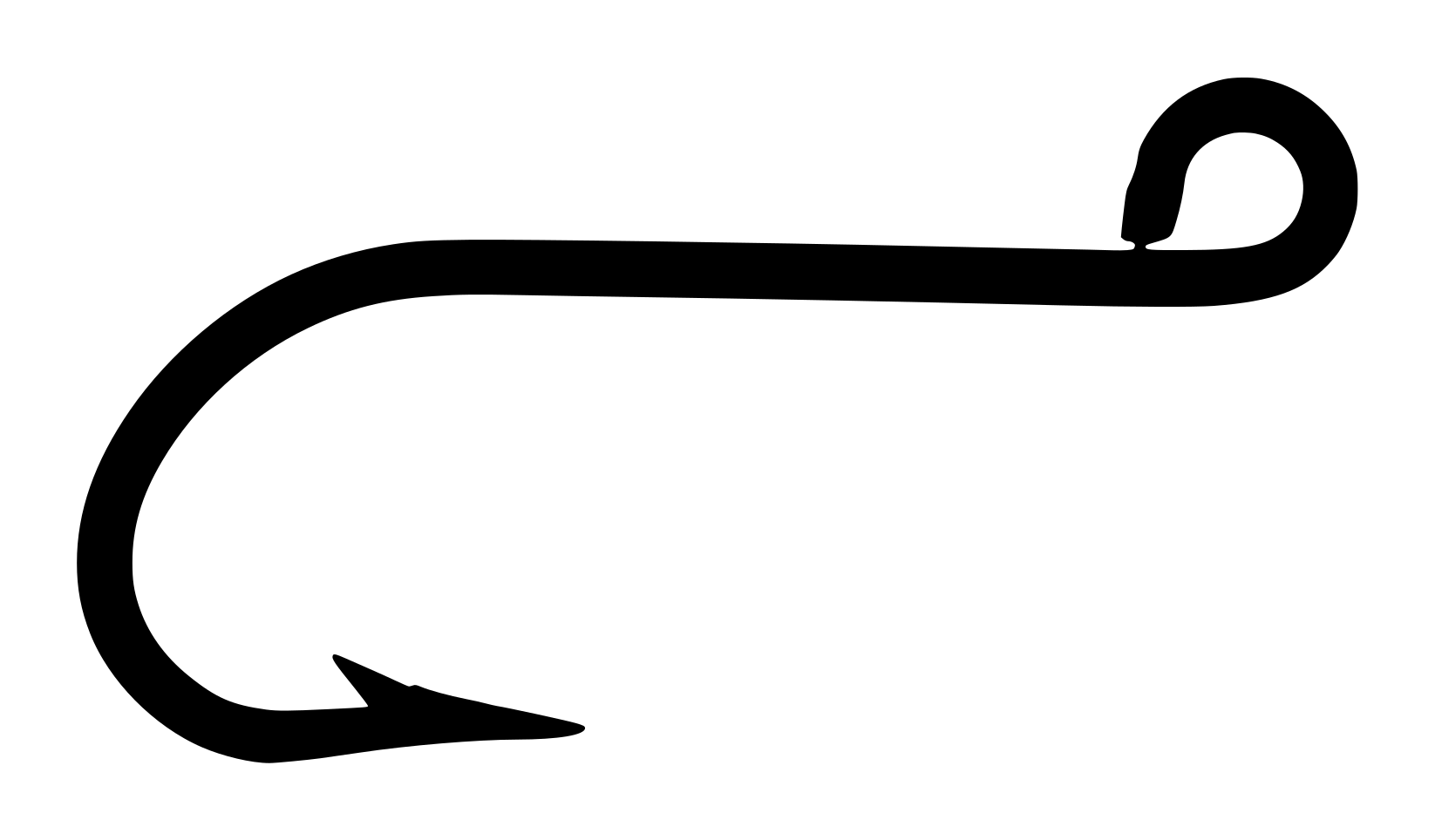
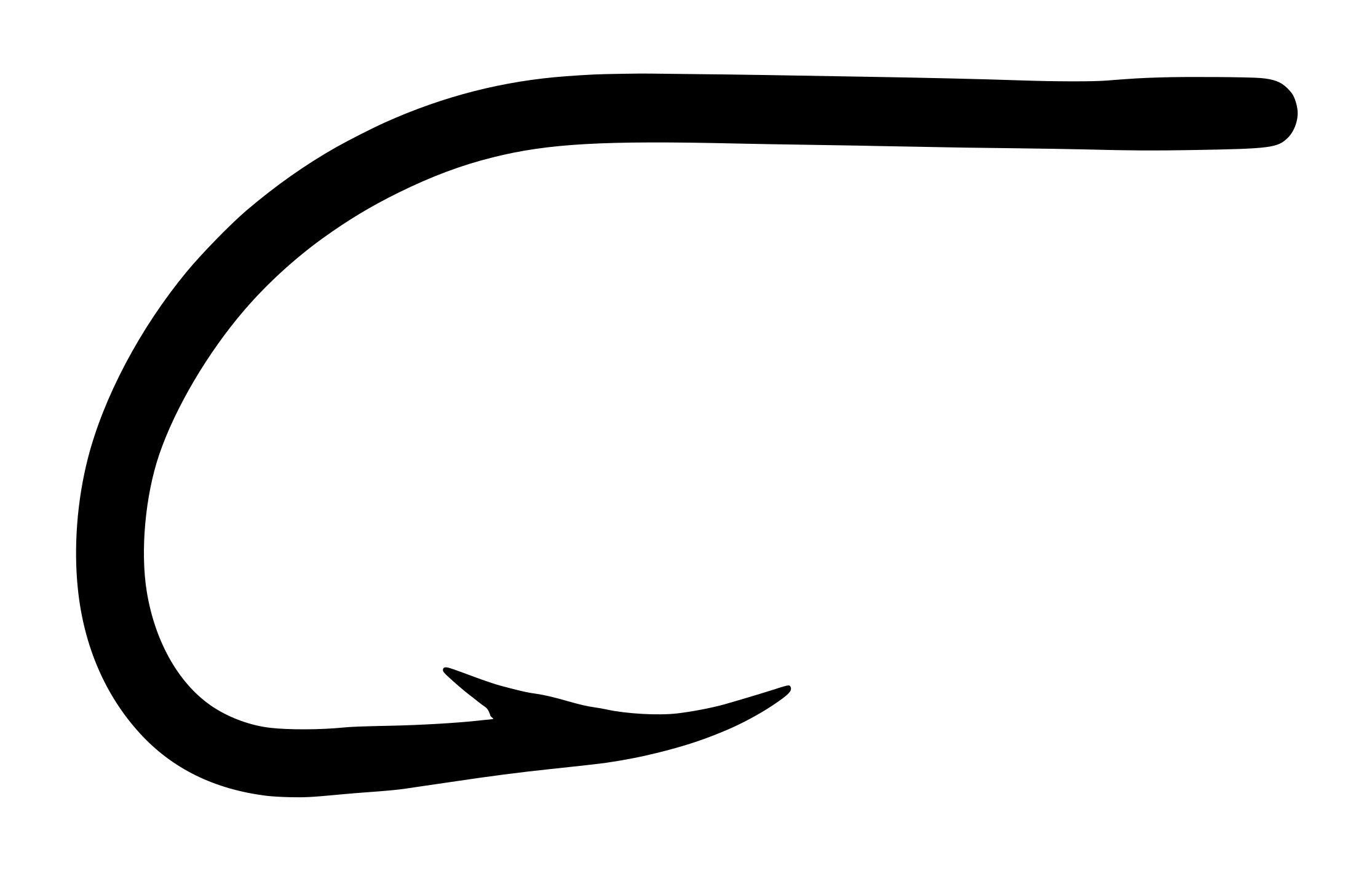
Mustad 9243 A Viking Hook, size No. 3, manufactured in Gjøvik, Norway. A heavy-wire saltwater and bait hook with a short shank, wide gap, and forged construction. The hook features a straight ball eye, hollow point, and nickelled finish.
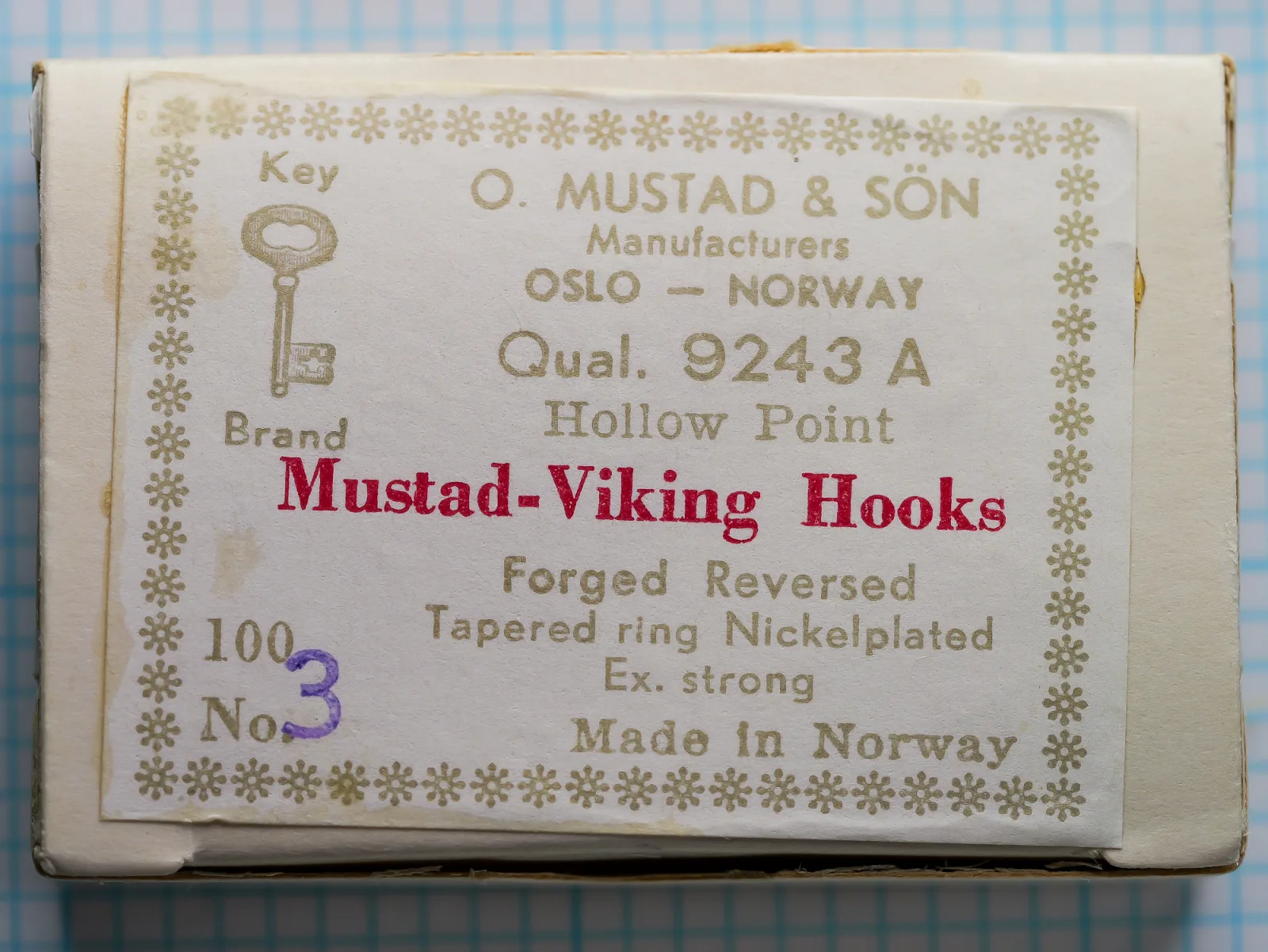
The package is a manufacturer box in original condition with printed text in the Mustad house style. The box label identifies the hook as “Forged Reversed Tapered ring Nickelplated Ex. strong,” indicating this is intended for heavy bait and saltwater fishing. The straight eye is unusual on a hook marketed as reversed, suggesting the label reflects the bend geometry rather than the point offset.
The Viking bend is a Mustad design variant combining aspects of the Beak and standard offshore profiles. Dating to approximately the 1950s-1960s based on box construction and typography, this hook represents a period of aggressive expansion by Mustad into the saltwater market. The combination of heavy forging and nickelled protection indicates design intent for trolling, shark fishing, and heavy bait work in marine conditions.
Rated 4.0/10 for collectability. The model is moderately scarce in original packaging, particularly in smaller sizes. Collector demand is modest but specialized — sought by vintage saltwater specialists and fishing historians interested in post-war offshore tackle development.
Original manufacturer box lid showing the Mustad house-style label with ornamental snowflake border, model designation, and hand-written size notation in purple ink.
Photographic record
3 cataloged imagesSelect any record to load it above.
3 images shown
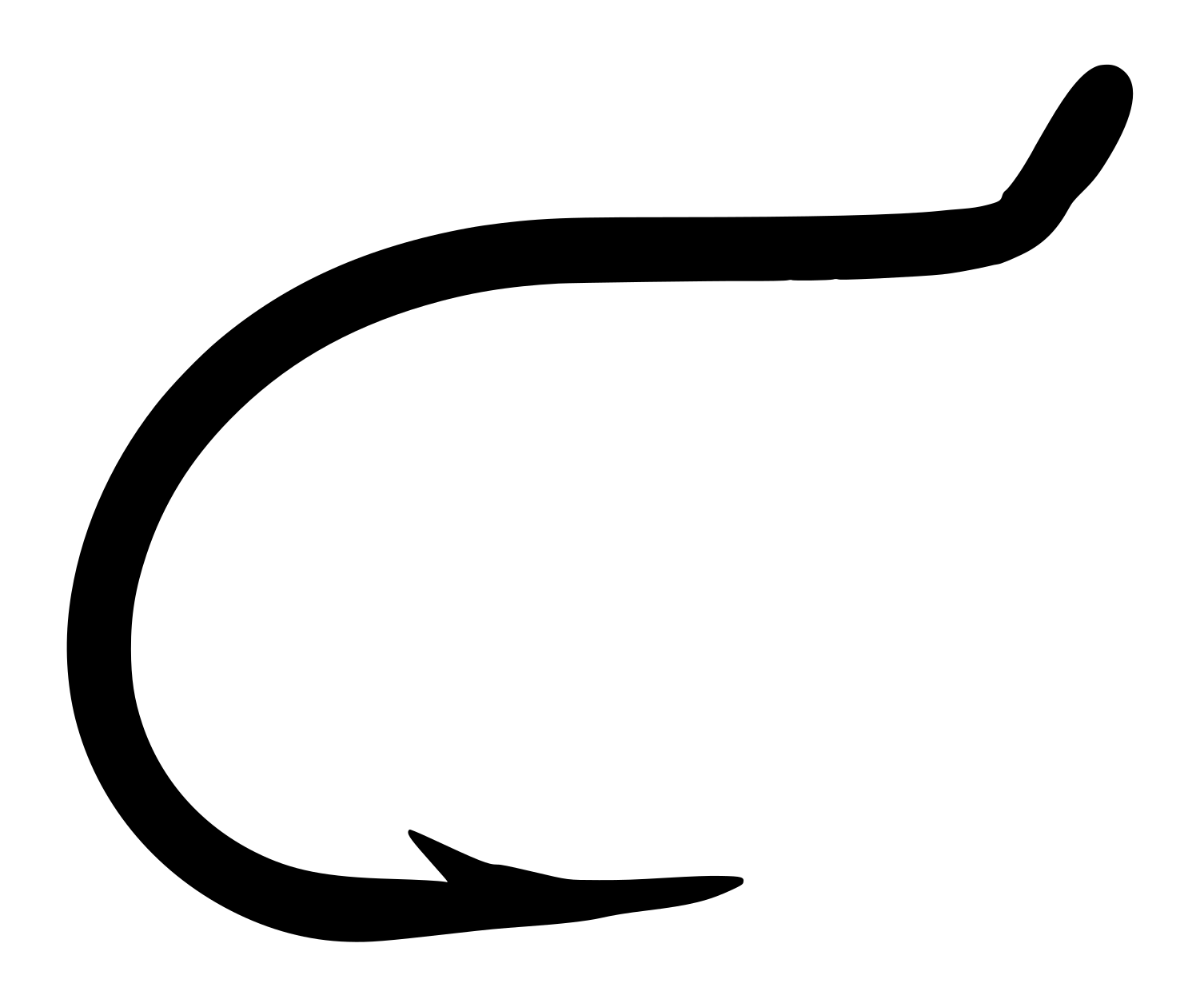
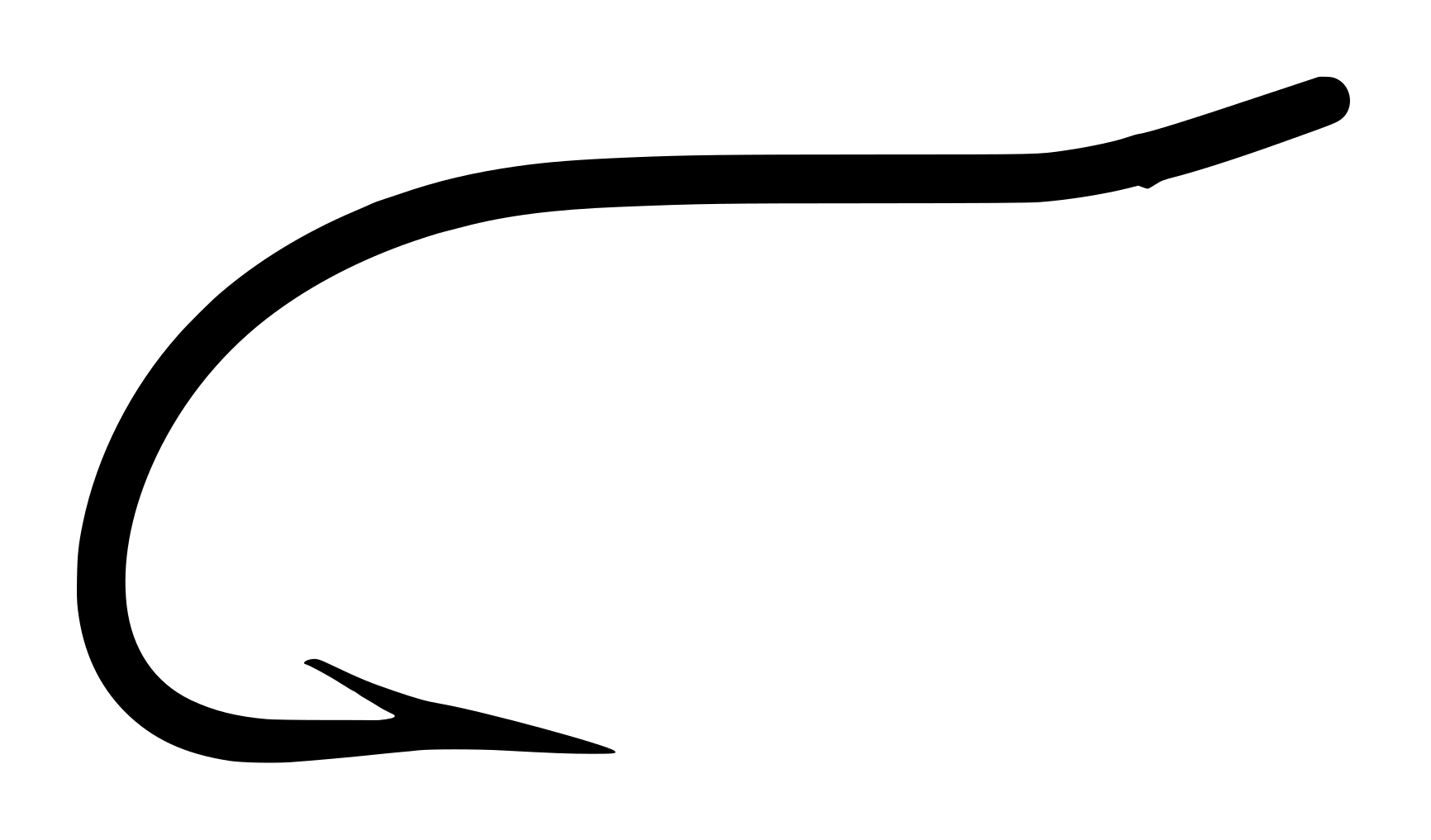
Mustad 9243 A Viking Hooks Box LabelOriginal manufacturer box lid showing the Mustad house-style label with ornamental snowflake border, model designation, and hand-written size notation in purple ink.Open originalMustad 9243 A Viking Hooks Side ProfileSide-facing profile of the Viking bend showing the short shank, wide gap, and forged wire geometry characteristic of saltwater bait hooks, photographed on 1/10-inch measurement grid.Open originalMustad 9243 A Viking Hooks Overhead ViewOverhead view of the hook showing the symmetrical Viking bend profile and the straight (inline) ball eye orientation relative to the shank plane, on measurement grid.Open original
Technical profile
Straight / Inline Ball Eye | Viking | Short (1X–2X Short) | Heavy (1X Heavy) Wire | Hollow Point | Nickelled
Eye
Ball Eye, Straight / InlineBall eye with uniform diameter loop, wire ends butted cleanly and ground smooth. The eye is tapered slightly toward the shank to reduce bulk — this is the "Tapered ring" feature mentioned on the box label. Straight (inline) orientation, perpendicular to the shank plane P.
Wire
Heavy (1X Heavy), Forged
Shank
Short (1X–2X Short) — Plain
Bend
viking, Wide gapThe Viking bend is a short, wide-gaped design with a distinctive curve combining the sweep of a Beak with the point angle of a standard O'Shaughnessy. The point is straight, not reversed or kirbed; the bend is symmetrical through the curve. The "Reversed" label on the box refers to the bend style classification, not point offset P.
Point
Hollow Point (concave inner face)Short, close-set barb positioned near the tip. Standard Mustad barb geometry for the period, swept slightly backward. No micro-barbs or secondary barbs P.
Finish
Nickelled / Nickel-Plated — Confirmed (stated on packaging)Nickelled finish with cool silver-grey tone, characteristic of post-1950s Mustad saltwater protection. The finish is uniform across the shank and bend, indicating electrolytic nickel plating rather than hand-finish P.
The specimen and manufacturer box are in excellent condition. The hooks exhibit bright nickelled finish with no corrosion or patina. The box has aged paper stock with light toning to the label and slight creasing at the corners. The printed text remains clear and legible. Two corners show minor wear consistent with shelf storage. No hooks appear to be missing from the original count of 100 V.
The hollow point is a Mustad design specification for saltwater bait work, featuring an inwardly curved inner face that creates a blade-like cutting geometry. This design penetrates thick hide and scale more effectively than a rounded superior point. The concavity provides a secondary mechanical advantage — the curve traps the hook point slightly off-center, reducing the rotational angle required to seat the point in dense tissue.
The forged wire is flattened in cross-section, increasing material volume and reducing the likelihood of straightening under load from heavy bait or large fish. The heavy gauge (1X Heavy) is approximately 20% thicker than standard wire for the size, typical of commercial saltwater specifications where hook strength is prioritized over delicacy.
The straight ball eye eliminates the turned-down or turned-up offset, providing a direct pull-line for trolling rigs or bait presentations where the hook must track straight without added torque. The “tapered ring” (tapered eye loop) reduces the bulk of the knot area, important in heavy-bait applications where thick monofilament or wire leader is used.
The nickelled finish provides galvanic protection against saltwater corrosion, extending the service life in marine conditions. The finish is thin electroplate, not a thick mechanical coating, typical of mid-century manufacturing economics.
This pattern was made in sizes 1-10 (I). We have measurement for size 3. Know the others? Submit calipered measurements and we'll review and add them. Thank you!
Historical context
mustad
O. Mustad & Son originated in Gjovik, Norway, in 1832 as a family ironworking concern. By the mid-twentieth century, Mustad had established itself as a globally dominant industrialized hook manufacturer through aggressive product diversification, trademark development, and export distribution. Unlike the Redditch craftsman tradition (Partridge, Allcock, Edgar Sealey), Mustad operated large-scale stamping and forging facilities capable of producing tens of millions of hooks annually.
The company expanded into saltwater and specialty markets in the 1950s, introducing the Viking, Beak, and various heavy-duty designs. Nickelled protection and forged wire were premium specifications marketed to commercial and sport fishermen in North America and Scandinavia. By the 1960s, Mustad hooks were the dominant imported brand in American tackle shops, competing on price, availability, and performance rather than the hand-craft reputation of English makers.
Series History
The Viking bend first appeared in the Mustad catalog circa 1950 as a medium-weight alternative to the heavier Beak for saltwater fishing. The 9243 A, designated “A” for “Anglo” or “Atlantic” market, represents a variant optimized for export to North America and the UK. The model remained in production through the 1970s with minor refinements to the eye and point geometry.
The series included sizes ranging from 1 through 10, with heavy-wire and extra-strong constructions as the norm. The “Reversed” designation on the packaging refers to the bend profile (offset geometry of the Viking bend itself) rather than a left-hand point offset. The tapered ring (tapered eye loop) was a Mustad feature for reducing bulk at the tie-point, common on their exported saltwater range.
Era and Packaging Dating
Box construction and paper stock consistent with mid-twentieth-century Mustad manufacturing. Offset lithography print method with hand-written size notation in purple ink is typical of 1950s-1960s export packaging. No barcode present (barcode introduction 1974+). Typography and ornamental border are consistent with Mustad's established house style from this period. The "Oslo—Norway" designation reflects post-WWII formal corporate identity. The use of "Qual." (Quality) prefix on the model code is consistent with Mustad's export nomenclature from 1950-1965. Nickelled finish and forged construction became standard Mustad saltwater specifications in the early 1950s.
Norwegian Forging Mastery
The "Ex. strong" designation on the packaging refers not to ultimate tensile strength but to the forging depth and wire cross-section. Mustad used this term to distinguish production-forged hooks from simple bent-wire models. In the 1950s, Norwegian industrial metallurgy was among the world's best — Mustad's Gjøvik facility employed steam hammers capable of compressing wire in a single blow, creating the flattened profile visible in this hook's cross-section. Competitors in England and America attempted to replicate this by hand-forging or multi-stage pressing, but few achieved the consistency of Norwegian production. For a working fisherman buying hooks at a general store, "Ex. strong" and "Mustad" from Norway became synonymous with reliability in heavy bait and offshore fishing.
Design lineage and influence
The Viking bend is a Mustad innovation of the early 1950s, designed to occupy the middle ground between the lightweight O’Shaughnessy (which became overburdened in heavy bait applications) and the heavier Beak (which was oversized for medium-bait work). The bent profile draws from both predecessors — the sweep and point angle of the Beak combined with the gap geometry of a standard O’Shaughnessy.
Contemporary competitors included the Pflueger Medalist (a similar wide-gap saltwater design) and various English imports from Allcock and Partridge. However, Mustad’s aggressive pricing and consistent distribution through American tackle wholesalers established the Viking as the market default for offshore bait fishing by the late 1950s.
Downstream, the Viking influenced the Mustad O’Shaughnessy 1000 series and contributed to the evolution of modern trolling and shark-fishing hook profiles. The design remains in limited production today under model numbers including 39960 and 39956 variants.
Best matchRelated by Attribute
Computed automatically from catalog data — updated as new hooks are added.
Matches: Bend, Shank, Gap, Point, Finish +4 moreDiffers: Wire: Heavy (1X Heavy) vs Standard; Eye: Ball Eye vs Tapered Eye; Eye Orient.: Straight / Inline vs Turned Up
Matches: Bend, Shank, Gap, Eye, Point +5 moreDiffers: Wire: Heavy (1X Heavy) vs Fine (1X Fine); Eye Orient.: Straight / Inline vs Turned Up; Application: Saltwater, Bait vs Bait
Matches: Bend, Shank, Gap, Point, Forging +2 moreDiffers: Wire: Heavy (1X Heavy) vs Extra-Heavy (2X+); Eye: Ball Eye vs Tapered Eye; Eye Orient.: Straight / Inline vs Turned Down +2 more
Matches: Bend, Shank, Point, Forging, Shank Feat. +2 moreDiffers: Wire: Heavy (1X Heavy) vs Standard; Gap: Wide vs Standard; Eye: Ball Eye vs Tapered Eye +3 more
Matches: Shank, Wire, Eye, Point, Forging +2 moreDiffers: Bend: Viking vs Sproat; Gap: Wide vs Standard; Eye Orient.: Straight / Inline vs Turned Up +2 more
The 9243 A was designed for heavy saltwater bait fishing and trolling. The wide gap and heavy wire accommodate live or dead baits for large fish — sharks, tuna, and saltwater catfish. The forged construction and nickelled protection suit extended immersion in saltwater. The short shank and wide gap are characteristic of bait presentations where the hook must penetrate thick-lipped or bony-mouthed species with minimal bend-point leverage.
Secondary Applications
The hook may be used for pike and large freshwater catfish, though the saltwater protection is unnecessary in these applications. Heavy bait trolling for ocean stripers or surf fishing with large mullet or mackerel are period-appropriate uses. The straight eye and heavy wire are less suitable for fly tying or dry-fly presentation.
Collector notes
Rated 4.0/10. The model is moderately scarce in original unopened packaging, particularly in smaller sizes (3-6). Demand is specialized — collectors of vintage saltwater tackle and Mustad historians seek it actively, but broader fly-fishing and trout-hook collectors overlook it. The complete box in excellent condition is the primary value driver.
Reference value
$8 – $22 USD estimate
Packaging condition
Excellent — minimal wearRecorded specimen
Packaging format
GW-M-BOX-001Catalog code
Positive Factors: Original manufacturer box is rare — most Mustad hooks were sold on cards or loose. Size No. 3 in this series is genuinely scarce; larger sizes (6-10) are more common. The 9243 A is a documented catalog model with traceable history. Nickelled finish in original condition is desirable among saltwater specialists. The straight ball eye and heavy forging are uncommon specifications relative to Mustad’s mass-market Aberdeen and Sprout designs.
Limiting Factors: Mustad’s industrial production volumes remain vast — even supposedly rare models often appear in markets with patience. The saltwater and bait focus limits appeal to dry-fly and nymph collectors who dominate hook-collecting activity. The “reversed” terminology on the box creates identification confusion, potentially reducing search efficiency by collectors unfamiliar with Viking bend terminology. The heavy wire and wide gap have limited modern fly-tying applications.
Value Drivers: Unopened or near-unopened boxes command 2-4x premiums over loose hooks. Size No. 3 is worth 20-30% more than sizes 6-10. Nickelled finish in original condition (no patina) adds 10-15% premium. The box lid text and hand-written annotation are desirable provenance markers. Boxes with visible use (opened corners, partial hook loss) drop to moderate collectibility (3.0-3.5 rating).
Most Desirable Configuration: Unopened or sealed box, complete hook count (100), No. 3 size, original label intact and legible, nickelled hooks showing no oxidation.
Packaging
Rigid manufacturer box, approximately 4.5" × 3.5" × 1.5", constructed from cream-colored chipboard with a separate fitted lid. The exterior lid displays printed label in the Mustad house style with ornamental snowflake border in gold/tan ink. Text includes manufacturer name, location (Oslo—Norway), model code (Qual. 9243 A), point description (Hollow Point), product name (Mustad-Viking Hooks in red serif type), hook properties (Forged Reversed, Tapered ring, Nickelplated, Ex. strong), and quantity (100) with size notation (No. 3 handwritten in purple ink). The lid interior is unprinted kraft stock. The box bottom is plain cream chipboard. Paper stock is typical of 1950s-1960s era manufacturing. Print is offset lithography with hand-addition of size notation.
Market Value Notes
Low ($8): Good condition — opened box, 85-95 hooks present, box showing shelf wear and light toning, hooks bright but some minor oxidation possible.<br />
High ($22): Excellent condition — sealed or effectively sealed box, complete 100-hook count, minimal wear to box and label, all hooks showing bright nickelled finish with no patina.<br />
Premium factors: Original manufacturer box (2-3x multiplier over loose hooks); size No. 3 or smaller (adds 20-30%); complete hook count; label legibility and annotation clarity.<br />
Platforms: eBay (UK and US auctions occasional listings for Mustad saltwater vintage), specialized vintage tackle dealers, regional fishing tackle fairs.<br />
Confidence: E estimated — limited comparable sales data. Most Mustad hooks in boxes sell $5-35 depending on size and condition; saltwater models command modest premium. Heavy wire and 1950s-1960s era support upper range estimate.
Where to Find
eBay UK auctions occasionally feature unopened Mustad saltwater boxes from estate lots. eBay US has fewer listings for this specific model but search terms "Mustad Viking Hooks 9243" or "Mustad No. 3 saltwater" may locate comparable examples. Specialized vintage tackle dealers in coastal regions (New England, California, UK south coast) are more likely to stock. Fishing tackle swap meets and regional antique shows in maritime communities occasionally include Mustad saltwater inventory lots. Expect limited availability — searches may span several months without results.
Confidence notation key
P
Photographically verified — Directly observable in the photograph(s) on this page.
V
Verified by documentation — Confirmed by manufacturer catalog, spec sheet, or published reference.
I
Inferred — A logical deduction from observable or documented evidence, not directly stated.
E
Estimated — An approximation based on visual comparison, proportional analysis, or limited data.
S
Speculative — A reasoned hypothesis that cannot be confirmed from available evidence.
Claims with no notation are confirmed by multiple independent sources. All photographs on garrenwood.com are taken on a measurement grid where each square equals 1/10 inch (0.1″ / 2.54 mm).