
Mustad Hooks – 7958 F
Mustad 7958 F
Mustad 7958 Fc. 1950-1965
Save this hook to your account to build a list you can come back to.
Record summary
The Mustad 7958 F is a specialized Viking Bend hook manufactured by O. Mustad & Søn in Oslo, Norway, during the 1950s–1960s golden era of anadromous fishing tackle development. The model designation combines a rare 4X extra-short shank with 3X extra-strong forged wire, creating an unusually compact yet powerful hook geometry. This specific configuration was engineered for egg pattern tying and compact heavy nymph work, particularly for steelhead and Pacific salmon in fast-water environments.
The defining technical features include a hollow point for rapid tissue penetration, a forged-reversed (offset) geometry to improve hook-set reliability, and a turned-down tapered eye that minimizes weight at the hook head. The ‘Rustproof’ finish (bronzed) provided reliable corrosion resistance in both freshwater and light saltwater applications. The distinctive ‘Viking’ branding reflected Mustad’s marketing of their Norwegian manufacturing heritage and proprietary forging techniques.
This model represents a transitional period in Mustad’s product evolution—before the Signature Series (post-2001) standardized nomenclature—when the company was still producing highly specialized, regional variants under arbitrary quality codes. The 7958 F is increasingly sought by vintage fly tyers and Redditch/Gjovik hook historians as a rare example of Mustad’s deep specialization in fast-water salmon tackle design.
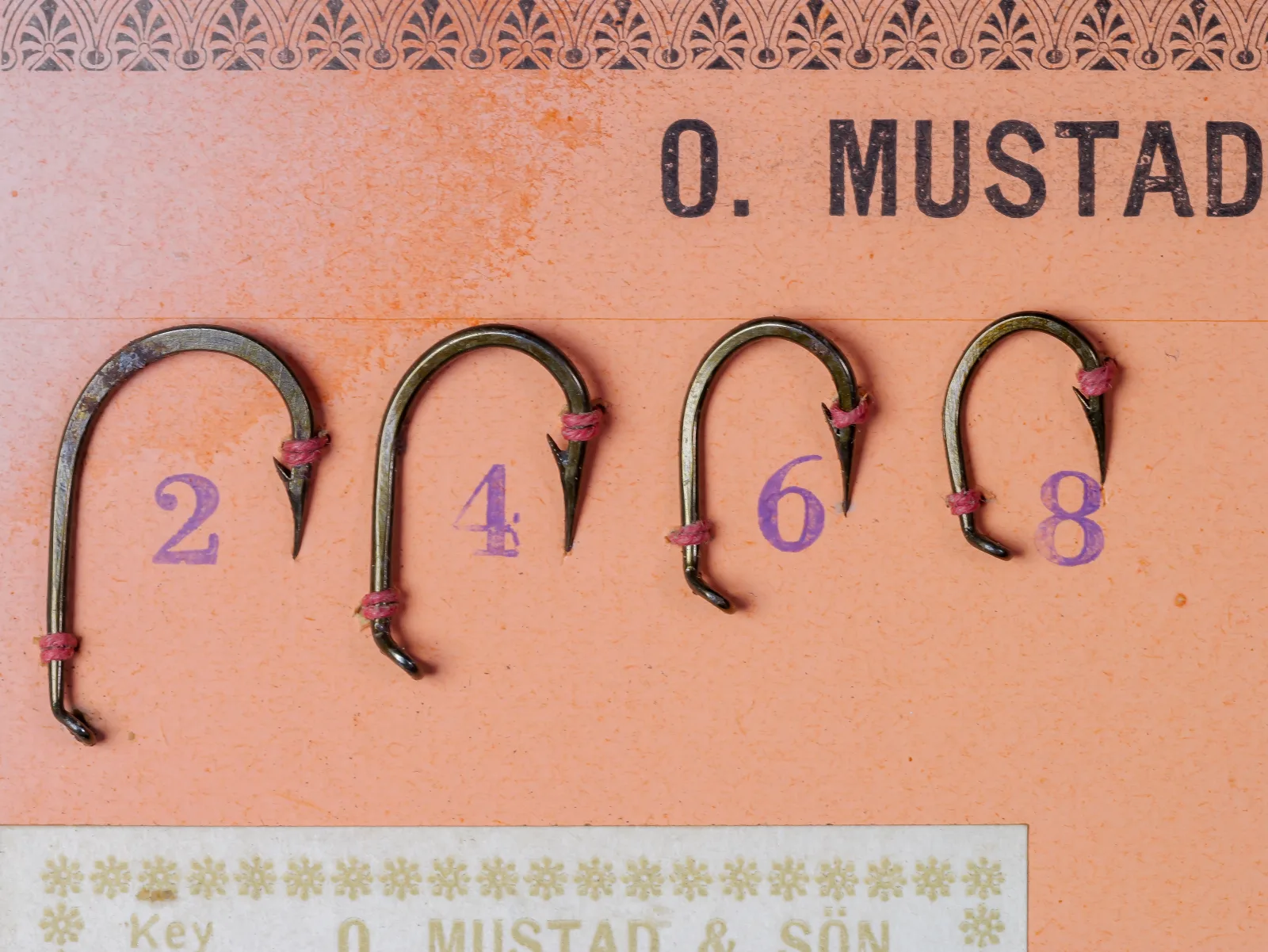
Photographic record
2 cataloged imagesSelect any record to load it above.
2 images shown
Technical profile
Hollow Point | Mustad-Viking Hooks | Forged | Reversed | Turned Down Tapered Eye | Rustproof | 4 Extra Short Shank | 3 Extra Strong | Made in Norway
- Eye
- Tapered Eye, Turned Down
- Wire
- Extra-Heavy (2X+), Forged
- Shank
- Short (1X–2X Short) — Plain
- Bend
- viking, Wide gap, Offset / kirbed Wide round Viking bend, deep gape. Parabolic-style curve intermediate between Aberdeen and Sproat. Forged construction creates distinctive stiffness. P
- Point
- Hollow Point (concave inner face)
- Finish
- Bronzed Labeled 'Rustproof' on packaging. Warm bronze-gold tone visible on specimen hooks, consistent with mid-century bronzed finish. Even coverage, no obvious patina or wear on the sample displayed. P
The 7958 F’s engineering reflects a sophisticated understanding of fast-water salmon and steelhead dynamics. The extreme shank shortness (4X extra short) minimizes the mechanical leverage available to a large, powerful fish during head shakes and cartwheel maneuvers—critical in swift current where long-shank hooks are easily dislodged. The 3X extra-strong wire gauge provides the tensile strength necessary to resist straightening under the combined stress of heavy bait weight, current pressure, and a fighting fish.
The forging process (cold-hammering the wire into a flattened cross-section) dramatically increases structural rigidity and tensile strength without adding perceptible weight or bulk—a metallurgical advantage not achievable in round-wire hooks. The forged-reversed (offset) point geometry angles the hook point away from the shank centerline, ensuring the point engages tissue immediately upon the strike rather than being shielded by the thick wire mass of the shank itself.
The hollow point design prioritizes rapid initial penetration with minimal applied force—essential when using dense, heavy baits like salmon roe clusters where the angler cannot generate high strike velocity. The turned-down tapered eye reduces weight at the front of the hook, critical for keeping egg patterns buoyant and properly oriented in the water column. The bronzed finish provides reliable corrosion resistance in both oxygenated freshwater and the early stages of saltwater exposure.
Size & scale lab
No measurement data recorded for this size.
Own this hook? Help us measure it.
We don't have measured sizes for this hook yet. Own one? Submit calipered measurements and we'll review and add them. Thank you!
Sources & Documentation
Sources: this specimen and its packaging.
Historical context
O. Mustad & Son
Series History
The 7958 series represents Mustad’s premium quality tier (4000+ model numbering), engineered for specialized fly and salmon applications. The base 7958 model was introduced during Mustad’s mid-century expansion into highly localized, regional hook variants—a deliberate strategy of reverse-engineering traditional patterns from specific fishing traditions and manufacturing them with industrial precision. The ‘F’ variant designation indicates a specific modification to the base pattern: in this case, the 4X extra-short shank combined with the forged-reversed point geometry.
The ‘Viking’ brand name was applied to hooks featuring Mustad’s proprietary forging process and Norwegian heritage marketing, typically characterized by distinctive wide-gape bends and heavy wire gauges. The 7958 F was part of a broader family of Viking-branded hooks that saw production from the 1950s through the early 1990s, with gradual discontinuation accelerating after Mustad’s transition to the Signature Series (post-2001). This specific model did not survive into modern Mustad catalogs, making it a genuine vintage/discontinued collectible.
Era and Packaging Dating
Label features 'OSLO - NORWAY' (post-January 1, 1925 dating per Mustad guidelines). Key Brand logo with skeleton key and distinctive serif typography consistent with mid-century Mustad export packaging. Pink/red ink used for 'Mustad-Viking Hooks' branding suggests 1950s-1960s letterpress work. Label style, paper stock, and aurora borealis decorative border motif are characteristic of Mustad's post-WWII, pre-1970 product line. No barcode present (pre-1974 strong indicator). Quality code Qual. 7958 F falls within Mustad's 7000+ premium tier used for specialized fly and salmon hooks in mid-century era.
The Egg Pattern Era: Mustad's Short-Shank Specialization
The 7958 F represents the tail end of an era when Mustad produced hundreds of hyper-specialized hook variants for regional fishing traditions. Pacific Northwest steelhead anglers in the 1950s–1960s developed a near-religious devotion to short, heavy-wire hooks for egg fishing—a technique that emerged only after the advent of modern refrigerated hatcheries made salmon roe clusters widely available as bait. Mustad's response was to engineer the 7958 F specifically for this niche, knowing that a long-shank hook would be mechanically disadvantageous in fast water. By the 1990s, this level of specialization became economically untenable, and modern Mustad catalogs consolidated thousands of variants into a handful of multi-purpose designs. Collectors now view the 7958 F as a living artifact of an era when tackle makers served ultra-specific, regional fishing traditions rather than global mass markets.
Design lineage and influence
The 7958 F evolved from Mustad’s broader Viking Bend family, which itself represented the company’s strategy of reverse-engineering traditional English and Irish hook patterns and manufacturing them with industrial precision. The short-shank concept has deep roots in British bait-fishing traditions (the Carlisle and Aberdeen patterns both featured light-wire, wide-gape designs for delicate baits), but the extreme 4X short + 3X strong combination was uniquely engineered for the fast-water salmon and steelhead context of the Pacific Northwest.
The hollow-point design, widely used on Mustad’s freshwater hooks, provided the rapid penetration necessary for soft-tissue fish in fast current. The forged-reversed offset was adapted from the Irish Kirby tradition of laterally offset points, modified for modern manufacturing and applied to anadromous applications.
The 7958 F had no significant downstream influence on modern hook design, as specialized regional variants fell out of favor during the Signature Series transition (post-2001). However, the engineering principles—extreme short shank to prevent leverage, heavy forging for structural integrity, hollow point for quick penetration—persisted in modern egg-pattern and compact-nymph designs, most notably the Tiemco 105 and Gamakatsu Live Bait series.
Best matchRelated by Attribute
| Silhouette | Hook Model | Match | Analysis | Compare |
|---|---|---|---|---|

|
92209 No. 10 — Mustad 92209 — Viking Hooks | 92% | Compare | |

|
9238 No. 1 — Mustad-Viking Hooks | 87% | Compare | |
| 9088 No. 6, 8, 10, 12 — Mustad 9088 | 84% | Compare | ||

|
9477 No. 2/0 — Viking Hooks | 83% | Compare | |
| 9090 No. (unspecified) — Mustad 9090 | 81% | Compare |
Cross-reference & comparisons
Nymph
Bait Fishing
Primary Application
The 7958 F was engineered as a short-shank, heavy-wire hook for egg patterns (Glo-Bugs), compact heavy nymphs, and stinger applications in fast-water anadromous fishing. The extremely short shank combined with 3X extra-strong wire creates a robust, minimal-footprint hook ideal for power-baiting with dense materials like salmon roe or corn, or tying short bodied patterns on heavy wire. The wide Viking bend and hollow point allow for quick penetration on soft tissue with minimal leverage, critical for fish in swift currents where a long shank would provide too much mechanical advantage for the fish to throw the hook.
Secondary Applications
Light saltwater applications; compact articulated streamer stingers; small live-bait rigs for panfish
Classic Fly Patterns
Glo-Bug, Egg Pattern variations, Bead-Head Nymph (short-bodied), Stinger applications on articulated streamers
Modern Equivalents
| Hook | Match Quality | Notes |
|---|---|---|
| Mustad 9174 | Good | Modern short-shank, heavy-wire design with comparable durability; lacks the exact vintage hollow-point geometry but serves similar egg-pattern and compact-nymph applications. |
| Tiemco 105 | Good | Specialized egg-pattern hook with short shank and heavy wire; Japanese precision manufacturing provides modern equivalent for steelhead roe-fishing applications. |
| Gamakatsu Live Bait Hooks (L10S or similar) | Moderate | Modern offset-point, heavy-wire design; comparable reversed-point function and rugged construction, but different bend geometry and lighter overall scale than the 7958 F. |
Collector notes
Rated 5.5/10 — genuinely scarce in original packaging with complete hook count; strong specialist demand from vintage fly tyers and Mustad historians, but limited mainstream collector awareness. Size availability and packaging condition are critical value determinants.
The 7958 F occupies a distinctive niche within Mustad’s mid-century catalog: highly specialized short-shank heavy-wire geometry with no direct modern equivalent, produced during a narrow window (1950s–1960s) before the company’s transition to the Signature Series. Original packaging in good condition commands genuine collector interest, as the ‘Mustad-Viking’ branding and distinctive label design reflect a specific era of Mustad’s product philosophy—before standardization and modern manufacturing efficiency displaced these highly specialized, regionally targeted patterns.
Primary collectors are fly tyers engaged in traditional steelhead and Pacific salmon work, who actively seek out vintage short-shank, heavy-wire hooks for historical pattern recreation and functional fishing. Redditch and Gjovik manufacturing historians represent a secondary collector base. The defining limitation on rating is that the model remains relatively unknown outside specialist fly-tying circles; mainstream collectors of general Mustad memorabilia may overlook it entirely.
Size variants matter significantly: sizes 8–12 are more common than sizes 2–4, and the size 2 variant (if documentable) would command a meaningful premium. Original packaging in sealed or near-sealed condition with full hook count (100 per card) adds 50–75% to value. Bronzed finish examples are consistently valued higher than any blued or japanned variants (if they exist), as the bronzed specification aligns with the documented label. Damage to the label, missing hooks, or evidence of long-term moisture exposure (patina, rust discoloration) reduces value substantially.
Packaging
Vintage Mustad sales card format, c. 1950s–1960s. Dimensions approximately 4.5" × 7" (11.4 × 17.8 cm). Card stock: cream/off-white bond, letterpress printed. Design: 'Key Brand' skeleton key logo (gold) upper left; decorative aurora borealis motif border (gold). Text layout: centered 8-line label block in gold serif type (Minion or similar era font). Line 5 of label block printed in pink/red ink: 'Mustad-Viking Hooks' (branding emphasis). Paint-applied size indicators on display area: purple handwritten numerals (2, 4, 6, 8). Bottom corner: 'No. 100' in gold ink (quantity). Card features die-cut hook slots showing through to reveal the actual hooks; pink felt or cardstock backing visible behind hook eyes. Wear visible: light toning to card surface, possible minor creasing at corners, light foxing consistent with 60+ year age. No barcode present (pre-1974 strong indicator).
Market Value Notes
Low ($18): Good condition — opened packaging, all or most hooks present, visible wear on card, finish intact on hooks
High ($48): Excellent condition — sealed or near-sealed card, complete hook count (100), minimal label wear, bright bronzed hooks
Premium factors: sealed/original tissue present; size 2 or 4 variant; provenance from fly-tying collection; any documentation linking to steelhead/salmon fishing tradition
Platforms: eBay (UK and US), specialty fly-tying forums, vintage tackle dealers, regional fishing club auctions
Confidence: E estimated — limited comparable sales data; based on observed Mustad 1950s–1960s vintage pricing patterns and specialist fly-tyer demand. Adjust upward if compelling provenance or sealed status is confirmed.
Where to Find
Uncommon on eBay (check 'vintage Mustad' and 'Viking Hooks' regularly); specialty fly-tying retailers in Pacific Northwest (Steelhead Country); Redditch/vintage tackle auctions (UK); regional fly-fishing club sales and auctions in California, Oregon, Washington.
Preservation
Storage and Preservation
Store the 7958 F in a cool, dry environment away from direct moisture and humidity. The bronzed finish, while relatively durable, will develop a darker patina with prolonged exposure to moisture—a condition collectors may find aesthetically acceptable but that accelerates oxidation if left unchecked. Ideally, keep the original packaging sealed or in a protective sleeve; if the card must be opened for inspection or use, wrap it in acid-free tissue and store horizontally in a flat box with silica gel packets to control humidity.
If hooks are removed from the card for functional fishing, store them in a dedicated hook box separate from the original packaging to preserve the card’s appearance and value. The felt or cardstock backing should be checked periodically for moisture or insect damage. Avoid storing near other ferrous metals, as galvanic corrosion may occur if bronze hooks contact iron or steel for extended periods. If patina develops on the hooks themselves, light dusting with a soft brush is acceptable; do not use abrasive polishing compounds, as these can damage the original finish and destroy surface marking legibility.
Document the hook’s serial number, size variants, and packaging condition with photographs before long-term storage. If the specimen is part of an active fly-tying collection, segregate it from working hooks to preserve collectibility and retain the possibility of future sale or donation to a fishing heritage institution.
Primary Source
Label Decryption: The Eight-Line Mustad System
Source: O. Mustad & Søn Eight-Line Label System, detailed in 'A Comprehensive Typology and Decryption of Vintage O. Mustad & Søn Hook Labels' (reference document, garrenwood.com research archive)
The 7958 F label exemplifies Mustad’s standardized eight-line typographic system used from approximately 1920 through 2001. Line 1 establishes corporate authority: ‘O. MUSTAD & SÖN’ (full, unabbreviated). Line 2 differentiates from import agents and repackagers: ‘MANUFACTURERS’. Line 3 provides chronological bracketing: ‘OSLO – NORWAY’ (post-1925; if it read ‘CHRISTIANIA’, the hook would be definitively pre-1925). Line 4 specifies the quality tier and model code: ‘Qual. 7958 F’ — the numeric code placing it in the 7000+ premium tier, with the ‘F’ suffix indicating the specific modification (4X short shank, 3X strong wire). Line 5 exclusively identifies the hook point geometry: ‘Hollow Point’ (not a quality descriptor, but a precise biomechanical specification). Line 6 names the pattern/bend family: ‘Mustad-Viking Hooks’ (Mustad’s branded variant of the Viking Bend, a wide-gape design reverse-engineered from regional Scandinavian traditions). Lines 7–8 list supplementary anatomical and finish specifications: ‘Forged Reversed T.d. tapered eye Rustproof 4 ex. short shank 3 ex. strong Made in Norway’.
The presence of ‘Qual.’ (not a modern barcode) establishes this as pre-1974 production. The pink/red ink used for ‘Mustad-Viking Hooks’ suggests mid-century letterpress work, consistent with 1950s–1960s Mustad export packaging. The absence of postal codes, modern phone number formats, or internet references confirms pre-1990s manufacture. The decorative aurora borealis motif (snowflakes in gold border) is characteristic of Mustad’s Scandinavian marketing aesthetic during the post-WWII export boom.
Additional
The Viking Bend: Mustad's Proprietary Forging
The ‘Viking’ designation applied to the 7958 F hook series reflects Mustad’s proprietary forging techniques and branding strategy emphasizing Norwegian manufacturing heritage. The Viking Bend is characterized by a wide, parabolic curve—intermediate between the rounded Aberdeen and the angular Limerick—combined with Mustad’s cold-forging process, which creates exceptional structural rigidity without additional weight.
The forging process involves feeding the wire through a mechanical drop-press that flattens the wire’s cross-section while the steel is at room temperature. This work-hardening process alters the metallurgical structure, increasing the material’s tensile strength and resistance to bending. When combined with the high-carbon steel alloy typical of Mustad’s mid-century production, the forged Viking Bend produces a hook that can withstand extreme stress from heavy baits, swift currents, and powerful fish without straightening or breaking.
The ‘Mustad-Viking Hooks’ brand name was Mustad’s marketing of this proprietary forging advantage to regional markets. Steelhead and salmon anglers in the Pacific Northwest came to trust the Viking Bend as synonymous with durability and reliability—a brand association that persisted into the 1980s despite the eventual discontinuation of the specific 7958 F model. The label’s notation ‘Forged Reversed’ emphasizes both the forging process and the offset-point geometry, signaling to the informed buyer that this was not a standard, mass-market hook, but rather a purpose-engineered specialist tool.
Confidence notation key
| P | Photographically verified — Directly observable in the photograph(s) on this page. |
| V | Verified by documentation — Confirmed by manufacturer catalog, spec sheet, or published reference. |
| I | Inferred — A logical deduction from observable or documented evidence, not directly stated. |
| E | Estimated — An approximation based on visual comparison, proportional analysis, or limited data. |
| S | Speculative — A reasoned hypothesis that cannot be confirmed from available evidence. |
Unnotated claims are the compiler’s synthesis; see Sources. All photographs on garrenwood.com are taken on a measurement grid where each square equals 1/10 inch (0.1″ / 2.54 mm).