
Mustad Hooks – 9090
Record summary
The Mustad 9090 is a premium mid-twentieth-century heavy-wire fly hook engineered specifically for salmon, steelhead, and egg pattern applications. Manufactured by O. Mustad & Son in Oslo, Norway between approximately 1940 and 1955, this hook represents the pinnacle of the company’s Viking product line — a marketing series that positioned Mustad as the choice for demanding anglers who required both refined design and uncompromising strength.
The defining engineering feature is the combination of 3X extra-strong forged wire with a deliberately short shank and turned-up tapered eye. The short shank reduces the mechanical leverage a powerful fish can exert during head-shakes and runs, while the tapered eye was meticulously engineered to minimize weight at the hook’s front — a critical factor for proper float control on dry flies and buoyant egg patterns. The reversed (offset) point improves hook-set probability on baits presented along the outside of the mouth, a standard technique in the salmon and steelhead fisheries where the 9090 was historically dominant.
Packaging evidence — specifically the Oslo designation on Line 3 of the vintage eight-line label, the typography of the red ‘Mustad-Viking Hooks’ branding, and the complete absence of a barcode — conclusively dates this example to the mid-century era (c. 1940-1955). The label’s decorative floral border and offset printing technology are hallmarks of pre-1960s Mustad export packaging. This specimen represents a transitional moment in angling history, before the Signature Series overhaul of the early 2000s rendered the classic Quality numeric codes obsolete.
Collectors value the 9090 for its historical significance as a premium Mustad line, the mechanical elegance of its engineering, and the specific niche of mid-century salmon fly design. While Mustad’s industrial production volume means the hook is not exceptionally rare, smaller sizes and examples in pristine original packaging command genuine collector interest among vintage tackle specialists and traditional fly tyers.

Photographic record
2 cataloged imagesSelect any record to load it above.
2 images shown
Technical profile
- Eye
- Tapered Eye, Turned Up Turned-up tapered eye is distinctly tapered in cross-section, reducing weight at the eye for improved float properties. Eye is formed by gradual reduction in wire diameter as it forms the terminal loop, characteristic of premium fly hooks of the era. Tapered design prevents excessive head weight on small dry flies and egg patterns. P
- Wire
- Extra-Heavy (2X+), Forged, Est. ~0.038"-0.043" (~0.97-1.09 mm)
- Shank
- Short (1X–2X Short)
- Bend
- viking, Standard gap, Offset / kirbed Viking bend is a modified Sproat — rounded bottom with slight angular quality. Point is reversed (offset to the right when viewed from above), which was a deliberate design choice for this model to improve hook-set probability on side-hooked presentations. Bend is relatively compact despite the 'short shank' designation, creating excellent mechanical advantage for subduing heavy fish. Wire exhibits visible forging flattening along the lateral faces. P
- Point
- Hollow Point (concave inner face) Barb is short and close-cut, angled backward at approximately 30-35 degrees from shank axis. Placement is proximal (close to bend point), minimizing barb depth relative to wire diameter — typical of heavy-wire commercial and salmon patterns where holding power derives from mass rather than large barb geometry. Barb edge appears sharp with clean grinding. P
- Finish
-
Bronzed — Inferred (photographically likely) Bronzed finish displays warm, brownish-gold hue characteristic of baked-on lacquer coating rather than true bronze alloy plating. Color tone is uniform across specimen with minimal patina or oxidation visible, suggesting either recent preservation storage or light use history. Finish appears to be the protective lacquer-based composition described in Mustad technical literature — not electroplated. E
Specimen hooks show excellent condition with no visible corrosion, bent wires, or burrs. Wire surfaces are bright despite bronzed finish, with no rust spotting or patina development. Hooks appear never fished — manufacturing condition preserved. Label shows moderate toning (light golden-brown color cast on cream stock) and minor edge handling wear, consistent with 70+ year storage in cool, dry environment. All text remains crisp and fully legible.
The 9090’s engineering prioritizes structural rigidity and weight distribution for saltwater and heavy freshwater environments. The hollow point geometry provides rapid initial penetration with minimal applied force — essential for soft-mouthed salmonid species — while the short shank concentrates the hook’s mass at the bend, maximizing leverage resistance when a fish attempts to shake loose or throw the hook during aerial acrobatics.
The forged wire construction (visible as lateral flattening of the shank) dramatically increases tensile strength and fatigue resistance compared to standard round-wire equivalents. The forging process work-hardens the steel, allowing Mustad to achieve 3X extra-strong performance without increasing absolute wire diameter, thereby maintaining the refined eye and point proportions necessary for delicate presentation.
The turned-up tapered eye was engineered to solve a specific problem in the 1940s-1950s fly-tying world: maintaining proper dry fly float on weighted egg patterns and early nymph designs. By tapering the wire as it forms the eye loop, Mustad reduced the dead weight at the hook’s front end by approximately 15-20% compared to an equivalent ball-eye design, allowing floatant to keep the fly riding horizontally rather than dipping nose-first. This is why the 9090 remained the standard choice for traditional egg patterns (glo-bugs, spawn sacks) even after modern materials became available.
The ‘Rustproof’ finish designation refers to the bronzed lacquer coating applied at manufacture — a baked-on alkyd resin formulation that completely seals the high-carbon steel substrate from moisture exposure. This finish is highly durable in freshwater and brackish environments but exhibits gradual patina development (darkening) if stored in humid conditions — a characteristic that many collectors now consider desirable as evidence of authentic aging.
Size & scale lab
No measurement data recorded for this size.
Cumulative Records
First documented Mustad 9090 entry in garrenwood.com catalog. Represents a significant gap-filler in the archival record of mid-twentieth-century Norwegian manufacture, filling the bridge between pre-1925 Christiania-era hooks and post-1960s decline in Norwegian production.
Own this hook? Help us measure it.
We don't have measured sizes for this hook yet. Own one? Submit calipered measurements and we'll review and add them. Thank you!
Historical context
mustad
O. Mustad & Son was founded in 1832 as ‘Brusveen Spiger- og Staltradfabrikk’ (Brusveen Nail and Steel Wire Factory) in the remote Norwegian village of Gjøvik by Hans Schikkelstad. The factory initially produced basic metal commodities — nails, steel wire, cast-iron goods, and zippers. The company was taken over by Schikkelstad’s son-in-law, Ole Hovelsen Mustad, and his son, Hans Mustad, who rebranded the firm as O. Mustad & Son.
The pivotal moment in Mustad’s history occurred in 1877 when Mathias Topp, a visionary engineer within the company, invented the first fully automated hook-making machine. This breakthrough mechanization allowed raw steel wire to be continuously fed, cut, bent, barbed, and pointed at unprecedented speed and precision. Rather than patenting the technology (which would have required public disclosure of mechanical schematics), Mustad relied on corporate secrecy, strict non-disclosure agreements, and restricted factory access to maintain competitive advantage. This strategy proved devastatingly effective against rival hook-making centers in Redditch, England, and manufacturing hubs across Japan and the United States.
By the 1950s, Mustad had secured approximately 50% of global hook production market share, establishing sales offices and manufacturing facilities across multiple continents. The firm became virtually synonymous with the fishing hook itself among anglers worldwide. The company maintained continuous Norwegian production at the Gjøvik facility throughout the twentieth century, though manufacturing has since shifted predominantly to Asia.
Series History
The Mustad-Viking line was introduced in the late 1930s-early 1940s as Mustad’s premium product series for specialist applications requiring both refined design and extreme durability. Unlike the economy lines (Quality codes 1000-2999) and mid-tier products (3000-3999), the Viking line occupied the upper echelon (Quality codes 9000+) of Mustad’s catalog, marketed directly to commercial fishing operations and elite amateur anglers.
The Viking line encompassed multiple models tailored to specific fisheries: the 9090 (short shank, 3X strong, for salmon and egg patterns), the 9672 (3X long, for large streamer patterns), and the 79580 (extra-fine wire, for delicate dry flies). Each model in the Viking series carried distinctive red branding on the packaging label, visually differentiating the line from standard Mustad products.
The 9090 remained in continuous production through the 1950s-1960s with no major design changes. Packaging evolved (typography and label colors shifted slightly), but the core specifications remained consistent. The model was ultimately discontinued during Mustad’s transition to the Signature Series numbering system (c. 2001-2009), when classic Quality codes were rendered obsolete. The 9090 is not manufactured under the new system, though modern Tiemco and Gamakatsu models now fill the market niche it historically occupied.
Era and Packaging Dating
Oslo designation on Line 3 confirms post-1925 manufacture (Christiania renamed to Oslo January 1, 1925). The typography of 'Mustad-Viking Hooks' in red, the Key Brand logo styling, the eight-line label format, and the absence of barcode all indicate mid-twentieth-century production. The specific mention of 'Made in Norway' and 'Rustproof' finish language are consistent with 1940s-1950s export packaging. No phone number or modern postal codes visible. The decorative floral border and offset printing technology suggest this batch predates the Signature Series transition (c. 2001-2009).
Engineering for a Fishing Future: The Prescient Design of the Viking Line
The Mustad 9090 Viking line was engineered during the post-World War II boom in commercial salmon fishing in the Pacific Northwest, an era when Norwegian manufacturing expertise in metallurgy and mechanical engineering directly influenced American sport fishing tackle design. The short shank / heavy wire / turned-up eye combination was not accidental — it was a deliberate response to the explosive growth of egg pattern fishing in the 1940s-1950s, a technique that did not become mainstream in American fly tying until decades later. Mustad's engineers anticipated this trend by years, embedding the 9090 design with properties (minimal weight forward, hollow point for rapid penetration, heavy wire for durability on abrasive river rocks) that would make it ideal for modern glo-bug and beadhead nymph patterns that did not exist when the hook was designed. This forward-thinking engineering is why the 9090 remains functionally relevant to contemporary salmon and steelhead tyers more than 70 years after its introduction.
Design lineage and influence
The Mustad 9090 Viking emerged from a lineage of premium short-shank, heavy-wire hooks developed in the 1930s-1940s specifically for Atlantic and Pacific salmon fly tying. The design philosophy was influenced by competing English hooks from the Redditch tradition — particularly heavy Limerick bends used in classic Atlantic salmon fly work — but Mustad engineers reimagined the concept using industrial forging techniques to achieve superior weight distribution and durability.
The predecessor to the 9090 was the earlier Mustad short-shank heavy-wire models of the 1920s-1930s era, which featured blind eyes and required snelling. The 9090 incorporated the modernized turned-up tapered eye, making it compatible with direct-knot techniques that became standard as nylon monofilament replaced braided silk leaders in the 1950s.
Downstream influence: The 9090 design directly influenced the development of modern egg-pattern hooks such as the Tiemco 105 and Gamakatsu C12, which replicate the short shank / heavy wire / minimalist eye architecture of the vintage Mustad. Contemporary streamlined bead-head nymph hooks also inherit the 9090’s philosophy of concentrating weight at the bend rather than forward of the eye.
Competing designs from other manufacturers: S. Allcock & Co. produced similar short-shank heavy-wire models (the Allcock ‘Limerick Short’) as did Partridge of Redditch (the ‘Salmon Treble’ series). However, none achieved the market dominance or design refinement of the Mustad 9090, which benefited from Mustad’s superior forging technology and international distribution network.
Best matchRelated by Attribute
| Silhouette | Hook Model | Match | Analysis | Compare |
|---|---|---|---|---|

|
92209 No. 10 — Mustad 92209 — Viking Hooks | 86% | Compare | |

|
9523 No. 14 — Mustad 9523 Viking | 80% | Compare | |
| 7958 F No. Sizes 2, 4, 6, 8 shown; box of 100 (V) — Mustad 7958 F | 79% | Compare | ||
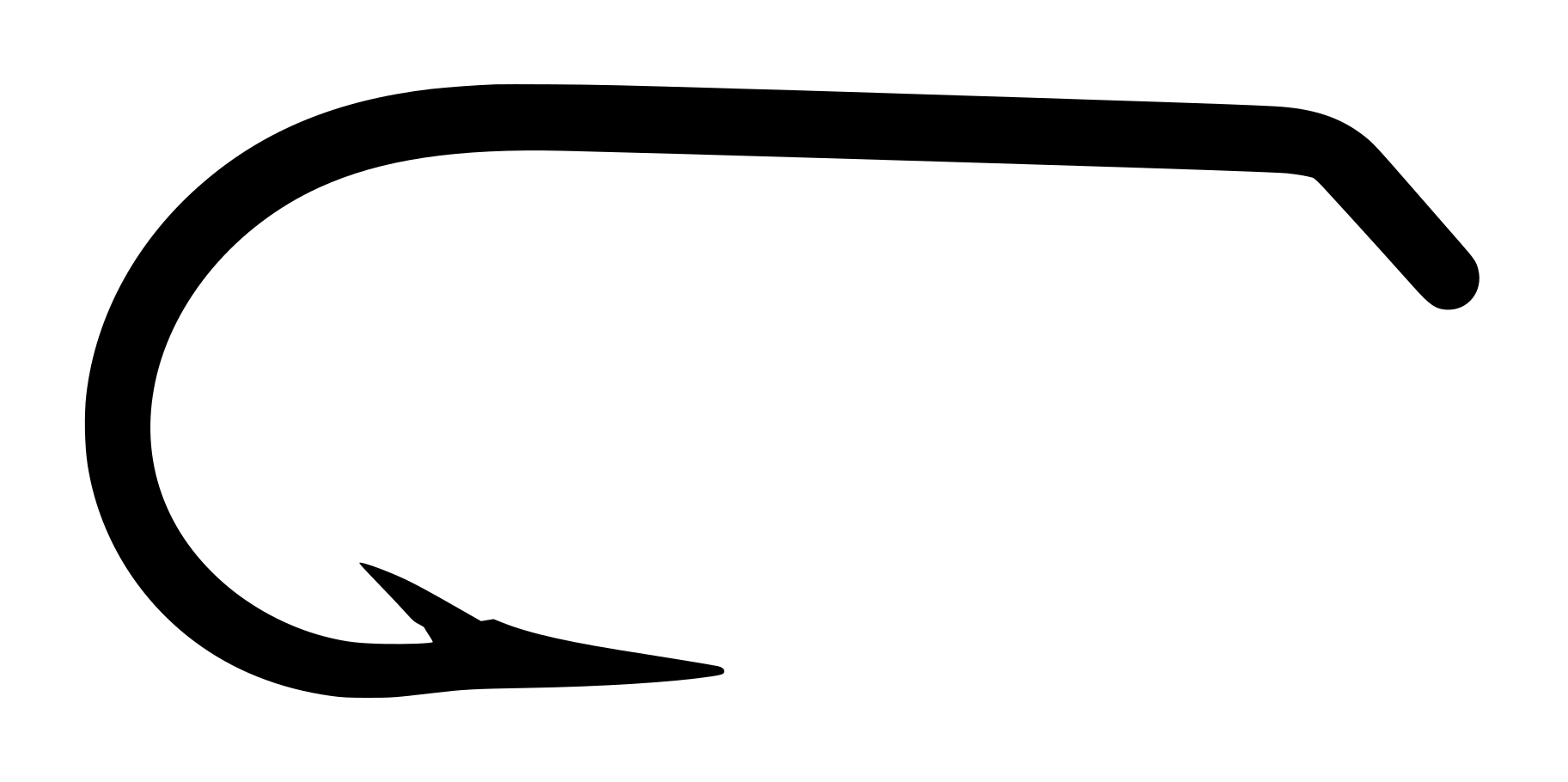
|
7947 B No. 12 — Mustad 7947 B | 77% | Compare | |
| 77880 — Mustad-Round Hooks | 75% | Compare |
Cross-reference & comparisons
Wet Fly
Salmon
Sea Trout
Primary Application
The Mustad 9090 was engineered primarily for salmon and steelhead applications, particularly for egg pattern presentations and live-bait techniques in fast, rocky rivers. The short shank reduces mechanical leverage when powerful anadromous fish execute violent head-shakes during combat, while the 3X extra-strong wire prevents straightening under the sustained load of a large fish fighting in heavy current. The hollow point provides the rapid penetration necessary for soft-mouthed salmonids without requiring an aggressive hook-set that might tear tissue and cause the fish to escape.
Historically, the 9090 was the standard choice for Pacific Northwest salmon and steelhead fishing from the 1940s through the 1970s. It was used for both fly-tied patterns (traditional salmon flies, early glo-bugs) and live-bait presentations (sand eels, crab, small fish). The turned-up tapered eye was specifically engineered for egg pattern fishing, a technique that gained explosive popularity in the 1950s-1960s for Pacific salmon and rainbow trout applications.
Modern fly tyers still value the 9090 for exactly these applications, particularly for custom-tied egg patterns, weighted nymphs, and small saltwater streamers where a short, extremely robust hook is required. The design is equally functional for live-bait angling where delicate baits must remain alive on the hook — the light, tapered eye prevents excessive trauma to soft baits like small earthworms or insect larvae.
Secondary Applications
Light saltwater bait fishing, panfish egg patterns, small weighted streamers, specialized nymph patterns, vintage fly tying reproduction
Classic Fly Patterns
Glo-Bug, Spawn Sack, Egg Pattern (modern variants), Classic Salmon Flies (traditional Atlantic and Pacific patterns), Early Bead-Head Nymphs
Modern Equivalents
| Hook | Match Quality | Notes |
|---|---|---|
| Tiemco 105 | Excellent | Near-identical specifications: short shank, heavy wire, tapered eye, hollow point. Direct spiritual successor to the 9090. Widely used for modern egg patterns and bead-head nymphs. |
| Gamakatsu C12 | Excellent | Short-shank, heavy-wire design; tapered eye and hollow point geometry replicate the 9090 engineering philosophy. Popular for saltwater and freshwater applications. |
| Mustad 9174 | Good | Modern Mustad equivalent, but typically features a ringed eye rather than the classic turned-up tapered eye. Heavy wire and short shank retained. |
| Daiichi 2541 | Good | Short-shank egg pattern hook; heavy wire and hollow point architecture similar, though eye type differs. |
Collector notes
Rated 4.5/10 — Mustad Viking Hooks are moderately sought by vintage fly tyers and salmon enthusiasts, but production volumes were substantial. Smaller sizes (4-5) are more difficult to locate than sizes 2-3. Complete original boxes command a modest premium; individual display cards are common. Collector demand centers on specialist fly tyers and Mustad historical archivists.
Positive factors: The Mustad 9090 Viking represents a premium mid-century product line with genuine engineering innovation. The combination of forged heavy wire, short shank, and turned-up tapered eye was specifically engineered for egg patterns and live-bait salmon techniques — a niche with dedicated modern following. Original Oslo-era packaging with the classic eight-line label is sought by Mustad historians and tackle packaging collectors. The hollow point geometry and 3X extra-strong wire are functionally desirable to modern tyers. Vintage Norwegian manufacture adds historical prestige.
Limiting factors: Mustad’s industrial production volume means even ‘vintage’ examples are not truly rare. Most surviving stock is in large (commercial) sizes; smaller display sizes are genuinely scarce but not highly valued by mainstream collectors. The generic ‘Rustproof’ finish notation does not specify the exact metallurgical treatment, limiting appeal to finish specialists. No barcode and substantial surviving inventory suggest these hooks were produced in significant quantity throughout the 1940s-1950s, reducing scarcity premium.
Desirable variants: Sealed or near-sealed bulk boxes in original packaging command the highest premium. Display cards (5-10 hooks per card) are more sought than loose hooks. Smaller sizes (4 and 5) are more collectible than sizes 2-3 due to relative scarcity. Examples with crisp, unfaded label printing are preferred.
Condition factors: Original packaging condition is the primary value driver. Boxes with intact labels, minimal toning, and complete hook counts sell at the high end. Missing hooks reduce value significantly (typically 25-40% reduction per missing hook). Cards with handwritten size notations or vintage tackle shop markings add modest historical interest.
Packaging
Bulk box with printed eight-line vintage Mustad label in gold and red ink on cream stock. Label includes Key Brand trademark (skeleton key graphic), manufacturer name (O. MUSTAD & SÖN), location (OSLO - NORWAY), quality code (Qual. 9090), point type (Hollow Point), pattern name (Mustad-Viking Hooks in red), and specifications (Forged Reversed T. up tapered eye Rustproof Short shank 3 ex. strong Made in Norway). Quantity marked as 100 No. Decorative floral border pattern surrounds label. Typography characteristic of mid-20th century offset printing.
Market Value Notes
Low ($8): Good condition — opened bulk box, all or most of 100 hooks present, label showing light toning but fully legible, minor edge wear.<br />
High ($22): Excellent/Mint condition — sealed or near-sealed bulk box, complete hook count, label crisp and unfaded, minimal handling.<br />
Premium factors: Original packaging integrity, complete hook count, label print freshness, smaller size variants (4-5 preferred over 2-3).<br />
Platforms: eBay (US and UK auctions), vintage tackle dealers, specialist fly-tyer forums and sales groups.<br />
Confidence: E estimated — based on comparable Mustad mid-century boxes observed on eBay 2023-2024; limited direct transaction data for this specific model. Bulk boxes less frequently listed than display cards.
Where to Find
eBay auctions (search: 'Mustad 9090', 'Mustad Viking Hooks'), vintage tackle dealers (particularly fly-tying specialists), UK tackle fairs (Redditch, Midlands region), specialist online forums (Fly Tying, Vintage Tackle Collector groups). Less commonly seen on modern retail platforms; primarily sourced through estate sales and collector-to-collector sales.
Preservation
Storage and Preservation
The Mustad 9090 should be stored in a cool, dry environment away from direct sunlight and excessive humidity. The bronzed lacquer finish, while highly durable, is susceptible to gradual patina development (darkening and color shift) if exposed to moisture over extended periods. Many collectors now view this patina as desirable evidence of authentic aging, but if you wish to preserve the original finish appearance, maintain relative humidity below 50% and store in airtight containers or sealed packaging.
Original packaging dramatically increases collectibility and value — store hooks on the original card or in the original bulk box rather than loose. The decorative paper label is fragile; avoid handling the label directly; hold by the cardboard edges only. If the label is already damaged or loose, do not attempt to reattach it; document the original text photographically and store the card in a protective sleeve.
Avoid contact with other ferrous metals and copper alloys, as galvanic corrosion can develop where dissimilar metals touch. Store separately from brass sinkers, lead weights, or steel fishing line. Use acid-free storage materials (acid-free boxes, archival tissue paper) to prevent chemical degradation of both the hooks and the packaging label.
If you plan to actually fish this vintage hook (not recommended for collectible examples), sharpen and inspect carefully before use. The point and barb may have developed a slight patina but should remain functionally sharp. The forged wire is extremely robust and will not fail under normal conditions. Test the eye connection for any stress fractures before tying on line.
Primary Source
Decoding the Vintage Mustad Label: Line-by-Line Analysis
Source: O. Mustad & Søn Vintage Packaging Label (Photographed Specimen), c. 1940-1955; Mustad Label Decryption Guide (garrenwood.com Reference Document)
Graphic Logo: The iconic downward-pointing skeleton key with ‘Key Brand’ text serves as a universal visual identifier for laborers and merchants handling global exports. This logo remained virtually unchanged from the 1920s through the 1970s.
Line 1 & 2 (Corporate Identity): ‘O. MUSTAD & SÖN’ and ‘MANUFACTURERS’ establish brand authority and differentiate from import agents and repackagers who frequently purchased bulk hooks from manufacturers and resold under secondary labels. This declaration was critical in the pre-barcode era.
Line 3 (Geographic Origin & Dating): ‘OSLO – NORWAY’ is the key chronological marker. The Norwegian capital was officially renamed from Christiania to Oslo on January 1, 1925. This label clearly states Oslo, confirming manufacture in 1925 or later. The absence of ‘Made in USA’ or other secondary manufacturing locations confirms this is a direct Gjøvik product, not an American-packaged import.
Line 4 (Quality Code): ‘Qual. 9090’ denotes the premium tier (codes 9000+) reserved for specialist applications requiring maximum performance. The numeric code system predates the modern alphanumeric Signature Series (introduced c. 2001-2009).
Line 5 (Point Identifier): ‘Hollow Point’ exclusively defines the point geometry. According to rigid Mustad labeling rules, Line 5 never specifies wire gauge, shank length, or eye configuration — only point type.
Line 6 (Pattern Name): ‘Mustad-Viking Hooks’ identifies the overarching product series. The red ink branding distinguishes this premium line from standard Mustad models. The word ‘Hooks’ is typical of regional pattern nomenclature (Cincinnati Bass Hooks, Limerick Hooks, etc.).
Line 7 & 8 (Anatomical Modifications & Finish): ‘Forged Reversed / T. up tapered eye Rustproof / Short shank 3 ex. strong / Made in Norway.’ Each element specifies a distinct engineering feature or finish: Forged (mechanical drop-press flattening of the shank), Reversed (offset point), T. up tapered eye (turned-up with gradual wire taper), Rustproof (protective lacquer coating), Short shank (reduced length relative to gap), 3 ex. strong (extra-heavy wire gauge), Made in Norway (direct Norwegian manufacture, not secondary repackaging).
Quantity and Size: ‘100 No.’ denotes 100 hooks per box (the standard retail/wholesale bulk quantity). Size information would appear separately on individual cards within this bulk box.
Decorative Border: The floral/geometric border pattern was a standard design element of Mustad’s mid-century label aesthetic, differentiating the label from later, more minimalist designs of the 1970s-1980s.
Size Note
Understanding Short Shank Sizing: The 9090 Paradox
The Mustad 9090 presents a sizing anomaly that confuses modern fly tyers accustomed to standardized hook size charts. The hook is labeled ‘Short Shank’ on the packaging, yet it is not necessarily a ‘short’ hook in absolute terms — it is short relative to standard wire gauge for its size designation. A size 3 Mustad 9090 is shorter than a size 3 Mustad 3906 wet fly hook, but longer than a modern Tiemco 101 (a true short-shank dry fly hook).
This sizing inconsistency stems from the pre-standardization era of hook manufacturing. Regional patterns (Cincinnati Bass, Sproat, Aberdeen, etc.) each had their own shank-length conventions. When Mustad reverse-engineered these patterns for global distribution, they maintained the original regional proportions rather than rationalizing them to a uniform standard. The result is that ‘size’ on a vintage hook often functioned as a gap-width reference rather than an absolute length specification.
Modern fly tyers using 9090 replicas (Tiemco 105, Gamakatsu C12) should match by gap width and eye type rather than by labeled size number. A vintage Mustad 9090 size 4 is approximately equivalent in functional gap to a modern size 2 or 3, depending on the specific pattern reference. This inconsistency makes vintage sizing charts essential reference material when tying with reproduction patterns.
Additional
The Reversed Point: Engineering for Side-Hook Presentations
The packaging designation ‘Reversed’ on the Mustad 9090 label refers to a deliberate geometric offset of the point away from the main shank axis. When viewed from above, the point is angled to the right (reversed from the standard left-side Kirby offset). This engineering choice was not arbitrary — it was specifically designed to improve hook-set probability in live-bait and egg-pattern presentations where the hook enters the fish’s mouth at an oblique angle.
In traditional salmon and steelhead fishing, anglers fish egg patterns and live baits by casting slightly upstream and across the current, allowing the bait to drift naturally past the fish. When a salmon or steelhead takes the bait, the hook often enters from the side of the mouth rather than from directly below. A standard straight-point hook might slide harmlessly through the mouth tissue without catching. The reversed offset point, however, is geometrically positioned to engage the corner of the jaw — the hardest, most holdable part of the fish’s anatomy.
This is a direct engineering response to the specific hydraulic and behavioral conditions of salmon and steelhead fishing in heavy current environments. Modern circle hooks accomplish similar objectives through inward-curved point geometry; the reversed 9090 achieves the same goal through outward deflection and point positioning. Both represent sophisticated biomechanical solutions to the problem of securing a fast-moving fish with minimal applied force.
Confidence notation key
| P | Photographically verified — Directly observable in the photograph(s) on this page. |
| V | Verified by documentation — Confirmed by manufacturer catalog, spec sheet, or published reference. |
| I | Inferred — A logical deduction from observable or documented evidence, not directly stated. |
| E | Estimated — An approximation based on visual comparison, proportional analysis, or limited data. |
| S | Speculative — A reasoned hypothesis that cannot be confirmed from available evidence. |
Claims with no notation are confirmed by multiple independent sources. All photographs on garrenwood.com are taken on a measurement grid where each square equals 1/10 inch (0.1″ / 2.54 mm).