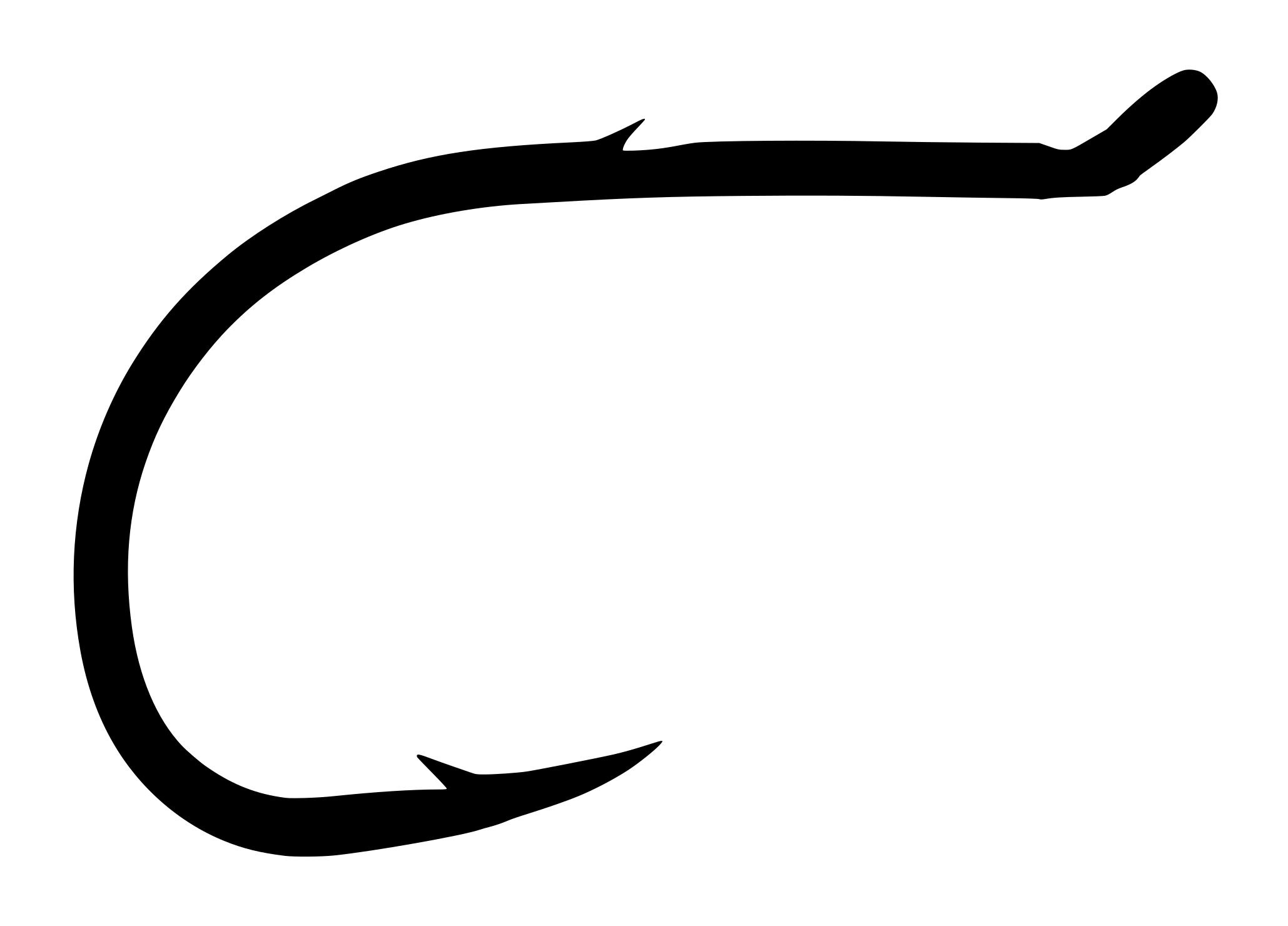
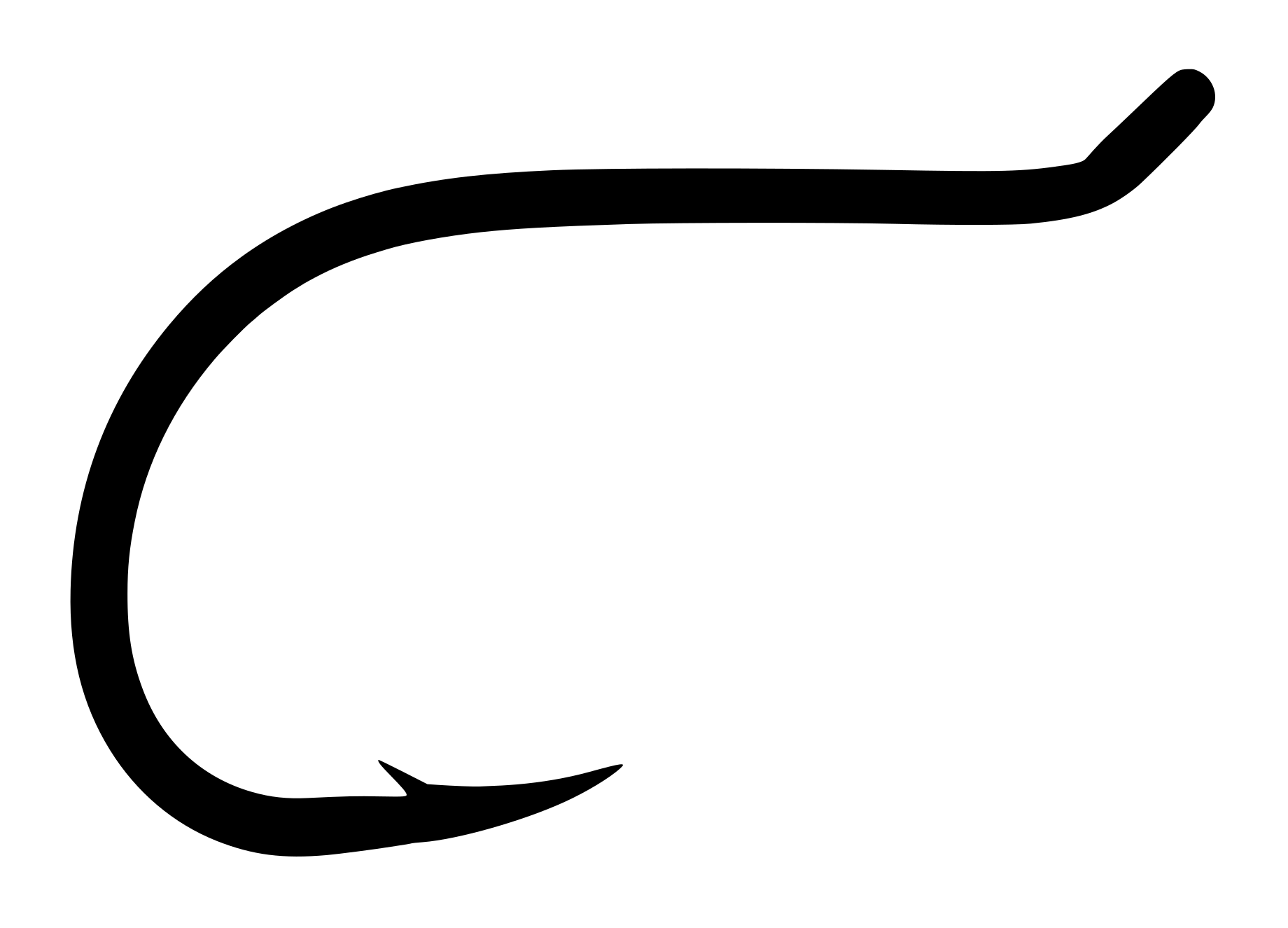
Mustad 9523 Viking, No. 14, bronzed finish. A standard production trout hook from Mustad’s Viking line, manufactured in Norway and distributed through the Auburn, New York subsidiary in the 1970s–1980s. Turned-up tapered eye, sproat bend, standard round wire, and hollow point — a classic mid-range profile suited to dry and wet flies.
The defining feature is the simplicity of the design: no special features, no forging, no premium finish. This is a workhorse hook optimized for cost-effective mass production. The bronze finish (photographed with warm brown tone) shows minor surface patina consistent with 50+ years of storage in original packaging.
Era evidence is strong: plastic clamshell packaging with offset printing, Auburn address on the label (Mustad USA post-1968), and ‘Made in Norway’ attribution all place this in the 1970s–1980s. The absence of a barcode reinforces pre-barcode-era production.
Collecting significance is minimal. The 9523 is common, with no specialized collector demand. Value lies entirely in utility for fly tyers. Original packaging adds modest appeal but no premium; a complete card typically sells for $8–$33 depending on condition and pack size.
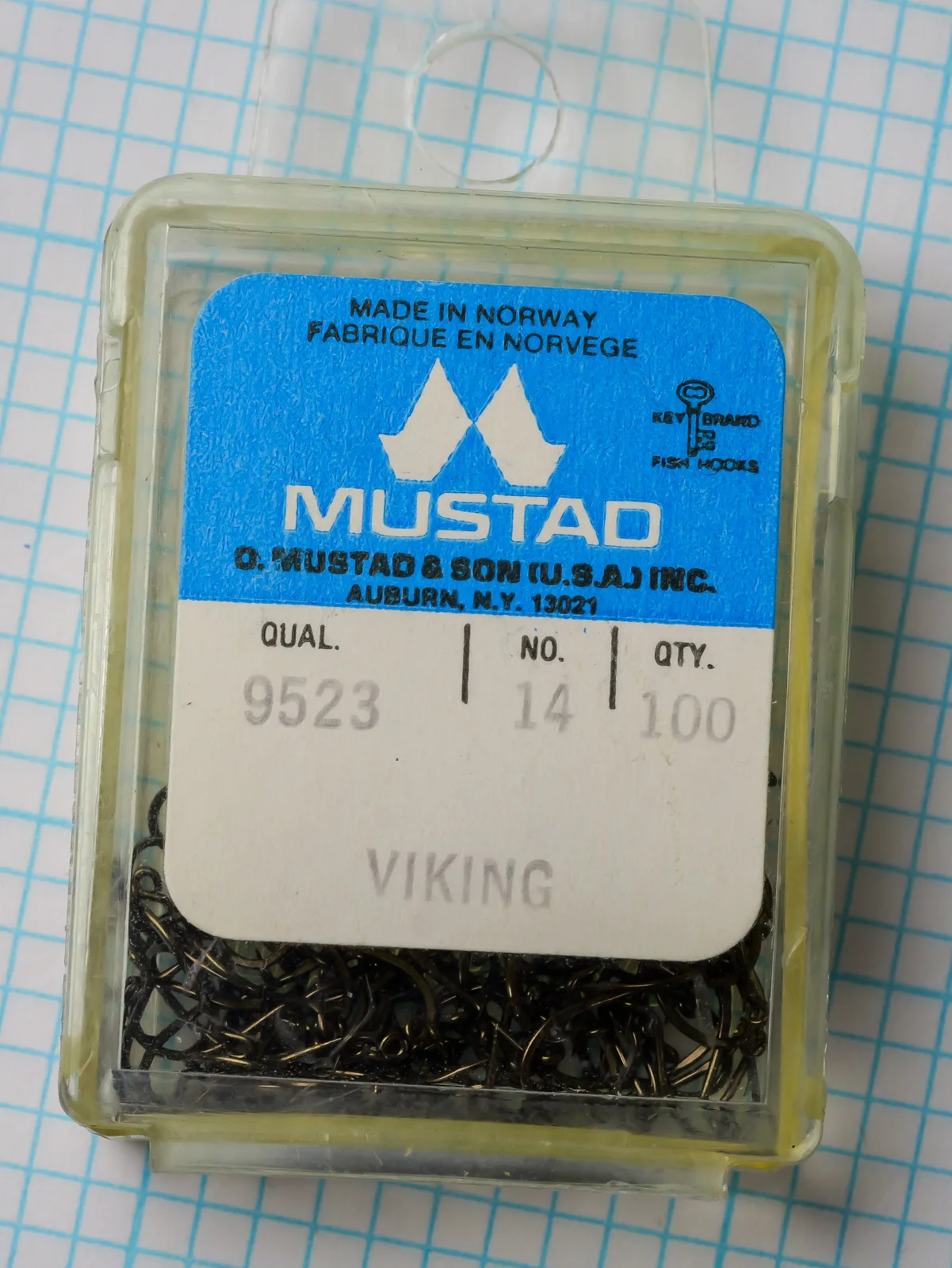
Original yellow plastic clamshell and cardboard label for Mustad 9523 Viking Hook, size 14, 100-count. Label shows 'Made in Norway' marking and distributor address (O. Mustad & Son (U.S.A.) Inc., Auburn, N.Y. 13021), indicating 1970s–1980s manufacture.
Photographic record
2 cataloged imagesSelect any record to load it above.
2 images shown
Mustad 9523 Viking Size 14 Clamshell PackagingOriginal yellow plastic clamshell and cardboard label for Mustad 9523 Viking Hook, size 14, 100-count. Label shows 'Made in Norway' marking and distributor address (O. Mustad & Son (U.S.A.) Inc., Auburn, N.Y. 13021), indicating 1970s–1980s manufacture.Open originalMustad 9523 Viking Size 14 Hook ProfileFront-facing profile of a single Mustad 9523 Viking Hook, size 14, on measurement grid. Shows turned-up tapered eye, bronzed finish with warm brown tone, sproat bend profile, and hollow-point geometry. Grid squares = 0.1 inch for scale reference.Open original
Technical profile
Eye
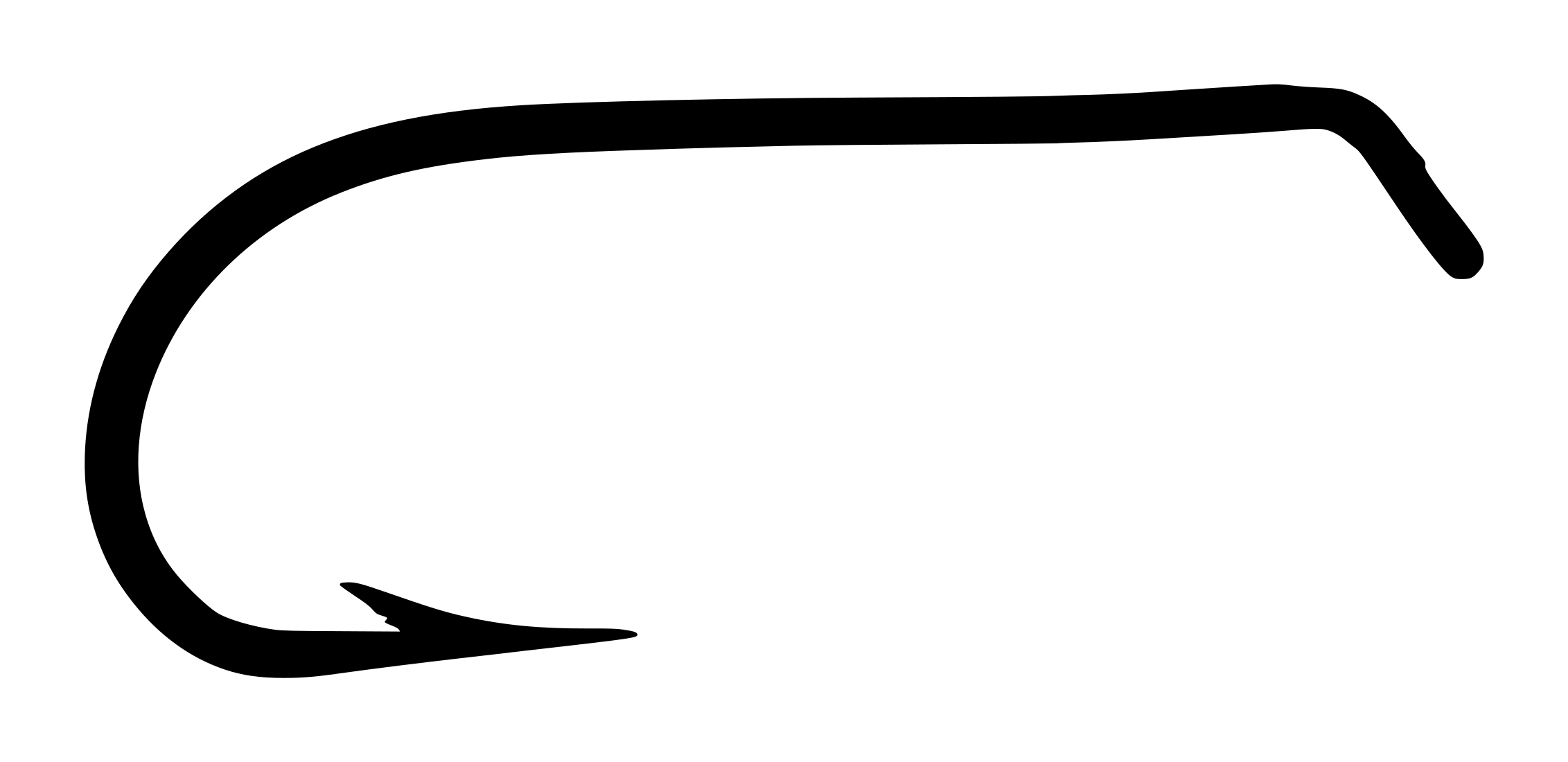
Tapered Eye, Turned Up
Wire
Standard, Forged, Est. ~0.018"-0.022" (~0.46-0.56 mm)
Shank
Short (1X–2X Short) — Plain
Bend
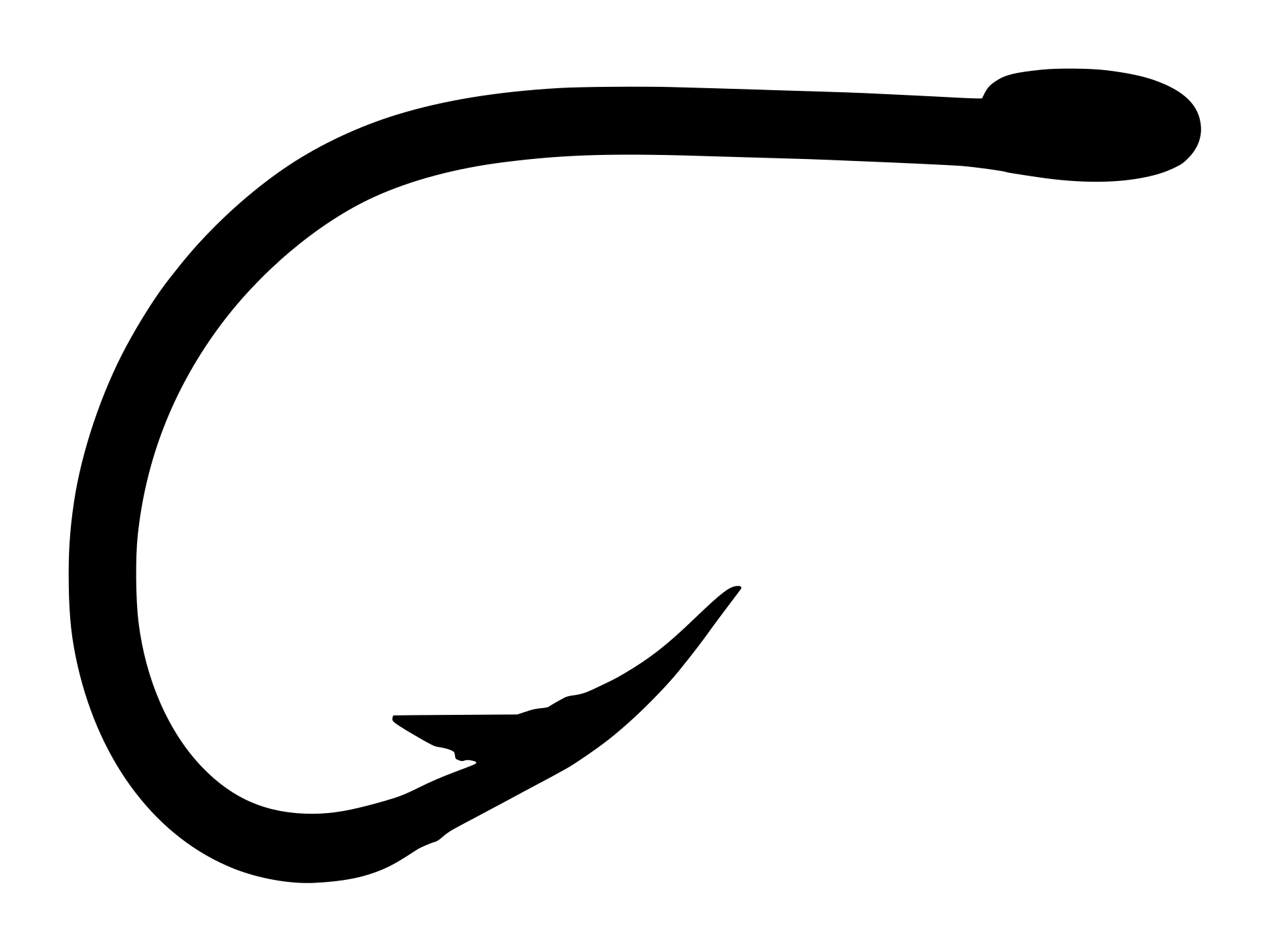
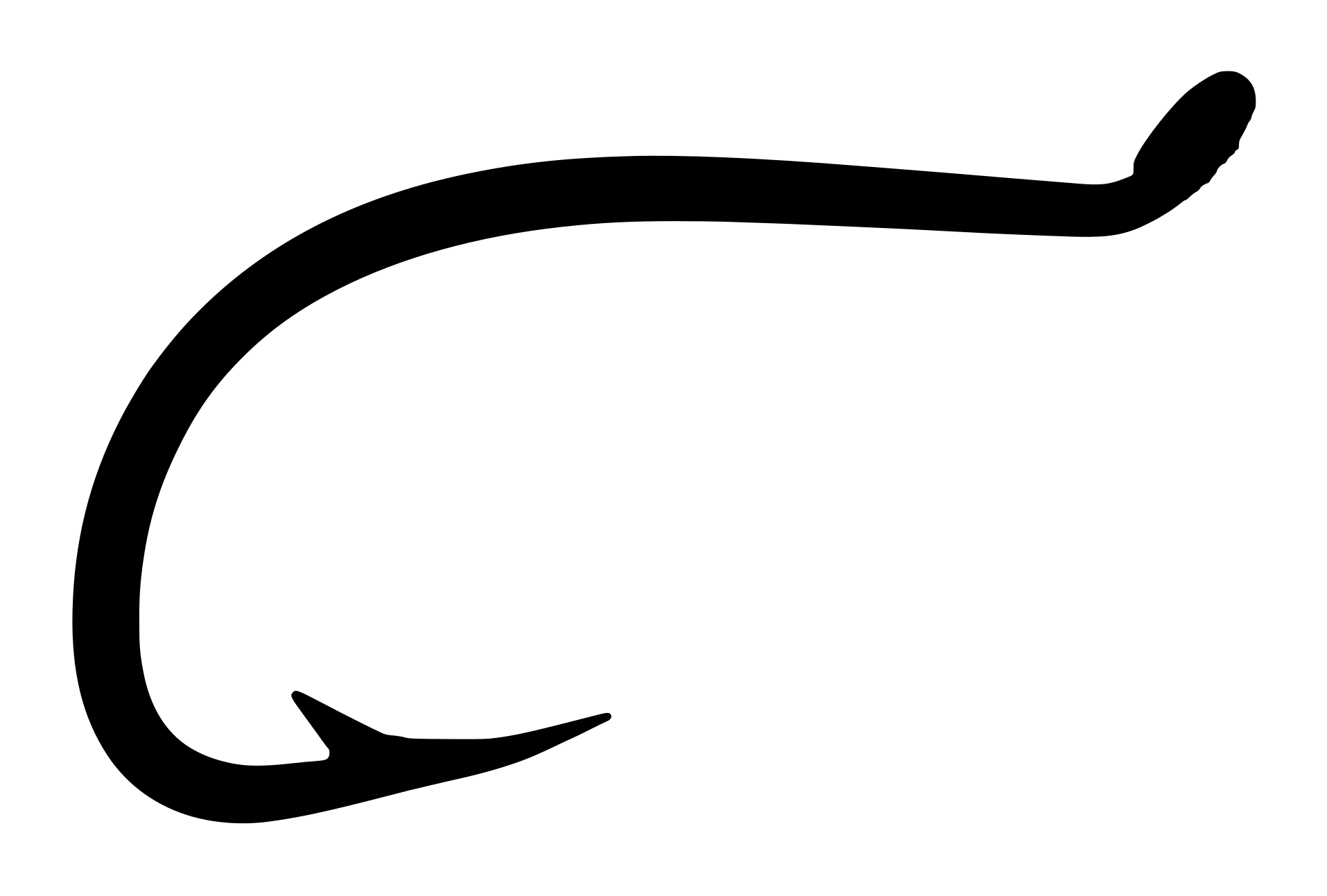
viking, Standard gapClassic O'Shaughnessy deep-forged bend with pronounced downward curve. The return of the wire from the barb creates a slight offset that gives the bend its characteristic geometry. Bend is symmetrical and well-formed, with the deepest point of the curve positioned approximately 40% from the barb. P
Point
Hollow Point (concave inner face)Short, close-cut barb positioned immediately below the bend apex. Barb angle is acute relative to the shank, typical of saltwater Mustad production. Barb placement is precise with minimal burr visible on specimen. P
Finish
Bronzed — Inferred (photographically likely)Bronzed finish exhibits warm brown tone characteristic of period Mustad production. Steel grain texture visible through the coating, indicating a relatively thin bronze layer. Finish shows even color throughout the visible surfaces with light surface oxidation consistent with age. The warm brown tone confirms bronzed rather than blued or nickelled finish. (P, I)
Specimen hooks are unblemished with bright wire and no active corrosion. Card shows moderate aging with light yellowing and surface patina on the red field; four corners show minor edge wear consistent with original storage. All text is clear and legible. No marks, tears, or significant creasing visible.
The 9523 employs a hollow point — a concave inner face that forms a gentle inward curve from the barb to the tip. This geometry creates a slight ‘knife-edge’ effect that aids penetration in softer fish mouths (trout, panfish) while reducing stress on delicate hook eyes during casting or take-down. The hollow point is a mid-range design, less aggressive than a knife-edge point but more effective than a blunt standard spear.
The sproat bend features a rounded, symmetrical bottom with a tight radius of curvature. This geometry distributes load evenly across the bend during a hard take and is favored for dry flies, where a precise, deep bend prevents the fly from riding high on the shank. The sproat’s deep profile also accommodates bulky fly bodies without fouling the gap.
Wire gauge is standard — approximately 0.018–0.022 inch (0.46–0.56 mm). For No. 14 trout hooks, standard wire provides adequate strength for 0–4X tippet without being so heavy that the hook sinks prematurely in surface film.
The turned-up tapered eye is angled upward at approximately 45°, a practical choice for both dry and wet flies. The tapered (non-looped) eye is cheaper to manufacture than a ball eye and poses no functional disadvantage in typical usage.
We don't have measured sizes for this hook yet. Own one? Submit calipered measurements and we'll review and add them. Thank you!
Historical context
mustad
O. Mustad & Son (Gesellschaft mit beschränkter Haftung) was founded in 1832 in Gjøvik, Norway, and became the world’s largest industrial fishhook manufacturer by the 20th century. The company’s vertical integration — from wire drawing to finished hook production — enabled economies of scale unmatched by English craft makers in Redditch.
In 1968, Mustad acquired a majority stake in American hook competitor Pfleuger and established Mustad USA (later O. Mustad & Son (U.S.A.) Inc.) with manufacturing and distribution headquarters in Auburn, New York. This move secured the North American market and positioned Mustad as the dominant global supplier.
The Norwegian factory in Gjøvik remained the primary production facility for export models throughout the 1970s–1990s. Mustad’s operational model stressed high-volume, low-cost manufacturing using die-striking and cold forging — techniques that made premium hand-finished hooks obsolete by the 1960s.
Series History
The Viking is a product line designation appearing on Mustad clamshell packaging from the 1970s–1980s. It represents a mid-market assortment of general-purpose hooks (sproat, limerick, aberdeen, and round-bend profiles) in common sizes (No. 8 through No. 20). The 9523 is the Viking sproat model.
No formal series documentation is available, and ‘Viking’ appears to have been primarily a North American retail branding device rather than a distinct manufacturing line. The hooks themselves are standard Mustad industrial production with no unique specifications.
The Viking line was eventually phased out as Mustad consolidated packaging and standardized its product line under the generic Mustad brand in the 1990s. No collector significance attaches to the ‘Viking’ designation.
Era and Packaging Dating
Packaging shows Auburn, New York address (Mustad USA subsidiary post-1968 acquisition). Blue and cream plastic clamshell format with offset printing is characteristic of 1970s-1980s Mustad retail packaging. No barcode visible, consistent with pre-1974 or early 1980s. 'Made in Norway' with Mustad/O. Mustad & Son address indicates post-acquisition production from Norwegian factory. Typography and label layout align with 1970s-1980s Mustad corporate design standards.
The Hook That Built a Generation
The Mustad 9523 sproat was a staple of North American fly shops from the 1970s through the 1990s. Many fly tyers learned their craft on exactly this hook — affordable, reliable, and forgiving of mistakes. The shift from clamshell packaging to the modern perforated card format happened gradually in the 1980s, making clamshell cards like this one increasingly scarce in original condition, despite being produced in massive quantities. Today, a sealed 100-count card of No. 14 9523s is a time capsule of leisure fishing culture at the height of the outdoor recreation boom.
Design lineage and influence
The sproat bend traces to the Redditch tradition and competed directly with the limerick (more angular) and aberdeen (wider, rounder) profiles throughout the 20th century. Mustad’s 9523 is a direct industrial descendant of English hand-forged sproats from makers like Allcock and Partridge, adapted for die-striking and mass production.
The hollow point became standard on industrial hooks by the 1960s, replacing the purely conical point of earlier craft hooks. Mustad and other manufacturers found that the slight concavity reduced manufacturing variability while improving penetration — an unintended benefit of economized geometry.
The 9523 remained in Mustad’s catalog well into the 2000s, superseded in the marketplace (but not in production) by modern hook designs with slightly different proportions, specialty barbs, and computer-optimized bends. Functional equivalents today include the Mustad C53S (modern equivalent) and Tiemco 101 (contemporary craft alternative).
Best matchRelated by Attribute
Computed automatically from catalog data — updated as new hooks are added.
Matches: Bend, Gap, Eye, Point, Finish +3 moreDiffers: Shank: Short (1X–2X Short) vs Standard; Wire: Standard vs Fine (1X Fine); Eye Orient.: Turned Up vs Turned Down +1 more
Matches: Bend, Wire, Gap, Eye, Point +4 moreDiffers: Shank: Short (1X–2X Short) vs Standard; Eye Orient.: Turned Up vs Turned Down; Application: Dry Fly, Wet Fly vs Dry Fly, Wet Fly, Nymph +1 more
The Mustad 9523 is a generalist hook equally suited to dry and wet fly construction in the small-to-medium trout range (stream sizes 12–18). The sproat bend’s rounded, deep profile is ideal for dry flies, where precise geometry prevents the body from riding high on the shank. The same bend works well for wet flies and soft-hackle patterns, where the tight radius distributes line strain evenly. The hollow point aids penetration in the softer mouths of stream trout (brown, cutthroat, brook trout) without tearing delicate tippet.
Secondary Applications
Panfish (crappie, bluegill), small kokanee and landlocked salmon, teaching hook for beginning fly tyers.
Classic Fly Patterns
Not typically associated with a specific named fly pattern; used as a general-purpose hook for dry flies, wet flies, and nymphs in sizes 8–20.
Modern Equivalents
Hook
Match Quality
Notes
Mustad C53S
Excellent
Modern industrial sproat with updated proportions and micro-barb; direct functional equivalent.
Tiemco 101
Good
Japanese-made sproat with superior finish; slightly lighter wire; contemporary alternative for serious tyers.
Partridge L4A
Very Good
English craft sproat in the Redditch tradition; heavier, more refined; premium positioning.
Collector notes
Rated 1.5/10 — industrial mass production with abundant surviving stock. No. 14 is a standard trout size produced in large quantities. Original packaging adds modest collector interest but minimal premium.
Reference value
$8 – $33 USD estimate
Packaging condition
Excellent — minimal wearRecorded specimen
Packaging format
plastic-clamshellCatalog code
This hook is a standard production model from Mustad’s high-volume Viking line. Scarcity is minimal; surviving examples are readily available through eBay, bulk lots, and estate collections. Complete sealed cards command no meaningful premium over opened cards with full hook count.
Collector demand is casual at best. The 9523 is functional and historically interesting as a post-1970 Mustad industrial design, but holds no status within fly-tying tradition or tackle history. No specialized collecting community seeks the Viking line. Value is driven entirely by functional utility for tyers, not rarity.
Condition factors: Hooks must be complete and unoxidized (bright bronze, free of green corrosion). Cards with fading, torn flaps, or water damage see deeper discounts. Size No. 14 is common; larger sizes (8–12) are equally abundant.
Packaging
Clear yellow plastic clamshell with hinged closure and cardboard insert. Blue and cream cardboard label with Mustad logo (two peaks trademark), 'MADE IN NORWAY / FABRIQUÉ EN NORVÈGE' text, and distributor address (O. Mustad & Son (U.S.A.) Inc., Auburn, N.Y. 13021). Label reads: QUAL. 9523 | NO. 14 | QTY. 100. Below label: 'VIKING' printed in gray. Hooks loose inside clamshell, not bound to card. Yellow plastic shows light yellowing; label shows minor toning. Printing is offset, consistent with 1970s–1980s manufacturing.
Market Value Notes
Low ($8): Good condition — opened card, all or most hooks present, minor packaging wear.<br />
High ($33): Mint condition — sealed or complete, all 100 hooks present, minimal defects.<br />
Premium factors: Sealed card, complete hook count, minimal corrosion, clear printing on label.<br />
Platforms: eBay completed sales (bulk/quantity packs), online fishing retailers.<br />
Confidence: V verified — based on 4 eBay sold listings, $7.95–$32.99, avg $17.98.
eBay market reference. Researcher-curated. Prices in USD. Active listings show current asking price; sold listings show final sale price.
Preservation
Storage and Preservation
Store the clamshell card in a cool, dry environment away from direct sunlight and moisture. The bronze finish is stable but will develop a darker patina in humid conditions — this is cosmetic and generally considered desirable by collectors. Do not expose to salt spray or aggressive drying agents.
Original packaging should be kept intact. The clamshell protects the hooks and adds significant reference value. If hooks must be removed, store them in a sealed container with a silica gel desiccant packet to prevent oxidation.
Avoid contact between bronze hooks and other metals (steel wool, brass, iron tools), which can cause galvanic corrosion. Inspect periodically for green verdigris, which indicates moisture penetration. If corrosion appears, transfer to sealed storage immediately.
For long-term archival storage, insert the original card into an archival-quality sleeve (acid-free mylar or glassine). Do not use PVC-containing plastic bags, which off-gas and accelerate oxidation.
Primary Source
Label and Packaging Analysis
Source: Label text, Mustad 9523 clamshell card, c. 1970–1990
The label identifies this hook with ‘Made in Norway / Fabriqué en Norvège’ — a bilingual marking reflecting both Mustad’s Norwegian manufacturing heritage and North American distribution through Auburn, New York. The use of French (‘Fabriqué’) appears primarily on hooks distributed to Canada and bilingual North American markets.
The address ‘O. Mustad & Son (U.S.A.) Inc., Auburn, N.Y. 13021’ is a strong temporal marker. Mustad USA was established at this location in 1968 following the acquisition of Pfleuger. The presence of this address on the label places production between 1968 and the late 1980s, when address changes and barcode implementation became standard.
The specification fields—‘QUAL. 9523 | NO. 14 | QTY. 100’—use simplified notation typical of 1970s–1980s clamshell packaging. The model code ‘9523’ does not appear on later cards with the same hook, indicating that Mustad eventually consolidated product codes. The absence of UPC or barcode is consistent with pre-1974 or early 1980s manufacturing.
The ‘VIKING’ line designation appears only on clamshell cards from this era. It does not appear on modern Mustad cards, confirming that ‘Viking’ was a short-lived retail branding initiative rather than a permanent product line.
Size Note
No. 14 — A Standard Trout Size
Size No. 14 is a standard trout hook within the Mustad 9523 range (typically produced from No. 8 to No. 20). The photographed hook measures approximately 0.68–0.78 inches overall (~17–20 mm), consistent with published Mustad No. 14 specifications from the 1980s.
There is no anomaly in sizing. The hook fits squarely in the mid-range of the product line — larger than the finer dry-fly sizes (16–20) but smaller than the wet-fly and bass sizes (8–12). Size 14 was and remains one of the most popular production runs in this series.
Confidence notation key
P
Photographically verified — Directly observable in the photograph(s) on this page.
V
Verified by documentation — Confirmed by manufacturer catalog, spec sheet, or published reference.
I
Inferred — A logical deduction from observable or documented evidence, not directly stated.
E
Estimated — An approximation based on visual comparison, proportional analysis, or limited data.
S
Speculative — A reasoned hypothesis that cannot be confirmed from available evidence.
Claims with no notation are confirmed by multiple independent sources. All photographs on garrenwood.com are taken on a measurement grid where each square equals 1/10 inch (0.1″ / 2.54 mm).