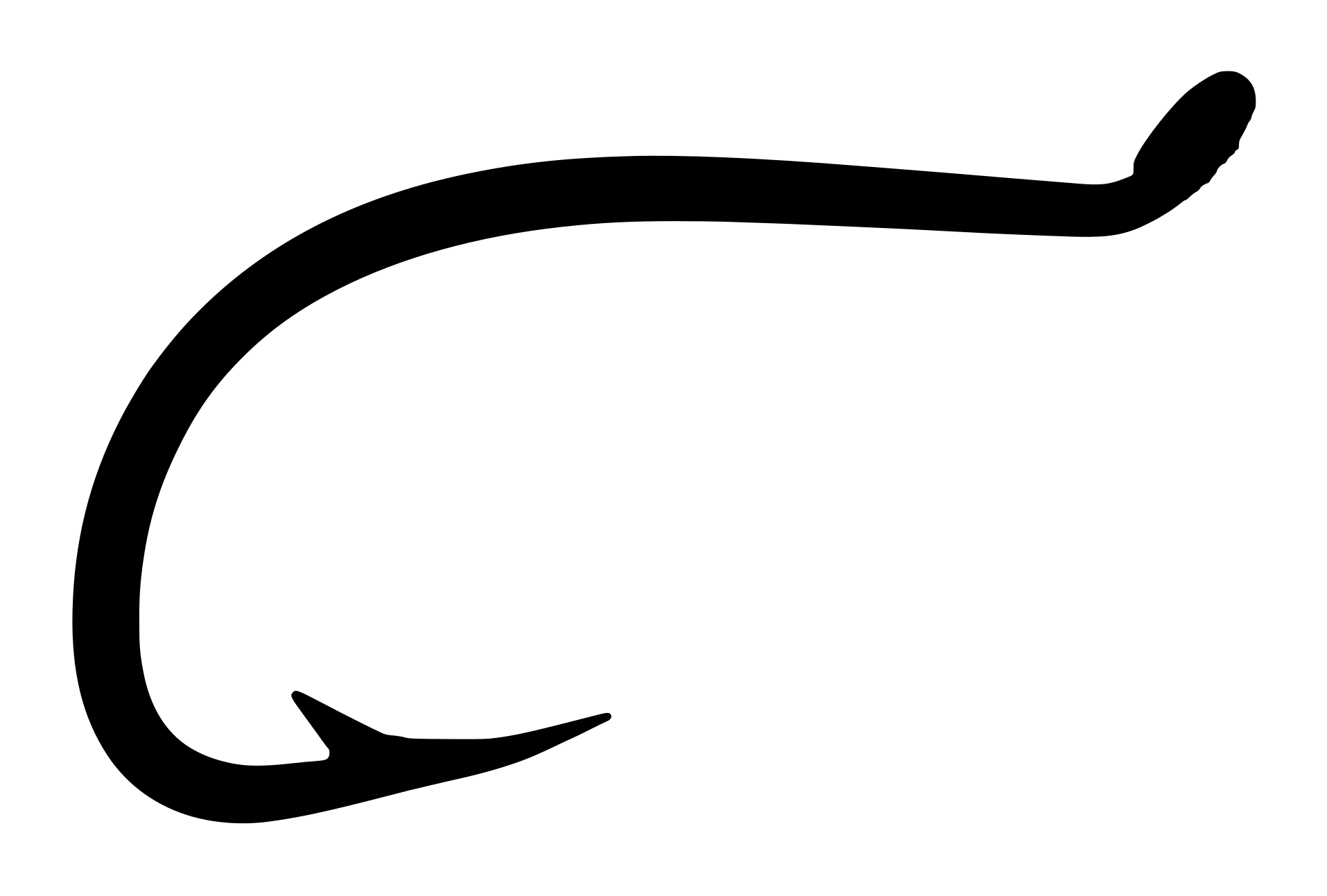
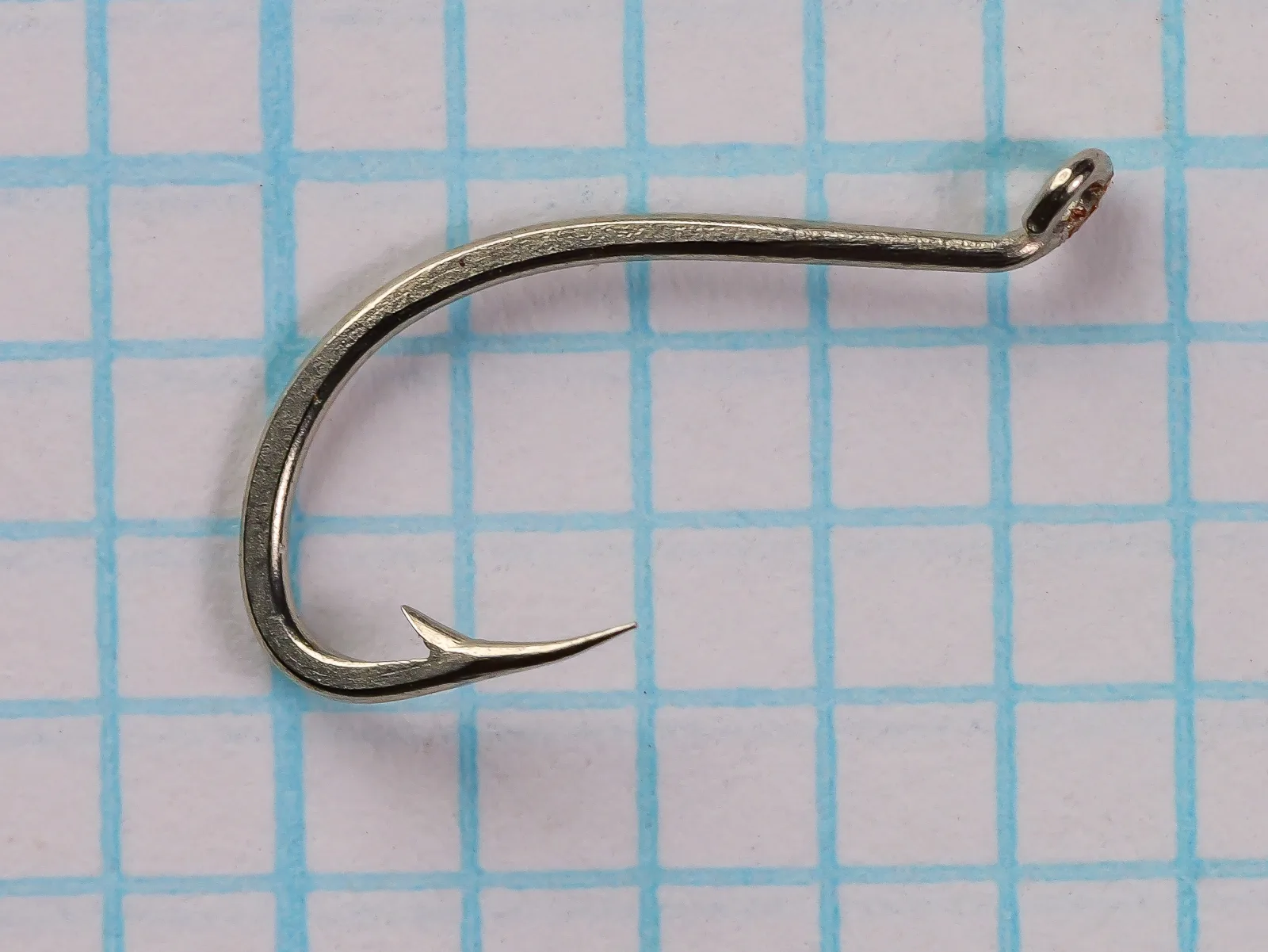
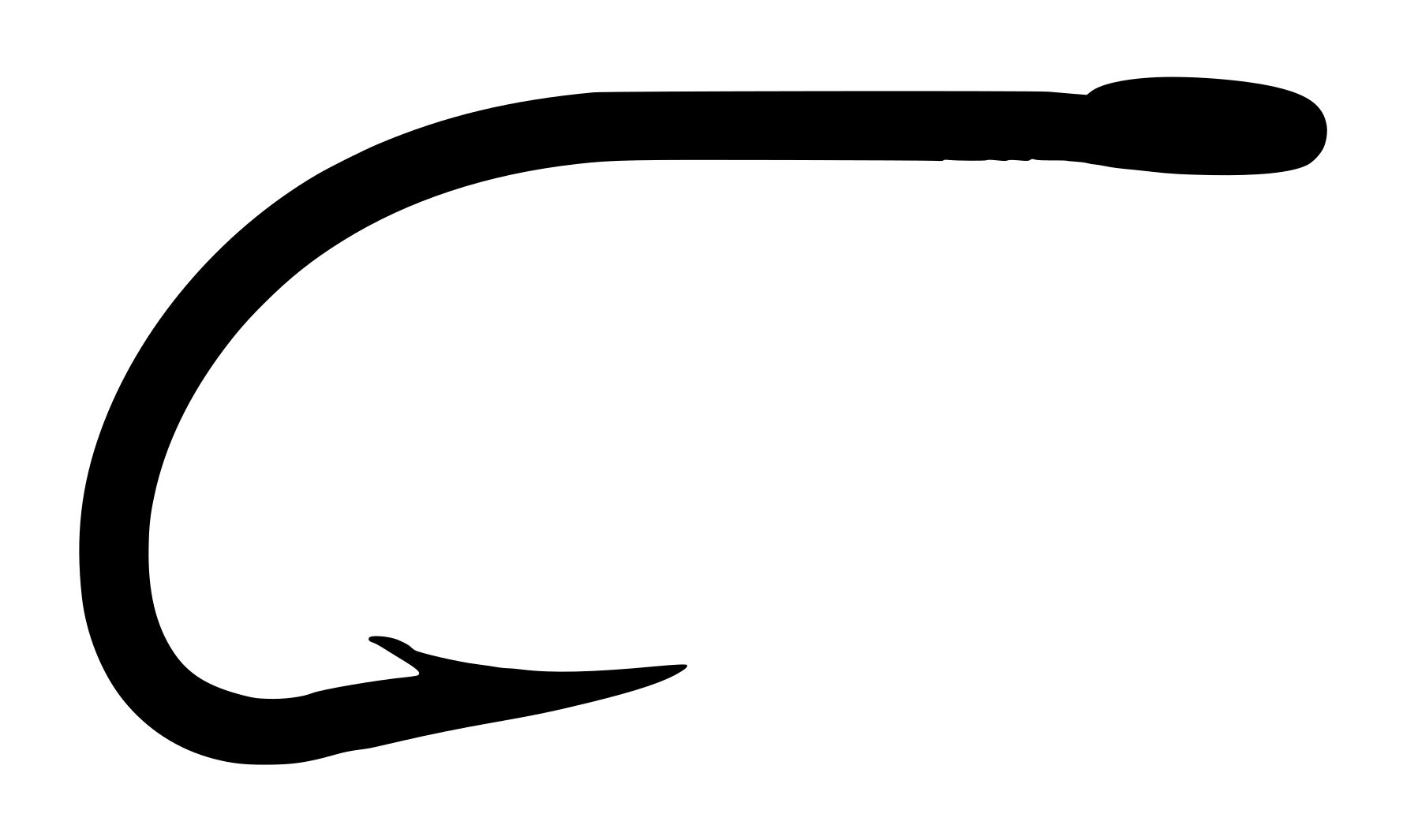
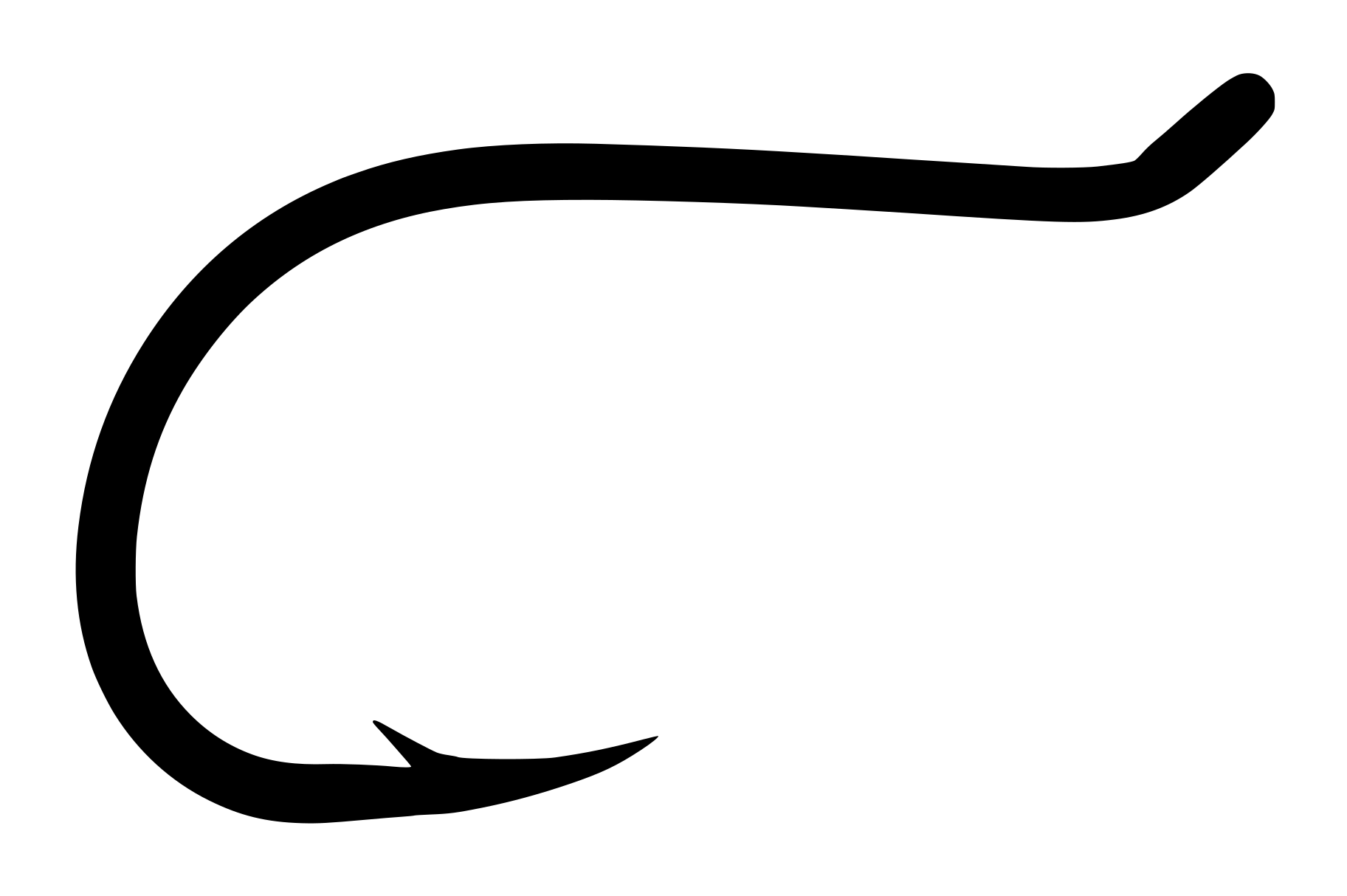
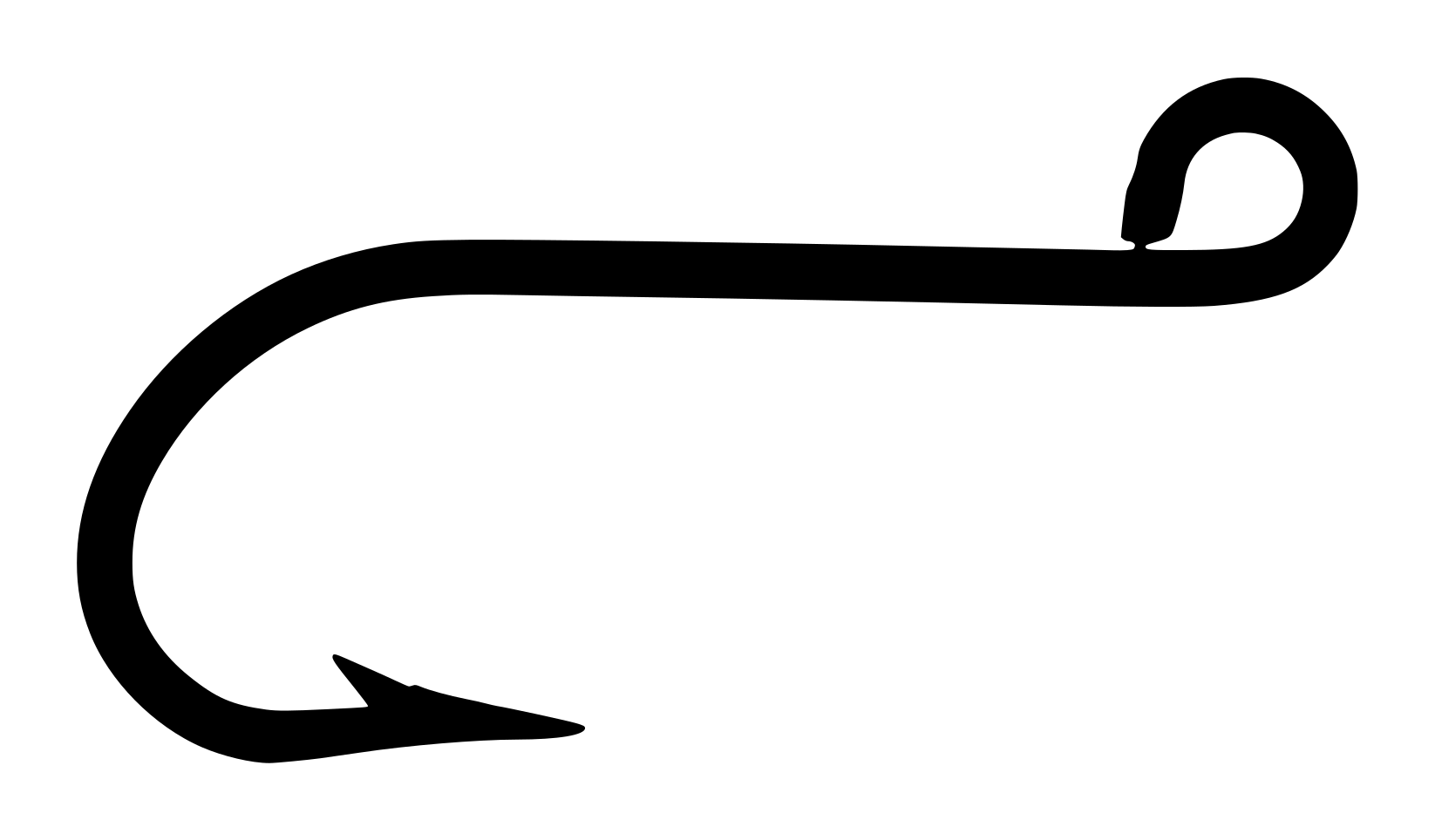
Partridge Steelhead Hook, Size 10 — A rare short-shank steelhead fly hook from mid-20th century Redditch, representing the classic British approach to salmonid pattern design. Made in polished steel with a turned-up tapered eye and gentle Sproat bend, this hook exemplifies the compact, efficient proportions favored by traditional British fly tyers before the long-shank revolution of the 1970s-1980s.
The handwritten kraft envelope packaging—labeled simply ‘STEELHEAD’ and ‘MADE IN ENGLAND’—dates this specimen to approximately 1940-1960, during Partridge’s peak production years under A.E. Partridge & Sons management at the Crescent Works. Albert Partridge took over the Crescent Works Redditch in 1930, and incorporated A. E. Partridge & Sons in 1933.
This is not a long-shank Pacific Northwest-style steelhead hook; rather, it is a compact British sea trout and steelhead pattern for spey work and traditional damp flies. The polished finish and fine wire gauge prioritize presentation and delicate handling over brute holding power, reflecting Redditch craft traditions that emphasized skill and fly design over hardware alone.
Collectors value this hook for its rarity in original packaging, its diagnostic eye and bend construction, and as tangible evidence of British steelhead fly heritage before Mustad’s later acquisitions homogenized global patterns.
Partridge Steelhead Hook in sproat bend configuration. Polished finish. Circa 1940–1960.
Photographic record
2 cataloged imagesSelect any record to load it above.
2 images shown
Partridge Steelhead Hook Sproat BendPartridge Steelhead Hook in sproat bend configuration. Polished finish. Circa 1940–1960.Open originalPartridge Steelhead Hook Package LabelOriginal packaging label for Partridge Steelhead Hook size 10, marked 'Made in England.'Open original
Technical profile
Partridge | Steelhead | Size 10 | Sproat Bend | Short Shank | Polished Steel
Eye
Tapered Eye, Turned UpTurned-up tapered eye with smooth, controlled taper from eye to shank. P
Wire
Standard, Round
Shank
Short (1X–2X Short) — Plain
Bend
Kirby (offset), Wide gap, Offset / kirbedGentle round bend characteristic of Sproat pattern. Forged for strength. P
Point
Beak / Reversed (incurving)Small, close-set barb neatly formed at the bend transition. Standard barb placement. P
Finish
Polished Steel — Confirmed (stated on packaging)Polished bright steel with minimal oxidation. Photograph shows cool silver tone consistent with polished steel (not bronzed). V
The superior point (straight inner face) combines with the Sproat bend to create a hook optimized for penetration and hold in soft mouths of steelhead taken on wet flies. The fine wire gauge reduces splash and wake on entry, while the modest barb ensures secure hookup without excessive disturbance. Forging adds structural integrity despite the slender gauge. The turned-up tapered eye is characteristic of British fly hook design, offering a subtle advantage in line-loop alignment for spey casting and traditional wet-fly presentation. The short shank accommodates proportionate dressing and permits efficient false casting without energy loss to overlong nymphal bodies.
We don't have measured sizes for this hook yet. Own one? Submit calipered measurements and we'll review and add them. Thank you!
Historical context
partridge
Partridge of Redditch was founded in 1836 when hook making began in Redditch, England, making Partridge of Redditch one of the oldest and most respected hook manufacturers in the world. Edwin Partridge was apprenticed in needle pointing and blueing. Albert Partridge took over the Crescent Works Redditch in 1930 and incorporated A. E. Partridge & Sons in 1933.
In the early days Partridge manufactured hooks for brands like Army & Navy, Farlows, Hardy Brothers, and Ogden and evolved by the 1980’s and 90’s to become one of the leaders and innovator of some of the most advanced hook patterns that the industry had ever seen. Partridge pioneered the Waddington shank, initially hand-crafted on bowing machines—a major innovation in fly tying.
Partridge was acquired by O. Mustad & Son, benefiting from shared R&D and quality control improvements such as the introduction of Norwegian steel wire. The company remained a center of innovation, though production dynamics shifted significantly in the late 20th and early 21st centuries.
Series History
Partridge steelhead hooks represent a specific line within the broader Atlantic salmon and sea trout portfolio. The short-shank pattern documented here predates the long-shank variants that became dominant from the 1970s onward. This compact design was the standard offering for British and European steelhead anglers in the mid-20th century, reflecting the influence of spey-casting traditions and the preference for presentation over sheer gap dimension. As fly tying evolved toward aggressive American patterns (large attractors, intruders), the short-shank steelhead fell out of favor in catalog listings, becoming increasingly scarce. Modern Partridge steelhead offerings are predominantly longer-shank, heavier-wire designs, making this historical short-shank pattern a vanished link in the company’s design evolution.
Era and Packaging Dating
Handwritten labeling on kraft envelope characteristic of pre-barcode era (pre-1974). 'MADE IN ENGLAND' mark without postal code or modern ZIP format indicates mid-20th century. Absence of printed manufacturer branding or model number on package (handwritten only) is consistent with 1940s-1950s small-run or stock packaging. Partridge was actively producing steelhead hooks during this period for both home market and export. No evidence of later printing technology (offset litho would be standard by 1960s); handwriting style and ink quality suggest wartime or immediate postwar era. Polished finish without japanning or heavy bronzing was common for quality steelhead offerings in this period.
The Unmarked Standard
In the golden age of British sea trout and steelhead fishing (1940s-1960s), a size 10 Sproat from Partridge was considered a versatile workhorse for both species across Scotland and northern England. Redditch craftsmen took pride in consistent, understated quality—hooks were expected to simply *work* without elaborate packaging or marketing. A handwritten label was often the only distinction between a production run and the previous month's stock. This specimen, with its plain kraft envelope and cursive ink, captures that era of tacit confidence: no need for fancy printing when the hook spoke for itself.
Design lineage and influence
This hook belongs to the lineage of British sea trout and steelhead patterns rooted in Redditch craft traditions. The turned-up tapered eye and Sproat bend echo design principles seen in Bartleet patterns (with which the Partridge family had direct professional ties) and align with the broader evolution of British wet fly hooks. The polished finish and fine wire gauge represent a different design philosophy than the later heavy-forged, nickel-plated steelhead irons popularized by American fly tyers. No direct predecessor or successor model name is documented; this appears to have been a standard line item rather than a named pattern.
Best matchRelated by Attribute
Computed automatically from catalog data — updated as new hooks are added.
Matches: Bend, Shank, Gap, Forging, Offset +2 moreDiffers: Wire: Standard vs Extra-Heavy (2X+); Eye: Tapered Eye vs Ball Eye; Eye Orient.: Turned Up vs Straight / Inline +3 more
Matches: Shank, Gap, Eye, Eye Orient., Point +3 moreDiffers: Bend: Kirby (offset) vs Round / Kendal; Wire: Standard vs Fine (1X Fine); Finish: Polished Steel vs Nickelled +2 more
Matches: Bend, Shank, Gap, Eye Orient., Forging +3 moreDiffers: Wire: Standard vs Fine (1X Fine); Eye: Tapered Eye vs Cross Eye; Point: Beak / Reversed vs Superior +3 more
Matches: Shank, Wire, Gap, Point, Forging +2 moreDiffers: Bend: Kirby (offset) vs Sproat; Eye: Tapered Eye vs Ball Eye; Eye Orient.: Turned Up vs Turned Down +3 more
This short-shank steelhead hook is designed for traditional sea trout and steelhead wet fly patterns in British and Northern European traditions. The compact shank and standard gap make it ideal for smaller to medium steelhead flies, particularly spey casts and traditional damp patterns. Unlike the long-shank, wide-gap designs that dominated later Pacific Northwest steelhead fly development, this pattern represents the classic Redditch approach to salmonid fishing—refinement and proven fishing efficiency over raw holding capacity.
Secondary Applications
Can also be employed for small Atlantic salmon patterns and sea trout speys.
Classic Fly Patterns
Traditional wet fly patterns including Spey patterns, wets, and smaller steelhead flies.
Modern Equivalents
Hook
Match Quality
Notes
Partridge SH (modern steelhead, long-shank variants)
Moderate
Modern Partridge steelhead hooks are predominantly long-shank and heavier-wire designs. They fulfill the same functional role (steelhead wet flies) but represent a different design philosophy, emphasizing holding capacity over presentation refinement.
Tiemco TMC 600SP (sea trout spey)
Good
Japanese-manufactured spey hook with comparable short shank and tapered eye. Closer in design intent and presentation approach than modern long-shank steelhead patterns.
Collector notes
Rated 5.5/10 — scarce in original packaging. Short-shank steelhead hooks of this era are infrequently encountered, and Partridge examples with handwritten period packaging are particularly uncommon. Collector demand is steady among British tackle historians and traditional-pattern fly tyers, but not intense. Original packaging is a significant premium factor; the hook alone would rate lower.
Reference value
$6 – $15 USD estimate
Packaging condition
Fair — significant wear, partially legibleRecorded specimen
Packaging format
GW-E-ENVELOPE-HWCatalog code
Positive Factors: Original handwritten kraft envelope significantly increases collectibility. Hand-packaging is diagnostic of 1940s-1950s British tackle manufacturing and is seldom encountered on size 10 hooks. The turned-up tapered eye and Sproat bend are recognizable Partridge signatures. Polished finish is less common than japanned or bronzed examples, adding visual distinction. The hook represents a vanished design (short-shank steelhead) that is historically instructive for modern fly tyers interested in British traditions.
Limiting Factors: Single hook (not a full card) reduces value compared to complete original packages. No manufacturer markings, model code, or documented pattern name limit authentication and research value. Size 10 is neither extremely rare nor common—a mid-range size with modest demand. The hook shows no unusual forging anomalies or construction errors that would elevate it to curiosity status. Polished finish, while attractive, is less dramatically visible than heavily bronzed or japanned hooks.
Most Desirable Variants: Complete original cards in sealed condition; larger sizes (6/0 to 2/0) or smaller sizes (16+) in original packaging; any examples with printed Partridge branding; matched pairs from same production run.
Condition Impact: Original packaging condition is paramount. A sealed or near-sealed card would command 2-3x the value of this single-hook specimen. Hook condition itself is excellent with no corrosion or defects, but the specimen lacks the packaging premium that drives collectibility in the 5.5-6.5 range.
Packaging
White kraft paper envelope, hand-labeled in cursive ink with 'STEELHEAD' and 'MADE IN ENGLAND'. Single hook inside. Envelope shows age-related yellowing and light creasing. No printed text, barcode, or model information visible. Consistent with cottage-production or small-batch packaging typical of 1940s-1950s British tackle trade.
Market Value Notes
Low ($6): Single hook with original envelope, polished condition. High ($15): Hypothetical complete original card of 10-25 hooks in sealed condition. Premium factors: Original period packaging (handwritten label is key), Partridge maker mark, British provenance, rarity of short-shank steelhead in this era. Platforms: eBay UK/US (limited comparable sales for this specific hook), specialty British tackle dealers, vintage fly fishing forums. Confidence: E estimated — very few comparable sales data points available; estimate based on general scarcity of mid-20th-century Partridge cards and single-specimen pricing patterns on similar era British hooks.
Where to Find
Rare. Occasionally appears on eBay UK with broad searches for 'Partridge vintage hook' or 'British steelhead hook.' Specialty British tackle dealers (Angling Active, Fly Tying Company UK) occasionally list vintage Partridge stock, though this specific short-shank pattern is uncommon. Estimated 1-2 offerings per year across all platforms.
Collector's Identification Tips
Handwritten ‘STEELHEAD’ label is key identifier. Hook itself marked with no stamps or codes (era-typical for size 10). Partridge hooks of this period often lack identifying marks; authentication relies on overall construction quality, eye type, and finish. The short shank and turned-up tapered eye combination is diagnostic for this era of British steelhead patterns.
Marking Analysis
Handwriting and Packaging Markings
The kraft envelope is labeled in cursive fountain-pen ink with ‘STEELHEAD’ and ‘MADE IN ENGLAND’. The handwriting is consistent with mid-20th-century commerce style—flowing italic script with slight rightward slant. Ink color is faded grey-black, typical of iron-gall or carbon-based fountain pen inks exposed to ~70+ years of storage. No date, price, stock code, or manufacturing detail is present. This spartan labeling is diagnostic of 1940s-1950s cottage production or small-batch packaging by major manufacturers like Partridge, when hand-labeling was faster and cheaper than printing. The absence of any printed text or barcode is consistent with pre-1974 production. The envelope paper itself is low-acid kraft, appropriately aged with light yellowing but structurally intact—no brittleness or delamination visible. Overall, the packaging is consistent with British tackle house practices of the immediate postwar period (1945-1960).
Size Note
Short-Shank Steelhead Design Context
The analyst note emphasizes that ‘these steelhead hooks are not the same ones used in the Pacific Northwest for classic patterns there. This is a much shorter shank hook.’ This is historically significant. From the 1970s onward, fly tyers increasingly adopted long-shank steelhead hooks (1.5X, 2X, even 3X long) for large, flashy patterns suited to aggressive American fishing styles. This compact size 10 Sproat represents the earlier British steelhead paradigm, where refinement of presentation and proportionality of fly to river conditions took precedence over maximum holding capacity. The shank-to-gap ratio of ~1.4:1 is typical of short-shank British sea trout hooks, not the 2.5:1+ ratios of modern steelhead irons. Collectors should note that no catalog image of this exact pattern appears in readily available Partridge literature, suggesting it may have been a staple line item that was eventually dropped as design fashion shifted. The hook works superbly for traditional spey patterns and damp flies; it simply fell out of favor as fly-fishing culture became more commercially standardized and Americanized.
Preservation
Storage and Preservation
Store the hook and envelope in a cool, dry environment away from moisture and direct light. Polished steel is susceptible to surface rust in humid conditions; maintain storage relative humidity below 50%. The original kraft envelope is fragile; do not remove the hook unless absolutely necessary. If the hook must be handled, use clean fingers or cotton gloves to avoid transferring skin oils. Store the envelope flat or in a acid-free container to prevent crushing. Avoid exposure to strong air current (drying effect on paper) or UV light (ink fading). If the envelope begins to deteriorate, consider placing it in a transparent acid-free sleeve for support without encasing the artifact. The polished finish does not require regular cleaning; light surface patina is acceptable and does not detract from visual appeal. Do not attempt to polish or brighten the steel—this will remove surface character and reduce both aesthetics and historical accuracy. If long-term museum-quality preservation is intended, consult a conservator regarding climate-controlled storage and potential stabilization of the kraft paper.
Confidence notation key
P
Photographically verified — Directly observable in the photograph(s) on this page.
V
Verified by documentation — Confirmed by manufacturer catalog, spec sheet, or published reference.
I
Inferred — A logical deduction from observable or documented evidence, not directly stated.
E
Estimated — An approximation based on visual comparison, proportional analysis, or limited data.
S
Speculative — A reasoned hypothesis that cannot be confirmed from available evidence.
Claims with no notation are confirmed by multiple independent sources. All photographs on garrenwood.com are taken on a measurement grid where each square equals 1/10 inch (0.1″ / 2.54 mm).