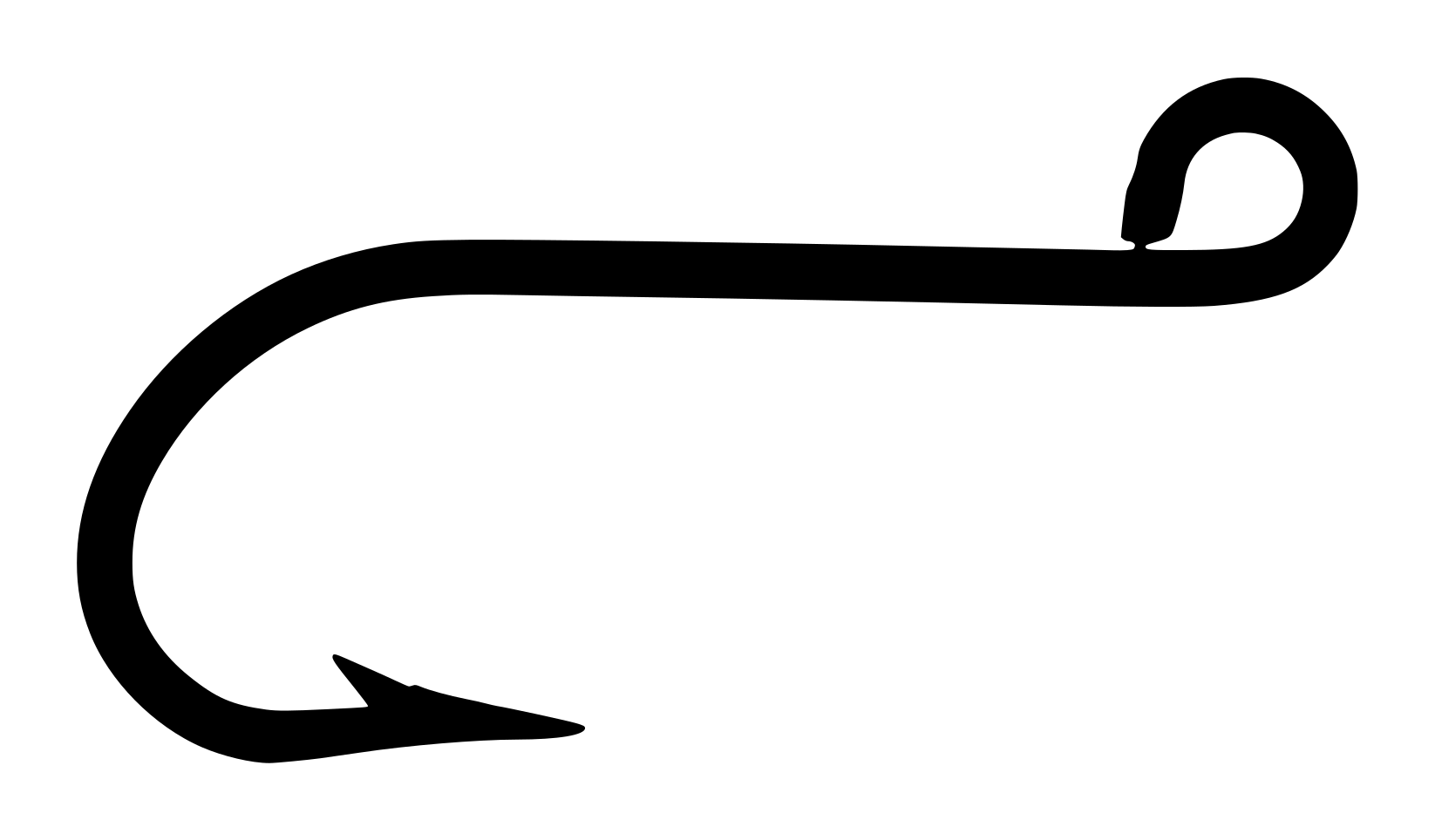
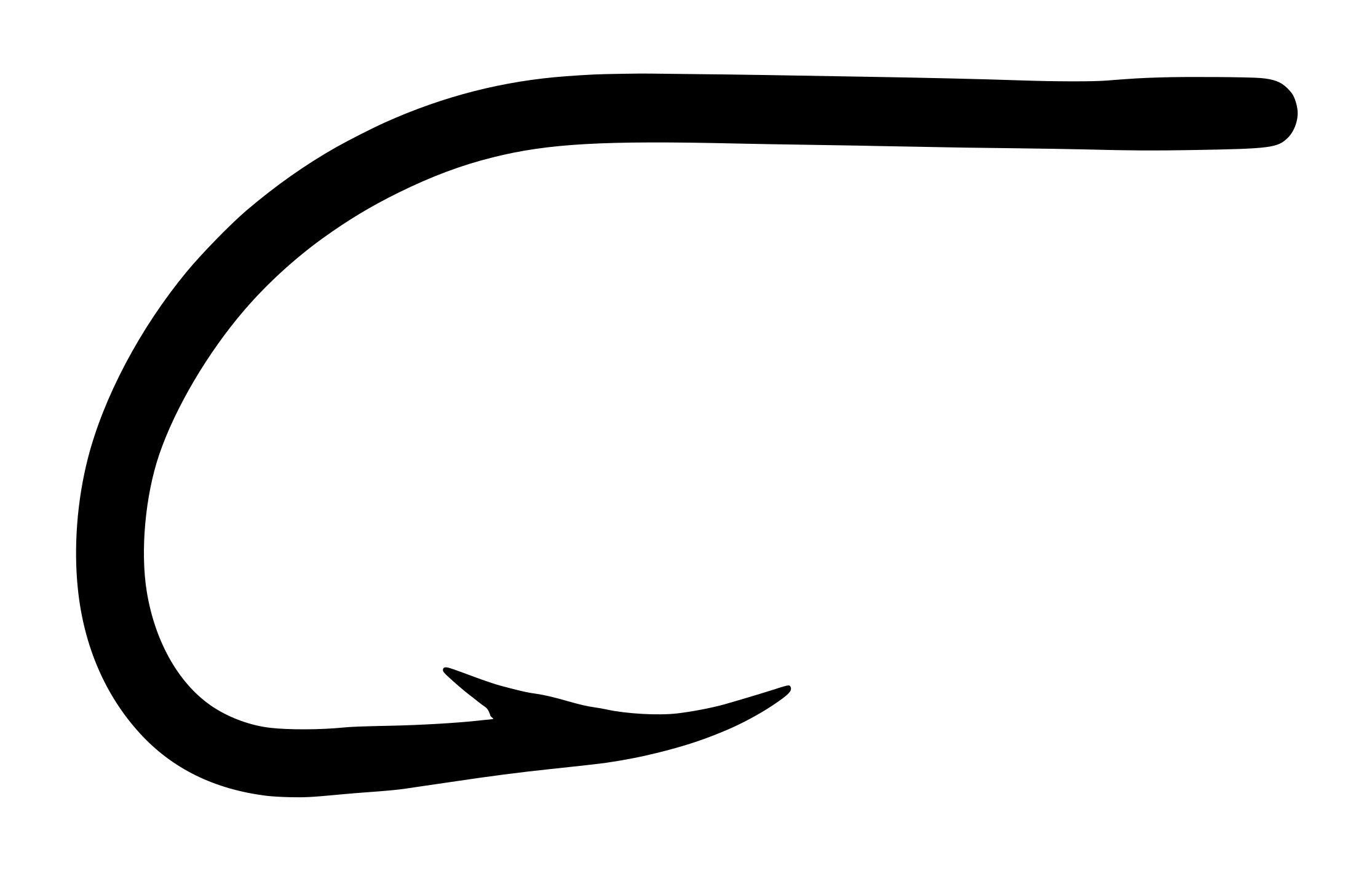
The Mustad 9260 D Beak Hook is a heavy-wire bait hook manufactured by O. Mustad & Søn in Oslo, Norway, during the early-to-mid twentieth century. The model name refers to the distinctive reversed-offset bend geometry — the point is offset to the right when viewed from above — paired with a short shank, wide gap, and forged wire construction. Bronzed finish is confirmed on original packaging.
This is a working bait hook designed for live and cut-bait fishing in saltwater and larger freshwater species. The heavy wire and hollow point provide holding power against active prey and strong jaw pressure. Two longitudinal slices cut into the shank serve as bait-holder grooves, a common feature on Mustad bait hooks of this era.
The original manufacturer box, labeled in block letterpress with model number and specifications, dates to circa 1920s–1950s and contains 100 hooks in size 12. The early Mustad branding and absence of a barcode are consistent with pre-war or immediate post-war production. Original boxes are significantly less common than loose cards and command a premium among collectors.
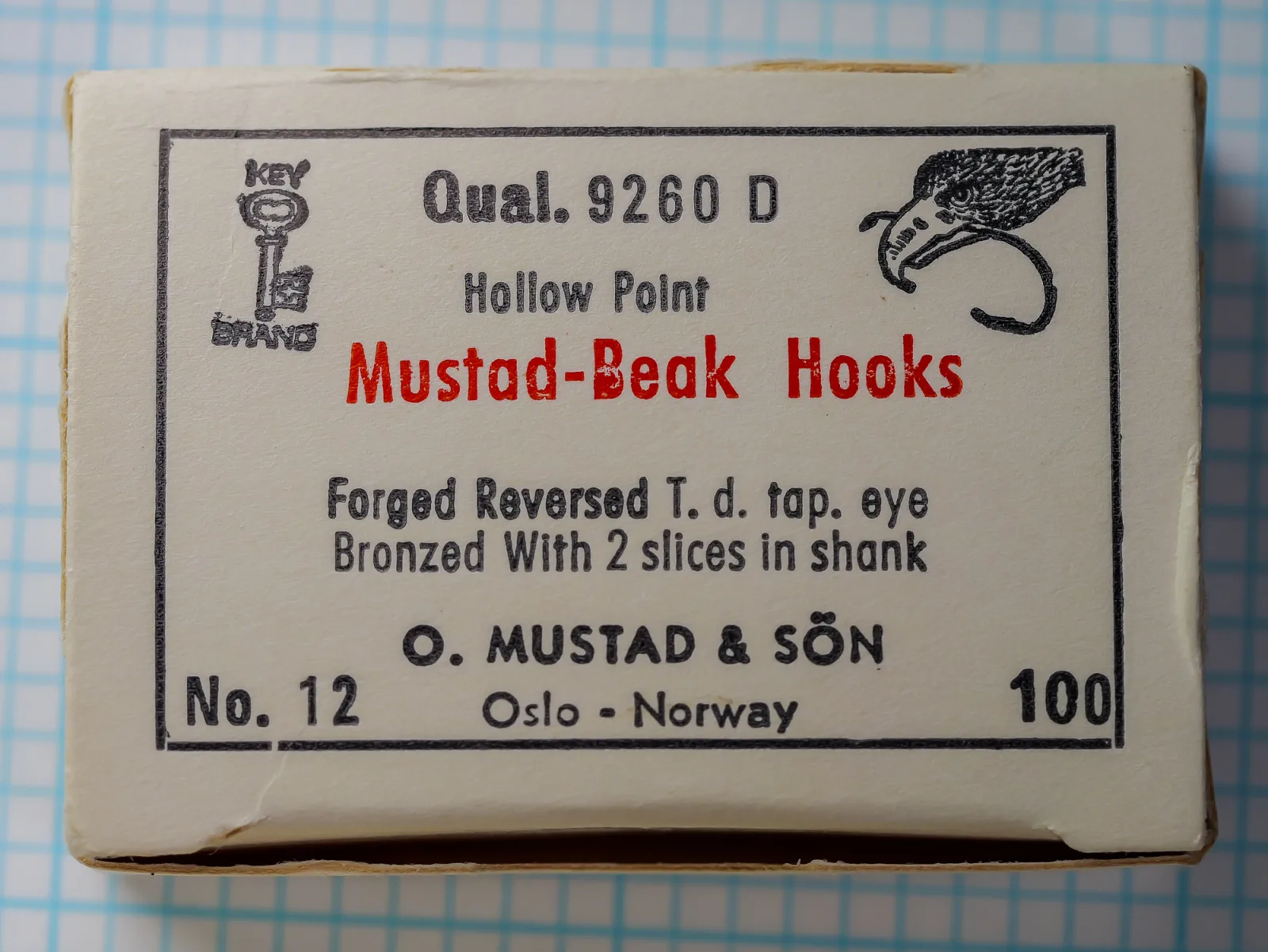
Original manufacturer box label for the Mustad 9260 D, displaying Key Brand logo, model code, specifications (Hollow Point, Forged Reversed, Bronzed, 2 slices), quantity (100), and Oslo, Norway origin. No barcode present; letterpress print on cream stock dates packaging to pre-1950s era.
Photographic record
2 cataloged imagesSelect any record to load it above.
2 images shown
Mustad 9260 D Beak Hook Original Manufacturer Box — Label DetailOriginal manufacturer box label for the Mustad 9260 D, displaying Key Brand logo, model code, specifications (Hollow Point, Forged Reversed, Bronzed, 2 slices), quantity (100), and Oslo, Norway origin. No barcode present; letterpress print on cream stock dates packaging to pre-1950s era.Open originalMustad 9260 D Beak Hook Size 12 — Side Profile with GridSingle Mustad 9260 D beak hook, size 12, photographed on 1/10-inch measurement grid. Shows the characteristic reversed-point (beak) offset geometry, short shank, wide gap, and bronzed wire finish with visible age patina. Forged wire profile is visible under the bronzed coating.Open original
Technical profile
Turned Down Tapered Eye | Beak / Reversed Point | Short | Heavy ( Wire | Hollow Point | Bronzed
Eye
Tapered Eye, Turned DownTapered eye confirmed by researcher examination. Wire tapers progressively into the eye loop, reducing bulk at the point of attachment. Turned down orientation — eye loop angled downward from the shank line. P
Wire
Heavy (1X Heavy), Forged
Shank
Short (1X–2X Short) — Baitholder Slices
Bend
Beak / Reversed Point, Wide gap, Offset / kirbedBeak / Reversed Point geometry confirmed. Point is offset to the right when viewed from eye looking down the shank (reversed offset, not kirbed). Bend is relatively compact; short shank accentuates the wide gap-to-shank ratio typical of bait hooks. Forged wire construction adds depth and strength to the bend. P
Point
Hollow Point (concave inner face)Not documented in detail from photographs. Standard small barb position consistent with early Mustad bait hooks; likely closely cut and angled to grip without crushing soft bait.
Finish
Bronzed — Confirmed (stated on packaging)Bronzed finish confirmed on original packaging label. Photograph shows warm brown-amber tone characteristic of bronzed wire, with visible steel grain texture beneath the coating. Finish is uniform across the bend. Age patina visible on the bronze surface, consistent with 70–100 years of storage. (P/V)
Original manufacturer box with label intact. Lid shows light age toning (brown staining consistent with 70–100 years of storage). Label text remains legible. Box structure remains rigid and serviceable. Some hooks may be missing or corroded (not fully documented in images provided).
Heavy forged wire (1X Heavy gauge) is selected for bait-fishing applications where holding power against live fish and strong jaw pressure is essential. The forging process flattens and work-hardens the wire cross-section, increasing durability and set-resistance.
The hollow point is a concave inner-face geometry that forms a knife-edge effect on the point. This geometry is distinct from the Superior Point (which has a near-straight inner taper). The hollow point is moderately aggressive and holds soft baits securely while providing sharp penetration.
The short shank (1X–2X Short) and wide gap combination is intentional: it leaves maximum room inside the bend for the bait, while the short shank maintains control and reduces leverage stress at the eye attachment point. The two longitudinal slices cut into the shank provide mechanical grip for bait threads or binding — a simple but effective alternative to knobbed or marked-ridged shanks.
The reversed-point offset (beak geometry) places the hook point to the right, angling the barb subtly outward from the shank plane. This geometry is believed to reduce accidental slippage during the strike, though the mechanism is not documented in Mustad technical literature.
This pattern was made in sizes 12-16 (V). We have measurement for size 12. Know the others? Submit calipered measurements and we'll review and add them. Thank you!
Historical context
mustad
O. Mustad & Søn, founded in 1832 in Gjovik, Norway, became one of the world’s largest industrial hook manufacturers by the early twentieth century. The company expanded production capacity dramatically in the 1920s and 1930s, establishing sales networks throughout Europe and North America. Oslo, Norway (listed on this box label) was a major distribution center for Mustad products during this period, though primary manufacturing remained in Gjovik.
Mustad’s product line during the interwar period included hundreds of hook patterns designed for specific fisheries and bait types. The 9000-series model codes (such as 9260 D) belong to the classic middle range of production hooks — working tools rather than premium specialty items. These hooks were sold in bulk to tackle shops, mail-order distributors, and fishing guide outfitters across Europe.
The Key Brand logo on this box is an early Mustad trademark, predating the more elaborate winged anchor logo of the 1950s onward. The presence of this simple key graphic is a reliable dating indicator for pre-1950s Mustad packaging.
Series History
The Mustad-Beak series represents a specific subset of Mustad’s bait-hook offerings, defined by the distinctive reversed-point (beak) offset geometry. This design was introduced in the early twentieth century and remained in production through at least the 1950s, though later variants transitioned to non-forged wire.
The 9260 D designation places this hook in Mustad’s mid-range production catalog. The “D” suffix likely indicates a specific variant — possibly denoting size range, wire gauge, or finish — though Mustad’s internal coding system is not fully documented in surviving trade catalogs.
Beak hooks were marketed to sea-bait fishermen, pike specialists, and commercial bait-fishing operations. The combination of short shank, wide gap, and heavy forged wire made them suitable for live-bait and strip-bait work in saltwater and large-lake environments. Discontinuation date for this model is unknown, but the absence in post-1960s Mustad catalogs suggests it was withdrawn in favor of simplified, non-forged designs by the 1960s.
Era and Packaging Dating
Packaging characteristics: no barcode (pre-1974 indicator); letterpress print with black ink on cream stock; Oslo, Norway address without postal code; Key Brand logo (simple key graphic) consistent with early-to-mid twentieth-century Mustad branding; typed model designation "Qual. 9260 D"; rigid manufacturer box format with label glued to lid; absence of modern product codes all support interwar to post-WWII production.
Eel Trappers and the Beak Hook
In the 1930s, Mustad's bait-hook lines were heavily marketed to commercial eel and pike trappers across Scandinavia and northern Europe. The short shank and wide gap of the 9260 D were optimized for live eel threading — a specialized technique in which a snare needle was run through the eel's nostril and the hook was threaded alongside the line to catch larger pike without injuring the bait. This niche application kept the beak hook in production well past the era of hand-forged hooks, as industrial production allowed Mustad to offer the design at a price that made it economical even for small-volume regional fisheries.
Design lineage and influence
The reversed-point (beak) concept has roots in nineteenth-century British hook design, where offset-point hooks were believed to reduce slippage during the strike. Mustad adopted and standardized this geometry in their industrial production, creating a reliable working hook that competed with similar designs from Allcock and other English makers.
Contemporary bait hooks from the 1920s–1950s period include the Allcock Pennell patterns and the Edgar Sealey bait hooks, which also featured short shanks, wide gaps, and offset-point geometries. Mustad’s forged-wire construction and consistent dimensioning gave the 9260 D a reputation for durability that persisted among professional bait fishermen.
The beak design had limited downstream influence on modern fly hooks; it remained a specialist bait-hook category and did not migrate into saltwater or specialty fly-tying markets. Modern bait hooks have largely abandoned the reversed-point geometry in favor of straight or kinked shanks.
Best matchRelated by Attribute
Computed automatically from catalog data — updated as new hooks are added.
Matches: Bend, Shank, Eye, Finish, Forging +3 moreDiffers: Wire: Heavy (1X Heavy) vs Extra-Heavy (2X+); Gap: Wide vs Standard; Eye Orient.: Turned Down vs Turned Up +2 more
Matches: Bend, Eye, Eye Orient., Point, Finish +5 moreDiffers: Shank: Short (1X–2X Short) vs Standard; Wire: Heavy (1X Heavy) vs Standard; Gap: Wide vs Standard +1 more
Rated 3.5/10 — uncommon to scarce. Original manufacturer boxes are significantly rarer than cards and command a collecting premium; size 12 in bronzed finish is less common than larger sizes. Collector demand is moderate among Mustad historians and vintage bait-hook specialists. Condition of the original box is the primary value driver.
Reference value
$5 – $12 USD estimate
Packaging condition
Good — moderate wear, legibleRecorded specimen
Packaging format
GW-MUS-BOX-001Catalog code
Positive factors: Original manufacturer box format is substantially rarer than glued-card packaging and commands a 2–4x value premium. Early Mustad branding (Key Brand logo, letterpress print, pre-barcode era) dates this specimen reliably to 1920s–1950s, adding historical interest. The forged-wire, hollow-point bait-hook category remains sought by vintage tackle collectors and bait-fishing historians. Size 12 is a functional working size suitable for medium game fish and retains potential collecting interest.
Limiting factors: Beak/reversed-point geometry is a specialized design with limited aesthetic appeal to fly-tying collectors. The model is not documented in surviving Mustad trade catalogs; exact production span is unknown. Mustad’s industrial production volumes (hundreds of thousands of hooks) mean even older examples are not truly rare in absolute terms. No named designer or collaborator credit adds prestige. The bait-hook category has fallen out of fashion compared to saltwater and fly-tying hooks.
Condition premium: Unopened boxes in excellent condition command $40–60. Opened boxes with all 100 hooks present: $5–12. Opened boxes with 50% or fewer hooks: $3–10. Loose hooks only: $0.10–0.30 each or $5–15 per bulk lot.
Packaging
Rigid cardboard box with separate glued-on label. Box is cream-colored stock; label is printed in black letterpress ink on glossy cream paper, mounted directly to the lid. No barcode. Printed text includes: Key Brand logo (simple key icon), model designation "Qual. 9260 D", hook name "Mustad-Beak Hooks", specifications ("Hollow Point", "Forged Reversed T.d. tap. eye", "Bronzed With 2 slices in shank"), manufacturer and location ("O. MUSTAD & SØN", "Oslo - Norway"), size ("No. 12"), and quantity ("100"). Box dimensions and hook arrangement interior not documented. Label shows moderate age toning consistent with early-to-mid twentieth century storage.
Market Value Notes
Low ($5): Good condition — box opened, 80–100% of hooks intact, light wear on label and box edges.<br />
High ($50): Excellent to Mint condition — box sealed or near-sealed, all 100 hooks present, minimal label toning.<br />
Premium factors: Original manufacturer box (vs. loose or card); complete hook count; label legibility and age patina character; early Mustad branding (Key logo).<br />
Platforms: eBay (UK and US), vintage tackle dealers, specialist auctions.<br />
Confidence: E estimated — limited comparable sales data available; range reflects typical manufacturer-box bait-hook pricing with Mustad brand premium.
Where to Find
eBay.co.uk and eBay.com (vintage fishing tackle section, intermittent listings); specialist UK vintage tackle dealers (Coventry, midlands); occasional lots in European tackle auctions and fishing memorabilia sales. Manufacturer boxes from this era appear roughly 2–3 times per year across major platforms.
Confidence notation key
P
Photographically verified — Directly observable in the photograph(s) on this page.
V
Verified by documentation — Confirmed by manufacturer catalog, spec sheet, or published reference.
I
Inferred — A logical deduction from observable or documented evidence, not directly stated.
E
Estimated — An approximation based on visual comparison, proportional analysis, or limited data.
S
Speculative — A reasoned hypothesis that cannot be confirmed from available evidence.
Claims with no notation are confirmed by multiple independent sources. All photographs on garrenwood.com are taken on a measurement grid where each square equals 1/10 inch (0.1″ / 2.54 mm).