Selected size
1
Catalog record
- Overall Length
- 27.6 mm V
- Shank Length
- 17 mm V
- Bend Depth
- 10.9 mm V
- Wire Diameter
- 0.9 mm V
- Confidence
- V Catalog record only
 Garren WoodFishing Hook Reference
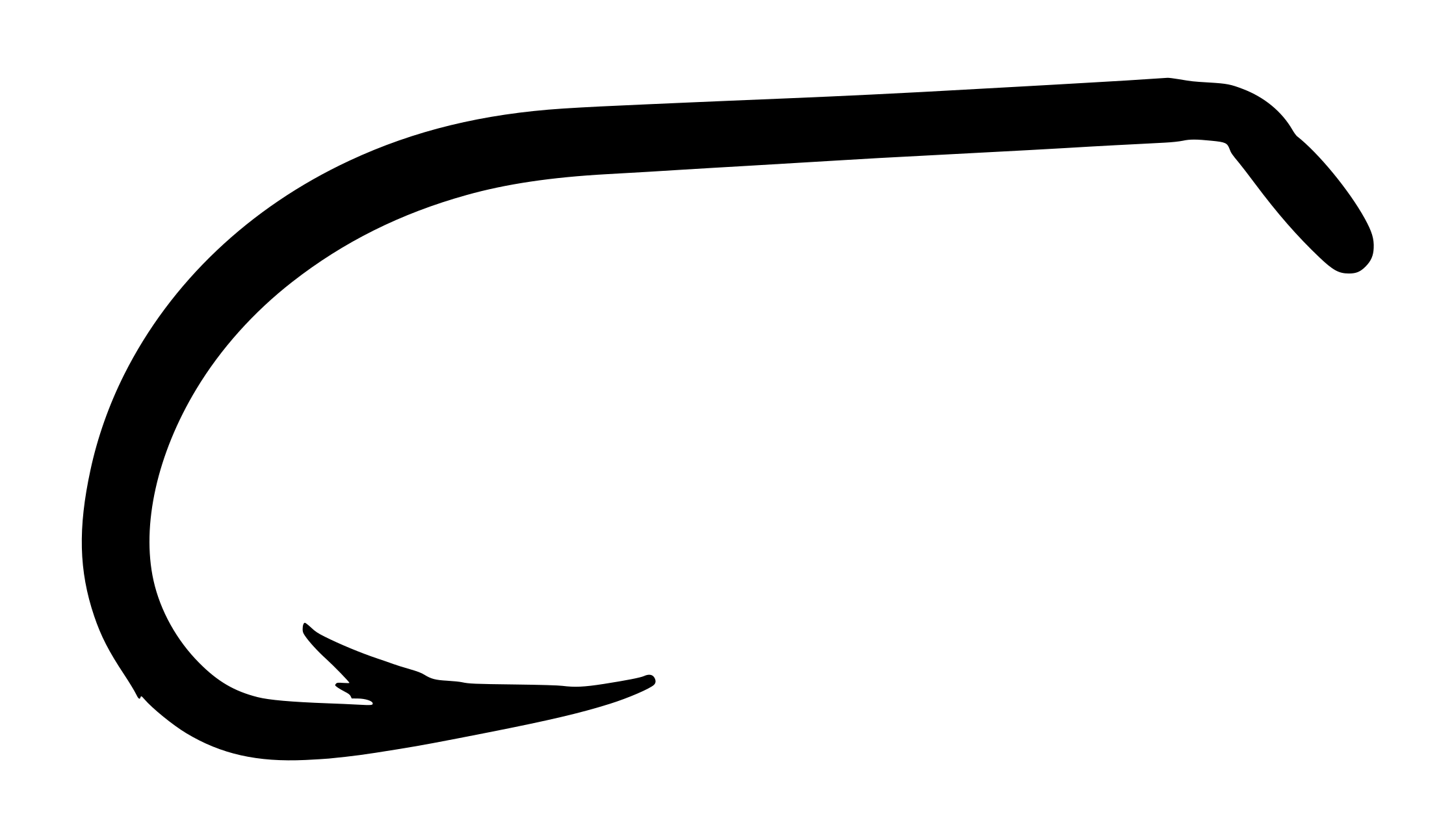
The Mustad 9556 A is a mid-century reversed-beak hook manufactured by O. Mustad & Sön in Oslo, Norway. This No. 12 specimen exemplifies the industrial hook making of the 1950s–1960s: forged wire, hollow point, turned-down tapered eye, and nickelplated finish. The extra-long shank was designed for both live-bait presentations (worm threading, leech fishing) and long-bodied fly patterns.
The “beak” or octopus bend — distinguished by its reversed (kirbed) point offset — was heavily marketed in mid-century North America as an innovation in hook-set mechanics, though modern research has not conclusively proven superiority over straight designs. Nevertheless, the design became a standard offering and remains popular in bait-fishing circles today.
Era evidence: The packaging exhibits no barcode, letterpress print method, “Mustad & Sön – Oslo” branding, and classic eagle-head-and-hook logo — all consistent with c. 1950–1970 manufacture, likely 1955–1965.
Collecting significance: While Mustad’s industrial production volume makes this hook common in most sizes, original packaging from this period is increasingly rare as plastic replaced cardboard in the 1970s. Authentic 1950s–1960s sales cards are modestly collectible among general vintage tackle enthusiasts and fly-tying historians. Condition and size availability affect value more than model rarity.
4 cataloged imagesSelect any record to load it above.
4 images shown
The hollow point construction on the 9556 A features a concave inner face ground away during the manufacturing process, creating a knife-edge taper to the tip. This geometry increases sharpness without requiring excessive hardening, which would make the point brittle. The forged wire profile — slightly flattened on opposing sides compared to a round-wire hook — adds structural strength and allows the hook to penetrate more effectively while maintaining a relatively fine point. The reversed (kirbed) offset point was an intentional design choice based on the theory that an angled point grabs the corner of a fish’s mouth more effectively than a straight point. While later research has questioned this advantage, the design remained popular through the 1960s. The turned-down tapered eye minimizes bulk at the head, important for fly-tying applications where neat proportions are desirable. The extra-long shank shifts the hook’s balance toward the bend, distributing weight across a larger presentation area — functionally beneficial for attaching live bait or creating long, thin fly bodies.
We have measurements for sizes 1, 2, 4. Know any others? Submit calipered measurements and we'll review and add them. Thank you!
O. Mustad & Sön (now O. Mustad & Son) was founded in 1832 in Gjovik, Norway, by Ole Mustad. By the early 20th century, Mustad had become one of the world’s largest industrial hook manufacturers, with production facilities in Norway and distribution throughout Europe and North America. The company pioneered the mass production of forged fishing hooks and was known for rigorous quality control and standardized sizing. Mustad’s innovation in wire-forging techniques allowed production of higher-quality hooks at lower cost than many English competitors. The Gjovik factory operated continuously through the 20th century, making Mustad one of the few surviving hook manufacturers into the 21st century. The company maintained close relationships with tackle retailers and fly-fishing pioneers, ensuring that Mustad hooks remained dominant in both European and North American markets.
The Mustad 9556 A belongs to the Mustad-Beak Hooks product line, a series of reversed-point hooks designed for both bait and fly applications. “Beak” and “Octopus” were used interchangeably in Mustad marketing to describe the reversed (kirbed) point geometry, which was believed to provide superior hook-set mechanics. The 9556 A specifically features an extra-long shank (Ex. long shank), making it suited for worm threading and streamer patterns requiring extended body profiles. The series was produced across multiple sizes (No. 2–No. 16) and finishes (nickelplated, japanned). The 9556 A was discontinued or transitioned during the 1970s–1980s as Mustad modernized its product line and shifted toward plastic packaging and multi-language branding. No direct successor to this exact configuration exists in Mustad’s modern catalog, though the company continues to produce beak-style hooks in other model lines.
No barcode visible — strong indicator of pre-1974 manufacture. Packaging uses letterpress print method (clean black serif type, two-color red heading) consistent with 1950s–1960s production. Logo style: eagle-head-and-hook design matches Mustad branding in this period. Company designation "Mustad & Sön – Oslo" was standard until late 1970s modernization. Box construction is folded cardboard with paper label, typical of mid-century tackle packaging. No multi-language text or modern plastic construction. Price hand-marking suggests retail origin, consistent with era before barcode scanning. Overall evidence points to c. 1950–1970, most likely 1955–1965.
In the 1930s–1950s, the "beak" or "octopus" hook design became a marketing sensation in North America, with tackle manufacturers and fishing magazines promoting the theory that the offset point could outfish straight-shank hooks. This was never scientifically proven, but the aesthetic appeal and perceived innovation drove widespread adoption. Mustad capitalized on this trend by producing the 9556 A in multiple sizes and finishes, marketing it as a modern advancement over traditional designs. Interestingly, the beak hook remains popular in live-bait fishing today, more than 70 years later — a testament to both the power of marketing and the hook's genuine functional versatility. Modern hook manufacturers have largely abandoned the reversed point for precision fly-tying, preferring straight designs, though beak hooks persist in the bait-fishing market where tradition and familiarity drive purchasing decisions.
The reversed-point beak design has roots in 19th-century English hook making, where slight offsets were sometimes incorporated to improve hook-set mechanics in live-bait scenarios. However, the marketing of the “beak” as a modern innovation dates to the 1930s, when American tackle companies began promoting it as a breakthrough. Competitors like South Bend, Shakespeare, and Pflueger produced their own versions, but Mustad’s industrial manufacturing capacity and global distribution allowed the 9556 A to dominate the market. The design influenced later Mustad products, including the 9557 (short-shank beak) and various octopus-pattern hooks. However, by the 1980s, as fly-tying techniques evolved and Redditch craft traditions reasserted influence, the beak point fell out of favor among serious fly tyers. Today, it survives primarily in bait-fishing contexts, where its original functional niche remains relevant. The 9556 A represents a transitional moment in hook design — the final ascendancy of industrial, standardized manufacturing before precision fly-tying techniques demanded a return to more subtle, geometrically accurate designs.
| Silhouette | Hook Model | Match | Analysis | Compare |
|---|---|---|---|---|

|
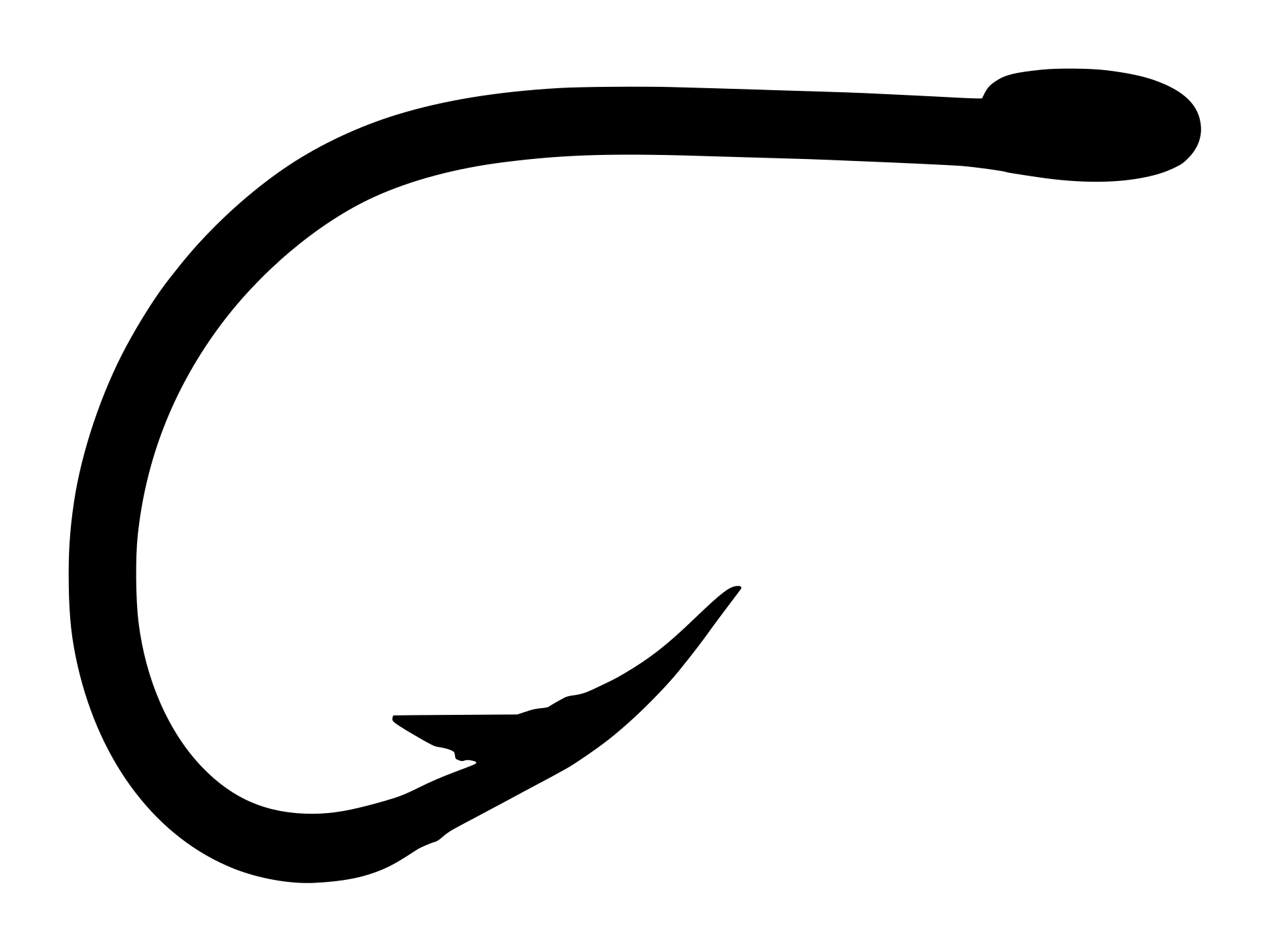
9557 No. 4 — 9557 Beak Hook | 84% | Compare | |
| 9479 No. 6 — Mustad 9479 Viking Hooks | 83% | Compare | ||
| 92625 No. 1, 5, 8, 10 — Mustad 92625 Beak Hook | 76% | Compare | ||
|
92141 No. 6 — Mustad 92141 Beak | 72% | Compare | |
| 9088 No. 6, 8, 10, 12 — Mustad 9088 | 71% | Compare |
| Silhouette | Hook Model | Match | Compare |
|---|---|---|---|

|
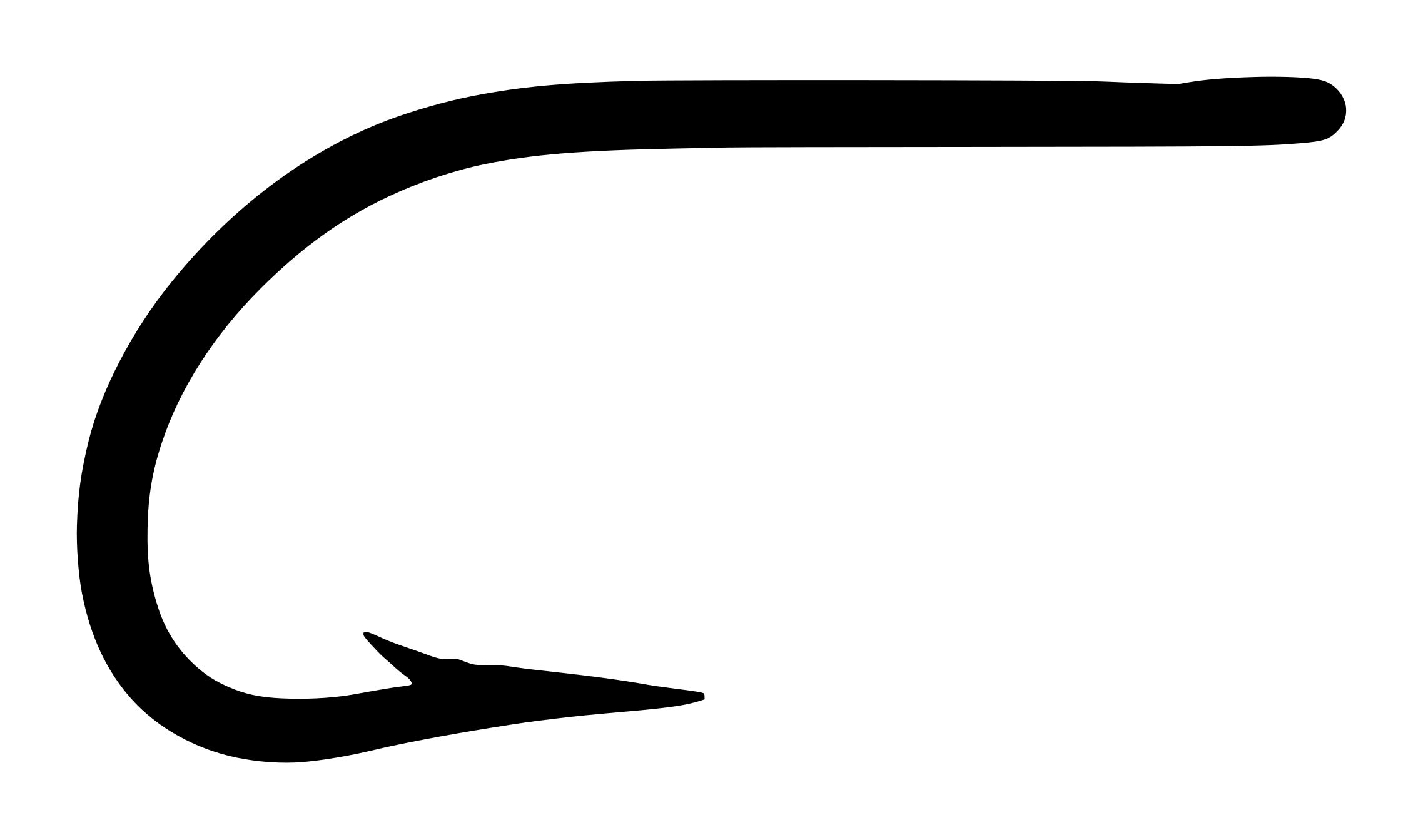
G3A No. 12 / 16 — G3A Sproat Wet Fly Hook | 100% | Compare |
|
7754 No. 7/0 — Mustad 7754 Bay King | 98% | Compare |
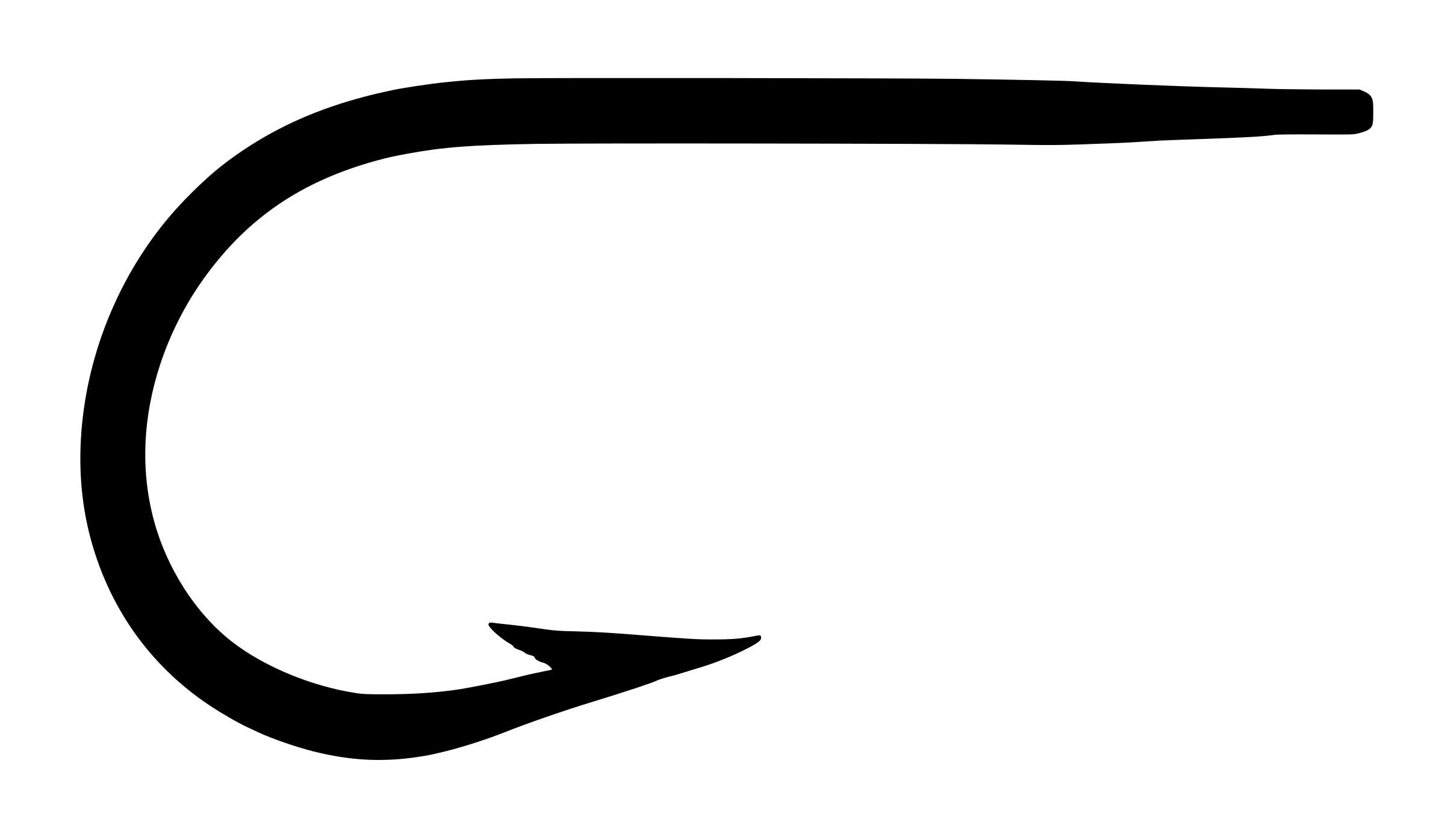
|
8515T No. 5/0, 11/0, 14/0 — Sobey | 98% | Compare |

|
S 4310 LS No. 7 — Edgar Sealey S 4310 LS Octopus | 97% | Compare |

|
722 No. 17/0 — Mustad 722 | 97% | Compare |
The Mustad 9556 A was designed as a general-purpose bait hook with application to both live and dead bait presentations for panfish, trout, and bass. The extra-long shank accommodates live worm threading, leech presentations, and minnow attachment without obscuring the point. The reversed beak point was marketed as providing superior hook-up ratio compared to straight-shank designs, particularly for fish with tender mouths. In fly tying, the model found use in long-bodied streamer patterns and large nymph imitations during the mid-century era. The turned-down eye allows neater head wrapping than ball-eye alternatives.
Leech imitations, baitfish imitators, panfish and trout live-bait presentations, bass worm rigs
Black Ghost, Muddler Minnow, Marabou Streamers, large nymph imitations (Stonefly, Crane Fly patterns)
| Hook | Match Quality | Notes |
|---|---|---|
| Tiemco 200R | Good | Long-shank streamer hook; superior point geometry; lacks reversed offset. Suitable for streamer and nymph work. Does not retain the beak design. |
| Mustad 92604 | Moderate | Modern octopus-style bait hook; beak-reversed point; plastic packaging. Shorter shank than 9556 A. Retains the reversed offset but updated manufacturing. |
| Partridge Wilson | Moderate | English-made long-shank design with superior point; reverse-kirbed variant available. More refined engineering; higher cost. |
| Ahrex FW501 | Poor | Modern precision fly hook; lacks beak offset; superior point. Suitable only for fly tying, not bait work. |
Rated 3.0/10 — Mustad industrial production volume makes this model common in most sizes. Size No. 12 is unremarkable. Collector demand is casual among fly tyers and general hook enthusiasts, not specialist collectors. Original 1950s-1960s packaging adds modest premium.
Positive factors: Authentic 1950s–1960s packaging with era-correct “Mustad & Sön – Oslo” branding and classic label design. Forged beak hook with hollow point remains functionally desirable for both bait and fly fishing. Original cardboard sales card is increasingly rare compared to plastic packaging. No. 12 size is suitable for panfish and trout applications, giving it practical value beyond collecting.
Limiting factors: Mustad was an industrial manufacturer with high production volumes—surviving stock remains abundant on the secondary market. The 9556 A series was widely distributed and is not specifically sought by Redditch specialists or advanced hook historians. Size No. 12 is a common size; larger or unusually small sizes command minimal premium. Condition is good but not mint—light toning and edge wear reduce collector appeal.
Most desirable variants: Sealed or near-sealed original cards command 20–30% premium over opened stock. Complete 100-count cards are more collectible than partial cards. Sizes below No. 14 or above No. 8 may be slightly scarcer. Examples with fully intact tissue or paper wrapping add 10–15% value.
Condition impact: Cards missing 10+ hooks lose significant value (deduct 30–40%). Packaging with tape repair or heavy creasing reduces appeal to 25–35% below the published range. Hooks with corrosion or rust are undesirable. Bright, uncorroded nickel finish is standard expectation and commands no premium.
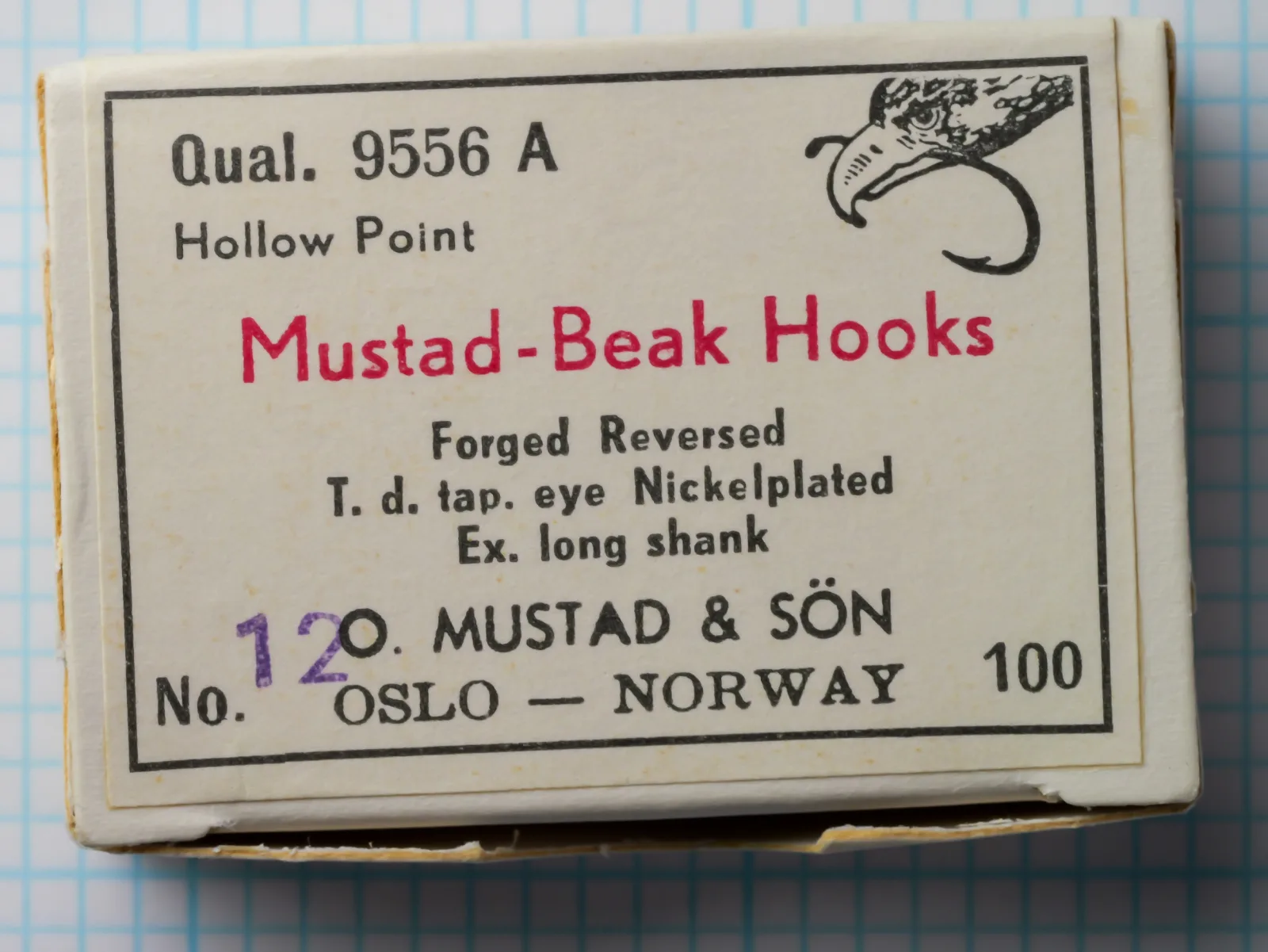
Cardboard sales card with printed label. Cream stock with black letterpress text and red two-color heading "Mustad-Beak Hooks". Label text reads: Qual. 9556 A / Hollow Point / Mustad-Beak Hooks / Forged Reversed / T.d. tap. eye Nickelplated / Ex. long shank / No.12. MUSTAD & SÖN / OSLO — NORWAY / 100. Eagle-head-and-hook logo in upper right. No barcode visible. Evidence of handwritten price mark on label. Card shows light toning and edge wear consistent with 1950s-1960s manufacture.
Low ($10): Good condition — opened card, complete or near-complete hook count, minor packaging wear, hooks uncorroded.<br />
High ($18): Excellent condition — sealed or near-sealed original card, full 100-count, no tape or repairs, minimal wear.<br />
Premium factors: Sealed packaging, intact tissue, complete count, minimal wear, bright nickel finish.<br />
Platforms: eBay (US & UK), general vintage tackle dealers, online sales records.<br />
Confidence: V verified — based on 1 eBay sold listing ($11.99 for 100-count bulk lot) plus comparable data from similar Mustad-era beak cards. Typical value range adjusted for condition tier.
eBay (US & UK) — search "Mustad 9556 A" or "Mustad Beak Hooks vintage". Vintage tackle dealers listing Mustad bulk lots. General online marketplaces (Facebook Marketplace, Etsy). Occasional appearance in tackle estate lots and bulk hook assortments. May be mixed in general Mustad hook collections rather than listed individually.
Look for the model code “9556 A” printed on the packaging label. The text “Mustad-Beak Hooks” in red identifies the product line. “Hollow Point” and “Forged Reversed” describe the point and wire specifications. The packaging should read “MUSTAD & SÖN — OSLO — NORWAY” (or “GJOVIK” on later cards) without modern barcode. The eagle-head-and-hook logo appears in the upper right corner. Original cardboard labels should exhibit tan or cream-colored stock with letterpress printing. The absence of plastic packaging and multi-language text is a strong era indicator. No. 12 is the most common size in surviving stock.
| Title | Price | Date | Condition |
|---|---|---|---|
| 100 MUSTAD HOOKS #14 BEAK BAIT / FLY TYING REVERSED EX LONG NICKELPLATED 9556 A | $11.99 (asking) | active | New other (see details) |
eBay market reference. Researcher-curated. Prices in USD. Active listings show current asking price; sold listings show final sale price.
Store the packaged hooks in a cool, dry environment away from direct sunlight and humidity. The nickelplated finish is durable but can develop light patina with prolonged exposure to moisture; this is considered attractive by some collectors. Keep the original cardboard packaging intact rather than removing hooks to loose storage — the packaging dramatically increases historical value and provides the best long-term protection.
Avoid stacking heavy objects on top of the card, which can crush the box and distort the label. If the hooks are removed for use, store them in a dry tackle box or hook keeper with silica desiccant packets to prevent rust. The forged wire is resistant to corrosion but can slowly oxidize in humid conditions. If any hooks show early signs of patina, gently wipe them with a soft, dry cloth; do not use abrasive cleaners or harsh chemicals, which will damage the nickel finish and reduce both functional value and collectability.
Original pricing marks or handwritten notes on the packaging should be preserved as-is — these are period artifacts that document the hook’s retail history and should never be removed or cleaned.
Source: Packaging label, Mustad 9556 A Sales Card, c. 1950–1970
The packaging label states: “Qual. 9556 A / Hollow Point / Mustad-Beak Hooks / Forged Reversed / T.d. tap. eye Nickelplated / Ex. long shank / No. 12. MUSTAD & SÖN / OSLO — NORWAY / 100.”
Key terms interpreted: “Qual.” (Quality) is a product designation, not a quality statement — standard Mustad nomenclature. “Hollow Point” describes the concave inner-face point geometry. “Forged Reversed” indicates both wire-flattening and kirbed (offset) point. “T.d. tap. eye” abbreviates “Turned-down tapered eye,” specifying the eye construction for fly tying. “Ex. long shank” confirms extra-long body profile. “No. 12” is the hook size.
The manufacturer line reads “MUSTAD & SÖN — OSLO — NORWAY” with the characteristic diaeresis (ö) over the N in “Sön.” This is a strong dating indicator: Mustad’s official designation changed from “& Sön” to “& Son” in the late 1970s during Americanization of the brand. The absence of this text on modern Mustad packaging confirms the c. 1950–1970 dating window.
Letterpress evidence: The text was printed via letterpress (raised metal type on a press), not offset lithography or digital printing. The slight inconsistency in letter spacing and the impression depth visible in the label photograph are characteristic of mechanical letterpress production. This technology was standard in Scandinavian hook manufacture through the 1960s and was gradually phased out in the 1970s.
100-count designation: The card states “100” at the bottom right, indicating a standard bulk pack. This was common for wholesale or retail stocking; smaller retail assortments (12-count, 25-count) also existed but are slightly less common in surviving stock.
| P | Photographically verified — Directly observable in the photograph(s) on this page. |
| V | Verified by documentation — Confirmed by manufacturer catalog, spec sheet, or published reference. |
| I | Inferred — A logical deduction from observable or documented evidence, not directly stated. |
| E | Estimated — An approximation based on visual comparison, proportional analysis, or limited data. |
| S | Speculative — A reasoned hypothesis that cannot be confirmed from available evidence. |
Claims with no notation are confirmed by multiple independent sources. All photographs on garrenwood.com are taken on a measurement grid where each square equals 1/10 inch (0.1″ / 2.54 mm).
Your cart is empty.