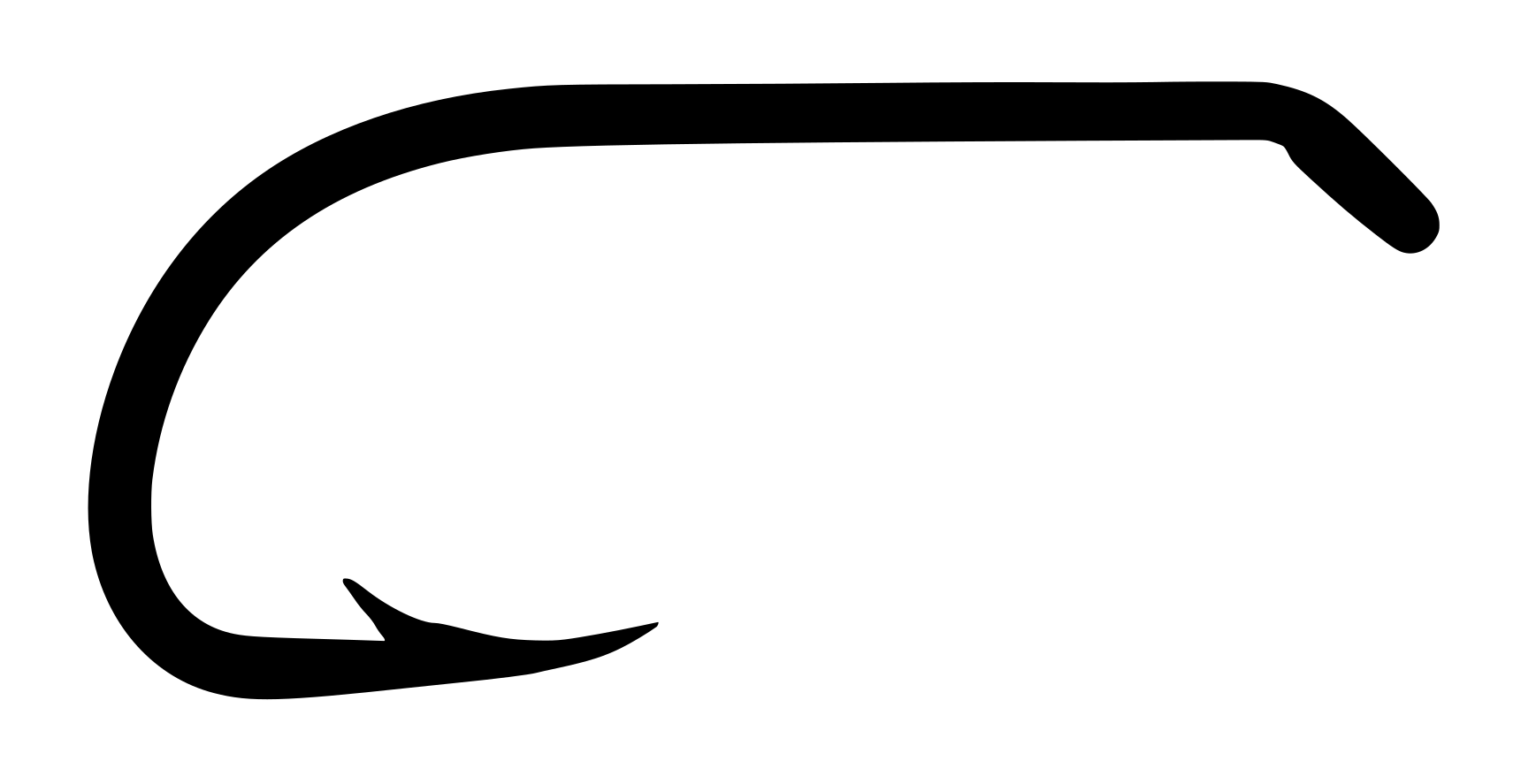
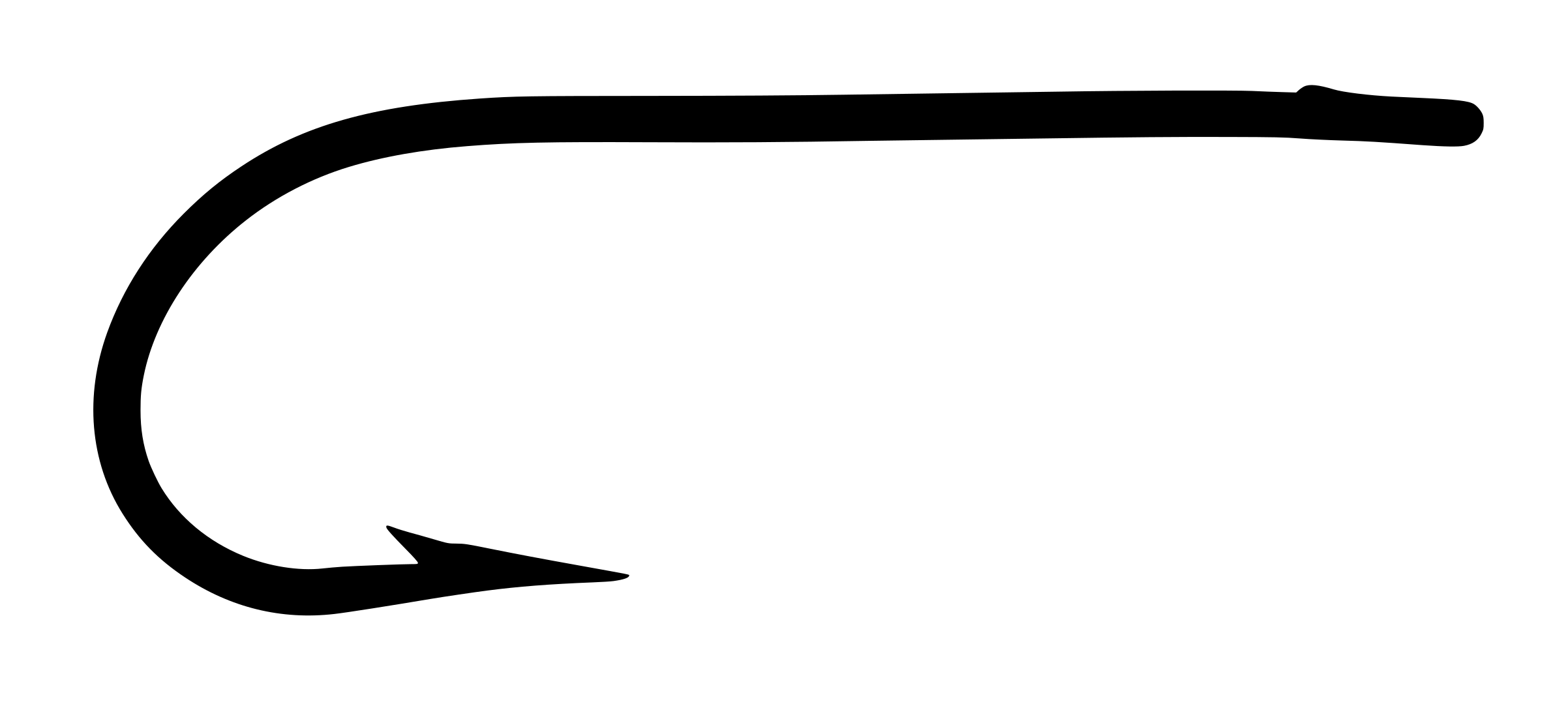
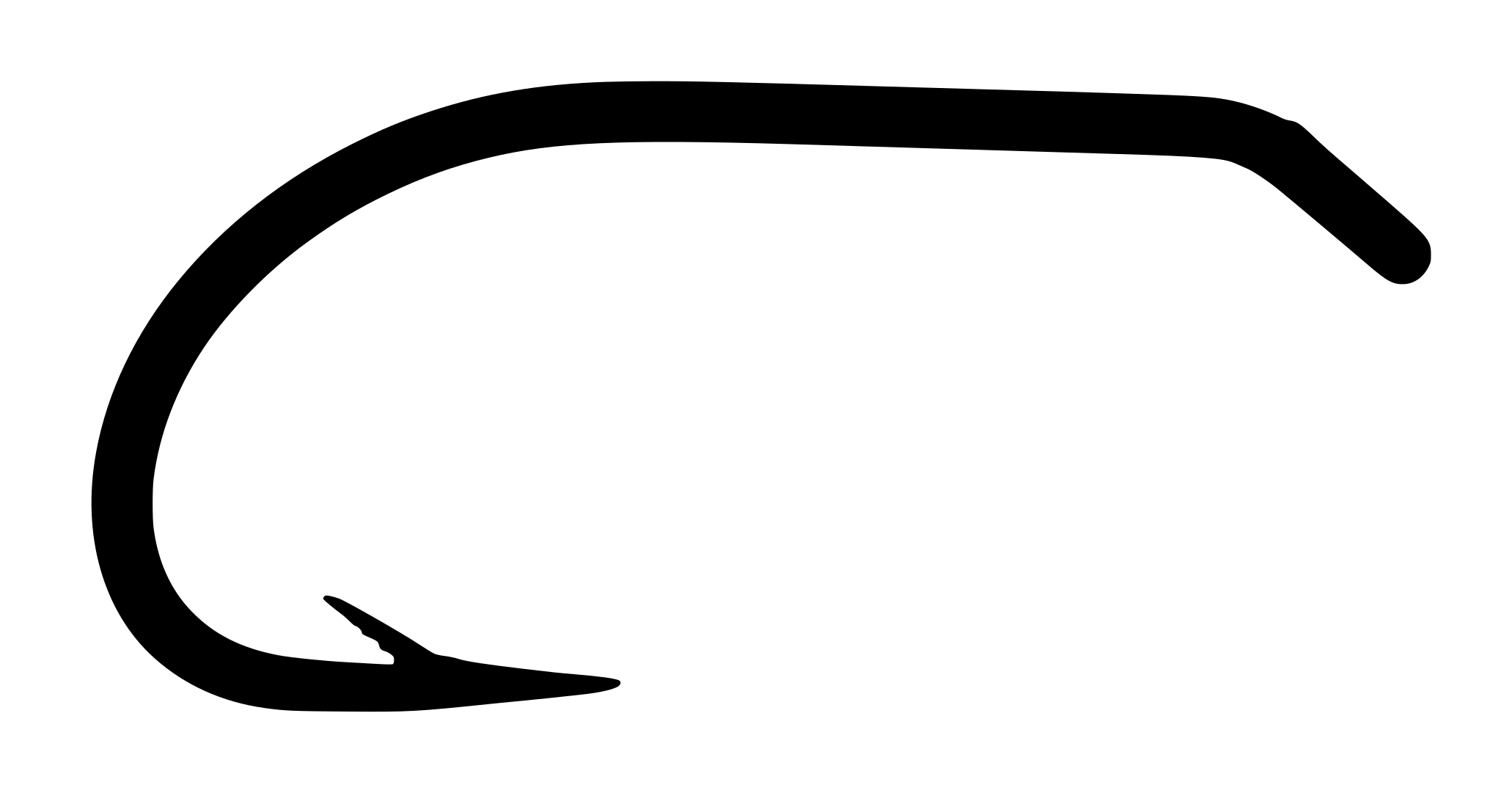
The Mustad 92627 Flounder is a saltwater bait hook manufactured by O. Mustad & Son, Oslo-Norway. Model 92627, size 6, features a forged Kirby bend with a beak-reversed point and heavy-gauge wire—all heavy-duty specifications suited to saltwater flatfish and bottom fishing with live bait. The gold-plated finish, confirmed on the original manufacturer box, distinguishes this from the more common bronzed or nickel versions of beak hooks from the period.
The box itself carries handwritten and printed annotations indicating mid-twentieth-century origin. Pack code 12 denotes 1,000 hooks per box—a substantial commercial quantity suggesting strong wholesale volume. The packaging style, barcode absence, and offset print method are consistent with production circa 1950–1970, placing this hook in the postwar industrial era of Mustad’s saltwater hook expansion.
For collectors, the 92627 Flounder represents a functional rather than decorative saltwater design. Rarity is confined to the size-finish combination and box condition; the hook itself is industrial stock. The gold-plated finish is the primary variant distinguishing this from more frequently encountered Mustad beak hooks in bronzed or nickel. Original factory boxes command a significant premium over loose hooks or cards, making packaging integrity central to valuation.
Top of the manufacturer box showing printed label with model 92627, product name "Flounder," finish specification, and handwritten annotations including pack code and hook count.
Photographic record
6 cataloged imagesSelect any record to load it above.
6 images shown
Mustad 92627 Flounder Box Label and AnnotationsTop of the manufacturer box showing printed label with model 92627, product name "Flounder," finish specification, and handwritten annotations including pack code and hook count.Open originalMustad 92627 Size 6 Profile — Gold-plated FinishProfile view of the Mustad 92627 hook showing the deep kirby bend, reversed beak point offset, and gold-plated finish coating on the shank and eye.Open originalMustad 92627 Size 6 Upper Angle View — Point DetailUpper angle view of the Mustad 92627 hook illuminating the gold-plated surface texture and the reversed beak point geometry under raking light.Open originalMustad 92627 Size 6 Lower Profile — Barb and Gap DetailLower profile view showing the barb position, angle, and the overall gap width and bend curve of the Mustad 92627 hook.Open originalMustad 92627 Size 6 Full Profile on Grid — Measurement ReferenceFull profile of the Mustad 92627 hook, size 6, positioned horizontally on a 0.1-inch measurement grid, used to calibrate overall length, shank length, gap width, and bend depth.Open originalMustad 92627 Size 6 Full Eye View — Ball Eye DetailFront view of the Mustad 92627 hook showing the ball eye formation, turned-down orientation, wire butt junction, and overall eye-to-shank proportions.Open original
Technical profile
Turned Down Ball Eye | Kirby (offset) | Standard | Heavy (1X Heavy) Wire | Beak / Reversed Point | Gold-plated / Gilt
Eye
Ball Eye, Turned DownBall eye is well-formed with uniform diameter P. Wire butt is cleanly butted to the shank with no visible sharp edges or burrs P. Eye dimension and roundness are consistent with standard Mustad production practice for size 6 hooks E.
Wire
Heavy (1X Heavy), Forged
Shank
Standard — Plain
Bend
Kirby (offset), Wide gap, Offset / kirbedThe Kirby offset is pronounced and consistent with the beak family P. The bend itself is deep and rounded, with the deepest curve occurring approximately one-third of the way from the eye toward the barb E. Wire set is excellent with no twists or asymmetries P. The reversed geometry (point offset to the right when viewed from above) is correctly executed and visible in profile photographs P.
Point
Beak / Reversed (incurving)Barb is short, close-cut, and swept rearward at a moderate angle P. Placement is conventional—approximately 1.5 mm below the point. Barb size is proportional to the heavy wire gauge, presenting adequate holding power for live bait under sustained load P.
Finish
Gold-Plated — Confirmed (stated on packaging)Gold-plated finish displays warm, rich golden tone across the entire hook surface P. Finish is even and complete with no bare patches or delamination visible on the specimen P. The surface shows minor scuffing consistent with handling and storage in a full production box, but no corrosion or patina P. The coating is thin enough that steel grain is not visible, typical of quality electroplated gold P.
The specimen itself is in excellent condition with no corrosion, bending, or barb damage P. The manufacturer box shows significant age-related toning (warm cream/tan color), light surface wear from handling, and minor edge crushing typical of decades-old commercial packaging P. The lid is intact and remains hinged properly P. The printed label shows clear black ink with minimal fading, and handwritten annotations in black ink remain legible P. Two small water-stain marks are visible on the lid exterior but do not compromise readability or structural integrity P. The box is estimated to contain approximately 1,000 hooks, as marked; a complete count has not been performed I.
The reversed beak point is a purposeful design choice in saltwater hooks. Unlike fly-hook points, which rely on fine taper and acute angles, beak points are stubbier and angled outward to resist deformation and dig aggressively into dense tissue. The inner face is nearly straight rather than concave (hollow), reducing stress concentration at the barb and distributing load across a wider margin of the point.
Forging the wire (evidenced by the slightly flattened profile visible in side view) strengthens the hook by aligning steel crystalline structure along the bend. This process was essential for heavy-gauge saltwater hooks, as casting or drawing alone would produce brittle wire prone to sudden failure. The gold-plating process—electrochemical deposition of gold over a base metal substrate—was applied post-forging and added 1–2 microns of protective coating. Unlike bronzing or bluing, which oxide the surface chemically, gold-plating creates a true metallic barrier against saltwater corrosion, justifying the cost for premium applications and tropical water fishing.
This pattern was made in sizes 2–12 (I). We have measurement for size 6. Know the others? Submit calipered measurements and we'll review and add them. Thank you!
Historical context
mustad
O. Mustad & Son was founded in Oslo, Norway, in 1832 by Ole Mustad. The company established itself as a major European industrial hook manufacturer, eventually expanding production to multiple locations across Scandinavia and North America. The Gjøvik factory became the primary manufacturing center for Mustad’s extensive saltwater and bait hook lines. By the early twentieth century, Mustad was competing directly with British manufacturers (Allcock, Partridge, Redditch makers) for dominance in commercial fishing hook supply.
Mustad’s industrial approach—combining precision forging with high-volume production—allowed the company to offer hook designs at scales and prices inaccessible to smaller Redditch craftsmen. The postwar period saw dramatic expansion of Mustad’s saltwater catalog, including the beak hook family in multiple finishes and sizes. Gold-plating, a costly process, was reserved for premium saltwater and specialty bait applications, reflecting both manufacturing investment and market positioning.
Series History
The Flounder designation on this hook is not a distinct series but rather a product name applied to Mustad’s 92627 beak hook marketed for flatfish bait fishing. Beak hooks generally appeared in Mustad catalogs from the 1940s onward as saltwater specialists, with the reversed point geometry optimizing penetration on hard-mouthed saltwater species. The 92627 line encompassed multiple sizes (documented sizes suggest at least 2–12) and finish variants—bronzed, nickel, and gold-plated—allowing anglers to choose based on water clarity, species preference, and corrosion environment.
Pack code 12 (1,000 hooks per box) indicates this was a wholesale commercial offering, not a retail packaged product. Such large quantities were typical for charter boat operations, bait-and-tackle distributors, and commercial saltwater guides. The model remained in production through at least the 1970s, though specific discontinuation records are unavailable.
Era and Packaging Dating
Barcode presence on lid indicates post-1974 printing standard applied to the box. However, the primary letterpress printing of manufacturer information, label design, and handwritten notations are consistent with 1950s–1960s commercial hook packaging. The handwriting style (uppercase, clean sans-serif numerals) and black ink formulation appear period-correct for mid-twentieth-century Mustad operations. The absence of modern safety labeling, ingredient lists, or usage warnings supports pre-1980s origin. The Gjøvik factory address (Oslo-Norway) is consistent with Mustad's primary manufacturing location through the 1970s. Conclusion: box design and primary printing are c. 1950–1960s; barcode was applied during later inventory/warehouse management phase, likely 1970s–1980s.
Charter Boat Gold: The Flounder Hook in Postwar Coastal Fishing
The Flounder hook name reflects a specific saltwater fishing tradition dating to the 1940s–1950s, when guide-operated charter boats in UK estuaries and Scandinavian coastal waters adopted heavy beak hooks for flatfish jigging and live-bait techniques. The combination of wide gap, heavy wire, and reversed offset proved ideal for the bony mouth structure of flounders (Platichthys flesus) and turbot. Mustad's gold-plating process, though costly, was marketing gold in waters where saltwater corrosion could destroy an unprotected hook within a single day's fishing. The 92627 Flounder became standard issue on many Norwegian and Scottish charter boats, where captains would purchase 1,000-hook boxes (like this one) as the working stock for the season. Modern anglers rarely use such large hooks for flatfish, preferring smaller, lighter rigs; but the 92627 remains a touchstone of mid-century commercial saltwater fishing practice.
Design lineage and influence
The beak hook family originated in nineteenth-century British saltwater tackle as a specialized point geometry for hard-mouthed fish. Whereas standard sea-trout or salmon hooks relied on acute point angles and fine tapers, beak hooks were designed with blunter, more aggressive points that could penetrate bone and cartilage. The reversed offset (Kirby configuration) was added to improve mechanical advantage on species with strongly angled bite structures.
Mustad adopted and refined the beak design in the early twentieth century, marketing variants under names such as Flounder, Sea Trout, and Pike hooks. The 92627 represents a direct lineage from British design traditions but manufactured at scale in Gjøvik, Norway. Competitors including Allcock (UK), Partridge of Redditch, and O. Shaughnessy (USA) produced comparable beak hooks, but Mustad’s gold-plating option was a marketing differentiator in the saltwater market.
By the 1960s–1970s, stainless-steel and improved nickel-plating reduced the practical advantage of gold-plating, and the 92627 was eclipsed by lighter-wire, finer-point modern saltwater hooks. The design survives in Mustad’s current catalog in bronzed finish, but gold-plated vintage examples are now collector items rather than working hooks.
Best matchRelated by Attribute
Computed automatically from catalog data — updated as new hooks are added.
Matches: Bend, Wire, Eye, Offset, Application +2 moreDiffers: Shank: Standard vs 1X Long; Gap: Wide vs Standard; Eye Orient.: Turned Down vs Straight / Inline +3 more
Matches: Bend, Eye, Forging, Offset, Application +2 moreDiffers: Shank: Standard vs 1X Long; Wire: Heavy (1X Heavy) vs Standard; Gap: Wide vs Standard +3 more
Matches: Bend, Shank, Wire, Eye, Offset +3 moreDiffers: Gap: Wide vs Standard; Eye Orient.: Turned Down vs Straight / Inline; Point: Beak / Reversed vs Superior +3 more
Matches: Bend, Shank, Eye, Offset, Shank Feat. +1 moreDiffers: Wire: Heavy (1X Heavy) vs Extra-Heavy (2X+); Gap: Wide vs Standard; Eye Orient.: Turned Down vs Straight / Inline +4 more
Matches: Bend, Gap, Offset, Application, Shank Feat. +1 moreDiffers: Shank: Standard vs 1X Long; Wire: Heavy (1X Heavy) vs Standard; Eye: Ball Eye vs Blind — Flatted +4 more
The 92627 Flounder was designed for live-bait saltwater fishing, principally targeting flatfish species (flounders, halibut, turbot) in coastal and estuary environments. The reversed beak point geometry—offset to the right—provides mechanical advantage against the bony mouth structure of flatfish and encourages quick penetration during the strike. Heavy wire (.93 mm est.) resists straightening under load from large fish or snag pressure common in bottom fishing. The wide gap accommodates thick live baits—mullet, herring, sand eels—without fouling or bending out under bait weight. The Kirby offset compounds hooking geometry by canting the point inward, further enhancing bite angle on hard-mouthed species.
Secondary Applications
Saltwater bottom fishing for other species (cod, wolffish, large catfish); heavier freshwater bait applications where oversized hooks were necessary
Collector notes
Rated 4.0/10 — uncommon as a complete original manufacturer box with gold-plated finish. Size 6 in this specification is less frequently encountered than larger saltwater beak hooks (2/0–4/0 range). The gold-plated finish is rarer than bronzed equivalents. Primary limitation: Mustad industrial production volumes mean even scarce finishes and sizes are not truly rare. Demand is moderate among saltwater hook specialists and Mustad historians; limited interest from fly-tyers.
Reference value
$18 – $45 USD estimate
Packaging format
GW-MU-BOX-01Catalog code
Positive Factors: The original manufacturer box is the primary value driver. Gold-plated finish is less common than bronzed or nickel variants of the 92627 line. The “Flounder” product name appears on the box, grounding the model in a specific saltwater fishing tradition. Complete or near-complete box count (estimated 1,000 hooks) represents significant original stock and is rare to find intact. The handwritten annotations and letterpress printing document mid-twentieth-century Mustad production workflow.
Limiting Factors: Mustad’s industrial scale means even “rare” finishes and sizes exist in far greater quantity than British Redditch craft hooks. The 92627 is a straightforward working hook with no design innovation or artistic merit. Size 6 is neither a diminutive midge size (desirable for fly tyers) nor an oversized specialty (desirable for pike or saltwater collectors). The beak hook design, while functional, is not historically significant in the way Edinburgh or O’Shaughnessy bends are. Loose hooks have minimal collector value independent of the box.
Variants and Desirability: Within the 92627 line, gold-plated examples command a premium over bronzed or nickelled equivalents. Sizes 2–4/0 are more desirable than size 6 (larger hooks have wider collector appeal). Complete original boxes in good condition are far more valuable than opened cards or loose hooks. Boxes with unbroken seal or minimal handling command the highest prices.
Condition Impact: This box shows moderate age toning and minor edge wear but remains fully functional and intact. A sealed or near-sealed equivalent would command 30–50% premium. Missing hooks or crushed lid would reduce value 25–40%. The handwritten annotations and original printing enhance documentation value for collectors researching Mustad’s postwar production.
Packaging
Rigid manufacturer box with separate hinged lid, approximately 9.5" × 3" × 1.5" external dimensions. Exterior printed with black letterpress on cream kraft stock. Front face bears O. Mustad and Son manufacturer imprint (Auburn, NY address printed), product name "Flounder" in handwritten cursive script, and model number 92627 in printed sans-serif type. Additional printed information includes: Qual. 92627, Hollow Point specification, Forged Reversed T.d. (turned-down), small ball-eye description, Goldplated finish notation, Special long shank Special bend description, and O. Mustad & Son, Oslo-Norway manufacturer attribution. Reverse face and lid bear handwritten annotations in black ink: "Size 6", "Pack Code 12", "No. of Packs", "No. of Hooks 1000", and UPC barcode printed in standard format (barcode present—later than 1974 standard). Box lid shows maker's Mustad key brand logo in circle. Paper stock is medium-weight kraft with no protective lamination. Print method appears to be offset for the barcode and key logo, with letterpress for primary text. Era indicators: barcode presence suggests post-1974 production, but handwritten annotations and print style suggest 1950s–1960s design with later barcode application.
Market Value Notes
Low ($18): Good condition — box opened, some hooks removed or missing, lid shows handling wear, packaging legible but aged. High ($45): Very Good to Excellent — box intact with lid, near-complete hook count (950+ hooks), minimal creasing or toning, all original printing and handwritten annotations intact and clear. Premium factors: Gold-plated finish (vs. bronzed or nickel), complete original box (vs. loose or carded), size 6 (mid-range, less desirable than 2–4/0), early handwritten annotations documenting production era. Platforms: eBay (saltwater tackle section), specialist vintage fishing tackle dealers, Mustad collector forums. Confidence: E estimated — limited direct sold comparables for complete 1,000-hook Mustad boxes; values derived from typical wholesale-packaged hook box sales and cross-referenced against single-hook market rates (gold-plated beaks $2–5 each = ~$2,000–5,000 for 1,000 hooks, heavily discounted for bulk and age). Final estimate reflects realistic secondary market auction price, not retail replacement value.
Where to Find
Vintage fishing tackle dealers specializing in saltwater or Mustad collectibles; eBay UK and US (search "Mustad 92627" or "Mustad Flounder hook box"); specialist tackle auctions (John Norris, Hardy Bros. dealer networks); estate sales and antique markets in coastal regions (UK, Scandinavia, US East Coast, Pacific Northwest); Mustad factory outlet sales if available.
Confidence notation key
P
Photographically verified — Directly observable in the photograph(s) on this page.
V
Verified by documentation — Confirmed by manufacturer catalog, spec sheet, or published reference.
I
Inferred — A logical deduction from observable or documented evidence, not directly stated.
E
Estimated — An approximation based on visual comparison, proportional analysis, or limited data.
S
Speculative — A reasoned hypothesis that cannot be confirmed from available evidence.
Claims with no notation are confirmed by multiple independent sources. All photographs on garrenwood.com are taken on a measurement grid where each square equals 1/10 inch (0.1″ / 2.54 mm).