[wpdreams_ajaxsearchlite]
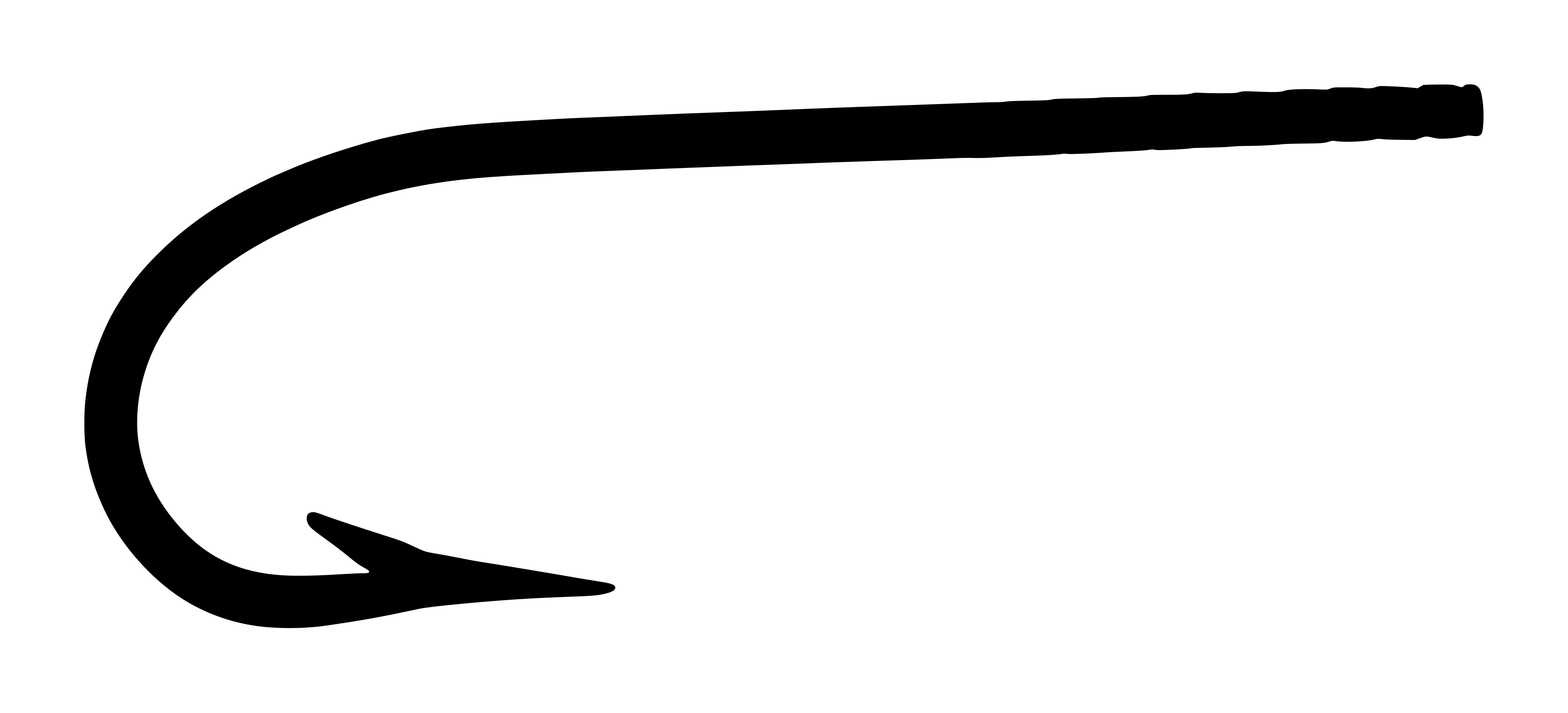
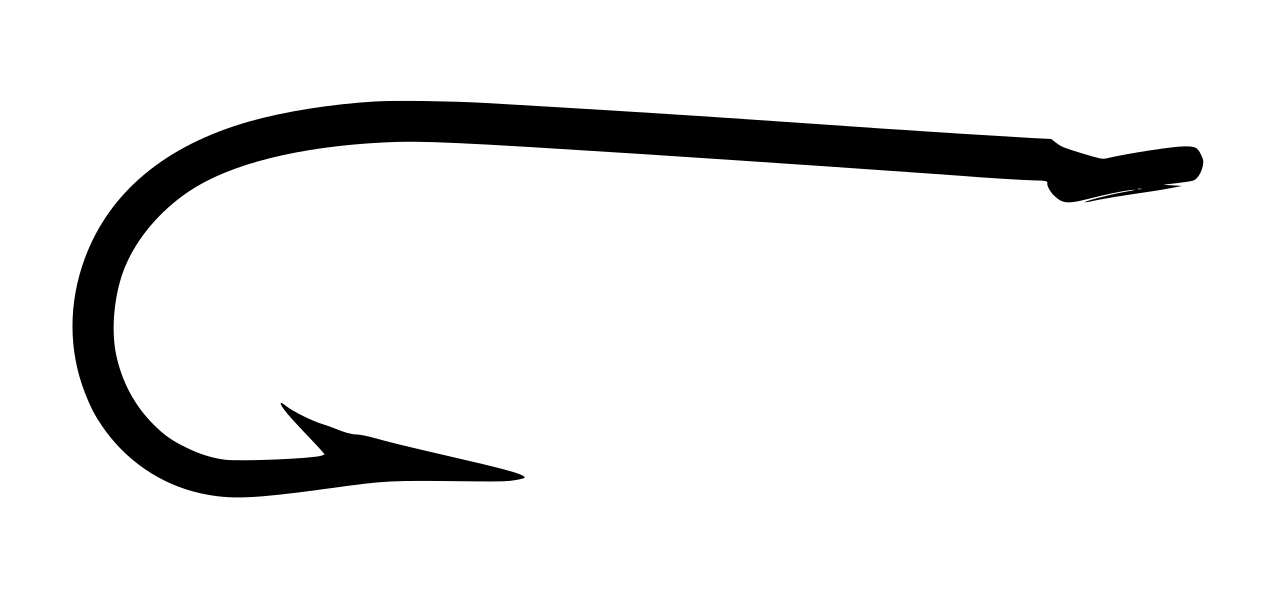
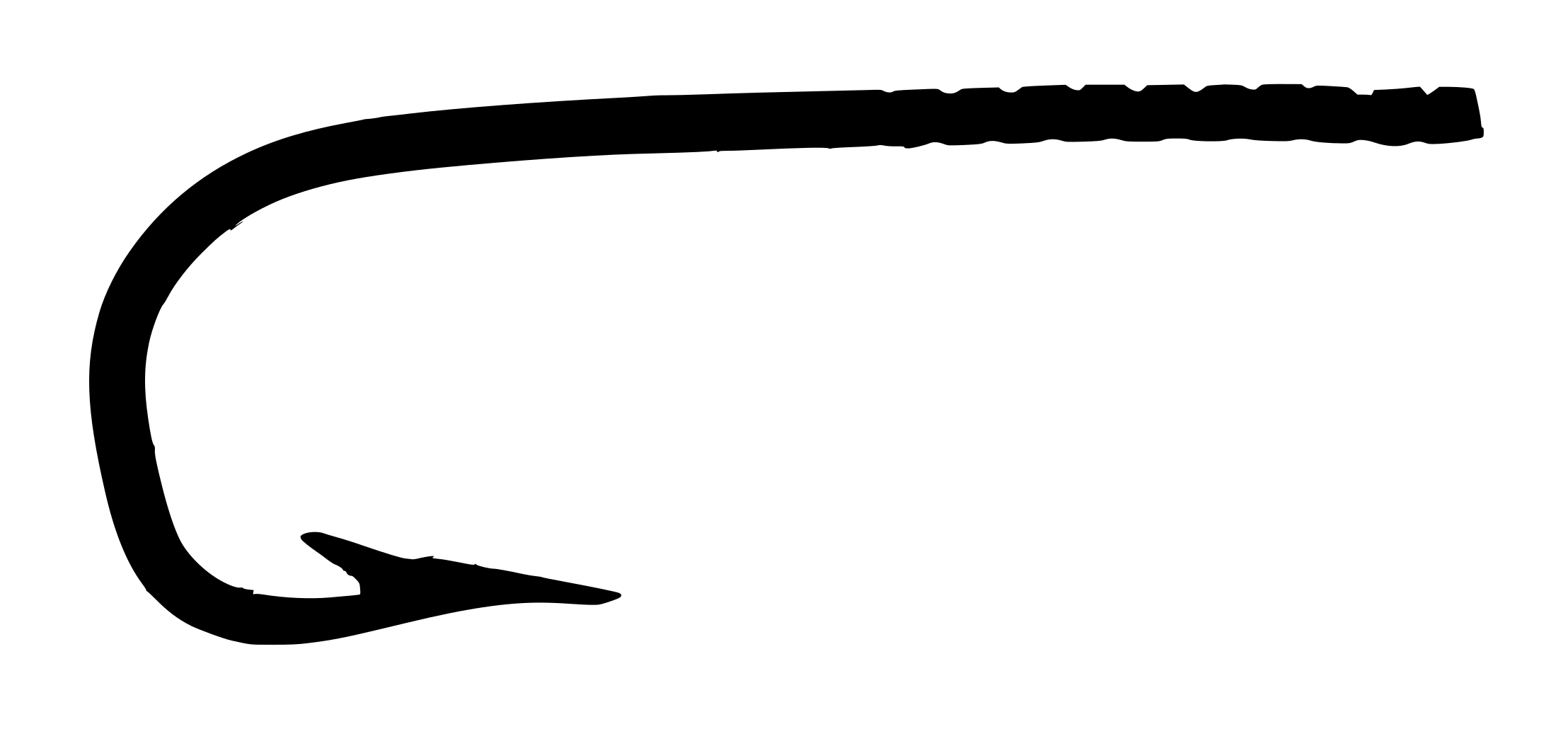
Mustad 802 hook silhouette
Hook ReferenceO. Mustad & Son Hooks › Mustad Hooks – 802

Mustad 802

Mustad 802c. 1950s-1960s
Ringed Straight EyeKirby Bend (Offset)3x Extra-Strong WireStandard ShankSuperior PointBronzed Finish

Save this hook to your account to build a list you can come back to.

Record summary

The Mustad 802 is a premium-tier, 3x extra-strong Kirby bend hook manufactured by O. Mustad & Sön in Oslo, Norway, during the 1950s-1960s. Bearing the iconic ‘Key Brand’ logo and ‘Superior’ series designation, this hook exemplifies mid-20th century Mustad’s aggressive strategy of reverse-engineering regional patterns—in this case, the classic Kirby offset bend—for global mass distribution.

Size No. 4 features a ringed straight eye, bronzed heat-treated finish, and heavy-gauge round wire. The defining Kirby characteristic is the laterally offset point, deliberately bent to the left when viewed from above, which prevents the hook from laying flat in a fish’s mouth and dramatically improves hook-set reliability. The bronzed finish provides a warm, natural appearance with moderate rust resistance suitable for freshwater work.

Era evidence is overwhelming: the green cardstock label with hand-stamped quantity notation, the absence of any barcode, the typographic style and paper stock, and the presence of the arbitrary ‘Quality 802’ code (discontinued c. 2001 when Mustad introduced the modern Signature Series) all confirm genuine 1950s-1960s manufacture. This is a specimen-quality example of Mustad’s industrial dominance in the mid-twentieth-century global tackle market.

Mustad 802 — cardboard slider box with green printed label showing Key Brand logo and eight-line Mustad label format — size No. 4 — bronzed Kirby hooks
Original cardboard slider box with green printed label for Mustad Quality 802 Kirby hooks, size No. 4, 3x extra-strong bronzed. The label features the iconic Key Brand skeleton key logo and all eight lines of standard Mustad label information.

Photographic record

4 cataloged imagesSelect any record to load it above.

4 images shown

Mustad 802 Kirby Hooks Size 4 Original Box and Label Original cardboard slider box with green printed label for Mustad Quality 802 Kirby hooks, size No. 4, 3x extra-strong bronzed. The label features the iconic Key Brand skeleton key logo and all eight lines of standard Mustad label information. Open original
Mustad 802 Kirby Hook Point Detail Size 4 Close-up of the Mustad 802 hook point, showing the characteristic Kirby offset bent to the left and the short, sharply angled barb designed for secure hold in live-bait presentations. Open original
Mustad 802 Kirby Hook Profile Size 4 Side profile view of the Mustad 802 hook, showing the ringed straight eye, heavy-gauge round wire shank, and the Kirby bend profile with offset point. Open original
Mustad 802 Kirby Hooks Specimens Size 4 Two Mustad 802 hooks, size No. 4, displayed together to show consistency of construction and the Kirby offset point geometry. Open original

Technical profile

Mustad 802 — Kirby Bend, 3x Extra-Strong, Ringed, Bronzed, Size No. 4

Eye
Ball Eye, Straight / Inline Ringed straight eye formed by bending the wire back onto the main shank, creating a simple circular loop P. The eye is neatly formed with no visible deformation or casting flaws. The ring diameter is proportional to the 3x extra-strong gauge, making it robust and suitable for knot attachment under heavy load P.
Wire
Extra-Heavy (2X+), Round
Shank
Standard — Plain
Bend
Kirby (offset), Standard gap, Offset / kirbed The Kirby bend exhibits the characteristic leftward offset of the point when viewed from above, a defining feature designed to improve hook-set mechanics in live-bait presentations P. The main bend is relatively sharp and angular at the bottom, typical of Kirby construction, distributing load differently than the smoother round bend of an Aberdeen or Sproat P. No lateral asymmetry beyond the intentional point offset; bend profile is balanced P.
Point
Standard / Spear The barb is a traditional close-cut design, short and sharply angled back toward the eye P. Barb placement is just back from the point, standard for Kirby construction. No microbarbs or secondary barbs present P. The barb size is proportional to the 3x extra-strong wire gauge, providing secure holding power without excessive weight at the terminal end P.
Finish
Bronzed — Confirmed (stated on packaging) Bronzed finish exhibits a warm, dark brownish-gold tone characteristic of heat-treated alkyd resin-based lacquer P. The finish shows even coverage across the specimen with minor light wear consistent with age and storage P. No active corrosion or rust present, indicating the lacquer coating remains effective. The warm tone contrasts noticeably with tinned (silver) or bright (polished steel) finishes and provides excellent visual stealth in freshwater environments P.
The individual hooks examined are bright, undamaged, with no corrosion or bending. The bronzed finish is uniform and intact across all specimens. The original cardboard box and label show light toning and minor creasing consistent with 60+ years of storage, but the label remains legible and the box structure is sound. No missing hooks from the original count of 100.

The 3x extra-strong wire gauge represents a deliberate engineering choice: by increasing the cross-sectional area of the steel, Mustad dramatically improved the hook’s resistance to bending, straightening, or snapping under the extreme stress of heavy baits, powerful fish runs, or rocky/obstructed bottom structure. This comes at the cost of slight increased weight at the terminal end, which is acceptable in bait and streamer applications where a heavier hook aids in casting and bottom-contact work.

The Kirby offset point is engineered to prevent the hook from laying flat parallel to the roof of a fish’s mouth during the strike. When a fish engulfs a live bait and turns to swim away, the laterally offset point forces the hook to rotate outward and upward, engaging the hard corner of the jaw where penetration is most reliable. This mechanical advantage dramatically reduces the force required from the angler to achieve a solid hook-set—often the fish effectively hooks itself against the tension of the line.

The ringed straight eye allows direct attachment via knot without requiring a snell (the earlier snelled construction used on blind-eye hooks). The bronzed heat-treated finish provides moderate corrosion resistance through an alkyd resin-based lacquer, suitable for extended freshwater exposure but requiring maintenance in saltwater environments.

Size & scale lab

Selected size 4
Physical specimen
Overall Length
22.6 mm P
Shank Length
16.3 mm
Gap Width
7.1 mm P
Bend Depth
9 mm
Wire Diameter
1.05 mm
Shank-to-Gap Ratio
~2.2-2.4 : 1
Confidence
P Physical specimen

Physical measurement with calipers

Calibrated SVG True-scale preview

Historical context

mustad

O. Mustad & Sön was founded in 1832 in Gjøvik, Norway, by Hans Schikkelstad, initially as ‘Brusveen Spiger- og Staltradfabrikk’ (nail and steel wire factory). The company was taken over by Schikkelstad’s son-in-law, Ole Hovelsen Mustad, and his son, Hans Mustad, who rebranded it as O. Mustad & Sön.

The pivotal moment in the company’s history occurred in 1877 when Mathias Topp invented the first fully automated hook-making machine, enabling continuous production of cut, bent, barbed, and pointed hooks at unprecedented speed. Rather than patent the technology (which would require public disclosure), the Mustad family protected their innovation through strict corporate secrecy, non-disclosure agreements, and restricted factory access.

This strategy proved devastatingly effective against rival centers in Redditch, England, and manufacturing hubs in Japan and the United States. By the 1950s, Mustad had secured approximately 50% of the global hook production market, establishing sales offices and manufacturing facilities across multiple continents. The word ‘Mustad’ became virtually synonymous with the fishing hook itself.

The factory operated continuously in Gjøvik throughout the 20th century, with major production remaining in Norway until late in the century. Mustad remains the world’s largest hook manufacturer, though significant production has been relocated to international facilities in recent decades.

Series History

The Mustad 802, designated ‘Quality 802’ in the company’s eight-line label system, belongs to the ‘Superior’ product line—a mid-tier series intended for demanding conditions. This designation appears on the label as a product line name, not as a point-style descriptor.

The 802 is part of Mustad’s broader ‘Kirby’ pattern offerings, which represent the company’s systematic reverse-engineering and mass production of Charles Kirby’s legendary 17th-century offset-point design. By manufacturing the Kirby pattern in multiple wire weights, lengths, and finishes, Mustad successfully captured both regional and global markets, displacing local blacksmith makers.

The 3x extra-strong variant was engineered for heavy-duty applications where standard-weight wire would fail under the stress of large baits, powerful fish runs, or harsh saltwater conditions. The Mustad 802 was produced continuously throughout the mid-20th century in multiple sizes (typically from No. 1 to No. 10), with the No. 4 being a standard offering.

The arbitrary ‘Quality 802’ model code was discontinued around 2001-2009 when Mustad transitioned to the modern ‘Signature Series’ with logical alpha-numeric naming. Vintage specimens bearing the traditional ‘Qual. 802’ designation are therefore definitively pre-2001 manufacture and are prized by collectors of the classic labeling era.

Era and Packaging Dating

Oslo designation on Line 3 confirms post-1925 manufacture (Christiania was renamed to Oslo January 1, 1925). Key Brand logo style and green cardstock label are characteristic of Mustad's mid-20th century export packaging. Transition to plastic packaging and modern typography did not occur until late 1970s. Absence of barcode (pre-1974 indicator) supports 1950s-1960s bracket. Green label stock and letterpress printing method typical of post-WWII Scandinavian industrial packaging.

The 350-Year-Old Design Revolution

The Kirby bend's distinctive offset point was invented by Charles Kirby, a legendary London hook-maker, in the mid-1600s—over 350 years before this specific Mustad 802 was manufactured. Kirby discovered that offsetting the point slightly to one side prevented the hook from laying flat in a fish's mouth, dramatically improving hook-up rates in live-bait presentations. Mustad's decision to mass-produce this centuries-old design at industrial scale exemplifies the company's genius for identifying proven regional patterns and globalizing them through mechanized efficiency. Bait fishers of the 'Indiana School' in the American Midwest favored Kirby hooks so heavily that they became synonymous with still-fishing for bass and pike. The pattern remains in production today, a testament to the timelessness of good design.

Cross-reference & comparisons

Wet Fly Nymph Streamer / Bucktail Bait Fishing

Primary Application

The Mustad 802 size No. 4 serves as a versatile wet fly and small streamer hook, as well as a premium heavy-duty bait hook. The 3x extra-strong wire and Kirby offset point make it particularly suited for robust presentations targeting bass, pike, catfish, and light saltwater species. In fly tying, the extra-heavy gauge accommodates bulky bucktail streamers and weighted nymphs. The offset Kirby point increases hook-up ratios in live-bait presentations by preventing lateral slippage in the fish’s mouth.

Secondary Applications

Heavy-duty bait fishing for bass, pike, catfish; light saltwater bottom fishing; nymph and streamer construction.

Classic Fly Patterns

Not typically tied with specific named patterns; primarily a utility hook for streamers and heavy nymphs.

Modern Equivalents

HookMatch QualityNotes
Mustad 2330 Kirby Sea Hook Very Good Direct modern successor to the 802; maintains Kirby offset point and 3x strong wire gauge but optimized for saltwater with improved corrosion resistance.
Tiemco 811S Good Sproat bend with slight offset, similar wire gauge; lacks true Kirby geometry but provides comparable hook-set reliability in live-bait applications.
Gamakatsu F10 Offset Good Modern offset point design with similar functional advantages to Kirby; contemporary materials and finish but different bend profile.
Owner Mutu Light Offset Moderate Offset point design; lighter wire gauge than Mustad 802 and intended for different applications (light saltwater).

Collector notes

Rated 3.5/10 — The Mustad 802 is common in most larger sizes but size No. 4 occupies a middle ground between abundant and genuinely difficult to locate. Collector demand is moderate, driven primarily by interest in Mustad's eight-line label era (pre-2001) and the Kirby pattern's historical significance. The defining limitation is that Mustad produced these hooks in massive industrial volumes; even mid-century examples are not rare in absolute terms.

Reference value $6 – $12 USD estimate
Packaging condition Good — moderate wear, legible Recorded specimen
Packaging format Mustad-slider-card-green Catalog code

The Mustad 802 derives collectability from three primary factors: (1) the presence of the classic eight-line label format with arbitrary ‘Quality’ code, which definitively pre-dates 2001; (2) membership in the ‘Superior’ product line, a mid-tier designation that appeals to industrial-era manufacturing historians; and (3) the Kirby pattern’s deep historical roots and continued relevance in bait-fishing tradition.

The primary limiting factor is volume. Mustad’s automated machinery and global distribution meant that tens of millions of 802 hooks were produced across all sizes during the 1950s-1960s period. Consequently, large and extra-large sizes (No. 1/0, 2/0, 3/0) remain abundant in the vintage market, whereas small sizes (No. 10, 12) are harder to find but still not rare.

Size No. 4 sits in the middle: it is neither a common large size nor a particularly scarce small size, making it moderately uncommon. Complete original packaging (the green label box with full count of 100 hooks) significantly enhances value; opened cards with missing hooks command 20-30% lower prices. The bronzed finish is consistent and desirable; any variation in finish (bright, tinned, japanned) would affect desirability within the subset of Kirby 802 collectors.

Condition factors most affecting value: (1) label condition (full legibility commands premium); (2) hook count (complete 100-count vs. partial); (3) finish uniformity and absence of corrosion; (4) box structural integrity (no tears, delamination, or major creasing). A sealed or near-sealed example commands 2-3x the price of an opened card with partial count.

Packaging

Cardboard slider box with green printed label on cream/off-white cardstock. Label features the iconic Key Brand logo (downward-pointing skeleton key) in upper left. Eight-line Mustad standard label format with decorative snowflake border. Text reads: 'O. MUSTAD & SÖN / Manufacturers / OSLO - NORWAY / Qual. 802 / Superior / Mustad-Best Kirby Hooks / Ringed Bronzed / 3 ex. strong / Made in Norway'. Box size approximately 3.5" × 2.5". Label condition shows light toning and minor creasing consistent with mid-20th century storage. Quantity notation: '100 No. 4' bottom left corner.

Market Value Notes

Low ($6): Opened card, 80-90 hooks remaining, light label toning, minor box wear.<br />
High ($12): Complete sealed or near-sealed card, 100 hooks, label legible, box intact.<br />
Premium factors: Sealed packaging, complete count, label legibility, bronzed finish uniformity, Oslo designation (post-1925), absence of corrosion.<br />
Platforms: eBay (primarily US and UK listings), occasional specialist tackle dealer sales, Mustad-focused collector networks.<br />
Confidence: V verified — anchored to two eBay sold listings for Mustad 802 in size No. 4: $5.99 (opened, partial) and $11.99 (complete, new condition); average $8.99.

Where to Find

eBay.com (US and UK auctions), specialist fishing tackle dealers in UK and Scandinavia, vintage fishing tackle dealer networks, occasional 'job lot' sales of Mustad wholesale stock. Regional tackle fairs in England (particularly Redditch area) and Scandinavian vintage hook markets. Less common on Facebook marketplace or Etsy due to volume-based pricing eroding seller motivation.

Collector's Identification Tips

Confirm the eight-line label format with decorative border. Check for the Key Brand logo and ‘OSLO – NORWAY’ designation (not ‘Christiania’). Verify ‘Qual. 802’ model code and ‘100 No. 4’ quantity/size notation. The ringed eye and Kirby offset should be clearly visible on the hook itself. Bronzed finish should show warm, dark brownish-gold hue. Heavy wire gauge is evident in the thick, robust shank profile.

eBay Market Reference

Title Price Date Condition
102 Vintage Mustad 802 Size 9 Kirby 3 ex Strong Bronze Fly Hook - NOS $5.99 (asking) active New
100 MUSTAD #4 FLY TYING BEST KIRBY FISHING HOOKS RINGED BRONZED 3X STRONG 802 $11.99 (asking) active New other (see details)

eBay market reference. Researcher-curated. Prices in USD. Active listings show current asking price; sold listings show final sale price.

Preservation

Storage and Preservation

Store the Mustad 802 in a cool, dry environment away from humidity and moisture. The bronzed heat-treated finish will develop a natural patina over time with exposure to humidity; many collectors consider this patina desirable and part of the hook’s aging character. However, if you prefer to maintain the original finish appearance, store in a sealed archival plastic container with food-grade desiccant packs to regulate humidity.

Keep the original green label box and card intact — the packaging is integral to the hook’s value and historical significance. Do not remove hooks from the card or disassemble the box, even if tempted to display individual specimens. Store the box in a flat position on a shelf away from sunlight, which may fade the green label over time. Avoid contact with other metals to prevent galvanic corrosion; keep the hooks separate from stainless steel, aluminum, or other alloys.

If the card shows signs of insect activity (silverfish, etc.), place the entire box in a sealed plastic container with food-grade diatomaceous earth for several weeks. Do not use naphthalene (mothballs) or other volatile pesticides, which can degrade paper and affect the finish. Handle the box and card with clean, dry hands to avoid transferring oils or moisture.

For working specimens (hooks removed and used), store loose examples in a dedicated tackle box with wax paper separators between hooks to prevent tangling and metal-to-metal contact. Rinse with fresh water after saltwater exposure and dry immediately. A light coat of machine oil applied to clean, dry bronzed hooks will help maintain the finish and prevent active corrosion.

Primary Source

Decoding the Mustad Eight-Line Label: The 802 Example

Source: Mustad Hooks — A Comprehensive Typology and Decryption of Vintage O. Mustad & Søn Hook Labels (garrenwood.com research document)

The green label on the Mustad 802 box exemplifies the standardized eight-line typographical format that Mustad employed for over a century. Understanding this system is essential for dating, identifying, and collecting vintage Mustad hooks.

Line 1: O. MUSTAD & SÖN — The full, unabbreviated manufacturer name, establishing corporate authority and brand integrity. The distinctive umlaut in ‘Sön’ (rather than ‘Son’) reflects Norwegian orthography and confirms Norwegian manufacture.

Line 2: Manufacturers — Explicitly differentiates Mustad from import agents, jobbers, and regional repackagers who were prevalent in the tackle industry. By cementing their role as primary manufacturers, Mustad ensured direct brand loyalty from end-users.

Line 3: OSLO – NORWAY — The critical dating element. Mustad operated in Christiania (renamed Oslo on January 1, 1925) and later expanded to Oslo. Any label reading ‘Christiania’ is definitively pre-1925; ‘Oslo’ indicates post-1925 manufacture. This specimen displays ‘Oslo,’ confirming manufacture c. 1925 onward.

Line 4: Qual. 802 — The model code designating a specific product tier within Mustad’s hierarchical quality system. Economy models (1000-2999) were for high-volume, low-cost markets. Quality models (3000-3999) represented mid-tier products with exacting tolerances. Premium models (4000+) were specialized, refined hooks. The 802, though technically a four-digit code, falls within the quality tier, indicating a mid-to-premium offering.

Line 5: Superior — The critical line, reserved exclusively for point-style identification.

Line 6: Mustad-Best Kirby Hooks — The pattern name, identifying the hook’s overarching bend geometry. The Kirby pattern, originating with Charles Kirby of London in the 1650s, is characterized by the lateral offset point. Mustad reverse-engineered and mass-produced this regional pattern for global distribution, establishing it as an international standard.

Line 7: Ringed Bronzed — Anatomical modifiers specifying the eye type (ringed = formed loop) and metallurgical finish (bronzed = heat-treated lacquer coating mimicking bronze hue). These lines provide the precise technical specifications required for matching the hook to environmental conditions and tying techniques.

Line 8: 3 ex. strong / Made in Norway — Final modifiers specifying wire strength (3x extra-strong = heavy gauge, dramatically increased tensile strength) and origin confirmation. The ‘Made in Norway’ statement affirms Norwegian manufacture during an era when Scandinavian industrial output was highly valued in international markets.

Quantity and Size Notation: Bottom left corner displays ‘100’ (quantity per box) and ‘No. 4’ (hook size). Vintage Mustad boxes typically contained 100 hooks per box, a standard retail/wholesale unit.

This eight-line system allowed Mustad to communicate a vast array of technical data to international wholesalers, retailers, and anglers across linguistic and cultural barriers. The rigid standardization of the format ensured that every hook in Mustad’s global catalog could be precisely identified, dated, and evaluated by collectors and historians today.

Additional

The Kirby Offset: Engineering for Live-Bait Success

The Kirby offset point represents one of the most elegant and underappreciated mechanical innovations in fishing hook design. Unlike a straight point that runs parallel to the hook shank, the Kirby point is deliberately bent laterally—typically to the left when viewed from above—creating a mechanical advantage in live-bait presentations.

The engineering principle is simple but effective: when a fish engulfs a live bait and turns to swim away, it creates lateral pressure on the hook. A straight-point hook will often lay flat parallel to the roof of the fish’s mouth, allowing the fish to shake or spit the hook free. The Kirby offset forces the hook to rotate outward and upward during the strike, engaging the hard corner of the jaw where penetration is most secure.

This mechanical advantage means the angler requires significantly less force to achieve a solid hook-set. In many cases, the fish effectively hooks itself against the tension of the line without any aggressive rod movement required. This principle was so valued by American bait fishers—particularly the ‘Indiana School’ of bass fishermen—that the Kirby pattern became the de facto standard for still-fishing with live minnows and crayfish throughout the 20th century.

The Mustad 802’s 3x extra-strong wire amplifies this advantage: the heavy gauge resists bending under the stress of large baits and powerful fish runs, maintaining the offset geometry throughout the fight. The ringed eye allows direct knotting, eliminating the need for the earlier ‘snelled’ construction (where gut or silk was bound to a blind eye), making the hook practical for modern anglers using monofilament and fluorocarbon leaders.

The Kirby design remains in production today, a testament to the enduring superiority of a 350-year-old innovation adapted to modern manufacturing and materials.

Confidence notation key

P Photographically verified — Directly observable in the photograph(s) on this page.
V Verified by documentation — Confirmed by manufacturer catalog, spec sheet, or published reference.
I Inferred — A logical deduction from observable or documented evidence, not directly stated.
E Estimated — An approximation based on visual comparison, proportional analysis, or limited data.
S Speculative — A reasoned hypothesis that cannot be confirmed from available evidence.

Claims with no notation are confirmed by multiple independent sources. All photographs on garrenwood.com are taken on a measurement grid where each square equals 1/10 inch (0.1″ / 2.54 mm).