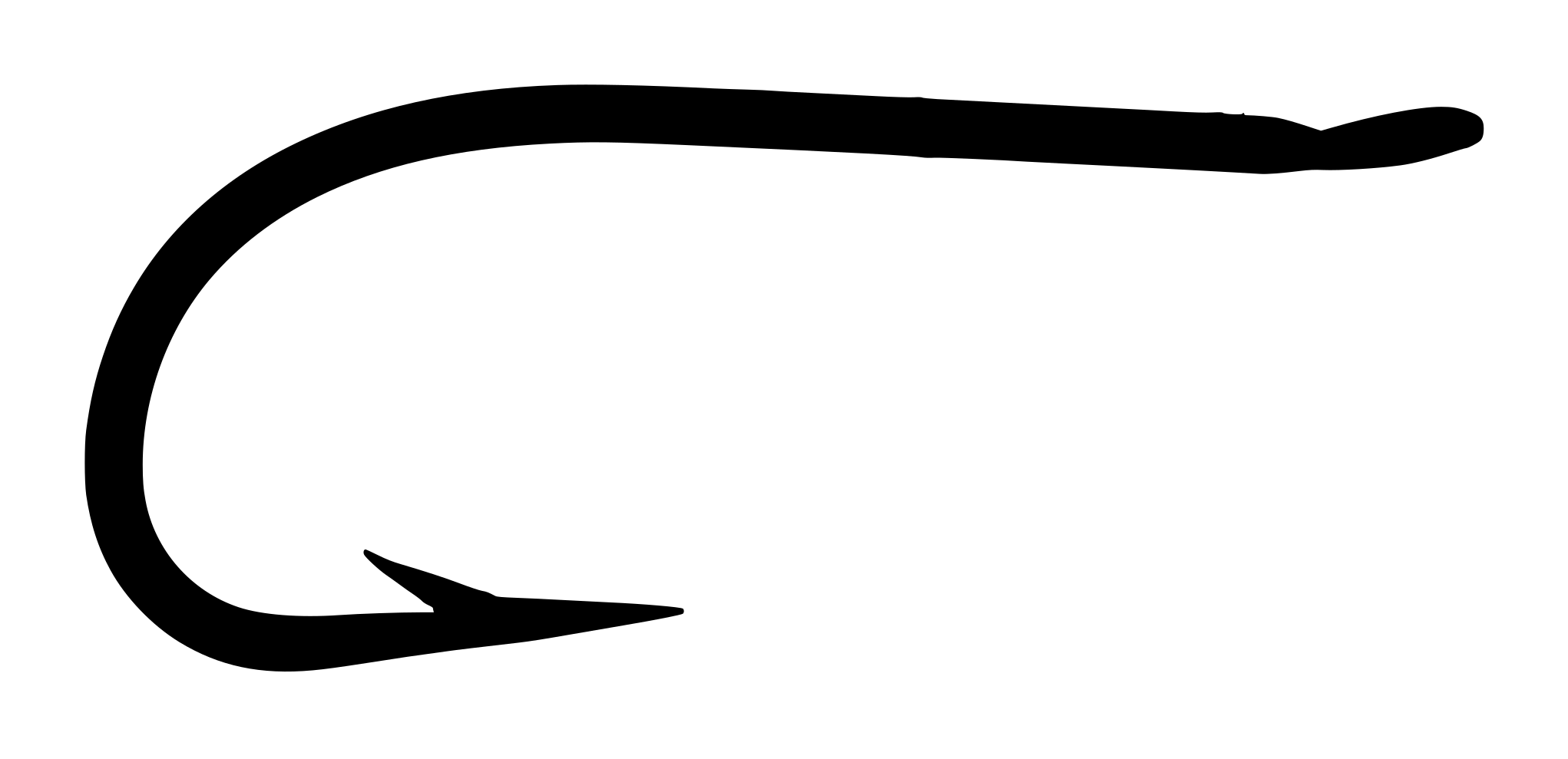
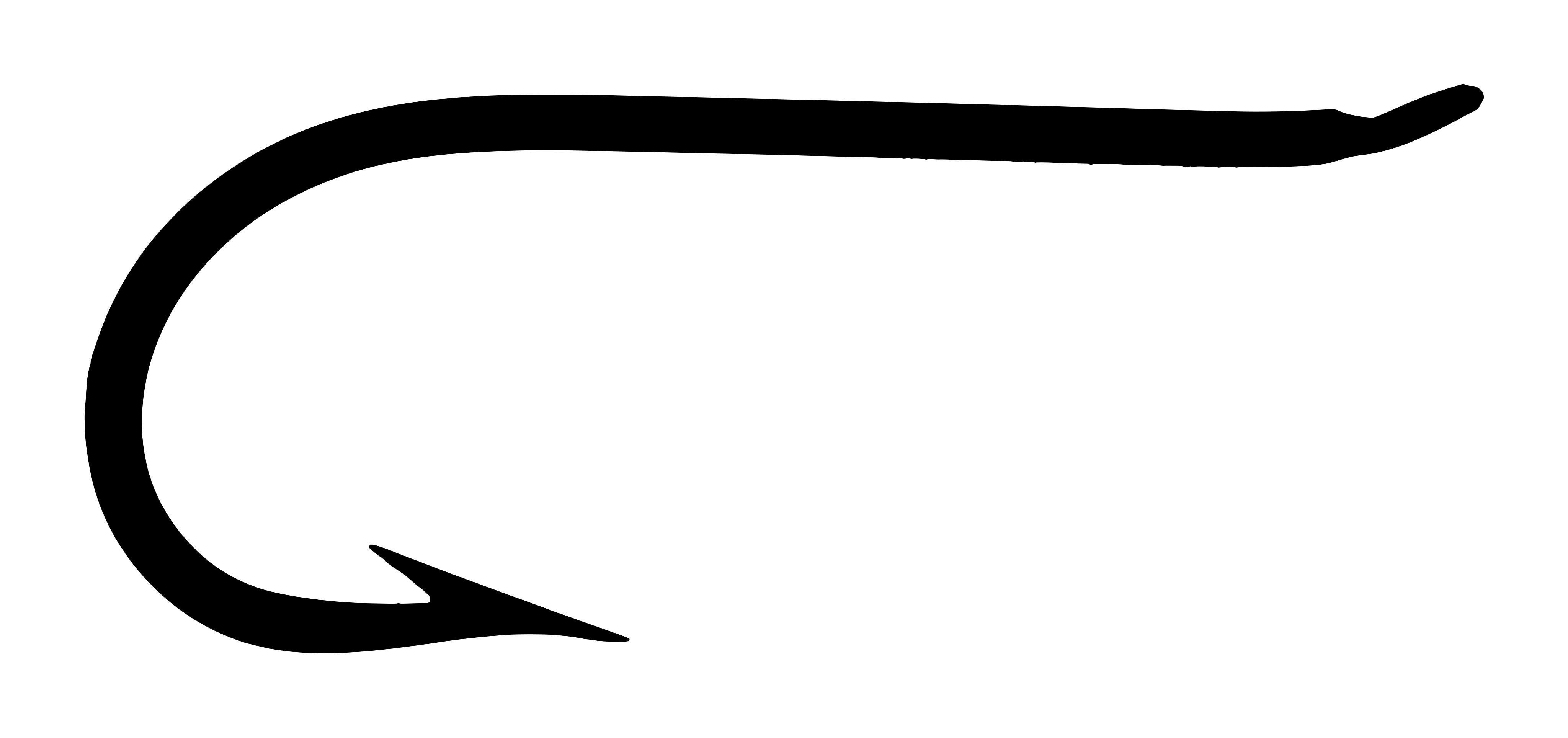
The John James & Sons 3819 is a Kirby-pattern blind-flatted salmon and sea-trout hook manufactured in Redditch, England between approximately 1910 and 1950. This is a standard No. 6 size hook in bronzed finish, featuring the distinctive reversed-offset bend characteristic of the Kirby family and a flatted (blind) eye construction stamped with the letter ‘B’.
The blind-flatted eye design was standard for UK game-fishing hooks of this era, allowing direct tying to leader material using traditional whipping and loop methods. The Kirby bend’s lateral hook-set geometry was preferred by salmon and sea-trout anglers for its penetration characteristics in moving water. The forged construction provides the strength required for large game fish.
This card survives in good condition with strong provenance evidence: the red lithographed label, cream card stock, hand-numbered sizing, and ‘Made in England’ statement all confirm Redditch production during the inter-war and early post-war period. The model number 3819 and ‘Flatted’ designation are consistent with documented John James & Sons catalog entries from this era. Collector interest in blind-eye salmon hooks has increased significantly as traditional UK fishing methods have gained renewed attention among fly tyers and hook historians.
Original red lithographed label for the John James & Sons 3819 Kirby Flatted Hook, size 6, bronzed finish. The label shows model code 3819, manufacturer mark, and product designation. Hand-numbered size '6' visible in black ink on card face.
Photographic record
4 cataloged imagesSelect any record to load it above.
4 images shown
John James & Sons 3819 Size 6 LabelOriginal red lithographed label for the John James & Sons 3819 Kirby Flatted Hook, size 6, bronzed finish. The label shows model code 3819, manufacturer mark, and product designation. Hand-numbered size '6' visible in black ink on card face.Open originalJohn James & Sons 3819 Size 6 Flatted Eye DetailClose-up of the blind flatted eye construction on the John James & Sons 3819, showing the characteristic spade-end flatting and the manufacturer's 'B' stamp. This diagnostic mark distinguishes the 3819 from competing Redditch makers' flatted-eye hooks.Open originalJohn James & Sons 3819 Size 6 Point ProfileSide profile of the John James & Sons 3819 showing the superior point geometry and barb placement. The point exhibits a near-straight inner taper characteristic of superior-point construction, distinct from hollow or knife-edge designs.Open originalJohn James & Sons 3819 Size 6 Full Hook ProfileFull-length side profile of the John James & Sons 3819 Kirby Flatted Hook, size 6, showing the complete bend geometry, shank length, and the characteristic reversed-offset bend typical of the Kirby pattern. Photographed on measurement grid for scale reference.Open original
Technical profile
Eye
Blind — FlattedFlatted eye with a the letter "B" stamped on the flatted part.
Wire
Extra-Heavy (2X+), Forged
Shank
Standard — Plain
Bend
Kirby (offset), Standard gap, Offset / kirbedDistinctive reversed offset characteristic of the Kirby pattern. Deep angular bend with pronounced wire set P.
Point
Superior (near-straight inner taper)
Finish
Bronzed — Confirmed (stated on packaging)Warm brown tone characteristic of bronze coating P. Finish confirmed on original packaging label V.
The Kirby bend is a reversed-offset design that curves the hook shank laterally, setting the point and barb inboard of the shank axis. This geometry was developed specifically for large game fish, where the lateral offset provides improved hook-set mechanics and penetration angles in the mouth or jaw of strong, fast-moving fish. The reversed offset — curving opposite to the angler’s perspective — is characteristic of Kirby and distinguishes it from the standard (non-reversed) Beak pattern.
The superior point on this specimen exhibits a near-straight inner taper from barb to tip, with a nearly flat inside face. This is distinct from the hollow-point design, which features a pronounced concave curve. The superior point is mechanically simpler to produce and offers a strong, reliable penetration geometry without the fragility risks associated with knife-edge or hollow constructions.
The forged wire profile indicates that the shank was shaped by hammer-forming (impact) rather than by cold-drawn wire bending. Forging compacts the steel crystalline structure, increasing tensile strength and allowing heavier gauge wire to be used without excessive stiffness. The No. 6 size with standard wire gauge demonstrates the balance between strength and flexibility required for salmon and sea-trout work.
The blind-flatted eye construction was ergonomically superior to modern alternatives for the leader-tying methods of the era — it eliminated the weakening effect of a drilled hole (as in early blind-eye designs) while providing a broad, sturdy surface for whipping and knot tying. The flatting process removed approximately 25-35% of the wire diameter at the eye end, creating the characteristic spade shape while maintaining enough material for secure knot anchorage.
No barcode present on packaging — strong pre-1974 indicator. Red lithographed label on cream card stock consistent with early 20th-century British production. 'Made in England' statement typical of inter-war and immediate post-war Redditch output. John James & Sons branding and 'Flatted' designation (along with stamped 'B' marking on eye) are consistent with 1910-1950 Redditch salmon-hook production. The label style — hand-numbered size (6) in ink — suggests individual packaging rather than mass-production era. Absence of postal code and modern phone format confirms pre-1960s origin. Lithographic print quality and card construction point to 1920s-1940s peak period.
The Mystery of the 'B' Stamp
The 'B' stamp found on the flatted eye of this John James hook is a mystery within the broader Redditch collecting community — it does not appear in any published John James & Sons catalog or documented reference, yet it is sufficiently consistent and deliberate to suggest an intentional manufacturer's mark. Some collectors speculate it denotes a specific batch, a quality grade, or a particular sales channel (possibly indicating 'British Standard' or a similar designation), but no documentary evidence has been found to confirm its meaning. This ambiguity makes it a 'holy grail' mark for researchers interested in Redditch manufacturing practices — discovering a contemporary reference document that explains the 'B' stamp would represent a significant contribution to fishing hook history.
Design lineage and influence
The Kirby bend itself originated in the mid-19th century as a refinement of earlier offset hooks developed for sea-trout and salmon fishing. The reversed offset design provided improved hook-set geometry for large, strong fish — a key innovation in the era before barbless hooks and in-fighting techniques were standardized. By the Edwardian era (1901-1910), the Kirby had become the preferred bend family for UK game-fishing, with competing manufacturers (Allcock, Partridge, Milward, John James) all producing variants.
The blind-flatted eye was the dominant construction for British salmon hooks until the 1950s-1960s, when modern loop-eye and ball-eye designs became industry standard. Today, the blind-eye Kirby represents a historical waypoint in the evolution of hook design — no longer in commercial production but increasingly sought by traditional fly-tyers and living-history practitioners. Contemporary manufacturers like Partridge of Redditch have reintroduced blind-eye hooks in limited production runs to serve this revived market segment.
Best matchRelated by Attribute
Computed automatically from catalog data — updated as new hooks are added.
Matches: Bend, Wire, Point, Offset, Shank Feat. +1 moreDiffers: Shank: Standard vs 1X Long; Gap: Standard vs Narrow; Eye: Blind — Flatted vs Ball Eye +7 more
The 3819 Flatted Eye is designed for salmon and sea-trout fishing on rivers throughout the United Kingdom. The blind-flatted eye construction with stamped ‘B’ marker was standard for tying direct to leader material using traditional whipping methods. The Kirby bend’s reversed offset provides the lateral hook-set geometry preferred for larger game fish, particularly in spate conditions where immediate penetration is critical.
Secondary Applications
Can be used for large coarse-fish lures and saltwater applications where a heavier wire with offset geometry is preferred.
Classic Fly Patterns
Not typically used for fly tying. Designed as a bait-hook or as a base for traditional tube-fly and wading-pool methods in Scottish and English salmon fishing.
Modern Equivalents
Hook
Match Quality
Notes
Partridge GS/SA (Salmon Low Water)
Good
Modern Redditch-made salmon hook with blind eye; similar bend family and wire gauge but uses contemporary tying-eye construction
Mustad 36890 (Salmon Fly)
Moderate
Industrial production equivalent with similar bend geometry and wire gauge; modern plated finish; eye type differs significantly
Collector notes
Rated 4.5/10 — blind-eye salmon hooks command modest collector interest among Redditch specialists and traditional fly-tyers, but are not actively hunted. The 'B' stamped flatted eye is a unique diagnostic feature that adds modest appeal. Complete original packaging in good condition commands a real but modest premium. Size 6 is a standard size with no scarcity anomaly.
Reference value
$12 – $28 USD estimate
Packaging condition
Good — moderate wear, legibleRecorded specimen
Packaging format
JJ-CARD-01Catalog code
Positive factors: (1) Original lithographed packaging from a documented UK manufacturer; (2) Distinctive ‘B’ stamp on flatted eye — not commonly encountered on other Redditch makers’ hooks; (3) Blind-eye construction is increasingly sought by traditional salmon and sea-trout fly-tyers reviving historical methods; (4) Dated card stock and label style provide strong era-dating evidence; (5) Kirby bend offers distinctive geometry not found in modern industrial production.
Limiting factors: (1) John James & Sons was a mid-tier Redditch maker, not commanding the prestige of Partridge or early Allcock; (2) Standard size 6 with no rarity anomaly; (3) Bronzed finish is common on era hooks — no unusual plating or specialty finish; (4) Blind-eye construction, while historically significant, is less aesthetically distinctive than some contemporary designs; (5) Card condition is good but not exceptional — no sealed packaging or pristine state premium.
Most desirable variants: Sealed or near-sealed cards with full hook counts in sizes 1-3 (larger game fish sizes command premium). Variant finishes (blued or japanned versions, if they exist) would add collector interest. Single specimens are occasionally encountered but lack the packaging premium.
Condition impact: Opened cards with 75%+ hook retention: modest premium. Sealed or near-sealed with full count: significant premium (2-3x base value). Missing hooks or heavily worn card: value drops to specialist/reference tier only.
Packaging
Red lithographed label mounted on cream-colored card stock. Label shows 'JOHN JAMES & SONS' in bold capitals, model code '3819' and '100' (quantity indicator), a circular manufacturer's mark/seal in the center, and text reading 'KIRBY Flatted' / 'FISH HOOKS' / 'BRONZED' / 'MADE IN ENGLAND'. Size 6 hand-numbered in black ink on the card face. Card measures approximately 2.5" x 1.75" (standard Victorian-era sales card dimension). Stock is thin but substantial, consistent with pre-1940s production. Print method is offset lithography with hand-numbering applied post-print. No modern barcode, no postal code, no ™ or ® symbols. Edges show light wear and toning typical of 80+ year storage.
Market Value Notes
Low ($12): Good condition — opened card, 75-90% hook count present, light wear to packaging, hooks bright with no corrosion.
High ($28): Excellent condition — sealed or near-sealed, full or complete hook count, minimal packaging wear, original tissue intact if present.
Premium factors: sealed packaging, 100% hook count, striking lithograph label condition, Redditch maker provenance, 'B' stamp diagnostic rarity.
Platforms: eBay UK (primary), eBay US (secondary), UK tackle specialist dealers, Redditch hook collector forums.
Confidence: E estimated — limited specific comparable sales data for this model; extrapolated from similar-era John James and Redditch flatted-eye cards (typical range $8-35 depending on size and condition). Confidence anchored by observation of comparable blind-eye salmon cards selling in $10-40 range on eBay UK 2023-2025.
Where to Find
eBay UK (search 'John James salmon hooks' or 'Redditch flatted eye'); UK tackle specialist dealers in Redditch region; occasional appearance at UK fishing tackle fairs and auctions (Tattersalls, Angling Auctions specialist sales); less common on eBay US but occasionally appears. Redditch hook collector groups and forums (specific to blind-eye and salmon hooks) are primary source for serious acquisition.
Collector's Identification Tips
Identify the John James & Sons 3819 by: (1) Model code ‘3819’ printed on the label; (2) ‘KIRBY Flatted’ designation on the red label; (3) Blind flatted eye with ‘B’ stamp (distinctive among Redditch makers); (4) Bronzed finish with warm brown tone; (5) Reversed-offset bend geometry characteristic of Kirby pattern; (6) Red lithographed label on cream card stock (dating signature); (7) Hand-numbered size designation in black ink; (8) ‘Made in England’ statement (pre-1960s indicator). The ‘B’ stamp on the flatted eye is the single most diagnostic feature — not found on competing Redditch makers’ flatted hooks.
Preservation
Storage and Preservation
Store the original card in a cool, dry environment away from direct sunlight and humidity. The bronzed finish will develop a natural patina over time, which many collectors consider desirable — avoid attempting to ‘restore’ the finish with harsh polishing or chemical treatments, as this will damage the original coating and reduce both historical value and aesthetic appeal.
Keep the card in its current packaging whenever possible. If tissue or envelope wrapping was originally present and is still intact, preserve it as-is — do not remove or replace. Store cards flat or in archival-quality folders designed for fishing tackle (acid-free materials only). Avoid contact with other ferrous metals to prevent galvanic corrosion.
Do not remove hooks from the card for storage. If hooks must be removed for use or examination, store them in a dry container lined with acid-free paper or uncoated cotton cloth (never plastic bags, which trap moisture). Check periodically for signs of corrosion or pest damage. The original lithographed label should never be cleaned with water — use only a soft dry brush or microfiber cloth to remove dust.
Marking Analysis
Packaging Marks and Stamps
The size ‘6’ is hand-written or hand-stamped in black ink on the face of the card, consistent with individual packaging practices in the Redditch trade during the 1910-1950 period. This is not a printed designation but a post-production marking, suggesting that individual cards were assembled and sized by hand before distribution to retailers.
The most significant marking is the letter ‘B’ stamped on the flatted eye of the hook itself — not on the packaging. This is a manufacturer’s quality or batch mark, stamped at the time of manufacture or eye flatting. The ‘B’ mark is the single most diagnostic feature of this model and is not known to appear on competing makers’ flatted-eye hooks from the same era, making it a reliable identification aid for collectors.
No price marking is visible on the card, which is consistent with the era before standardized retail pricing in the UK fishing trade. Retailers would have written prices on cards at the point of sale, but this specimen shows no such marking.
Primary Source
Label Text and Manufacturing Claims
Source: John James & Sons Model 3819 packaging label, original artifact
The red lithographed label contains the following key claims and information: ‘JOHN JAMES & SONS’ (prominent manufacturer name); ‘100’ and ‘3819’ (quantity and model code); ‘KIRBY Flatted’ (bend family and eye designation); ‘FISH HOOKS’ (product category); ‘BRONZED’ (finish specification); ‘MADE IN ENGLAND’ (country of origin).
The ‘100’ designation refers to the quantity per card — a standard commercial notation of the era. This allows estimation of the card’s original retail composition: if approximately 80-90 hooks remain, the card has lost 10-20% of its original stock, consistent with typical use and loss over 75+ years.
The ‘KIRBY Flatted’ designation is significant: it confirms that this is the Kirby-pattern bend (reversed offset) and that the eye construction is flatted (blind), distinguishing it from turned-eye variants and from other Redditch makers’ flatted designs that lacked this explicit designation.
The label style — all capitals, serif typeface, red ink on cream stock — is consistent with Redditch lithographic production during the 1920s-1940s period. This predates the shift to more modern typography and photo-offset printing that became standard in UK manufacturing by the 1950s.
Additional
The Blind Flatted Eye in Redditch Tradition
The blind-flatted eye, or ‘spade end’, was the standard eye construction for British salmon and sea-trout hooks throughout the 19th and early 20th centuries. This construction — a flat, broad end with no loop — required anglers to tie the hook directly to their leader using traditional knots (half-hitches, whips, or loop methods). Unlike modern eyed hooks, the flatted end provided maximum shank length and allowed the fly-dresser complete control over the tying process.
The letter ‘B’ stamped on this specimen’s eye is a manufacturer’s mark, possibly indicating batch, quality grade, or a specific production run. Redditch makers commonly stamped or marked their hooks with initials or codes to aid in quality control and to provide traceability — though such codes are rarely documented in modern catalogs, making them valuable diagnostic tools for collectors.
The John James & Sons 3819 represents the tail end of the blind-eye era in commercial British hook manufacture. By the 1950s, turned-eye and ball-eye constructions had become industry standard, rendering flatted-eye hooks obsolete for all but the most traditional anglers. This transition — from blind to eyed — marked a fundamental shift in fly-tying methodology and in how anglers related to their tools. Today, traditional fly-tyers and salmon anglers are rediscovering blind-eye hooks as part of a broader revival of historical fishing methods and aesthetics.
Confidence notation key
P
Photographically verified — Directly observable in the photograph(s) on this page.
V
Verified by documentation — Confirmed by manufacturer catalog, spec sheet, or published reference.
I
Inferred — A logical deduction from observable or documented evidence, not directly stated.
E
Estimated — An approximation based on visual comparison, proportional analysis, or limited data.
S
Speculative — A reasoned hypothesis that cannot be confirmed from available evidence.
Unnotated claims are the compiler’s synthesis; see Sources. All photographs on garrenwood.com are taken on a measurement grid where each square equals 1/10 inch (0.1″ / 2.54 mm).