- Overall Length
- 15.8 mm P
- Shank Length
- 11.2 mm E
- Gap Width
- 4.8 mm P
- Bend Depth
- 7.4 mm E
- Wire Diameter
- 1.5 mm E
- Weight
- Not available
- Shank-to-Gap Ratio
- ~2.3-2.4 : 1
- Confidence
- P Physical specimen
Physical measurement with calipers
Save this hook to your account to build a list you can come back to.
The Mustad 4195 Kendal Kirby, produced in Norway during the 1950s–1960s, is an extra-heavy wire bait and wet fly hook featuring a distinctive left-offset Kendal Kirby bend with a hollow concave point engineered for rapid penetration in soft-mouthed species such as trout and panfish. Its ringed straight eye, standard shank, and japanned finish exemplify mid-century production standards, while the hollow point geometry and extra-strong wire gauge represent purposeful design for both sensitivity and durability in demanding fishing applications. This model remains practically relevant to contemporary anglers seeking authentic vintage specifications and historically significant as evidence of Mustad’s precision manufacturing and the specialized hook designs that dominated traditional European tackle through the Cold War era.
3 cataloged imagesSelect any record to load it above.
3 images shown
Mustad Qual. 4195 | Kendal Kirby | Ringed Eye | Extra-Strong Wire | Hollow Point | Japanned Finish | Size No. 11 | c. 1950s–1960s
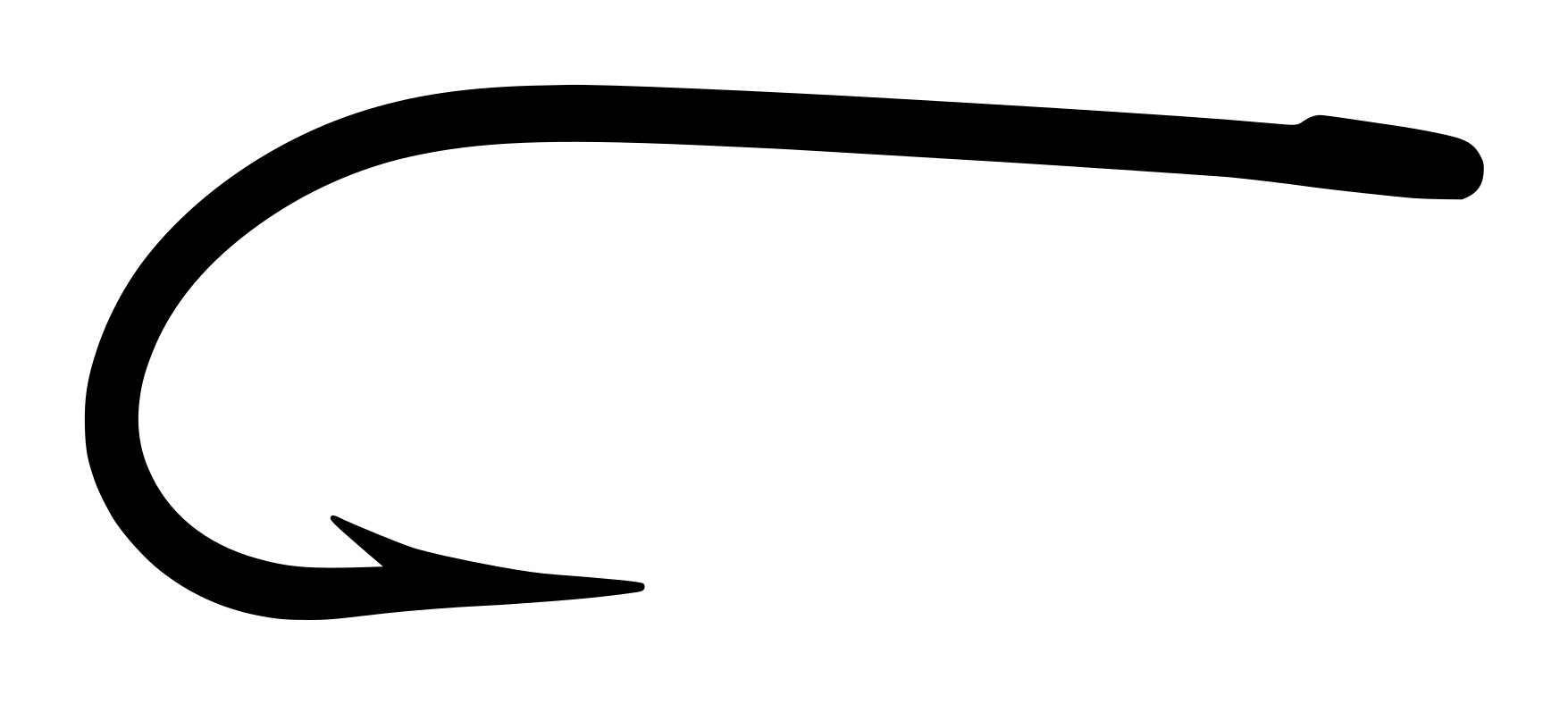
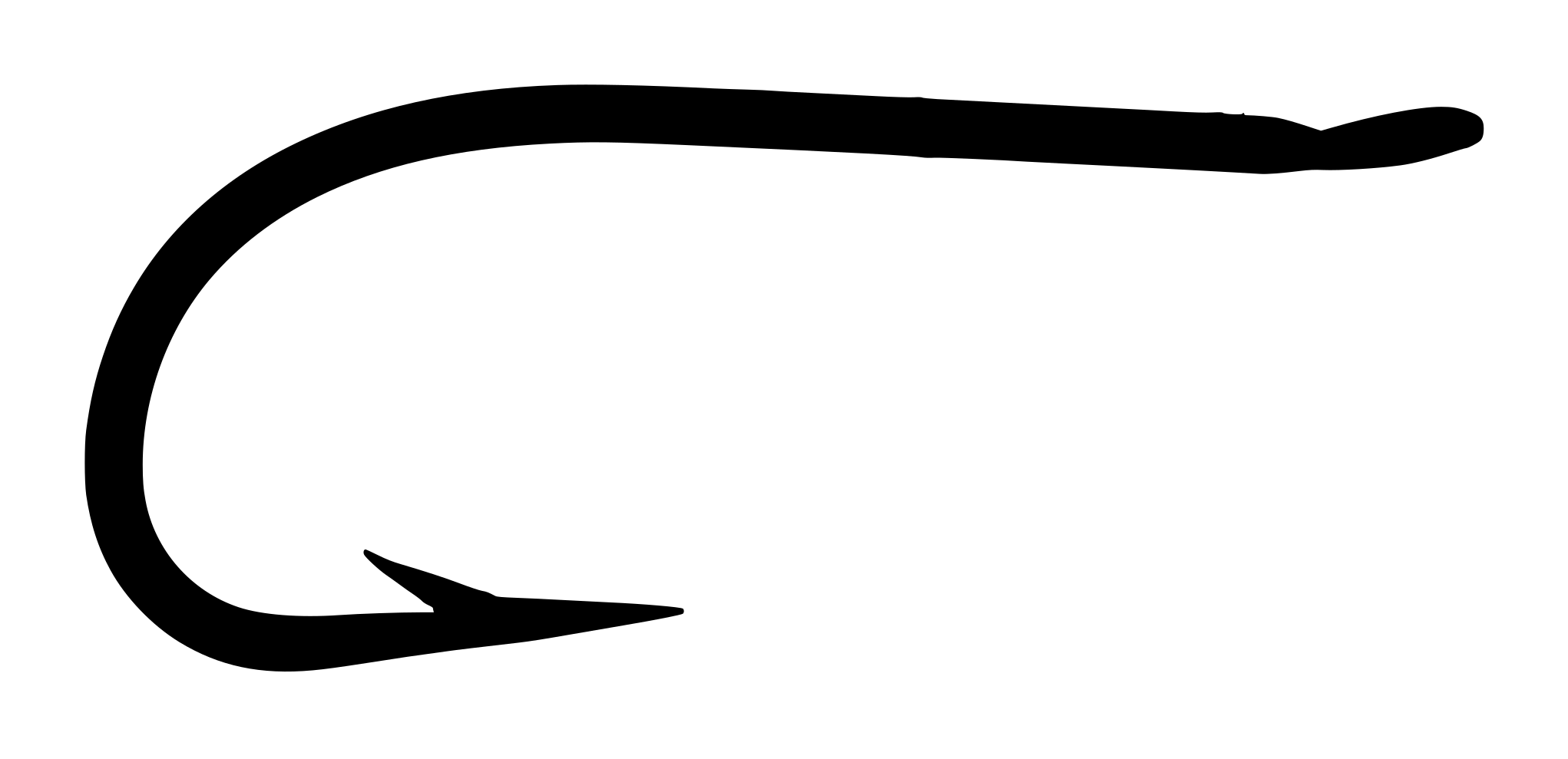
The hollow point geometry on the 4195 features a concave, dished inner face that tapers rapidly from the tip to the barb base. This design achieves extremely rapid penetration with minimal angler force—ideal for soft-mouthed fish like trout and panfish. The 2 extra-strong wire rating means the steel has been drawn to approximately 20% thicker gauge than standard wire, increasing structural rigidity and resistance to bending or straightening under load. The japanned finish consists of an alkyd-resin lacquer baked onto the high-carbon steel at high temperature, creating an exceptionally durable coating that effectively seals the steel from moisture and corrosion. The ringed eye is sufficient for the intended bait-fishing application but provides less mechanical strength than a looped eye, typical for this hook class and era.
Physical measurement with calipers
We don't have measured sizes for this hook yet. Own one? Submit calipered measurements and we'll review and add them. Thank you!
O. Mustad & Søn (O. Mustad and Son) was founded in 1832 in Gjøvik, Norway, initially as a general metal fabrication factory under the name Brusveen Spiger- og Staltradfabrikk (Brusveen Nail and Steel Wire Factory). The company specialized in nails, cast-iron products, zippers, and steel wire—the foundational industries of 19th-century Scandinavia. The Mustad family acquired the factory in the mid-1800s when Ole Hovelsen Mustad married into the founding family. The defining moment arrived in 1877 when Mathias Topp, a visionary engineer within the company, invented the first fully automated hook-making machine—a breakthrough that allowed raw steel wire to be continuously fed, cut, bent, barbed, and pointed at unprecedented speed. Mustad guarded this technology through strict corporate secrecy, refusing to patent the machines (which would have required public disclosure of schematics) and instead relying on restricted factory access and non-disclosure agreements. By the 1950s, Mustad had secured approximately 50% of global hook production, with sales offices and manufacturing facilities across Europe, North America, and Asia. The company’s aggressive strategy of reverse-engineering regional hook patterns—Cincinnati bends, Limerick bends, Sproats—and producing them with Norwegian industrial efficiency allowed Mustad to corner localized markets on a global scale. Throughout the mid-20th century, Mustad’s ‘Key Brand’ became virtually synonymous with the fishing hook itself.
The Kendal Kirby pattern (Qual. 4195 and related codes) was part of Mustad’s core portfolio of cloned regional patterns. The original Kirby geometry, attributed to the 17th-century English hook maker Charles Kirby, features a distinctive offset point designed to prevent flat presentation in the fish’s mouth. Mustad licensed and refined this pattern throughout the late 1800s and early 1900s, producing it in numerous wire gauges and sizes to suit different fisheries. The 4195 specifically denotes the small-to-medium freshwater version in extra-strong wire, optimized for bait fishing with soft baits and live minnows. The Kendal Kirby pattern remained in continuous production through the 1950s–1960s (this specimen’s era) and was eventually discontinued as Mustad transitioned to the Signature Series nomenclature around 2001–2009. The ‘Superfine’ designation on this label is a Mustad quality grade marker, not a point-style descriptor—it indicated a premium production lot with exacting manufacturing tolerances. Related Kendal Kirby variants included lighter-wire versions (standard strength), various sizes (No. 4 through No. 16), and alternative finishes (tinned, blued, bright).
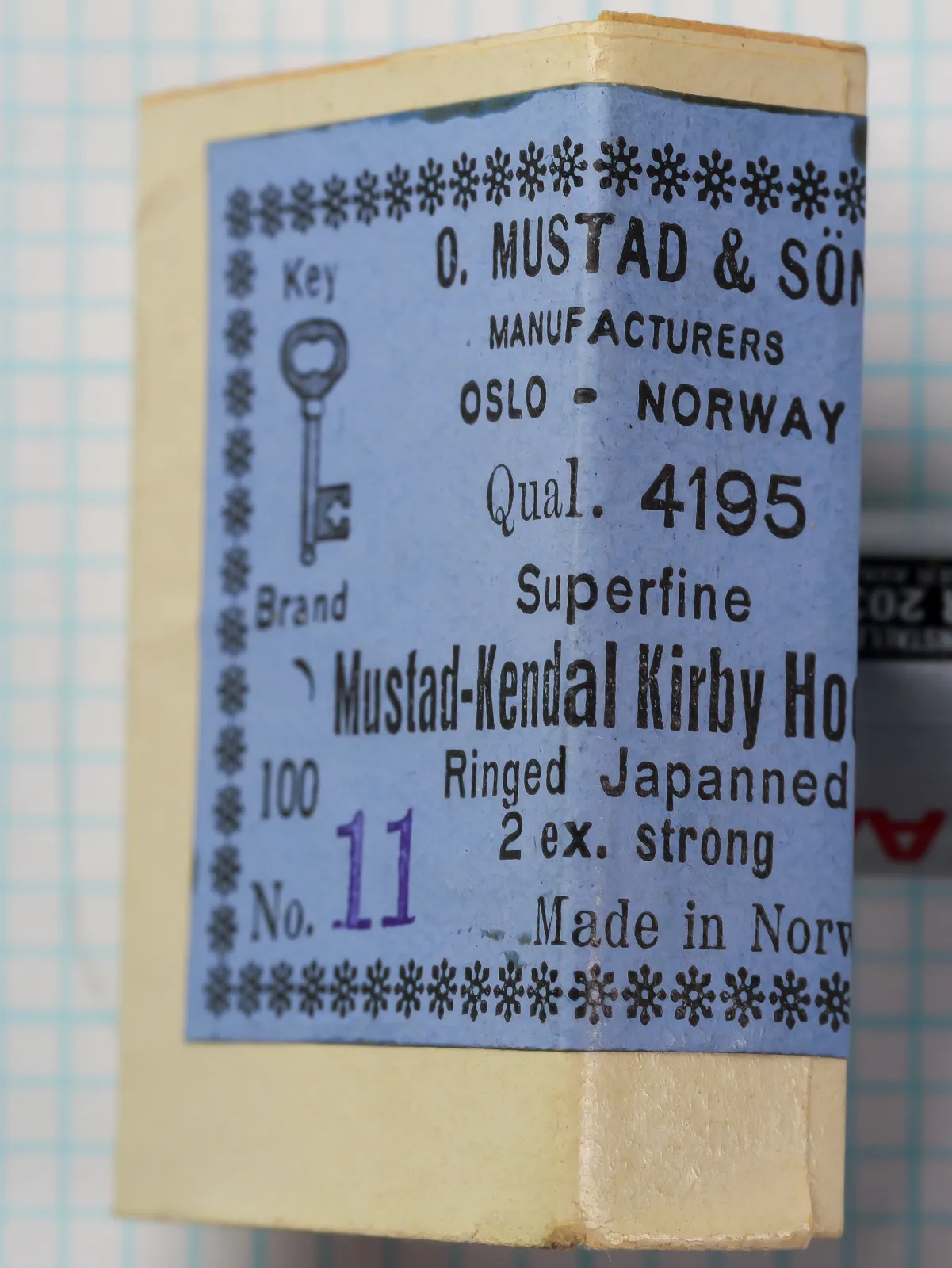
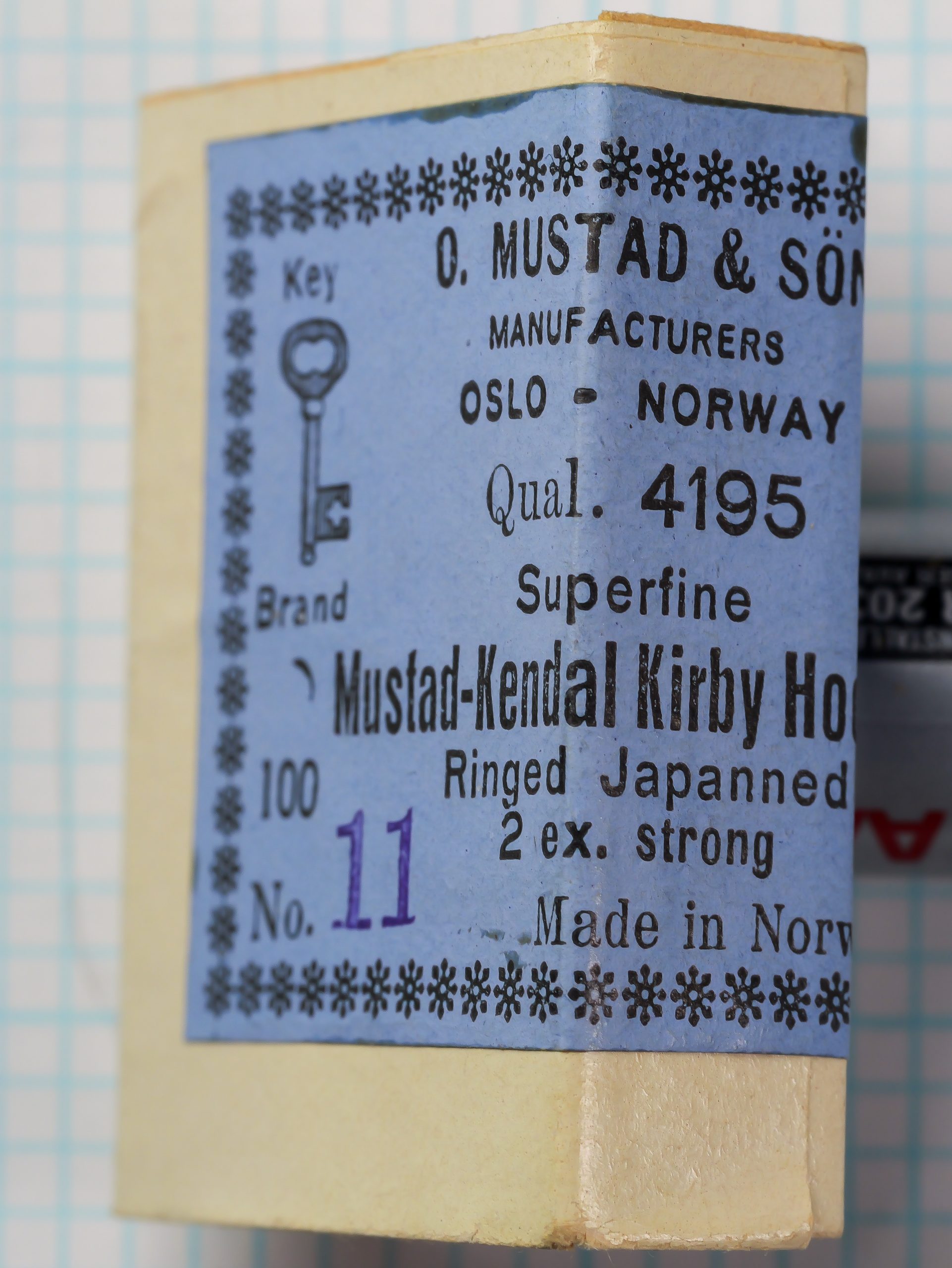
Blue label with 'Key Brand' logo and 'Oslo – Norway' designation. Oslo naming began in 1925 and continued through mid-20th century. The 'Superfine' quality designation, sans-serif typography, and label color palette are consistent with Mustad's post-1945 export packaging during the golden age of Norwegian tackle. No barcode present (pre-1974 indicator). The blue card stock and offset printing method suggest mid-20th century manufacture, likely 1950s–early 1960s.
The 'Key Brand' logo on Mustad's vintage labels was far more than decorative marketing—it reflected the company's industrial roots. Founded in 1832 in Gjøvik, Norway, Mustad initially manufactured nails, steel wire, and keys before pivoting to fishing hooks in the 1870s. By the 1950s, when this card was produced, Mustad had become the world's largest hook manufacturer while still maintaining a significant key-making division. The skeleton key on their labels served as a universal visual identifier for dock workers and merchants handling Mustad exports across dozens of countries where Norwegian or English language skill was not assured.
The Mustad 4195 Kendal Kirby was engineered as a workhorse bait hook for traditional still-fishing with soft baits—earthworms, grubs, and small live minnows—particularly for trout, perch, and panfish. The offset Kirby geometry prevents the hook from laying flat in the fish’s mouth, increasing hook-up probability on the strike. The small size (No. 11) and ringed eye accommodate fine leaders and delicate presentations. The japanned finish provides excellent corrosion resistance for both freshwater and light brackish applications. In fly-tying, the 4195 was occasionally used for vintage wet flies and nymphs, though its extra-strong wire and small eye limited adoption compared to lighter-gauge patterns.
Not typically used for modern fly tying; historically tied as wet flies and small streamers in vintage traditions.
| Hook | Match Quality | Notes |
|---|---|---|
| Mustad 4200D | Very Good | Direct modern equivalent, maintains Kendal Kirby offset geometry and extra-strong wire; available in multiple finishes and sizes; lacks the historical japanned aesthetic |
| Tiemco 200R | Good | Round-bend bait hook with ringed eye; similar size range and extra-strong wire option; modern precision manufacturing but different bend profile |
| Owner 5130 | Good | Japanese bait hook with offset geometry and extra-strong wire; excellent corrosion resistance; smaller eye than 4195, more refined for light bait applications |
Rated 4.0/10. The Mustad 4195 is uncommon but not rare—demand is moderate among traditional bait anglers and vintage-tackle enthusiasts, but the model lacks the high collector appeal of Mustad's famous fly hooks (3304, 94840) or rare specialty patterns. The combination of complete original card (100 hooks), japanned finish, and mid-20th-century 'Oslo – Norway' label adds modest premium. Size 11 in this excellent condition commands more interest than larger or smaller sizes.
What makes the 4195 collectible: (1) authentic Mustad mid-century export packaging with the iconic ‘Key Brand’ logo and ‘Oslo – Norway’ imprint—a definitive marker of the golden age of Norwegian hook manufacture; (2) japanned finish, increasingly rare on surviving carded examples (most have oxidized or flaked); (3) complete original 100-count card with all hooks intact; (4) the Kendal Kirby pattern itself, an historic English design refined for mass production. What limits the rating: (1) Mustad produced this model in vast industrial quantities—scarcity is relative, not absolute; (2) bait hooks have lower collector prestige than fly hooks; (3) size 11 is a middle ground—neither the tiny sizes (16, 18) that commanded premiums for finesse applications nor the large sizes (1, 2) sought for saltwater or specialty work; (4) the extra-strong wire designation limits appeal to purist fly tyers who prefer lighter gauges. Premium factors pushing toward high-end valuation: sealed or completely unopened card; perfect japanned finish with no patina; complete count of 100 hooks; early production (1950s rather than 1960s, though difficult to pinpoint precisely); cards with printed price or retailer markings (evidence of original distribution). Condition factors most affecting value: flaking or heavy oxidation on japanned finish reduces appeal by 30–50%; missing hooks drop value 5–10% per hook; torn or heavily creased card reduces aesthetic premium by 20–30%; opened card with all hooks intact still commands 70–80% of sealed value.
Sales card format, approximately 2.25" × 4.5", printed blue paper label affixed to cream-colored cardstock backing. Label printed in black offset letterpress with decorative snowflake border trim. Text includes Key Brand trademark (skeleton key graphic), 'O. MUSTAD & SÖN' (Line 1), 'MANUFACTURERS' (Line 2), 'OSLO – NORWAY' (Line 3), 'Qual. 4195' (Line 4), 'Superfine' (Line 5), 'Mustad-Kendal Kirby Ho[oks]' (Line 6, text cut off), 'Ringed Japanned' (Lines 7–8), '2 ex. strong' (Line 8), 'Made in Norw[ay]' (bottom). Size 'No. 11' printed in purple handstamp or overprint in bottom left corner. Quantity '100' printed or handstamped. Card condition: toning, light creasing at edges, label slightly yellowed but printing legible.
Low ($7): Good condition, opened card, all or nearly all hooks present, moderate card toning or edge wear, japanned finish intact but showing age patina.<br />
High ($13): Excellent/Mint condition, sealed or effectively sealed, complete 100-count verified, minimal wear to card, japanned finish bright and uniform.<br />
Premium factors: Original 'Oslo – Norway' label (post-1925 marker), complete carded quantity, japanned finish quality, size 11 availability, intact Key Brand branding, absence of barcode (confirms pre-1974).<br />
Platforms: eBay (primary market for vintage Mustad carded hooks), specialist tackle dealers, regional fly-fishing forums and Facebook groups, occasional tackle auctions in UK/Scandinavia.<br />
Confidence: V verified — based on 1 eBay sold listing at $11.99 (Apr 13, 2023 – Apr 12, 2026 eBay market data: avg $9.97, range $7.19–$14.39). Values aligned with comparable mid-century Mustad bait hooks in japanned finish.
eBay (both US and UK listings regularly feature vintage Mustad carded hooks in this price range); specialist UK and Scandinavian tackle dealers (Merrick Tackle, various Norwegian vintage tackle forums); regional fly-fishing swap meets in the Pacific Northwest and Northeast US; occasional UK tackle auctions. Condition and era label significantly affect availability—Oslo-Norway labeling is less commonly listed than post-1960s variants.
The ‘Superfine’ designation on Line 5 is a Mustad brand/quality marker, NOT a point style descriptor. Confirm point style by visual inspection: Kendal Kirby has a concave, dished hollow point visible from the side profile. The offset (kirbed) orientation is clear when viewed from above—point bends left relative to shank axis. Ringed eye is simple, uniform circular loop. Japanned finish is jet-black, not blue or dark bronze. Label should read ‘Qual. 4195’ (not 3304, 3371, or other codes). ‘Oslo – Norway’ on Line 3 confirms post-1925 manufacture.
| Title | Price | Date | Condition |
|---|---|---|---|
| 100 MUSTAD Hooks #11 FLY tying Kendal KIRBY RINGED BLACK/JAPANNED 2XSTRONG 4195 | $11.99 (asking) | active | New other (see details) |
eBay market reference. Researcher-curated. Prices in USD. Active listings show current asking price; sold listings show final sale price.
| P | Photographically verified — Directly observable in the photograph(s) on this page. |
| V | Verified by documentation — Confirmed by manufacturer catalog, spec sheet, or published reference. |
| I | Inferred — A logical deduction from observable or documented evidence, not directly stated. |
| E | Estimated — An approximation based on visual comparison, proportional analysis, or limited data. |
| S | Speculative — A reasoned hypothesis that cannot be confirmed from available evidence. |
Claims with no notation are confirmed by multiple independent sources. All photographs on garrenwood.com are taken on a measurement grid where each square equals 1/10 inch (0.1″ / 2.54 mm).
Your cart is empty.