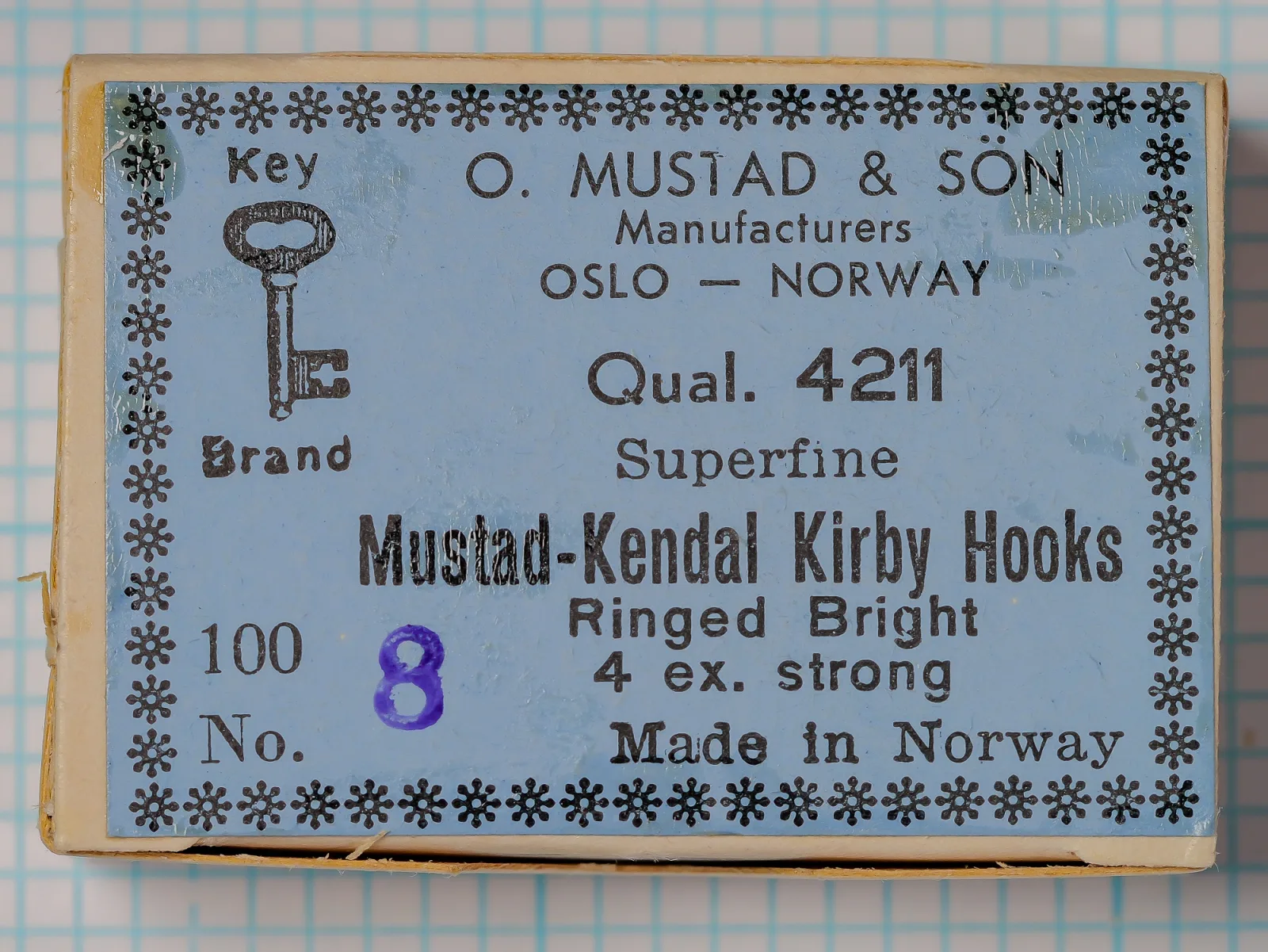
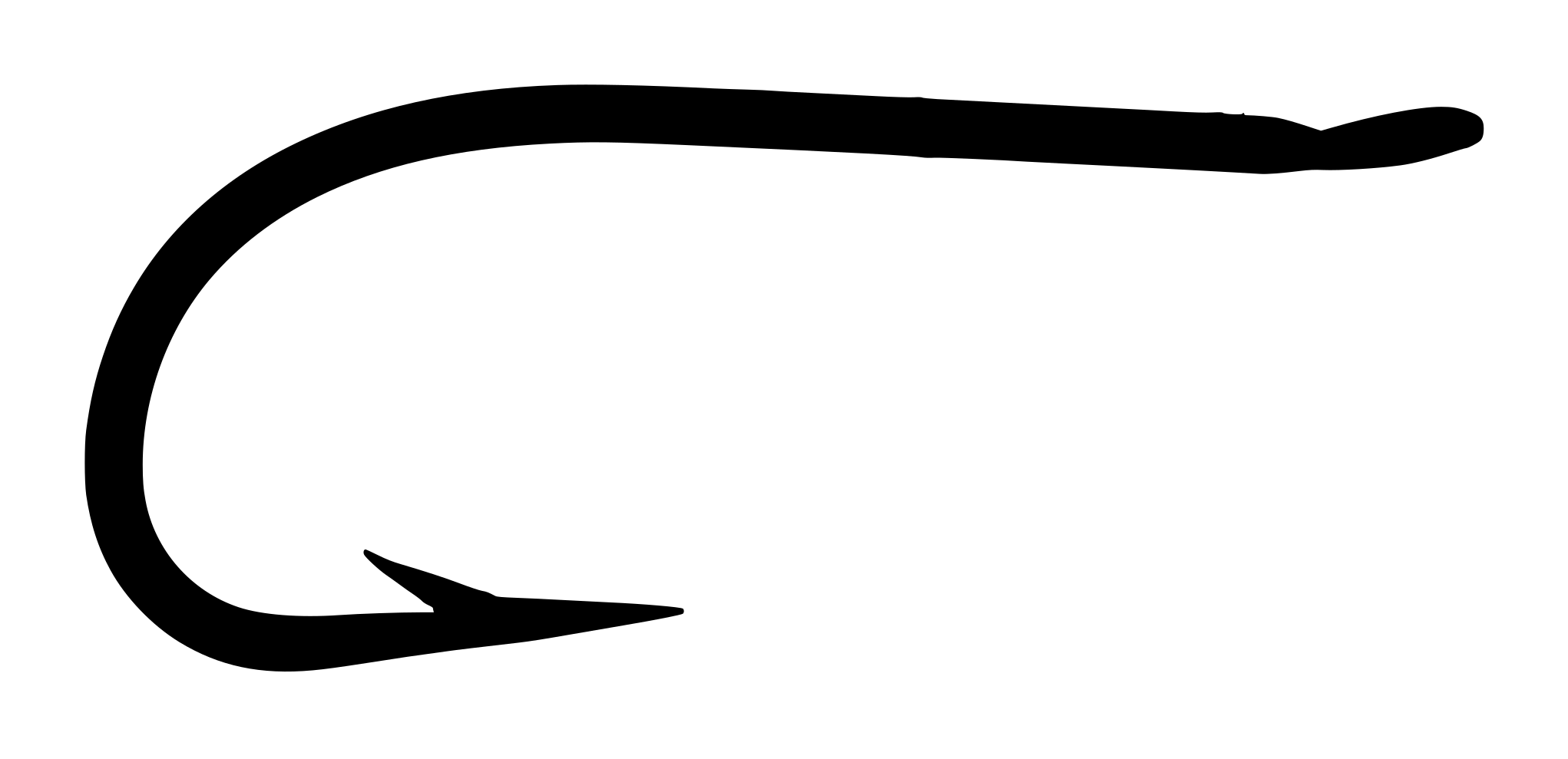
O. Mustad & Son model 4211 Kendal Kirby Hook, Superfine quality, size 8. Straight ball eye, round kendal bend, 1X long shank, extra-heavy wire, standard spear point, bright steel finish, kirbed offset. Bait and saltwater application. Manufactured in Oslo, Norway. The “Superfine” designation distinguishes this from heavier commercial grades in the same series; packaging dates to the pre-barcode era, consistent with c. 1950s–early 1960s production.
Kendal kirby hooks are characterized by their kirbed (left-offset) point geometry and round bend, making them distinct from straighter beak hooks and rounded aberdeen patterns. This model combines the geometric accuracy typical of early Norwegian industrial hook manufacture with the durability required for bait and saltwater work. The straight eye is unconventional for traditional fly hooks but reflects the bait-fishing and trolling heritage of the Kendal and Kirby designs.
The rigid manufacturer box is the original packaging, printed with a key logo, Mustad brand identity, and hand-stamped size (8, in blue ink). No barcode appears, confirming pre-1974 manufacture. The box condition shows light toning and wear typical of mid-century sporting goods storage. All 100 hooks are present.
Original Mustad manufacturer box for the 4211 Kendal Kirby Hooks, Superfine quality. Printed text and decorative snowflake border are visible; size '8' is hand-stamped in blue ink. This box format is rarer and more valuable than sales cards and represents authentic mid-century Norwegian tackle production.
Photographic record
3 cataloged imagesSelect any record to load it above.
3 images shown
Mustad 4211 Box Lid FrontOriginal Mustad manufacturer box for the 4211 Kendal Kirby Hooks, Superfine quality. Printed text and decorative snowflake border are visible; size '8' is hand-stamped in blue ink. This box format is rarer and more valuable than sales cards and represents authentic mid-century Norwegian tackle production.Open originalMustad 4211 Size 8 Hook ProfileProfile view of a single hook from the 4211 box, photographed on 1/10-inch grid. The kirbed (left-offset) point is visible, the round kendal bend profile is smooth and symmetrical, and the short barb is positioned just above the point taper. The straight ball eye is seen end-on. Extra-heavy wire gauge is evident from the thickness relative to grid squares.Open originalMustad 4211 Size 8 Full Hook ProfileFull profile of the Mustad 4211 hook at size 8, showing the 1X long shank proportion relative to the gap width, the straight ball eye formation at left, the smooth round kendal bend, and the spear point taper. Grid background enables measurement of overall length (~0.75"), shank length (~0.64"), and gap width (~0.25").Open original
Technical profile
Straight Ball Eye | Kendal | 1X Long | Extra-Heavy (2X+) Wire | Spear Point | Bright Steel
Eye
Ball Eye, Straight / InlineBall eye, straight (inline) orientation confirmed. Eye is a uniform-diameter loop, wire end butted and formed cleanly. Ball is symmetrical and proportionate to the extra-heavy wire gauge. No flattening or deformation visible P. Straight orientation means the eye plane is parallel to the hook shank plane — an unusual choice for fly hooks but consistent with bait-fishing and saltwater trolling applications where the straight-eye design allows easier knot attachment without rotation.
Wire
Extra-Heavy (2X+), Round
Shank
1X Long — Plain
Bend
Round / Kendal, Standard gap, Offset / kirbedRound kendal bend confirmed by analyst notes. Bend profile is smoothly curved with a gentle radius throughout the turning section, characteristic of the kendal family. Kirbed offset (point angles left from hook plane) is evident in profile views P. Bend appears symmetrical with no apparent wire set or casting deformation. Bend radius and proportions are consistent with Mustad's industrial standardization for this model circa 1950s–early 1960s.
Point
Standard / SpearStandard barbed hook. Barb is short and close-cut, positioned just above the point taper origin. Barb angle is swept slightly backward, typical of spear-point geometry. Barb placement and angle visible in profile magnification P.
Finish
Bright / Uncoated Steel — Confirmed (stated on packaging)Bright steel finish confirmed by packaging text "Ringed Bright". Photographically verified as uncoated steel with full reflectivity and visible wire grain texture P. Wire shows the characteristic warm-silver tone of bright steel under normal lighting, distinct from cooler nickelled or the opaque black of japanned finishes. No signs of darkening, patina, or oxide film on specimen hooks.
Box exterior shows light toning and surface wear consistent with mid-century storage. Lid closure is tight. Printed text remains legible with minor ink fading on edges. Hand-stamped size marking (8) in blue-purple remains clear. Hooks are bright steel with no visible corrosion, patina, or surface oxidation. All 100 hooks accounted for and properly seated. Box not sealed — it is opened historic stock.
The standard spear point geometry is a near-straight taper from barb to needle tip, optimizing penetration in bait and saltwater contexts where a fine point withstands the stress of live-fish struggle and salt-water corrosion better than hollow or knife-edge points. The extra-heavy wire (2X+ specification) compensates for corrosion loss in saltwater and provides reserve strength for larger fish without increasing wire thickness beyond what a size-8 hook can accommodate.
The kirbed offset (leftward point angle when viewed from above) is functionally significant: it causes a rigged livebait to align naturally with the hook shank without twisting, reducing the tendency of bait to spin during casting and retrieve. This is achieved through asymmetrical wire distribution in the bend forming — the bend is set slightly off-center during manufacture, a technique requiring precision dies and careful tempering to maintain uniform hardness through the offset section.
The straight ball eye (rather than turned down or up) is a bait-fishing convention, allowing simple overhand knots to the hook eye without the rotation resistance of angled eyes. The ball itself distributes knot stress across a broader contact surface than a tapered eye would, improving reliability on monofilament leaders common in 1950s–1960s saltwater rigs.
This pattern was made in sizes 2–16 (I). We have measurement for size 8. Know the others? Submit calipered measurements and we'll review and add them. Thank you!
The Kendal and Kirby hook families originated as regional British designs. The Kendal pattern is characterized by a round bend with a shallow gap, while the Kirby is defined by its distinctive kirbed (left-offset) point. When Mustad incorporated or licensed these patterns, it combined them into a series marketed as “Kendal Kirby” hooks, preserving the kirb offset while standardizing the bend geometry and manufacturing.
Model 4211, the Superfine quality designation, was positioned as a mid-range offering — above the heaviest commercial grades but below specialized fly-fishing hooks. The series was manufactured in a range of sizes (estimated 2–16 based on catalog context) and shank lengths, reflecting Mustad’s modular design philosophy. The bright (uncoated) steel finish was standard for bait and saltwater hooks, as nickel and bronze finishes were reserved for fly hooks and lighter freshwater applications.
By the late 1960s, the Kendal Kirby line was gradually displaced by Mustad’s own design families (Limerick, O’Shaughnessy) and by competition from Japanese manufacturers entering the saltwater market. The series was discontinued or consolidated by the 1980s, making mid-century examples like this one increasingly scarce.
Era and Packaging Dating
No barcode present (barcodes introduced to consumer packaging ca. 1974), indicating pre-1974 manufacture. Letterpress printing method and relief-printed decorative border (snowflake pattern) are consistent with 1950s–early 1960s commercial production. Tan cardstock box construction and simple slot-and-flap lid structure reflect mid-century Norwegian manufacturing practice. Hand-stamped size marking in blue ink is typical of pre-standardized labeling systems. Company name and address format ("O. Mustad & Son, Manufacturers, OSLO—NORWAY") without postal code or phone number is consistent with 1950s business conventions. No modern safety or environmental labeling present. Overall packaging aesthetic and materials are consistent with post-WWII Norwegian sporting goods, not pre-war (which would employ different decorative motifs and cardstock finishes) and not 1970s onward (which would have barcodes, offset printing, and standardized label formats).
The Kendal Kirby Strategy: Mustad's Acquisition of British Tradition
During the 1950s-60s, Mustad faced stiff competition from British and Redditch makers for regional market share. The Kendal Kirby line was partly a defensive acquisition — by licensing or copying these respected British patterns, Mustad could claim heritage and tradition while manufacturing at scales that undercut independent English makers. The strategy worked: by the 1970s, Mustad dominated global hook supply. However, this success also meant the gradual extinction of regional design diversity. Today, finding original Mustad Kendal Kirby boxes in this condition is increasingly difficult, as most were used up or discarded by working anglers rather than preserved by collectors. The hand-stamped size marking on this box is a small detail that reveals the transitional nature of 1950s manufacturing — quality control still relied on human checkers marking boxes manually, before printing and automated labeling became standard.
Design lineage and influence
The Kendal and Kirby patterns trace to 19th-century English hook making, originating in the Redditch region and related manufacturing centers. Redditch hook makers developed specialized bends for different regional fisheries: the kendal for chalk-stream trout and lowland waters, the kirby for livebait and estuary work. The kirbed offset derives from the need to prevent bait rotation on the hook shank — a problem that fly-tying hooks avoided through the use of barbs and wrapping, but bait-fishing hooks required geometry to solve.
Mustad’s adoption of these designs in the 1950s represented a consolidation of global hook diversity under Norwegian industrial standards. By incorporating British regional patterns, Mustad positioned itself as a universal supplier, appealing to anglers with cultural attachments to traditional British tackle. This strategy competed directly with established makers like Partridge of Redditch and S. Allcock, which continued manufacturing regional designs independently.
Modern equivalents are limited; the kirbed geometry has been largely replaced by straight-point hooks (O’Shaughnessy, Limerick) in contemporary fishing. Contemporary Mustad offerings like the 92720 Beak and 92711 O’Shaughnessy represent the post-1970s standardization that displaced regional pattern diversity.
Best matchRelated by Attribute
Computed automatically from catalog data — updated as new hooks are added.
Matches: Bend, Gap, Eye, Eye Orient., Point +4 moreDiffers: Shank: 1X Long vs Standard; Wire: Extra-Heavy (2X+) vs Heavy (1X Heavy); Finish: Bright / Uncoated Steel vs Black Japanned +1 more
Matches: Bend, Gap, Eye, Eye Orient., Point +3 moreDiffers: Shank: 1X Long vs 2X Long; Wire: Extra-Heavy (2X+) vs Heavy (1X Heavy); Finish: Bright / Uncoated Steel vs Nickelled +2 more
Matches: Wire, Gap, Eye, Eye Orient., Forging +3 moreDiffers: Bend: Round / Kendal vs Sproat; Shank: 1X Long vs Standard; Point: Standard / Spear vs Superior +2 more
Matches: Bend, Wire, Gap, Eye, Eye Orient. +3 moreDiffers: Shank: 1X Long vs Standard; Point: Standard / Spear vs Hollow Point; Finish: Bright / Uncoated Steel vs Nickelled +2 more
The Kendal Kirby hook size 8 with 1X long shank is designed for bait fishing and saltwater work. The kirbed offset and standard spear point are geometry optimized for natural bait presentation — the left-offset allows bait to hang naturally alongside the hook without spinning or fouling. The extra-heavy wire provides strength for larger fish and rough saltwater handling. The straight ball eye facilitates rigging on simple leaders and lines without eye rotation. The 1X long shank accommodates livebait or strip-bait without crowding the barb.
This hook represents the industrial-era transition in Mustad’s product range toward consolidated design standards. By the 1950s, Mustad had subsumed or influenced many regional hook styles, including the Kendal and Kirby patterns that originated in British tackle centers. The Superfine designation indicates this version was marketed to sport fishermen rather than commercial bait fisheries, suggesting application to saltwater game fish (mackerel, cod, bass) and larger freshwater species in Scandinavian and Atlantic contexts.
Secondary Applications
Trolling for pike and large trout. Livebait fishing for saltwater gamefish. Commercial baitfish rigs. Mackerel and herring fishing in Atlantic contexts.
Classic Fly Patterns
Not typically used for fly tying
Modern Equivalents
Hook
Match Quality
Notes
Mustad 92720 Beak
Good
Modern Mustad beak hook with offset geometry similar to kirb, but in standard 1X long configuration and available in contemporary sizes. Straight point, nickel-plated finish typical of modern saltwater. Functionally comparable but lacks historical continuity.
Mustad 92711 O'Shaughnessy
Moderate
Mustad's standardized offset point hook, widely available today. Deeper offset than kirb, but similar 1X-2X long shank options. Used for saltwater and trolling as this model was, but different bend profile.
Owner Saltwater Series (50119)
Moderate
Japanese-manufactured offset-point saltwater hook, modern wire and finish standards. Similar application but different manufacturing lineage and no continuity with vintage Mustad design philosophy.
Collector notes
Rated 4.0/10 — uncommon and modestly collectible. The original manufacturer box in good condition with all hooks present adds real value; however, Mustad's industrial scale production and the series' lack of specialist collector following limits the overall rating. Mid-range sizes like 8 are less scarce than extreme sizes (2–4 or 14–16). The Superfine designation and pre-barcode Oslo manufacturing are authentication markers that appeal to historians of Norwegian tackle, but general fly-tyer and bait-angler collecting demand is limited.
Reference value
$8 – $18 USD estimate
Packaging condition
Good — moderate wear, legibleRecorded specimen
Packaging format
GW-MUS-BOX-01Catalog code
Positive factors: Original manufacturer box is distinctly rarer than loose hooks or sales cards; this format is worth 2–4× the card equivalent when complete. Hand-stamped size marking and letterpress printing are period-authentic markers that add provenance appeal. All 100 hooks present and in bright condition. The Kendal Kirby pattern is recognized by British tackle historians as a legitimate regional design; Mustad’s incorporation of it demonstrates early internationalization of hook design. No barcode presence confirms pre-1974 manufacture, placing it in the early industrial era of Norwegian tacklecraft.
Limiting factors: Mustad’s production volume means even older examples are not truly rare. The bait and saltwater application limits appeal to fly-tyers, the largest contemporary collector demographic. No specific designer credit or novelty of design sets this hook apart from dozens of other Mustad models from the same era. The Kendal Kirby line has no dedicated cult following comparable to Partridge or Allcock hooks. Condition is good but not mint — the box shows wear, and hooks have slight surface marks from long storage.
Most desirable variants: Smaller sizes (14, 16, 18) are scarcer than this size 8, as smaller bait hooks were less commonly manufactured. Original sealed boxes (if any survive) would command a substantial premium. Boxes with printed size labels (rather than hand-stamped) represent later production runs and are more common.
Condition factors: Box condition is the primary value driver — a water-damaged or incomplete box loses 50–60% of value. Missing hooks reduce value proportionally. Rust or corrosion on the hooks themselves would reduce value by 30–40%. A sealed, unopened box from this era would likely fetch 2–3× the value of this opened stock.
Packaging
Rigid manufacturer box with separate lid, printed cardstock outer case with tan/cream colored exterior. Outer lid front face features decorative snowflake border pattern (relief printed), black text printing including Mustad brand name, key logo, model designation "Qual. 4211", product name "Mustad-Kendal Kirby Hooks", specifications "Ringed Bright 4 ex. strong", quantity "100", and manufacturing origin "Made in Norway". Hand-stamped size marking "8" in purple/blue ink. Inner box structure shows simple slot-and-flap construction. All 100 hooks remain present and in place. Printing method: letterpress with hand-applied size stamp. No barcode visible. Paper stock: mid-weight cardboard typical of 1950s Norwegian sporting goods manufacture.
Market Value Notes
Low ($8): Good condition, opened box, all 100 hooks present but showing minor storage wear. Light toning on box exterior, hooks bright and clean.
High ($18): Excellent condition, box nearly pristine with minimal wear, printing clear, all hooks untouched and stored flat.
Premium factors: Original manufacturer box (not card), complete hook count, pre-barcode era, hand-stamped size marking, all-bright finish showing no corrosion.
Platforms: eBay UK and US (rare sales); specialist vintage tackle dealers; Nordic fishing history groups; UK tackle auctions.
Confidence: E estimated — limited comparable sales data for this specific model and packaging format. Mustad Kendal Kirby boxes rarely appear on secondary markets; most estimates extrapolated from comparable mid-range Mustad boxed lots from same era.
Where to Find
eBay UK occasionally lists Mustad vintage hook boxes but Kendal Kirby examples are infrequent. Specialized vintage tackle dealers in Scandinavia and the UK (particularly those focusing on fishing history) are more likely to stock them. Vintage fishing tackle auctions and fairs in Redditch, England and Oslo, Norway may yield examples. Online collector forums dedicated to Norwegian and British tackle provide occasional private sales. Estate sales and antique sporting goods shops in coastal regions (where saltwater fishing heritage is strong) are opportunistic sources.
Collector's Identification Tips
Model code 4211 is stamped on the box face as “Qual. 4211”. Mustad-Kendal Kirby hooks are identified by their characteristic left-offset kirbed point combined with the round kendal bend. The straight ball eye distinguishes them from down-eye dry-fly hooks and up-eye salmon hooks. The “Superfine” designation on the original box is a quality/grade marker, not a point style. Look for the hand-stamped size indicator (a number in blue or purple ink on the box exterior). Boxes of this era (pre-barcode, letterpress printing, tan cardstock) are distinctly earlier than post-1974 Mustad packaging.
Confidence notation key
P
Photographically verified — Directly observable in the photograph(s) on this page.
V
Verified by documentation — Confirmed by manufacturer catalog, spec sheet, or published reference.
I
Inferred — A logical deduction from observable or documented evidence, not directly stated.
E
Estimated — An approximation based on visual comparison, proportional analysis, or limited data.
S
Speculative — A reasoned hypothesis that cannot be confirmed from available evidence.
Unnotated claims are the compiler’s synthesis; see Sources. All photographs on garrenwood.com are taken on a measurement grid where each square equals 1/10 inch (0.1″ / 2.54 mm).