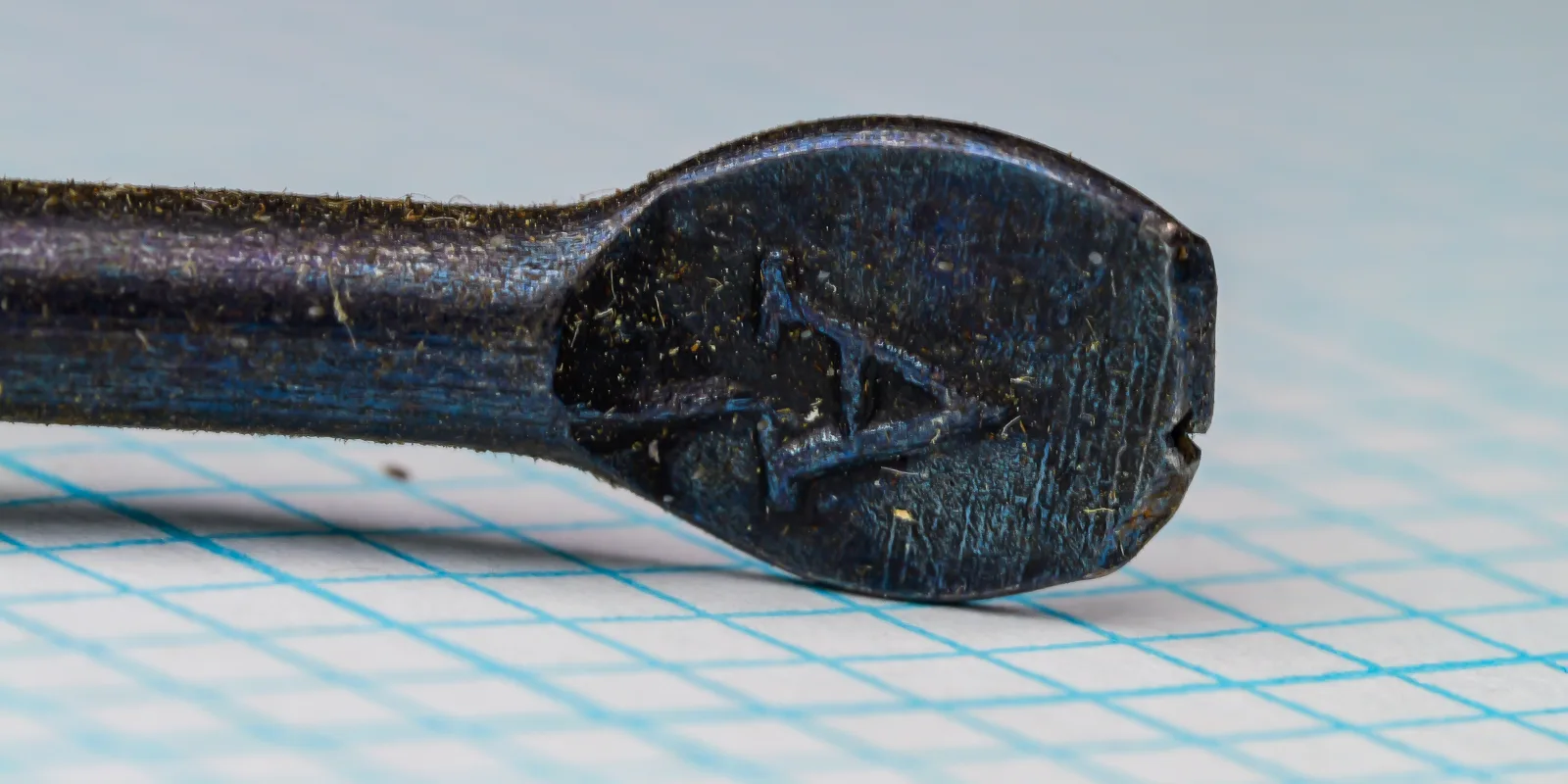
The Samuel Allcock 198 Flatted Eye is a classic Redditch-era salmon and sea-trout hook, produced by S. Allcock & Co. in Redditch, England during the late Victorian to Edwardian period (c. 1890-1920). This is a standard-shank hook featuring a distinctive blind-flatted (spade) eye and Kirby-pattern offset bend, with a superior point geometry. The blued finish displays the characteristic cool blue-grey oxide typical of quality English hooks from this era.
The ‘Best Spring Steelfu’ sub-brand designation suggests this hook was marketed as a premium product within Allcock’s portfolio, targeting professional salmon and sea-trout anglers. The flatted eye construction — a signature of British salmon hooks — was preferred for strength and ease of line attachment in demanding saltwater and estuarine conditions.
This hook represents an important manufacturing tradition in Redditch hook craftsmanship. Allcock was one of the major English hook makers, and surviving examples with original packaging are increasingly collectible. The No. 2 size in flatted-eye configuration is relatively uncommon and sought by specialists in vintage salmon tackle and Redditch hook history.
Close-up detail of the blind-flatted (spade) eye on the Samuel Allcock 198 Size 2, showing the distinctive flat rectangular termination and cool blue-grey blued finish characteristic of quality Redditch salmon hooks.
Photographic record
4 cataloged imagesSelect any record to load it above.
4 images shown
Allcock 198 Flatted Eye Size 2 — Hook Eye DetailClose-up detail of the blind-flatted (spade) eye on the Samuel Allcock 198 Size 2, showing the distinctive flat rectangular termination and cool blue-grey blued finish characteristic of quality Redditch salmon hooks.Open originalAllcock 198 Flatted Eye Size 2 — Point ProfileSide profile of the Samuel Allcock 198 showing the superior point geometry with nearly straight inner taper and the Kirby-pattern bend curvature, on measurement grid.Open originalAllcock 198 Flatted Eye Size 2 — Full ProfileFull profile view of the Samuel Allcock 198 Size 2 from above, showing the complete Kirby-pattern offset bend, blind-flatted eye, and proportional relationship between shank and gap on measurement grid.Open originalAllcock 198 Flatted Eye — Original Sales CardOriginal Samuel Allcock & Co. die-cut sales card showing the bright yellow background, ornamental decorative border, printed text identifying the model number, sub-brand ('Best Spring Steelfu'), and 'No. 2 Warranted' size designation.Open original
Technical profile
Eye
Blind — Flatted
Wire
Extra-Heavy (2X+), Round, Est. ~0.055"-0.065" (~1.4-1.65 mm) E
Shank
Standard — Plain
Bend
Kirby (offset), Standard gap, Offset / kirbed
Point
Superior (near-straight inner taper)
Finish
Blued — Inferred (photographically likely)
The superior point geometry visible on this specimen features a nearly straight inner taper from barb to tip, with a nearly flat inside face. This design maximizes hook-holding power by creating a longer, more gradual penetration path into the fish’s mouth, reducing the tendency for the point to slip or unbend under high tension — critical for landing large salmon and sea-trout without light tippet.
The Kirby bend’s backward offset (approximately 10-15 degrees from the vertical plane) places the point closer to the angler’s side of the hook, improving penetration angle when line tension is applied at an acute angle — common in current-fished wet-fly and spinning presentations. The offset also reduces the lever arm on the hook shank, decreasing lateral forces that might bend or straighten a hook under load.
The blind-flatted eye eliminates the protruding ring that characterizes ball-eye or tapered-eye hooks, creating a smooth transition from eye to shank. This construction provides two advantages: (1) maximum knot strength without sharp corners that can cause line abrasion or weaken the attachment point, and (2) reduced snagging on underwater obstructions. The flat face of the spade allows an angler to tie a ‘Turle knot’ or similar connection that distributes tension evenly across the eye.
The standard wire gauge (approximately 0.055″-0.065″) is heavy enough to resist unbending under the sustained load of a large fish, yet not so heavy that penetration is compromised. The blued finish provides rust resistance without the brittleness that can accompany japanned coatings, allowing the steel to retain flexibility under shock loads.
The Samuel Allcock 198 line appears to have been a standard-offering model within Allcock’s salmon and sea-trout hook catalog. The ‘Best Spring Steelfu’ designation suggests it was positioned as a quality-tier product, likely marketed to professional anglers and established tackle shops. The model number (198) is characteristic of Allcock’s systematic cataloging approach.
The Kirby-pattern offset bend combined with a blind-flatted eye was a traditional design configuration for British salmon hooks, reflecting generations of river and estuarine fishing experience. This specific combination — particularly effective for holding large salmon and sea-trout — would have remained in production across multiple decades with only minor refinements to wire gauge or finish specifications.
The hook does not appear to be part of a broader ‘series’ in the modern sense, but rather a standalone model maintaining consistent specifications throughout its production run. Without access to Allcock’s complete catalogs, the exact introduction and discontinuation dates cannot be confirmed, but the packaging and manufacturing characteristics suggest continuous production from approximately 1890 through the 1920s, with possible extensions into the 1930s-1940s.
Era and Packaging Dating
No barcode present — strong indicator of pre-1974 origin. Packaging style consistent with late Victorian/Edwardian period: die-cut sales card with ornamental border, bright yellow background, black letterpress printing. Paper stock is lightweight wove typical of pre-1920 manufacture. Phone number format absent. Samuel Allcock & Co. mark-style and sub-brand nomenclature ('Best Spring Steelfu') characteristic of early-to-mid 20th century Redditch production, but design language suggests earlier origin (1890-1920 bracket). Blind-flatted eye and Kirby bend typical of salmon and sea-trout hooks from this era.
Spring Steel and Victorian Marketing
The 'Best Spring Steelfu' sub-brand name is a curious artifact of Victorian marketing language, likely abbreviated or corrupted through typesetting. 'Spring Steel' was a premium material designation indicating high-carbon steel that retained temper and elasticity under load — essential for hooks that would be repeatedly cast, set, and stressed by fighting large salmon. Allcock used this designation to distinguish premium hooks from commodity-grade offerings, assuring anglers they were purchasing steel selected for its spring properties, not brittle or low-grade material.
Design lineage and influence
The Kirby-pattern offset bend was one of the oldest and most persistent hook designs in English angling, with origins tracing to the 18th century or earlier. The Kirby’s characteristic backward offset and shallow bend made it exceptionally effective for holding large fish without deep penetration — a critical advantage in salmon and sea-trout fishing where line strength and hook durability were paramount.
The blind-flatted eye construction was a distinctly English innovation, preferred for salmon and sea-trout hooks because the spade-end allowed anglers to tie very strong knots without a protruding eye ring that could catch on vegetation or weeds. This eye type became a hallmark of Redditch-tradition hooks and was adopted across multiple manufacturers including Partridge, Edgar Sealey, and Milward.
The Samuel Allcock 198 would have competed directly with equivalent offerings from Partridge of Redditch (e.g., their Kirby-pattern sea-trout hooks) and Edgar Sealey’s lines. By the early 20th century, the superior point geometry had become standard across quality English salmon hooks, replacing older spear-point configurations that were more prone to bending under load.
The design remained largely unchanged through the mid-20th century, with production eventually shifting to other manufacturers as Allcock’s independent operations consolidated. Modern Partridge of Redditch and some Mustad offerings preserve the essential Kirby + blind-flatted eye + superior point configuration, making the Samuel Allcock 198 a direct ancestor of contemporary salmon hooks.
Best matchRelated by Attribute
Computed automatically from catalog data — updated as new hooks are added.
Matches: Bend, Gap, Eye, Eye Orient., Point +4 moreDiffers: Shank: Standard vs 1X Long; Wire: Extra-Heavy (2X+) vs Heavy (1X Heavy); Finish: Blued vs Black Japanned +3 more
Matches: Bend, Gap, Eye Orient., Point, Forging +2 moreDiffers: Shank: Standard vs 1X Long; Wire: Extra-Heavy (2X+) vs Heavy (1X Heavy); Eye: Blind — Flatted vs Blind — Marked Shank +5 more
The Samuel Allcock 198 Flatted Eye was designed specifically for salmon and sea-trout fishing in British rivers and estuaries. The Kirby-pattern offset bend and superior point geometry made it exceptionally effective for holding large fish on relatively light tippets — a necessity for salmon fishing where 8-12 pound breaking-strain gut leaders were standard in the early 20th century.
The blind-flatted eye was preferred by salmon anglers because it facilitated extremely strong knot attachment without a protruding eye that could abrade the leader. Anglers would typically tie a Turle knot or similar direct connection to the spade end, creating a nearly flush attachment that minimized snagging on rocks and weed.
This hook was used primarily for wet-fly fishing (cast across current and worked downstream through the water column) and for spinning or worm presentations in larger rivers. The No. 2 size was standard for general salmon work in rivers of moderate to large size.
Secondary Applications
Could also be employed for large sea-trout (sea-run brown trout) in estuaries, and for saltwater coarse fishing (bait) in coastal waters. The robust construction and blued finish made it suitable for brackish-water and light saltwater work.
Classic Fly Patterns
Not typically used for fly tying — designed as a wet-fly hook for cast-and-worked presentations of salmon flies tied on gut loops or loop-eye hooks, not modern fly-tied patterns.
Modern Equivalents
Hook
Match Quality
Notes
Partridge of Redditch Kirby — salmon
Excellent
Direct spiritual successor — blind-flatted Kirby in current Partridge line maintains the same bend family and eye type
Mustad C70SD (Salmon Dry) or similar Mustad Kirby patterns
Good
Modern Mustad offers Kirby-pattern salmon hooks, though typically with turned-down ball eye rather than blind-flatted; functionally similar for salmon work
Collector notes
Rated 4.5/10 — Samuel Allcock hooks are widely available from 1920s-1950s production, keeping the rating moderate. However, this specific model (198 Flatted Eye) in original packaging is less commonly encountered than standard ball-eye variants. The No. 2 size is particularly sought among salmon hook collectors. Collector demand is modest but steady among Redditch specialists and vintage salmon-tackle historians.
Reference value
$8 – $22 USD estimate
Packaging condition
Good — moderate wear, legibleRecorded specimen
Packaging format
GW-AC-CARD-01Catalog code
Collectible factors: Original die-cut sales card with vibrant yellow background and ornamental border is an exceptional artifact of Victorian/Edwardian packaging design. Blind-flatted eye construction is specifically sought by historians of British salmon and sea-trout traditions. Samuel Allcock is a recognized name within Redditch hook collecting, and early-era cards (pre-1920) command increased interest. Complete original string tie intact adds authenticity value. The ‘Best Spring Steelfu’ sub-brand designation is less common than generic Allcock markings.
Limiting factors: Samuel Allcock hooks were mass-produced in industrial volume, so individual hooks are not rare. The No. 2 size is standard for salmon work but not exceptionally scarce in the broader Allcock catalog — larger sizes (2/0, 3/0) and smaller sizes (1, 1/0) command premium interest. Complete original packaging significantly enhances value, but many specimens are found loose or on damaged cards. The blued finish is more common than japanned or bronzed variants from this maker, moderating collector demand.
Variant considerations: Size 2 in original packaging is the most desirable configuration. If packaging is absent or severely damaged, value drops to $3-8 for loose hooks. Sealed or near-sealed cards command the premium end. Cards with partial text loss or foxing occupy the mid-range. Size 1/0 and 2/0 variants are more scarce than the No. 2 documented here.
Condition impact: Cards with original string tie intact and minimal paper loss are valued highest. Cards missing several hooks drop 30-50% from high-end estimates. Loose hooks without packaging context command minimal premium. Evidence of original retail price markings or handwritten notations increases historical interest and value slightly.
Packaging
Original die-cut sales card with bright yellow background and ornamental border pattern. Printed text in black: 'No. 198 / SAMUEL ALLCOCK & CO.'s / BEST SPRING STEELFU / KIRBY / SEA FISH HOOKS / No. 2 WARRANTED / 10' (number of hooks). Partial text visible includes 'SEA FISH HOOKS'. Card shows foxing and light age discoloration; label has been partially obscured or removed. Red string tie holds hooks to card through punched holes. Paper stock is lightweight wove, typical of late Victorian or Edwardian era. Original string tie intact.
Market Value Notes
Low ($8): Good condition — card opened or partially damaged, 2-3 hooks missing, moderate foxing or toning, string tie intact
High ($22): Excellent condition — card complete with all 10 hooks, minimal wear, original string tie present, packaging text clear and bright
Premium factors: Complete original sales card with bright yellow and ornamental border; No. 2 size in flatted-eye configuration; 'Best Spring Steelfu' sub-brand variant; String tie intact; All 10 hooks present; Evidence of late Victorian/Edwardian manufacture
Platforms: eBay (UK and US), specialist vintage fishing tackle dealers, regional antique markets, occasional estate sales
Confidence: E estimated — based on comparable Allcock-era salmon hooks from 1890-1920 period; limited specific sales data for this exact model; estimates assume sales-card format with original packaging
Where to Find
eBay UK (search 'Samuel Allcock 198' or 'Allcock flatted eye salmon hook'). Vintage fishing tackle dealers in southern England and Redditch area. Antique fishing tackle fairs and auctions in the UK. Regional estate sales in areas with strong angling history (Hampshire, Somerset, Wiltshire). US collectors occasionally source these through international eBay or UK-based online dealers specializing in vintage British tackle.
Collector's Identification Tips
Model identification: Look for the printed model number ‘198’ and the sub-brand ‘Best Spring Steelfu’ on the original card or label. Samuel Allcock & Co.’s name should be clearly printed, along with the Redditch origin inference (though not always explicitly stated on early packaging).
Eye construction: The blind-flatted (spade) eye is diagnostic. The eye will appear as a flat, rectangular or rounded-rectangle terminal, not a protruding ball or tapered ring. Examine the end of the shank: it should be visibly flattened/filed, not rounded.
Bend family: The Kirby is recognizable by its backward offset (hook points toward the rear of the shank) and relatively shallow, rounded bend bottom. It differs from the more angular Limerick and from the straight-sided Dublin pattern.
Point geometry: The superior point has a nearly straight inner face (nearly flat inside), not the concave hollow characteristic of later modern hooks. Under magnification (10-20x), the inner edge should appear as an almost straight taper, not an inward curve.
Finish assessment: The blued finish appears as a cool blue-grey oxide under direct light, not warm brown (bronzed) or glossy black (japanned). Age patina may darken the appearance, but the underlying finish will show blue-grey metallic character where not oxidized.
Packaging era markers: The die-cut sales card with ornamental border, bright yellow background, and letterpress printing are all characteristic of late Victorian/Edwardian era (c. 1890-1920). Absence of barcode, postal codes, or modern phone formats confirms pre-1974 origin.
Preservation
Storage and Preservation
Store original packaging in a cool, dry environment away from direct sunlight and moisture. The blued finish will naturally develop a patina with age and humidity exposure — many collectors find this desirable aging, but control humidity (below 60% RH) to prevent rust or heavy oxidation. Do not attempt to polish or refinish original hooks; patina is part of the historical record.
Keep the original sales card intact whenever possible. Store cards flat or in acid-free boxes, never rolled or creased. The bright yellow card stock is susceptible to UV fading — store away from window light. If hooks remain on the card, ensure the original string tie stays in place; do not remove hooks unless necessary.
If you acquire loose hooks from this model, store them in a cool, dry vial or small box with silica gel desiccant packs replaced every 6-12 months. Avoid contact between the hooks and other metals (e.g., do not store mixed with steel shot or iron filings) to prevent galvanic corrosion. Do not use plastic containers that trap moisture.
Never submerge original packaging in water or attempt to clean it with any solvent. Light dusting with a soft dry brush is acceptable; any foxing or discoloration is historically significant and should be preserved as-is. If the card develops insect damage or mold, consult a paper conservator before attempting remediation.
Marking Analysis
Marks and Annotations
The original sales card in this example shows no visible handwritten annotations, owner marks, or retail price notations. The printed text is entirely in black letterpress on yellow stock — characteristic of professional die-cut card production rather than handwritten or stamped pricing.
The card’s condition shows age-related foxing (brown spots and toning) and some areas of text loss or damage, likely from storage conditions and natural aging rather than use marks or annotation. If specimens are encountered with handwritten size notes, retail prices, or dealer marks, these should be recorded as part of the provenance documentation — such marks can help establish the card’s retail journey and regional distribution history.
Primary Source
Packaging Text and Claims
Source: Original Samuel Allcock & Co. die-cut sales card, printed text: 'No. 198 / SAMUEL ALLCOCK & CO.'s / BEST SPRING STEELFU / KIRBY / SEA FISH HOOKS / No. 2 WARRANTED / 10'
The original card identifies the hook as ‘SAMUEL ALLCOCK & CO.’s BEST SPRING STEELFU’ — a designation that warrants examination. ‘Best Spring Steel’ was Victorian marketing language indicating premium material selection. The abbreviation ‘Steelfu’ is unusual; it may be a typographical corruption, regional variant, or abbreviation of a longer compound term. The use of the possessive form (‘Allcock & Co.’s’) was standard in Victorian business nomenclature.
The card states ‘SEA FISH HOOKS’ — explicitly positioning this model for saltwater and estuarine work. The printed warranty ‘No. 2 WARRANTED’ indicates Allcock guaranteed the hook’s size and quality, a significant claim in an era when standards varied widely across manufacturers. The number ’10’ at the bottom indicates the quantity per card.
The ornamental border and bright yellow background are consistent with premium-tier product positioning — commodity hooks typically used plain white or kraft card stock. The use of color printing and decorative elements signals this was marketed as a high-value product justifying premium pricing.
No barcode, ISBN, postal codes, or modern manufacturer information appears — all consistent with late 19th or early 20th century origin. The absence of a manufactured-in country statement is typical of pre-WWII British packaging (origin was assumed to be understood by local purchasers).
Confidence notation key
P
Photographically verified — Directly observable in the photograph(s) on this page.
V
Verified by documentation — Confirmed by manufacturer catalog, spec sheet, or published reference.
I
Inferred — A logical deduction from observable or documented evidence, not directly stated.
E
Estimated — An approximation based on visual comparison, proportional analysis, or limited data.
S
Speculative — A reasoned hypothesis that cannot be confirmed from available evidence.
Unnotated claims are the compiler’s synthesis; see Sources. All photographs on garrenwood.com are taken on a measurement grid where each square equals 1/10 inch (0.1″ / 2.54 mm).