Selected size
5/0
Catalog record
- Overall Length
- 51.8 mm V
- Shank Length
- 30.2 mm V
- Bend Depth
- 17.5 mm V
- Wire Diameter
- 1.6 mm V
- Confidence
- V Catalog record only
 Garren WoodFishing Hook Reference

Save this hook to your account to build a list you can come back to.
The Mustad 3408 is a classic heavy-wire O’Shaughnessy-pattern hook manufactured by O. Mustad & Søn in Norway across multiple production eras. Documented specimens include a mid-century orange-box example with bronzed finish and a later blue-label specimen featuring a dark-grey corrosion-resistant finish. The model is distinguished by its turned-down ball eye, separating it from the more common straight-eye 3407 variant.
The 3408 was intended for heavy wet flies, streamers, salmon applications, and bait fishing where a strong forged hook with down-eye alignment was advantageous. The forged shank increases rigidity under load while maintaining practical proportions for fly-tying and bait-rigging applications. Packaging evidence supports Norwegian production across both mid-century and late-period Mustad export eras, though exact production transitions likely varied by market region.
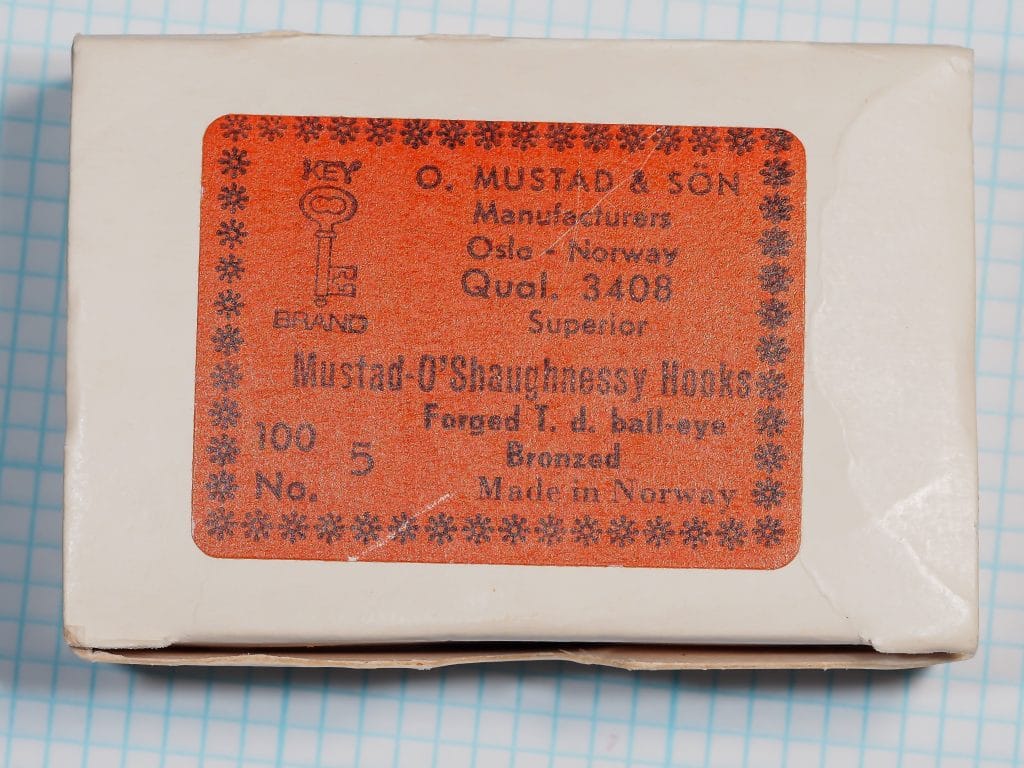
7 cataloged imagesSelect any record to load it above.
7 images shown
The 3408’s forged shank is mechanically created by placing the wire in a drop-press that flattens the lateral sides without reducing the overall mass. This cold-forging process dramatically increases structural rigidity and tensile strength, preventing the hook from bending open or straightening out under the extreme stress of large fish strikes — particularly important for powerful anadromous species like Atlantic salmon and steelhead where line pressure can exceed 20+ pounds. The turned-down ball eye is superior to a straight eye for fly tying, as it naturally orients the fly horizontally in the water and reduces the likelihood of the tying thread slipping under load. The O’Shaughnessy bend geometry — slightly steeper than a pure round bend — creates a geometric lock in the jaw of hard-mouth species, making it the preferred pattern for saltwater and big game applications. The heavy wire gauge (approximately 0.065-0.070 inches) provides the mass required for weighted streamers and the structural integrity needed for live bait fishing in rocky or debris-laden environments.
Physical measurement with calipers
The Mustad 3408 is not a unique or record-setting design within garrenwood.com's catalog, but the zinc finish variant is notably rare and represents an important metallurgical variant of the O'Shaughnessy line. The combination of vintage 1950s-60s orange box and forged construction documents a critical period in Mustad's post-war manufacturing standardization.
We have measurement for size 5/0. Know any others? Submit calipered measurements and we'll review and add them. Thank you!
Sources: this specimen and its packaging.
Orange vintage box shows classic mid-century Key Brand logo with elaborate decorative border, consistent with 1950s-1960s Mustad export packaging. Line 3 designation is 'OSLO - NORWAY' (not Christiania), confirming post-1925 manufacture, and the offset printed typography and paper stock are characteristic of the 1950s-60s era. Blue label on newer hooks features the modernized 'M' logo and bilingual text ('NORWAY NORVÈGE'), typical of 1990s-early 2000s export packaging before Mustad moved production to China. The zinc finish variant on the Size 6 specimen is rarer and may indicate production for specific regional markets during this later period.
The O'Shaughnessy bend became one of the defining heavy-duty hook patterns of the late 19th and 20th centuries, widely adopted for salmon, saltwater, and bait-fishing applications. Mustad industrialized the pattern into numerous production variants for global export markets. The dark-grey finish seen on the later Size 6 specimen likely reflects a corrosion-resistant production coating used during Mustad's later Norwegian manufacturing era, prior to the company's large-scale transition to modern stainless and offshore production systems.
The O’Shaughnessy pattern emerged from 19th-century Irish and British hook-making traditions and became strongly associated with heavy-duty bait and salmon fishing applications. Precise attribution of the original design lineage remains historically debated, as hook-pattern naming conventions in Ireland and Redditch were not consistently standardized during the period. Mustad later industrialized the O’Shaughnessy form into one of the company’s foundational heavy-wire production patterns for freshwater, salmon, and saltwater applications.
The turned-down eye variant (3408) reflects a practical adaptation for snelled bait rigs and certain fly-tying applications where a down-eye orientation was preferred. By the mid-20th century, similar down-eye heavy hooks were widely used across Atlantic salmon, sea-trout, and streamer-fly traditions throughout Europe and North America. The forged construction and heavy wire profile positioned the 3408 as a durable industrial hook intended for powerful fish species and demanding fishing conditions.
| Silhouette | Hook Model | Match | Analysis | Compare |
|---|---|---|---|---|
|
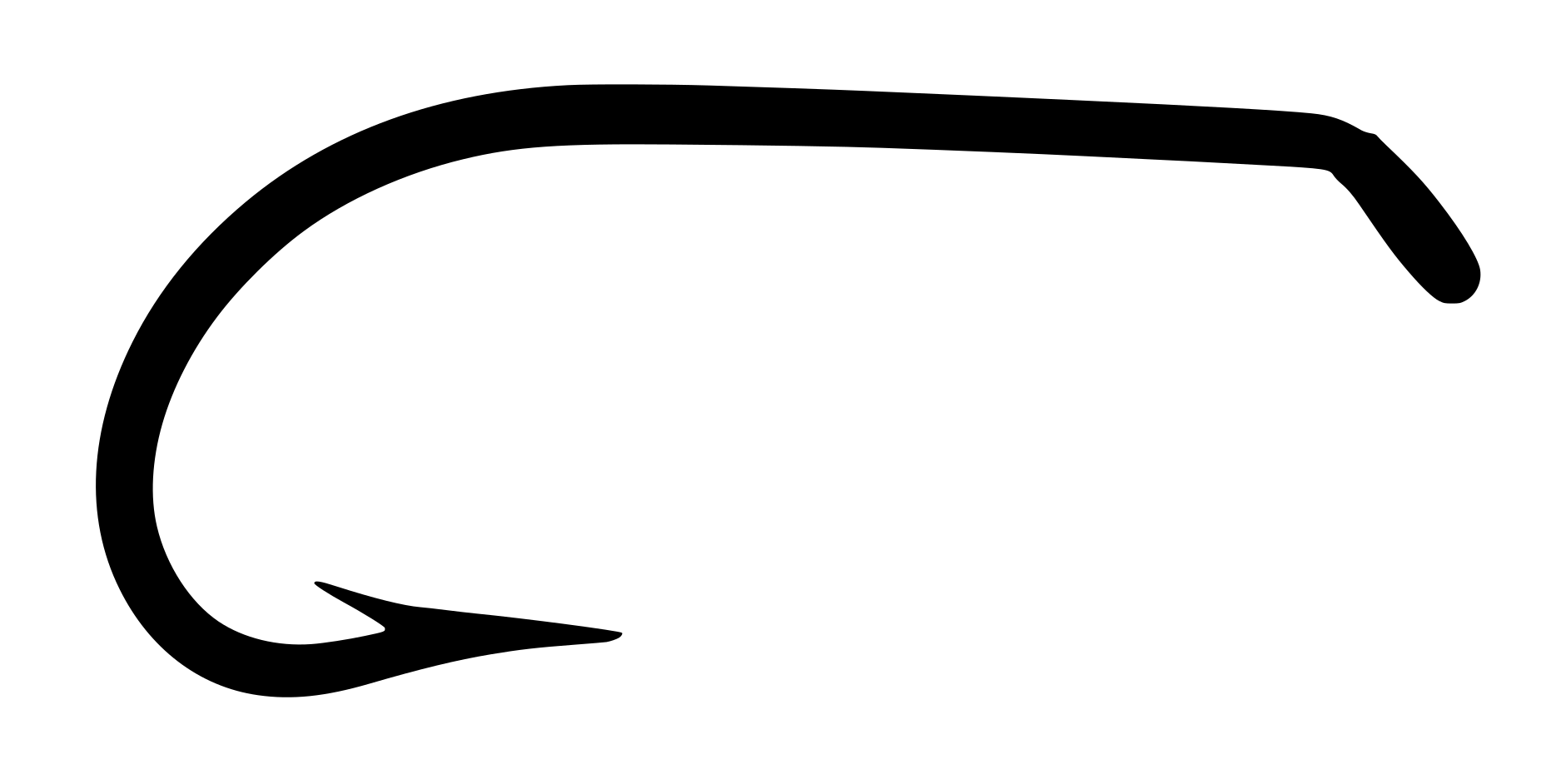
3408 D No. 5 — O'Shaughnessy Hooks | 81% | Compare | |
| 3413 No. (unspecified) — Qual. 3413 O'Shaughnessy | 76% | Compare | ||

|
790 No. 12 — T.D.E. Forged O'Shaughnessy Limerick Hook | 75% | Compare | |

|
3406 No. 6 — Mustad 3406 | 75% | Compare | |
|
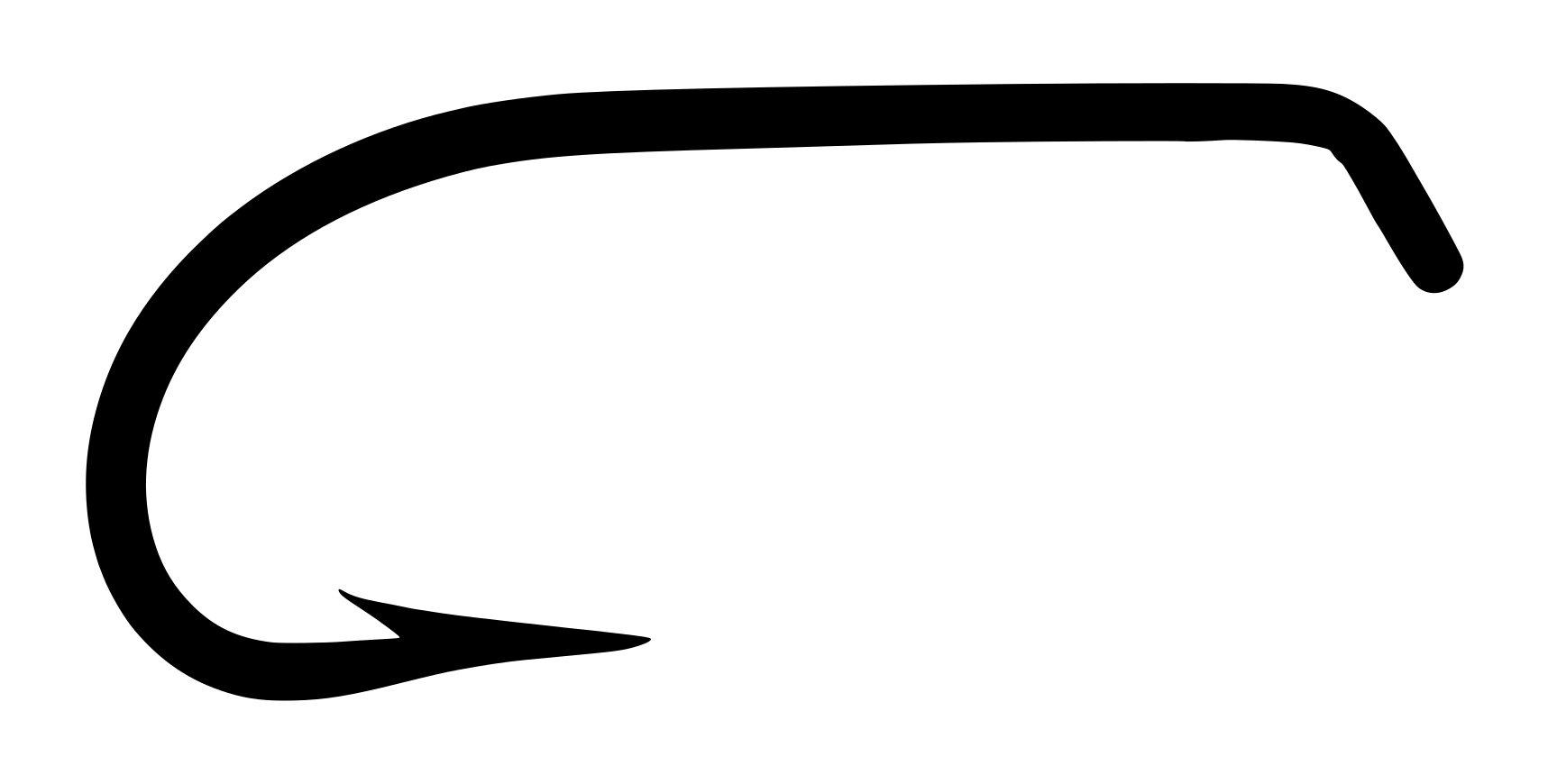
3408 B No. 5 — O'Shaughnessy Hooks | 72% | Compare |
| Silhouette | Hook Model | Match | Compare |
|---|---|---|---|
|
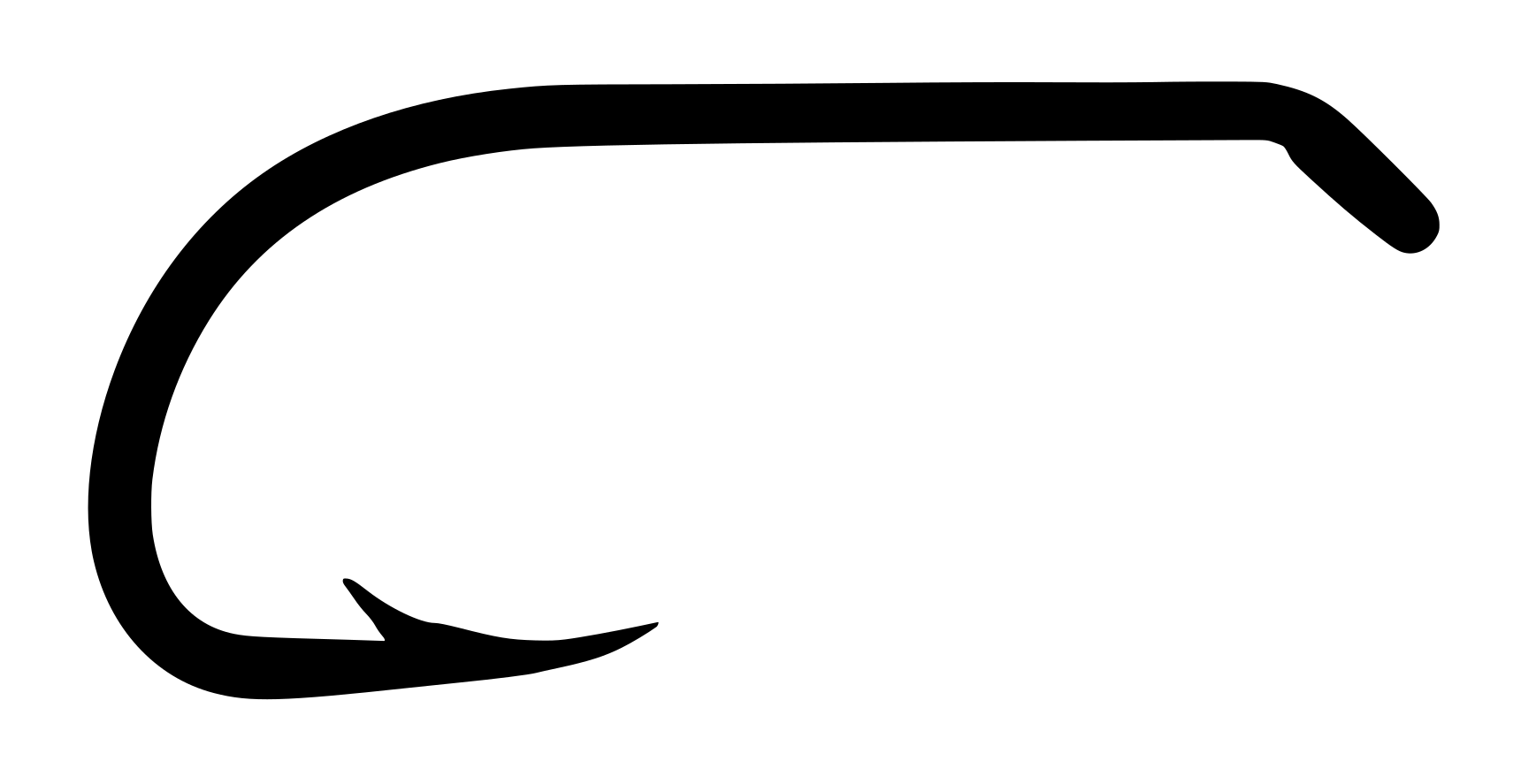
92627 No. 6 — Flounder | 78% | Compare |

|
1921 No. 3, 9 — Mustad 1921 | 72% | Compare |
|
|
3408 B No. 5 — O'Shaughnessy Hooks | 68% | Compare |
|
|
3408 D No. 5 — O'Shaughnessy Hooks | 68% | Compare |

|
3116 A No. 7 — Mustad-Limerick Hooks | 65% | Compare |
The Mustad 3408 is a heavy-wire O’Shaughnessy pattern designed primarily for wet flies, streamers, and bait fishing for strong fighting fish. The turned-down ball eye and forged shank make it ideal for snelling (direct attachment to the shank) or fly tying applications where a down eye helps the fly swim level. The heavy wire and robust bend distribute the stress of large fish strikes evenly, making it suitable for Atlantic salmon, steelhead, pike, and saltwater species. The forged construction provides exceptional strength without adding excess weight, allowing weighted streamer flies and traditional wet flies to sink efficiently.
Trolling baits, live bait rigs for bass and carp, heavy nymph patterns, offshore applications with the zinc finish variant.
Woolly Bugger, Matuka, traditional wet flies for trout and salmon
| Hook | Match Quality | Notes |
|---|---|---|
| Mustad 3906B | Good | Not a close geometric equivalent. The 3906B is a sproat-style wet-fly hook with lighter proportions and a different bend profile, though both models share traditional forged Mustad construction and wet-fly utility. |
| Mustad 34007 | Good | Modern O'Shaughnessy equivalent, stainless steel, but straight eye instead of down eye |
| Daiichi 2141 | Moderate | Similar heavy-wire streamer hook with turned-down eye, but different bend geometry |
The Mustad 3408 is an uncommon variant in the widely produced O'Shaughnessy line, primarily due to the turned-down eye configuration and the rarer zinc finish. The combination of vintage orange box (1950s-60s) and the specialized zinc coating makes this an attractive collectible for vintage tackle enthusiasts and fly tiers. However, O'Shaughnessy patterns are common overall, and the 3408 lacks the extreme rarity of earlier hand-forged variants or specialty finishes.
Positive Factors: The turned-down eye makes the 3408 a specialized variant within the broader O’Shaughnessy family. The later dark-grey corrosion-resistant finish variant appears less commonly encountered than standard bronzed examples, adding modest collector interest. The vintage orange-box packaging with Key Brand logo is desirable to Mustad packaging collectors and provides strong mid-century dating evidence. Norwegian manufacture, forged construction, and period-correct labeling all contribute to the model’s appeal among traditional tackle collectors and fly tiers.
Limiting Factors: O’Shaughnessy hooks were mass-produced in very large quantities across many decades and manufacturers, limiting absolute scarcity. While the 3408 eye configuration is somewhat less common than the 3407, surviving boxed examples still appear regularly on secondary markets. Collector demand is therefore moderate rather than exceptional, with packaging condition and completeness contributing more strongly to value than the hook model alone.
The vintage orange box is a classic mid-century Mustad export label affixed to a plain cardboard box. The label is bright orange with dark brown/black typography and the iconic Key Brand logo (downward-pointing skeleton key) in the upper left. The eight-line label format strictly follows Mustad's standardized international typographical system: Line 1: 'O. MUSTAD & SON', Line 2: 'Manufacturers', Line 3: 'Oslo - Norway', Line 4: 'Qual. 3408', Line 5: 'Superior', Line 6: 'Mustad-O'Shaughnessy Hooks', Line 7-8: 'Forged T.D. Ball-Eye', 'Bronzed', and 'Made in Norway'. The quantity and size notation reads '100 No. 5'. The label features a decorative floral border (small asterisks or crosses) around the perimeter. The blue label (newer variant) shows the modernized 'M' logo and bilingual text ('NORWAY NORVÈGE'), indicating post-1980s production before Mustad transitioned to plastic packaging and Chinese manufacture.
Market value for a vintage boxed example with intact orange label and full 100-hook count typically ranges $8-12 USD; premium pricing ($15-18) applies to rare zinc finish variants or exceptional condition boxes. Unboxed loose hooks fetch $0.10-0.25 per hook depending on finish and condition. Blue label examples from the 1990s-2000s trade at $3-6 per box, reflecting lower collector demand. Prices vary by platform: eBay auctions typically command 15-25% premium over bin prices; specialist vintage tackle dealers mark up 30-50% above auction averages. Condition of the box (cover color retention, label legibility, paper integrity) drives premium pricing — heavily yellowed or partially illegible labels reduce value 20-40%.
Vintage O'Shaughnessy variants appear regularly on eBay (primarily in estate tackle lots), specialist vintage fishing tackle dealers, and annual tackle collector swap meets. Zinc finish variants are rarer and more likely to appear in curated collections or museum-quality lots. Boxed examples with intact orange labels are sought by packaging collectors and vintage tackle enthusiasts. Original retail sources in the 1950s-60s would have been general sporting goods stores, fly-fishing shops, and mail-order tackle suppliers.
Store vintage Mustad 3408 hooks in their original cardboard boxes in a cool, dry environment away from moisture and humidity. The bronzed finish is susceptible to patina development and oxidation when exposed to humid conditions — while some collectors regard this patination as desirable, it can compromise hook sharpness and barb integrity if corrosion penetrates the lacquer coating. The rarer zinc finish is more corrosion-resistant but still benefits from dry storage conditions to preserve the matte grey appearance and prevent white corrosion bloom.
Keep hooks on their original cards rather than loose in bulk containers, as this prevents mechanical wear on the barbs and points. Original packaging adds significant monetary and historical value — a boxed example may command 3-5× the price of unboxed loose hooks. Avoid storage near other metals to prevent galvanic corrosion where dissimilar metals contact. Do not expose hooks to salt spray or direct water contact unless they are in active use.
If you plan to fish these vintage hooks, inspect the barbs and points under magnification before use. The superior point geometry and forged construction maintain exceptional sharpness for decades when stored properly, but a single casting session can generate micro-fractures in old lacquer finishes. Test a specimen on scrap leather or canvas first to confirm the point hasn’t dulled.
The Mustad 3408 exists across a wide size range (No. 2 to No. 8, and reportedly in 1/0 and 2/0 for heavy applications). The specimens documented here are Size 5 (orange box) and Size 6 (blue label and loose hooks). Vintage Mustad sizing follows standard American hook nomenclature where smaller numbers (1, 2, 4) represent larger hooks, and larger numbers (8, 10, 12) represent progressively smaller hooks. The measured specimens (Size 5 and 6) are mid-range light-to-medium-heavy hooks appropriate for wet flies, streamers, and bait fishing.
The quality code ‘3408’ remains constant across all sizes — the size designation is specified separately on the box label and in handwritten or printed annotations. This differs from modern Mustad’s integrated alphanumeric codes (e.g., R50, S70) where the number encodes size information. Collectors should verify the size on the original box label, as hooks from mixed batches or estate lots sometimes become separated from their original packaging.
Source: Vintage Mustad 3408 orange label, circa 1950s-60s; Mustad official hook guide (Mustad-Guide.pdf)
The vintage orange label exemplifies Mustad’s rigorous eight-line typographical standard that remained nearly unchanged from the 1920s through the 1980s. Each line serves a specific function in the international classification system: Line 1 establishes manufacturer authority (O. MUSTAD & SON — emphasizing Norwegian origin). Line 2 differentiates Mustad as a primary manufacturer, not a distributor or repackager. Line 3 (OSLO – NORWAY) provides critical dating evidence, as this designation only appears on hooks manufactured after January 1, 1925, when Christiania was officially renamed Oslo.
Line 5 on the orange label reads ‘Superior’ – This line is reserved exclusively for hook point specification. On this label, ‘Superior’ denotes the point style—a near-straight inner taper characteristic of superior-point geometry, providing durability and reliable penetration without the extreme delicacy of hollow points.
The label designation ‘Mustad-O’Shaughnessy Hooks’ (Line 6) confirms the bend pattern. The notation ‘Forged T.D. Ball-Eye’ (Lines 7-8) specifies the mechanical construction (forged = drop-press flattened shank for strength) and eye configuration (T.D. = Turned Down; Ball-Eye = non-tapered terminal loop). This technical precision allowed international buyers, dock workers, and tackle distributors to instantly understand the hook’s geometry without language barriers.
The zinc-finish Mustad 3408 (Size 6, modern blue label) represents a notable but poorly documented chapter in Mustad’s metallurgical development. Zinc plating or zinc-based surface treatments are not mentioned in standard Mustad catalogs or the official hook guide, yet surviving specimens clearly show a uniform matte dark grey coating consistent with zinc application. This finish likely dates to the 1960s-70s, when Mustad was experimenting with alternative corrosion-resistant coatings before the widespread adoption of stainless steel alloys and modern tin plating.
Zinc plating was chosen for hooks intended to perform in harsh freshwater environments (lakes with acidic water, rivers with high mineral content) or light saltwater use where the matte finish provided a non-reflective presentation. The finish is more corrosion-resistant than lacquered bronze or japanning, yet cheaper and easier to apply than tin electroplating at industrial scale. Surviving zinc-finish Mustad hooks are uncommon, suggesting either limited production runs or poor long-term preservation (zinc can corrode if the underlying steel chemistry is unfavorable).
The rarity of zinc variants makes them highly desirable to collectors of metallurgical history and vintage industrial tackle. Any zinc-finish Mustad hook should be documented with high priority, as these specimens provide a window into the company’s R&D processes during the post-war boom period.
| P | Photographically verified — Directly observable in the photograph(s) on this page. |
| V | Verified by documentation — Confirmed by manufacturer catalog, spec sheet, or published reference. |
| I | Inferred — A logical deduction from observable or documented evidence, not directly stated. |
| E | Estimated — An approximation based on visual comparison, proportional analysis, or limited data. |
| S | Speculative — A reasoned hypothesis that cannot be confirmed from available evidence. |
Unnotated claims are the compiler’s synthesis; see Sources. All photographs on garrenwood.com are taken on a measurement grid where each square equals 1/10 inch (0.1″ / 2.54 mm).
Your cart is empty.