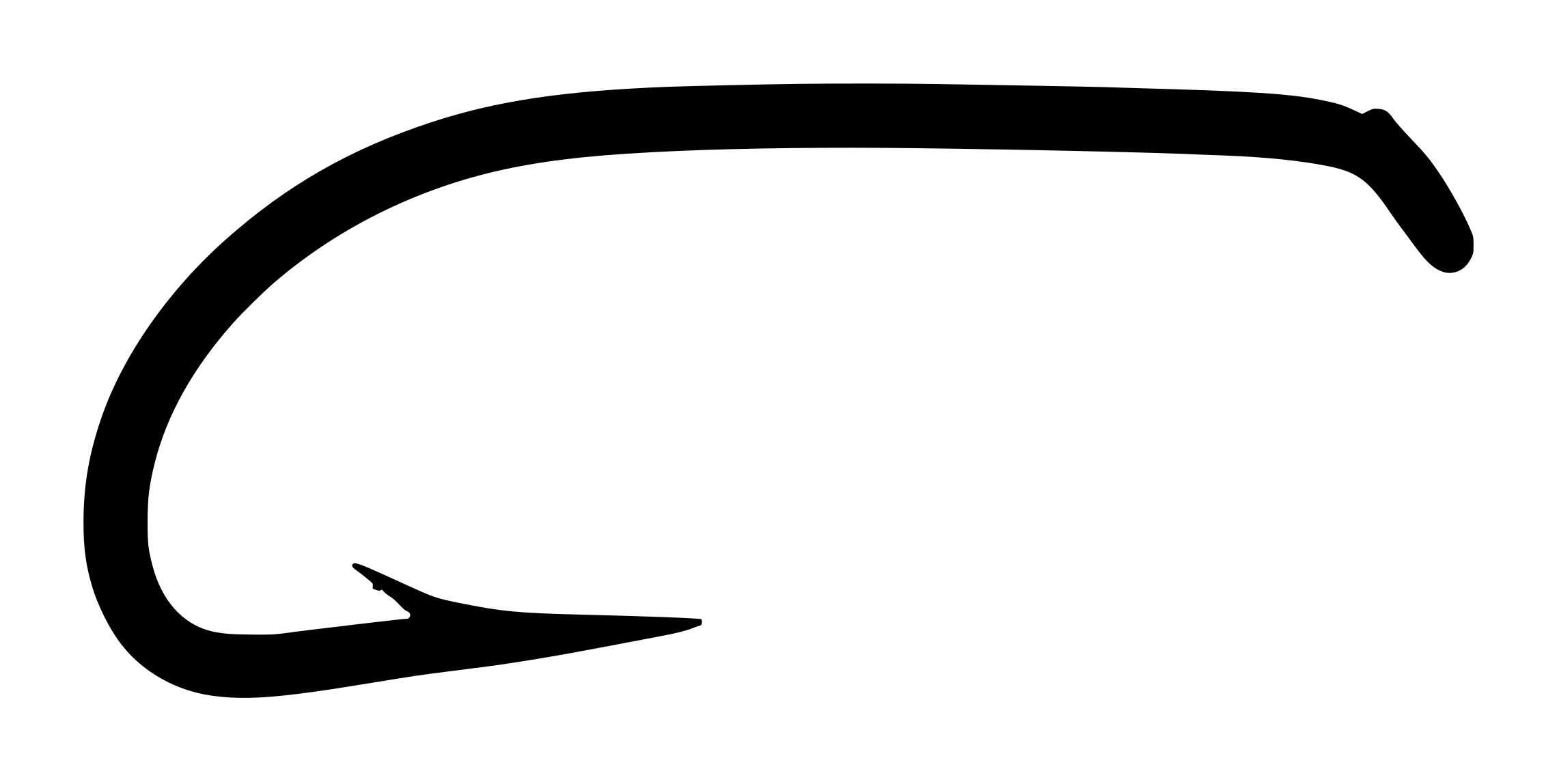
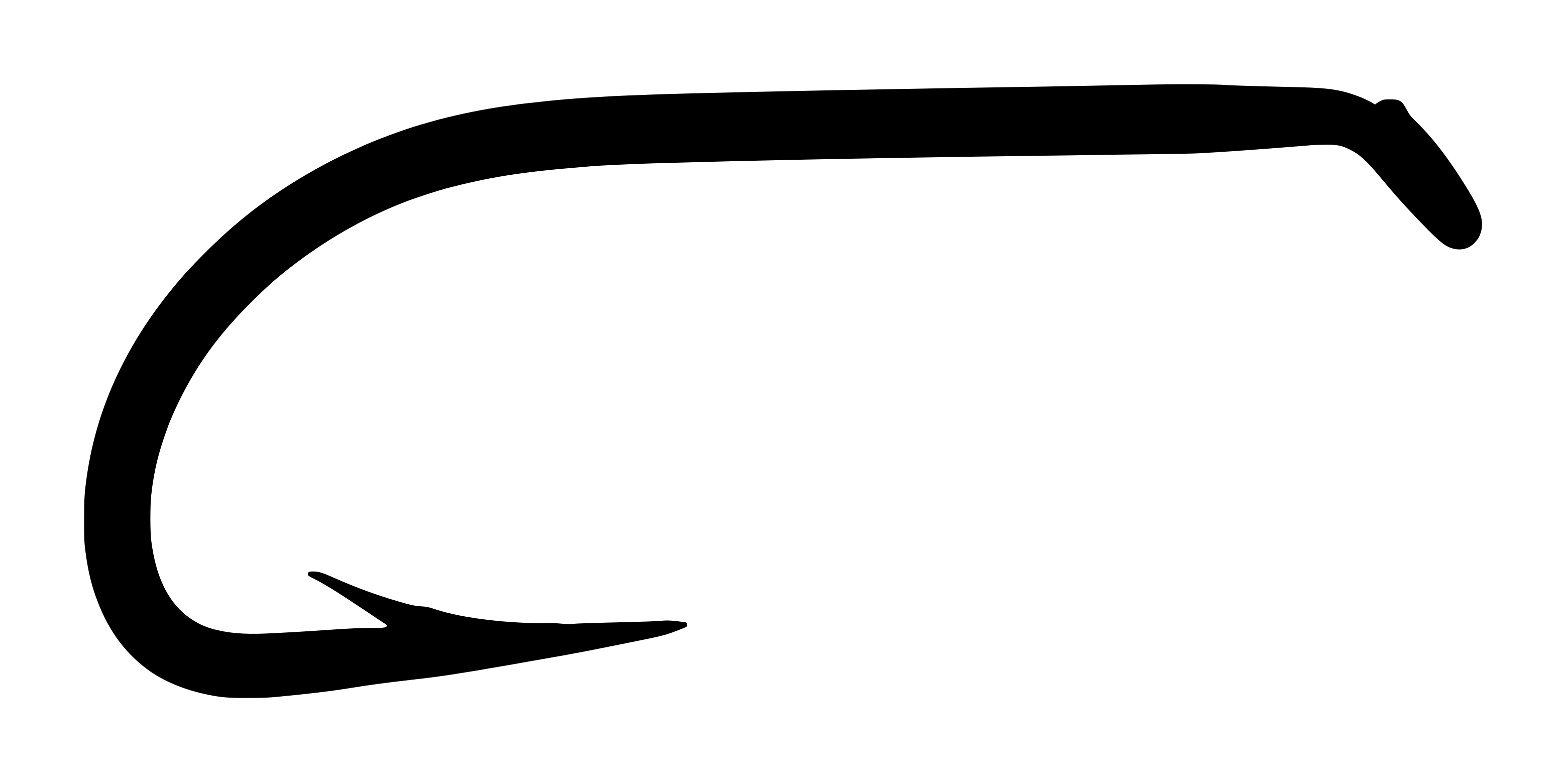
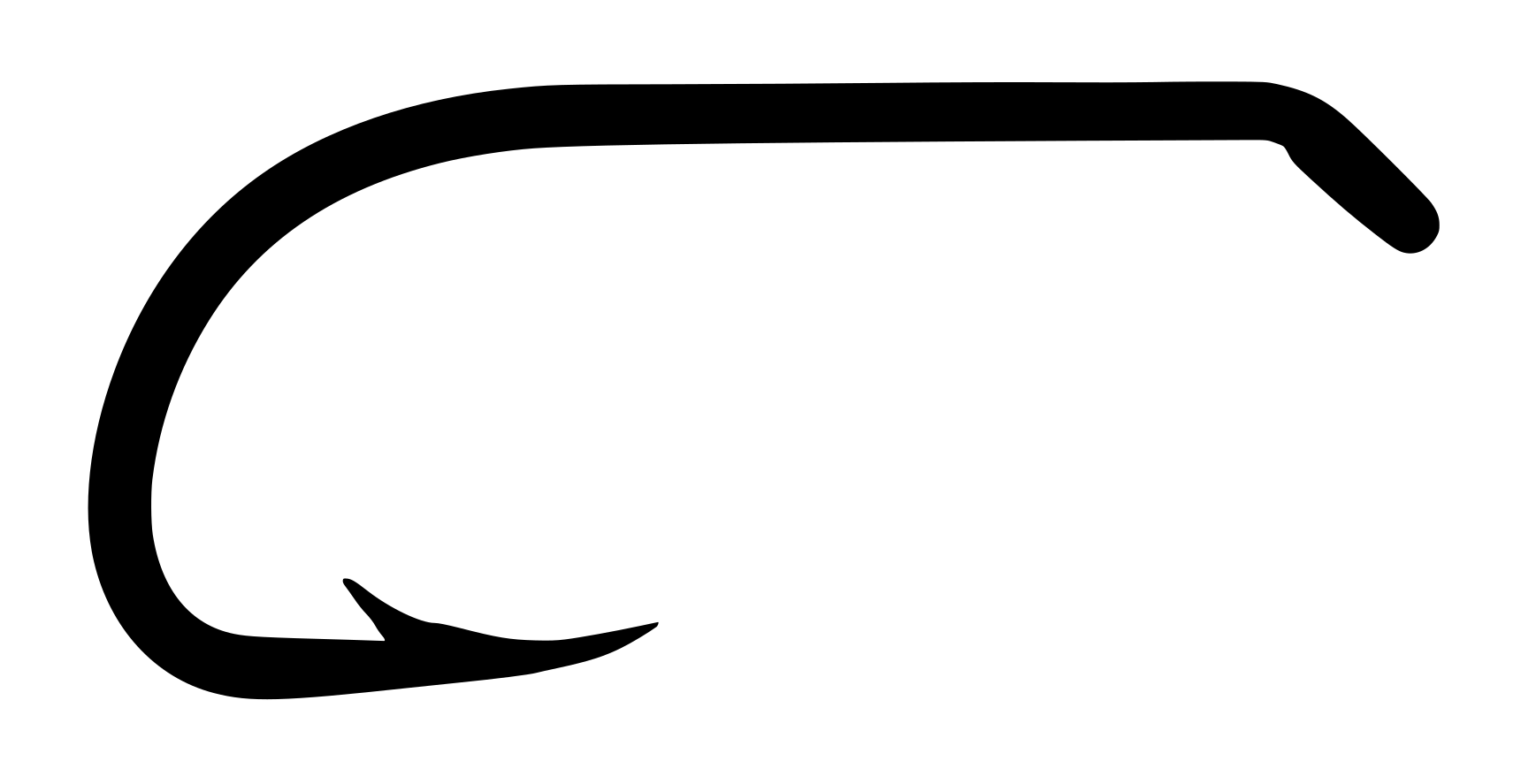
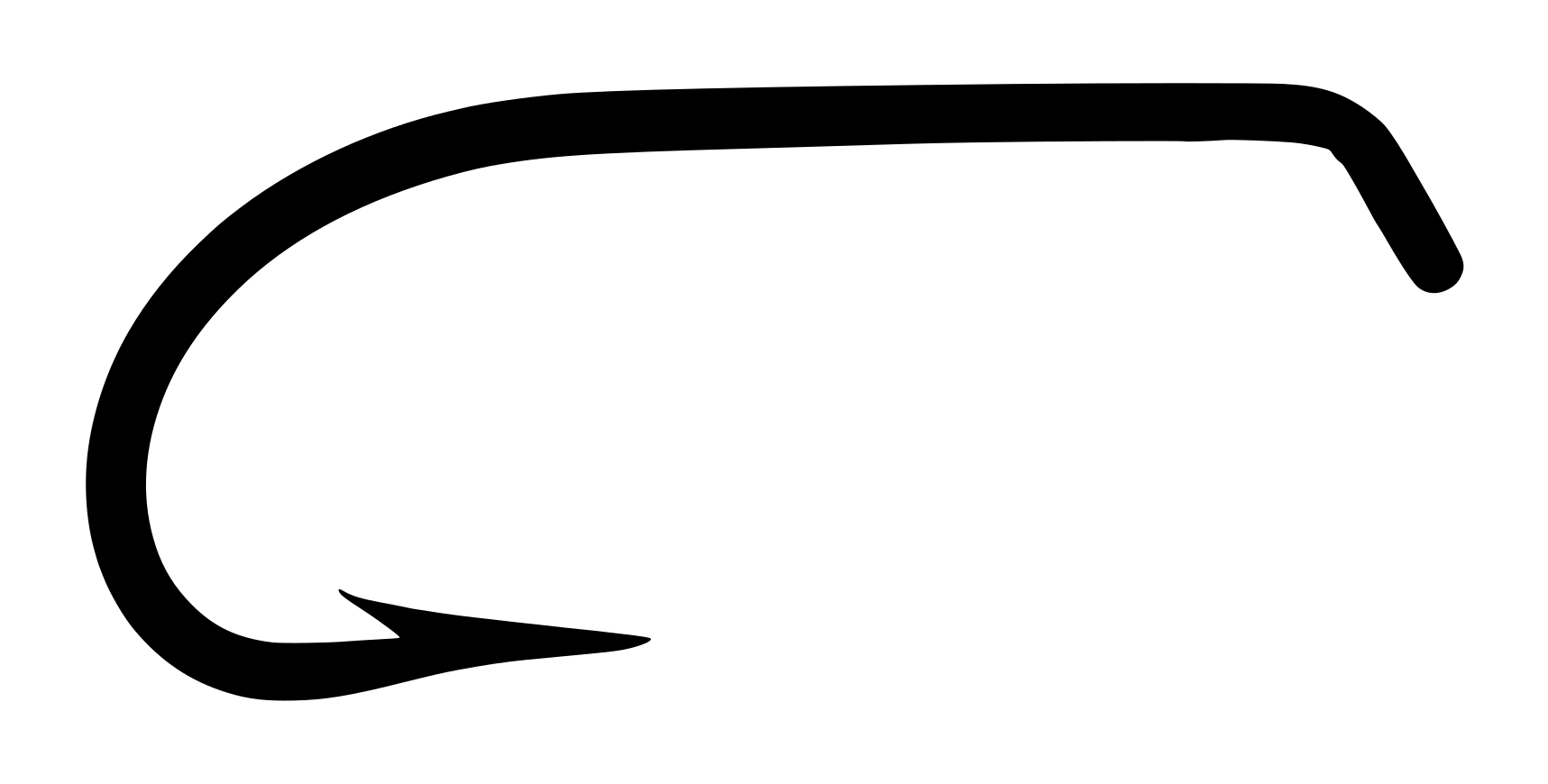
- Overall Length
- 24.5 mm
- Shank Length
- 8.5 mm
- Gap Width
- 10.5 mm
- Bend Depth
- 13.5 mm
- Confidence
- P Physical specimen
Grid-derived from photograph (1/10" grid)
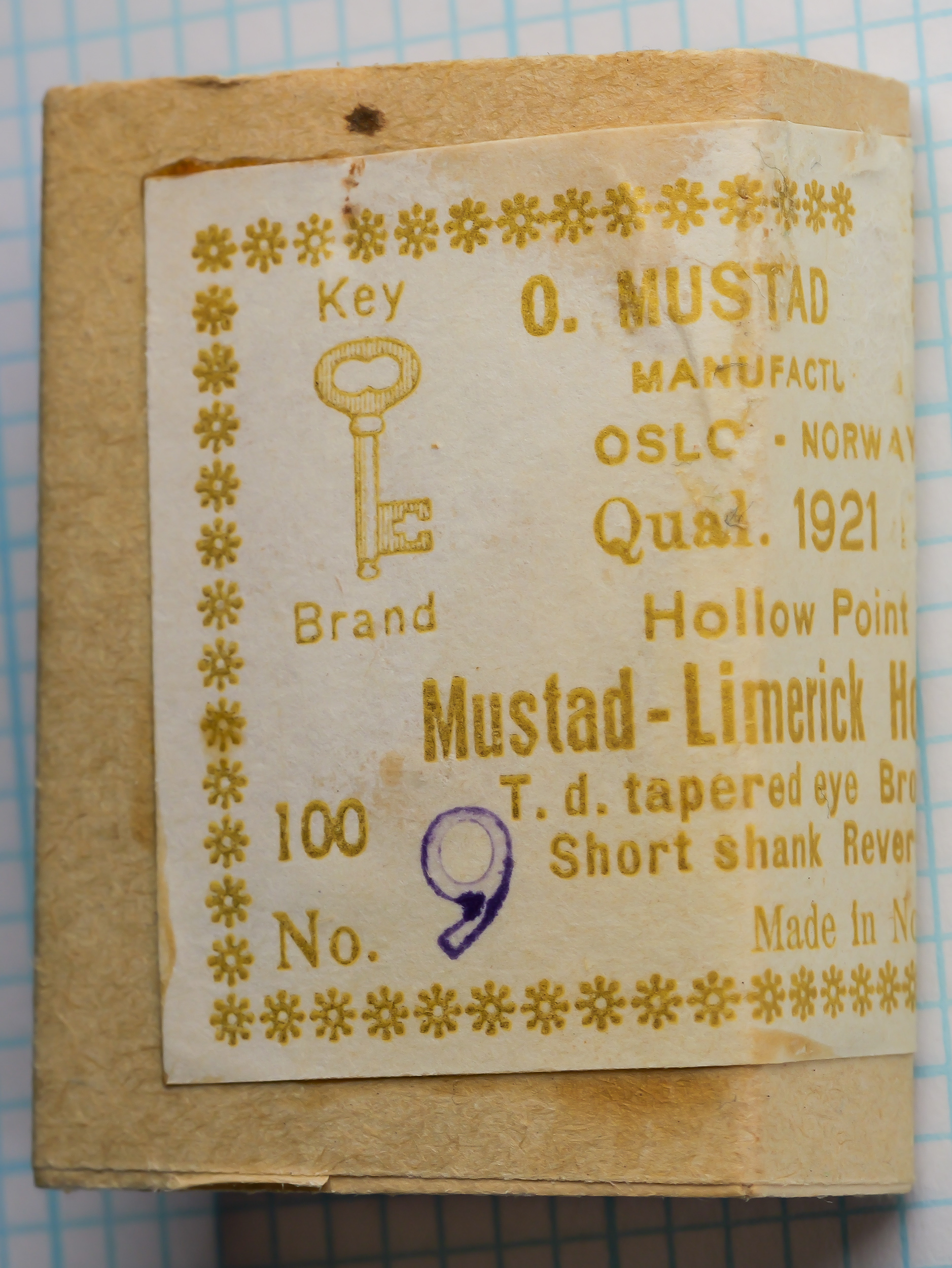
The Mustad 1921 represents a classic mid-20th century bait hook that found favor among both bait fishermen and fly tyers. Distinguished by its short shank, Limerick bend, and offset (reversed) point, this Norwegian-made hook was built with heavy wire and a durable bronzed finish P.
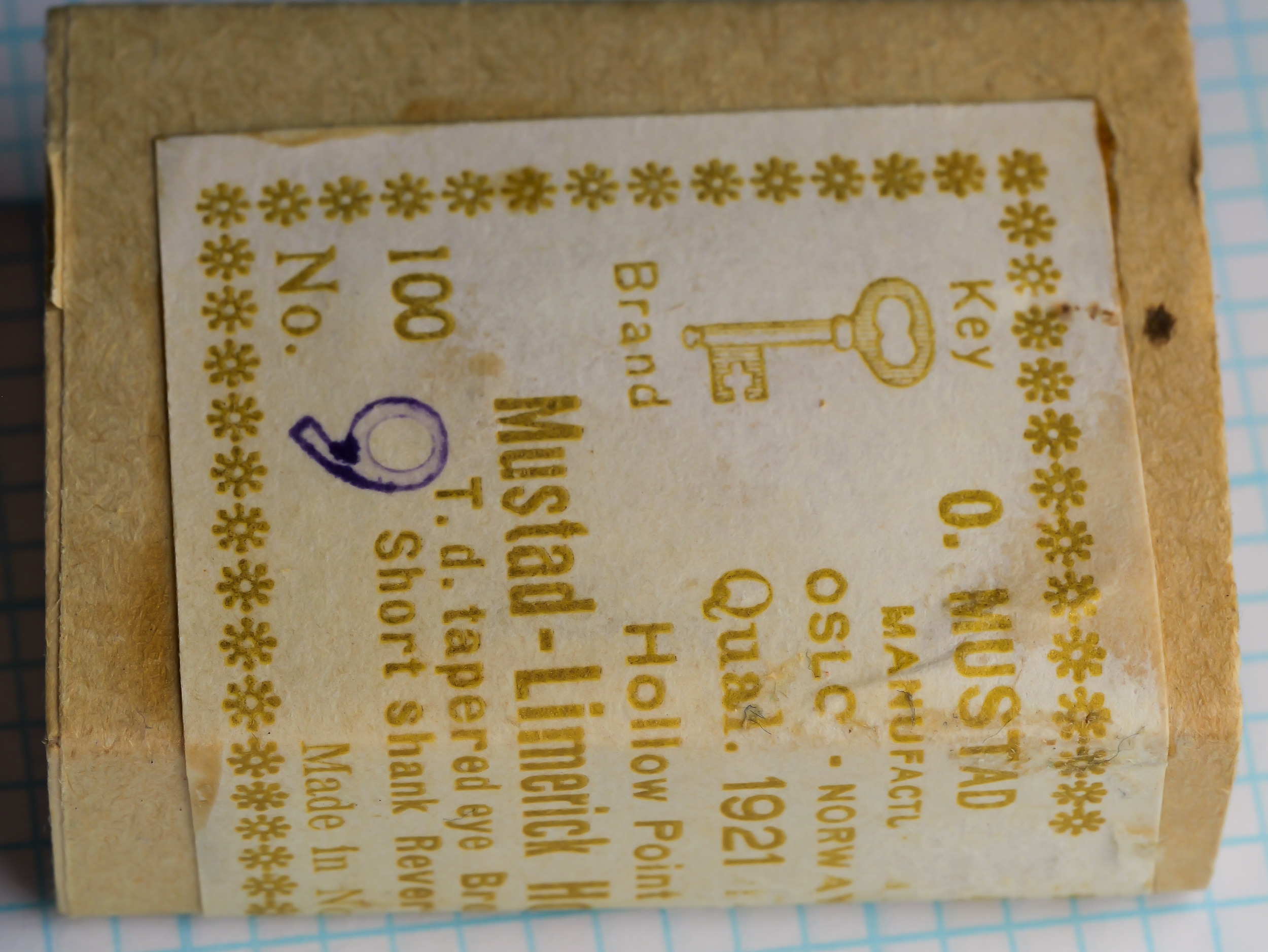
Dating from approximately 1950-1970 based on the white cardboard box construction and pencil markings, this size 3 specimen showcases Mustad’s ‘Key Brand’ quality line during their Oslo manufacturing period V. The turned-down tapered eye reflects the premium construction typical of Mustad’s export hooks of this era P.
While originally intended for bait fishing, the 1921’s compact proportions made it popular among fly tyers for traditional wet flies and spider patterns, though the offset point required consideration for proper fly presentation I.
8 cataloged imagesSelect any record to load it above.
8 images shown
The 1921’s engineering reflects classic bait hook design principles. The offset (reversed) point angles the hook tip slightly away from the shank plane, creating better penetration angles when fish take natural bait. The heavy wire gauge provides the strength necessary for larger fish while the short shank minimizes leverage that could bend or break the hook under stress.
The turned-down tapered eye represents premium manufacturing – the wire is mechanically thinned before forming the eye loop, reducing bulk while maintaining strength. The Limerick bend provides an optimal balance between fish-holding capability and structural integrity, with its angular geometry distributing stress more effectively than rounded bends.
Grid-derived from photograph (1/10" grid)
We don't have measured sizes for this hook yet. Own one? Submit calipered measurements and we'll review and add them. Thank you!
O. Mustad & Son was established in 1832 by Ole Mustad in Gjøvik, Norway, initially as a nail and wire manufacturing company. The company expanded into fishhook production in the 1870s under the leadership of Ole’s sons, Hans and Mathias Mustad. By the early 20th century, Mustad had become the world’s largest hook manufacturer, producing over 60,000 different hook patterns and supplying approximately half of the global market.
The company’s Oslo facility, which produced hooks like the 1921, was known for its high-quality ‘Viking’ steel tempering process. Mustad’s ‘Key Brand’ designation was used for their premium export hooks, symbolizing that their hooks were the ‘key’ to fishing success. The company maintained Norwegian production through the 1960s before gradually shifting manufacturing to lower-cost facilities, primarily in China.
The Mustad 1921 was part of Mustad’s extensive catalog of general-purpose fishing hooks during the mid-20th century. While not belonging to a specific named series, it represented the company’s approach to creating versatile hooks that could serve multiple fishing applications. The 1921’s design – featuring a short shank, heavy wire, and offset point – was optimized for bait fishing but proved adaptable enough for fly tying applications.
This model was produced during Mustad’s golden age of Norwegian manufacturing, when the company’s Oslo facility was renowned for consistent quality and innovative metallurgy. The 1921 was eventually discontinued as fishing preferences shifted toward specialized hook designs and lighter wire gauges in the 1970s and 1980s.
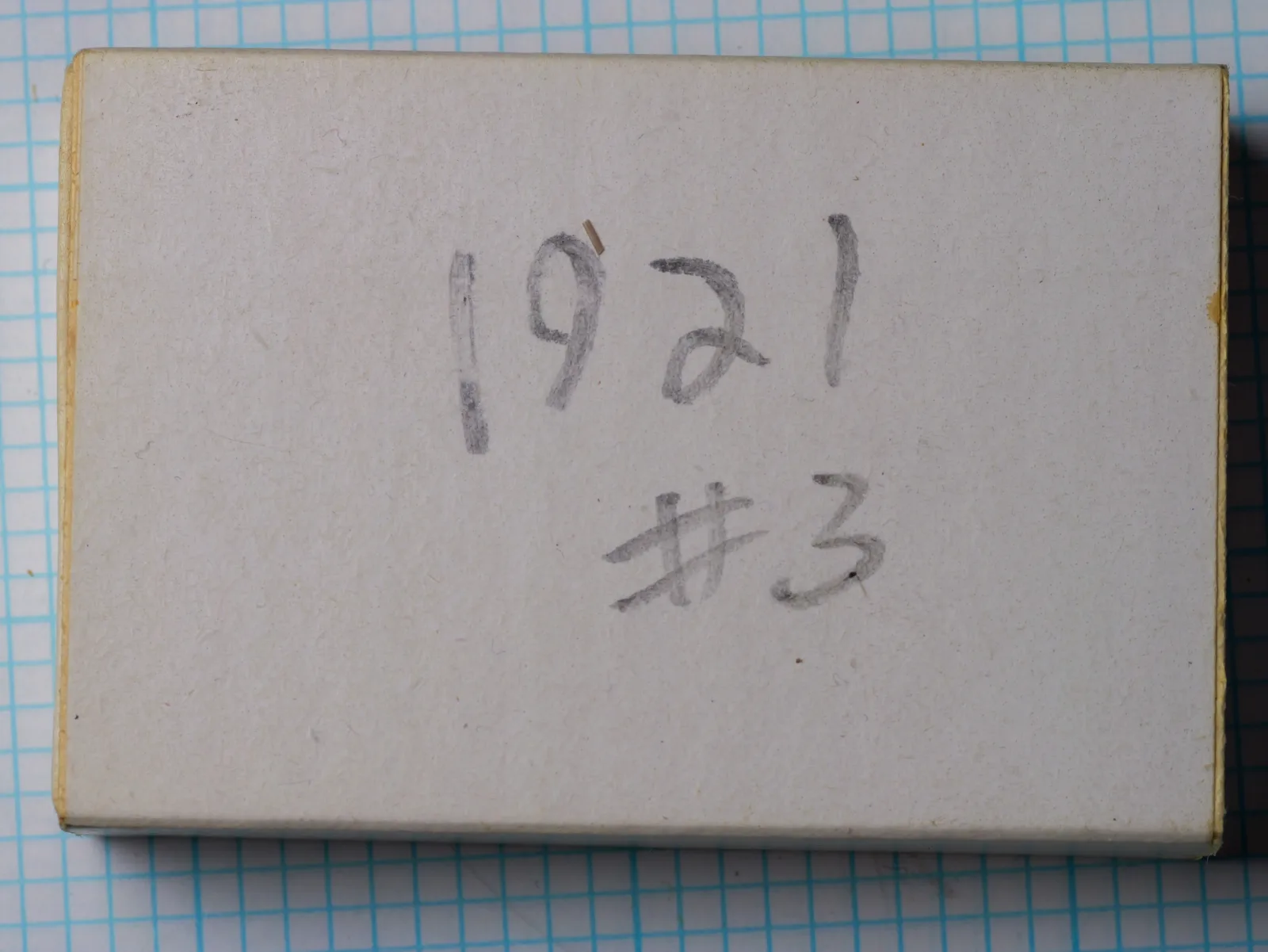
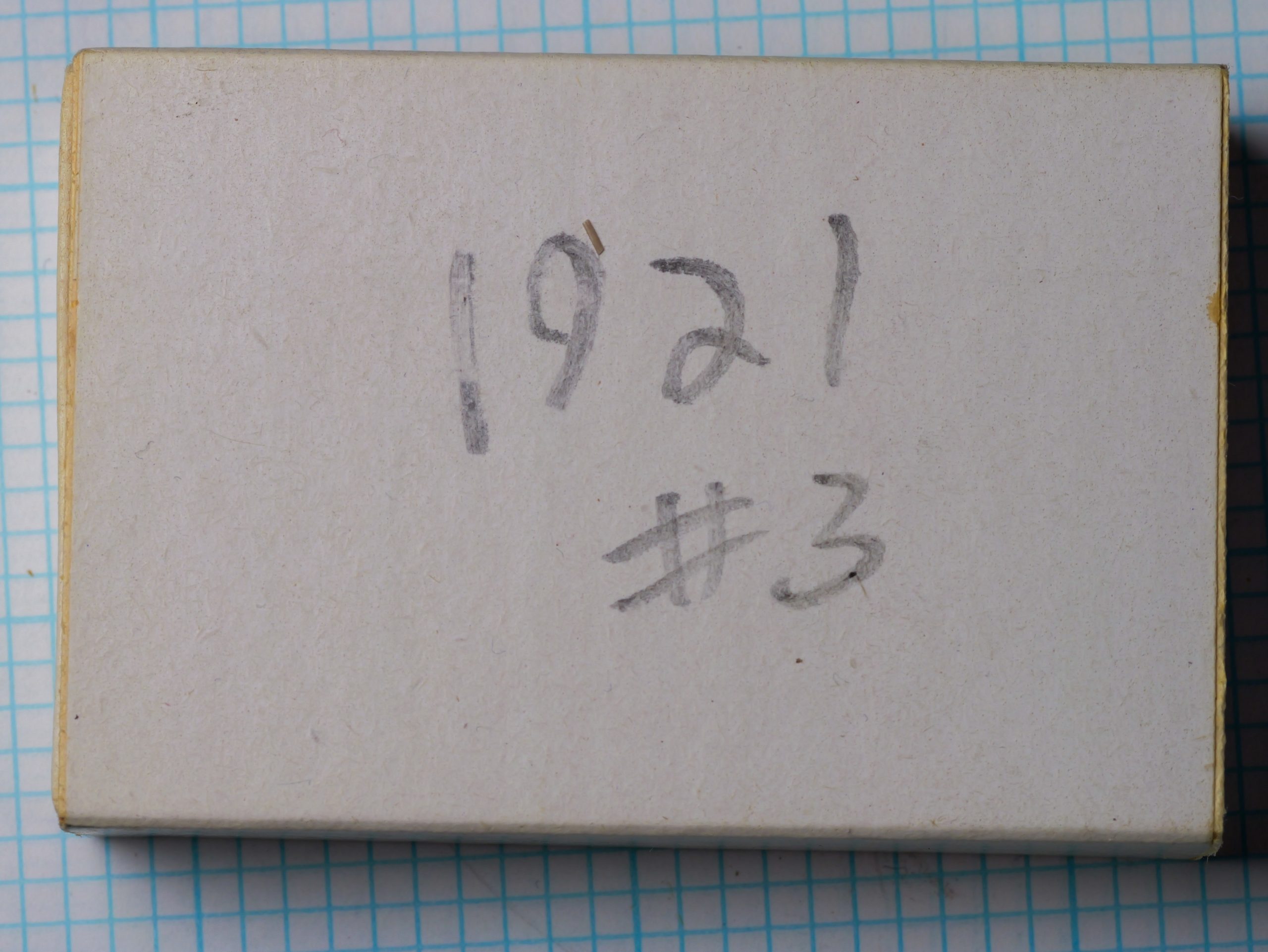
White cardboard box with pencil markings shows '1921' and '#3' in graphite. Box construction and marking style consistent with mid-century Mustad packaging before plastic containers became standard in the 1970s. Lack of barcode confirms pre-1974 production.
At its peak in the 1960s, Mustad's Oslo factory employed over 1,000 workers and produced more than 2 billion hooks annually. The company's quality control was so rigorous that each batch of hooks underwent 27 separate inspection steps, earning Norwegian-made Mustad hooks a reputation for reliability that persists among collectors today.
Originally designed as a premium bait hook for worms and salmon eggs, the Mustad 1921’s offset (reversed) point and short shank made it exceptionally effective for holding live bait. The heavy wire and bronzed finish provided durability in freshwater applications. Fly tyers adopted this hook for compact wet flies and spiders, though the offset point required careful consideration as it could cause flies to spin during casting.
Wet fly tying, particularly for traditional spider patterns and compact-bodied flies
Traditional wet flies, spider patterns, compact nymphs
| Hook | Match Quality | Notes |
|---|---|---|
| Mustad 3906 | Good | Similar shank length and bend but without offset point |
| Kamasan B175 | Moderate | Heavy wire traditional wet fly hook with comparable proportions |
Uncommon Norwegian-made Mustad with historical interest, though not rare enough for strong collector demand.
The Mustad 1921’s collectability is enhanced by its Norwegian manufacturing origin during Mustad’s acclaimed Oslo production period. The ‘Key Brand’ designation and original packaging add value, as does the hook’s dual-purpose design that bridges bait fishing and fly tying traditions.
However, collectability is limited by the hook’s relatively common occurrence in vintage tackle collections and the lack of any particularly unique design features. While quality construction and historical interest make it worthy of preservation, it falls short of the rarity needed for strong collector demand.
White cardboard box approximately 3.5 x 2.0 inches with fold-over lid construction. Hand-penciled markings '1921' and '#3' in graphite on lid. Box construction typical of Mustad mid-century export packaging with sturdy cardboard stock and clean white finish.
Original boxed examples command premium over loose hooks. Norwegian manufacture adds 30-50% to value compared to later production.
Vintage tackle dealers, estate sales, online auctions. Complete boxes more scarce than individual hooks.
Look for ‘Key Brand’ designation and ‘Made in Norway’ marking. Original white cardboard boxes are key identifier. Hook shows characteristic Norwegian bronze finish tone.
Store in a cool, dry environment to prevent moisture damage to both hooks and cardboard packaging. The bronzed finish is susceptible to patina development with humidity exposure, which may be considered desirable by some collectors. Keep hooks on original cards rather than loose to maintain provenance and value.
Original white cardboard boxes are fragile and should be handled minimally. Store boxes flat in archival containers to prevent crushing. The pencil markings are part of the historical record and should not be erased or altered.
The box lid displays clear pencil markings reading ‘1921’ and ‘#3’ in what appears to be period graphite pencil. The handwriting style and pencil type are consistent with mid-20th century tackle shop inventory practices. These markings likely represent dealer or angler notations for model identification and size verification.
The clear, deliberate script suggests these were made for organizational purposes rather than casual use notes. Such markings are common on vintage Mustad boxes and represent authentic period documentation of the hook’s identity and size.
| P | Photographically verified — Directly observable in the photograph(s) on this page. |
| V | Verified by documentation — Confirmed by manufacturer catalog, spec sheet, or published reference. |
| I | Inferred — A logical deduction from observable or documented evidence, not directly stated. |
| E | Estimated — An approximation based on visual comparison, proportional analysis, or limited data. |
| S | Speculative — A reasoned hypothesis that cannot be confirmed from available evidence. |
Claims with no notation are confirmed by multiple independent sources. All photographs on garrenwood.com are taken on a measurement grid where each square equals 1/10 inch (0.1″ / 2.54 mm).
Your cart is empty.