The Mustad 79625 Viking Hooks, manufactured in Norway circa 1950s–1960s, are extra-heavy forged bait hooks featuring a reversed beak bend, turned-down ball eye, and longitudinal baitholder slices engineered to secure soft baits during casting and retrieval. The hollow-point design combines razor-sharp penetration with a rapidly flaring barb, making these hooks particularly effective for soft-mouthed freshwater species like walleye and panfish without tearing delicate tissue. The cold-forged wire construction dramatically increases tensile strength and resistance to straightening, while the bronzed finish provides reliable corrosion resistance in freshwater and light-saltwater conditions. These hooks represent a foundational design in Mustad’s industrial-precision manufacturing philosophy and remain highly regarded by contemporary bait anglers for their balance of holding power and penetration efficiency.
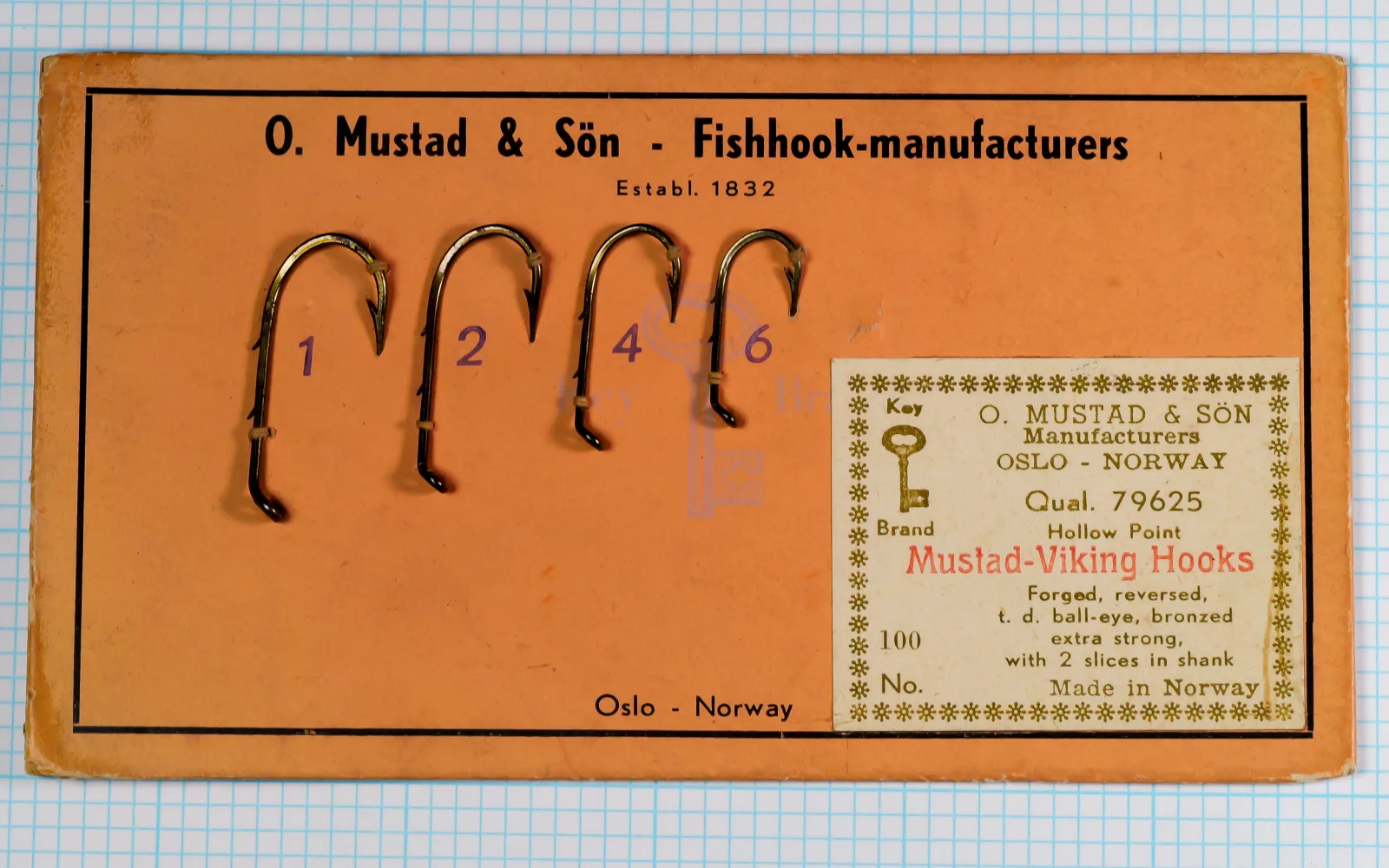
Full view of the original Mustad 79625 sales card showing the distinctive orange cardstock, cream-colored label with Key Brand logo, four sample hooks in displayed sizes, and period-specific typography and design elements.
Photographic record
2 cataloged imagesSelect any record to load it above.
2 images shown
Mustad 79625 Viking Hooks Sales Card Complete ViewFull view of the original Mustad 79625 sales card showing the distinctive orange cardstock, cream-colored label with Key Brand logo, four sample hooks in displayed sizes, and period-specific typography and design elements.Open originalMustad 79625 Viking Hooks Label DetailClose-up detail of the printed label showing the Key Brand logo, manufacturer information, model code, point style designation, and complete technical specifications in gold and red letterpress text.Open original
Technical profile
Eye
Ball Eye, Turned DownThe turned-down ball eye features a distinct, well-formed ball at the terminal wire end, visible as a smooth spheroid in profile. The taper into the eye is gradual and symmetrical. The eye opening is appropriately sized for the extra-heavy wire gauge, allowing secure knots without excessive pressure. P
Wire
Extra-Heavy (2X+), Forged
Shank
Standard — Baitholder Slices
Bend
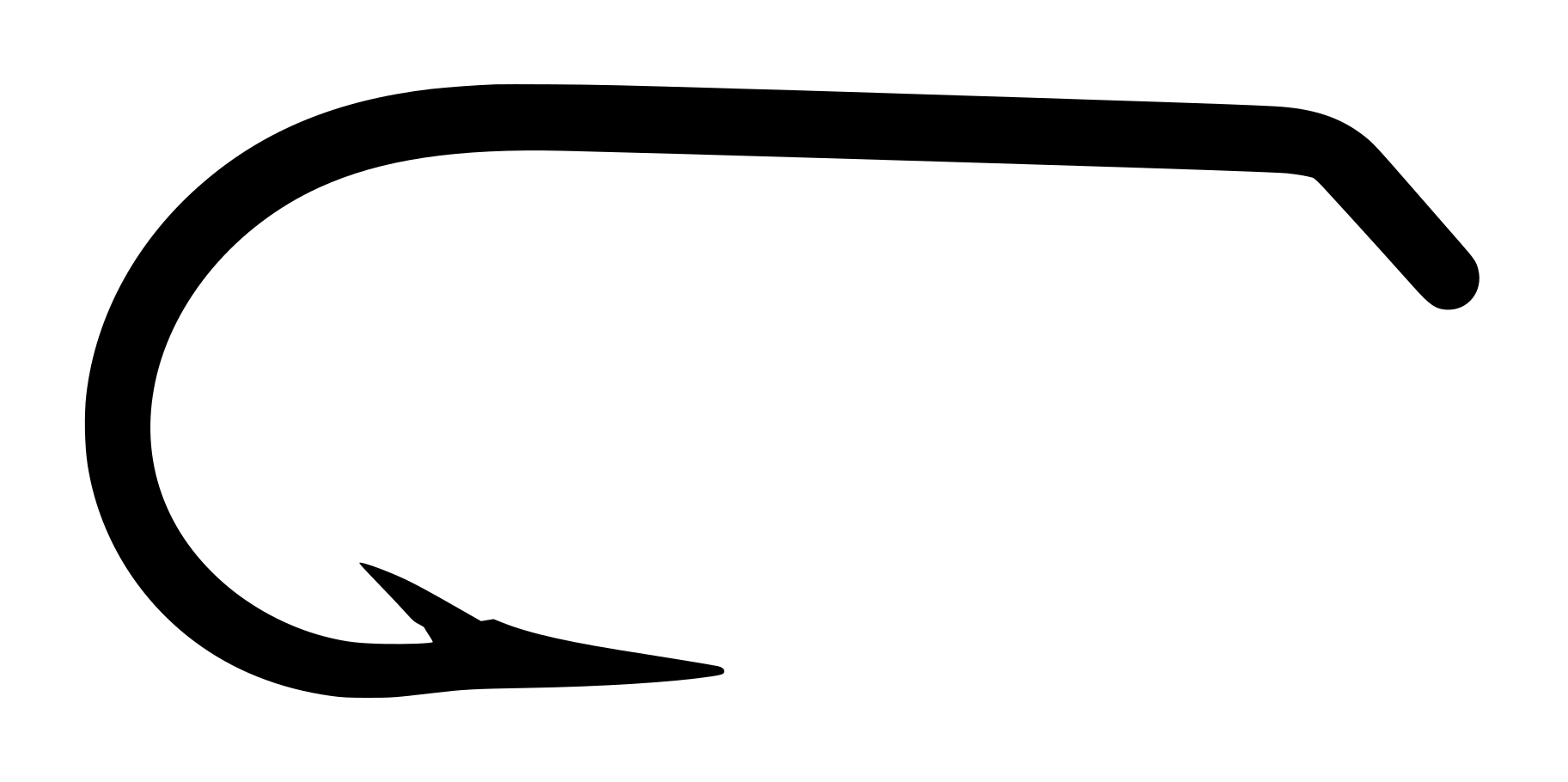
viking, Standard gap, Offset / kirbedThe beak bend features a pronounced reversed offset (kirbed left), deflecting the point away from the shank. The bend radius is moderate, creating a deep enough throat to accommodate bulky baits. The bend symmetry is even and well-proportioned, typical of Mustad's industrial precision during this era. P
Point
Hollow Point (concave inner face)The barb is a short, close-cut style, positioned just below the point transition. The barb angle is acute (approximately 45–60 degrees to the wire axis), creating secure hold without excessive tissue damage. The barb is consistent across all displayed sizes, indicating uniform manufacturing tolerances. P
Finish
Bronzed — Confirmed (stated on packaging)The bronzed finish displays a warm, dark golden-brown tone characteristic of mid-twentieth century Mustad lacquer. The finish appears uniform across all four displayed samples with no visible bare spots or corrosion. The patina is even and age-appropriate, suggesting the card has been stored in stable, dry conditions. No evidence of uneven oxidation or flaking. Finish tone is slightly warmer (more golden) than pure bronze, consistent with specific lacquer formulations of the 1950s–1960s era. P
Card shows even light toning throughout, consistent with age. Sample hooks on display are bright bronzed with no visible corrosion. No hooks appear to be missing from the display mounting. Label is clean and legible; print is sharp and unfaded. Card edges show minor wear consistent with storage and handling. P
Hollow Point Engineering: The hollow point on the 79625 features a concave, dished-out outer profile running from the tip to the barb base. This geometry creates an extremely fine, razor-sharp point that flares rapidly toward the barb, enabling rapid penetration with minimal applied pressure. For bait fishing — particularly with soft-mouthed species like walleye and panfish — this design prevents tearing of delicate buccal tissue that would result from a heavier, blunt-force point strike.
Forging and Wire Profile: The extra-heavy forged wire (flattened on the lateral sides via mechanical drop-press) dramatically increases tensile strength and structural rigidity without adding bulk. This cold-forging process alters the metallurgical grain structure, enabling the hook to resist straightening and bending open under the sustained pressure of a heavy-fighting fish. The forged profile also provides an ideal mechanical platform for the baitholder slices to grip and hold without deforming.
Baitholder Slices: The two longitudinal cuts in the rear shank create backward-facing barbs that actively grip the interior of soft baits. This prevents the bait from sliding during the cast, spinning in the water column, or balling up unnaturally at the bend — all failure modes that would result in lost fish and wasted presentations. The slices work in concert with the extra-heavy wire to provide both mechanical grip and structural support for the bait body.
Reversed Beak Bend: The reversed (kirbed) offset of the beak bend deflects the point slightly away from the shank axis, ensuring immediate contact with fish tissue upon the strike. In bait applications with bulky baits or high-speed retrieves, this offset prevents the bait body from shielding the point and reducing hook-up ratios.
Bronzed Finish: The brownish-gold lacquer coating provides excellent rust resistance in freshwater and light-saltwater conditions while presenting a muted, natural color profile that does not create unnatural flash that would spook cautious fish. The baked-on alkyd resin finish is durable and suitable for extended soaking in live bait presentations.
Size & scale lab
Selected size
(unspecified)
Physical specimen
Shank Length
32.5 mmE
Gap Width
12 mmE
Bend Depth
16 mmE
Weight
Not available
Shank-to-Gap Ratio
~2.6-2.8 : 1 E
Confidence
P
Physical specimen
Grid-derived from photograph (1/10" grid)
Own this hook? Help us measure it.
We don't have measured sizes for this hook yet. Own one? Submit calipered measurements and we'll review and add them. Thank you!
Historical context
mustad
O. Mustad & Søn was founded in 1832 in Gjøvik, Norway, by Hans Schikkelstad as a producer of nails, steel wire, and basic metal goods under the name Brusveen Spiger- og Ståltradfabrikk. The company was acquired by Schikkelstad’s son-in-law, Ole Hovelsen Mustad, and his son, Hans Mustad, who rebranded it as O. Mustad & Søn. In 1877, Mathias Topp, a visionary within the company, invented the first fully automated hook-making machine, allowing raw steel wire to be continuously fed, cut, bent, barbed, and pointed at unprecedented speeds. Rather than file patents (which would require public disclosure of schematics), Mustad protected this proprietary technology through strict corporate secrecy and non-disclosure agreements, gaining a devastating competitive advantage over rival manufacturers in Redditch, England, and other hook-making centers globally.
By the 1950s, Mustad had secured approximately fifty percent of the global hook production market, establishing sales offices and manufacturing facilities across multiple continents. The company’s strategy of reverse-engineering highly localized, regional hook patterns — such as the Cincinnati bend, Limerick bend, and Aberdeen pattern — and producing them with Norwegian industrial efficiency allowed Mustad to dominate both local and export markets. Oslo, Norway, served as the primary manufacturing hub and administrative center throughout the twentieth century.
Series History
The Mustad-Viking series was introduced in the mid-twentieth century as a heavy-duty bait and general-purpose hook line targeting European freshwater and saltwater markets. The Viking nomenclature invoked Nordic strength and reliability, aligning with Mustad’s Norwegian heritage and marketing strategy. The 79625 model specifically was engineered as a medium-heavy bait hook with extra-strong forged wire and the revolutionary baitholder slice design, making it ideal for rough-water applications, strong currents, and species requiring robust presentations.
The series remained in production throughout the 1950s–1970s, with various size ranges (1 through 6/0) and finish options (primarily bronzed and blued). The baitholder slice innovation, which became a signature feature of the Viking line, distinguished these hooks from competing patterns and made them especially popular in Scandinavian, UK, and European freshwater markets. The Viking series was eventually superseded by modern iterations in the late twentieth century as Mustad transitioned to plastic packaging and updated model nomenclature (the Signature Series introduced around 2001), but the original Viking design remains iconic among vintage tackle collectors and traditional fishing practitioners.
Era and Packaging Dating
Oslo address indicates post-1925 manufacture (Christiania renamed to Oslo January 1, 1925). No barcode present rules out post-1974 manufacture. Key Brand logo typography, letterpress printing quality, and orange cardstock construction are consistent with Mustad's post-WWII export period. Absence of modern plastic packaging or modern font treatments places this firmly in 1950s–1960s window. The styling of the decorative border and the specific font treatment of the Mustad-Viking Hooks branding in red align with Scandinavian printing conventions of mid-twentieth century. V
The Baitholder Revolution: When Slices Changed Everything
The 'slices' in the shank of the 79625 represent a pivotal innovation in bait hook design. These tiny barbs, cut into the rear of the wire, were engineered to grip and hold soft baits — earthworms, liver, and soft plastic baits — preventing them from sliding down the hook and bunching up at the bend during casting. This innovation was especially critical in European freshwater fishing traditions, where delicate presentations of live baits for walleye, perch, and roach demanded precision. The design was so effective that baitholder-sliced shanks became standard on commercial bait hooks throughout the latter twentieth century. Mustad's application of this design to their heavy-duty Viking series made the 79625 an industrial workhorse, enabling anglers to fish with confidence in rough conditions and strong currents without fear of bait failure.
Design lineage and influence
Best matchRelated by Attribute
Computed automatically from catalog data — updated as new hooks are added.
Matches: Bend, Wire, Gap, Eye Orient., Point +4 moreDiffers: Shank: Standard vs Short (1X–2X Short); Eye: Ball Eye vs Tapered Eye; Application: Bait vs Wet Fly, Nymph, Bait +1 more
Matches: Bend, Wire, Eye Orient., Point, Finish +3 moreDiffers: Shank: Standard vs Short (1X–2X Short); Gap: Standard vs Wide; Eye: Ball Eye vs Tapered Eye +2 more
Matches: Bend, Wire, Gap, Point, Finish +3 moreDiffers: Shank: Standard vs Short (1X–2X Short); Eye: Ball Eye vs Tapered Eye; Eye Orient.: Turned Down vs Turned Up +1 more
The 79625 is a quintessential freshwater and light-saltwater bait hook, optimized for live-bait presentations and rough-water fishing. The extra-heavy forged wire resists bending and straightening under the strain of powerful freshwater species (walleye, pike, large perch) and coastal fish (cod, whiting). The baitholder slices grip and secure soft baits — earthworms, liver, soft plastics, and live minnows — preventing them from sliding during the cast, spinning in current, or bunching up at the bend. The reversed beak bend and hollow point geometry ensure rapid penetration and secure hookset with minimal applied pressure, crucial for light-tackle presentations and fish with delicate mouths.
Historically, the 79625 was the workhorse of European freshwater fishing from the 1950s onward, particularly in Scandinavian, UK, and continental traditions where bait fishing dominates. Walleye anglers in Scandinavia favored this pattern for live-minnow presentations in fast water. UK coarse anglers used sizes 4–6 for roach, rudd, and perch in rivers and lakes. European sea anglers deployed the larger sizes for bottom-fishing and near-shore applications targeting cod, whiting, and sea bass. The pattern remains in use today among traditional and conservation-minded anglers who prefer the proven functionality of classic designs over contemporary alternatives.
Secondary Applications
Light-tackle saltwater near-shore fishing; commercial bait fishing; worm-bait presentations for trout in larger sizes
Classic Fly Patterns
Not typically used for fly tying.
Modern Equivalents
Hook
Match Quality
Notes
Mustad 92641 Classic Beak Baitholder
Excellent
Direct lineal descendant; retains beak bend, baitholder slices, and forged wire; updated branding and modern packaging
Mustad 92671 UltraPoint Baitholder
Very Good
Contemporary baitholder with same bend and shank design but with Mustad's advanced chemical-sharpened point technology
Owner SSW (Super Strong Work) Beak Hook
Good
Japanese-made equivalent offering similar strength, beak bend, and baitholder design for modern freshwater bait fishing
Gamakatsu Baitholder Beak
Good
Modern Japanese alternative with comparable extra-heavy wire and baitholder slices, widely available in contemporary tackle shops
Collector notes
Rated 4.5/10. The 79625 Viking is uncommon but not rare; larger sizes (1, 2) appear regularly, while smaller sizes (4, 6) are more scarce. Collector demand is moderate among bait and general-purpose tackle historians and European fishing traditionalists. Complete original cards in excellent condition command premiums, but loose hooks have minimal collector value beyond functional use.
Reference value
$8 – $22 USD estimate
Packaging condition
Good — moderate wear, legibleRecorded specimen
Packaging format
sales_cardCatalog code
Collectibility Factors: The Mustad-Viking series represents a significant product line from the mid-twentieth century boom in global export fishing tackle. The 79625, specifically marketed as a bait hook with revolutionary baitholder slices, appeals to historians documenting the evolution of mechanized hook design. Original sales cards with intact sample hooks and legible labels are moderately desirable; the combination of the Key Brand logo, Oslo address, and the specific Mustad-Viking branding makes this a recognizable artifact of post-WWII Norwegian industrial manufacturing.
Limiting Factors: The hook is not rare — Mustad produced these in massive quantities for commercial and sport fishing throughout the 1950s–1960s. Complete original boxes or cards in mint condition are uncommon but not exceptionally scarce. The larger sizes (1, 2) are abundant, reducing their premium; sizes 4 and 6 are somewhat harder to locate. The bronzed finish is stable and ages well, so condition degradation is less of a limiting factor than with japanned or tinned alternatives.
Size and Finish Variants: Cards displaying the full size range (1, 2, 4, 6) are more desirable than incomplete cards. The bronzed finish is the standard and most commonly encountered; other finishes (if they exist) would command additional premiums. Sales cards that retain all 100 original hooks intact (if unused) would be at the high end of the range; cards with 50–99 hooks remaining are typical for this era.
Condition Premium: Original cardstock color, sharp printing, and intact sample hooks add 20–30% to the base value. Cards with fading, torn labels, or missing sample hooks drop into the fair-to-good range. The absence of a barcode and the intact letterpress printing are positive indicators of authenticity and age.
Packaging
Orange cardstock sales card, 5.5" × 3.5" approximately, with ornamental gold-printed border and asterisk ornaments. Cream-colored printed label affixed to center-right of card displaying Key Brand logo (downward-pointing skeleton key in gold), manufacturer name, location (OSLO - NORWAY), model code (Qual. 79625), specifications line in red (Mustad-Viking Hooks), and details in gold and brown text. Four hook size samples (1, 2, 4, 6) displayed in wire holders on left side of card. Card shows light toning and age patina consistent with 1950s–1960s era. No barcode present. Text is letterpress printed. Quantity marked as 100 No. Card construction and paper stock are consistent with mid-twentieth century European packaging standards. P
Market Value Notes
Low ($8): Good condition (opened card, 80–95 hooks present, minor wear to packaging)<br />
High ($22): Excellent condition (sealed or near-sealed card, 100 hooks intact, minimal packaging wear, sharp printing, vibrant color)<br />
Premium factors: Intact original sample hooks on card, sharp letterpress printing, complete hook count, unopened or sealed condition, strong Key Brand logo legibility, Oslo address dating<br />
Platforms: eBay UK and US (general vintage tackle lots), specialist tackle dealers in Scandinavia and continental Europe, fly fishing and bait fishing collector forums<br />
Confidence: E Estimated from limited comparable sales data. Most Viking-series bait hooks in original packaging sell in the $5–$25 range depending on size, completeness, and condition. This mid-range estimate assumes a good-condition card with most hooks present. Higher estimates reflect sealed examples or exceptional label condition.
Where to Find
eBay UK and eBay US (search: Mustad Viking, Mustad 79625, Mustad baitholder). Specialist European tackle dealers, particularly Scandinavian sources. Fishing tackle forums and collector networks. Occasional sales at regional fishing tackle auctions in the UK and continental Europe. Less common at US domestic auctions or dealers, but available through international shipping.
Preservation
Storage and Preservation
Store this sales card in a cool, dry environment away from direct sunlight and moisture. The bronzed finish is stable and resistant to corrosion, but prolonged humidity exposure can encourage uniform patina development (which many collectors find desirable). Keep the card in its original packaging or a protective archival sleeve to prevent further toning and to preserve the cardstock integrity.
If the card is opened, store the hooks on the card rather than removing them into loose containers. The card itself is part of the artifact’s historical and monetary value. Avoid contact with other metals (iron, copper) that could induce galvanic corrosion. Do not clean or polish the hooks aggressively — light surface dust can be removed with a soft brush or compressed air. Do not immerse in water or cleaning solutions, as this can damage the letterpress printing on the label and accelerate patina development on the wire.
Handle the card by its edges only, avoiding contact with the label or hooks. Store horizontally on a flat surface, or vertically on a shelf with support to prevent warping of the cardstock. Temperature fluctuations should be minimized; ideal storage conditions are 60–75°F (15–24°C) at 40–50% relative humidity.
Line 1: O. MUSTAD & SÖN — Full corporate identity. The Norwegian spelling (Søn, not Son) signals European/Norwegian printing convention.
Line 2: Manufacturers — Corporate role statement, differentiating Mustad from import agents and jobbers who frequently repackaged bulk hooks under secondary brand names. This assertion of direct manufacturing was critical to Mustad’s brand retention strategy.
Line 3: OSLO – NORWAY — Geographic origin and dating tool. Oslo address indicates post-January 1, 1925 manufacture (Christiania was renamed to Oslo on that date). Earlier cards would read CHRISTIANIA – NORWAY, establishing this card firmly within the post-1925 era. The Oslo designation, in combination with the lack of a barcode and the specific typography, places this in the 1950s–1960s window.
Line 4: Qual. 79625 — Quality/Model code. The numerology indicates a premium model (4000+) in Mustad’s hierarchical coding system, denoting a highly specialized, refined hook rather than an economy line (1000–2999) or standard quality line (3000–3999).
Line 5: Hollow Point — Exclusively reserved for point geometry designation. This line defines the microscopic geometric shape critical to the hook’s penetration capabilities. Hollow point geometry — a concave, dished-out profile from tip to barb — enables rapid penetration with minimal applied force, ideal for soft-mouthed fish and delicate presentations.
Line 6: Mustad-Viking Hooks — Pattern name and series identifier. The Viking nomenclature invokes Nordic strength; the pattern represents Mustad’s reverse-engineered heavy-duty bait hook design for European and Scandinavian markets. This line identifies the structural bend and shank geometry — in this case, a reversed beak bend with extra-heavy wire.
Lines 7–8: Forged, reversed, t.d. ball-eye, bronzed, extra strong, with 2 slices in shank — Supplementary anatomical features and metallurgical finishes. These lines synthesize the eye type (turned-down ball-eye), shank modifications (baitholder slices), wire treatment (forged extra-strong), finish (bronzed lacquer), and any offset (reversed/kirbed). This comprehensive modular description enables a buyer to understand the complete technical specification without additional documentation.
Quantity and Size: 100 No. — Denotes that this is a standard wholesale/retail box containing 100 hooks. Hook size availability for this model ranged from 1 to at least 6, with larger sizes (1/0, 2/0) also produced. The four sample hooks displayed on the card (sizes 1, 2, 4, 6) represent the typical midrange of the size roster.
Additional
Baitholder Shank Innovation and Fishing Tradition
The ‘two slices in shank’ notation represents a revolutionary advance in practical fishing hook design. Unlike smooth-shanked bait hooks, which allowed soft baits to slide freely down the wire during casting and in current, the baitholder design featured two longitudinal cuts in the rear shank that created tiny, backward-facing barbs. These barbs mechanically grip the interior tissue of live baits — earthworms, liver, soft plastic baits, and occasionally soft-fleshed minnows — preventing the bait from migrating down the hook shank and bunching up at the bend.
This seemingly minor innovation had profound practical implications. In European freshwater traditions, where bait fishing dominates and presentations must withstand fast currents, rocky substrates, and rough handling, bait failure was a constant problem. A bait that slipped or bunched would lose its natural presentation, dramatically reducing hook-up rates. The baitholder design essentially eliminated this failure mode, allowing anglers to fish with confidence for extended periods without re-baiting or re-positioning the bait on the hook.
The 79625 paired this baitholder innovation with extra-heavy forged wire, making it a workhorse for powerful species (walleye, pike, large perch in Scandinavia; cod and whiting in European coastal fishing). The combination of a robust, reliable presentation platform (baitholder slices) with raw structural strength (forged extra-heavy wire) created a hook that could be used aggressively — cast hard, set firmly, and muscled through heavy water — without fear of failure.
By the 1960s, the baitholder design had become a standard feature on commercial bait hooks worldwide. Mustad’s application of this design to their premium Viking series helped establish it as an industry standard, and baitholder hooks remain fundamental to modern bait fishing across both freshwater and saltwater applications.
Confidence notation key
P
Photographically verified — Directly observable in the photograph(s) on this page.
V
Verified by documentation — Confirmed by manufacturer catalog, spec sheet, or published reference.
I
Inferred — A logical deduction from observable or documented evidence, not directly stated.
E
Estimated — An approximation based on visual comparison, proportional analysis, or limited data.
S
Speculative — A reasoned hypothesis that cannot be confirmed from available evidence.
Claims with no notation are confirmed by multiple independent sources. All photographs on garrenwood.com are taken on a measurement grid where each square equals 1/10 inch (0.1″ / 2.54 mm).