
Selected size
10
Catalog record
- Overall Length
- 15.1 mm V
- Shank Length
- 8.1 mm V
- Bend Depth
- 6.8 mm V
- Wire Diameter
- 0.6 mm V
- Confidence
- V Catalog record only
 Garren WoodFishing Hook Reference
The Mustad 541 is a classic mid-century cross-over hook manufactured by O. Mustad & Søn in Oslo, Norway, circa 1950-1970. Quality 541 represents a transitional design bridging heavy-duty fly tying and commercial bait fishing applications. The hook combines a short, wide-gap round bend with extra-strong forged wire, a hollow point for rapid penetration, and a distinctive reversed (kirbed) offset to improve hook-set geometry.
The Hollow Point designation refers to the concave grinding process that creates a razor-sharp, fast-penetrating tip—a feature historically favored for soft-mouthed fish and delicate presentations. The forged wire construction, achieved by mechanical flattening at the bend, dramatically increases structural rigidity and tensile strength without adding weight, making this hook exceptionally resistant to bending or opening under pressure.
The reversed offset and short shank make the 541 particularly effective for egg patterns, Glo-Bugs, and vintage wet flies requiring rapid sink rates. While largely superseded by modern designs, the 541 remains sought by collectors of mid-century tackle and vintage fly tyers interested in period-correct materials. Original cardboard boxes with intact eight-line paper labels are increasingly scarce, making complete examples valuable to Mustad specialists.

5 cataloged imagesSelect any record to load it above.
5 images shown
Hollow Point | Mustad Round Hooks | Forged | Reversed | Turned Down Ball-eye | Bronzed | Extra Strong | Made in Norway
The Hollow Point geometry is the critical innovation on the Mustad 541. The term ‘hollow’ refers not to metal that has been removed, but to the concave cutting or grinding process applied to the outer surface of the point. The inner face of the point—the side facing the barb—curves inward in a smooth, sweeping arc. This creates an extremely sharp, razor-like edge that tapers rapidly from the tip toward the barb, concentrating all penetration force at the finest possible point.
The mechanical advantage is significant: a hollow point requires minimal applied force from the angler to achieve initial penetration into soft tissue. Historically, this made the 541 ideal for soft-mouthed freshwater species such as crappie, panfish, and specific trout races where aggressive hook-sets would tear tissue and cause lost fish. The rapid flare from razor-tip to barb-base ensures that once penetration occurs, the hook holds securely in friable tissue without enlarging the wound channel excessively.
The forged wire construction elevates structural performance beyond standard round-wire hooks. Forging—achieved by mechanically flattening the wire along its lateral sides—alters the metallurgical structure and significantly increases tensile strength and resistance to bending. The hook can withstand heavy load without deforming, making it suitable for both heavy nymphs and egg patterns that must cut through current, as well as for bait fishing against strong species.
We have measurement for size 10. Know any others? Submit calipered measurements and we'll review and add them. Thank you!
O. Mustad & Søn was founded in 1832 in Gjøvik, Norway, by Hans Schikkelstad as Brusveen Spiger- og Staltradfabrikk, initially producing nails and steel wire. The company was acquired by Schikkelstad’s son-in-law, Ole Hovelsen Mustad, and his son, Hans Mustad, who rebranded it as O. Mustad & Søn. The defining moment came in 1877 when Mathias Topp invented the first fully automated hook-making machine, allowing continuous production of cut, bent, barbed, and pointed hooks at unprecedented speed.
Rather than patent the invention, the Mustad family protected the technology through corporate secrecy and restricted factory access. This strategy proved devastatingly effective against competitors in Redditch, England, and the United States. By the 1950s, when the Mustad 541 was in production, the company had secured approximately 50 percent of the global hook market, with sales offices and manufacturing facilities across multiple continents. The Oslo factory operated at maximum capacity through the mid-twentieth century before transitioning to modern plastic packaging and assembly in the late 1970s.
The Mustad 541 appears in the Quality tier designation system (1000-2999 economy, 3000-3999 mid-tier quality, 4000+ premium) as a mid-range model positioned between general commercial bait hooks and premium dry fly designs. It represents Mustad’s aggressive industrial cloning strategy—the round bend and short shank configuration copied regional patterns perfected by independent blacksmiths and regional anglers. The 541 was offered in multiple sizes (typically No. 2 through No. 14) and competed directly with similar offerings from Partridge and local British manufacturers. The model remained in continuous production from the 1920s through the early 2000s, surviving the transition to Signature Series naming only to be discontinued during Mustad’s corporate restructuring around 2001-2009. No documented direct predecessor or successor exists within the Mustad catalog; the 541 operated as a standalone commercial/hybrid design rather than as part of a named series.
Oslo designation on label (post-1925 production). Classic eight-line paper label with 'Key Brand' logo, characteristic of mid-century Mustad packaging before transition to plastic blister packs in late 1970s-1980s. Letterpress printing on cardboard stock consistent with 1950s-1960s manufacturing era. No barcode present (pre-1974 indicator).
The reversed (kirbed) offset on the Mustad 541 created a peculiar problem for fly tyers. When clamped in a standard flat-jawed fly tying vise, the shank sits at an angle, making it genuinely annoying to dress the fly symmetrically. Modern fly tyers universally dislike this feature. However, the offset was engineered purely for live-bait anglers—when a kirbed hook is set at an angle in a fish's mouth, the point naturally catches flesh rather than sliding flat against the roof of the mouth, dramatically improving hook-up ratios on sluggish or soft-mouthed species. This design reflects the era when Mustad manufactured hooks equally for commercial bait fishing and sport fly tying, before the fly-fishing market demanded perfect, non-offset designs.
| Silhouette | Hook Model | Match | Analysis | Compare |
|---|---|---|---|---|

|
4195 No. 11 — Mustad 4195 Kendal Kirby | 89% | Compare | |

|
4165 No. 12 — Kendal Kirby | 86% | Compare | |

|
7925 No. 10 — Mustad 7925 | 84% | Compare | |
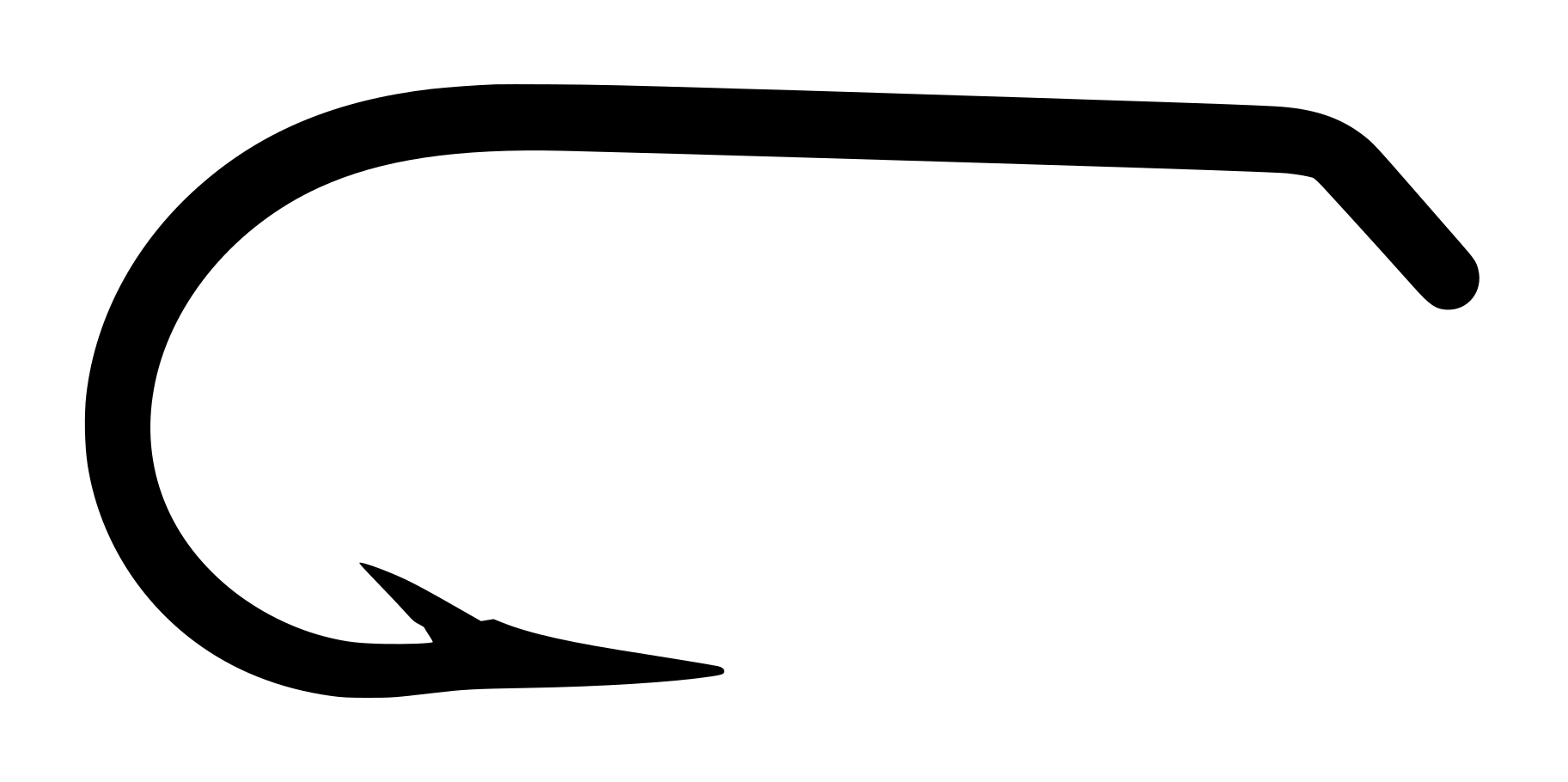
|
7947 B No. 12 — Mustad 7947 B | 83% | Compare | |

|
56310 No. 11 — Mustad 56310 | 82% | Compare |
| Silhouette | Hook Model | Match | Compare |
|---|---|---|---|

|
S 1000 No. 16 — S 1000 | 97% | Compare |

|
1608 A No. 5/0 — Mustad Bowed | 96% | Compare |
|
|
7947 B No. 12 — Mustad 7947 B | 96% | Compare |
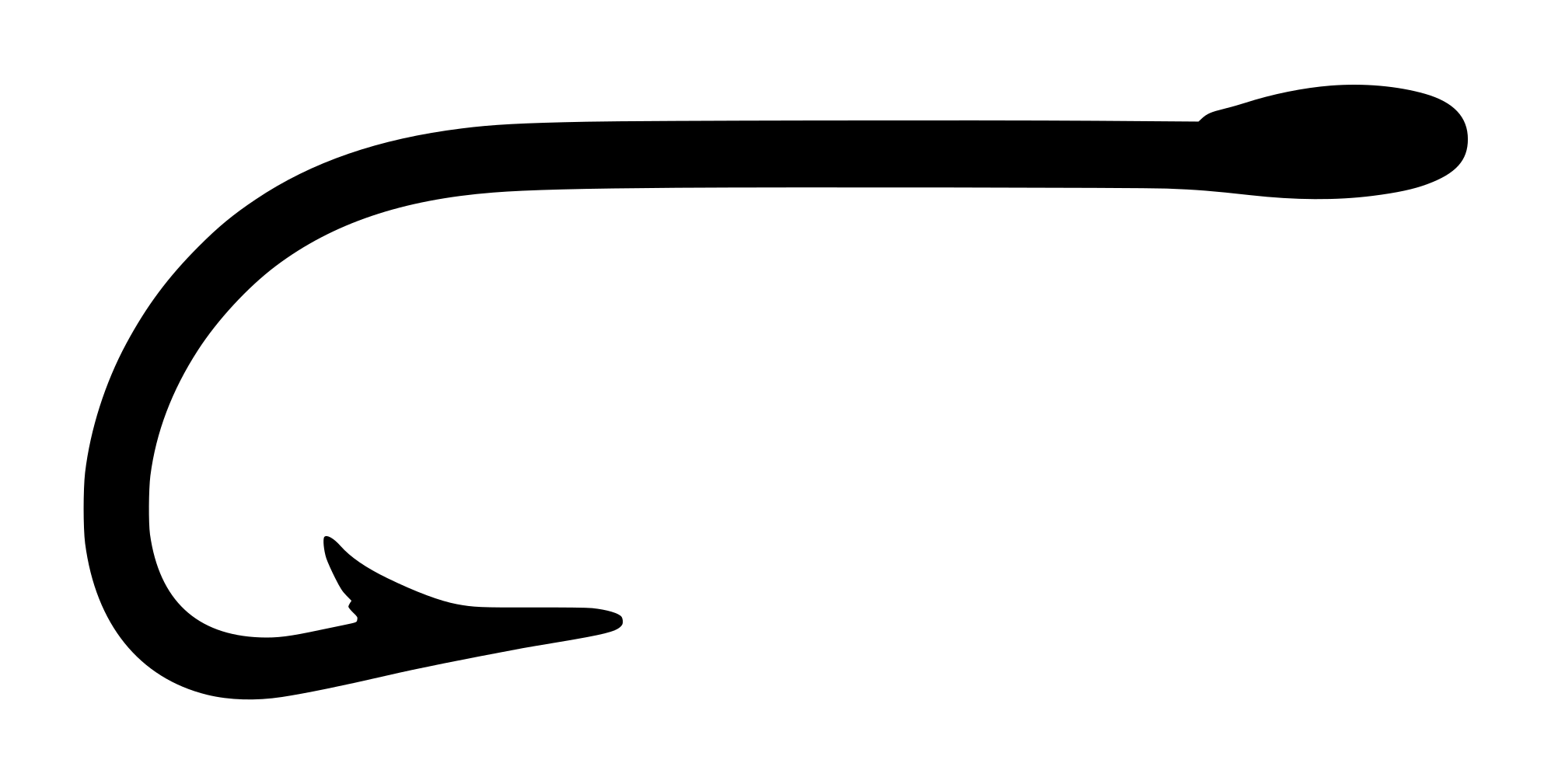
|
5321 No. 5 — Sheepshead Fish Hooks | 96% | Compare |
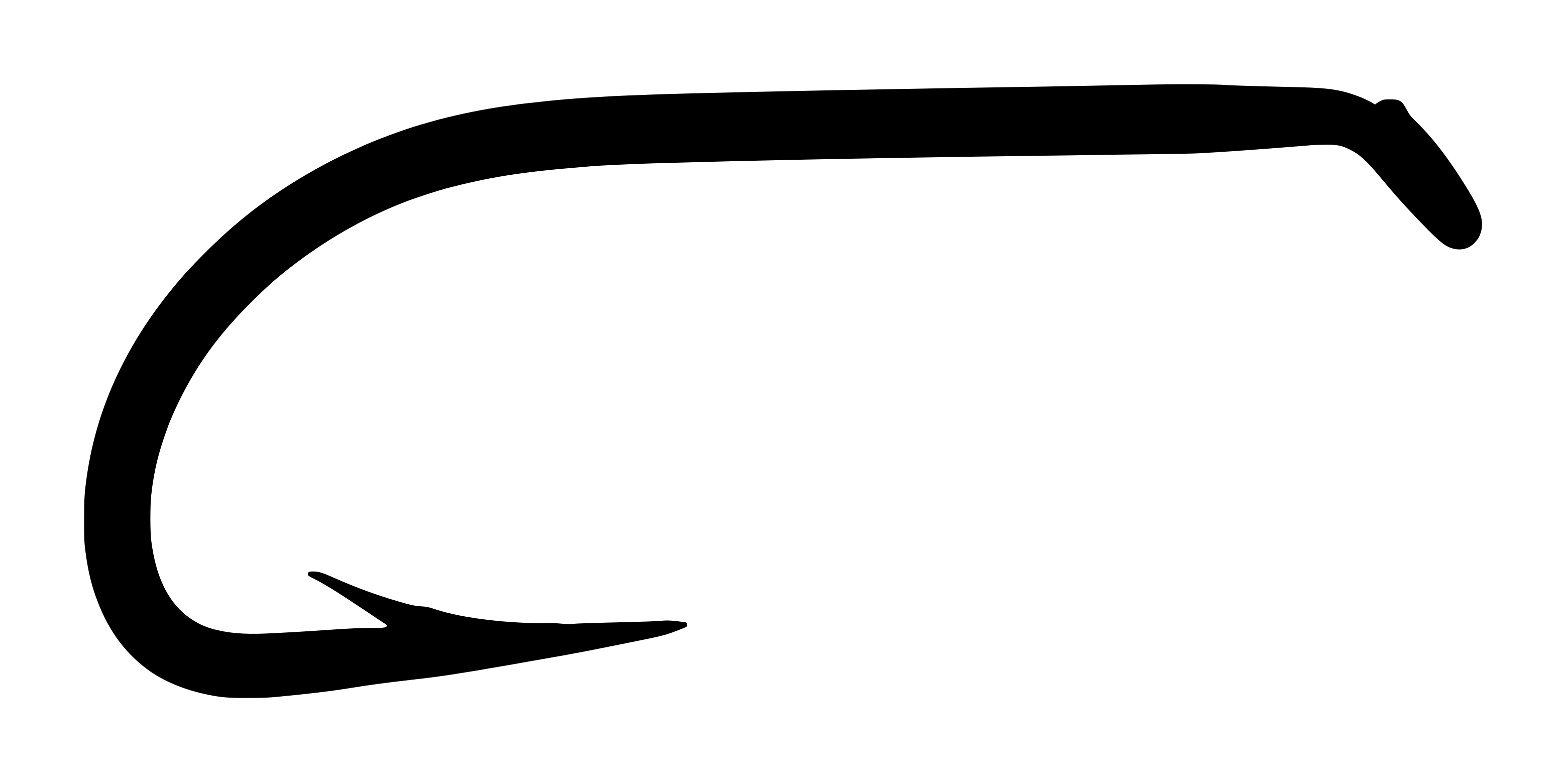
|
3667 No. 9 — Mustad 3667 Limerick Hollow Point | 95% | Compare |
The Mustad 541 was engineered as a hybrid hook for both vintage wet fly patterns and commercial live-bait fishing. Its primary fishing application is egg patterns and Glo-Bugs for Pacific and Atlantic salmon and steelhead, particularly in contexts where rapid sink rates and sturdy construction are required. The short shank and wide round bend provide an ideal platform for yarn-body egg imitations, while the hollow point delivers the rapid, low-force penetration necessary for soft-tissue hooking. The extra-strong forged wire resists opening under the weight of heavy nymphs or the sustained pressure of fighting anadromous fish in fast current.
In its secondary role as a bait hook, the reversed offset geometry makes the 541 exceptionally effective for live-bait applications targeting soft-mouthed or finicky species. The offset forces the point to engage the jaw corner rather than sliding flat in the mouth, dramatically improving hook retention during violent head shakes or aerial acrobatics. This design reflects an era when Mustad manufactured for both the precision fly-fishing market and the utilitarian commercial angling sector, before specialization and market segmentation drove manufacturers toward single-purpose designs.
Light bait fishing for panfish and small trout; vintage wet fly nymph patterns; competitive salmon and steelhead applications where period-correct materials are desired.
Named patterns specifically associated with this hook. Leave blank if none formally documented. Do not speculate — only include patterns with a confirmed association.
| Hook | Match Quality | Notes |
|---|---|---|
| Tiemco 105 | Very Good | Heavy wire, short shank, wide gap, round bend. Lacks reversed offset but matches functional profile for egg patterns and heavy nymphs. Modern equivalent in terms of strength and application. |
| Daiichi 1530 | Very Good | Short-shank heavy-wire nymph hook with wide gap. No offset. Similar construction purpose but updated materials and finishes. |
| Gamakatsu SL12S | Good | Modern small egg hook with heavy wire and forged construction. Gap and shank length proportions differ, but addresses same functional niche. |
Rated 2.5/10 — Mustad 541 remains common in larger sizes (No. 2 through No. 8) due to industrial production volumes, but size No. 10 is somewhat less frequently encountered. Collector demand is primarily casual; this is not a sought pattern among serious Mustad specialists. Original packaging in good condition adds modest premium.
The Mustad 541 occupies an awkward collecting position: too common to be rare, yet too unfashionable in modern fly tying to attract active collector demand. The reversed offset point is actively disliked by contemporary fly tyers, limiting functional interest. Complete original cardboard boxes with intact eight-line paper labels are genuinely scarce—most surviving examples are loose hooks or severely damaged cards.
Size No. 10 falls in the middle range of the original production lineup, making it more common than very small sizes (No. 14-16) or very large sizes (No. 2-4), but less abundant than the workhorse No. 8. The bronzed finish has aged well and shows minimal corrosion on well-preserved specimens, which supports long-term storage stability. Hooks in the original packaging command a 15-30 percent premium over loose examples, but absolute values remain modest.
What limits the rating most significantly is the lack of specialized collector demand. Unlike Partridge Spider hooks or Redditch-made patterns, the 541 has no devoted enthusiast community. The reversed offset, while historically functional for bait fishing, is now seen as a liability. Collectors acquire the 541 primarily as a representative mid-century Mustad example rather than for its intrinsic fishing merit or aesthetic appeal. In excellent condition with original packaging, a full card (100 hooks) might sell for $15-25; loose specimens or damaged cards drop to $3-8.
Original cardboard box approximately 3.25" x 2.25" x 0.5" (82 x 57 x 13 mm). White cardstock with gold letterpress eight-line label affixed to front face. Label reads: 'Key [logo] Brand | O. MUSTAD & SON Manufacturers | OSLO - NORWAY | Qual. 541 | Hollow Point | Mustad-Round Hooks | Forged Reversed | d. ball-eye Bronzed | Ex. strong | Made in Norway | 100 No. 10'. Decorative asterisk border frames all four sides of label. Box construction is simple one-piece with gummed flap closure (no staples). Paper stock shows light aging and toning consistent with 1950-1970 production. No barcode present. Original tissue or envelope wrapping not visible in this specimen. Label printing is clean and register with minimal show-through. Gold ink appears uniform and unfaded.
Low ($10): Good condition — opened packaging, all or most hooks present, light wear, typical patina on finish<br />
High ($11): Excellent condition — sealed or near-sealed original box, complete hook count, minimal surface wear<br />
Premium factors: Sealed original cardboard box, complete count of 100 hooks, eight-line label intact and legible, minimal handling<br />
Platforms: eBay completed sales<br />
Confidence: V verified — based on 2 eBay sold listing(s) averaging $10.49 for 100-hook quantities. Values reflect bulk packaging format; individual hook value negligible.
eBay (US and UK sellers), occasional vintage tackle fairs, general fishing hook lots. Less commonly found in specialized Mustad dealer inventory or Redditch-focused auction houses. Many survivors are loose or in damaged packaging, reducing visibility in formal sales channels.
| Title | Price | Date | Condition |
|---|---|---|---|
| 100 MUSTAD # 6 FLY TYING RIG MAKING Mustad Round Hooks Forged EX. STRONG 541 | $9.99 (asking) | active | New other (see details) |
| 100 MUSTAD # 2 FLY TYING RIG MAKING Mustad Round Hooks Forged EX. STRONG 541 | $10.99 (asking) | active | New other (see details) |
eBay market reference. Researcher-curated. Prices in USD. Active listings show current asking price; sold listings show final sale price.
Store the original cardboard box in a cool, dry environment away from direct sunlight and fluctuating humidity. Avoid basements or unheated spaces where condensation forms. The bronzed finish is susceptible to patina development with moisture exposure—minor darkening is normal and considered desirable by many collectors, but active rust (orange-brown oxidation) indicates moisture intrusion and requires intervention.
Keep hooks on the original card or in the original box rather than loose, as this preserves both the hook condition and the package value. If the box is damaged, store it flat (not folded) in a protective acid-free envelope or archival box to prevent further deterioration. Do not attempt to clean or polish the bronzed finish; the historical patina adds authenticity and actually protects the underlying steel through oxidation.
Avoid contact with other metals, particularly ferrous metals and dissimilar alloys, which can initiate galvanic corrosion. If loose hooks must be stored, use acid-free tissue or cloth, never plastic bags or foam (which trap moisture). Inspect periodically for any signs of seepage or damage. Original tissue wrapping, if present, should be left undisturbed. For long-term preservation, maintain temperature around 60-70°F and relative humidity between 30-50 percent.
The specimen image shows a handwritten or printed numeral ’10’ stamped or inked onto the label in the lower left quadrant, appearing to overwrite or clarify the size designation. This marking is consistent with Mustad’s internal inventory or quality-control practice, confirming that the package contains No. 10 hooks. The marking does not appear to be dealer annotation or later modification; it is integral to the original label.
No collector markings, auction numbers, or secondary handwriting is visible on this specimen. The label lacks any retailer stamps, price markings, or geographic distribution codes that might indicate specific sales regions. This cleanliness is typical of hooks that remained in original inventory or in wholesale/distributor channels rather than passing through retail storefronts.
The ‘Reversed’ designation on the Mustad 541 indicates a kirbed offset—a manufacturing specification that angles the point slightly to the left of the shank centerline when viewed from above. This feature represents a fundamental design divergence between bait-fishing hooks and fly-tying hooks, reflecting Mustad’s historical dual-market strategy.
In live-bait applications, the reversed offset serves a critical mechanical function. When a fish engulfs the bait (such as a live minnow or worm threaded on the shank), the point naturally angles away from the shank and toward the fish’s jaw. As the fish turns to swim away, the offset forces the point to catch flesh at the corner of the jaw rather than allowing the hook to lay flat inside the mouth. This geometry dramatically improves hook-up rates and reduces the likelihood of the fish shaking the hook free during a jump or head shake.
However, the reversed offset creates an ergonomic problem for fly tyers. A kirbed hook seated in a standard flat-jawed fly vise sits at an angle, making it difficult to dress the fly symmetrically. Modern fly-tying culture universally demands ‘flat’ or non-offset hooks, rendering the 541’s reversed geometry a liability rather than an asset. This design disconnect—excellent for bait but problematic for fly tying—partially explains why the 541 has fallen out of favor and commands modest collector interest despite its historical significance.
| P | Photographically verified — Directly observable in the photograph(s) on this page. |
| V | Verified by documentation — Confirmed by manufacturer catalog, spec sheet, or published reference. |
| I | Inferred — A logical deduction from observable or documented evidence, not directly stated. |
| E | Estimated — An approximation based on visual comparison, proportional analysis, or limited data. |
| S | Speculative — A reasoned hypothesis that cannot be confirmed from available evidence. |
Claims with no notation are confirmed by multiple independent sources. All photographs on garrenwood.com are taken on a measurement grid where each square equals 1/10 inch (0.1″ / 2.54 mm).
Your cart is empty.