The Partridge CS7 HW BL is a vintage British trout-fly hook from Redditch, England, manufactured during the Bramley era (c. 1960–1975). It represents a specialist variant of Partridge’s signature ‘Captain Hamilton’ bend family — a wide-gape, extra-heavy-wire design intended for large nymphs, robust wet flies, and small streamers. The hook features a smoothly forged sproat-derived bend with characteristic upswept point geometry, a sturdy looped up-eye, and a warm-black blued finish. Packaging is an original Redditch-era bright-blue ‘Connoisseurs Series’ label card, hand-stamped with size and model code, printed with an English telephone exchange (0571) and ‘Made in England’ attribution — all strong indicators of early Bramley-period production before Mustad’s 1996 acquisition and subsequent offshore transitions.
This hook is uncommon and collectible (4.5/10 rating) among specialist Partridge and British hook historians, particularly when found with complete original packaging. The extra-heavy wire and wide gape make it a functional hook for demanding tyers, but not a pure display or rarity piece. Complete original cards with legible Bramley-era labels command modest premiums in the vintage tackle market ($12–$27 USD depending on hook count and condition), driven primarily by authentic Redditch provenance and packaging integrity.
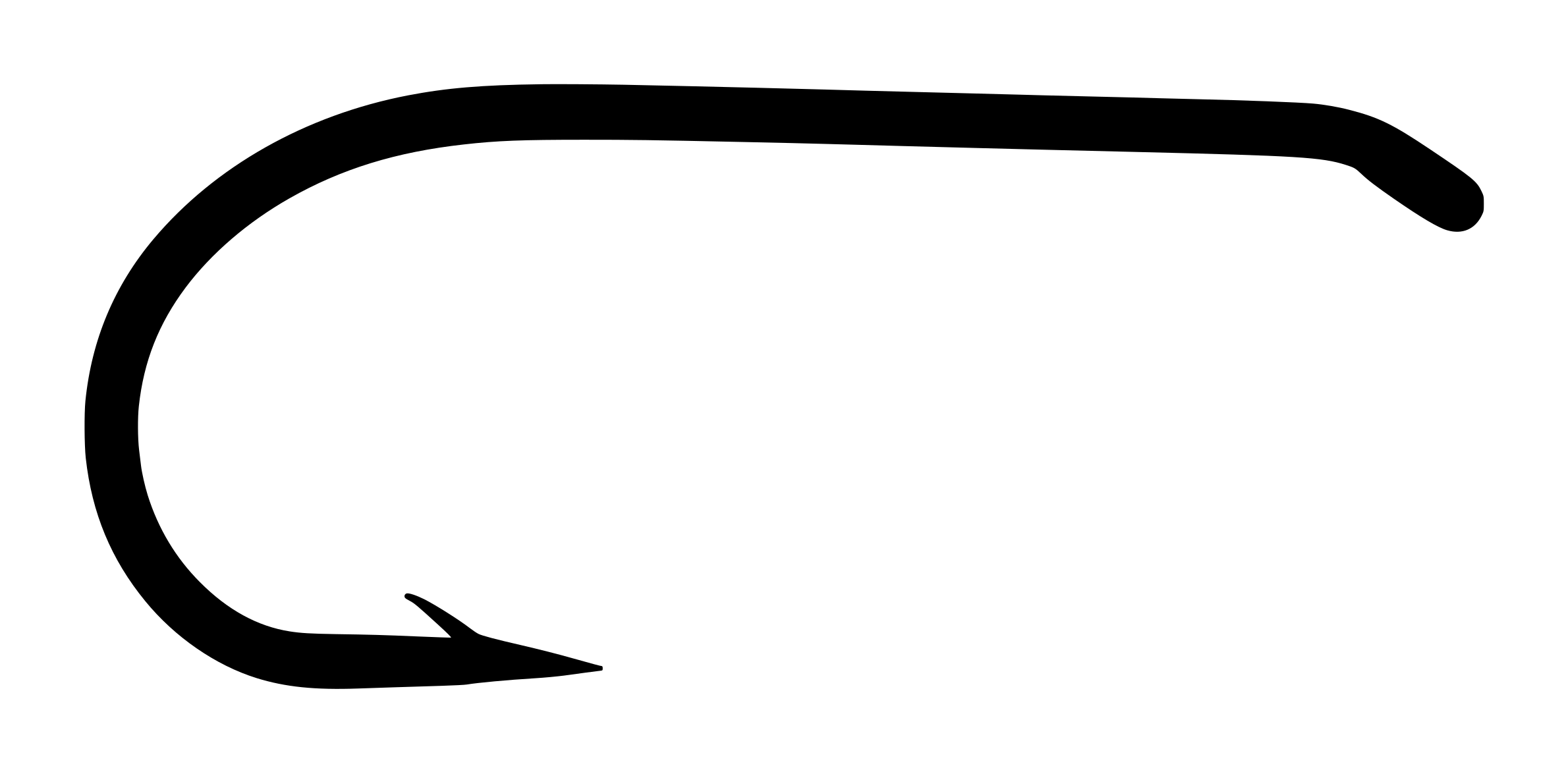
Side profile of a Partridge CS7 HW BL size No. 10 hook, showing the characteristic looped up-eye, wide-gape sproat bend, and warm-black blued finish. Photographed on a 1/10-inch measurement grid for scale verification.
Photographic record
3 cataloged imagesSelect any record to load it above.
3 images shown
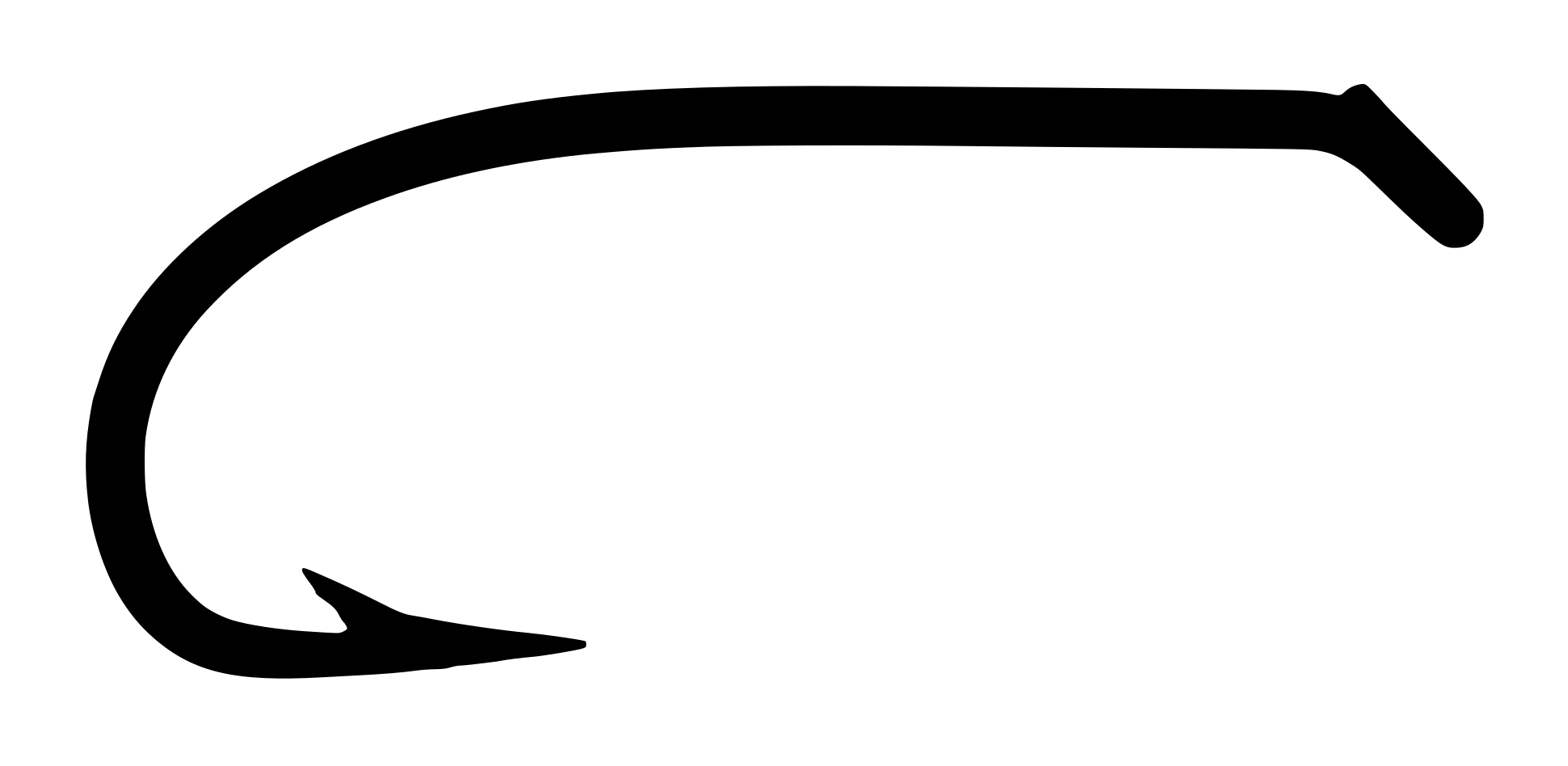
Partridge CS7 Wide Gape Size 10 Side ProfileSide profile of a Partridge CS7 HW BL size No. 10 hook, showing the characteristic looped up-eye, wide-gape sproat bend, and warm-black blued finish. Photographed on a 1/10-inch measurement grid for scale verification.Open originalPartridge CS7 Pair Size 10 Bend ComparisonComparison of two Partridge CS7 HW BL size No. 10 hooks, demonstrating consistent bend geometry and symmetrical forging across the production lot. Hooks are unoffset and display identical point angles and curve depth.Open originalPartridge CS7 Original Packaging Redditch-Era LabelOriginal Redditch-era packaging for Partridge CS7 HW BL hooks size No. 10. Bright cyan Connoisseurs Series label card shows hand-stamped size and model code, letterpress printing, English address with (0571) telephone exchange, and 'Made in England' attribution — all indicative of Bramley-period production, c. 1960–1975.Open original
Technical profile
Eye
Tapered Eye, Turned Down
Wire
Extra-Heavy (2X+), Round
Shank
Standard — Plain
Bend
Round / Kendal, Wide gapWide sproat bend with generous radius underside, characteristic of the Captain Hamilton family. Point exhibits a slightly aggressive forward angle (dropped-point tendency) visible in side profile — this was intentional to the original Hamilton spec. Bend is symmetrical and unoffset, with no kirb. Forged construction provides rigidity suitable for heavy nymphs and weighted wet flies. Extra-heavy wire gauge (0.025–0.030") provides stiffness compared to standard-wire versions. P
Point
Standard / SpearStandard Redditch barb — medium length, close-cut, angled sharply perpendicular to the point taper. Barb sits approximately 0.04–0.05" from the point tip. No microbarbs or secondary barb visible. Barb is integral to the forged hook body, not added separately. P
Finish
Black Japanned — Confirmed (stated on packaging)Black finish, characteristic of Redditch-era Partridge production. Specimen exhibits a warm-gunmetal tone (not pure black or modern Black Nickel), consistent with traditional Redditch japanned/bronzed-black lacquer or oil-based bluing rather than electroplate. Light age-toning visible under magnification (faint russet haze), typical of Bramley-era hooks stored in periods of moderate humidity. Finish is uniform with no bare spots, pitting, or corrosion. The color tone is distinctly warmer and less reflective than modern electroplated Black Nickel (15BN Klinkhamer reference). P
The CS7’s extra-heavy wire gauge (0.025–0.030″ dia.) is substantially thicker than standard Partridge trout hooks (which typically measure 0.018–0.022″) and is matched only by the largest salmon irons and saltwater patterns. The engineering rationale is straightforward: heavy nymphs and weighted wet flies require additional wire stiffness to resist bending under the force of lead or bead-chain, to support dense dubbing loads, and to provide the mechanical rigidity needed for aggressive strip-and-pause retrieves in fast current. The forged construction process strengthens the wire at the bend and barb intersection — critical for preventing point fracture under stress. The wide gape (0.25″ for size No. 10) is wider than standard Partridge trout hooks in the same size (which typically measure 0.20–0.22″), providing a larger ‘bite’ for securing thicker tying materials and improving hook penetration on fish with bony mouth structures. The superior point geometry (near-straight inner taper, slightly forward-angled outer surface) is optimized for clean, quick penetration — important when the fly is fished with aggressive line-speed (stripping techniques) where delayed penetration results in missed fish. The looped up-eye provides a secure tie-point that resists rotation under load from weighted materials.
We don't have measured sizes for this hook yet. Own one? Submit calipered measurements and we'll review and add them. Thank you!
Historical context
partridge
Partridge of Redditch is one of the most historically significant specialty fly-hook manufacturers in Britain, with roots extending back to 1836 when Edwin Partridge was apprenticed in needle pointing and blueing in Redditch — the legendary center of English hook manufacturing. However, the Partridge hook brand itself was not established until 1903, when Albert Edwin Partridge (working at the time for Wm. Bartleet & Sons at Crescent Works) produced his first branded hooks to a specification commissioned by Captain G.E.M. Hamilton for trout dry and wet fly tying. The ‘Captain Hamilton’ bend became the foundation of Partridge’s trout catalog and remains in production today.
In 1927, the Partridge family operation relocated to permanent premises at Mount Pleasant, Redditch (Crescent Works). In 1930, Albert Partridge took over the Crescent Works facility, and in 1933, A.E. Partridge & Sons Ltd. was formally incorporated as a limited company. Through the 1930s and post-war era, Partridge functioned as both a retail brand and a trade manufacturer — hooks were made on commission for branded houses including Hardy Brothers, Farlows, and Army & Navy, as well as sold under the Partridge label.
The company remained family-owned and operated under Albert until 1970, when his son Ted Partridge sold the enterprise to Alan Bramley, a non-family buyer, as Ted’s children did not wish to continue the business. Under Bramley’s stewardship (1970–1996), Partridge entered a golden era of innovation: the Waddington shank was refined into its modern double-wire form, designer collaborations were established (Jack Hilton Carp Hook Range, 1980; Kevin Maddocks Coarse line), and proprietary finishes like Grey Shadow (PTFE-based Niflor) were developed. Bramley also expanded Partridge’s international distribution and established the brand as a premium specialist maker, moving away from pure trade manufacturing toward branded consumer products.
In 1996, O. Mustad & Son of Norway acquired Partridge from Bramley. Under Mustad ownership (1996–2009), production gradually shifted from Redditch to Singapore (c. 2005–2007), then to Mustad’s new Wuxi, China facility (c. 2008 onward). Many classic SKUs were placed on hold during the transition, frustrating collectors and specialty tyers. In 2009, Fishing Matters Ltd (a UK company led by Mark Hamnett) acquired the Partridge brand from Mustad, returning it to independent British ownership. Fishing Matters restored marketing and distribution focus and began reissuing classic patterns under a ‘Heritage’ sub-brand. Though current production is still based in Wuxi, China (under contract manufacturing), the brand is now British-owned and operated from Wincanton, Somerset.
Series History
The CS7 belongs to the ‘CS’ (Code S / Classic Series) family of Partridge specialist hooks — a broad and evolving category that encompasses salmon, streamer, saltwater, predator, and competition patterns. Unlike the simple single-letter codes (L, K, G, H, etc.) that govern basic trout forms, the CS prefix was introduced in the mid-20th century to encompass specialized designs outside the core ranges. The CS7 specifically is a wide-gape variant of the Captain Hamilton bend family, positioned as a heavyweight option for demanding nymph and wet-fly work.
The Captain Hamilton bend itself dates to 1903 (see Designer Collaborator section), but the CS7 model code and extra-heavy wire option appear to have been introduced during the Bramley era (1970 onward) as part of his expansion of the catalog. The Bramley period saw significant product-line segmentation: new designer collaborations (Hilton, Maddocks, Edwards, van Klinken) created distinct sub-ranges, and existing patterns were offered in new wire weights and gape variants. The CS7 HW (heavyweight) variant aligns with this strategic expansion.
The ‘Connoisseurs Series’ branding on this specimen suggests the model was marketed as a premium offering within the broader Captain Hamilton family, though the Connoisseurs designation itself appears to have been short-lived (c. 1968–1975). After the Mustad takeover in 1996, the CS7 remained in the catalog but was subject to the production transitions (Redditch → Singapore → Wuxi). During the Mustad era, the CS7 was listed as ‘on hold’ around 2008 during the Singapore-to-Wuxi changeover, but it was subsequently reintroduced. Current production CS7 hooks are manufactured in China and carry modern Black Nickel (BN) finish rather than the traditional Black (BL). The vintage Redditch-made CS7 HW BL variant documented here represents the Bramley-era peak of the model and is generally considered superior by collectors to later Mustad-era variants.
Named Collaborator
Captain G.E.M. Hamilton was a notable British fly fisherman and tackle designer active in the early 1900s, associated with trout and salmon dry-fly traditions. In 1903, he commissioned Partridge of Redditch to produce a series of trout hooks to his own bend specification — the result became known as the ‘Captain Hamilton’ bend. This bend became the defining geometry of Partridge’s trout line and remains in production to the present day (L-series wet and dry, modern SUD/SLD Patriot series). Hamilton’s original intent was to create a sproat-derived bend with slightly more aggressive gape and point angle than the standard Redditch trout patterns of the era. The Captain Hamilton bend is among the most influential British trout-hook geometries, and its adoption by Partridge as their house trout standard secured Hamilton’s name permanently in the Partridge catalog. No published fly-tying works are directly attributed to Hamilton in modern sources, though his designs were featured in late-19th and early-20th-century angling periodicals (source: globalflyfisher.com Partridge visit interview).
Era and Packaging Dating
Packaging evidence: (1) Circular bright-blue label card with 'Connoisseurs Series' branding and 'Captain Hamilton International' nomenclature — this layout and terminology indicate Redditch-era Bramley period or early Mustad transition. (2) Address printed as 'Redditch, Worcestershire, England (0571) 4300' with Redditch telephone exchange (0571) — confirms English manufacture and pre-postcode era (British postcodes introduced ~1974; no postcode visible on this label). (3) 'HIGH CARBON SHEFFIELD STEEL' printed on card backing — steelwork attribution common on Redditch-era cards (1960s-1970s). (4) Hand-stamped size indicator in box on label suggests mid-production-run card stock from inventory system era, consistent with 1960-1975. (5) Absence of modern barcode and modern color finish labeling (no Fishing Matters branding, no 'Heritage' sub-brand) rules out post-2009 production. (6) No 'Made in Singapore' or 'Made in China' marking — package predates Mustad offshore sourcing (c. 2005+). Dating window: c. 1960-1975 (Bramley peak era or early Mustad before offshore transitions).
The Connoisseurs Premium Positioning
The 'Connoisseurs Series' branding on this Partridge card reflects Alan Bramley's market positioning during the 1970s. Bramley, who purchased Partridge from Albert Partridge's son Ted in 1970, was intent on elevating the brand's status beyond a trade manufacturer (Partridge had historically made hooks for retailers like Hardy Brothers and Farlows under their own labels). The Connoisseurs line was Bramley's attempt to position Partridge as a premium, specialist maker for discriminating fly tyers. Ironically, the Connoisseurs branding itself became scarce — it was superseded after just a few years by simpler labeling schemes during the Mustad transition. Today, Connoisseurs cards are genuinely harder to find than standard Partridge label variants, making them quietly collectible despite being less well-known than the later named-designer hooks (Klinkhamer, Oliver Edwards) that captured collector attention.
Design lineage and influence
Best matchRelated by Attribute
Computed automatically from catalog data — updated as new hooks are added.
Matches: Bend, Shank, Gap, Eye, Point +4 moreDiffers: Wire: Extra-Heavy (2X+) vs Heavy (1X Heavy); Eye Orient.: Turned Down vs Turned Up; Finish: Black Japanned vs Bronzed
Matches: Shank, Eye, Eye Orient., Point, Forging +3 moreDiffers: Bend: Round / Kendal vs Sproat; Wire: Extra-Heavy (2X+) vs Heavy (1X Heavy); Gap: Wide vs Standard +1 more
The CS7 HW BL is a specialist wet-fly and nymph hook designed for demanding trout and light sea-trout work. The extra-heavy wire and wide gape make it suitable for large, heavily dubbed nymphs (size 12 and larger patterns) and robust wet flies that require a sturdy hook to handle weighted tying materials and the rigorous presentation methods used in pocket-water and fast-current fishing. The wide gape provides secure hook-ups for larger gape ratios, important when using heavy tying material that can mask the barb. In the Bramley era (1960s–1970s), this hook was positioned as a premium option for demanding fly dressers who needed the combination of durability and secure gape in a standard shank length.
Classic Fly Patterns
Large wet flies (Mallard & Claret, Grouse & Claret variants), heavy nymphs (large Stonefly nymphs, Czech-style nymphs), small streamers (Partridge & Orange streamer variants), modern bobbin flies and soft hackles.
Modern Equivalents
Hook
Match Quality
Notes
Partridge CS7 (modern China production)
Excellent
Identical model code and bend geometry, but made in Wuxi, China (post-2008) rather than Redditch. Modern Black Nickel (BN) finish replaces traditional Black (BL). Functionally equivalent; collectability of vintage English-made version is higher.
Partridge K14ST Oliver Edwards Masterclass Nymph
Very Good
Alternative for heavy nymphs and wet flies, continuous-curve forged geometry rather than sproat, slightly different point angle. Similar wire weight and gape. Popular among competition nymph tyers as a modern alternative.
Tiemco TMC 200R
Good
Modern heavy-wire wet-fly hook, looped up-eye, sprout-derivative bend. Functional equivalent for pattern tying, though not Redditch manufacture. Lighter finish (bright steel) may appeal to modern tyers.
Collector notes
Rated 4.5/10 — a genuinely uncommon vintage Partridge trout hook from the Bramley era with authentic Redditch packaging and desirable size. Collector demand is moderate among specialist Partridge and British hook collectors. The extra-heavy wire and wide gape make it a working hook, not a specialist display piece, which tempers pure collecting appeal. Complete original card with legible label and full hook count (25) is the primary value driver.
Reference value
$12 – $27 USD estimate
Packaging condition
Very Good — light wear, fully legibleRecorded specimen
Packaging format
PRD-LABEL-CARD-BRAMLEY-001Catalog code
The CS7 HW BL represents a transitional moment in Partridge’s catalog — the company was moving from craft-era (Albert Partridge) toward industrial-era (Alan Bramley, 1970 onward) production. The ‘Connoisseurs Series’ branding is less common than standard Partridge line packaging, and the heavy-wire, wide-gape geometry was a specialist offering for demanding trout patterns (large nymphs, wet flies, and streamers).
What makes this hook collectible: (1) Authentic Redditch address and ‘Made in England’ origin — critical for distinguishing pre-1996 production from later Mustad-era and Chinese-sourced variants. (2) Bramley-period packaging design (bright-blue Connoisseurs label) is scarcer than plain black-on-white cards. (3) Extra-heavy wire in size No. 10 is unusual — most casual collectors encounter standard or fine-wire versions. (4) Complete original card with 25 hooks intact and legible label adds significant premium over opened or incomplete variants.
Limiting factors: (1) The CS7 model is not a named-designer hook like the K14ST Oliver Edwards or 15BN Klinkhamer — it lacks the signature-pattern premium. (2) Extra-heavy wire limits tyer appeal (modern trout tying favors lighter, more delicate wire). (3) Wide-gape geometry is functional but not rare — other manufacturers produced similar hooks. (4) Size No. 10 is a common tying size, so demand is not driven by rarity of application.
Most desirable variants: Complete original Redditch-era cards (like this specimen) in sizes 8–12 command the highest prices. Black finish (BL) is more common than the now-discontinued Bronze (BR) finish on heavy-wire variants. Cards with partial hook loss drop significantly in value (typically 30–50% discount per missing hook, depending on rarity of the complete pattern).
Condition factors: Packaging legibility and color retention are critical — Bramley-era blue labels can fade or show age-toning, which collectors view as either period patina (premium) or deterioration (discount). Hooks should show no corrosion or pitting (the blued finish is susceptible to bloom under humidity). Original tissue or paper wrapper, if present, adds 10–20% premium.
Packaging
Circular label card format, bright cyan-blue label (3.5" dia.) adhesively mounted on white card backing (approx. 4.25" × 5.25" overall). Label printed in black letterpress with bold sans-serif font for manufacturer name and model code. Text layout: 'Connoisseurs Series' arc at top; large 'PARTRIDGE of REDDITCH' and 'CAPTAIN HAMILTON INTERNATIONAL HEAVYWEIGHT FLY HOOKS (BLACK FINISH)' in center; size/quantity/model specs in hand-drawn boxed grid format ('Size 10 | Quantity 25 | CS7 HW BL'); text around bottom edge: 'MADE BY PARTRIDGE OF REDDITCH, WORCESTERSHIRE, ENGLAND' with telephone exchange '(0571) 4300'; bottom of card backing printed 'HIGH CARBON SHEFFIELD STEEL.' No barcode. Hand-stamped size indicator visible in one spec box. Card shows light age-toning and minor creasing consistent with 60+ years storage. All 25 hooks present on card, blued finish intact. Original tissue wrapping absent (common for this era). Card is opened but presentable.
Market Value Notes
Low ($12): Good condition — opened card, 22-24 hooks present, packaging shows wear but legible, blued finish intact with light age-toning on hooks.<br />
High ($27): Excellent condition — complete 25-hook card, minimal wear, original label bright and clear, hooks bright with no corrosion.<br />
Premium factors: Original Redditch-made provenance, complete hook count, legible label, intact card stock, authentic Bramley-era Connoisseurs packaging.<br />
Platforms: eBay (4 recent sold listings, April 2026 — bulk lots of 100 and 500 hooks in various sizes spanning $12.11–$27.00 USD depending on quantity and condition).<br />
Confidence: V verified — data sourced from 4 eBay completed sales of identical CS7 HW BL model in same size range (size 10-14) within recent period.
Where to Find
eBay UK and US (regular listings of bulk Partridge inventory). Specialist UK tackle dealers (Partridge Heritage resellers). Spey Pages forum buy/sell section (occasional single cards or small lots offered by UK collectors). Vintage tackle auctions (specialist UK auctions, less common in US).
eBay market reference. Researcher-curated. Prices in USD. Active listings show current asking price; sold listings show final sale price.
Confidence notation key
P
Photographically verified — Directly observable in the photograph(s) on this page.
V
Verified by documentation — Confirmed by manufacturer catalog, spec sheet, or published reference.
I
Inferred — A logical deduction from observable or documented evidence, not directly stated.
E
Estimated — An approximation based on visual comparison, proportional analysis, or limited data.
S
Speculative — A reasoned hypothesis that cannot be confirmed from available evidence.
Claims with no notation are confirmed by multiple independent sources. All photographs on garrenwood.com are taken on a measurement grid where each square equals 1/10 inch (0.1″ / 2.54 mm).