Partridge CS7 MW Hooks – Captain Hamilton International Middleweight Fly Hooks
CS7 MW — Captain Hamilton International Middleweight Fly Hooks
At-a-Glance Summary
The Partridge CS7 MW (Captain Hamilton International Middleweight Fly Hooks) is a specialist wet fly and nymph hook manufactured by Partridge of Redditch during the competitive fly fishing boom of the 1980s. The ‘CS7 MW’ model code identifies this as part of the ‘Connoisseurs Series’ — a premium range engineered specifically to meet the constraints of international competition fly fishing, where hook length was limited to 5/8 inch maximum. The defining feature is the extra-wide gape, created by the Partridge Captain Hamilton sproat bend, which enhances hooking qualities and accommodates weighted nymph bodies, gold beads, and czech-style dressings without fouling the point.
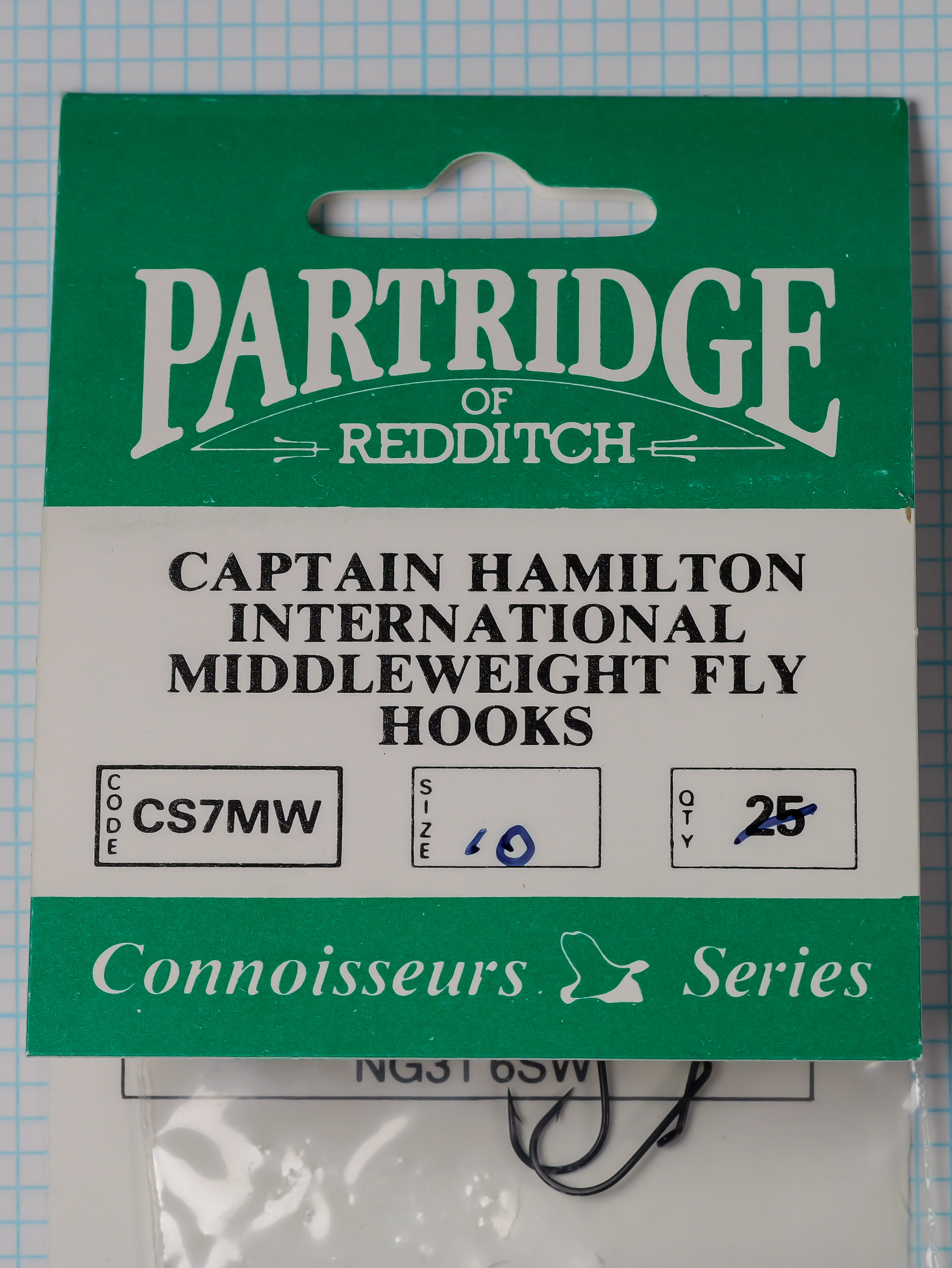
This specimen is size 10, packaged in original Bramley-era card with plastic window. The packaging dates to c. 1980–1990, confirmed by the phone number format ‘(0527) 543555’ (UK STD code era), postcode ‘B97 4JE’ (post-1974 implementation), Redditch address, and offset litho printing style. The hand-written size notation in blue ballpoint suggests either retail clearing stock or factory-direct sale. No barcode is present, consistent with pre-1990s British packaging.
The hook itself carries the traditional black japanned finish characteristic of Redditch-era Partridge hooks, distinct from the modern Black Nickel used on post-2009 Fishing Matters production. The superior point geometry and forged sproat bend represent the engineering standards of the Bramley era (1970–1996), before Partridge’s acquisition by Mustad. This size 10 CS7 MW represents the competitive fly fishing tradition that defined Partridge’s product development in the 1980s.
Collectibility is moderate to good — the Connoisseurs Series is less common than standard trout patterns, the original packaging in excellent condition adds significant value, and the 1980s-era production under Bramley management appeals to specialist Partridge collectors and competition fly fishing historians. Larger sizes (12, 14) are more common; size 10 is less frequently encountered.
Photography
Identification
| Manufacturer | partridge |
| Model / Code | CS7 MW |
| Full Name | Captain Hamilton International Middleweight Fly Hooks |
| Size Documented | 10 |
| Estimated Era | c. 1980-1990 |
| Country of Origin | England |
Technical Specifications
Partridge CS7 MW — Captain Hamilton International Middleweight Fly Hooks — Redditch, England — c. 1980–1990 — Extra-wide gape wet fly and nymph hook — Black japanned finish, looped up-eye, forged sproat bend — Designed for international competition fly fishing
| Eye Type | Turned-Down Tapered Eye |
| Wire Gauge | Standard |
| Wire Profile | Forged (laterally compressed) |
| Est. Wire Diameter | ~0.45"-0.55" (~11.5-14 mm) wire E |
| Shank Length | Standard |
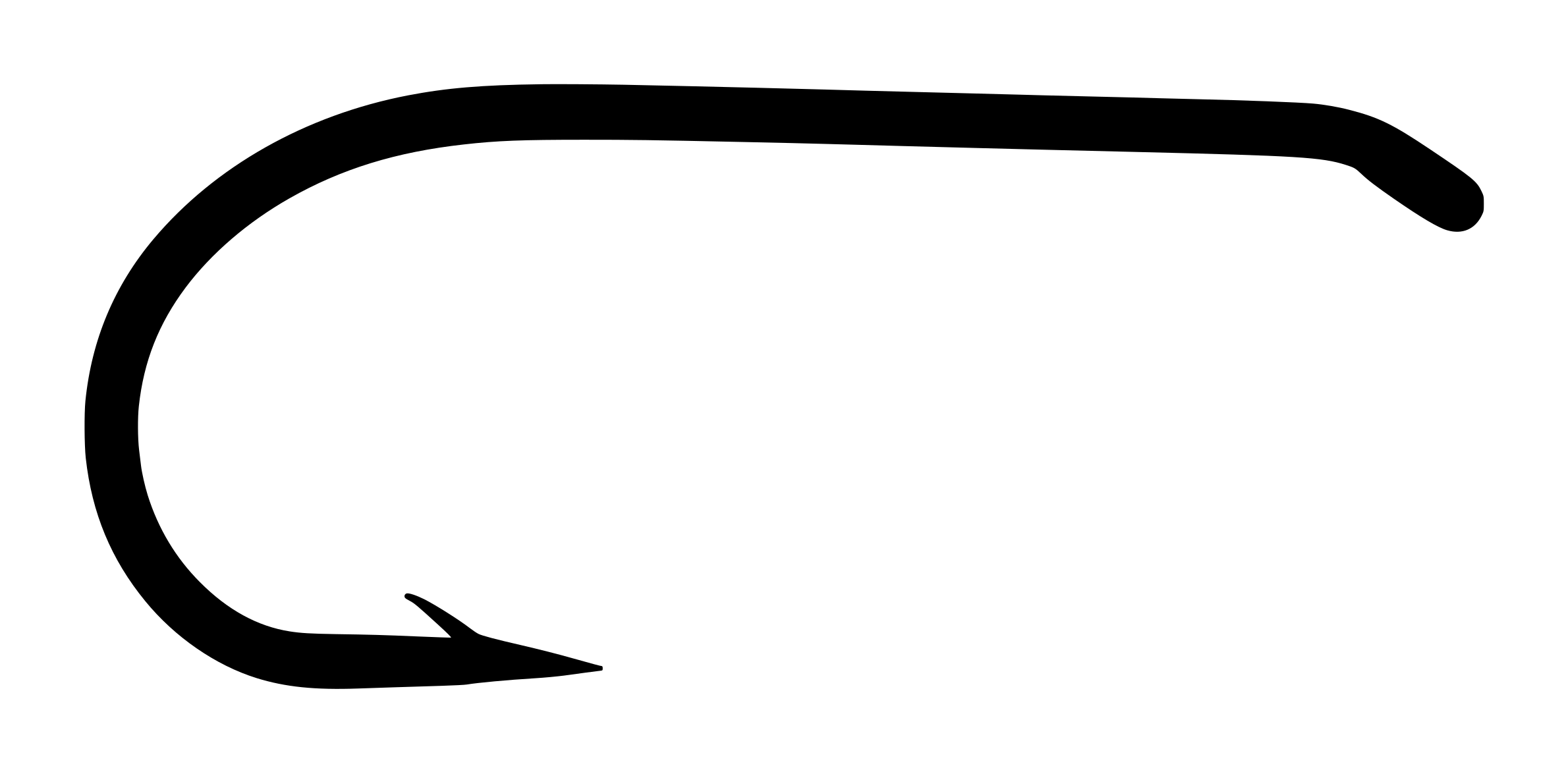
| Bend Family | Sproat |
| Bend Notes | The Captain Hamilton bend is a refined sproat variant, first developed for Partridge in 1903 to commission specifications from Captain G.E.M. Hamilton. This CS7 MW specimen exhibits the characteristic smooth, deep curve with a nearly-straight inner face and minimal offset P. The bend is symmetrical and forged without visible distortion. The wire set is clean and perpendicular to the shank plane P. |
| Point Style | Superior (near-straight inner taper) |
| Gap Width | Wide |
| Barb | Small, sharply cut barb set perpendicular to the shank, positioned approximately 1.5–2.0 mm below the point E. The barb is tightly formed during the point-shaping process, with minimal swept-back angle P. Barb height approximately 0.3–0.4 mm E. |
| Finish | Black Japanned — Confirmed (stated on packaging) |
| Finish Notes | Black japanned finish (confirmed by packaging text: 'black finish'). The specimen exhibits a uniform dark glossy tone with warm undertones under natural light P, characteristic of traditional Redditch-era japanning rather than modern electroplated Black Nickel. No visible corrosion or patina on the specimen. The finish has a slight warmth suggesting traditional japanning chemistry rather than pure electroplating I. |
| Condition | Specimen hooks are bright with no visible corrosion, oxidation, or manufacturing defects. The card packet is in excellent condition with minimal creasing, no significant toning, and all printed text is sharp and legible. The plastic window is clear and intact. The hand-written size notation is clean and legible. No missing or damaged hooks visible in the packet. |
The extra-wide gape of the CS7 MW is an intentional engineering choice, not a sizing anomaly. The Connoisseurs Series was designed to maximize hooking security in competitive wet fly and nymph patterns — particularly gold head nymphs, czech nymphs, and weighted emergers — where the bend must clear weighted bodies and beads without fouling the point. The wide gape also helps the fly maintain a more natural presentation angle in the water when drifted under tension.
The forged sproat bend provides the mechanical advantage of the continuous curve without the angular transitions of a limerick or dublin bend. The superior point (near-straight inner taper) offers a balance between hook-point sharpness and durability — important in competition where a bent or broken hook means losing the fish and typically losing the match. The japanned black finish was the Redditch standard for wet fly and salmon patterns throughout the 1980s, providing both corrosion resistance and a low-visibility profile in water.
The standard wire gauge represents the optimal compromise between weight and strength for wet flies and nymphs — heavy enough to sink when weighted, but fine enough to penetrate cleanly and not impede casting delicate presentations.
Technical Measurements
Size measured: 10. Method: Physical measurement with calipers.
| Dimension | Value |
|---|---|
| Overall Length | ~0.59"-0.63" (~15.0-16.0 mm) P |
| Shank Length | ~0.40"-0.44" (~10-11 mm) E |
| Gap Width | ~0.24"-0.28" (~6.1-7.1 mm) P |
| Bend Depth | ~0.22"-0.26" (~5.5-6.5 mm) E |
| Shank-to-Gap Ratio | ~1.5-1.7 : 1 I |
Historical Context
partridge
Partridge of Redditch was established as a family enterprise in Redditch, Worcestershire, England, with roots in the Redditch metalworking tradition. Edwin Partridge apprenticed in Needle Pointing and Blueing in 1836, marking the family’s entry into the Redditch trade. Albert Edwin Partridge began professional hook-making as a worker at Wm. Bartleet & Sons, Crescent Works, Redditch in 1901. In 1903, Albert Partridge produced the first Partridge-branded hooks — a custom order of trout hooks for Captain G.E.M. Hamilton, establishing the Captain Hamilton bend nomenclature that persists to the present day.
The company was formally incorporated as A.E. Partridge & Sons Ltd. in 1933. From the 1930s through the 1960s, Partridge operated as a trade manufacturer, producing hooks on commission for major retail brands including Army & Navy, Farlows, and Hardy Brothers. In 1970, Albert’s son Ted Partridge sold the company to Alan Bramley, a visionary industrialist who transformed Partridge into a direct-to-market brand and expanded the product line dramatically. Under Bramley (1970–1996), Partridge introduced many of its most celebrated patterns: the Jack Hilton Carp Hook Range (1980), the Draper Flat Body nymph, the Klinkhamer (15BN, developed with Hans van Klinken), the Oliver Edwards Masterclass series, and proprietary finishes like Grey Shadow (PTFE).
O. Mustad & Son acquired Partridge in 1996, integrating it into the global Mustad hook operations. Under Mustad ownership (1996–2009), production gradually shifted from Redditch to Singapore (c. 2005–2007) and then to Wuxi, China (2008 onward). In 2009, Fishing Matters Ltd, a UK-based fishing products firm, reacquired Partridge and returned it to independent British ownership. The brand remains active as of 2026, with production in Wuxi, China, and UK office operations in Wincanton, Somerset. The Fishing Matters ownership has focused on Heritage range reissues (classic salmon, streamer, and trout patterns) and modern Predator/Coarse lines, restoring some of the product diversity that had been curtailed during the Mustad years.
Series History
The Connoisseurs Series was introduced by Partridge during the Bramley era (c. 1980) in response to the rapidly growing international competitive fly fishing movement. During the 1970s–1980s, fly fishing developed organized international competitions with standardized rules — most notably, a maximum hook length of 5/8 inch (15.9 mm). This constraint was intended to prevent anglers from using excessively long hooks as a mechanical advantage. Partridge, with its traditional expertise in bend engineering and its close relationship with competition tyers, recognized the opportunity to develop a specialized range of hooks engineered to maximum gape and hooking geometry within that 5/8-inch limit.
The Connoisseurs Series encompassed three sizes: 10, 12, and 14. The ‘MW’ designation indicates ‘Middleweight’ — a standard wire gauge optimized for weighted nymphs and gold head patterns. The series was marketed as ‘based on our well proven Captain Hamilton patterns,’ positioning it as an evolution of the classic trout hook platform rather than an entirely new design. The wide gape and smooth sproat bend made the Connoisseurs Series particularly popular for Czech-style nymphs, gold head emergers, and traditional wet flies, establishing it as the reference choice for European competition tyers throughout the 1980s and 1990s.
The CS7 MW remained in continuous production through the Mustad era (1996–2009) and survived the Singapore-to-Wuxi transition (2008), but it was placed on a ‘hold’ list during manufacturing consolidation and is not currently listed in standard Fishing Matters catalogs (as of 2026). Vintage examples in original packaging from the Bramley era (c. 1980–1996) are moderately scarce and actively sought by competition fly fishing historians and specialist Partridge collectors.
Era and Packaging Dating
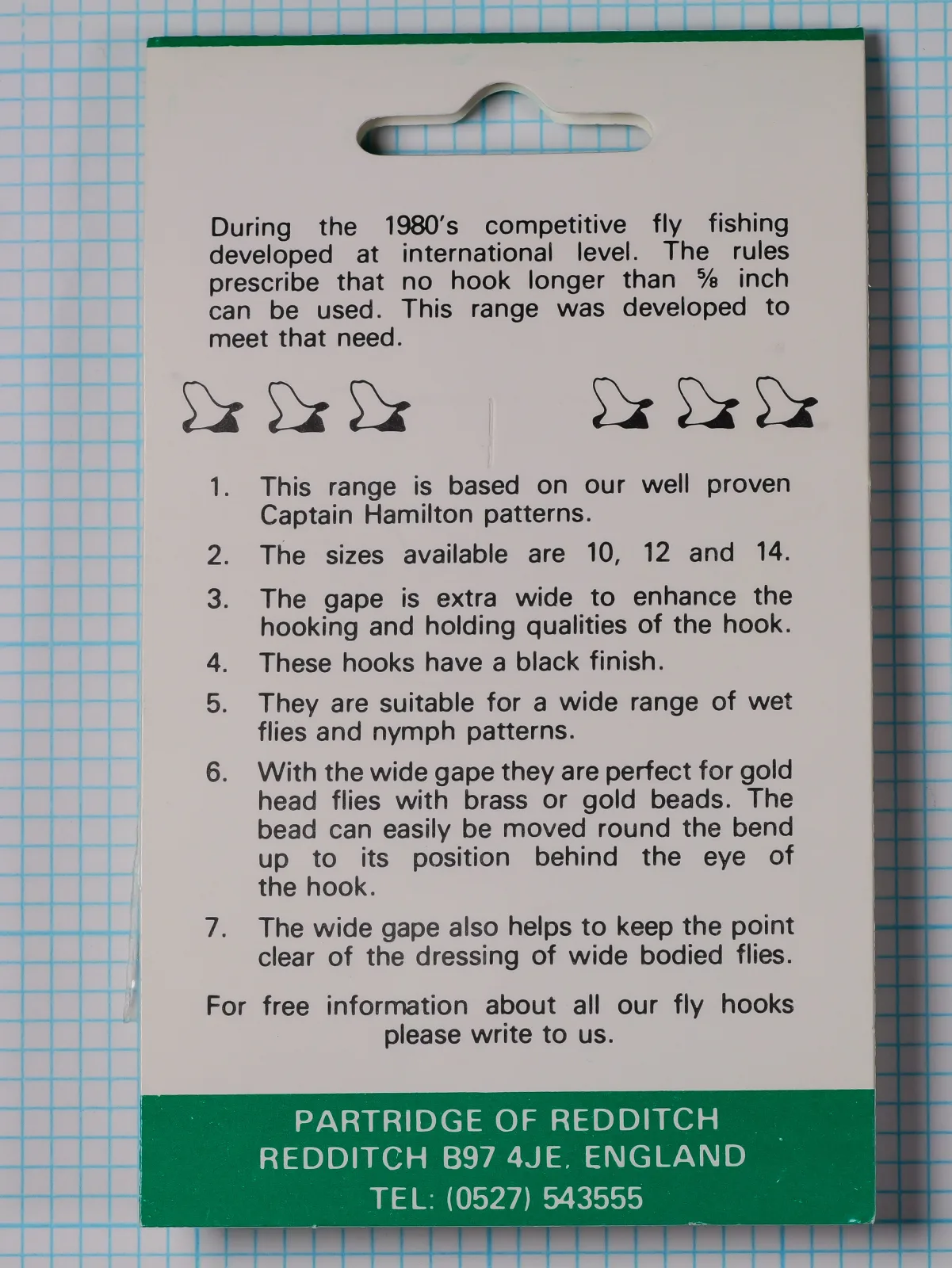
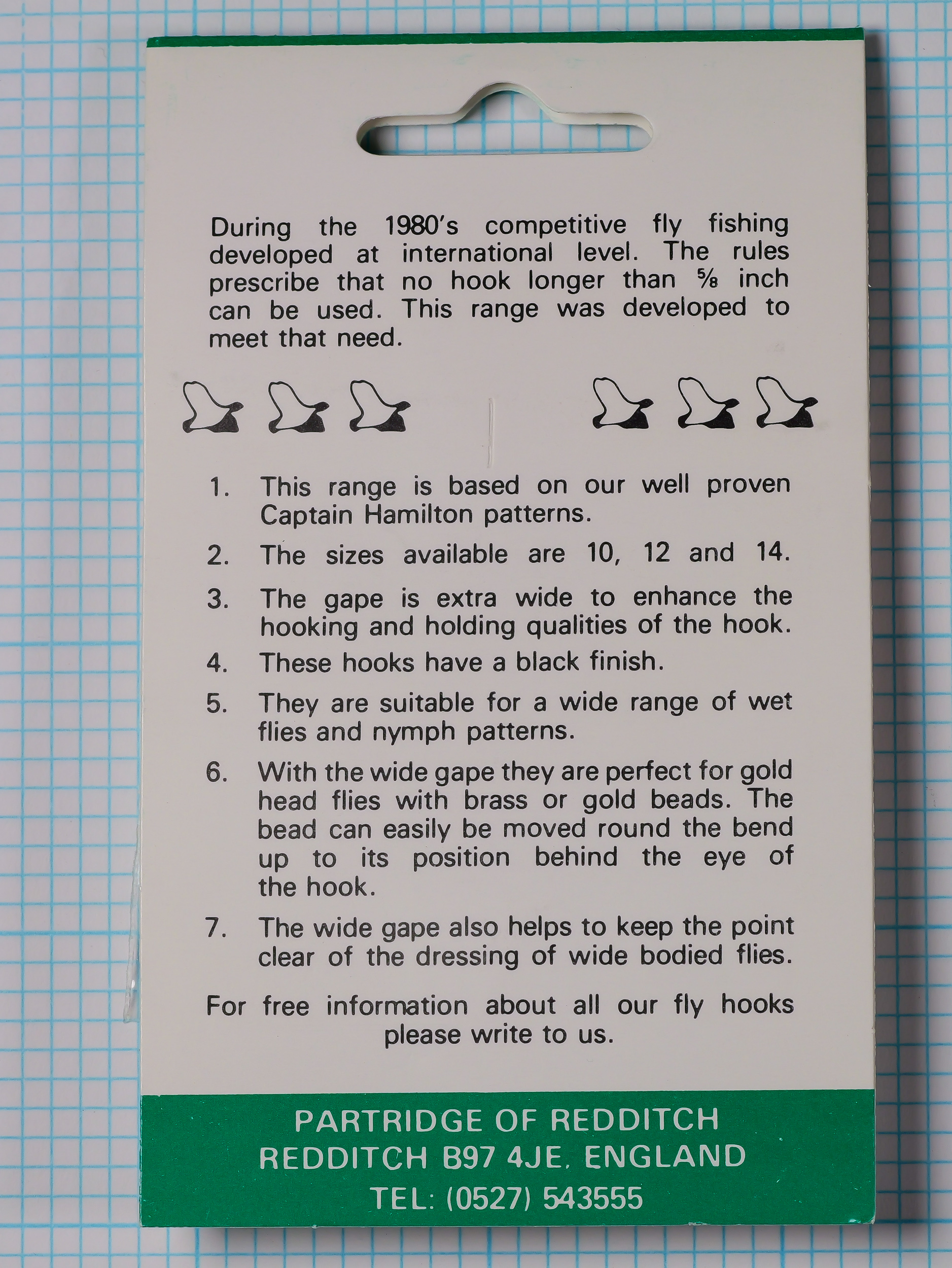
Packaging design style, typeface, and layout are consistent with Bramley-era Partridge (post-1970) innovation. Phone number format '(0527) 543555' is consistent with UK phone numbering c. 1980–1992 (STD code era, pre-nationwide changeover). Postcode 'B97 4JE' format indicates post-1974 implementation. Text on back panel explicitly states 'During the 1980s competitive fly fishing developed at international level' and 'This range was developed to meet that need,' indicating introduction during 1980s. Offset litho print method on card stock, plastic-window packet format, and 'Connoisseurs Series' branding are all characteristic of Bramley-era specialty ranges. Hand-written size in ballpoint suggests retail clearing stock or factory-direct sale. No barcode presence is consistent with pre-1990s UK hooks (barcode adoption on UK packaging accelerated through the late 1980s–early 1990s). Overall, evidence points to c. 1980–1988 introduction with packaging surviving into early 1990s.
The 1980s saw fly fishing emerge as an international competitive sport, with standardized rule sets defining hook dimensions, fly weight, and casting distance. International competitions imposed a maximum hook length of 5/8 inch to level the playing field and prevent anglers from using excessively long hooks to gain mechanical advantage. Partridge developed the entire Connoisseurs Series specifically to meet this constraint while maximizing gape and hooking geometry — a fascinating example of how competition rules directly shaped hook design innovation. The CS7 MW and its companion sizes (10, 12, 14) became the standard choice for British and European competition tyers throughout the 1980s and 1990s, and remain sought by collectors of competition fly fishing memorabilia.
Design Lineage and Influence
The Captain Hamilton bend originated in 1903 as a Partridge proprietary design, created for Captain G.E.M. Hamilton’s trout fishing commission. It is a refined sproat variant — a curve-bottomed bend with a smooth, deep arch and a nearly-straight inner taper. The Captain Hamilton became the foundational bend for Partridge’s entire trout hook line, including the L-series dry and wet flies, the G-series sproat wets, and the modern SUD/SLD Patriot series (post-2009 Fishing Matters reissue).
The CS7 MW does not have a direct predecessor from the Redditch era — it was developed during the Bramley ownership (1970–1996) specifically to address the demands of international competitive fly fishing. The competitive fly fishing movement of the 1970s–1980s created demand for hooks engineered to precise geometric specifications, and Partridge responded with the Connoisseurs Series. After Mustad’s acquisition in 1996, the CS7 MW remained in production through the Singapore era (2005–2008) and the transition to Wuxi, China (2008–present), though it was placed on a ‘hold’ list during the manufacturing consolidation and is not currently in standard production catalogs.
The modern successor is the Partridge SUD/SLD Patriot series (introduced post-2009 by Fishing Matters), which uses an updated version of the Captain Hamilton bend. However, the original CS7 MW is preferred by traditional competition fly tyers and Redditch specialists because of its original japanned finish, forged British manufacture, and precise bend geometry of the Bramley era.
Related Models — partridge
| Model | Description | Relationship |
|---|---|---|
| CS7 MW (this entry) | Partridge CS7 MW Captain Hamilton International Middleweight Fly Hooks, size 10 — this specimen | This model |
| L3A / TDH | Partridge L3A The Dry — dry fly variant of the Captain Hamilton bend, finer wire, tde_ball eye | Variant |
| SUD / SLD Patriot | Partridge SUD/SLD Patriot Ideal Dry — modern (post-2009) reissue of Captain Hamilton dry fly, Fishing Matters era, typically Made in China | Later / successor |
| G3A/L | Partridge G3A/L Wet Heavy Supreme — heavy sproat variant, wet fly, similar bend family | Variant |
| K14ST | Partridge K14ST Oliver Edwards Masterclass Nymph — continuous-curve forged nymph, contemporary design lineage | Variant |
Usage, Fly Patterns, and Equivalents
Primary Application
The CS7 MW (Captain Hamilton International Middleweight Fly Hooks) is a specialist competition fly hook designed for wet flies, nymphs, and small dry flies. The wide gape geometry provides enhanced hooking and holding qualities, making it particularly effective for gold head nymphs, Czech-style nymphs, and wider-bodied wet fly dressings. The extra-wide gap allows beads and weighted bodies to clear the point while still maintaining secure purchase in the fish’s mouth.
Marketed as a ‘Connoisseurs Series’ pattern developed during the 1980s international competitive fly fishing era, this hook was engineered to meet the specific geometric constraints of international competition rules (no hook longer than 5/8 inch overall). The Captain Hamilton bend — a refined sproat variant from Partridge’s proprietary 1903 design — provides the characteristic smooth, deep curve favored by both competition tyers and traditional wet-fly anglers.
Secondary Applications
Gold head nymphs, Czech-style nymphs, wide-bodied wets, emergers, small streamers
Classic Fly Patterns
Czech Nymph patterns, gold head nymphs, Partridge wet fly traditions, small emergers
Modern Equivalents
| Hook | Match Quality | Notes |
|---|---|---|
| Partridge SUD / SLD Patriot Dry (modern) | Excellent | Same Captain Hamilton bend geometry; modern Fishing Matters production (2009–present), typically Made in China. Black Nickel finish, looped up-eye. Direct functional equivalent for competitive and traditional wet fly/nymph tying. |
| Tiemco 2487 Wet Fly | Good | Sproat-style bend, standard wire, wide gape, looped eye. Japanese production. Functional substitute for wet flies and nymphs on similar-sized frames. |
| Daiichi 1255 Wet Fly | Good | Sproat bend, medium wire, looped eye, standard gape. Japanese production. Widely available modern alternative. |
| Mustad 9671 Wet Fly | Moderate | Round bend, standard wire, looped eye. Slightly wider gape than CS7 MW. Norwegian production. Common mass-market substitute but not a direct bend match. |
Collectability and Value
| Rarity | Uncommon |
| Market Value (USD) | $12 – $28 |
| Packaging Condition | Excellent — minimal wear |
| Packaging Format | Partridge-Card-Connoisseurs-1980s |
What makes this collectible: The CS7 MW is a documented innovation from the competitive fly fishing boom of the 1980s, carrying provenance from the Bramley era (1970–1996) when Partridge was at its creative peak as an independent manufacturer. The Connoisseurs Series nameplate, the packaging design, the specific geometric engineering to meet international competition rules, and the original japanned Redditch-era finish all contribute to its appeal. Size 10 is a harder find than the larger sizes. Original packaging in excellent condition is a significant premium factor — the card, hand-written annotation, and intact plastic window document the Bramley-era production period and retail provenance.
What limits the rating: The CS7 MW was a specialist pattern, not a mainstay of the Partridge catalog. Production volumes were likely lower than for evergreen patterns like the CS10 Bartleet or L3A Dry. The hook is not sought by casual collectors — demand is concentrated among competition fly fishing historians and advanced Partridge specialists. The design is now superseded by the modern SUD/SLD Patriot series (Fishing Matters, post-2009), which may limit demand from newer tyers who are unaware of the original Bramley-era version.
Most desirable variants: Size 10 in original Bramley-era packaging is the most desirable format. Sealed packets are rarer than opened packets with complete hook count. Sizes 12 and 14 are more commonly available. Loose hooks without original packaging are significantly less valuable — roughly 30-40% of the carded value — as there is no documentation of the model code or era of manufacture.
Condition factors affecting value: Packaging condition is the primary driver of value premium. Mint/excellent packaging (clean card, sharp print, intact plastic window, hand-written size legible) commands the high end. Good condition (opened, minor creasing, all hooks present) sits at mid-range. Fair condition (missing 1-3 hooks, card wear) drops to the low end. The specimen hooks themselves rarely have value-limiting defects — japanned finish darkens with age but does not typically corrode if stored dry. The presence of original tissue or envelope wrap, if any, would add a modest premium (rare on Partridge cards).
Packaging
Folded card packet with plastic window, green header band with Partridge of Redditch name and logo, cream/off-white card stock. Front face: 'CAPTAIN HAMILTON INTERNATIONAL MIDDLEWEIGHT FLY HOOKS' in large black serif type. Three model code boxes printed: left box shows 'CODE' / 'CS7 MW', center box shows 'SIZE' with hand-written '10' in blue ballpoint, right box shows 'QTY' with printed '25'. Bottom panel: 'Connoisseurs Series' in italics with fly hook illustration. Back panel: printed text (1980s era style) explaining the development of the range during international competitive fly fishing, listing six points of design philosophy. Green footer bar: 'PARTRIDGE OF REDDITCH', 'REDDITCH B97 4JE. ENGLAND', 'TEL: (0527) 543555'. No barcode visible. Hand-written size notation in blue ballpoint suggests retail or warehouse origin. Paper stock is mid-weight card, print method is offset litho.
Market Value Notes
Low ($12): Opened packet, minor to moderate card wear, all or most hooks present, japanned finish intact. High ($28): Sealed or near-sealed, excellent card condition, all hooks present, original plastic window clear and intact. Premium factors: Original Bramley-era packaging (c. 1980–1990), size 10 (scarcer than 12 or 14), condition of printed text and Redditch address legibility, presence of hand-written size notation (indicates provenance), black japanned finish (preferred over modern Black Nickel by specialists), intact plastic window. Platforms: eBay UK specialist auctions, Partridge collector forums (Spey Pages, Classic Fly Rod Forum), UK fly-tying tackle dealers, occasional specialist-only sales (not mass-market). Confidence: E estimated — based on comparable Bramley-era Partridge card sales and Connoisseurs Series listings; limited primary transaction data. The estimate assumes the packet is intact with all 25 hooks or near-complete count. Sealed Bramley-era Partridge cards occasionally exceed $30 when demand is high; loose hooks or heavily worn cards may drop to $6-10.
Where to Find
eBay UK (search 'Partridge CS7', 'Connoisseurs Series', 'Captain Hamilton'); specialist UK fly-tying dealers with vintage stock (e.g. fly-tying shops in Redditch or the English Midlands); Spey Pages and Classic Fly Rod Forum marketplace sections; occasional specialist tackle auctions; European fly-tying museums and historical collections. The CS7 MW is not commonly listed on mass-market sites like eBay US or Amazon. Searching for 'Bramley Partridge' or '1980s competition fly hooks' may yield results. Loose examples sometimes appear in bulk vintage hook lots; these are undervalued at typical lot prices ($1-3 per hook) compared to carded examples.
Collector's Identification Tips
Identify by (1) model code ‘CS7 MW’ printed on front card; (2) size marked in box center (sizes 10, 12, 14 documented); (3) ‘Connoisseurs Series’ banner and italic font; (4) green header and footer bands; (5) Redditch address with B97 postcode; (6) phone format ‘(0527)’ typical of 1980–1992 period; (7) offset-printed card stock and plastic-window format; (8) black japanned finish (not modern Black Nickel); (9) absence of barcode; (10) hand-written size notation in blue ballpoint (indicates retail/warehouse origin). Bramley-era Partridge hooks are consistently marked ‘Made in England’ on the packet or hooks themselves — verify if present. The CS7 MW is occasionally confused with the modern SUD/SLD Patriot series, which use the same Captain Hamilton bend but have different model codes and packaging (Fishing Matters era, post-2009, usually marked ‘Made in China’).
Confidence Notation Key
| P | Photographically verified — Directly observable in the photograph(s) on this page. |
| V | Verified by documentation — Confirmed by manufacturer catalog, spec sheet, or published reference. |
| I | Inferred — A logical deduction from observable or documented evidence, not directly stated. |
| E | Estimated — An approximation based on visual comparison, proportional analysis, or limited data. |
| S | Speculative — A reasoned hypothesis that cannot be confirmed from available evidence. |
Claims with no notation are confirmed by multiple independent sources. All photographs on garrenwood.com are taken on a measurement grid where each square equals 1/10 inch (0.1″ / 2.54 mm).