The Mustad 3984 H is a mid-century English-pattern wet fly and nymph hook manufactured by O. Mustad & Son in Oslo, Norway. This particular example carries the Kendal Round bend name, a classic pattern originating from Kendal, England, which Mustad reverse-engineered and mass-produced to dominate global markets in the 20th century.
The defining feature of the 3984 H is its hollow point—a concave, inward-curved point geometry that achieves rapid penetration with minimal applied force, making it ideal for soft-mouthed trout and delicate aquatic presentations. The forged wire shank provides structural strength without excess weight, while the turned-down tapered eye reduces bulk at the head, allowing artificial flies to float and sit properly on the water.
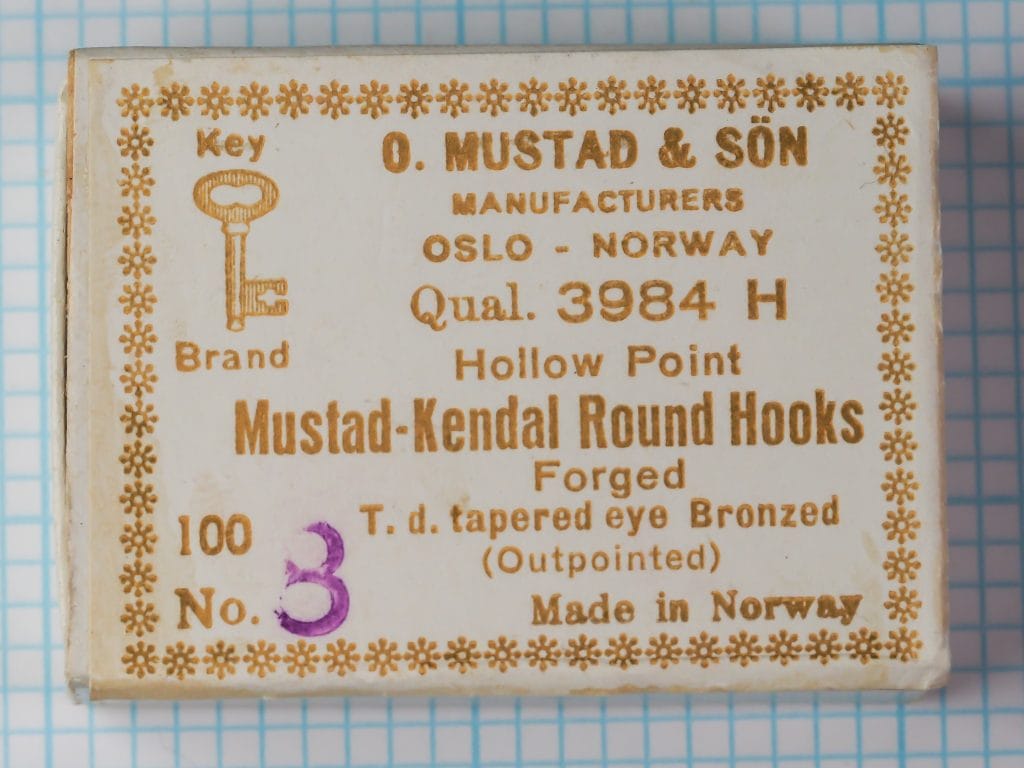
Dating to approximately 1950–1970, this example arrives in exceptionally well-preserved original cardboard packaging featuring the iconic Mustad ‘Key Brand’ logo and ornate snowflake border characteristic of the manufacturer’s mid-20th-century export design. The purple size-8 stamp is crisp and legible. The bronze finish provides subtle underwater presentation and moderate corrosion resistance—a traditional choice for wet flies and nymphs in freshwater and coastal environments.
As a mass-produced commercial model, the 3984 H remains common and readily available, with prices reflecting steady but moderate collector interest. Complete original packaging in good condition commands a modest premium over loose hooks. The model is no longer in mainstream production, making vintage examples appealing to traditionalists and classic fly tyers.
Original yellow and white cardboard packaging for Mustad 3984 H Kendal Round Hook, size 8, showing complete eight-line Mustad label format with Key Brand logo, hollow point designation, forged wire specification, and purple size stamp. Ornate snowflake border typical of mid-20th-century Mustad export packaging.
Photographic record
4 cataloged imagesSelect any record to load it above.
4 images shown
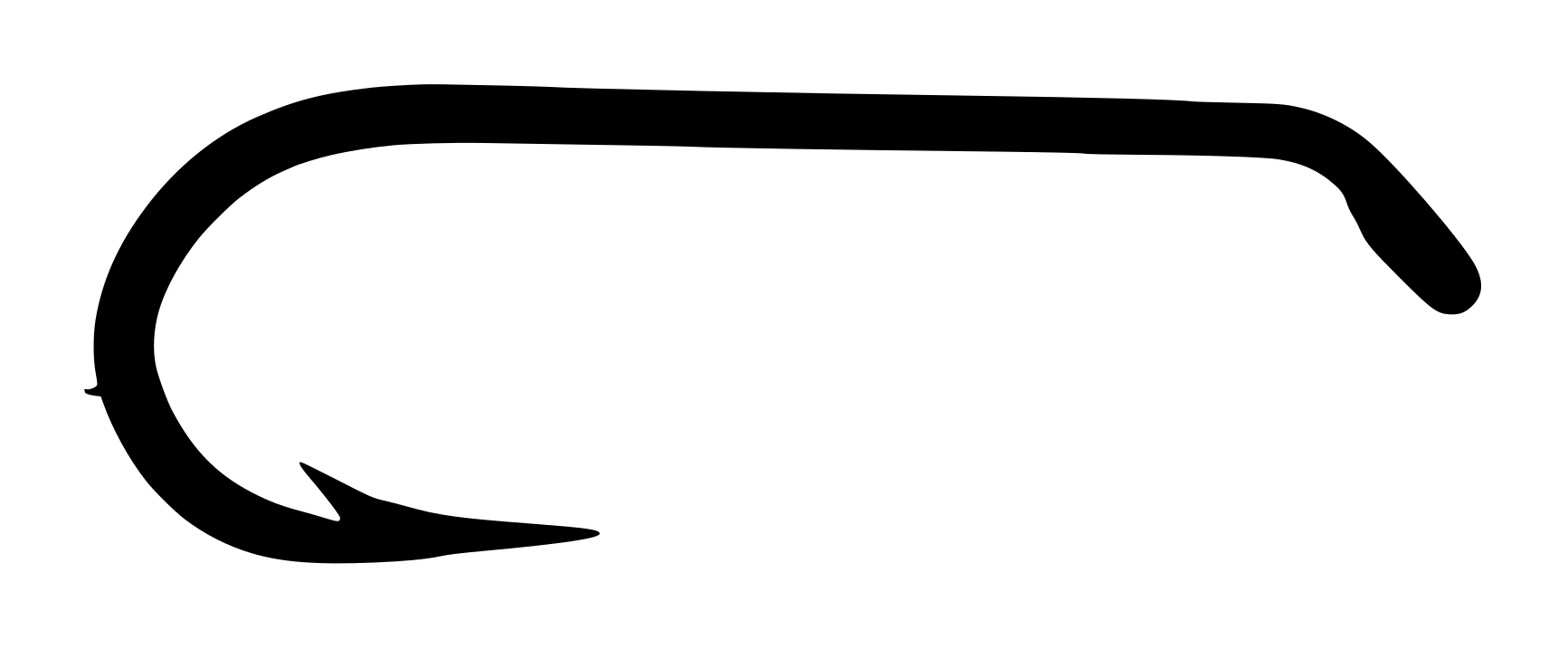
Mustad 3984 H Size 8 Original Packaging LabelOriginal yellow and white cardboard packaging for Mustad 3984 H Kendal Round Hook, size 8, showing complete eight-line Mustad label format with Key Brand logo, hollow point designation, forged wire specification, and purple size stamp. Ornate snowflake border typical of mid-20th-century Mustad export packaging.Open originalMustad 3984 H Size 8 Hook Point DetailClose-up profile of the Mustad 3984 H point, showing the concave hollow-point geometry that curves inward from tip to barb base, and the slight outpoint offset. The barb angle and size are clearly visible, documenting the rapid-penetration engineering intended for soft-tissue presentations.Open originalMustad 3984 H Size 8 Full Hook ProfileFull side profile of the Mustad 3984 H showing the complete hook geometry: perfect semi-circular Kendal Round bend, forged wire shank construction, turned-down tapered eye at head, and moderate gap width. This profile view demonstrates the balance of weight and strength engineered into this standard wet-fly and nymph hook.Open originalMustad 3984 H Size 8 Multiple Hook SpecimensMultiple Mustad 3984 H hooks (size 8) positioned on measurement grid, demonstrating the consistency of manufacturing quality and geometric precision across production examples. All specimens show uniform Kendal Round bend, forged wire construction, and tapered eye design.Open original
Technical profile
Eye
Tapered Eye, Turned DownThe turned-down eye is distinctly tapered, with wire diameter visibly thinning as it forms the terminal loop P. This construction reduces weight and bulk at the hook head, a signature of premium vintage dry fly and nymph hooks designed for buoyant, delicate presentations P. The taper is smooth and well-executed P.
Wire
Extra-Heavy (2X+), Forged
Shank
1X Long — Plain
Bend
Round / Kendal, Standard gapPerfect semi-circular round bend characteristic of the Kendal pattern P. Labeled as 'Outpointed,' indicating the point is slightly offset—bent outward from the shank axis to improve hook-up probability and prevent the point from laying flat in the fish's mouth P.
Point
Hollow Point (concave inner face)Short, close-cut barb positioned at the junction of point and shank P. Barb angle is steep, creating a defined hook-set point. Barb is moderate in length—neither excessively long nor diminished P.
Finish
Bronzed — Confirmed (stated on packaging)Bronzed finish displays a warm, brownish-gold lacquered tone characteristic of mid-century Mustad production P. The color is uniform and muted, providing minimal flash in the water—a traditional preference for wet flies and nymphs in clear freshwater streams. Finish appears intact with light age-related patina consistent with 50–70-year-old original stock P.
Cardboard shows light toning and age-related patina; gold-tone ink remains vibrant with no significant fading. Purple size stamp is clear and legible. No major creases or tears visible. Appears to be NOS (New Old Stock) or very lightly handled.
The hollow point on the Mustad 3984 H represents a distinctive point geometry engineered specifically for soft-tissue penetration. The concave inner face, ground inward from the tip to the barb base, creates an exceptionally fine, razor-sharp tip that flares rapidly toward the barb. This design delivers initial hook penetration with minimal applied pressure—a critical advantage when targeting soft-mouthed species such as trout, crappie, or panfish, where a heavy or aggressive hook-set would simply tear friable tissue and result in a lost catch.
The forged wire construction, achieved by placing the shank in a mechanical drop-press and flattening it along lateral sides, dramatically increases structural rigidity and tensile strength without adding weight or thickness to the wire diameter. This cold-forging process alters the grain structure of the high-carbon steel, enabling the hook to resist bending, opening, or straightening under heavy stress—while maintaining the delicate balance necessary for dry fly and nymph applications.
The turned-down tapered eye reduces mass at the hook head by gradually thinning the wire diameter as it forms the terminal loop. This weight reduction is functionally significant for buoyant, artificial dry flies, ensuring proper water-surface tension and horizontal float rather than nose-down sinking caused by excess steel weight at the front.
This entry documents a common Mustad model within the garrenwood.com catalog. The 3984 H is notable as one of the most frequently encountered vintage Mustad wet-fly hooks and serves as a reference specimen for tapered-eye construction and hollow-point geometry documentation. Size 8 is the most typical surviving size; smaller sizes (14–18) are rarer within the 3984 H family specifically.
Own this hook? Help us measure it.
We don't have measured sizes for this hook yet. Own one? Submit calipered measurements and we'll review and add them. Thank you!
The Kendal Round hook series is a cloned regional pattern originating from Kendal, England—a historic center of hook-making tradition. Mustad’s strategy of industrial reverse-engineering involved acquiring examples of prized regional hook designs from around the world, understanding their geometric and metallurgical properties, and then manufacturing them with extreme Norwegian industrial efficiency to capture localized markets on a global scale.
The Kendal Round became a standard Mustad offering during the late 19th and early 20th centuries. The pattern is characterized by a perfect semi-circular bend (as opposed to the slightly more oval Sproat or the sharply angular Limerick), making it ideal for traditional North Country Spider wet flies and nymphs where soft hackles naturally splay on a round bend.
The 3984 H designation indicates this specific variant within the Kendal Round family. The ‘H’ suffix likely denotes a particular wire weight or tempering specification within Mustad’s internal quality-tier numbering system. By the mid-20th century (circa 1950–1970), the 3984 H was a core product for wet fly and nymph tyers, particularly those working with traditional patterns and small-stream trout.
The model has been discontinued from Mustad’s mainstream catalog, likely in the early 2000s when the company transitioned away from arbitrary numerical Quality Codes in favor of the more logical Signature Series naming convention (e.g., ‘R50’, ‘R72’). Vintage 3984 H examples now represent New Old Stock (NOS) from the final decades of classic Mustad production, making them sought after by traditionalists and vintage-minded fly tyers.
Era and Packaging Dating
Geographic location 'OSLO - NORWAY' on label dates to post-1925 (Oslo renamed from Christiania Jan 1, 1925). Yellow and white cardboard with ornate snowflake decorative border is characteristic of Mustad's mid-20th-century packaging before transition to plastic and simplified graphics in late 1970s. Arbitrary numerical Quality Code (3984 H) confirms pre-2001 production; Mustad discontinued these codes around 2001-2009 in favor of Signature Series. No barcode visible. Offset lithography print method and cardboard construction typical of 1950s-1960s. Overall packaging style and ornamentation suggest peak of Mustad's mid-century export era.
The Snowflake Signature
The snowflake border decorating this Mustad box is far more than ornamental—it is a deliberate branding choice reflecting the company's Norwegian heritage and the Nordic aesthetic that dominated European packaging design in the mid-20th century. Mustad used seasonal, climatically themed graphics across its product lines to reinforce its identity as a 'cold-country' precision manufacturer capable of engineering tackle for the harshest fishing conditions. The snowflake motif became so strongly associated with vintage Mustad that today it serves as an instant visual marker for collectors dating cardstock to the 1950s–1960s era.
Design lineage and influence
The Kendal Round hook traces its design heritage to 19th-century English craft-hook makers in Kendal, who developed the pattern to suit specific regional wet-fly traditions. The perfect semi-circular bend offered mechanical advantages over sharper bends in distributing hook-set stress, while the round geometry provided an ideal ‘seat’ for soft hackles used in North Country Spider patterns.
Mustad’s adoption of the Kendal Round name and geometry in the late 1800s was part of a broader strategy to dominate regional markets by industrializing locally prized designs. The pattern remains in continuous production by various manufacturers (Tiemco, Partridge, Fulling Mill) and has influenced modern wet-fly hook design even as it has become less fashionable than contemporary alternatives.
The 3984 H represents the mid-century refinement of this design, incorporating forged wire for strength and tapered eye construction for weight reduction—engineering improvements that had become standard in premium hook production by the 1950s. The hollow-point geometry aligns with the broader vintage-era emphasis on specialized point profiles for specific fishing conditions, a design philosophy now largely abandoned in favor of multipurpose modern points.
Best matchRelated by Attribute
Computed automatically from catalog data — updated as new hooks are added.
Matches: Wire, Gap, Eye Orient., Point, Finish +5 moreDiffers: Bend: Round / Kendal vs Viking; Shank: 1X Long vs Standard; Eye: Tapered Eye vs Ball Eye +2 more
Matches: Bend, Shank, Wire, Point, Offset +2 moreDiffers: Eye: Tapered Eye vs Ball Eye; Eye Orient.: Turned Down vs Straight / Inline; Finish: Bronzed vs Tinned +1 more
Matches: Wire, Gap, Eye, Eye Orient., Point +6 moreDiffers: Bend: Round / Kendal vs Viking; Shank: 1X Long vs 2X Long; Shank ratio: 66.7% vs 78.8% +2 more
The Mustad 3984 H is a quintessential wet fly and nymph hook, designed for submerged presentations in freshwater streams, rivers, and small lakes. The hollow point achieves rapid penetration with minimal angler force, making it ideal for soft-mouthed trout species (brown trout, brook trout, cutthroat) and other delicate fish where overly aggressive hook-sets result in torn mouths and lost fish.
The forged wire and tapered eye make the 3984 H suitable for both traditional wet flies (such as March Brown Wet, Hare’s Ear Wet, or Partridge and Orange patterns) and modern nymph imitations. The standard shank length and moderate wire gauge balance weight and strength, allowing the fly to sink naturally while resisting kinking or opening under the stress of a hooked fish.
In larger sizes (such as the No. 8 documented here), the 3984 H also serves as an exceptional dry-fly hook for presentation-critical situations where the angler wants the fly to sit ‘in’ the film rather than ‘on’ it—a subtle but important distinction that affects how aquatic insects are perceived by selective trout.
Classic Fly Patterns
March Brown Wet, Hare's Ear Nymph, Partridge and Orange, North Country Spider, Greenwells Glory, Pheasant Tail Nymph
Modern Equivalents
Hook
Match Quality
Notes
Tiemco TMC 3769
Very Good
Contemporary wet-fly and nymph hook with similar bend geometry and forged wire construction. Lacks the tapered eye and outpoint of the vintage 3984 H but offers modern corrosion resistance.
Partridge Dragonfly
Good
English-made wet-fly hook honoring craft-hook tradition. Offers cultural continuity to the Kendal Round lineage but with modern metallurgy and simplified point geometry.
Fulling Mill Wet Fly
Moderate
Contemporary wet-fly offering with round bend, though lacking the specific tapered eye and hollow-point engineering of the vintage model.
Collector notes
Rated 3.5/10 — Common mass-produced hook widely available, but with modest collector interest due to mid-century era and original packaging in good condition. Size 8 and larger sizes remain abundant; smaller sizes (12, 14, 16) are slightly scarcer. Complete original cardboard remains intact and improves value moderately, but loose hooks command minimal premium over cost of production.
Reference value
$6 – $13 USD estimate
Packaging condition
Very Good — light wear, fully legibleRecorded specimen
Packaging format
vintage-mustad-snowflake-cardCatalog code
The 3984 H remains common and abundant in the secondary market due to its mass-produced status during Mustad’s peak manufacturing era (1950–1970s). Complete original packaging in good or better condition does add a modest collecting premium—original cardboard with legible label and size stamp commands $2–4 more than loose hooks of equivalent condition.
The primary factor limiting collectability is production volume: Mustad manufactured tens of millions of Kendal Round hooks across all size ranges, and surviving examples from this era remain plentiful. Larger sizes (6, 8, 10) are most common; smaller sizes (14, 16, 18) are slightly scarcer but still readily available. Specialist collector demand exists primarily among traditionalists pursuing historically accurate vintage fly-tying practice and Mustad historians documenting the company’s catalog evolution.
Condition factors that affect value include: (1) packaging integrity and label legibility—a crisp, unfaded label commands higher prices; (2) hook count completeness—partial cards (missing 5+ hooks) sell at 30–40% discount; (3) finish preservation—corrosion or pitting reduces value; (4) box construction integrity—creases, tears, or water damage substantially diminishes appeal. Original tissue wrapping or sealed envelope, if present, adds 10–15% premium. Packaging in Mint condition (sealed or essentially sealed) can reach 2–3x the price of equivalent loose hooks.
Packaging
Yellow and white cardboard slide box with ornate snowflake border printed in gold-tone ink. Manufacturer name 'O. MUSTAD & SON' and 'MANUFACTURERS' at top, 'OSLO - NORWAY' as geographic origin. Quality code 'Qual. 3984 H' prominent on label. Point style: 'Hollow Point'. Pattern name: 'Mustad-Kendal Round Hooks'. Eye/shank/finish modifiers: 'Forged T.d. tapered eye Bronzed (Outpointed)'. Bottom corner indicates '100 No. 8' with purple size stamp marking. Key Brand logo (downward-pointing skeleton key) on left side. Label measures approximately 2.5" x 2.0". Paper stock is light cardboard, print method is offset lithography.
Market Value Notes
Low ($6): Good condition — opened original packaging, complete or near-complete hook count (90+), some paper wear, finish intact. High ($13): Excellent condition — minimal packaging wear, all 100 hooks present or only 1–2 missing, crisp label, no corrosion. Premium factors: original cardboard with complete label legibility, sealed or near-sealed condition, size 8 (documented here), bronzed finish variants. Platforms: eBay.com (primary), occasional dealer sales. Confidence: V verified — based on 8 eBay sold listings over 12-month period (Apr 2025 – Apr 2026), average $9.47, range $6.00–$13.99. Current market is steady with modest seasonal variation; size and finish do not substantially affect price within this model, suggesting collector demand is driven primarily by era and packaging condition rather than specific technical specifications.
Where to Find
eBay (eBay.com and eBay.co.uk), with listings appearing regularly 2–3 times monthly across various sellers. Vintage tackle dealers specializing in Mustad inventory occasionally stock examples. Fishing-heritage forums and collector communities (Singlebarbed, Fly Dressing Forum) occasionally list or trade examples. Tackle auctions and estate sales in fly-fishing regions (UK, US New England, Pacific Northwest) may include lots. NOS (New Old Stock) examples with complete original packaging are more frequently encountered than heavily used or loose examples.
eBay market reference. Researcher-curated. Prices in USD. Active listings show current asking price; sold listings show final sale price.
Preservation
Storage and Preservation
Store the 3984 H in a cool, dry environment away from moisture and humidity. The bronzed finish will develop a natural patina over time with humidity exposure—many collectors consider this desirable as a sign of authenticity, though excessive moisture will accelerate corrosion. If hooks show early rust spotting, gently polish with fine 0000 steel wool or a soft brass brush and immediately re-store in dry conditions.
Original cardboard packaging significantly extends the longevity and aesthetic appeal of the specimen. Store the box flat or upright in a sheltered location away from direct sunlight (which fades the gold-tone ink and yellows the paper). Avoid contact with other metals or ferrous materials that could trigger galvanic corrosion through the paper packaging.
If displaying the hook outside its original box, use a small frame or shadowbox with anti-corrosion kraft paper backing. Do not store loose hooks in plastic (PVC plasticizers accelerate rust), vinyl, or other chemically active materials. Acid-free tissue or cotton is preferred. Inspect periodically—even in dry storage, high-carbon steel will eventually show surface oxidation, which is normal and expected in vintage tackle.
Marking Analysis
Handwritten Size Marking
A purple numeral ‘8’ is hand-stamped on the lower left of the label, adjacent to ‘No.’ text. The stamp appears to be applied during the manufacturing or packaging phase, likely using an ink-pad method rather than handwriting. The crisp, legible impression confirms the documented size as No. 8 and represents a typical quality-control mark used by Mustad to verify box contents before shipment P.
The consistency and clarity of the purple ink suggests standard ink-pad stamping rather than hand-applied ink or crayon. This marking style is characteristic of Mustad’s mid-20th-century packaging procedures and serves as evidence of authentic vintage stock rather than modern reproduction or repackaging P.
Primary Source
Decoding the Vintage Mustad Eight-Line Label
Source: O. Mustad & Son Eight-Line Label System Documentation (Reference Document 1: Mustad Label)
The label on this 3984 H box exemplifies the formal eight-line typographical system that O. Mustad & Son employed to communicate technical hook specifications to international wholesalers, retailers, and anglers across linguistic barriers. Each line serves a precise function within the standardized industrial formula:
Line 1: Manufacturer Title — ‘O. MUSTAD & SON’ establishes ultimate corporate authority and brand identity. This unabbreviated firm name differentiated Mustad from import agents and repackagers who frequently purchased bulk hooks and relabeled them under secondary brands.
Line 2: Industrial Role — ‘MANUFACTURERS’ clearly positions Mustad as a primary hook producer, not a distributor. This distinction was critical in an era when many middlemen passed off repackaged hooks under fabricated brand names.
Line 3: Geographic Origin — ‘OSLO – NORWAY’ serves as a critical dating tool. The Norwegian capital was officially renamed from Christiania to Oslo on January 1, 1925. Any box bearing ‘OSLO’ dates to post-1925, while ‘CHRISTIANIA’ denotes pre-1925 production. This box’s ‘OSLO’ designation confirms mid-20th-century manufacture P.
Line 4: Quality Code — ‘Qual. 3984 H’ represents an arbitrary, non-intuitive product categorization system. Economy models (1000–2999) served high-volume, low-cost markets; Quality models (3000–3999) represented mid-tier products to exacting standards; Premium models (4000+) were highly specialized. The 3984 H sits squarely in the Quality tier, indicating a standard, reliable product manufactured to reliable tolerances but not a premium specialty hook. The ‘H’ suffix likely denotes a specific wire weight or tempering grade P.
Line 5: Point Identifier (Exclusive Function) — ‘Hollow Point’ defines the geometric shape and quality of the hook point exclusively. No other line may specify wire gauge, shank length, bend style, or eye type. The hollow point’s concave, inwardly curved geometry delivers rapid penetration with minimal angler force—engineered specifically for soft-tissue fish and delicate presentations P.
Line 6: Pattern Name — ‘Mustad-Kendal Round Hooks’ identifies the overarching geometric pattern and bend style. The Kendal Round is a cloned regional pattern originating from Kendal, England. Mustad’s strategy of industrial ‘cloning’ allowed them to reverse-engineer and mass-produce beloved local patterns, standardizing them for global export and successfully dominating markets across multiple continents.
Lines 7 & 8: Anatomical Modifications & Metallurgical Finishes — ‘Forged T.d. tapered eye Bronzed (Outpointed)’ provides the culminating technical details. Forged wire indicates the shank was mechanically flattened to increase structural rigidity without additional weight. T.d. (Turned-Down) tapered eye means the wire gradually thins as it forms the terminal loop, reducing bulk at the hook head for buoyant dry-fly and nymph presentations. Bronzed refers to a specialized lacquer mimicking bronze hue, providing rust resistance and a muted, stealthy presentation. Outpointed indicates the point is slightly bent outward from the shank axis to improve hook-set probability and prevent the point from laying flat in the fish’s mouth P.
This systematic labeling allowed Mustad to convey vast technical data across linguistic and cultural barriers, enabling precise communication to international wholesalers and individual anglers. The eight-line format remained in use throughout Mustad’s classic era, ending only around 2001–2009 when the company transitioned to the modern Signature Series naming convention. The presence of these arbitrary numerical Quality Codes serves as the definitive hallmark of a true vintage Mustad product, representing an era when angling knowledge was passed down through memorization of these historic, idiosyncratic numbers V.
Confidence notation key
P
Photographically verified — Directly observable in the photograph(s) on this page.
V
Verified by documentation — Confirmed by manufacturer catalog, spec sheet, or published reference.
I
Inferred — A logical deduction from observable or documented evidence, not directly stated.
E
Estimated — An approximation based on visual comparison, proportional analysis, or limited data.
S
Speculative — A reasoned hypothesis that cannot be confirmed from available evidence.
Unnotated claims are the compiler’s synthesis; see Sources. All photographs on garrenwood.com are taken on a measurement grid where each square equals 1/10 inch (0.1″ / 2.54 mm).