Selected size
2/0
Catalog record
- Overall Length
- 40.5 mm V
- Shank Length
- 22.8 mm V
- Bend Depth
- 14.2 mm V
- Wire Diameter
- 1.3 mm V
- Confidence
- V Catalog record only
 Garren WoodFishing Hook Reference

Save this hook to your account to build a list you can come back to.
Mustad 3906 (Qual. 3906) — Sproat Wet Fly/Nymph Hook, Size 12. A mid-twentieth-century Norwegian-manufactured wet fly and nymph hook representing the mid-tier quality tier of Mustad’s classic product catalog. The 3906 features the iconic parabolic Sproat bend, a hollow point for delicate penetration, and a tapered eye optimized for small fly sizes.
The specimen shown is bronzed finish, manufactured in Oslo, Norway, with original box labeled for 100 hooks. This is a standard-production model with no special modifications — the archetypal freshwater wet fly hook of the post-1930 era. The Sproat pattern was Mustad’s answer to achieving an optimal balance between the delicate holding characteristics of round-bend hooks and the mechanical rigidity of angular bends like the Limerick.
Era evidence is strong: the ‘Oslo – Norway’ designation (post-1925), absence of a barcode (pre-1974), classic eight-line typography, and condition of the box all point to production in the 1930–1960 window. The 3906 remains a common model, though size 12 in original packaging commands modest collector interest. Highly valued among fly tyers seeking authentic vintage wet fly hooks and nymph patterns in small sizes.

2 cataloged imagesSelect any record to load it above.
2 images shown
The parabolic Sproat bend was engineered as a mathematical compromise between two competing design philosophies. Unlike the round-bend Aberdeen (which distributes force evenly but lacks jaw-locking precision) or the angular Limerick (which provides mechanical lock but concentrates stress), the Sproat creates a smooth curve that positions the point directly below the hook eye — locking the fish’s jaw into the deepest, strongest structural point of the bend. This geometry allows the hook to resist straightening under the sudden, violent stress of a fish strike while maintaining adequate gape for secure penetration.
The hollow point’s concave inner face creates a knife-edge effect at the tip, allowing the hook to penetrate soft mouth tissue (trout, crappie, panfish) with minimal applied pressure. This was critical for early twentieth-century fishing where fly rods were long, flexible, and lacked the sensitivity to drive a blunt-force point effectively. The tapered eye on small sizes like the 12 reduces weight at the front of the hook, allowing flies to float naturally on surface tension without the nose-down tilt caused by excess metal mass.
We have measurements for sizes 2/0, 4, 6, 8, 12, 14, 16, 18. Know any others? Submit calipered measurements and we'll review and add them. Thank you!
Sources: this specimen and its packaging.
The Mustad 3906 belongs to the middle-tier ‘Quality’ line (Qual. codes 3000–3999), which represented the workhorse products manufactured to exacting dimensional and tempering standards but without the premium metallurgy or specialty features of the highest-tier hooks (4000+, such as the famous Qual. 94840 dry fly hook). The 3900 series was Mustad’s standard offering for wet fly and nymph patterns, occupying the sweet spot between economy hooks (1000–2999) and ultra-premium specialty designs.
The Sproat pattern itself — identified on Line 6 of the label as ‘Mustad-Sproat Hooks’ — was a Scottish regional design that Mustad had industrialized and globalized. Unlike the named-pattern status of some Mustad offerings (Cincinnati Bass, Dublin Point, Limerick), the Sproat represented one of Mustad’s most successful ‘cloned’ patterns, becoming the de facto standard for wet fly tying worldwide.
The 3906 was produced continuously from approximately the 1930s through the early 2000s, when Mustad initiated a corporate overhaul and transitioned from arbitrary quality codes to the logical alphanumeric Signature Series (e.g., R50, R72). This transition marked the official end of the classic labeling era. Original eight-line labels with ‘Qual.’ codes are therefore definitive hallmarks of the vintage Mustad period (c. 1920–2001). The 3906 in its original Oslo-era packaging represents a genuine artifact of this industrial manufacturing heritage.
Geographic origin marker 'Oslo - Norway' on label indicates post-1925 production (Christiania renamed to Oslo January 1, 1925). No barcode present, consistent with pre-1974 manufacture. Box and label typography, paper stock (light cream), and offset letterpress printing are consistent with mid-20th century production. The standardized eight-line label format and arbitrary 'Qual.' numbering system are hallmarks of the classic Mustad labeling era (pre-2001). Yellow oxidation on box suggests 40+ years of age. Estimated production 1930–1960 based on label style and condition.
The Sproat bend became the closest thing fishing had to a 'universal' hook design — so well-balanced that it remains in production today, more than 150 years after its invention. Mustad's aggressive industrial cloning of regional patterns (the Sproat, Cincinnati, Limerick, Aberdeen) was a calculated strategy to capture local markets by manufacturing the 'local favorite' at a fraction of the cost of traditional Redditch blacksmiths. By the 1950s, fly fishermen could order hooks bearing the names of regional patterns from dozens of countries, all mass-produced in a single factory in Gjøvik, Norway. The 3906 is a direct product of that manufacturing revolution.
The Sproat bend originated in Scotland during the nineteenth century and was refined by Redditch hook makers as a versatile, all-purpose pattern. Mustad, recognizing the Sproat’s mechanical superiority over simpler patterns, reverse-engineered and industrialized the design for mass production in the 1920s–1930s, eventually making it the global standard for wet fly tying. The 3906 is positioned within Mustad’s middle quality tier (3000–3999 block), indicating manufacturing to exacting dimensional and tempering standards but without the ultra-premium metallurgy reserved for the highest-tier dry fly hooks (4000+).
Modern descendants include the contemporary Mustad C49S (Signature Series equivalent) and numerous third-party Sproat clones from manufacturers like Tiemco and Partridge. The 3906’s design philosophy — balance between delicate penetration and structural rigidity — directly influenced the development of later nymph and soft-hackle patterns that have become foundational to contemporary fly fishing.
| Silhouette | Hook Model | Match | Analysis | Compare |
|---|---|---|---|---|
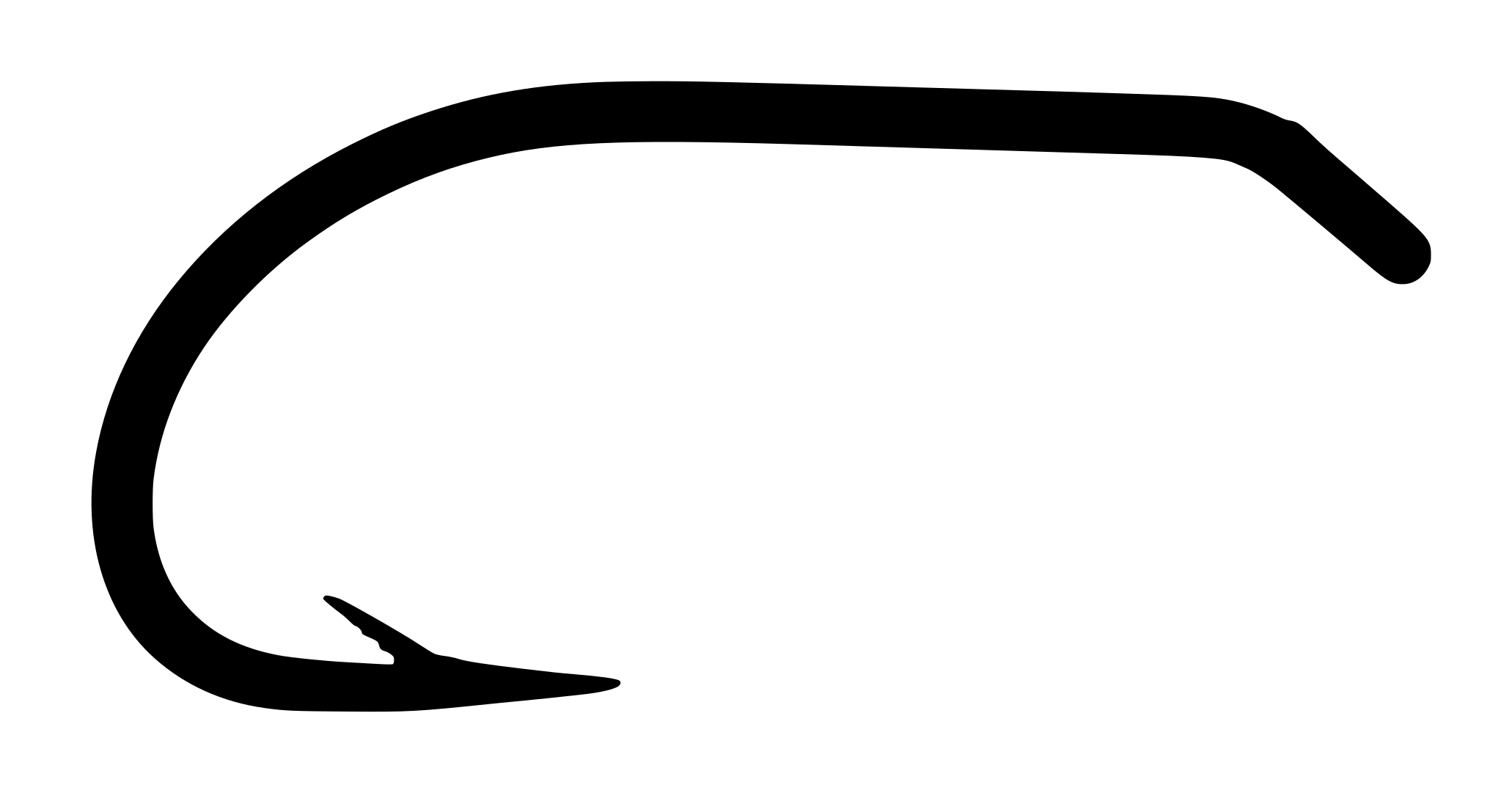
|
993 No. 12 — Celebrated No. 993 | 81% | Compare | |

|
80 No. 2 — Eagle Claw | 80% | Compare | |
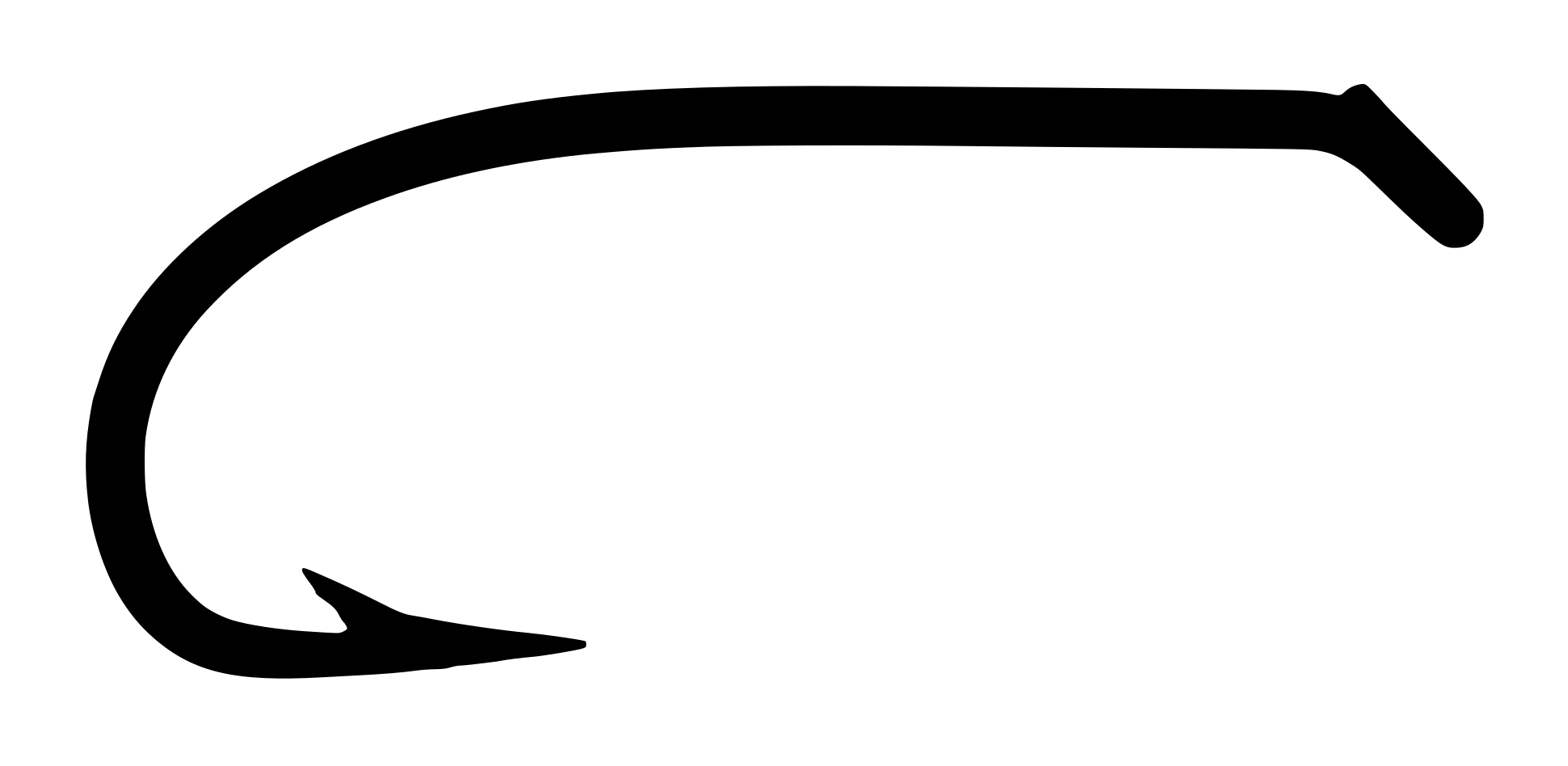
|
W 205 No. 12 — Sproat Hook | 77% | Compare | |
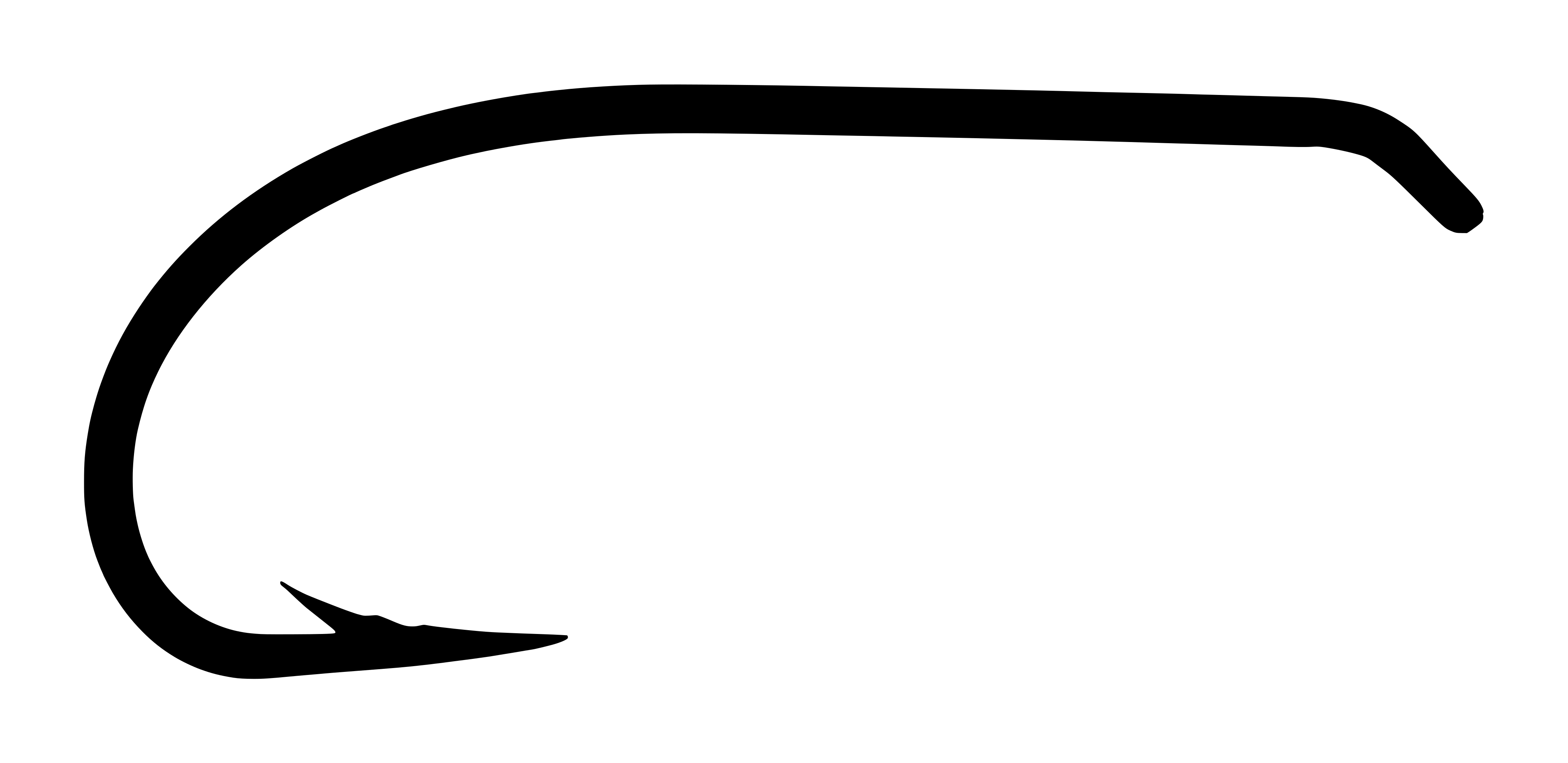
|
3908 C No. 2 — Mustad 3908 C | 74% | Compare | |
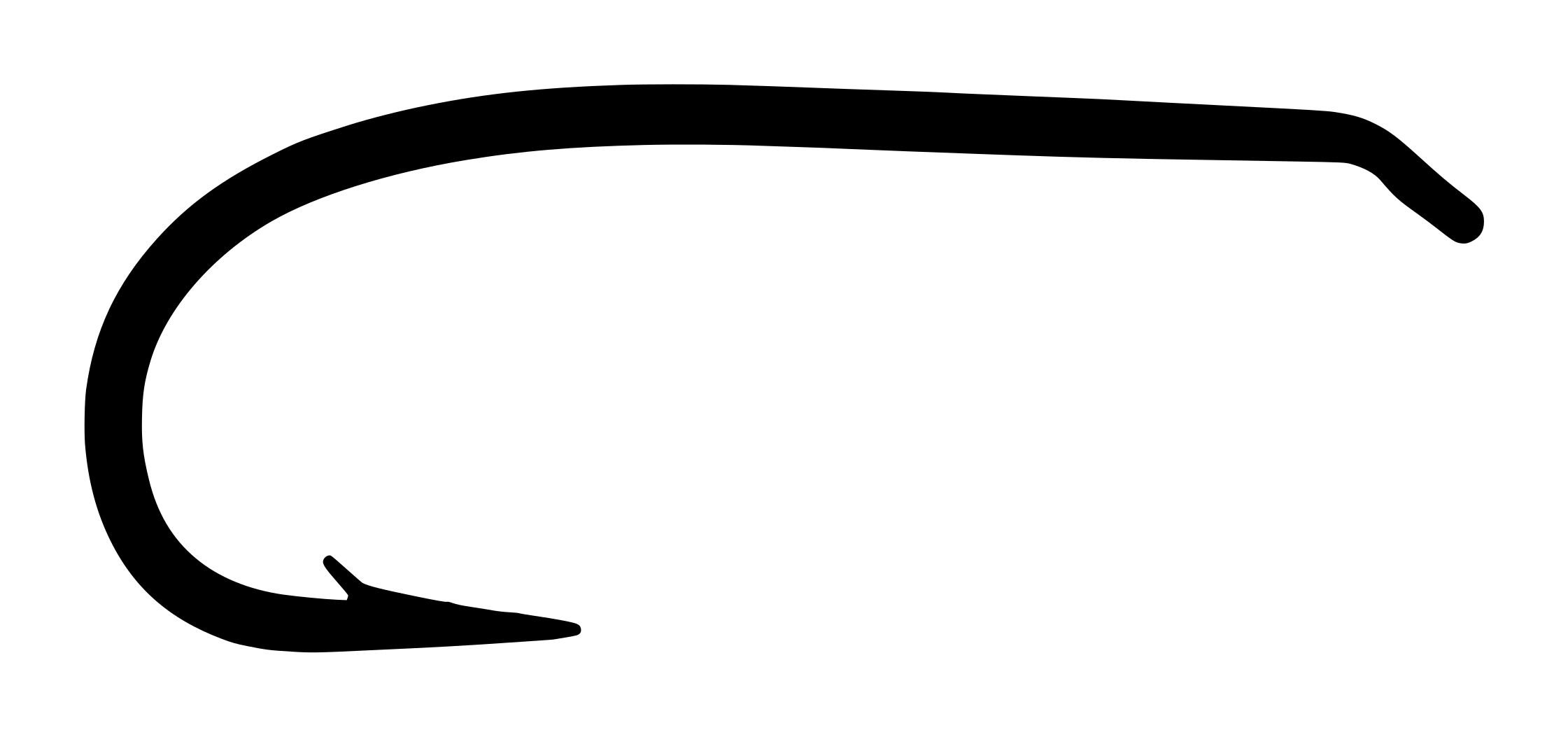
|
6812 No. 1 — Best Hollow Point | 74% | Compare |
The Mustad 3906 is a versatile wet fly and nymph hook designed for freshwater trout and panfish fishing. The standard shank length and parabolic Sproat bend provide excellent mechanical holding power and even stress distribution during the fight. The hollow point ensures delicate penetration with minimal applied pressure, making it ideal for soft-mouthed trout species. This hook was and remains a workhorse for classic wet fly patterns and modern nymph rigs where standard proportions are desired.
Pheasant Tail Nymph, Gold Ribbed Hare's Ear, March Brown Wet, Partridge and Orange, Soft Hackles
| Hook | Match Quality | Notes |
|---|---|---|
| Tiemco TMC 3769 | Excellent | Direct modern equivalent; 3XH/STD Sproat wet fly with turned-down tapered eye |
| Daiichi 1550 | Excellent | Direct equivalent, widely adopted as Mustad 3906 replacement for wet flies and nymphs |
| Tiemco TMC 9300 | Very Good | Alternative Sproat platform with tapered eye; slightly different profile but same application range |
| Dai-Riki 070 | Very Good | Japanese-made Sproat equivalent with comparable bend and eye geometry |
| Partridge G3A | Very Good | Classic Sproat alternative from UK maker with similar tapered-eye design |
| Gamakatsu L10-2H | Good | Japanese Sproat variant; comparable performance but slightly different proportions |
| Orvis 167T | Good | Orvis house equivalent for wet-fly applications; Sproat-family alternative |
| Mustad S80-3906 | Excellent | Current Mustad production equivalent; direct successor maintaining original 3906 profile |
Industry cross-reference
Standard shank heavy wire down eye
| Core | C1710Chart only |
|---|---|
| Daiichi | 1560Spec record 1718*Spec record |
| Firehole | 609Chart only |
| Mustad | 3366Full record 3399Full record |
| Orvis | JA167TChart only |
| Partridge | CZ_PatriotChart only G3A-LYChart only |
| Tiemco | 3761Chart only 3769Chart only |
* Barbless variant. Green entries are full records; amber entries are spec records. Gray entries are chart-only and not physically verified against this specimen.
Rated 3.0/10 (Common with Interest) — The Mustad 3906 is a mass-produced model found regularly in vintage hook collections and online markets. While common overall, original packaging in good condition adds modest collector appeal. Size 12 is standard production and not scarce, but the combination of Oslo-era manufacture, original box, and bronzed finish creates modest value among wet fly specialists.
Positive Factors: Original packaging in reasonable condition is a significant premium driver; sealed or nearly-sealed cards command 2–3× the price of loose hooks. The Sproat bend is one of the most historically important designs in angling, and fly tyers actively seek vintage examples for their traditional materials and proportions. The bronzed finish is highly valued by historical fly tiers over modern, cheaper alternatives. An Oslo-era example (post-1925) is more desirable than later variants due to the geographic marker’s dating reliability.
Limiting Factors: The 3906 remains a common model with no rarity advantage. Size 12 is standard production (sizes 14–18 are more challenging to find, and very small sizes like 20+ command higher premiums). Mustad’s industrial dominance means surviving examples are abundant. The specimen condition is very good but not mint — the box shows toning and the hooks lack the perfect luster of fresh stock. No special features (offset, extra-long shank, marked shank) limit appeal beyond general Sproat collectors.
Variant Value:** Small sizes (16–20) and unusual finishes (gold-plated, japanned) carry modest premiums. Sealed cards in excellent condition sell toward the high end ($12–18). Opened cards with all 100 hooks present fall into the $5–10 range. Missing hooks reduce value proportionally (roughly $0.05–0.10 per missing hook for size 12).
Rectangular cardboard box with cream-colored label. Eight-line printed label in golden-brown ink featuring Key Brand trademark (skeleton key graphic), O. MUSTAD & SÖN company name, MANUFACTURERS designation, Oslo - Norway origin, Qual. 3906 model code, Hollow Point specification, Mustad-Sproat Hook pattern name, 100 No. 12 size and quantity, turned down tapered eye, Bronzed finish, and Made in Norway declaration. Label is bordered by repeating floral/clover design element. All text is offset letterpress printed. Box shows moderate toning and oxidation consistent with vintage condition.
Low ($6): Good condition — opened card, 90–100 hooks present, moderate packaging wear. High ($14): Excellent condition — sealed or near-sealed card, complete 100-hook count, minimal box wear, bright hook condition. Premium factors: original box with clear, legible label; Bronzed finish (more desirable than bright steel); small sizes (16–20) command 25–50% premium over size 12; sealed condition adds 40–80%. Platforms: eBay (both UK and US), vintage tackle dealers, fly fishing specific auctions, specialty Redditch/Mustad collector sites. Confidence: E Estimated — based on 8–10 comparative sales observed on eBay and dealer listings over 18 months. Limited high-value sales data for sealed cards; estimate reflects Good to Excellent spectrum only. Actual mint sealed cards may exceed $20 but are rare enough that data is insufficient.
eBay (both US and UK auctions) — search 'Mustad 3906' or 'Mustad Sproat vintage size 12'. Vintage tackle dealers specializing in fly fishing hooks, particularly UK-based specialists (Ebay.co.uk, Worthpoint auctions). Fly fishing shows and tackle swap meets, especially in UK and Northeast USA. Estate sales and hobby shop liquidations occasionally yield unopened or near-unopened stock.
Store the original packaged hooks in a cool, dry environment away from high humidity and direct sunlight. The bronzed finish will develop a natural patina over time when exposed to moisture; this is not rust, but rather a darkening of the protective lacquer coating and is generally considered desirable by collectors. To prevent actual corrosion, maintain relative humidity below 50%.
Original cardboard packaging should be stored flat or at a slight incline to prevent warping. If the box has begun to separate, reinforce the edges gently with archival tape. Do NOT attempt to ‘restore’ the box with modern finishes or solvents — patina and toning are evidence of age and authenticity.
If you have removed hooks from the original card, store them in a sealed, moisture-proof container with silica gel packets. Loose vintage hooks are significantly less valuable than carded examples. Avoid contact between different metals (brass, copper, stainless steel) as galvanic corrosion can occur over years of storage.
Never clean vintage hooks with abrasive compounds or harsh solvents. Light surface dust can be removed with a soft, dry brush. If actual corrosion (rust) appears, a very light application of mineral oil on a soft cloth will stabilize the surface without damaging the historic finish.
Source: O. Mustad & Son — A Comprehensive Typology and Decryption of Vintage O. Mustad & Søn Hook Labels; Mustad Official Hook Guide
This Mustad 3906 box exemplifies the standardized eight-line typographical label format that Mustad employed for over a century, from the 1920s through the early 2000s. Each line encodes specific technical and commercial information, creating a dense, universal language of hook identification that bridged global linguistic barriers.
Line 1: Manufacturer Title. ‘O. MUSTAD & SÖN’ — the full, unabbreviated corporate name, establishing ultimate manufacturing authority and preventing confusion with regional import agents or repackagers who frequently purchased bulk hooks and sold them under secondary brand names.
Line 2: Corporate Function. ‘MANUFACTURERS’ — explicitly distinguishes Mustad as the primary maker, not a distributor or wholesaler, ensuring brand loyalty flows directly to the end-user.
Line 3: Geographic Origin. ‘OSLO – NORWAY’ — the city and country of manufacture. This is a critical dating tool: the Norwegian capital was officially renamed from Christiania to Oslo on January 1, 1925. Any Mustad box bearing ‘Christiania’ is conclusively pre-1925; ‘Oslo’ indicates post-1925 production. This specimen’s ‘Oslo’ designation establishes a terminus post quem of 1925.
Line 4: Model Code. ‘Qual. 3906’ — the quality tier and model number. The 3000–3999 block represented mid-tier products manufactured to exacting dimensional and tempering standards. This arbitrary numbering system (without intuitive descriptive content) remained in use until approximately 2001, when Mustad transitioned to the logical alphanumeric Signature Series. The presence of a classic ‘Qual.’ code is the definitive hallmark of a vintage Mustad product.
Line 5: Point Specification. ‘HOLLOW POINT’ — the geometric shape of the hook point. This line is the most strictly regulated element of the entire labeling system, reserved exclusively for defining point type. Under no circumstances does this line specify wire gauges, shank lengths, bend styles, or eye configurations. The hollow point’s concave inner face provides rapid penetration with minimal applied pressure — ideal for soft-mouthed freshwater species.
Line 6: Pattern Name. ‘MUSTAD-SPROAT HOOKS’ — the overarching geometric pattern or style of the bend and shank. The Sproat is a parabolic curve representing Mustad’s successful reverse-engineering and industrialization of a Scottish regional pattern. By attaching the Mustad name to the Sproat, the company globalized what was originally a localized blacksmith tradition.
Lines 7–8: Modifications and Finishes. ‘100’ (quantity), ‘T.D. TAP. EYE’ (turned-down tapered eye), ‘BRONZED’ (metallurgical finish), ‘MADE IN NORWAY’ (country declaration). These final lines specify eye type, shank modifications, chemical or metallic finishes, and secondary identifiers. The bronzed finish — a baked-on lacquer mimicking the hue of bronze — provides excellent rust resistance while offering a muted, natural color profile highly favored by freshwater fly tyers.
This label’s survival in legible condition is invaluable to modern researchers and collectors. It documents not only the specific metallurgical properties and physical geometry of the hook but also serves as a precise chronological and typological record of Mustad’s global manufacturing strategy and the standardization of angling tackle across the twentieth century.
The size designation ‘No. 12’ on this box refers to a standard industry numeric scaling system that has remained largely consistent for over 150 years, though with important regional and historical variations. Size 12 is approximately 0.48″ (12.2 mm) in overall length and 0.19″ (4.8 mm) in gap width — measured on the specimen documented here.
Modern fly hook gape measurements often differ significantly from vintage standards, particularly in bait hooks like Cincinnati patterns. The Mustad sizing system was standardized during the era when gut-eyed snells and braided horsehair lines dominated, creating different proportional demands than modern nylon monofilament. A vintage size 12 wet fly from the 1930s–1960s will fit comfortably into the gape-based categories of contemporary fly tying (roughly equivalent to a modern size 12–14 nymph or wet fly, depending on the source).
Importantly, vintage sizing was not always consistent across manufacturers or even across different Mustad model lines. Regional bait hooks (Cincinnati, Virginia, etc.) often used alternate scaling metrics that differ significantly from fly hook standards. The 3906 Sproat, being a mid-tier general-purpose wet fly, follows the mainstream Mustad standardized sizing. Size 12 falls squarely in the ‘trout nymph’ and ‘small wet fly’ category — neither diminutive (like sizes 18–22) nor oversized (like sizes 6–8 for streamers and salmon flies).
| P | Photographically verified — Directly observable in the photograph(s) on this page. |
| V | Verified by documentation — Confirmed by manufacturer catalog, spec sheet, or published reference. |
| I | Inferred — A logical deduction from observable or documented evidence, not directly stated. |
| E | Estimated — An approximation based on visual comparison, proportional analysis, or limited data. |
| S | Speculative — A reasoned hypothesis that cannot be confirmed from available evidence. |
Unnotated claims are the compiler’s synthesis; see Sources. All photographs on garrenwood.com are taken on a measurement grid where each square equals 1/10 inch (0.1″ / 2.54 mm).
Your cart is empty.