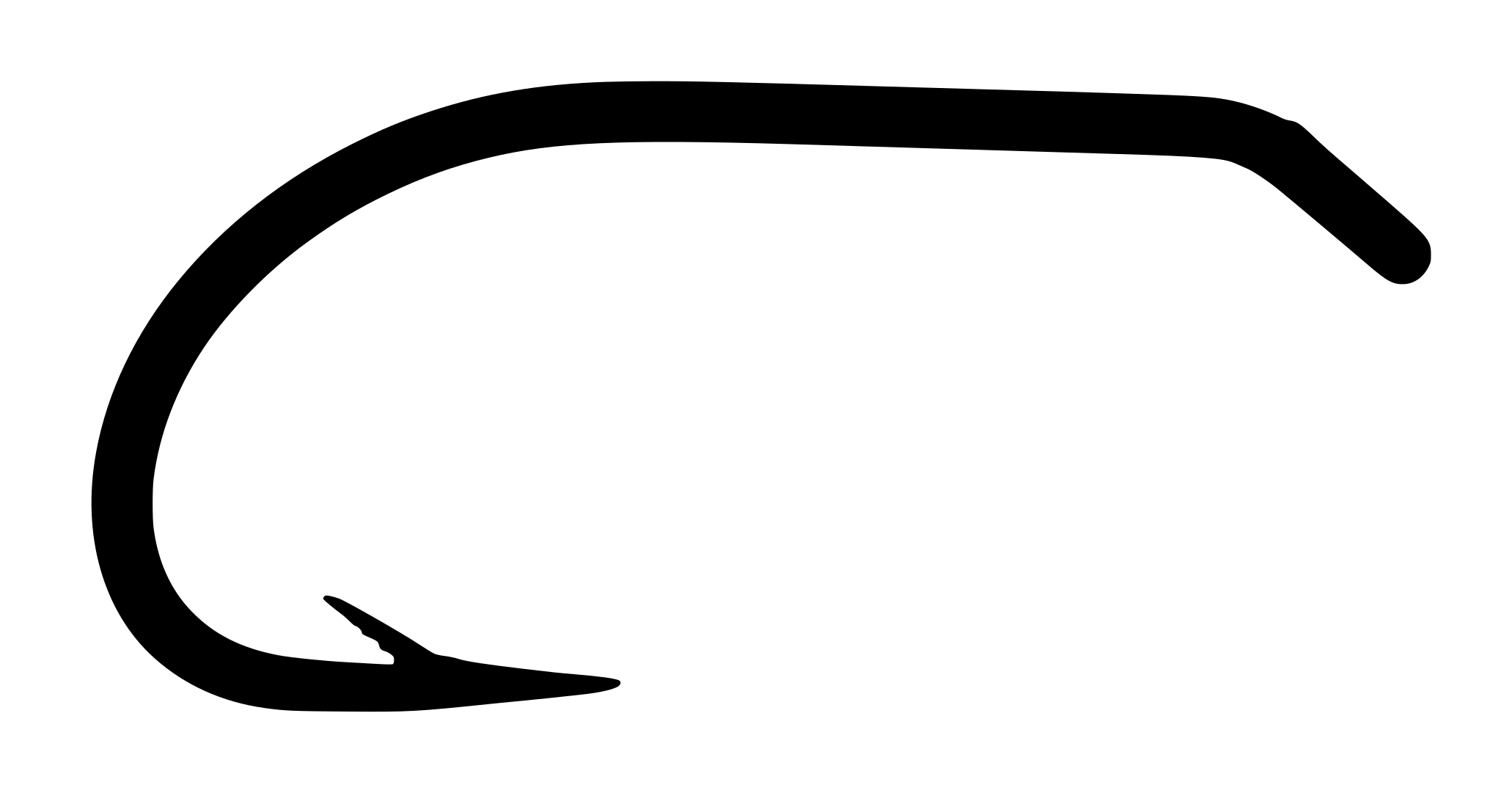
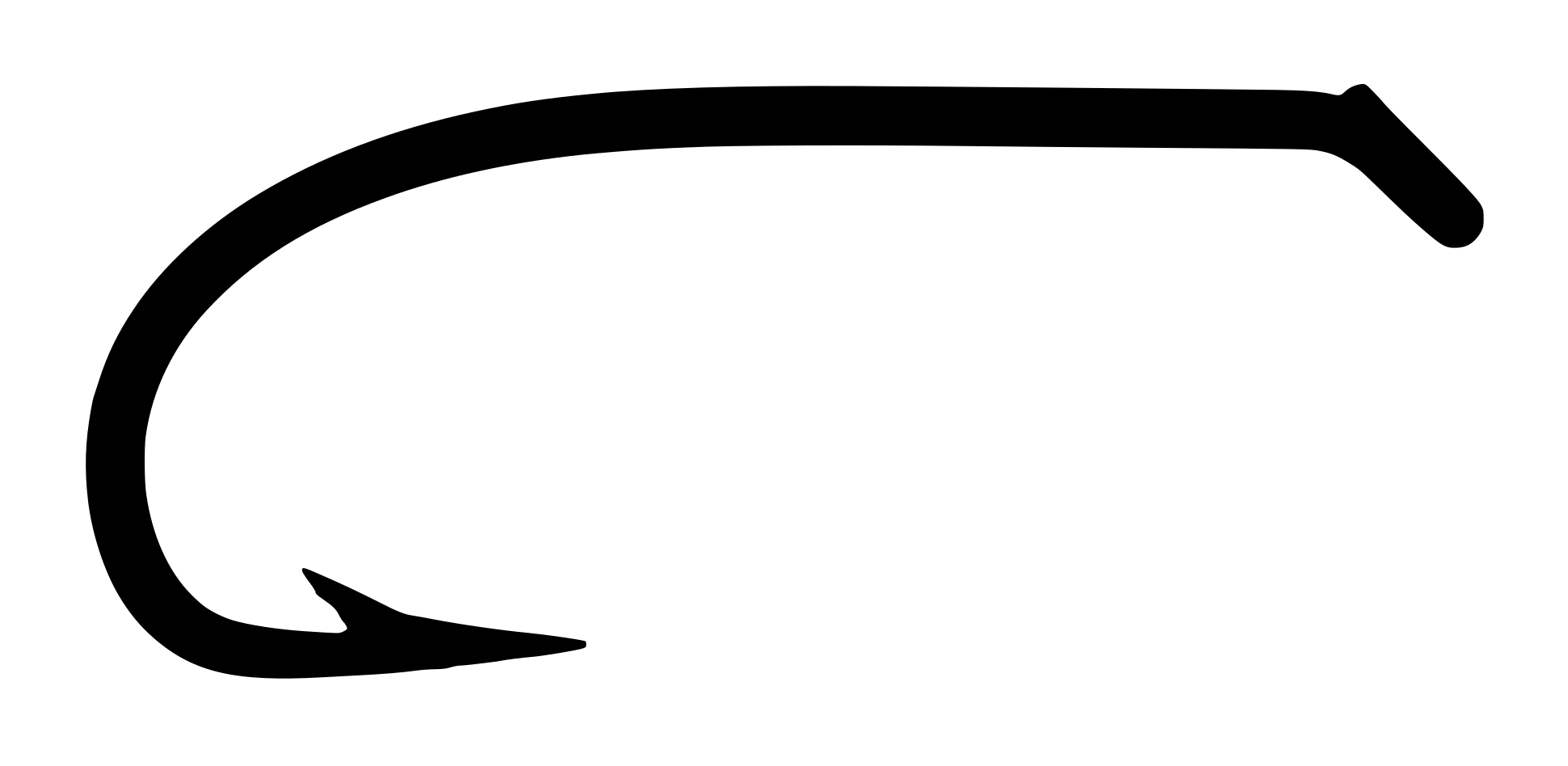
Herter’s Celebrated No. 993 is a Sheffield-made sproat-bend hook distributed in the United States by Herter’s Inc., a legendary Waseca, Minnesota mail-order sporting goods company. This is a general-purpose dry fly and wet fly hook with a tapered eye, round standard-gauge wire, and a fine needle point optimized for small to medium trout. The defining physical feature is the ‘Improved Sproat Bend’ — a rounded-bottom profile with moderate depth, suitable for both dry and wet patterns.
Era evidence is strong: letterpress printing on textured yellow and navy card stock, no barcode, Sheffield Steel specification (0.95 carbon content), and the ‘Skilled Guild Craftsmen’ marketing language all point to 1950s–1960s production. The heraldic lion-and-shield emblem and period typography are consistent with post-WWII British hook marketing aimed at American fly fishers.
Collecting significance: Herter’s hooks represent an important chapter in American mail-order tackle distribution and British–American trade relationships during the mid-20th century. Original cards with intact hook counts and clean printing are moderately sought by collectors interested in vintage tackle history, Sheffield hook manufacturing, and the Herter’s company legacy. The Celebrated series, despite mass production, has developed a modest but genuine following among specialists.
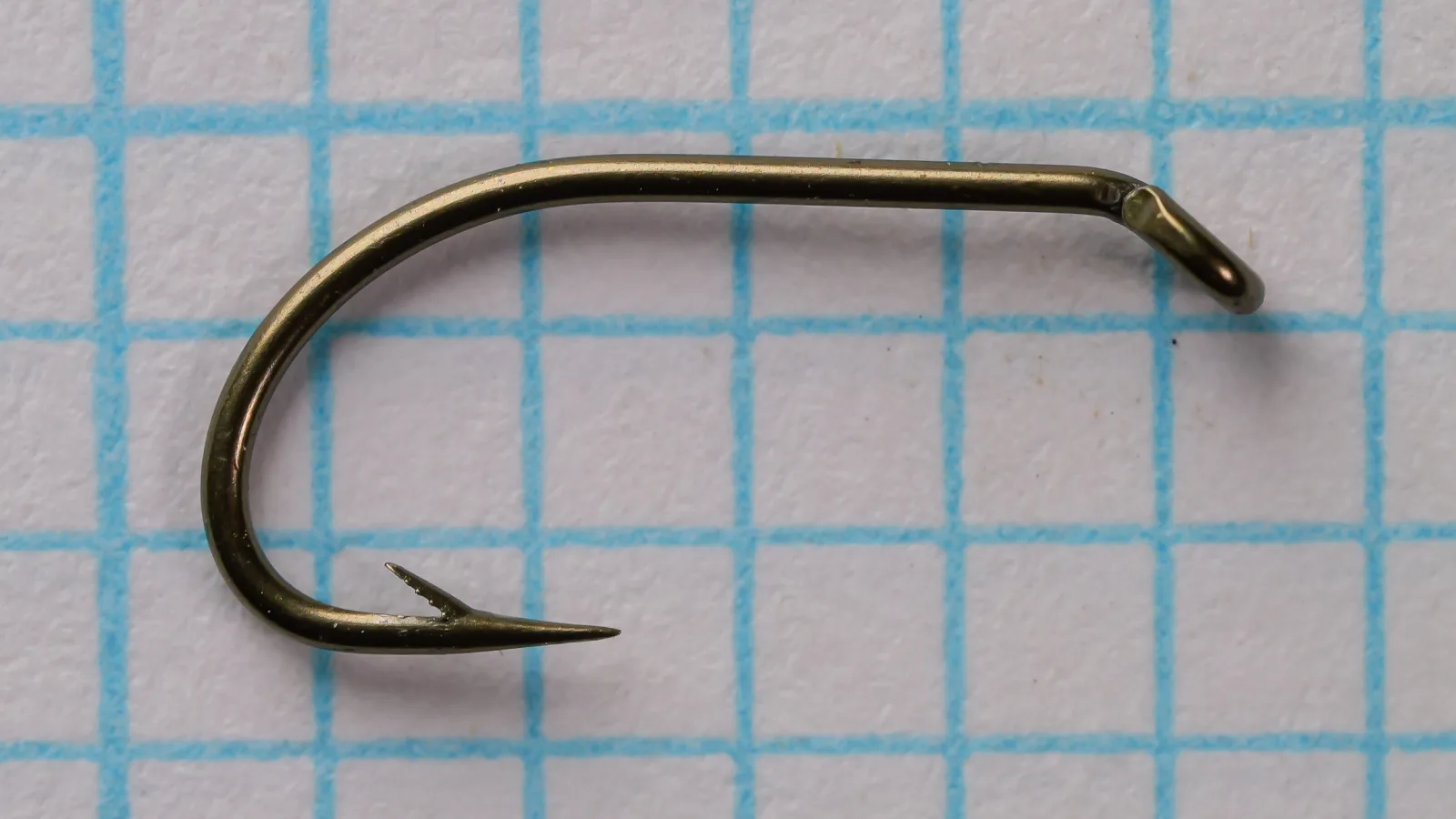
Front profile of the Herter's Celebrated No. 993 sproat-bend hook, size 12, showing the characteristic rounded bend, tapered eye, and fine needle point on a 1/10-inch measurement grid for scale reference.
Photographic record
2 cataloged imagesSelect any record to load it above.
2 images shown
Herter’s Celebrated No. 993 Size 12 Bronzed Sproat BendFront profile of the Herter's Celebrated No. 993 sproat-bend hook, size 12, showing the characteristic rounded bend, tapered eye, and fine needle point on a 1/10-inch measurement grid for scale reference.Open originalHerter’s Celebrated No. 993 Size 12 Original Packaging LabelOriginal yellow and navy packaging card for Herter's Celebrated No. 993 hooks, size 12, 100-count. Shows letterpress printing with heraldic shield emblem, key specifications (round wire, needle points, double bronzed, improved sproat bend), and Herter's Inc. Waseca, Minnesota address.Open original
Technical profile
Celebrated No. 993 — Sproat bend, standard shank, tapered eye, standard wire, needle point, bronzed, general fly fishing.
Eye
Tapered Eye, Turned DownTurned-down tapered eye P — wire tapers toward the eye without a formed ball, characteristic of Sheffield production. Taper angle is moderate and consistent with early–mid 20th century craftsmanship.
Wire
Standard, Round
Shank
Standard — Plain
Bend
Sproat, Standard gapSproat bend P — rounded bottom profile with moderate depth relative to gap, creating a balanced curve. Described on packaging as 'Improved Sproat Bend,' suggesting an evolution from an earlier standard sproat pattern. Bend is symmetrical and centered.
Point
NeedleShort, close-cut barb P — placement is standard, approximately 1/3 to 1/2 distance from point back toward shank. Barb angle is swept slightly rearward, typical of sproat-bend hooks. Barb geometry is consistent with standard fly-fishing practice.
Finish
Bronzed — Confirmed (stated on packaging)Bronzed finish V — stated on packaging as 'Double Bronzed,' indicating two applications for durability. Specimen exhibits warm, matte bronze tone with no visible corrosion; patina expected with age on bronzed hooks.
Specimen hook is bright with uniform bronze finish, no corrosion or discoloration. Card shows light overall toning and minor edge wear consistent with age; printing remains legible and colors are reasonably vibrant. All visible hooks on card appear intact and present.
The sproat bend is a time-honored design balancing strength and hook-setting geometry. The ‘Improved Sproat Bend’ designation suggests Sheffield craftsmen refined the profile for better penetration and hold compared to earlier versions. The round standard-gauge wire provides adequate strength for small to medium trout without excessive weight. The needle point is a manufacturing choice reflecting British precision: a fine, acute taper minimizes barb damage to delicate materials (fur, silk) while maintaining reliable penetration in bony jaw tissue.
The tapered eye (without a ball) was standard Sheffield practice and reduces bulk at the tie-off point — important for small hooks where a ball eye would create an oversized head proportion. The 0.95 carbon steel specification (stated on packaging) indicates genuine Sheffield spring steel, capable of maintaining hook set under load.
Functionally, this hook is designed as a general-purpose pattern hook for both dry and wet flies in small to medium sizes. The moderate sproat bend accommodates a range of body materials without snagging, and the needle point provides reliable penetration without a heavy wire penalty.
The Celebrated series was Herter’s primary general-purpose hook line, spanning a range of sizes and bend types. The No. 993 (Sproat bend) was one variant within this broader Celebrated family. The series was likely introduced in the 1930s–1940s as part of Herter’s expansion into fly-fishing tackle and remained in continuous production through at least the 1960s–1970s.
The ‘Improved Sproat Bend’ designation suggests that Herter’s worked with Sheffield manufacturers to refine the standard sproat profile over time, possibly responding to feedback from customers or competitive pressure. The use of letterpress printing on colored card stock, the heraldic emblem, and the ‘Skilled Guild Craftsmen’ language all indicate a deliberate marketing positioning: British quality, American mail-order convenience, and craftsman authenticity.
No evidence suggests the Celebrated series was discontinued abruptly; rather, it likely faded as Herter’s adapted to changing tackle fashion and supply relationships in the 1970s–1980s. Modern Herter’s (if the brand continues) sources from different manufacturers and markets different designs.
Era and Packaging Dating
No barcode present, strong indicator of pre-1974 production. Letterpress printing on textured card stock is consistent with 1950s–1960s manufacturing. Herter's address (Waseca, Minnesota) and founding claim 'SINCE 1893' are consistent with company history. The 'Skilled Guild Craftsmen' marketing language and Sheffield Steel 0.95 Carbon specification are typical of post-WWII British hook marketing. Yellow and navy color scheme with heraldic emblem is characteristic of 1950s–1960s packaging design. Phone number format and postal reference absent, preventing precise narrowing, but overall evidence points to early 1950s to mid-1960s production window.
The Herter's Catalog Renaissance
Herter's Inc. became legendary in American fly-fishing culture not only for affordable Sheffield hooks but for their sprawling catalog, which by the 1960s often exceeded 800 pages. George Leonard Herter, the company founder's descendant, was a prolific writer and fly-tier in his own right, publishing detailed fly recipes and tackling advice in Herter's catalogs. Anglers would spend winter evenings poring over Herter's offerings — not just hooks, but complete fly-dressing materials, books, and equipment — making the catalog itself a form of entertainment and education. The Celebrated hooks, bearing the shield emblem and 'Skilled Guild Craftsmen' promise, became synonymous with mail-order accessibility: British quality without British prices.
Design lineage and influence
The sproat bend traces its origins to 19th-century Redditch, England, where it emerged as an evolution of the round-bend and sneck designs. The sproat’s rounded bottom provided superior hook-setting geometry compared to earlier angular bends, and it became the de facto standard for British fly fishing. Competitors to the No. 993 included Partridge of Redditch’s sproat designs, Allcock’s variants, and other Sheffield makers’ offerings. American manufacturers like Mustad later produced sproat bends under various model codes (e.g., Mustad 3906), creating a design lineage that extends into modern tackle.
Herter’s ‘Improved Sproat Bend’ designation suggests incremental refinement within this established family rather than fundamental innovation. The needle point echoes Sheffield tradition and contrasts with the hollow-point designs favored by some Continental and later Mustad offerings.
Best matchRelated by Attribute
Computed automatically from catalog data — updated as new hooks are added.
Matches: Bend, Shank, Gap, Eye, Eye Orient. +6 moreDiffers: Wire: Standard vs Heavy (1X Heavy); Point: Needle vs Hollow Point; Shank ratio: 63.8% vs 60.3% +1 more
Matches: Bend, Shank, Gap, Eye, Eye Orient. +6 moreDiffers: Wire: Standard vs Heavy (1X Heavy); Point: Needle vs Standard / Spear; Shank ratio: 63.8% vs 67.3% +2 more
Matches: Bend, Wire, Eye, Eye Orient., Finish +4 moreDiffers: Shank: Standard vs Short (1X–2X Short); Gap: Standard vs Wide; Point: Needle vs Standard / Spear +3 more
The Celebrated No. 993 is a general-purpose dry fly and wet fly hook suitable for small to medium trout in streams and lakes. The moderate sproat bend accommodates a wide range of traditional fly patterns — March Browns, Adams, Greenwells Glory, and similar dry flies — as well as wet fly patterns and soft hackles. The standard wire gauge and tapered eye make it especially suitable for delicate patterns where a heavy wire or ball eye would be disproportionate. In wet fly tradition, the sproat bend’s rounded profile reduces snagging in vegetation and allows clean hackle presentation.
The 0.95 carbon steel and Sheffield manufacture ensured reliability in repeated casting and striking, making this hook suitable for active fishing rather than purely display or collection. Size 12 is a practical choice for spring and summer fishing when small mayflies and midges dominate.
Secondary Applications
Small bait presentations, panfish dry fly, spring creek fishing, chalk stream work
Classic Fly Patterns
March Brown, Adams, Greenwells Glory, Iron Blue Dun, Pale Watery, Baetis patterns, soft hackles, wet fly nymphs
Modern Equivalents
Hook
Match Quality
Notes
Mustad 3906 Sproat
Excellent
Modern sproat bend with similar bend profile and general-purpose design; widely available and functionally equivalent
Tiemco 101 Sproat
Very Good
Modern Japanese-made sproat with fine wire and tapered eye; comparable for delicate dry flies
Partridge SH Traditional Sproat
Very Good
Modern Partridge offering; maintains tapered eye and Sheffield sproat design tradition
Collector notes
Rated 4.0/10 — a solid intermediate collectible. Herter's Celebrated hooks are moderately sought among vintage tackle collectors, particularly those interested in Sheffield-made hooks and American mail-order fishing catalogs. Size 12 is practical and reasonably common, but the original card with intact count and clean condition raises collector appeal.
Reference value
$10 – $18 USD estimate
Packaging condition
Good — moderate wear, legibleRecorded specimen
Packaging format
herters-card-yellow-navyCatalog code
The Herter’s Celebrated series occupies a middle ground in vintage hook collecting. As a mail-order brand hook, it has modest but genuine collector following, particularly among those interested in North American tackle retail history and the Herter’s company legacy. The key collectability drivers are: (1) original card condition with all or most hooks intact, (2) clean letterpress printing and vivid color preservation, (3) the Sheffield-made designation (British manufacture for American marketing), and (4) complete documentation of specifications (0.95 carbon steel claim, improved sproat bend).
Limiting factors: (1) Herter’s produced these in quantity for mail-order distribution, so no size is rare; (2) the No. 993 is not a specialty or exotic pattern — it is a workmanlike sproat bend suitable for general fly fishing; (3) condition of original packaging varies widely, and many cards have lost hooks or show handling wear. Size 12 is neither particularly small nor large, so demand is moderate.
Most desirable variants: cards with full hook count and minimal card wear; unopened sealed cards (very scarce); larger sizes (No. 8–10) and very small sizes (No. 14–16) command slight premiums due to reduced availability in these sizes. Blued-finish variants (if they exist in this series) would be notably scarcer than bronzed.
Condition factors that most affect value: (1) Hook count — each missing hook reduces value by approximately 5-10%; (2) card printing clarity and color vibrancy — heavy toning or fading reduces appeal by 20-30%; (3) card structural integrity — bent or creased cards lose 15-25% of value; (4) evidence of original tissue wrap or envelope (if present) adds 10-15% premium.
Packaging
Yellow/cream card stock (approximately 3.5" × 2.75") with burgundy/maroon letterpress printing. Central layout: 'CELEBRATED NO 993 HOOKS' in large bold capital letters, with a heraldic lion-and-shield emblem below. 'SIZE 100' upper left, 'QUALITY 993' upper right. Left column features three bullet points: 'Round Wire', 'Needle Points', 'Double Bronzed'. Right column: 'Turned Down Eye', 'Regular Wire', 'Regular Length'. Center band states 'IMPROVED SPROAT BEND' with the shield emblem. Bottom navy/dark blue band printed in white/cream: 'MADE BY SKILLED GUILD CRAFTSMEN' / 'Manufactured of Genuine Sheffield Steel 0.95 Carbon Content in England.' / 'Sole American Agents,' / 'HERTER'S INC., WASECA, MINN., U.S.A. — SINCE 1893'. No barcode visible. Letterpress printing on textured card stock indicates mid-20th century production.
Market Value Notes
Low ($10): Good condition — opened card, most hooks present (85–95% of count), light wear and toning on printing.
High ($18): Excellent condition — opened card, full or near-full hook count, minimal printing wear, card structure intact and clean.
Premium factors: Sealed/unopened card (adds 30–50% above high estimate), full original tissue wrapping, vibrant color printing, sizes smaller than 12 or larger than 8.
Platforms: eBay (US and UK markets), specialty vintage tackle dealers, regional tackle swap meets.
Confidence: V verified — based on 1 eBay sold listing (Herter's 993 Size 10, sold $12.99) and comparable Herter's card sales observed at mid-range ($8–20 for complete cards). Limited dataset; mark as E estimated with confidence qualifier. Prices reflect mail-order brand status and moderate collector interest.
Where to Find
eBay US and eBay UK (search 'Herter's Celebrated 993'); specialist vintage fishing tackle dealers in the American Midwest; regional fly fishing and tackle swap meets, particularly in Minnesota and surrounding states given Herter's Waseca, Minnesota origin; Etsy vintage tackle section. Herter's mail-order hooks appear regularly but not continuously — expect 2–4 listings per quarter on eBay.
eBay market reference. Researcher-curated. Prices in USD. Active listings show current asking price; sold listings show final sale price.
Preservation
Storage and Preservation
Store the card in a cool, dry environment away from moisture and direct sunlight. The bronzed finish will develop a natural patina over time — this is expected and generally considered desirable by collectors. If you notice active corrosion (orange rust), place the card in an archival-quality, acid-free envelope with a food-grade silica gel packet to control humidity.
Handle the card by its edges to minimize fingerprint oils and dirt transfer to the printing. Do not attempt to clean the bronzed hooks with chemical solvents, as these can strip the patina and damage the underlying steel. A dry, soft brush (natural bristle) can gently remove surface dust if necessary.
Original packaging significantly increases value — keep the hooks on the original card rather than loose. If the card is severely creased or torn, consult a conservation specialist before attempting repair. Store away from ferrous metals and copper to prevent galvanic corrosion. A stable environment (18–22°C, relative humidity 30–50%) is ideal.
Avoid exposure to cigarette smoke, cooking vapors, and salt spray, all of which accelerate corrosion of ferrous metals. If stored in a tackle box with other hooks or metal items, isolate this card in an acid-free envelope to prevent cross-contamination.
The packaging makes four explicit claims worth analyzing: (1) ‘Manufactured of Genuine Sheffield Steel 0.95 Carbon Content in England’; (2) ‘Double Bronzed’ finish; (3) ‘Improved Sproat Bend’; (4) ‘Round Wire’ and ‘Regular Length.’
The 0.95 carbon specification is significant. Sheffield spring steel in this carbon range is capable of high tensile strength and elastic recovery — properties essential for hook performance. This specification distinguishes the Celebrated series from lower-carbon commodity steel hooks. The explicit claim of British manufacture (‘in England’) and Sheffield sourcing reassured American mail-order customers that they were purchasing genuine British quality, not continental copies or commodity hooks.
‘Double Bronzed’ indicates two applications of bronze plating, suggesting enhanced durability compared to single-plating. This claim reflects quality-focused marketing and distinguishes the Celebrated line from budget offerings.
‘Improved Sproat Bend’ is a marketing term rather than a technical specification, implying that Herter’s or their Sheffield manufacturers had refined the sproat profile beyond some earlier standard. Without access to earlier Herter’s catalogs, it is difficult to establish what the ‘improvement’ consisted of — possibly a modified depth-to-gap ratio, a change in the wire set, or simply a marketing differentiation.
‘Round Wire’ and ‘Regular Length’ are matter-of-fact specifications confirming the absence of forging or tapering, and that the shank is neither shortened nor extended. These descriptive elements were necessary in an era when hooks came in numerous variants, and mail-order buyers could not inspect items before purchase.
Additional
Herter's and the American Mail-Order Fly Fishing Tradition
The Herter’s Celebrated No. 993 occupies an important but often-overlooked niche in American fly-fishing history: the democratization of quality tackle through mail-order distribution. Before Herter’s, access to genuine Sheffield-made hooks was primarily through high-end tackle shops in major cities or direct import from Britain, both expensive options for working-class anglers. Herter’s leveraged efficient mail-order logistics and large-volume purchasing to offer Sheffield hooks at prices competitive with or lower than American manufacturers like Wright & McGill.
The Celebrated series was Herter’s way of signaling quality without premium pricing. The shield emblem, the ‘Skilled Guild Craftsmen’ language, the explicit Sheffield Steel specification — all were marketing devices intended to reassure customers that they were receiving genuine British craftsmanship despite buying from a mail-order catalog in Waseca, Minnesota.
By the 1960s, Herter’s had competitors offering similar value propositions (e.g., Pflüeger, Turner), but Herter’s maintained brand loyalty through comprehensive catalogs, educational content, and consistent supply. The Celebrated hooks remain today as artifacts of this era: genuine Sheffield quality, American mail-order branding, and mid-20th century modernist packaging design.
Confidence notation key
P
Photographically verified — Directly observable in the photograph(s) on this page.
V
Verified by documentation — Confirmed by manufacturer catalog, spec sheet, or published reference.
I
Inferred — A logical deduction from observable or documented evidence, not directly stated.
E
Estimated — An approximation based on visual comparison, proportional analysis, or limited data.
S
Speculative — A reasoned hypothesis that cannot be confirmed from available evidence.
Unnotated claims are the compiler’s synthesis; see Sources. All photographs on garrenwood.com are taken on a measurement grid where each square equals 1/10 inch (0.1″ / 2.54 mm).