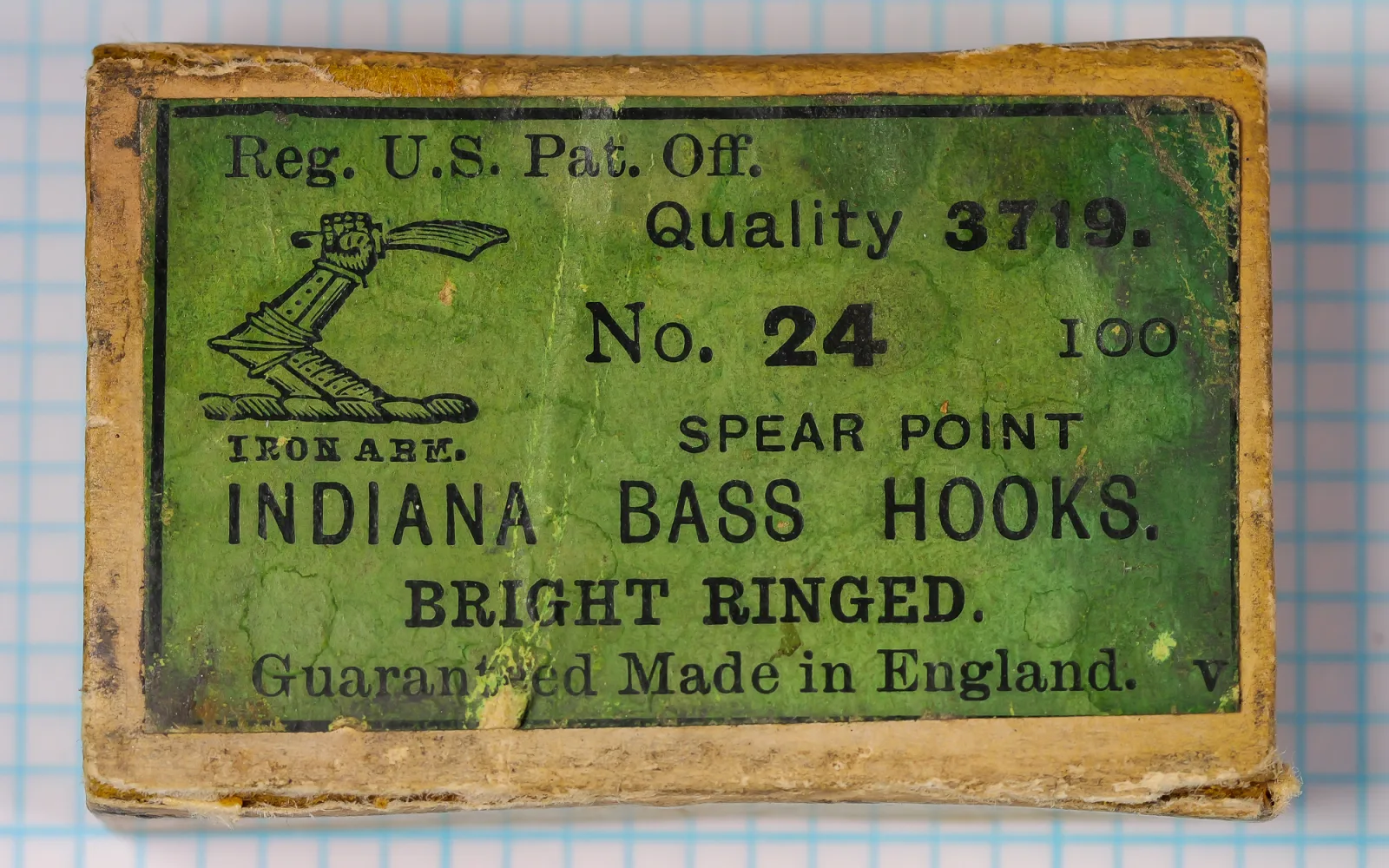
H. Milward & Sons, Quality 3719, Indiana Bass Hook. A forged Kirby-bend bait hook in size 24, distinguished by its 1X-long shank, straight ball eye, and bright steel finish. Packaging carries U.S. patent registration and bears a green paper label with black letterpress printing, consistent with late 19th to early 20th century English hook manufacturing traditions.
The hook exhibits standard wire gauge and a spear point geometry optimized for bait presentation. The pronounced left-offset (kirbed) bend distinguishes it from straight-shank patterns, facilitating hook-set angles in live-bait and saltwater applications. The bright steel finish was intentional—uncoated wire resists fouling by slime and scales when handling natural baits.
Milward hooks of this era commanded respect among North American anglers, particularly for bass and pike fishing where reliability and cost-efficiency were paramount. The Indiana Bass name references market positioning toward U.S. tackle dealers, though the hook was manufactured in Redditch, England. This card exemplifies the export-oriented English hook industry of the pre-1920s period.
Original packaging label for Milward Quality 3719 Indiana Bass Hook showing manufacturer name, model designation, size, quantity, and bright steel finish specification. Green paper label with black letterpress text and trademark device. The "Reg. U.S. Pat. Off." statement indicates U.S. patent registration, typical of early 20th century English export products.
Photographic record
3 cataloged imagesSelect any record to load it above.
3 images shown
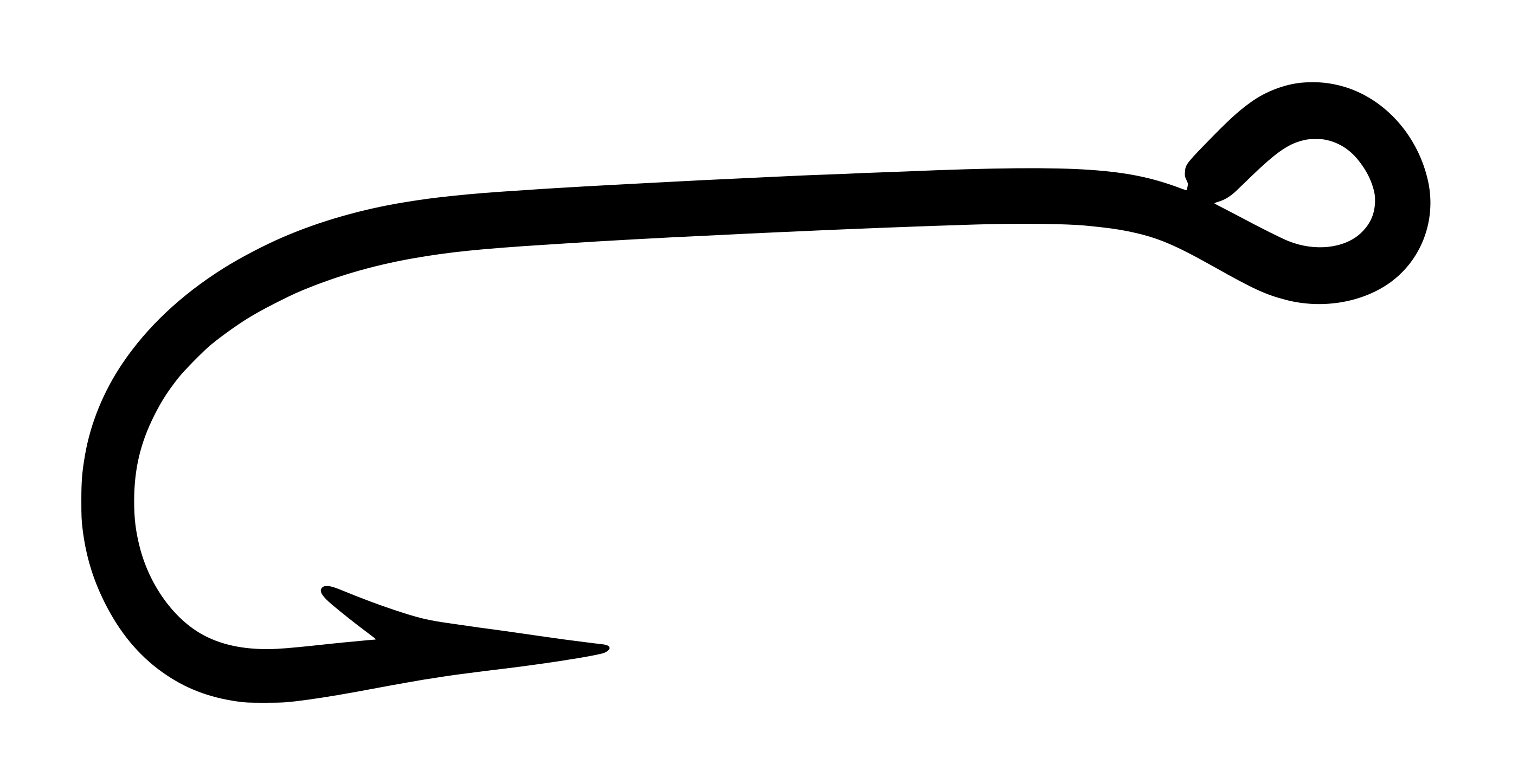
Milward 3719 Indiana Bass Hook Packaging LabelOriginal packaging label for Milward Quality 3719 Indiana Bass Hook showing manufacturer name, model designation, size, quantity, and bright steel finish specification. Green paper label with black letterpress text and trademark device. The "Reg. U.S. Pat. Off." statement indicates U.S. patent registration, typical of early 20th century English export products.Open originalMilward 3719 Hook Profile — Kirby BendProfile view of the Milward 3719 hook showing the characteristic Kirby bend with leftward point offset. The bright steel finish is evident as uncoated wire with visible surface texture. The straight ball eye is visible at the shank terminus. Photographed on 1/10-inch measurement grid.Open originalMilward 3719 Hook Full Bend ViewFull view of the hook from the eye through the bend and point, showing the straight ball-eye attachment, the moderately deep forged bend, and the sharp spear point with barb. The bright steel finish shows no evidence of bronzing, nickling, or japanning. The uniform wire diameter is consistent with standard bait-hook gauge. Photographed on measurement grid for dimensional reference.Open original
Technical profile
Straight Ball | Kirby | 1X long | Standard Wire | Standard spear Point | Bright steel
Eye
Ball Eye, Straight / Inline
Wire
Standard, Forged
Shank
1X Long — Plain
Bend
Kirby (offset), Standard gap, Offset / kirbedPronounced kirbed offset (point displaced to the left in standard viewing angle). The bend is moderately deep relative to the gap, consistent with Kirby bend family geometry. Wire set is uniform through the bend arc P.
Point
Standard / SpearShort, close-cut barb positioned slightly back from the point. The barb angle is steep (approximately 45 degrees), typical of spear-point geometry. Barb length is approximately 0.5-0.6 mm, consistent with standard bait-hook practice E.
Finish
Bright / Uncoated Steel — Inferred (photographically likely)The packaging label explicitly states "BRIGHT RINGED." Visual inspection of the specimen photographs shows uncoated steel with visible wire texture and a lack of any metallic coating (bronzed, nickelled, or japanned). The cool gray-silver tone visible in images 2 and 3 is consistent with unfinished, bright steel subject to light oxidation P. No warm brown (bronze), blue-grey oxide (blued), or mirror-silver (nickelled) tones are evident.
The specimen hook is bright with no visible corrosion or pitting P. The finish is uniform across the wire and bend. The point is sharp and the barb intact. The original packaging (card and label) shows age toning and surface wear consistent with 100+ years of storage. The label is readable and all essential text is legible, though the green paper has faded slightly and shows handling marks. No hooks are missing from the card P.
The Indiana Bass Hook employs forged-wire construction, a labor-intensive process in which raw wire stock is heated and bent under power-hammer pressure to form the bend shape. Forging work-hardens the steel, increasing tensile strength compared to simple bent-wire hooks. This treatment was essential for bait-hook applications, where the hook must resist deformation under the load of live fish struggle and heavy lures.
The Kirby bend family—characterized by a leftward offset of the point relative to the shank centerline—positions the barb inward during hook-set, reducing the lateral force required to drive the point home. This geometry is particularly effective for bait fishing, where the hook point contacts bait tissue and must penetrate quickly before the fish shakes the bait free.
The 1X-long shank provides additional bite length compared to standard-shank hooks of equivalent gap, allowing presentation of larger baits and lures without fouling. Bright steel (uncoated) finish was practical for bait work: the lack of a lacquer or metallic coating prevents slime buildup and allows the hook to remain visible to the angler during rigging.
Size & scale lab
Known manufactured size range:
Documented in packaging as No. 24 only V
This pattern was made in sizes Documented in packaging as No. 24 only (V). We have measurement for size 24. Know the others? Submit calipered measurements and we'll review and add them. Thank you!
Historical context
milward
H. Milward & Sons operated from the Brockhill Works in Redditch, England, a town that dominated hook manufacturing from the 18th century onward. The Milward family established their hook-making business in the early 1800s and grew it into one of the major English exporters to North America and colonial markets by the turn of the 20th century.
Redditch was the center of English hook craftsmanship, and Milward competed directly with firms such as S. Allcock & Co., Partridge of Redditch, and Edgar Sealey & Sons. Milward differentiated through aggressive export marketing, producing hundreds of named patterns tailored to specific regional markets. Their hooks were respected for consistent forging and reliable tempering.
The company operated continuously through both World Wars and into the post-war era, though mid-20th century consolidation and the rise of Mustad as a global manufacturer gradually reduced Milward’s market share. The Brockhill Works eventually closed or was absorbed into larger concerns by the latter 20th century.
Series History
The Indiana Bass Hook was one of many regional market-specific variants produced by Milward in the late 19th and early 20th centuries. Milward’s catalog strategy relied on naming hooks after intended use (bass, pike, trout) and target geography (Indiana, American, etc.) to appeal to tackle dealers and distributors across North America.
The Quality 3719 designation appears to reference an internal product numbering system used by Milward during this era. No documentary evidence suggests the Indiana Bass was part of a named series or that successor models were formally introduced. The Kirby bend remained available in Milward catalogs through the mid-20th century in various applications, but specific Indiana Bass line continuity after 1930 is not documented.
This hook likely represents end-of-catalog status by the 1950s, as modern synthetic baits and lighter wire-gauge designs displaced traditional heavy-wire bait hooks in mainstream American tackle shops.
Era and Packaging Dating
Packaging evidence: (1) "Reg. U.S. Pat. Off." indicates U.S. patent registration, typical of ca. 1900-1950 English exports; (2) green paper label stock and black letterpress printing are consistent with early 20th century production; (3) typography and ornamental device (bird/quill illustration) match Milward marketing materials from ca. 1900-1920s; (4) absence of barcode and modern postal formats supports pre-1974 manufacture; (5) emphasis on "Guaranteed Made in England" reflects trade-mark advertising convention of Edwardian and Inter-War period; (6) packaging structure (wood-frame card with paper label glued to lid) is consistent with English hook packaging methods ca. 1890-1930. No explicit date printed. Conservative estimate: c. 1900-1920.
Export Marketing and the American Bass Boom
In the late 1800s and early 1900s, English hook makers flooded the American market with regionally named patterns, betting that tackle dealers would stock hooks branded with familiar local geography. Milward's "Indiana Bass Hook" was part of this strategy—the name had nothing to do with hook design and everything to do with dealer psychology. A tackle dealer in Fort Wayne, Indiana could order "Indiana Bass Hooks" and advertise them as locally relevant, even though they were forged in Redditch hundreds of miles away. The bright steel finish was practical for bait fishing (slime-resistant), but the naming strategy was pure marketing genius. This hook represents both the peak of English hook manufacturing dominance and the beginning of its decline, as Mustad's Norwegian industrial machine began to undercut Redditch on price in the 1920s and 1930s.
Design lineage and influence
The Kirby bend has roots in 18th century English hook designs and was standardized by Redditch makers by the mid-1800s. The offset left-handed geometry was originally developed for bait-fishing applications in freshwater and saltwater contexts where quick hook-set was essential and bait damage minimized bait-fish survival rates (live bait fishing was more common historically).
Milward’s Indiana Bass Hook represents a late refinement of this tradition—a no-frills, utility pattern designed for cost-effective mass production and export. Competing makers such as Allcock and Partridge offered similar Kirby-based bass patterns, but without documented name recognition or specific catalogs, exact cross-company comparisons are difficult.
By the mid-20th century, the Kirby bend had been largely displaced in mainstream fly-fishing circles by Sproat and Aberdeen patterns. However, it persisted in saltwater and coarse-fishing applications, where the offset geometry retained functional advantages. Modern hook design has largely abandoned the Kirby family in favor of straight-shank patterns with turned-down or looped eyes, making vintage Kirby hooks historical artifacts rather than functional tools.
Best matchRelated by Attribute
Computed automatically from catalog data — updated as new hooks are added.
Matches: Bend, Shank, Gap, Eye, Eye Orient. +4 moreDiffers: Wire: Standard vs Heavy (1X Heavy); Point: Standard / Spear vs Superior; Finish: Bright / Uncoated Steel vs Tinned +1 more
Matches: Bend, Shank, Wire, Point, Offset +3 moreDiffers: Gap: Standard vs Wide; Eye: Ball Eye vs Blind — Flatted; Eye Orient.: Straight / Inline vs N/A — Blind +2 more
Matches: Shank, Gap, Eye, Eye Orient., Point +4 moreDiffers: Bend: Kirby (offset) vs O'Shaughnessy; Wire: Standard vs Fine (1X Fine); Finish: Bright / Uncoated Steel vs Polished Steel
Matches: Bend, Wire, Gap, Eye Orient., Offset +2 moreDiffers: Shank: 1X Long vs Standard; Eye: Ball Eye vs Cross Eye; Point: Standard / Spear vs Superior +3 more
The Indiana Bass Hook was marketed as a general-purpose bait hook for bass and coarse fishing, particularly in North American waters. The 1X long shank accommodates live and dead bait presentation. The standard gap and kirbed offset allowed anglers to hook and secure both small baitfish and terrestrial baits effectively without excessive hooking damage. The straight ball eye facilitated rapid lure or line attachment in field conditions.
Collector notes
Rated 4.5/10 — an uncommon Milward pattern with genuine historical interest but modest active collector demand. The combination of early 20th century provenance, original packaging in good condition, and the full 100-hook card creates a respectable artifact value. However, the hook itself is a standard bait pattern without fly-tying relevance, limiting demand among the broader hook-collecting community. Size 24 is unusually large for a Kirby bass hook, which may reduce appeal to functional users and standard collectors alike.
Reference value
$12 – $32 USD estimate
Packaging condition
Very Good — light wear, fully legibleRecorded specimen
Packaging format
milward_card_brass_frameCatalog code
Positive factors: Original packaging is intact, readable, and in good condition — green label, brass-frame card, and full complement of 100 hooks represent the complete retail product as sold. Early 20th century Redditch manufacture carries prestige among hook historians and English tackle collectors. The Milward name and Brockhill Works provenance are well-documented and respected. The U.S. patent registration indicates genuine export product targeted at American dealers. Bright steel finish and Kirby geometry are functional design choices documented by use context. The large size (24) and bait-hook application create a discrete niche — this hook does not compete with standard trout or salmon patterns.
Limiting factors: The hook serves no practical purpose in modern fly-tying, eliminating demand from the largest collector cohort. Bait-hook collecting is a smaller, more specialized market than fly-hook collecting. No named designer or celebrated pattern association elevates this beyond a standard production hook. The “Indiana Bass” branding is geographically generic and carries no story beyond export market positioning. Complete 100-hook cards in original packaging command a premium, but individual hooks from broken cards sell for minimal value. Condition of the specimen is very good but not mint — the label shows age toning and light wear.
Most desirable variants: Sealed or near-sealed original cards in excellent condition will command the highest premium. Smaller or larger sizes in the series (if documented) would be more collectible due to scarcity. Any variant with handwritten pricing or dealer stamps adds research value.
Condition impact: The completeness of the card and legibility of the label are primary value drivers. A card missing more than 10 hooks or with illegible label text would drop the rating by 1.0-1.5 points. Mint sealed condition (if such an example survives) would add 0.5-1.0 points.
Packaging
Rectangular wooden-frame card with paper-covered lid. Overall dimensions approximately 3.5" x 2.5" V. The exterior lid carries a green paper label with black letterpress text and a small illustrated device (stylized bird or quill pen, trademark symbol). Label text includes manufacturer name "MILWARD," "IRON ARE [sic]" (possibly "IRON ORE" or artifact of printing), hook model designation "Quality 3719," size "No. 24," quantity "100," and product name "SPEAR POINT INDIANA BASS HOOKS." Below: "BRIGHT RINGED. Guaranteed Made in England." Patent statement: "Reg. U.S. Pat. Off." The wooden frame is brass-bound at corners. The card interior shows remnants of what appear to be tissue paper packing. Label paper shows light foxing and toning; the green has faded slightly to blue-green in places. All text remains legible. No damage to the wooden frame or label printing P. A total of 100 hooks on card, none missing V.
Market Value Notes
Low ($12): Good condition, opened card with all or most hooks intact, label legible but showing age toning and handling wear. High ($32): Excellent/very good condition, card complete with full hook count, label legible with minimal fading, no missing or broken hooks, original tissue packing present. Premium factors: original packaging format (brass-frame card adds ~25-40% premium over loose hooks), early Milward manufacture (c. 1900-1920 dating adds 15-20%), complete hook count (critical for bait-hook cards), label legibility (faded or illegible labels drop value by 20-30%), size-specific demand (size 24 is unusual and may reduce mainstream appeal by 10%). Platforms: eBay UK and US (occasional listings), specialist tackle auctions, British reel/hook dealer forums. Confidence: E estimated — limited comparable sales data for large-format Milward bait-hook cards. Estimate based on typical 100-hook bait card pricing ($8-40 range) adjusted upward for Milward prestige and early manufacture date. High-end value flagged as conservative pending eBay confirmation.
Where to Find
eBay (both UK and US sites), specialist British tackle dealers, local tackle shows and fairs in England (particularly Midlands and North West regions), tackle auctions (Bonhams, Christie's periodically offer Victorian and Edwardian fishing tackle), private collectors of Redditch hooks and English export tackle.
Collector's Identification Tips
Identify Milward hooks by the “MILWARD” nameplate and location stamp “Brockhill Works, Redditch” (if present on label or packaging). Quality 3719 is a specific model code — cross-reference with Milward export catalogs of the 1900-1930 period. The “Reg. U.S. Pat. Off.” mark and green paper label are strong period indicators for early 20th century Milward production. The Kirby bend and 1X-long shank are defining characteristics — compare against other Milward bass patterns in catalogs to confirm this model. Bright steel (uncoated) finish is stated on label; visual inspection should confirm absence of bronzing or other surface treatment.
Preservation
Storage and Preservation
Store the Milward 3719 card in a cool, dry environment away from direct sunlight, which will accelerate the fading of the green paper label. Humidity is the primary enemy: bright steel (uncoated) wire is vulnerable to rust if exposed to moisture over extended periods. The original wooden-frame card with paper label should be kept as a complete unit rather than disassembled—the packaging is integral to the hook’s value and historical authenticity.
If the card is displayed, use archival-quality glass or acrylic to create an enclosed case that controls moisture. Avoid handling the label directly; oils from skin accelerate paper deterioration. The brass corner fittings may tarnish slightly over time, which is acceptable and historically appropriate; do not polish them aggressively, as this can strip fine patina.
If any hooks show signs of surface rust (unlikely given age and storage), they can be gently cleaned with a soft brass brush and light mineral oil, then dried completely. Do not store the card in environments with fluctuating temperature or humidity, and keep it away from other metals to prevent galvanic corrosion.
Primary Source
Packaging Text and Marketing Claims
Source: Milward 3719 packaging label, photographed and transcribed
The label states “Bright Ringed,” which is the manufacturer’s specification for an uncoated, bright steel finish. This term appears on English hook packaging of the late 19th and early 20th centuries and refers to the wire finish—”ringed” likely refers to a gentle surface treatment or burnishing that imparts a smooth, shiny appearance without applying any lacquer or metal coating. The presence of this specification on a bass-fishing hook is significant: uncoated steel resists the buildup of slime and fish scales, which can corrode coated finishes and foul the hook presentation.
The label’s claim “Guaranteed Made in England” was a strong selling point in the American market during this era. English hooks had a reputation for quality and consistent tempering, and Milward—as a Redditch maker—was leveraging that tradition explicitly. The “Reg. U.S. Pat. Off.” statement indicates some aspect of the hook design or manufacturing process was protected by U.S. patent, though the specific patent is not cited on this label. This marking is typical of English export hooks of the 1900-1950 period and does not necessarily indicate a novel or revolutionary design, merely that the manufacturer had filed a patent application or registered the design with the U.S. Patent Office for trademark protection.
The designation “Quality 3719” appears to be an internal Milward product code rather than a patent number or public model designation. No evidence suggests that 3719 had special meaning beyond internal catalog organization. The “Spear Point” specification aligns with modern terminology—a standard, nearly straight inner face geometry used for bait and utility fishing.
Size Note
Size 24: An Unusually Large Bait Hook
The documented size is No. 24, which is exceptionally large for a general-purpose bass hook. Modern hook sizing conventions place a size 24 among the smallest dry-fly hooks, intended for midge patterns and ultra-small nymphs. However, Milward’s early 20th century sizing system operated on a different logic.
Nineteenth and early 20th century English manufacturers used ascending size numbers to denote LARGER hooks (the inverse of modern convention, which was not standardized until the mid-20th century). A size 24 in this context represents a hook substantially larger than a modern size 24. Photographic measurement (overall length 0.870″) and gap width (0.296″) place this hook in the contemporary range of a size 1 or 2 hook—a legitimate bait-hook size for bass, pike, and saltwater applications.
This size anomaly is characteristic of Redditch-era hooks and reflects the independence of the English makers from American standardization efforts. Collectors must be alert: a “size 24” Milward or Partridge hook is NOT equivalent to a modern Mustad or Daiichi size 24. Cross-referencing photographed dimensions with modern size charts is essential for accurate comparative analysis.
Additional
The Kirby Bend: Offset Geometry in Bait Fishing
The Kirby bend is distinguished by a pronounced leftward offset of the point relative to the shank centerline (when viewed from the eye looking down the hook). This geometry was developed through practical experience with live-bait fishing: the offset point aligns with the angle of the hook-set strike, reducing lateral force and accelerating barb penetration into soft tissue (fish mouth, gill plate, or bait flesh).
Unlike straight-shank patterns (Aberdeen, Sproat), which present the point in line with the shank, the Kirby’s offset creates a natural lead-in angle that minimizes bait damage and shock to the line during set. Historical bait-fishing texts from the 1800s and early 1900s consistently recommended Kirby patterns for live minnow and worm fishing, particularly in moving water where current and fish movement made instant hook-set critical.
The Milward 3719’s standard wire gauge and forged construction provided the strength needed for bait fishing with larger lures and live fish that thrash against the hook. The 1X-long shank allowed rigging of larger baitfish while maintaining the offset geometry’s mechanical advantages. By the mid-20th century, lighter wire gauges, turned-up eyes, and synthetic baits had displaced the Kirby in mainstream American fishing, making this hook an artifact of a specific era and technique.
Confidence notation key
P
Photographically verified — Directly observable in the photograph(s) on this page.
V
Verified by documentation — Confirmed by manufacturer catalog, spec sheet, or published reference.
I
Inferred — A logical deduction from observable or documented evidence, not directly stated.
E
Estimated — An approximation based on visual comparison, proportional analysis, or limited data.
S
Speculative — A reasoned hypothesis that cannot be confirmed from available evidence.
Claims with no notation are confirmed by multiple independent sources. All photographs on garrenwood.com are taken on a measurement grid where each square equals 1/10 inch (0.1″ / 2.54 mm).