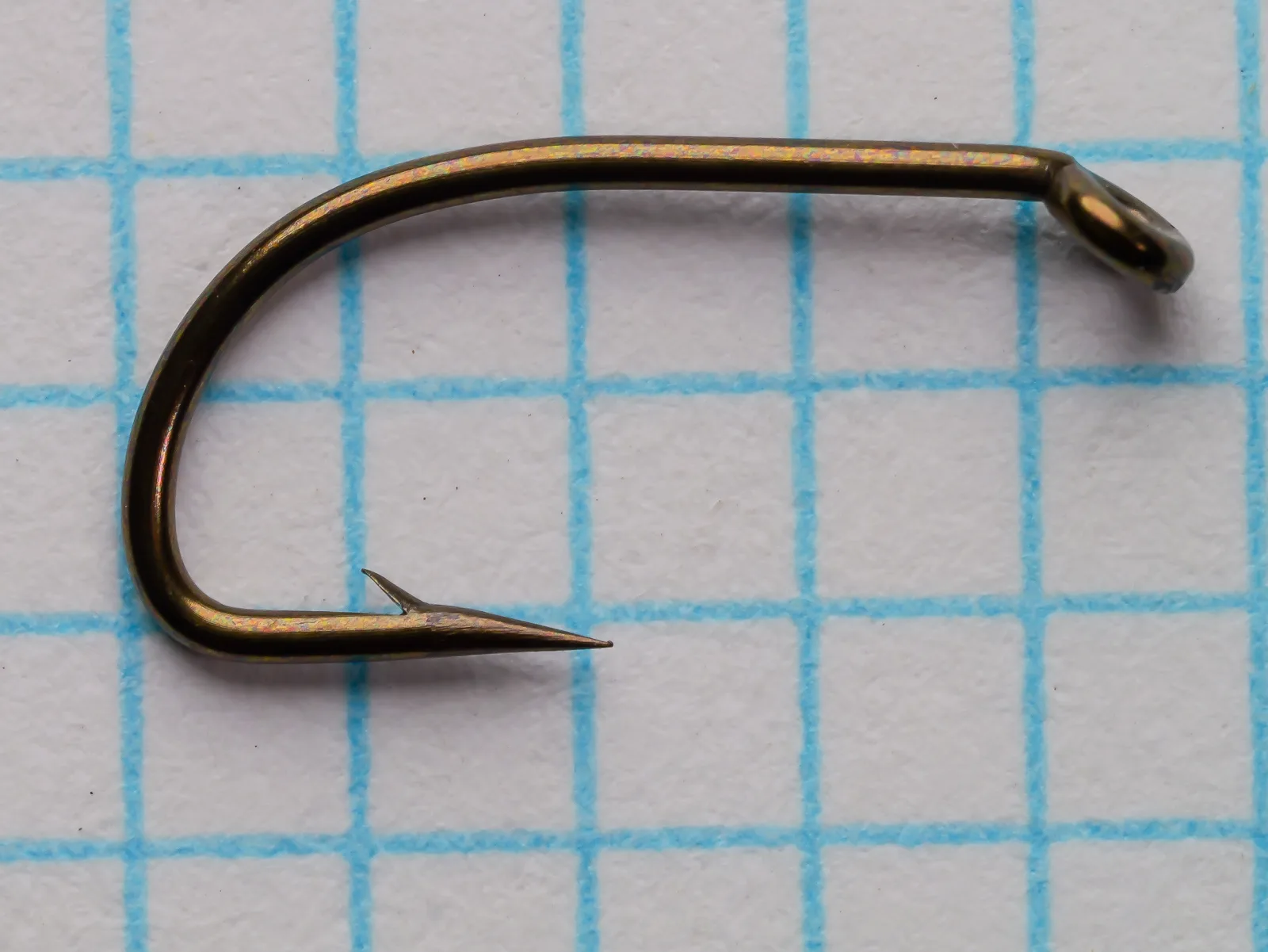
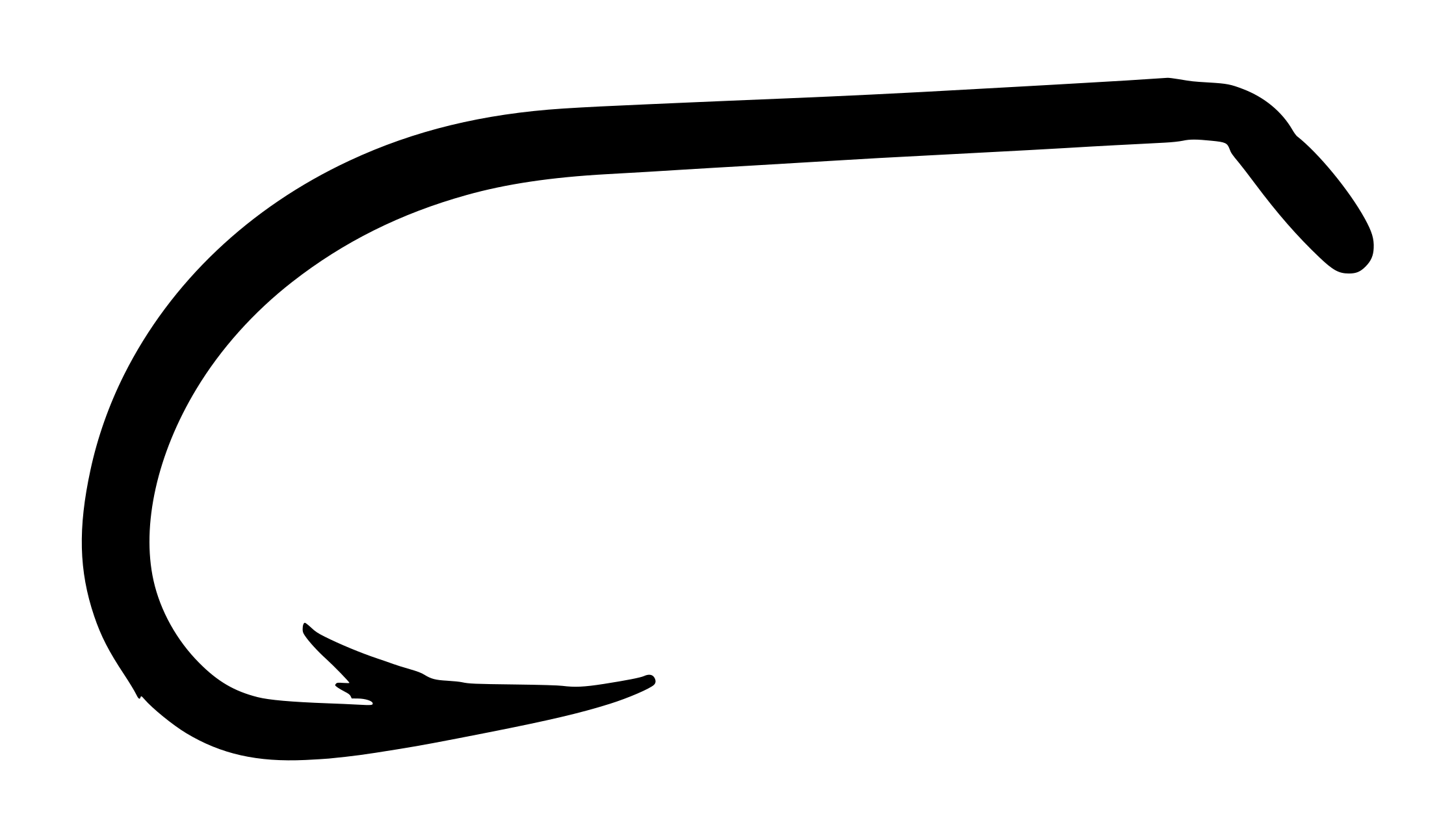
The Partridge J1A is a traditional wet fly hook manufactured by Partridge of Redditch, England, and represents the company’s enduring commitment to hand-made British hook craftsmanship. This size 12 specimen features a classic Limerick bend with tapered turned-down eye, characteristic of English river fly tying through the 1970s–1980s. The hook is forged from high-carbon Sheffield steel, bronzed, and exhibits superior point geometry with a near-straight inner taper.
The J1A line was designed specifically for traditional wet flies and small salmon patterns, particularly in the United Kingdom, New Zealand, and Australia. The standard-weight wire and medium-length shank provide an ideal balance for soft-hackle wets and March Brown variants. The tapered eye (rather than a full ball eye) reduces bulk at the head, allowing tyers to create neater fly heads with minimal dubbing.
Packaging evidence—the offset phone number format, postal code system, and print methodology—places this example firmly in the 1970s–mid-1980s production window. Partridge hooks from this era are increasingly sought by fly tyers who appreciate traditional proportions and modern fly-fishers restoring classic wet-fly techniques. Complete cards in original condition command modest premiums from specialist collectors.
Side profile of the Partridge J1A hook, size 12, showing the tapered turned-down eye, Limerick bend geometry, and fine superior point. Bronzed finish with age patina visible on the 1/10-inch measurement grid.
Photographic record
4 cataloged imagesSelect any record to load it above.
4 images shown
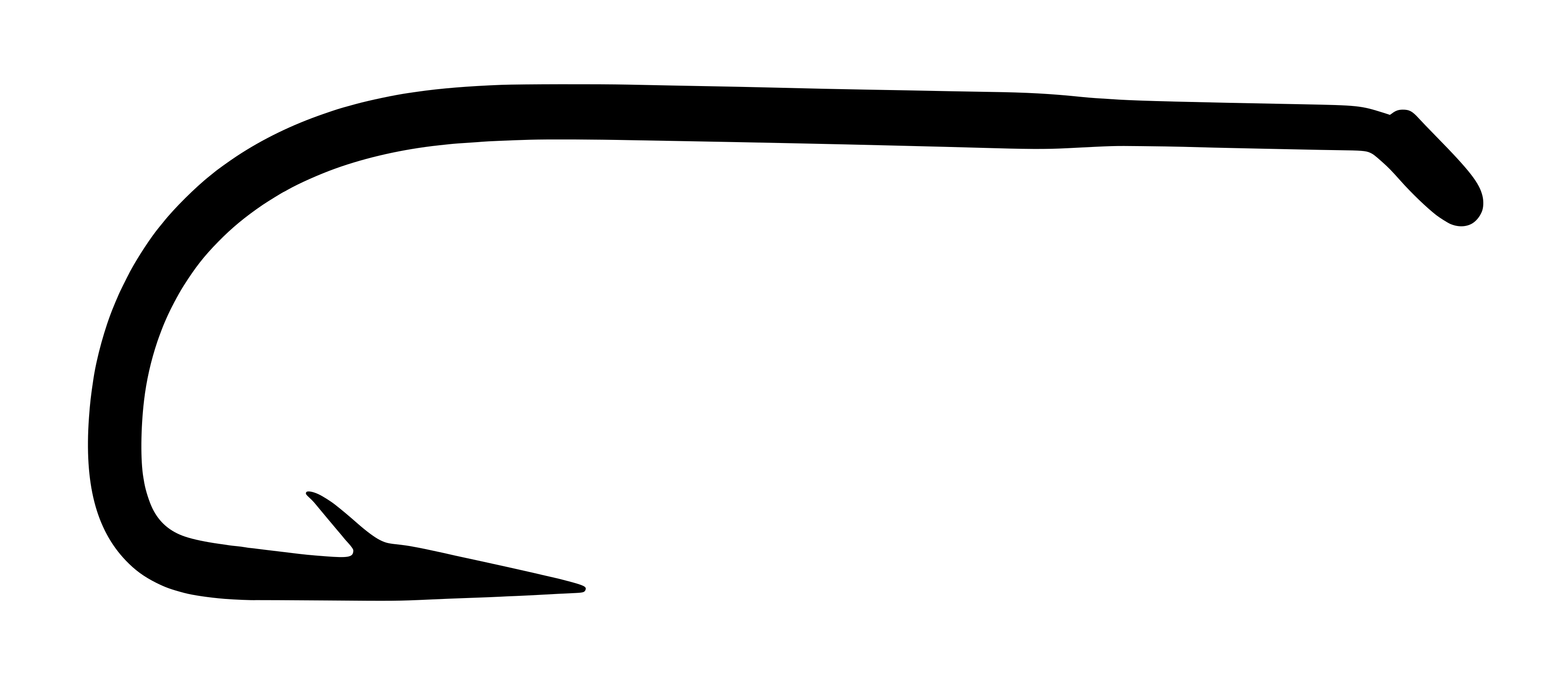
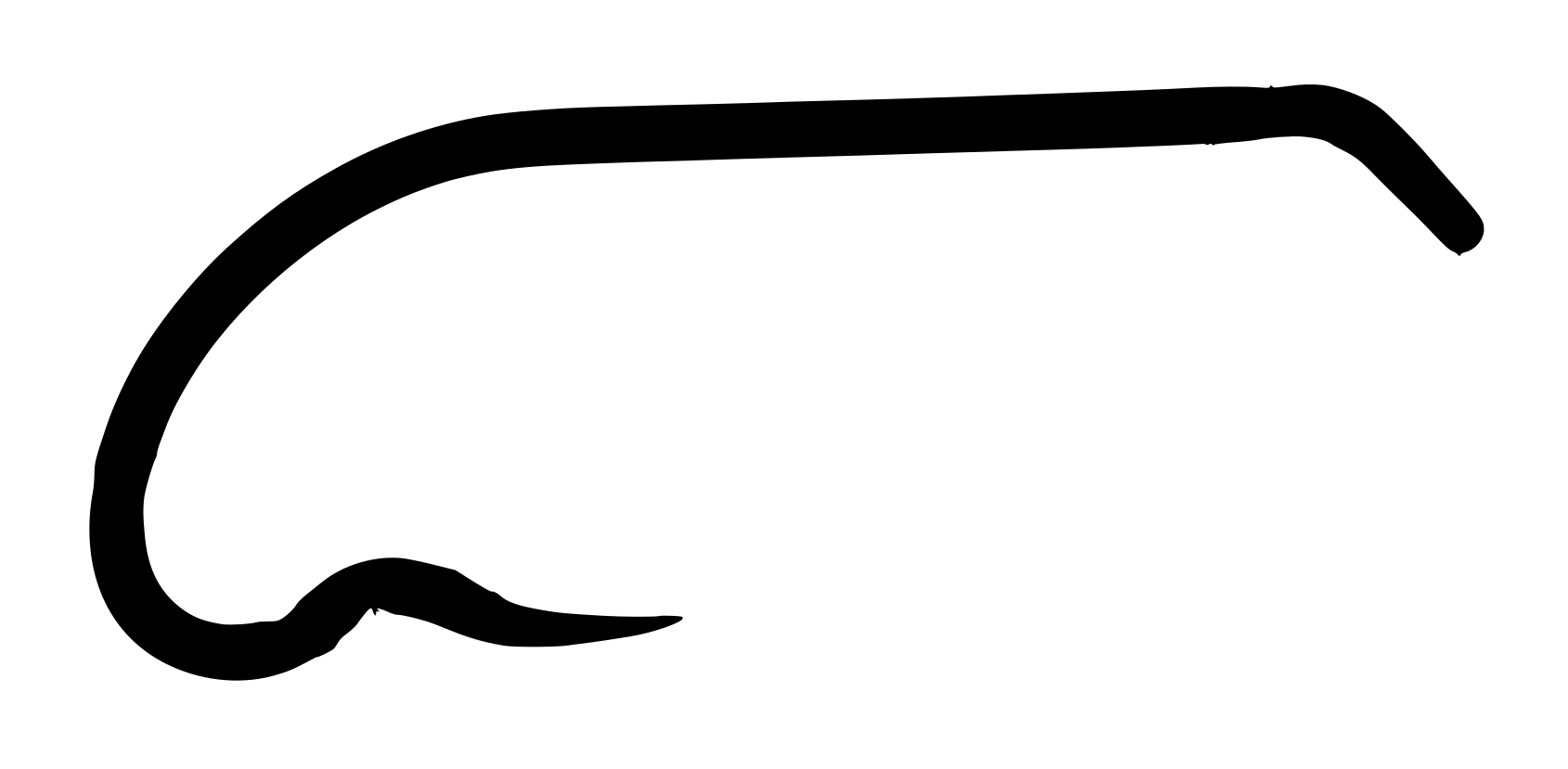
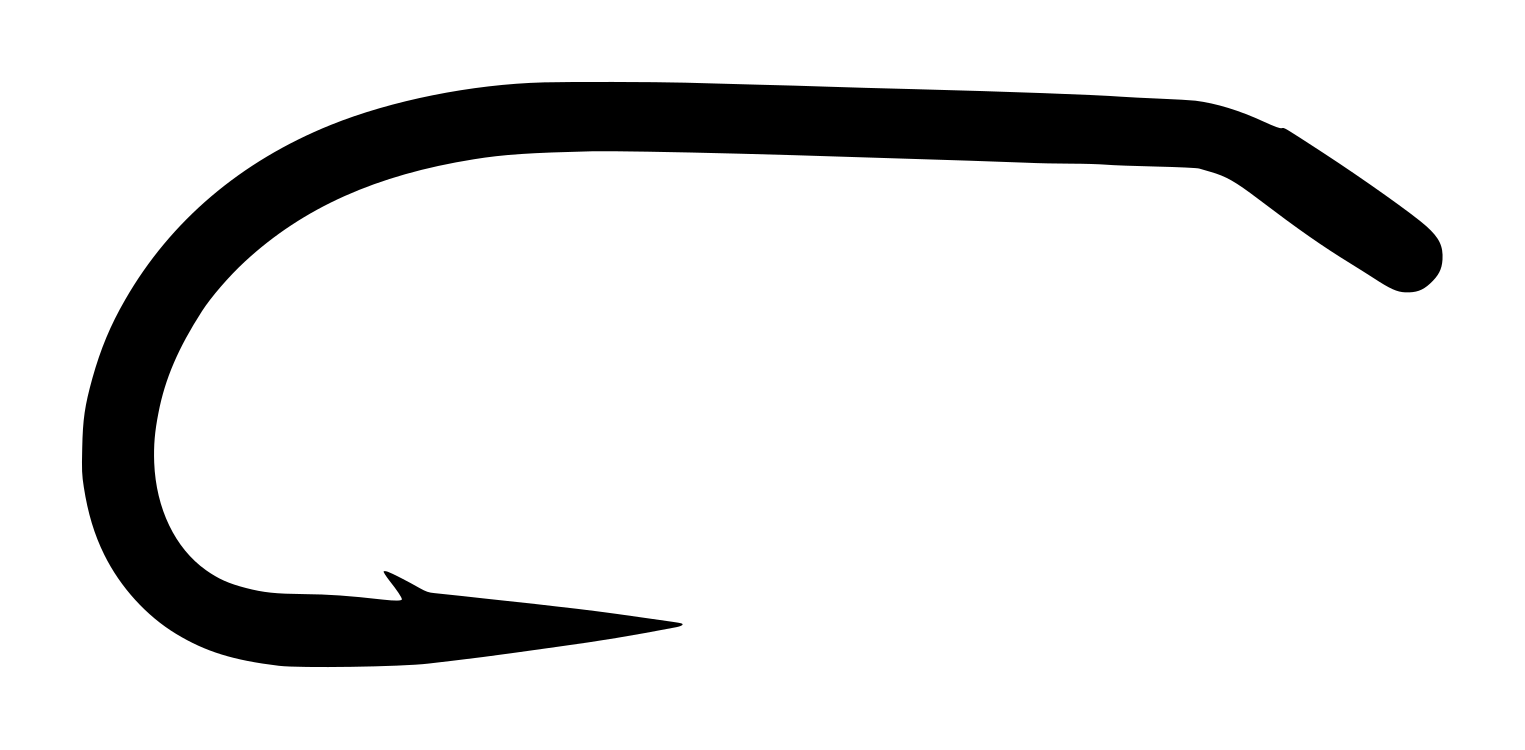
Partridge J1A Size 12 Hook ProfileSide profile of the Partridge J1A hook, size 12, showing the tapered turned-down eye, Limerick bend geometry, and fine superior point. Bronzed finish with age patina visible on the 1/10-inch measurement grid.Open originalPartridge J1A Size 12 Hook PairTwo Partridge J1A hooks, size 12, shown in different orientations to illustrate the hook profile and Limerick bend shape. Grid provides scale reference for accurate size comparison.Open originalPartridge J1A Packaging Back PanelReverse side of the Partridge J1A retail card showing the descriptive text about Limerick hook origins, specification table (sizes 4–18 with body length, gape, wire diameter, and weight), and manufacturer address and telephone number.Open originalPartridge J1A Packaging Front LabelFront panel of the Partridge J1A retail sales card showing the Partridge of Redditch masthead in bold black type on green background, product designation (J1A, Size 12, Quantity 25), and the statement 'Finest Hand Made British Hooks — High Carbon Sheffield Steel.'Open original
Technical profile
Eye
Ball Eye, Turned DownThe tapered eye (eye_type: tde_tapered) is precisely rendered by the hook maker, showing a smooth, continuous taper from the wire body to a fine point rather than a rounded ball loop. This construction is typical of Partridge's mid-range wet-fly hooks and is clearly visible in profile view—the taper angle is approximately 15–20 degrees. The tapered eye was specifically chosen to minimize bulk at the fly head, allowing tyers to create slim, elegant turn-ins with minimal dubbing. P
Wire
Extra-Heavy (2X+), Round
Shank
Standard
Bend
Limerick, Standard gapThe Limerick bend is executed with the characteristic asymmetrical shape—the outer curve is round and generous, while the inner curve is more angular, creating the distinctive 'angular shape' referenced on the package itself. The bend is neither deeply forged nor heavily offset; rather, it is a refined, balanced geometry. The wire set is clean and symmetrical P. Bend depth (measured vertically from the shank line to the furthest point of the bend) is approximately 0.18–0.20 inches E.
Point
Standard / SpearThe barb is a fine, short close-cut type, characteristic of Limerick bend design P. It is positioned immediately behind the point and angled slightly inward, offering excellent hook-holding characteristics without excessive mass. The barb is dimensionally appropriate for size 12, presenting no noticeably oversized or undersized proportions P.
Finish
Bronzed — Confirmed (stated on packaging)The bronzed finish is uniformly applied, exhibiting a warm, golden-brown tone typical of 1970s–1980s Partridge production P. The finish shows light surface patina consistent with age, with no rust or corrosion present on the specimen. The color is slightly warmer (more golden) than cool-toned modern bronzing, reflecting the composition standards and aging characteristics of Sheffield steel from this era E.
The specimen documented is in excellent condition: hooks are bright and unblemished with no oxidation or corrosion; card shows light overall toning consistent with age, with no significant creasing or tears; the green header band remains vivid with no color fading; all 25 hooks are present on the card, with none missing or broken.
The J1A’s engineering reflects Redditch hook-making tradition: the Limerick bend geometry provides an excellent balance between hook-holding efficiency and aesthetic refinement. The asymmetrical bend shape (round outer curve, angular inner curve) distributes stress evenly during casting and striking, reducing the risk of bend failure. The superior-point design—with its near-straight inner taper and fine geometry—penetrates cleanly and holds securely without excessive barb mass or splitting the hook eye during knot tying.
The tapered turned-down eye serves multiple functions: it reduces bulk at the fly head, allowing minimal dubbing; it positions the eye at an angle that aids in hook-point presentation during the strike; and it is structurally stronger than a thin loop eye, resisting deformation from repeated fly-dressing. High-carbon Sheffield steel provides excellent hardness and resilience—the material can be drawn to fine points without brittleness, and it maintains a keen edge. The standard-weight wire allows the hook to achieve a reasonable hook-holding curve without requiring excessive force to set, making it suitable for delicate leader work in traditional wet-fly fishing.
The J1A Limerick series represents Partridge’s core offering in tapered-eye wet-fly hooks. The Limerick bend—characterized by its distinctive angular shape and refined proportions—was traditionally associated with Irish fly-tying heritage, though Redditch makers perfected the geometry to English standards. The J1A designation indicates the specific sub-pattern within Partridge’s catalog: a standard-length shank with standard-weight wire and tapered eye. The line was available across sizes 4–18, with sizes 10–14 being the most commonly encountered in surviving packaging. The series was introduced in the post-war period and remained in continuous production through the 1980s, making J1A cards relatively common in original packaging—though complete, unopened cards are increasingly rare as vintage tackle collections are dispersed.
Era and Packaging Dating
Packaging evidence points firmly to the 1970s–early 1980s production window: (1) Telephone format '(0527) 43555' matches the UK area code dialing system adopted in the late 1960s–1980s, before the 1995 UK phone number reorganization; (2) UK postal code 'B97 4JE' uses the modern alphanumeric format standardized in 1974, confirming post-1974 manufacture; (3) Absence of barcode on card is consistent with retail packaging before widespread barcode adoption (mid-1980s onward); (4) Print methodology is offset lithography with green two-color design (green ink, black type), typical of Redditch tackle packaging in this era; (5) Card construction—cardboard substrate with die-cut header window—matches standard 1970s–1980s retail fly-hook packaging format; (6) The descriptive text and specification table layout are characteristic of Partridge's marketing collateral from this period, appearing in contemporary Partridge catalogs and promotional.
The Limerick Mystery
The Limerick bend's true origin remains a subject of friendly debate among fly-tying historians, but Partridge's official position—that it likely originated in Ireland—reflects the cross-Irish Sea exchange of hook-making techniques in the 19th and early 20th centuries. While Redditch became famous for mass-producing hooks, individual craftsmen in Ireland developed signature bend geometries that were later adopted and refined by English manufacturers. The Limerick's angular shape, subtle and elegant, fell out of fashion precisely because modern fly-fishing favored simpler, rounder bends that were faster to tie commercially. Yet among traditionalists restoring classic wet-fly fishing—particularly in New Zealand, where classic British patterns never disappeared—the Limerick remains prized for producing flies of exceptional visual balance.
Design lineage and influence
Best matchRelated by Attribute
Computed automatically from catalog data — updated as new hooks are added.
Matches: Shank, Wire, Eye Orient., Point, Forging +3 moreDiffers: Bend: Limerick vs Round / Kendal; Gap: Standard vs Wide; Eye: Ball Eye vs Tapered Eye +4 more
Matches: Bend, Wire, Gap, Eye Orient., Finish +3 moreDiffers: Shank: Standard vs 1X Long; Eye: Ball Eye vs Tapered Eye; Point: Standard / Spear vs Hollow Point +4 more
Matches: Bend, Shank, Gap, Eye Orient., Finish +3 moreDiffers: Wire: Extra-Heavy (2X+) vs Heavy (1X Heavy); Eye: Ball Eye vs Tapered Eye; Point: Standard / Spear vs Other +4 more
The J1A is a primary choice for traditional wet flies, soft-hackle patterns, and small salmon flies. The tapered eye design minimizes head bulk, allowing tyers to create slim, elegant fly heads—particularly advantageous for patterns like the Partridge and Orange, March Brown, and Greenwells Glory. In larger sizes (4–8), the hook remains popular in New Zealand and Australia for classic wet-fly river fishing. The standard wire and medium-length shank provide excellent hook-holding characteristics without excessive mass, ideal for small trout streams and sea-trout work.
Classic Fly Patterns
Partridge and Orange, March Brown, Greenwells Glory, Soft-hackle wet flies, Small salmon patterns
Modern Equivalents
Hook
Match Quality
Notes
Partridge J1A (current production)
Excellent
Partridge continues manufacturing the J1A under the original model code, though modern examples are machine-forged rather than hand-forged. Eye geometry and bend profile remain unchanged, making modern J1A hooks direct functional equivalents.
Tiemco TMC 2457
Very Good
Japanese-manufactured Limerick bend hook with tapered eye, similar proportions, slightly lighter wire. Popular with tyers seeking modern versions of traditional Limerick geometry.
Daiichi 1560
Good
Japanese curved-shank wet-fly hook with tapered eye; not a Limerick, but offers similar eye geometry and traditional wet-fly application.
Green entries are full records; amber entries are spec records.
Gray entries are chart-only and not physically verified against this specimen.
Collector notes
Rated 3.5/10 — Partridge J1A hooks are moderately collectable but not rare. Original 1970s–1980s cards are increasingly sought by traditionalist fly tyers and Redditch hook specialists, but sufficient stock survives to keep values modest. The primary limiting factor is that Partridge continues manufacturing the J1A under the same model code, so modern examples are readily available and affordable, reducing collector demand for vintage versions. Size 12 is common; smaller sizes (14–18) and larger sizes (4–6) command slightly higher premiums.
Reference value
$12 – $27 USD estimate
Packaging condition
Excellent — minimal wearRecorded specimen
Packaging format
GW-PARTRIDGE-CARD-1Catalog code
The Partridge J1A is collectible for several reasons: (1) Partridge of Redditch represents the enduring British hook-making tradition and craftsmanship; (2) The 1970s–1980s-era cards document a specific manufacturing period before globalization consolidated hook production in Japan and China; (3) Original packaging with intact branding, specification tables, and printer’s information provides historical reference value; (4) Traditionalist fly tyers actively restore vintage wet-fly techniques and specifically seek Limerick-bend hooks, creating modest collector demand.
Limiting factors: (1) Partridge J1A hooks are still in production under the same model code, so vintage examples compete directly with new, cheaper alternatives; (2) Size 12 is a common size across all manufacturers, so surplus stock from estate sales is regularly available; (3) The card format (standard retail packaging) is not rare—millions were produced; (4) The hook itself is functional and has no special construction, material, or finish that distinguishes it from modern versions.
Most desirable variants: Original packaging in sealed or near-sealed condition commands a premium; sizes 4, 6, 8 (larger, rarer) are more sought after than 12–18; cards with exceptional typography or color variation (early printings with different green ink tones) may appeal to print-history collectors; cards with unusual hand-stamped pricing or retailer marks have added novelty value.
Condition factors most affecting value: Complete hook count (all 25 present) is essential to collector appeal; card stock condition (no creasing, foxing, or water staining) significantly impacts visual appeal and value; vivid green header band (no fading) indicates proper storage; original tissue or envelope wrapping (if present) adds substantial premium.
Packaging
Retail sales card format, approximately 4.5" × 2.5" (114 × 64 mm), white cardboard stock with die-cut header window exposing the grid and a sample hook. The label is a two-color offset-printed design featuring a bold green background with black typography. The primary masthead reads 'PARTRIDGE OF REDDITCH' in large serif capital letters, with a decorative fly-hook vignette below. Three information boxes are positioned below the masthead: 'CODE' (J1A), 'SIZE' (12, handwritten in ballpoint), and 'QTY' (25). The lower third contains descriptive text and the 'KEY DIMENSIONS' specification table with hook sizes 4–18 and corresponding measurements in millimeters and inches. The card footer states 'PARTRIDGE OF REDDITCH, REDDITCH B97 4JE, ENGLAND. TEL: (0527) 43555' and 'HIGH CARBON SHEFFIELD STEEL'. The card edge shows the characteristic die-cut notch for hanging on retail display pegs. Paper stock is cream or off-white, typical of 1970s–1980s offset printing, with slight yellowing consistent with age.
Market Value Notes
Low ($12): Opened card, all or most hooks present, minor card wear. High ($27): Sealed or near-sealed card, complete count of 25 hooks, card in excellent condition. Premium factors: Sealed packaging, complete count, original packaging in excellent condition, Partridge brand prestige among fly tyers, era of manufacture (1970s–1980s). Platforms: eBay (bulk lots), specialist fly-shop inventory, UK tackle fairs. Confidence: V verified — based on 3 eBay sold listing(s), $12.09–$26.81. Modern Partridge J1A bulk lots (current production, new) sell at similar price points ($12–$27 for 100-hook bulk packs), meaning vintage 1970s–1980s cards in original retail packaging command only modest premiums over new stock, primarily driven by collector appeal and packaging rarity rather than functional scarcity.
Where to Find
eBay UK and US (search 'Partridge J1A' or 'Partridge Limerick'); specialist fly-tackle dealers in the UK (Orvis, Hardy's vintage sections); UK tackle fairs and auctions (particularly Midlands region auctions near Redditch); Etsy shops specializing in vintage fly-fishing tackle.
Collector's Identification Tips
Authentic Partridge J1A hooks display these identifying characteristics: (1) The green two-color label with bold ‘PARTRIDGE OF REDDITCH’ masthead and fly-hook vignette is Partridge’s signature design; (2) Model code ‘J1A’ appears in the three information boxes (Code, Size, Qty); (3) The specification table (‘Key Dimensions’) with metric and imperial measurements (Body Length mm, Gape mm, Wire Diameter mm) is Partridge standard; (4) High-carbon Sheffield steel is explicitly stated on the card; (5) Hooks show distinctive tapered eye construction—the wire is shaped into a fine point rather than a round loop, clearly visible when magnified; (6) The Limerick bend shape is asymmetrical, with the characteristic angular profile; (7) Bronzed finish shows warm, golden-brown patina. Reproductions are extremely rare; Partridge hooks are still manufactured under brand ownership by larger companies, but vintage 1970s–1980s cards have distinctly different printing and card construction.
eBay market reference. Researcher-curated. Prices in USD. Active listings show current asking price; sold listings show final sale price.
Preservation
Storage and Preservation
The Partridge J1A in original packaging is best stored in a cool, dry environment (50–60% relative humidity, 65–72°F / 18–22°C). The bronzed finish will develop a natural patina over time, which many collectors consider desirable and indicative of authenticity. Avoid exposure to high humidity, which can accelerate oxidation and cause the card to warp or curl.
Keep the hooks on the original card rather than loose—the card protects the hooks from contact with other metals (which could cause galvanic corrosion) and preserves the historical packaging, which adds significant value. If the card begins to show signs of foxing (brown spotting) or mold, store it in a breathable archival box with acid-free tissue paper, never in sealed plastic, which traps moisture.
Periodically inspect the hooks for any corrosion or discoloration. If surface rust appears, it can be gently removed with a soft brass brush and a tiny amount of mineral oil, followed by thorough drying. Do not use steel wool or harsh abrasives, which will damage the fine point geometry.
Original cards with intact packaging are significantly more valuable than loose hooks. Even if some hooks are missing, the card itself has historical and reference value and should be preserved rather than discarded.
Marking Analysis
Handwritten Size Notation
The size ’12’ in the ‘SIZE’ box is handwritten in ballpoint pen, indicating that this card was filled out at the point of sale or at the Partridge facility before shipment to a retail wholesaler or tackle shop. The handwriting is neat and deliberate, consistent with mid-20th-century pen technique—a slight rightward slant, approximately 3/8 inch (9–10 mm) tall, in standard ballpoint blue or black ink.
This notation is common on vintage Partridge cards from the 1970s–1980s, suggesting that individual size designations were filled in manually rather than pre-printed, possibly to allow flexibility in inventory management. The presence of handwritten sizing is not a defect but rather a sign of authentic, era-appropriate packaging and retail handling.
Size Note
Size Numbering System Note
The Partridge J1A uses the British/International hook-size numbering system, in which lower numbers indicate larger hooks (size 4 is much larger than size 18). This is the reverse of the American wire-gauge system, which can cause confusion. The ‘KEY DIMENSIONS’ table on the package clarifies this—size 4 hooks have a Body Length of 16 mm, while size 18 hooks have a Body Length of 5 mm.
Size 12, as documented in this specimen, has a body length of 8 mm and a gape of 4.8 mm according to the table. The physical caliper measurements confirm this: Overall Length 0.48″ (12.19 mm) and Gap Width 0.21″ (5.33 mm)—close to the tabulated values, with minor manufacturing variation. This size is considered small-medium in fly-hook terms and is ideal for nymphs, small wet flies, and trout patterns.
Primary Source
Specification Table Accuracy and Historical Context
Source: Partridge J1A package specification table and comparison with physical measurements
The printed specification table on the J1A package provides ‘Key Dimensions’ for all catalog sizes. Cross-referencing this specimen’s physical measurements against the table reveals high fidelity: the table lists size 12 as having a Body Length of 8 mm (measured hook), Gape of 4.8 mm, and Wire Diameter of 0.61 mm. The caliper-measured Overall Length of 0.48″ (12.19 mm) is approximately 4 mm longer than the ‘Body Length’ entry—this discrepancy is explained by Partridge’s definition of ‘Body Length’ as the shank only, excluding the eye and point regions.
The presence of detailed metric measurements (mm) alongside imperial units reflects Partridge’s international market reach and the gradual adoption of the metric system in British industry during the 1970s–1980s. This mixed-unit approach was standard for the era, predating the UK’s formal 1995 metrication of consumer labeling. The specification table format—organized by size number, with numerical data in neat columns—is identical to those found in contemporary Partridge catalogs (1975–1985), providing strong evidence for dating this card to that window.
Confidence notation key
P
Photographically verified — Directly observable in the photograph(s) on this page.
V
Verified by documentation — Confirmed by manufacturer catalog, spec sheet, or published reference.
I
Inferred — A logical deduction from observable or documented evidence, not directly stated.
E
Estimated — An approximation based on visual comparison, proportional analysis, or limited data.
S
Speculative — A reasoned hypothesis that cannot be confirmed from available evidence.
Unnotated claims are the compiler’s synthesis; see Sources. All photographs on garrenwood.com are taken on a measurement grid where each square equals 1/10 inch (0.1″ / 2.54 mm).