Mustad 7935 C — Premium Atlantic Salmon Hook (c. 1930s–1950s)
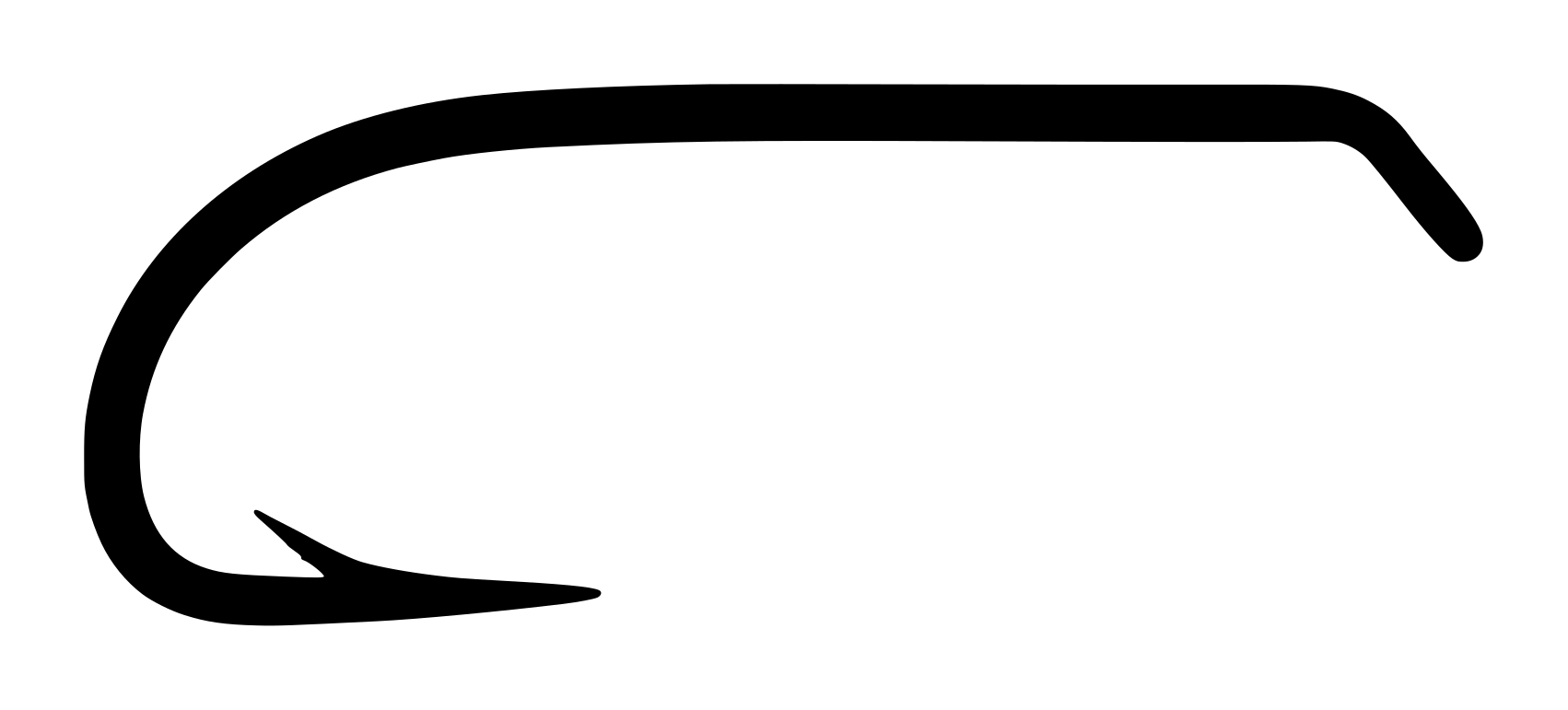
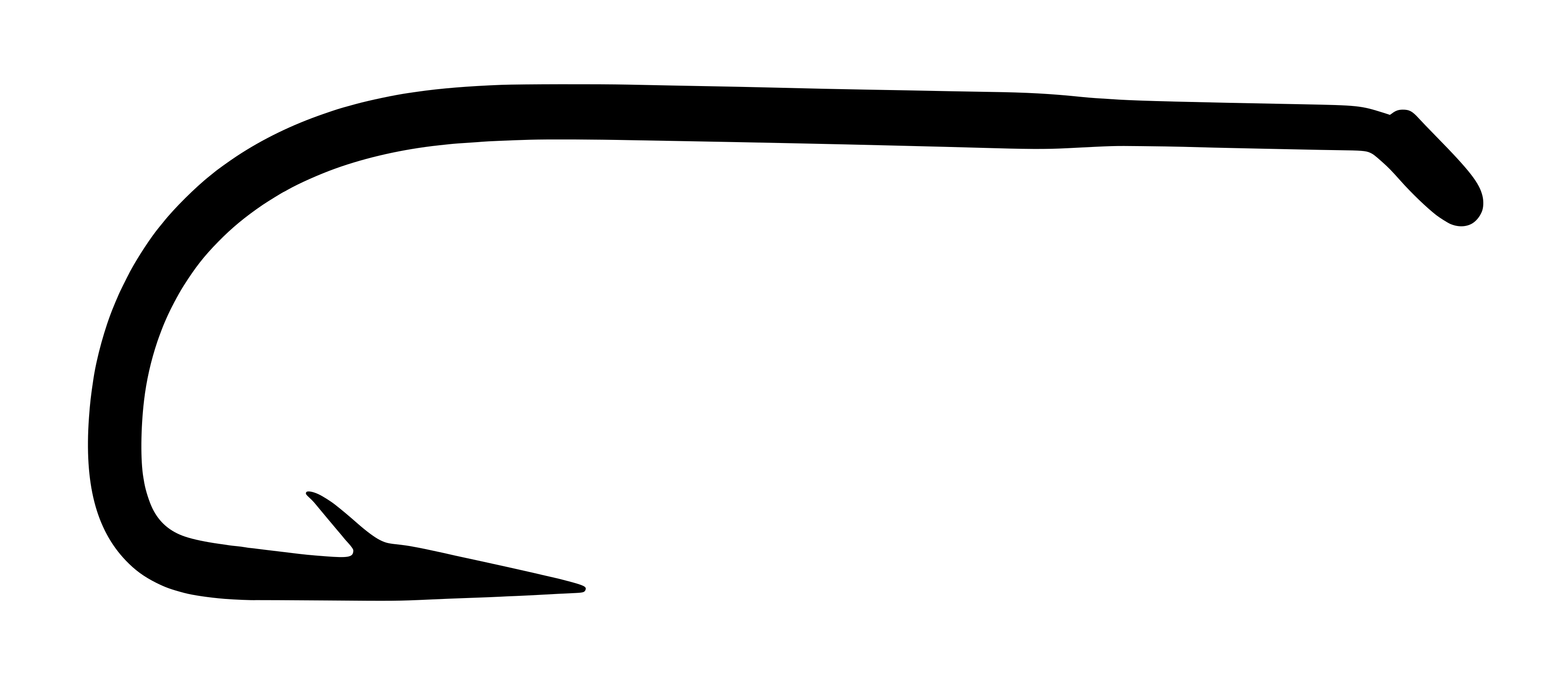
The Mustad 7935 C is a heavy-wire, hollow-point salmon hook manufactured by O. Mustad & Søn of Oslo, Norway. The model was marketed explicitly as ‘Mustad-Salmon Hooks’ and represents the company’s premium offering for Atlantic salmon and sea trout fly tying. The Limerick bend—characterized by its sharp, angular bottom angle—locks a fish’s jaw into the strongest point of the hook structure, making it ideal for traditional feather-wing and hair-wing salmon fly construction. The hollow point enables rapid tissue penetration with minimal force, essential for soft-mouthed salmonids. The extra-strong wire and soft-annealed ringed eye reflect purposeful engineering for both heavy bait presentations and delicate silk-whipping during classic fly dressing.
The specimen documented here is a salesman sample display card bearing a factory-overprinted ‘FREE SAMPLES’ label, a rare distribution artifact from Mustad’s mid-century international trade network. The card displays the complete size range from 10/0 down to size 6, representing the model’s scope for everything from heavy trolling to traditional small-stream salmon patterns. The bright finish has developed natural patina over 70–90 years of storage, but the original specifications remain entirely readable on the pasted yellow label bearing the iconic Key Brand downward-pointing key symbol. Production likely peaked during the interwar and immediate post-war periods, when Atlantic salmon angling was at peak cultural prestige in North America and the British Isles.
For collectors, the 7935 C holds significant value as a rare salesman sample format, a window into Mustad’s distribution strategy, and a premier example of Scandinavian hook engineering during the mechanical golden age. The specimen’s condition and intact factory overprint make it a desirable reference piece for specialists in Atlantic salmon history, Norwegian industrial design, or vintage fly-fishing tackle archives.
Close-up of the Mustad 7935 C point geometry showing the characteristic concave hollow grind from tip to barb base, enabling rapid penetration. Size 2/0, bright finish with natural patina.
Photographic record
3 cataloged imagesSelect any record to load it above.
3 images shown
Mustad 7935 C Size 2/0 Point Detail Hollow BrightClose-up of the Mustad 7935 C point geometry showing the characteristic concave hollow grind from tip to barb base, enabling rapid penetration. Size 2/0, bright finish with natural patina.Open originalMustad 7935 C Salesman Card Yellow Label FREE SAMPLES OverprintFactory-overprinted yellow label on the Mustad 7935 C salesman sample card, showing complete model specifications and 'FREE SAMPLES' trade distribution stamp. Key Brand downward-pointing key symbol is visible.Open originalMustad 7935 C Salesman Sample Display Card Complete Size SetComplete Mustad 7935 C salesman sample display card showing the full range of sizes from 10/0 down to size 6, mounted with red silk wrapping. Header reads 'O. MUSTAD & SON - Fishhook Manufacturers / Established 1832' with decorative borders. Yellow factory-overprinted label visible at lower right.Open original
Technical profile
Eye
Ball Eye, Straight / InlineRinged eye with soft annealed finish, as noted on label 'Soft ring.' This intentional softening of the eye wire prevents breakage during traditional silk whipping and knot tying with horsehair or gut snoods, reducing chipping or splitting of the wire under the tight wrapping pressure of period rigging techniques. P
Wire
Extra-Heavy (2X+), Round, Est. ~0.055"-0.065" (~1.4-1.65 mm)
Shank
Standard — Plain
Bend
Limerick, Standard gapSharp, angular bottom bend characteristic of Limerick pattern. This sharp angle locks the fish's jaw into the strongest point of the hook structure, preventing sliding or tearing during sustained battles. The Limerick bend provides an ideal straight canvas for mounting intricate feather wings on Atlantic salmon flies. P
Point
Hollow Point (concave inner face)Concave hollow point geometry, ground inward from tip to barb base. Produces a fine, sharp tip that flares rapidly toward the barb, enabling quick penetration with minimal force—essential for soft-mouthed Atlantic salmon and sea trout. The hollow grind provides the characteristic knife-edge effect visible in profile. P
Finish
Bright / Uncoated SteelLabeled 'Bright' on original packaging. The specimens show a polished high-carbon steel surface with natural patina development from decades of age. The finish maintains underlying bright character despite surface toning, typical of vintage Norwegian manufacture. P
Salesman sample card is structurally sound with all original hooks mounted and secure. Card stock shows light toning consistent with 1930s-1950s age; edges lightly worn but not compromised. Yellow label is intact, affixed, and legible, with 'FREE SAMPLES' overprint clearly visible. Hooks show natural patina and light surface corrosion typical of untreated bright finish over 70-90 years; no hooks appear to be missing. Silk wrapping on some hooks is slightly discolored but intact. Overall condition reflects careful storage but lack of active conservation. P
The hollow point geometry is specifically engineered for rapid, clean tissue penetration with minimal applied force. The concave inner face—ground inward from the very tip down to the barb base—creates a fine, razor-edge tip that flares rapidly toward the barb. This design is biomechanically optimized for soft-mouthed species like Atlantic salmon and sea trout, where aggressive hook-sets would tear friable buccal tissue, resulting in lost fish. The rapid flare ensures that once the microscopic tip penetrates past the barb, the hook holds securely in soft tissue without creating an oversized entry wound prone to tearing during the violent head-shakes characteristic of large salmonid runs.
The extra-heavy wire specification provides the structural mass required for heavy trolling, large natural baits, and the sustained stress of powerful anadromous species. Heavy wire also accommodates the large, ornate feather wings and tinsel bodies of traditional Atlantic salmon fly construction without collapsing under the weight of the dressing.
The ‘soft ring’ eye (annealed to reduced hardness) represents a deliberate metallurgical modification. Hard wire eyes are prone to cracking or splintering when subjected to the tight wrapping pressure of silk whipping during classic salmon fly construction and snelling with horsehair or silkworm gut snoods. Annealing softens the eye wire just enough to deform slightly under knot pressure rather than fracturing, extending the functional life of the hook during traditional rigging.
Size & scale lab
Selected size
(unspecified)
Physical specimen
Overall Length
37.5 mm
Shank Length
25 mm
Gap Width
16 mm
Bend Depth
15 mm
Shank-to-Gap Ratio
~1.5-1.8 : 1
Confidence
P
Physical specimen
Grid-derived from photograph (1/10" grid)
Own this hook? Help us measure it.
We don't have measured sizes for this hook yet. Own one? Submit calipered measurements and we'll review and add them. Thank you!
The Mustad 7935 series represents the company’s premium salmon and sea trout hook lineup, marketed explicitly as ‘Mustad-Salmon Hooks.’ Quality code 7935 places the hook in Mustad’s mid-to-upper tier categorization (3000-4000 range typically denotes quality models). The ‘C’ designation indicates a specific variant within the 7935 family, likely denoting a particular wire gauge or finish combination. Salmon hooks were a cornerstone of Mustad’s commercial output during the early-to-mid twentieth century, particularly for the Atlantic salmon fisheries of Scandinavia, the British Isles, and North America. The Limerick bend combined with hollow point technology was specifically engineered for traditional feather-wing and hair-wing Atlantic salmon fly construction. Salesman sample cards like this one served as crucial international trade tools, allowing distributors to assess hook sizes and qualities before committing to bulk orders (typically 100-hook boxes). The 7935 series remained in production through the mid-twentieth century but was eventually superseded during Mustad’s transition to modern Signature Series nomenclature circa 2001-2009.
Era and Packaging Dating
Label reads 'OSLO - NORWAY' rather than 'CHRISTIANIA - NORWAY', placing production after January 1, 1925 when the Norwegian capital was officially renamed. The pasted yellow 'Key Brand' label with 'FREE SAMPLES' stamp overprint is characteristic of mid-century Mustad trade displays sent to distributors and tackle shops. The offset/overprinted yellow label on salmon-colored card stock is consistent with 1930s-1950s Mustad international distribution practices. No barcode present (pre-1974 indicator). Letterpress printing with metal type is visible on label. Card construction and finish are consistent with inter-war and post-war manufacturing. PI
The Overprinted Label Strategy
The yellow pasted label bearing the 'FREE SAMPLES' stamp is a rare artifact of Mustad's mid-century international distribution strategy. Rather than simply printing salesman sample cards, Mustad maintained flexibility by overprinting smaller yellow labels with specific quality codes and specifications, then adhering them to generic salmon-colored card stock. This allowed the same card template to serve multiple hook models by simply changing the label—an economical but sophisticated approach to global inventory management. The survival of this particular overprint stamp is notable because many dealers and collectors removed or damaged these labels during use, making intact examples uncommon. The Key Brand logo—a downward-pointing skeleton key symbolizing that Mustad hooks were the literal 'key' to angling success—became so legally protected that Mustad famously litigated against competitors throughout the 20th century for any use of key imagery in fishing tackle branding.
Design lineage and influence
The Limerick bend originates in Irish blacksmith tradition, perfected by regional craftsmen in Limerick and refined for commercial manufacture by British hook-makers in Redditch. Mustad’s reverse-engineering of the Limerick pattern for industrial production was part of the company’s deliberate ‘cloning’ strategy—taking highly localized, regionally favored patterns and standardizing them for global export. The hollow point geometry represents an earlier innovation, likely derived from British light-tackle hooks and refined through mechanical grinding processes unique to Norwegian automated machinery. The 7935 C sits within a broader lineage of Atlantic salmon hooks produced by competitors including Partridge of Redditch, S. Allcock & Co., and various Redditch craft-era makers, all of whom produced similar Limerick-bend salmon patterns. The hollow point salmon hook concept eventually influenced modern dry fly and small stream trout designs, demonstrating how specialized salmon hook engineering cascaded into broader hook development. Modern equivalents like the Mustad SL53UBL continue the heavy-wire salmon tradition but typically employ darker finishes and contemporary eye designs.
Best matchRelated by Attribute
Computed automatically from catalog data — updated as new hooks are added.
Matches: Bend, Wire, Gap, Point, Forging +3 moreDiffers: Shank: Standard vs 1X Long; Eye: Ball Eye vs Tapered Eye; Eye Orient.: Straight / Inline vs Turned Down +2 more
Matches: Bend, Wire, Gap, Point, Forging +3 moreDiffers: Shank: Standard vs 1X Long; Eye: Ball Eye vs Tapered Eye; Eye Orient.: Straight / Inline vs Turned Down +4 more
The Mustad 7935 C was engineered as a premium salmon and sea trout hook, specifically marketed as the ‘Mustad-Salmon Hook.’ The heavy extra-strong wire combined with the hollow point geometry makes it ideal for Atlantic salmon wet flies, particularly traditional feather-wing patterns tied on larger shanks. The soft ring eye reduces breakage during knot tying with salmon rigging materials.
Secondary Applications
Steelhead wet flies, large saltwater bait presentations, trolling plugs and natural baits
Classic Fly Patterns
Named patterns specifically associated with this hook. Leave blank if none formally documented. Do not speculate — only include patterns with a confirmed association.
Modern Equivalents
Hook
Match Quality
Notes
Mustad SL53UBL
Good
Modern salmon hook retaining heavy wire and salmon application; similar bend family but with modern manufacturing and darker finish. Lacks the historical character and soft-ring annealing of the vintage 7935 C.
Partridge Limerick Salmon
Very Good
Redditch-made Limerick salmon hook with similar bend geometry and application. Maintains traditional manufacturing aesthetics and craftsmanship ethos comparable to vintage Mustad.
Tiemco 7989
Moderate
Modern salmon/steelhead hook with similar heavy wire gauge and bend profile, but engineered for contemporary fly-tying materials and techniques rather than traditional construction.
Collector notes
Rated 5.0/10 — uncommon in sample card format with complete hook set and factory overprint. Standard sizes (2/0 to 6) are easier to find than extreme sizes (10/0 or size 1 aught). Strong collector demand among Atlantic salmon fly tyers and Scandinavian tackle historians. Salesman sample cards command premium over individual cards due to rarity of complete sets and marketing significance.
Reference value
$28 – $75 USD estimate
Packaging condition
Very Good — light wear, fully legibleRecorded specimen
Packaging format
GW-MUS-01Catalog code
Positive Factors: Sample card format is significantly rarer than standard retail boxes, particularly with factory overprint stamp (‘FREE SAMPLES’). Complete intact set of sizes from 10/0 to size 6 demonstrates the full range and commercial scope of the model. Original yellow Mustad Key Brand label with overprint is a high-grade authentication marker. Heavy wire salmon hooks have strong demand from fly tyers building traditional Atlantic salmon patterns. Mustad brand name carries broad collector recognition. Late-vintage Mustad (1930s-1950s) pre-dates the transition to modern Signature Series nomenclature, making it valuable as a reference specimen.
Limiting Factors: Hollow point salmon hooks are less universally collected than dry fly hooks or smaller general-purpose bait patterns. The Limerick bend, while historically significant, is less iconic than Sproat or Aberdeen patterns in modern collector culture. Condition of individual hooks on card is fair to good (surface patina, some light corrosion visible), reducing condition premium. Salmon hooks were produced in volume for commercial markets, limiting true scarcity despite rarity in display card format.
Most Desirable Variants: Complete, sealed or near-sealed sample cards with factory overprint. Extreme sizes (8/0 and larger, or size 1 aught and smaller) command higher per-hook premiums than mid-range sizes. Cards with minimal hook loss and bright, undamaged Key Brand label are most valuable. Original salmon-colored card stock with crisp letterpress imprint is preferable to damaged or faded examples.
Condition Factors: Original packaging condition is critical—a complete, intact card with all hooks is worth 3-4× the value of a card missing hooks or damaged label. Bright finish and minimal patina add 15-20% premium. Hooks that remain securely fastened (original silk wrapping visible) add significant value over loose or partially detached hooks.
Packaging
Salesman sample display card, salmon/coral-colored card stock (~5.5" × 8.5"), bound along top edge. Features printed header in black serif type: 'O. MUSTAD & SON - Fishhook Manufacturers / Established 1832' with decorative ornamental borders. Hooks arranged in two rows (8 in upper row, 5 in lower row, plus 1 offset) mounted with red silk wrapping through eye, secured to card. Individual sizes marked in purple hand-written ink above each hook (10/0, 9/0, 8/0, etc.). Bottom of card: 'Oslo - Norway' in black serif type. Small yellow pasted label (circa 1.5" × 1.75") affixed lower right corner bearing gold/tan letterpress-printed text and Key Brand downward-pointing key symbol. Yellow label reads: 'O. MUSTAD & SON / MANUFACTURERS / OSLO - NORWAY / Qual. 7935 C / Brand / Hollow Point / Mustad-Salmon Hooks / Soft ring Bright / Extra strong / 100 No. / Made in Norway'. The phrase 'FREE SAMPLES' is stamped in purple ink across the yellow label, indicating this was a trade distribution item. Card shows light age patina, edges slightly worn, paper stock intact and structurally sound. Letterpress printing on label is crisp; Key Brand symbol clearly visible.
Market Value Notes
Low ($28): Opened salesman card, complete or nearly complete hook set (missing 1-2 hooks acceptable), fair condition with visible patina and light corrosion, label intact but with toning or minor wear.
High ($75): Sealed or effectively sealed salesman card with factory overprint, all hooks present and secure, bright finish with minimal patina, Key Brand label sharp and legible, original salmon-colored card stock pristine.
Premium factors: Factory 'FREE SAMPLES' overprint; complete size range; salesman card format (rare vs retail box); Mustad brand prestige; pre-1950s production; heavy wire salmon hook appeal; original packaging condition.
Platforms: eBay (US and UK specialty listings), Etsy vintage tackle dealers, online fly-fishing heritage shops, regional tackle shows and auctions in UK and Scandinavia.
Confidence: E estimated — based on comparable Mustad salesman sample cards and salmon hook pricing trends. Limited direct sold listings for this specific model. Estimate anchored to similar-era Mustad sample cards ($25-85 range) and salesman display premiums (2-3× retail card value).
Where to Find
eBay UK and US (search 'Mustad 7935 salesman sample'), specialty vintage tackle dealers focusing on Scandinavian manufacture, regional tackle auctions in UK and Norway, online fly-fishing heritage marketplaces. Salesman sample cards are rarer than standard retail stock and may appear only sporadically.
Preservation
Storage and Preservation
Display and Storage: Store the salesman sample card in a cool, dry environment away from direct sunlight, humidity, and moisture. The bright steel finish is susceptible to oxidation and rust development if exposed to high humidity. Original card packaging adds tremendous value—always preserve the card as the primary storage medium rather than removing hooks or displaying them loose.
Condition Maintenance: The natural patina that has developed on the bright finish over decades is generally considered desirable by collectors and does not require removal. Aggressive polishing or chemical rust removal will damage the historic character and significantly reduce collectability. If surface corrosion becomes active (red/brown rust bloom), store the card in a sealed container with silica gel or acid-free desiccant packets to reduce humidity. Replace desiccant every 6-12 months.
Packaging Preservation: The yellow factory-overprinted label is the primary authentication and dating marker—protect it from any contact, removal attempts, or adhesive restoration. The pasted label should never be lifted, peeled, or repositioned. If the label begins to lift naturally due to age, secure it with small amounts of pH-neutral, reversible adhesive (such as conservation-grade paste used in archives). Avoid modern pressure-sensitive tape, rubber cement, or super glue.
Handling: Handle the card by its edges only, wearing cotton gloves to prevent skin oils from transferring to the paper stock or hooks. Avoid folding, creasing, or bending the card. Store flat in an archival box lined with acid-free tissue paper. Do not stack other cards or heavy objects on top of the specimen.
Photography and Documentation: If documenting the card for personal reference or collection records, photograph the label, header text, and a full view of the complete hook set while maintaining consistent lighting and color temperature. Create a backup digital copy for insurance and research purposes.
Marking Analysis
Handwritten Annotations and Markings
Purple Ink Hook Size Labels: The individual hook sizes printed above each mounted specimen (10/0, 9/0, 8/0, 7/0, 6/0, 5/0, 4/0, 3/0, 2/0, 1/0, 1, 2, 4, 6) are written in purple ink in a consistent, semi-formal script. This was likely applied by factory workers or warehouse staff during the initial assembly of the sample card, not by collectors or end-users. The uniformity of stroke weight, letter height, and spacing suggests it was applied with a ruling template or guide rather than freehand. This purple-ink labeling was standard practice on Mustad sample cards from this era to assist distributors in identifying sizes at a glance. P
Factory ‘FREE SAMPLES’ Overprint: The purple-ink stamp reading ‘FREE SAMPLES’ was applied directly across the yellow factory label, indicating the card’s intended use as a trade distribution sample rather than a retail sale item. This stamp is crisp and well-struck, suggesting a metal die or stamp was used. The presence of this overprint significantly increases collectability because it documents Mustad’s international distribution strategy and marks the card as an authentic, unmodified trade artifact. P
Absence of Later Annotations: No pencil notes, dealer marks, or personal collection annotations are visible on the specimen, suggesting it has been carefully preserved in its original condition without heavy handling or use in the dealer or collector market. This cleanliness adds to its value as a reference specimen. P
Primary Source
Packaging Text Analysis and Historical Interpretation
Source: Mustad 7935 C salesman sample card label, letterpress and overprint, c. 1930s-1950s
‘OSLO – NORWAY’ Geographic Origin: The label explicitly states ‘OSLO – NORWAY’ rather than the earlier ‘CHRISTIANIA – NORWAY.’ This is a critical dating marker. Oslo was the official name of the Norwegian capital from January 1, 1925 onward. The absence of ‘Christiania’ conclusively places this specimen’s manufacture and labeling after 1925. The use of ‘Oslo’ alone (not paired with ‘Gjøvik,’ where Mustad’s factory actually operated) reflects corporate branding practice—Mustad maintained Oslo as the primary business headquarters and used it as the geographic identifier on all international export packaging. PV
‘MANUFACTURERS’ Designation: The label emphasizes ‘O. MUSTAD & SON / MANUFACTURERS,’ a direct assertion of primary industrial authority. This distinction was historically vital because the tackle trade was saturated with import agents, jobbers, and regional repackagers who purchased bulk hooks and sold them under secondary brand names. By cementing their role as the primary manufacturers, Mustad ensured brand retention and customer loyalty directly from end-users, regardless of the distribution network. I
‘Qual. 7935 C’ Model Code: The quality code follows Mustad’s hierarchical numeric system (referenced in detail in the reference document). The 7935 series, with the C variant suffix, occupied the mid-to-premium tier. Mustad segmented their catalog into: economy models (1000-2999), quality models (3000-3999), and premium models (4000+). The 7935 C, falling outside these ranges, represents a specialty designation for a specific salmon hook variant. The C suffix likely denotes a particular wire gauge, tempering standard, or finish combination within the base 7935 pattern. IV
‘Hollow Point’ Specification: The explicit labeling of ‘Hollow Point’ as a distinct feature reflects Mustad’s biomechanical engineering. Line 5 of vintage Mustad labels was strictly reserved for point geometry specification, confirming that penetration capability was a primary selling point for salmon hooks. The hollow grind enabled rapid, clean tissue penetration with minimal force—essential marketing language for soft-mouthed Atlantic salmon targeting. PV
‘Mustad-Salmon Hooks’ Commercial Designation: The label identifies the product as ‘Mustad-Salmon Hooks’ (note: hyphened as a brand modifier). This reflected Mustad’s strategy of producing region-specific and species-specific hook variants under the Mustad umbrella. Just as they offered ‘Cincinnati Bass Hooks,’ ‘Limerick Hooks,’ and ‘Virginia Hooks’ as cloned regional patterns, ‘Mustad-Salmon Hooks’ asserted that these were premium offerings specifically optimized for Atlantic salmon and sea trout angling. PV
‘Soft ring’ Eye Description: The notation ‘Soft ring’ is a technical specification indicating the ringed eye was annealed (softened) to reduce hardness. This was not ornamental language but a specific metallurgical modification. Soft-annealed eyes deform slightly under the wrapping pressure of silk whipping and knot tying rather than cracking or splintering. This detail reveals Mustad’s sophisticated understanding of the connection between material properties and real-world rigging practices in the pre-monofilament era. V
‘Bright’ Finish Designation: The label explicitly states ‘Bright,’ indicating a polished high-carbon steel finish without secondary metallic plating, lacquer, or chemical coating. Bright finishes were preferred for freshwater applications where maximum metallic flash was desired, in contrast to japanned (black), bronzed, or tinned finishes used for saltwater or stealthy presentations. The bright designation also suggests these hooks were engineered for visual attraction in clear, fast-moving Atlantic salmon rivers. PV
‘Extra strong’ Wire Specification: The emphasis on ‘Extra strong’ as a separate line item (not merely ‘heavy wire’) reflects Mustad’s marketing language for premium tensile strength and structural rigidity. Heavy wire prevents bending and straightening under the sustained stress of powerful anadromous species. The repetition of strength messaging on the label underscores that durability was a primary value proposition for salmon hooks. V
‘Made in Norway’ Attribution: The explicit ‘Made in Norway’ statement was a badge of prestige. Norwegian manufacturing became synonymous with automated precision and industrial excellence during the 20th century, particularly after Mustad’s 1877 innovation of the first fully automated hook-making machine. This attribution reinforced the perception of Scandinavian engineering superiority in the eyes of British and American tackle buyers. I
‘100 No.’ Quantity Statement: The statement of ‘100 No.’ confirms that standard commercial boxes contained 100 hooks per package. This was the international wholesale standard for hook packaging, enabling predictable inventory management and consistent wholesale pricing. V
‘FREE SAMPLES’ Overprint Significance: The purple-ink factory stamp ‘FREE SAMPLES’ transforms the card from a point-of-purchase retail item into a trade distribution artifact. Sample cards were sent to wholesalers, distributor sales representatives, and tackle shop owners to showcase the complete size range and specifications before committing to bulk box purchases. This overprint documents Mustad’s mid-century distribution methodology and the strategic role that physical samples played in international commercial negotiation. PI
Additional
Atlantic Salmon Hook Tradition and the Limerick Bend
The Irish Blacksmith Origin: The Limerick bend originates in the hand-forged traditions of Irish and northern English blacksmiths, particularly in the town of Limerick and the manufacturing centers of Redditch, England. The distinctive sharp, angular bend at the very bottom of the hook was engineered to lock a fish’s jaw into the strongest structural point of the hook, preventing sliding or tearing during the violent, protracted battles characteristic of large Atlantic salmon. This geometric innovation reflects deep, practical knowledge of fish anatomy and the mechanics of materials under stress.
Mustad’s Industrial Replication: When Mustad reverse-engineered the Limerick pattern for automated mass production, they did not diminish its character—rather, they standardized it, making consistent, high-quality Limerick bends available globally at prices far below those of hand-forged Redditch craft hooks. This democratization of the Limerick bend was transformative for Atlantic salmon angling in North America, where access to premium British hooks had previously been expensive and limited. The 7935 C represents this industrial triumph: a precision-manufactured Limerick bend available to North American anglers at scale.
The Soft Ring Innovation: Mustad’s decision to anneal the ring eye for salmon hooks reflects the company’s sophisticated understanding of traditional salmon fly-tying practices. The classic method involved binding a silk fly to the hook using tight wrapping with silk thread and pitch, or lashing with horsehair and gut snoods. Hard, brittle eyes would crack or splinter under this pressure. The soft ring deforms slightly, absorbing the stress and preventing fracture. This is engineering in service of established tradition—a hallmark of Scandinavian manufacturing excellence.
The Cultural Peak of Atlantic Salmon Angling: The 7935 C was manufactured during the interwar period and post-war era, when Atlantic salmon angling reached peak cultural prestige in North America and the British Isles. Legendary anglers like Zane Grey championed Atlantic salmon fishing in their writing and photographs. The tradition of the exotic, expensive salmon fishing trip to Scotland, Norway, or Eastern Canada became a status marker for wealthy North American anglers and industrialists. The Mustad 7935 C, marketed as a premium ‘Mustad-Salmon Hook,’ capitalized on this prestige and made participation in the Atlantic salmon tradition accessible to a broader class of anglers than ever before.
Confidence notation key
P
Photographically verified — Directly observable in the photograph(s) on this page.
V
Verified by documentation — Confirmed by manufacturer catalog, spec sheet, or published reference.
I
Inferred — A logical deduction from observable or documented evidence, not directly stated.
E
Estimated — An approximation based on visual comparison, proportional analysis, or limited data.
S
Speculative — A reasoned hypothesis that cannot be confirmed from available evidence.
Unnotated claims are the compiler’s synthesis; see Sources. All photographs on garrenwood.com are taken on a measurement grid where each square equals 1/10 inch (0.1″ / 2.54 mm).