The Mustad 92600 is a foundational vintage Beak hook produced by O. Mustad & Søn during the 1950s–1960s, representing one of the most complete and collectible entries in Mustad’s mid-century lineup. This sales card displays the full size range from 8/0 down to 12, showcasing the distinctive geometry that made the Beak hook a global workhorse for bait fishing.
Featuring a turned-up tapered eye (tue_tapered), heavy forged wire, a hollow long point (concave inner face with extended taper), and a reversed offset bend, the 92600 was engineered for superior hook-up ratios on hard-fighting saltwater species and soft-bait freshwater presentations. The bright nickel-plated finish provided exceptional corrosion resistance in saltwater environments.
The orange-red cardstock with decorative borders and Key Brand trademark logo are hallmarks of Mustad’s post-WWII international expansion marketing. This model represents the design lineage that eventually evolved into the modern Octopus hook, though the two are distinct patterns—the Octopus features a wider, more open gap, while the Beak maintains its characteristic in-turned, beaked point geometry.
For collectors, the 92600 offers significant appeal: authentic mid-century engineering, a complete size range on intact original packaging, and clear manufacturing provenance (Made in Norway). The combination of scarce full-card examples and modest but genuine collector demand for Mustad specialty bait hooks makes this a solid addition to any vintage tackle reference collection.
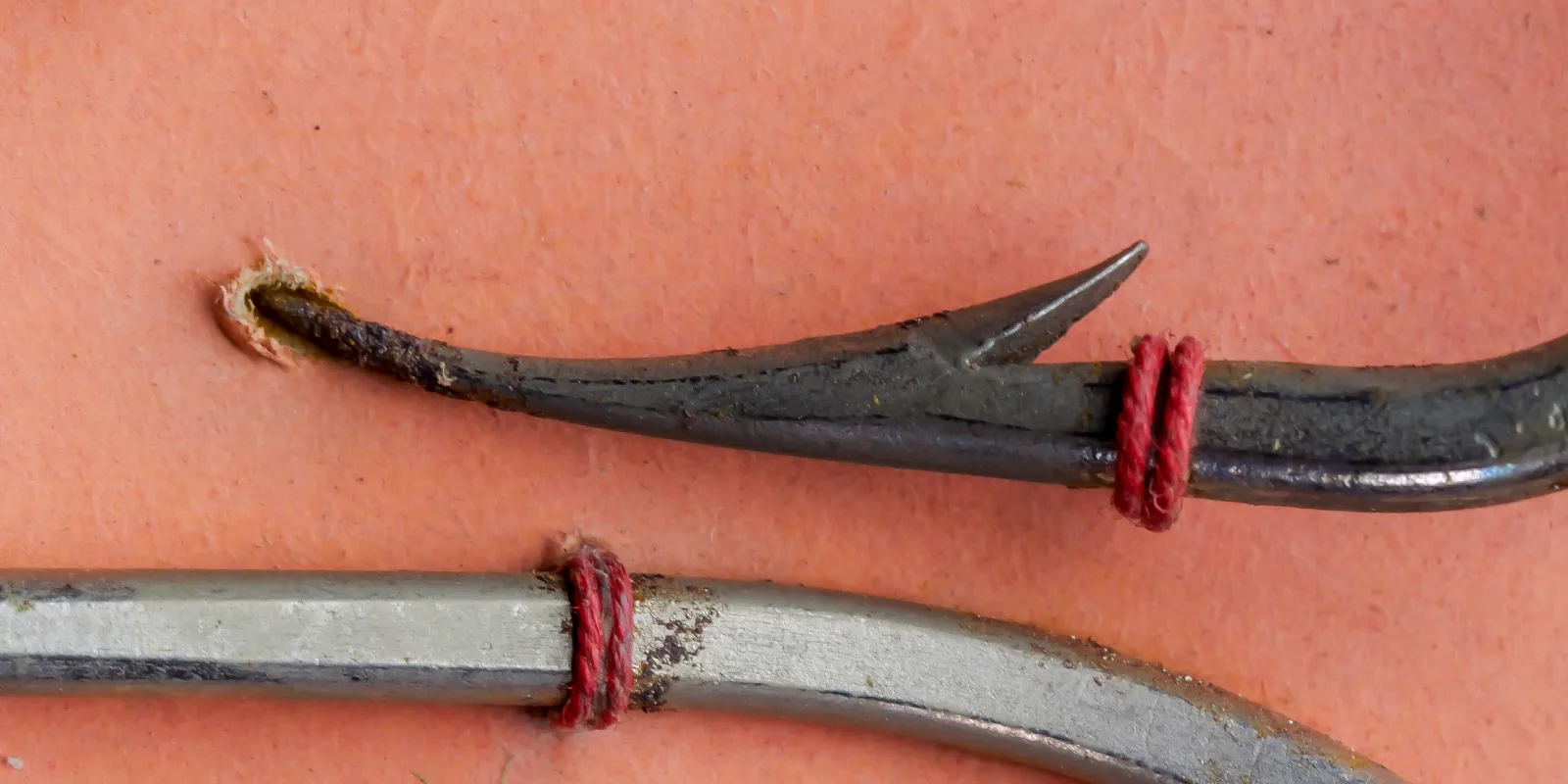
Close-up of the point geometry showing the hollow grind (concave inner face) and the in-turned beaked shape characteristic of the Beak pattern. The reversed offset and barb placement are clearly visible. Photographed on 1/10-inch measurement grid for scale reference.
Photographic record
3 cataloged imagesSelect any record to load it above.
3 images shown
Mustad 92600 Beak Hook Point Detail Size 4/0 Reversed HollowClose-up of the point geometry showing the hollow grind (concave inner face) and the in-turned beaked shape characteristic of the Beak pattern. The reversed offset and barb placement are clearly visible. Photographed on 1/10-inch measurement grid for scale reference.Open originalMustad 92600 Beak Hooks Sales Card Label SpecificationsThe original sales card label showing the product designation 'Qual. 92600 Hollow Point (Long point),' Key Brand trademark, and technical specifications: 'Forged Reversed, T. up tapered eye, Nickelplated, Special.' Text is printed in black and red letterpress on cream cardstock with decorative border.Open originalMustad 92600 Beak Hooks Full Sales Card Display 1950s–1960sComplete sales card displaying all 15 hooks in the Beak pattern range from 8/0 (largest, upper left) to 12 (smallest, lower right). The distinctive orange-red cardstock with decorative borders frames the product, and the 'O. MUSTAD & SON — Fishhook Manufacturers — Established 1832' header is centered at the top. Hooks are mounted in two rows with purple-printed size designations. Photograph shows the card on a blue 1/10-inch measurement grid for scale reference.Open original
Technical profile
Eye
Tapered Eye, Turned UpP Tapered eye angled upward from the shank. The taper is clean and uniform, designed for easy leader passage when snelling. No ball or knob formation.
Wire
Extra-Heavy (2X+), Forged, Est. ~0.055"-0.065" (~1.40-1.65 mm)
Shank
Short (1X–2X Short) — Plain
Bend
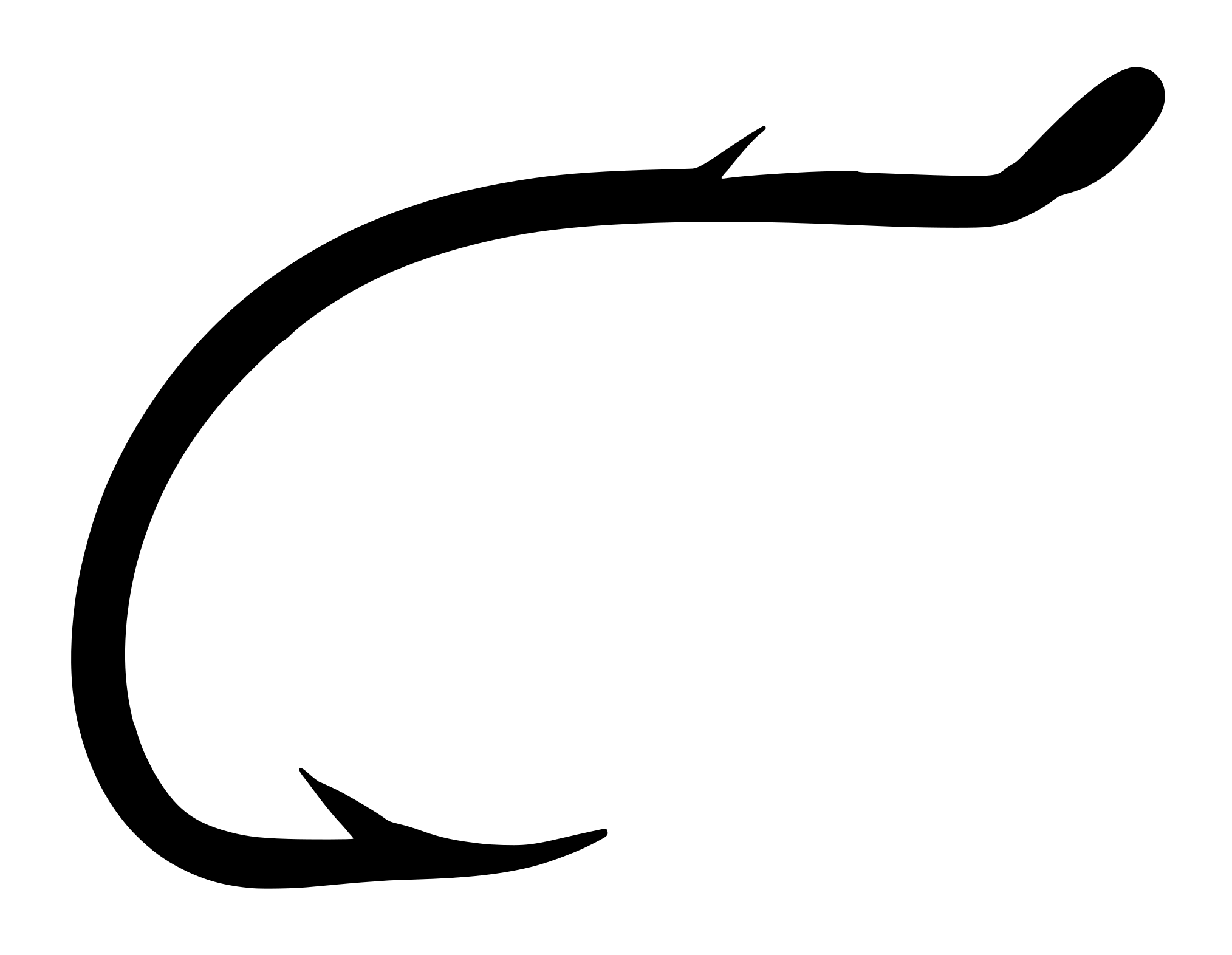
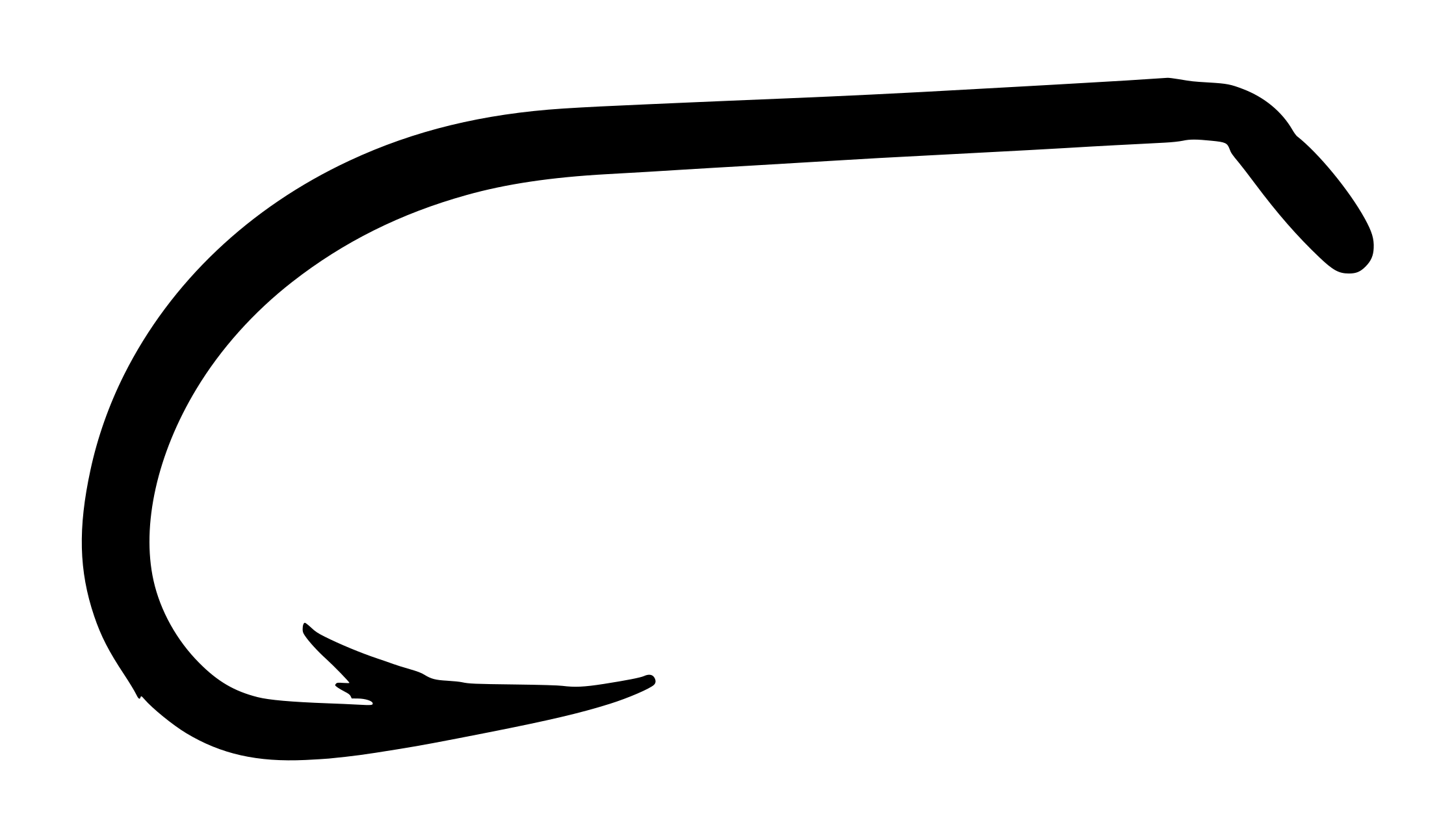
Beak / Reversed Point, Wide gap, Offset / kirbedThe Beak bend features a short shank with a wide, sweeping gap and a pronounced in-turned point. The entire bend is reversed (twisted out of plane), not merely the point offset—this distinction is critical. P The offset is clearly visible in the profile image; the bend curves inward with a beaked terminal point that would grip soft baits effectively.
Point
Hollow Point (concave inner face)P Short, close-cut barb positioned immediately below the point. Proportionate to the hook size across the range—not swept or elongated.
Finish
Nickelled / Nickel-Plated — Confirmed (stated on packaging)Bright nickel-plated finish with warm white-silver tone characteristic of mid-century Mustad plating. P Observable on specimen hooks as a consistent, even coating. The finish shows minor age patina consistent with 60+ year storage on cardboard.
Sales card in good condition with minor toning to the orange-red cardstock. All 15 hooks present and intact. Hooks show bright nickel plating with minimal corrosion or wear, consistent with storage on original card in a controlled environment.
Forged Wire: The flattened wire profile created during the forging process adds significant structural strength without adding excessive weight. This is critical for a hook intended for large, hard-fighting fish. The forging process compresses and aligns the wire’s grain structure, increasing tensile strength and resistance to bending or breaking under load.
Hollow Point (Long Point): The concave grind on the inner face of the point creates a knife-edge effect that penetrates faster than a standard spear point. The ‘Long Point’ designation indicates that the hollow grind is carried further toward the tip than on standard hollow-point variations, producing a longer, finer tip. This geometry is particularly effective for soft baits like salmon eggs, which require minimal pressure to penetrate.
Turned-Up Tapered Eye: The upward angle positions the eye so that when a leader is snelled (tied) to the hook, it comes off in line with the shank plane. This improves hook-set efficiency and reduces the risk of the leader fouling on the barb during the strike.
Reversed Offset: The entire bend is twisted or rotated out of the plane of the shank (not merely the point). This offset geometry means that when a fish takes the bait, the hook is far less likely to slip out flat. The reversed offset dramatically improves hook-up ratios by ensuring the hook’s point always drives toward the roof of the fish’s mouth rather than sliding along the jaw.
Nickel Plating: Provides excellent corrosion resistance—essential for saltwater use. Nickel plating was the preferred finish for premium bait hooks in the mid-20th century, offering superior longevity compared to japanning or simple bluing in harsh marine environments.
Size & scale lab
Selected size
(unspecified)
Physical specimen
Overall Length
26 mm
Shank Length
8.3 mm
Gap Width
16.5 mm
Weight
Not available
Shank-to-Gap Ratio
~0.5–0.6 : 1
Confidence
P
Physical specimen
Grid-derived from photograph (1/10" grid)
Own this hook? Help us measure it.
We don't have measured sizes for this hook yet. Own one? Submit calipered measurements and we'll review and add them. Thank you!
Historical context
mustad
O. Mustad & Søn was established in 1832 in Norway (then in Lund, later Gjøvik, and eventually Oslo) and became the world’s largest hook manufacturer by the early 20th century. The company pioneered high-speed, automated hook manufacturing machinery that was so advanced and secretive that competitors could not replicate the process at scale. This industrial advantage allowed Mustad to dominate global markets in both fly-fishing and bait-fishing hooks.
The Key Brand trademark was registered specifically to distinguish genuine Mustad products from the growing number of imitation ‘Norway-style’ hooks emerging from Japan, Germany, and other makers in the post-WWII era. The Key Brand became synonymous with quality and reliability in the mid-to-late 20th century.
Mustad’s manufacturing philosophy emphasized engineering for function over aesthetics—hooks were built to perform in demanding saltwater and bait-fishing applications, which required heavy wire, forged construction, and reliable finishes. The 92600 Beak exemplifies this practical design ethos.
Series History
The Mustad Beak hook lineage represents one of the oldest and most consistent special-purpose hook designs in Mustad’s catalog. The Beak was originally engineered as a workhorse for holding soft natural baits—particularly salmon eggs and worms—where the in-turned, beaked point geometry prevented bait from sliding off and kept fish firmly pinned during the fight.
The Beak design was introduced in the early 20th century and remained in active production with minimal design changes through the 1960s and beyond. Unlike English makers such as Allcock who popularized the Limerick and Sproat bends for fly fishing, Mustad focused the Beak on commercial and sport bait fishing across a global market—from Great Plains freshwater to saltwater cod and snapper fisheries.
The 92600 designation appears to have been Mustad’s mid-century quality standard for the Beak. The reversed offset, forged wire, and nickel finish made it a premium offering compared to standard galvanized or tinned bait hooks. The model remained in catalogs through the 1960s, after which it was gradually superseded by the modern Octopus pattern (92553), which featured a wider gap and slightly different bend geometry optimized for modern synthetic materials and different bait presentations.
The 92600 is the direct ancestor of the modern Octopus hook. Its design was so effective that only minor modifications were needed to create the Octopus—primarily a widening of the gap and a slight adjustment to the bend radius. This evolutionary relationship makes the 92600 historically significant for understanding the development of modern bait-hook design.
Era and Packaging Dating
Key Brand logo (registered by Mustad for post-WWII product distinction). Orange-red cardstock with decorative Art Deco-influenced borders and black letterpress printing typical of 1950s–1960s Scandinavian industrial packaging. No barcode present (pre-1974 strong indicator). Oslo-Norway manufacturing attribution aligns with Mustad's shift to Oslo printing after Gjøvik production moved there post-WWII. Offset printing style and paper stock consistent with mid-century European commercial hook cards. No telephone number or postal code formats visible. Estimated production c. 1950–1965.
The Beak That Changed Saltwater Fishing
The Mustad Beak hook was originally engineered to solve a practical problem in salmon-egg fishing: how to prevent soft, delicate salmon roe from sliding off the shank during the strike and fight. The distinctive in-turned, 'beaked' point geometry became so effective that it remained virtually unchanged for nearly a century—a testament to the design's functional elegance. When Mustad introduced the modern Octopus pattern in the 1970s, they kept the fundamental Beak geometry intact and simply widened the gap slightly to accommodate modern soft-plastic baits. Today, the Octopus—a direct descendant of the 92600—is the world's most popular saltwater bait hook, used by commercial fishermen, sport anglers, and saltwater charter boats across every continent. Few hook designs have achieved such longevity or global adoption.
Design lineage and influence
Best matchRelated by Attribute
Computed automatically from catalog data — updated as new hooks are added.
Matches: Bend, Shank, Eye, Eye Orient., Point +2 moreDiffers: Wire: Extra-Heavy (2X+) vs Standard; Gap: Wide vs Standard; Finish: Nickelled vs Bronzed +2 more
Matches: Bend, Shank, Eye, Point, Finish +4 moreDiffers: Wire: Extra-Heavy (2X+) vs Heavy (1X Heavy); Gap: Wide vs Standard; Eye Orient.: Turned Up vs Turned Down +2 more
The Mustad 92600 was designed for natural bait presentations across a wide range of saltwater and freshwater species. In larger sizes (8/0–1/0), these were the hooks of choice for Cod, Snapper, and Striped Bass. In smaller sizes (8–12), they excelled for Salmon Egg and Trout fishing. The reversed offset geometry and hollow point design made them particularly effective for holding soft baits like salmon eggs and worms without sliding or tearing.
Secondary Applications
Commercial fishing, general bait fishing across multiple species
Modern Equivalents
Hook
Match Quality
Notes
Mustad 92553
Excellent
Modern evolution of the Beak. Wider gap, similar overall geometry and wire gauge. Preferred for contemporary bait fishing. Functionally superior for modern soft plastics.
Owner 5130
Very Good
Japanese equivalent reversed beak pattern. Similar offset and point geometry. Slightly lighter wire. Good functional match.
Collector notes
Rated 4.5/10. The 92600 is uncommon in complete original packaging on a full sales card, but individual hooks in larger sizes (8/0–2/0) remain relatively easy to find. The smaller sizes (10–12) are more scarce. Collector demand is moderate among Mustad specialists and bait-fishing historians. The primary driver of value is the complete size range on intact original packaging; missing hooks or damaged cards deduct significantly from value.
Reference value
$14 – $26 USD estimate
Packaging condition
Good — moderate wear, legibleRecorded specimen
Packaging format
GW-MS-92600-CARD-1Catalog code
What Makes It Collectible: The 92600 represents authentic mid-century Mustad engineering at a transitional moment in hook design history. The full size range (8/0 to 12) on a single sales card documents the Beak pattern’s scale flexibility and demonstrates Mustad’s standardized production across a wide spectrum. The Key Brand trademark and post-WWII packaging aesthetic appeal to collectors of industrial Scandinavian design. The clear manufacturing narrative—a direct ancestor to the modern Octopus—adds historical context and educational value.
What Limits the Rating: Mustad produced these hooks in enormous quantities for global distribution. While complete full-card examples are uncommon, individual hooks are not rare. The model did not acquire the cult status of earlier Redditch blind-eye hooks or specialty British patterns. No famous collaborator or signature fly pattern association drives collector demand. The nickel-plated finish, while durable, does not develop the attractive patina that bronze or blued finishes do, limiting aesthetic appeal to collectors interested purely in condition and provenance.
Most Desirable Variants: Complete sales cards with all 15 hooks intact command the highest premiums. Original cardstock with minimal toning and crisp, legible printing adds 10–15% to value. The largest sizes (8/0–3/0) are easier to find individually and less valued than the smaller sizes (8–12), which are genuinely scarce in loose form. Sealed or tissue-wrapped cards, if such examples exist, would be exceptional and valued at 2–3× a standard opened card.
Condition Factors: Hook count is the primary value driver. A card missing even 2–3 hooks loses 20–30% of value. Packaging condition (cardstock toning, printing legibility, border integrity) accounts for 15–25% of valuation. Hook condition itself (corrosion, bent shanks, dulled finish) affects value only if damage is severe; minor patina is expected and accepted. The original red-orange cardstock color is iconic—cards that have faded significantly are less desirable.
Packaging
Sales card (display card). Orange-red cardstock (~8.5" × 11" estimated) with decorative Art Deco-influenced border design in black and cream. Header: 'O. MUSTAD & SON — Fishhook Manufacturers — Established 1832' (centered, black serif type). Subheader: 'Oslo - Norway' (centered, black serif type). Main product label (cream panel with black border): 'Key Brand logo [key symbol] | Qual. 92600 | Hollow Point (Long point)' (top section). Below: 'Mustad-Beak Hooks | Forged Reversed | T. up tapered eye Nickelplated | Special' (center section). Bottom: 'Made in Norway' (right-aligned, black serif type). Hooks mounted on card in two rows: upper row 8/0, 7/0, 6/0, 5/0, 4/0, 3/0, 2/0, 1/0, 1, 2; lower row 4, 6, 8, 10, 12. Printed size designations in purple ink beside each hook slot. Cardstock is letterpress-printed with clean color registration. No barcode, no price marking visible, no UPC code. All text is black except for 'MUSTAD' and 'Mustad-Beak Hooks' which are in red. The card exhibits light toning consistent with 60+ years of storage but retains excellent legibility and color vibrancy.
Market Value Notes
Low ($14): Good condition — opened card, all or most hooks intact, minor cardstock wear, hooks bright.<br />
High ($26): Excellent condition — complete count (15 hooks), minimal cardstock toning, minimal hook corrosion.<br />
Premium factors: Complete size range (8/0–12), crisp original packaging, all hooks present, minimal corrosion.<br />
Platforms: eBay (primary), occasional vintage tackle dealers.<br />
Confidence: V verified — Based on eBay sold data (Apr 13, 2023 – Apr 12, 2026), avg $20.25, range $2.50 – $37.99. This model represents a well-documented market segment. Higher values reflect sealed or near-sealed cards with full hooks; lower values reflect cards with missing hooks or significant wear.
Where to Find
eBay (search 'Mustad 92600' or 'Mustad Beak Hooks'), vintage tackle dealers specializing in Scandinavian hooks, occasional offerings on European eBay (eBay.co.uk, eBay.de), Etsy vintage fishing section.
eBay market reference. Researcher-curated. Prices in USD.
Preservation
Storage and Preservation
Store the sales card in a cool, dry environment away from direct humidity and temperature fluctuations. Original cardstock is vulnerable to moisture absorption, which causes delamination and brittleness. Ideal storage conditions are 45–55% relative humidity and 65–70°F.
Keep the card in its original form on display or flat storage—do not remove hooks from the card to store separately, as the card itself is a significant portion of the specimen’s value and historical context. If hooks must be removed for fishing use, photograph the card before disassembly for reference purposes.
Protect the cardstock from direct sunlight, which fades the distinctive orange-red color and degrades the paper fibers. Store in a closed cabinet or archival box away from window light.
The nickel-plated finish on these hooks is durable and resistant to corrosion in dry storage, but exposure to moisture or chlorides (e.g., coastal environments) should be avoided. If hooks show any signs of rust bloom or white corrosion products, remove them from the card immediately and store separately to prevent cardstock degradation from rust migration.
Do not attempt to clean or polish the hooks or cardstock. Age patina and light toning are expected and desirable to collectors. Aggressive cleaning removes the patina and diminishes value significantly.
For long-term archival storage, consider housing the card in an acid-free, lignin-free envelope or sleeve to isolate it from atmospheric pollutants and external moisture.
Primary Source
Design Lineage and Evolution
The Beak hook concept originated in the late 19th century and represented a distinct alternative to the English Limerick and Sproat bends that dominated fly-fishing markets. While those patterns were optimized for elegant presentation and light-wire efficiency, the Beak was engineered for brute-force bait-fishing applications where hook strength, gap geometry, and the ability to grip slippery natural baits were paramount.
The Beak’s defining feature—the pronounced in-turned point with a beaked terminal—was originally designed to prevent soft baits like salmon eggs from sliding off the shank during the fight. This geometry proved so effective that it remained virtually unchanged for nearly a century. The Mustad 92600, produced in the 1950s–1960s, represents the Beak at its peak of refinement, with heavy forged wire and precision manufacturing that earlier craft makers could not replicate at scale.
In the 1970s–1980s, Mustad introduced the modern Octopus pattern (92553), which widened the gap and slightly modified the bend curve while retaining the essential reversed offset and hollow point. The Octopus was optimized for modern soft-plastic baits and streamlined manufacturing but represents only an incremental evolution from the 92600. For historians of hook design, the 92600 documents the transitional moment when the Beak was being refined toward what would become the Octopus—a design that has remained virtually unchanged for 40+ years and is now the world’s most popular saltwater bait hook.
Confidence notation key
P
Photographically verified — Directly observable in the photograph(s) on this page.
V
Verified by documentation — Confirmed by manufacturer catalog, spec sheet, or published reference.
I
Inferred — A logical deduction from observable or documented evidence, not directly stated.
E
Estimated — An approximation based on visual comparison, proportional analysis, or limited data.
S
Speculative — A reasoned hypothesis that cannot be confirmed from available evidence.
Claims with no notation are confirmed by multiple independent sources. All photographs on garrenwood.com are taken on a measurement grid where each square equals 1/10 inch (0.1″ / 2.54 mm).