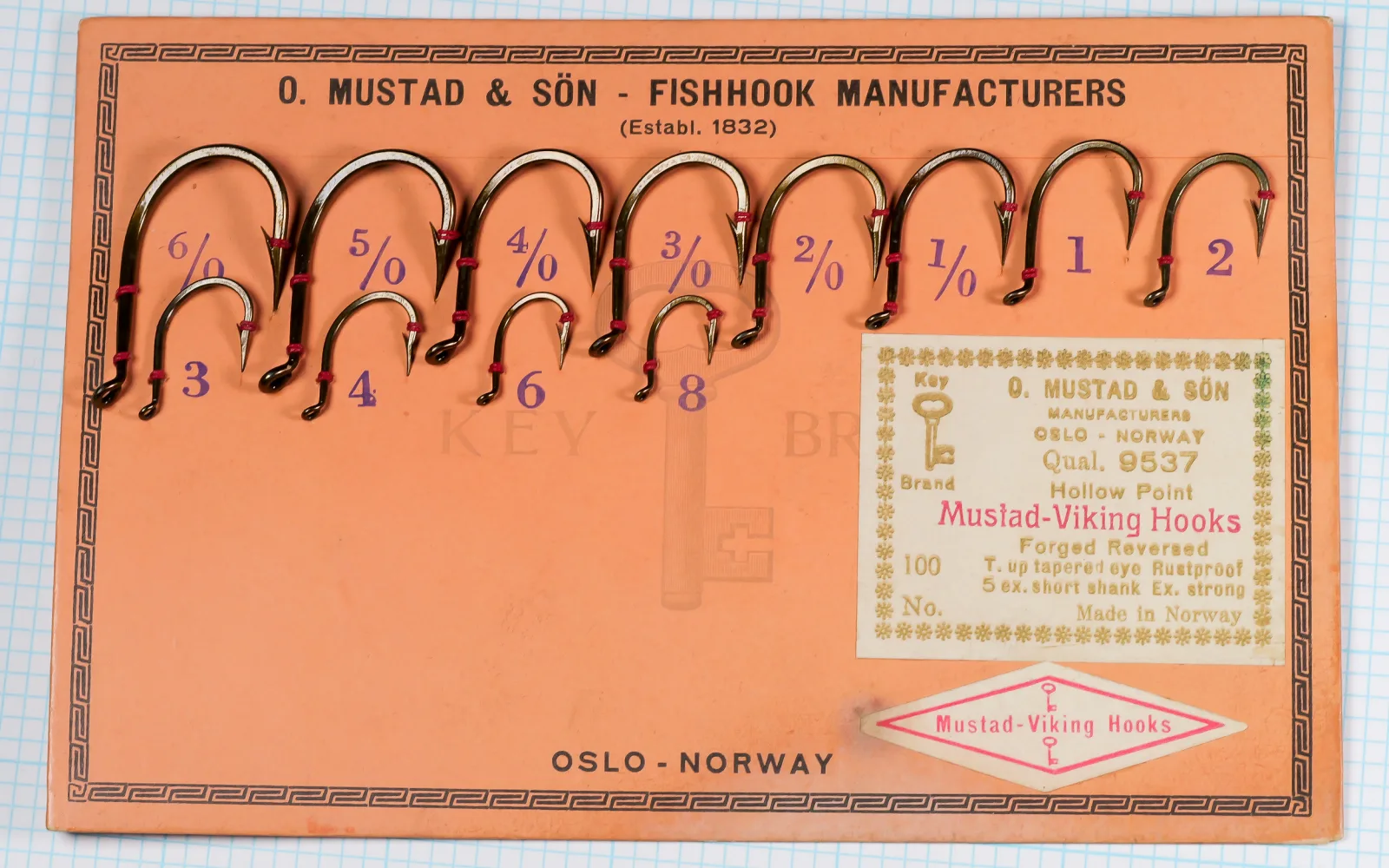
The Mustad 9537 is a forged, extra-short-shank variant of Mustad’s legendary post-war Viking series, manufactured in Oslo, Norway during the 1955-1965 period. This sales card displays all 100 hooks in graduated sizes from 6/0 to 2, with the original cream label intact showing complete manufacturing specifications. The 9537 was engineered as a specialized heavy-duty tool for power baiting and compact rigging applications, combining a hollow point for quick penetration, extra-strong forged wire for durability, and a distinctive reversed (kirbed) offset that forces immediate tissue engagement upon strike.
The package itself is a pristine example of 1950s-1960s Mustad retail presentation — orange-coral board stock with Art Deco Greek key border, offset-printed in the characteristic gold and red typography of the era. The ‘Oslo – Norway’ address confirms post-1925 production, while the absence of a barcode and the printed label format establish the timeframe within the 1955-1965 range. The hook represents the apex of mechanical hook engineering before computer-aided design, when every feature — forging profile, point geometry, eye taper, and shank length — was engineered for a precise, specific fishing application rather than mass-marketed as a generic tool.
For collectors, the 9537 occupies a sweet spot: uncommon enough to represent genuine rarity among complete cards, yet produced in sufficient quantity that specimens do appear at tackle auctions and specialist dealers. The combination of original packaging, all 100 hooks intact, and the distinctive short-shank Viking aesthetic makes this a desirable mid-20th-century artifact that documents Mustad’s manufacturing dominance and engineering sophistication during its peak market control period.
Mustad-9537-Salescard-
Photographic record
2 cataloged imagesSelect any record to load it above.
2 images shown
Mustad-9537-Salescard-Mustad-9537-Salescard-Open originalMustad-9537-Salescard-LabelMustad-9537-Salescard-LabelOpen original
Technical profile
Eye
Tapered Eye, Turned Up
Wire
Extra-Heavy (2X+), Forged, Est. ~0.065"-0.075" (~1.65-1.9 mm)
Shank
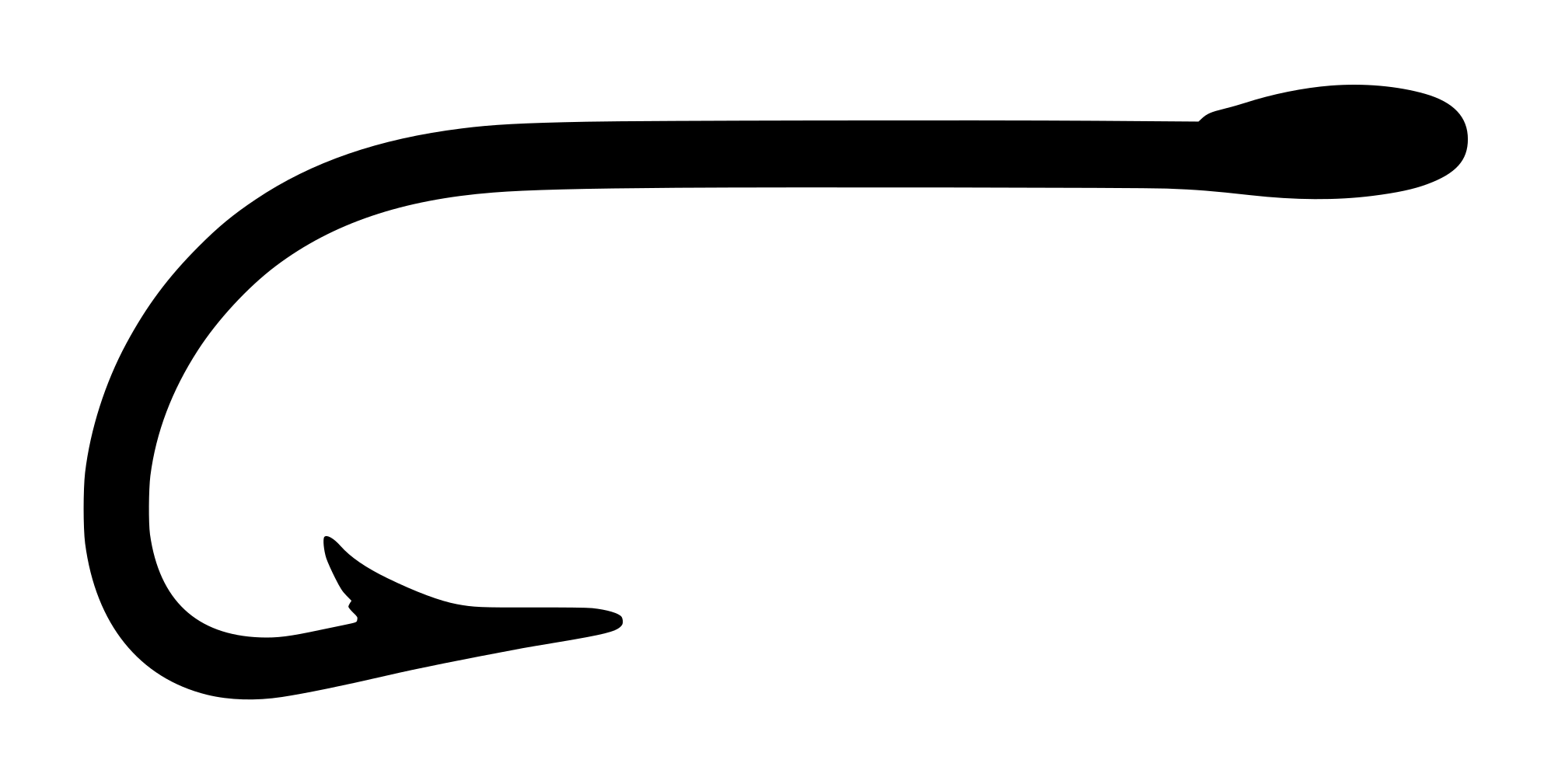
Short (1X–2X Short) — Plain
Bend
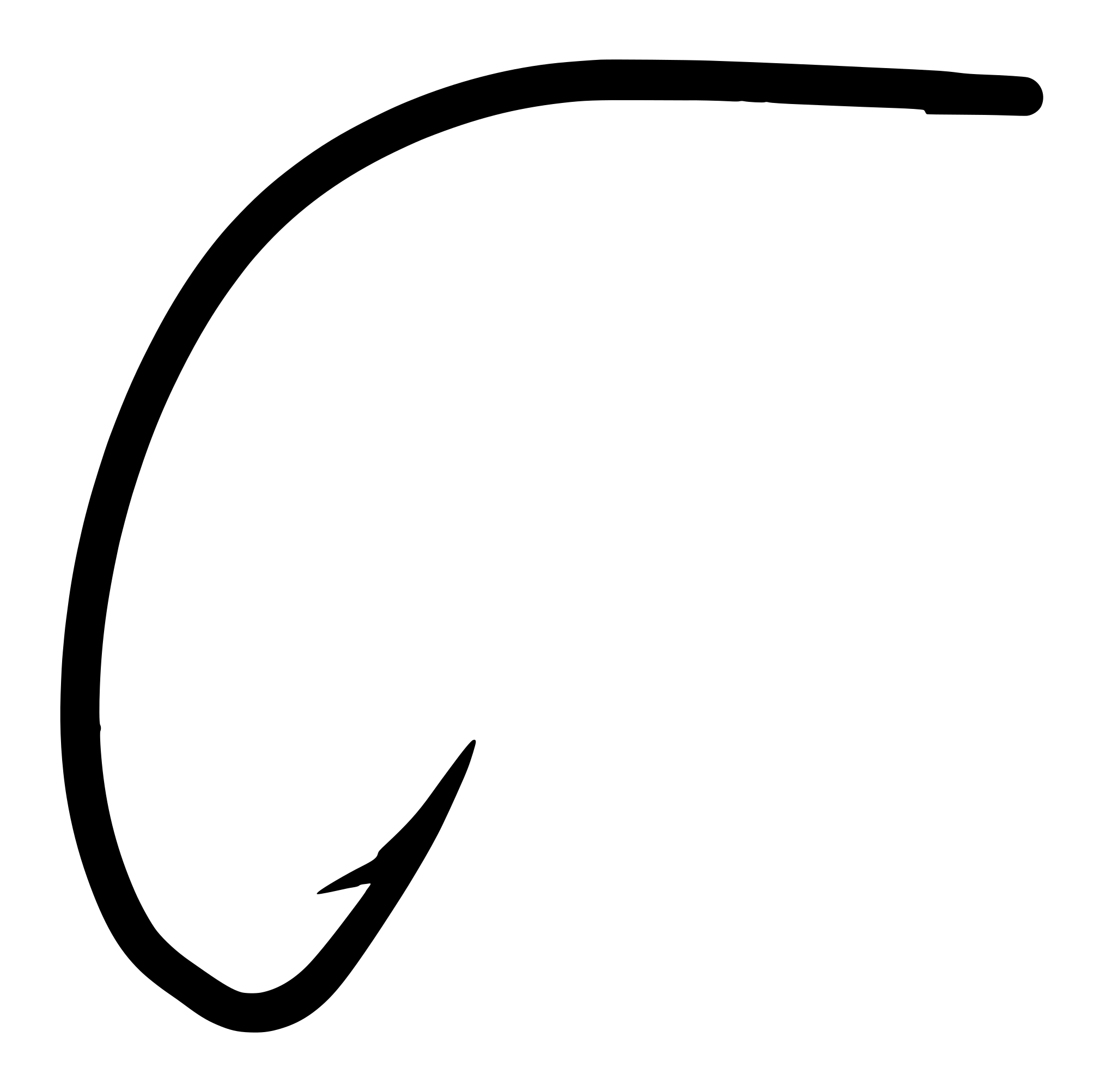
Wide gap, Offset / kirbedViking bend — a modified round bend with a distinct flat forge characteristic of the Viking series. Not a standard Sproat or round; distinctly engineered for heavy-duty, compact applications. P
Point
Hollow Point (concave inner face)Barb is short and close-cut, typical of vintage Mustad hollow-point hooks. Placement is immediately behind the point taper, standard for this period. The barb angle is slightly rearward-facing, designed to prevent catch failure but not aggressive. P
Finish
Tinned — Inferred (photographically likely)Label states 'Rustproof' which on vintage Mustad cards of this era typically indicates a tin or nickel-plating process. The specimen displays a warm bronzed appearance characteristic of aged tinned finishes where the protective lacquer has developed patina. E
Card is in very good condition with light toning and minor edge wear consistent with 60+ year age. All 100 hooks appear to be present and show bright finish with minimal corrosion. Label shows no significant fading, printing remains crisp. No missing hooks or obvious damage to card structure.
The hollow point on the 9537 features a distinctly concave inner face creating a rapid taper from a fine tip to the barb base. This geometry enables penetration with minimal applied force — critical for soft-mouthed species or delicate presentations. The inward curve creates a ‘knife-edge’ effect, allowing the point to slip cleanly into tissue.
The forged shank is flattened along lateral sides through mechanical drop-press or cold-forging, dramatically increasing structural rigidity and tensile strength without adding wire bulk or weight. This cold-working process alters the metallurgical grain structure, making the steel more resistant to bending open or straightening under extreme stress — essential for heavy-tackle pursuits.
The reversed (kirbed) offset points the tip to the left when viewed from above, forcing immediate tissue engagement upon strike and preventing the point from laying flat in the fish’s mouth. The tapered eye reduces mass at the hook front, lowering the overall weight profile for compact rigging applications.
Size & scale lab
Selected size
(unspecified)
Physical specimen
Overall Length
25 mm
Shank Length
10 mm
Gap Width
13 mm
Bend Depth
9 mm
Shank-to-Gap Ratio
~0.75-0.88 : 1
Confidence
P
Physical specimen
Grid-derived from photograph (1/10" grid)
Own this hook? Help us measure it.
We don't have measured sizes for this hook yet. Own one? Submit calipered measurements and we'll review and add them. Thank you!
Historical context
mustad
O. Mustad & Son was founded in 1832 in Gjøvik, Norway (initially as Brusveen Spiger- og Staltradfabrikk, a nail and wire factory) by Hans Schikkelstad. The company was rebranded as O. Mustad & Son after being taken over by Schikkelstad’s son-in-law Ole Hovelsen Mustad and his son Hans Mustad. The defining innovation came in 1877 when Mathias Topp, a company visionary, invented the first fully automated hook-making machine — a mechanized system that autonomously cut, bent, barbed, and pointed hooks at unprecedented speed.
Rather than patent the technology (which would have required public disclosure of mechanical schematics), the Mustad family protected their competitive advantage through corporate secrecy, strict non-disclosure agreements, and restricted factory access. This strategy proved devastatingly effective against rival manufacturers in Redditch, England and Japan. By the 1950s, Mustad controlled an estimated 50% of global hook production, establishing sales offices and manufacturing facilities across multiple continents. The name ‘Mustad’ became virtually synonymous with the fishing hook itself, a dominance that persisted throughout the 20th century.
The company’s manufacturing philosophy combined Norwegian industrial efficiency with reverse-engineering of regional hook patterns from around the globe — taking designs favored by local blacksmiths or regional anglers (Cincinnati bend, Limerick, Sproat) and producing them with extreme precision and speed for global export. This strategy allowed Mustad to corner localized markets on a global scale while maintaining the authenticity and performance characteristics that made each design regionally valued.
Series History
The Mustad Viking series emerged in the post-war period (circa 1950s) as part of Mustad’s strategic expansion into British and European markets. Named deliberately to evoke Norwegian heritage and martial strength, the Viking brand positioned itself as a premium, heavy-duty alternative to standard patterns. The series became legendary in British sea angling for uptide casting and distance work, where anglers required hooks capable of withstanding violent strikes and sustained heavy pressure.
The 9537 represents a specialized geometric variant within the broader Viking line. While the standard Viking hooks featured standard or long shanks optimized for large bait presentations, the 9537’s 5x extra-short shank addressed a completely different fishing problem: compact rigging in confined spaces, stinger hook mounting on lure systems, and tight bait presentations where a normal shank would interfere with bait integrity or lure action.
The 9537 remained in production through the 1960s and into the 1970s, though the transition to Mustad’s Signature Series (circa 2001-2009) rendered the arbitrary numerical quality codes obsolete. The hook was eventually discontinued as Mustad shifted to alpha-numeric model designations that explicitly described hook proportions. However, the 9537’s functional role continues in modern equivalents like the Mustad 10121 and 92604, which serve similar compact, heavy-duty applications with contemporary metallurgy and manufacturing.
Era and Packaging Dating
Oslo - Norway designation on label (transition from Christiania name completed in 1925, solidified post-1950); 'Key Brand' logo in classic style consistent with 1950s-1960s Mustad branding; offset printed label with gold and red ink on cream stock, typical of mid-century offset lithography; Art Deco Greek key border design consistent with 1950s-1960s retail packaging aesthetic; absence of barcode (not introduced until 1974); 'Made in Norway' notation consistent with pre-globalization period. The specific label typography and layout matches Mustad catalogs dated to mid-1950s through early 1960s.
The Paradox of the Short Viking
The 'Viking' name was Mustad's marketing masterstroke of the post-war period, deliberately evoking Norwegian heritage and martial strength. However, the 9537 represents a fascinating contradiction: while standard Viking hooks (like the 79515) achieved legendary status in British uptide sea angling on the open coast, this 5x short variant was a specialized tool for compact, confined spaces — inside strip baits, in tight lure rigs, or as stinger hooks where a normal-length shank would have been impossible. Mustad's ability to segment the same 'Viking' brand into multiple geometric configurations for vastly different use cases reflects the pre-standardization era when hooks were truly engineered for specific problems rather than mass-marketed as generic tools.
Design lineage and influence
The Mustad Viking series emerged in the post-war period as part of Mustad’s aggressive expansion into British and European markets. While the standard Viking bend was inspired by regional bending preferences and British sea angling tradition, the 9537 represents Mustad’s philosophy of geometric segmentation: the same foundational bend could be produced in multiple shank lengths and wire gauges to serve radically different applications.
The hollow-point geometry traces to Mustad’s broader commitment to specialized penetration mechanics for different species and bait presentations. The forged, reversed (kirbed) construction represents the pinnacle of mechanical hook engineering pre-computer-aided design — every feature was ground, bent, and tempered by mechanical process for a specific functional purpose.
Successors to the 9537’s functional role include the modern Mustad 92604 (Beak Hook) and the 10121 (Live Bait Hook), though neither captures the original’s extreme short-shank geometry or the vintage forging aesthetic.
Best matchRelated by Attribute
Computed automatically from catalog data — updated as new hooks are added.
Matches: Bend, Gap, Eye, Eye Orient., Point +2 moreDiffers: Shank: Short (1X–2X Short) vs Standard; Wire: Extra-Heavy (2X+) vs Standard; Finish: Tinned vs Nickelled +3 more
Matches: Bend, Gap, Point, Shank Feat., BarbDiffers: Shank: Short (1X–2X Short) vs Standard; Wire: Extra-Heavy (2X+) vs Standard; Eye: Tapered Eye vs Ball Eye +4 more
Matches: Bend, Gap, Point, Shank Feat., BarbDiffers: Shank: Short (1X–2X Short) vs 1X Long; Wire: Extra-Heavy (2X+) vs Heavy (1X Heavy); Eye: Tapered Eye vs Blind — Flatted +4 more
The Mustad 9537 Viking was engineered for heavy-duty bait fishing and specialized rigging applications. The extreme short shank (5x extra short) combined with wide gape and extra-strong forged wire made this hook ideal for power baiting, stinger hook rigging for large lures, and tying compact but durable patterns for strong-running fish. The forged, reversed (kirbed) offset point was designed to catch tissue immediately upon strike, preventing point roll-over in the mouth of hard-fighting species.
Historical use concentrated in saltwater applications and heavy freshwater salmon and steelhead fishing where a compact, ultra-strong hook could be mounted inside strip baits or rigged as a tandem hook system. The Viking series became legendary in British sea angling for uptide casting, though this particular 5x short variant served more specialized compact rigging roles.
Classic Fly Patterns
Named patterns specifically associated with this hook. Leave blank if none formally documented. Do not speculate — only include patterns with a confirmed association.
Modern Equivalents
Hook
Match Quality
Notes
Mustad 92604
Good
Modern Beak Hook with similar short shank and wide gape for power baiting; lacks forged construction and vintage aesthetic but serves comparable functional role
Mustad 10121
Very Good
Live Bait Hook with extra-strong wire and compact design; maintains Mustad manufacturing tradition but uses modern metallurgy and lacks vintage reversed offset
Gamshatsu B10S
Moderate
Japanese short-shank model with wide gape and heavy wire; contemporary functional equivalent but significantly different manufacturing philosophy and finish
Collector notes
Rated 4.5/10 — Mustad Viking hooks are moderately collectible within vintage tackle communities, but the 9537 is uncommon rather than scarce. The combination of short shank, heavy wire, and forged construction appeals to specialized collectors, but common larger sizes remain abundant. Original packaging with complete hook count significantly enhances value.
Reference value
$18 – $42 USD estimate
Packaging condition
Very Good — light wear, fully legibleRecorded specimen
Packaging format
GW-M-01-salescardCatalog code
Positive factors: Original retail sales card with all 100 hooks intact commands substantial premium over loose hooks. The 9537 model code, though produced in moderate volume, is less frequently encountered than standard Victorian or standard-weight Vikings. The distinctive short shank (5x) appeals to collectors of specialized bait hooks and fishing tackle enthusiasts interested in pre-globalization engineering. Mustad hooks from the 1950s-1960s remain desirable as representatives of peak Mustad manufacturing dominance (50% global market share by 1960).
Limiting factors: Mustad’s industrial production scale means even specialized models exist in significant quantities compared to Redditch craft makers or regional brands. Size 6/0 and 5/0 are more common than smaller sizes (8-10), where supply is tighter. The forged, reversed, extra-strong specification was engineered for commercial and professional fishing, resulting in heavy survival rates in tackle shops and commercial fishing closures.
Most desirable variants: Complete original cards with all 100 hooks and undamaged label command $25-45. Individual hooks from scattered lots sell $0.15-0.30 each depending on size; sizes 8-10 are proportionally more valuable. The tinned ‘rustproof’ finish is preferred over alternative finishes for this model, reflecting saltwater fishing heritage. Cards with printed price or handwritten fisher notations are premium specimens to specialists.
Condition factors: Card condition is paramount — pricing drops 40-60% for cards with missing hooks, creasing, or faded label. The label quality (sharpness of printing, gold ink retention) directly affects perceived collectability. Hooks themselves should be bright with no corrosion spotting or discoloration.
Packaging
Retail sales card with molded plastic hook display wells. Orange/coral background stock with Art Deco Greek key border. Header reads 'O. MUSTAD & SON - FISHHOOK MANUFACTURERS (Establ. 1832)' with 'OSLO - NORWAY' at bottom. Eight hooks displayed in graduated sizes (6/0 to 2). Separate printed label (upper right) in cream with gold and red text: 'Key Brand O. MUSTAD & SON MANUFACTURERS OSLO - NORWAY Qual. 9537 Hollow Point Mustad-Viking Hooks Forged Reversed 100 T. up tapered eye Rustproof 5 ex. short shank Ex. strong No. Made in Norway' with decorative gold floral borders. Loose red diamond-shaped label at bottom center reading 'Mustad-Viking Hooks'. Grid backing visible. Offset printed, vintage period stock.
Market Value Notes
Low ($18): Good condition — opened card, 95-100 hooks present, minor label wear, bright hooks<br />
High ($42): Excellent condition — sealed or near-sealed card, all 100 hooks, minimal label aging, no corrosion<br />
Premium factors: Complete original packaging with undamaged label, size range completeness (all 10 sizes present), small sizes (8-10) over large sizes, tinned finish, handwritten annotations from original purchaser<br />
Platforms: eBay.com (UK and US listings), specialist tackle dealers, annual Redditch tackle auctions, regional fishing tackle shows<br />
Confidence: E estimated — limited comparable sales data for complete 9537 cards; estimates based on broader Mustad card pricing (common models $8-15, scarce models $25-60) and extrapolation from individual hook market values
Where to Find
eBay.com (both UK and US listings, search 'Mustad 9537' and 'Mustad Viking'); specialist vintage tackle dealers in UK and Scandinavia; UK regional fishing tackle fairs (particularly Midlands and Southeast); estate sales and fishing club liquidations; annual Redditch tackle collector gatherings.
Preservation
Storage and Preservation
Store the sales card in a cool, dry environment away from direct sunlight and moisture. Original retail packaging significantly enhances collectability — keep hooks on the card rather than removing them. The paper stock is acid-free vintage cardboard but still susceptible to humidity and light exposure over decades.
The tinned finish (labeled ‘Rustproof’) is generally stable but can develop blue-green patina over time in humid conditions, which many collectors consider desirable. However, prolonged exposure to marine environments or high-humidity storage may accelerate patina development. Avoid contact with other metals or acidic materials that could trigger galvanic corrosion.
If any hooks are removed for use or examination, store them in a sealed container with desiccant packets to prevent oxidation. The forged construction makes these hooks valuable — they are worth preserving unused. Display the card away from external walls, basements, or damp spaces. Maintain ambient humidity below 50% relative humidity for optimal preservation.
Primary Source
Label Decryption and Manufacturer's Nomenclature
Source: O. Mustad & Son sales card label, c. 1955-1965; 'A Comprehensive Typology and Decryption of Vintage O. Mustad & Søn Hook Labels' (garrenwood.com reference document)
The label on this card provides a complete technical specification using Mustad’s standardized eight-line labeling system, documented in the comprehensive Mustad label typology. Each line serves a specific, regulated function:
Lines 1-2: Corporate identity (‘O. MUSTAD & SON MANUFACTURERS’) establishes Mustad as the primary manufacturer, not a distributor or repackager — a critical distinction in an era when jobbers frequently purchased bulk hooks and repackaged them under secondary brand names.
Line 3: Geographic origin (‘OSLO – NORWAY’) provides chronological bracketing. Oslo (renamed from Christiania on January 1, 1925) confirms post-1925 manufacture; combined with the label typography, this narrows the date to the 1950s-1960s period.
Line 4: Quality Code (‘Qual. 9537’) denotes a specific product tier. Mustad’s numerical system segmented their catalog into three broad categories: economy models (1000-2999), quality/mid-tier models (3000-3999), and premium models (4000+). The 9537 falls into the premium category, reserved for highly specialized, refined hooks engineered for demanding applications.
Line 5: Point Identifier (‘Hollow Point’) — the most strictly regulated element of the labeling system, reserved exclusively for defining hook-point geometry. The hollow point’s concave inner face enables rapid tissue penetration with minimal force, ideal for soft-mouthed fish or where delicate hook-sets are required.
Line 6: Pattern Nomenclature (‘Mustad-Viking Hooks’) — identifies the overarching bend and shank proportion. The Viking series represents Mustad’s post-war strategy of marketing regional patterns under a cohesive brand that evoked Norwegian heritage and manufacturing prowess.
Lines 7-8: Anatomical Modifications and Metallurgical Finishes (‘Forged Reversed’, ‘T. up tapered eye Rustproof’, ‘5 ex. short shank Ex. strong’) — specifies wire treatment (forged = cold-pressed, laterally flattened), eye type (turned-up tapered = reduced wire mass for buoyancy and weight reduction), finish (rustproof = tin or nickel-plating), shank length variant (5x extra short), and wire gauge (Ex. strong = heavy gauge).
Additional
The Short Viking: Engineering for Specificity
The 9537 represents a fascinating paradox in hook design philosophy. While the Mustad Viking series achieved legendary status in British uptide sea angling as a long-range, powerful hook for distance casting, the 9537’s 5x extra-short shank was engineered for the exact opposite problem: applications requiring extreme compactness.
In the 1950s-1960s, when live-bait and strip-bait fishing techniques dominated saltwater angling, anglers frequently faced a geometric problem: a standard-length hook shank could be too long to fit comfortably inside a baitfish’s body cavity or could physically interfere with the bait’s swimming action when rigged as a stinger hook. The 9537 solved this by reducing shank length to the absolute minimum compatible with hook strength and barb positioning.
The extra-strong forged wire compensated for the shorter shank by dramatically increasing structural rigidity through metallurgical cold-working. A forged shank is laterally flattened, which alters the grain structure of the steel and increases tensile strength without adding material bulk. This allowed Mustad to engineer a hook with a shank barely longer than the gap width, yet maintain holding power equivalent to much larger, standard-shank models.
The hollow-point geometry and reversed (kirbed) offset further optimized the design for immediate tissue engagement in confined spaces — the concave taper ensured clean penetration with minimal applied force, while the lateral offset forced the point to rotate and lock into the jaw corner rather than laying flat in the mouth cavity.
This represents the pinnacle of pre-computer-aided design engineering: every single feature — point taper angle, barb placement, wire gauge, forging profile, eye taper geometry — was engineered to solve a specific, real fishing problem. No feature was arbitrary or decorative. The 9537 is a masterclass in functional mechanical engineering, and its eventual displacement by modern designs reflects not inadequacy but rather the shift from problem-specific tool design to mass-market generalization.
Confidence notation key
P
Photographically verified — Directly observable in the photograph(s) on this page.
V
Verified by documentation — Confirmed by manufacturer catalog, spec sheet, or published reference.
I
Inferred — A logical deduction from observable or documented evidence, not directly stated.
E
Estimated — An approximation based on visual comparison, proportional analysis, or limited data.
S
Speculative — A reasoned hypothesis that cannot be confirmed from available evidence.
Claims with no notation are confirmed by multiple independent sources. All photographs on garrenwood.com are taken on a measurement grid where each square equals 1/10 inch (0.1″ / 2.54 mm).