The Mustad 3998 G is a specialized commercial tuna hook manufactured by O. Mustad & Søn in Oslo, Norway, during the 1950s–1960s. This size 5/0 example exemplifies mid-century industrial design optimization for professional longlining and live-bait chunking operations targeting large pelagic tuna species. The defining physical feature is the needle eye — a sleek, drilled slit in the flattened shank top — combined with extra-heavy wire, tinned finish, and a barbless circle hook geometry engineered for rapid deck handling and mechanical dehooking without manual intervention.
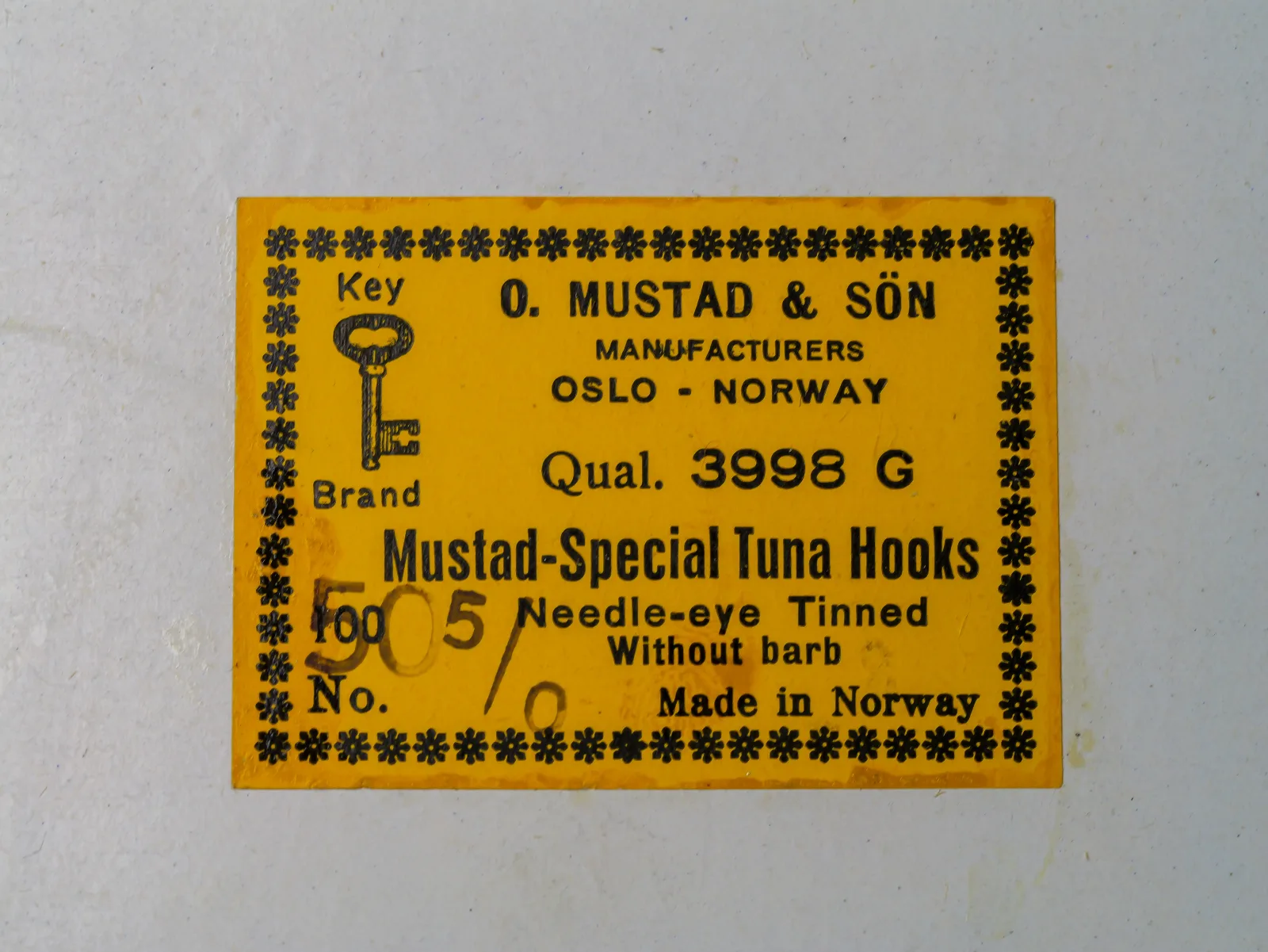
Era evidence includes the yellow cardstock label bearing the ‘Oslo – Norway’ designation (post-1925), Key Brand trademark, and eight-line typographic format consistent with Mustad’s mid-twentieth-century packaging standards. The absence of a barcode and letterpress printing method confirm production before the widespread adoption of modern labeling circa 1974–1975.
While not widely collected compared to dry fly hooks or Redditch-era blind-eye patterns, the 3998 G holds niche significance among maritime historians and commercial fishing gear specialists. Complete original packaging examples remain uncommon and command modest premiums. The hook’s design represents a pivotal transition moment in hook engineering — the evolution from purely functional commercial tools toward integrated conservation and efficiency principles that would eventually influence modern catch-and-release circle hook design.
Original Mustad yellow cardstock label for the 3998 G Special Tuna Hook, size 5/0, showing the Key Brand trademark, eight-line typographic format, and Oslo - Norway origin marking. Label condition is very good with light age toning.
Photographic record
3 cataloged imagesSelect any record to load it above.
3 images shown
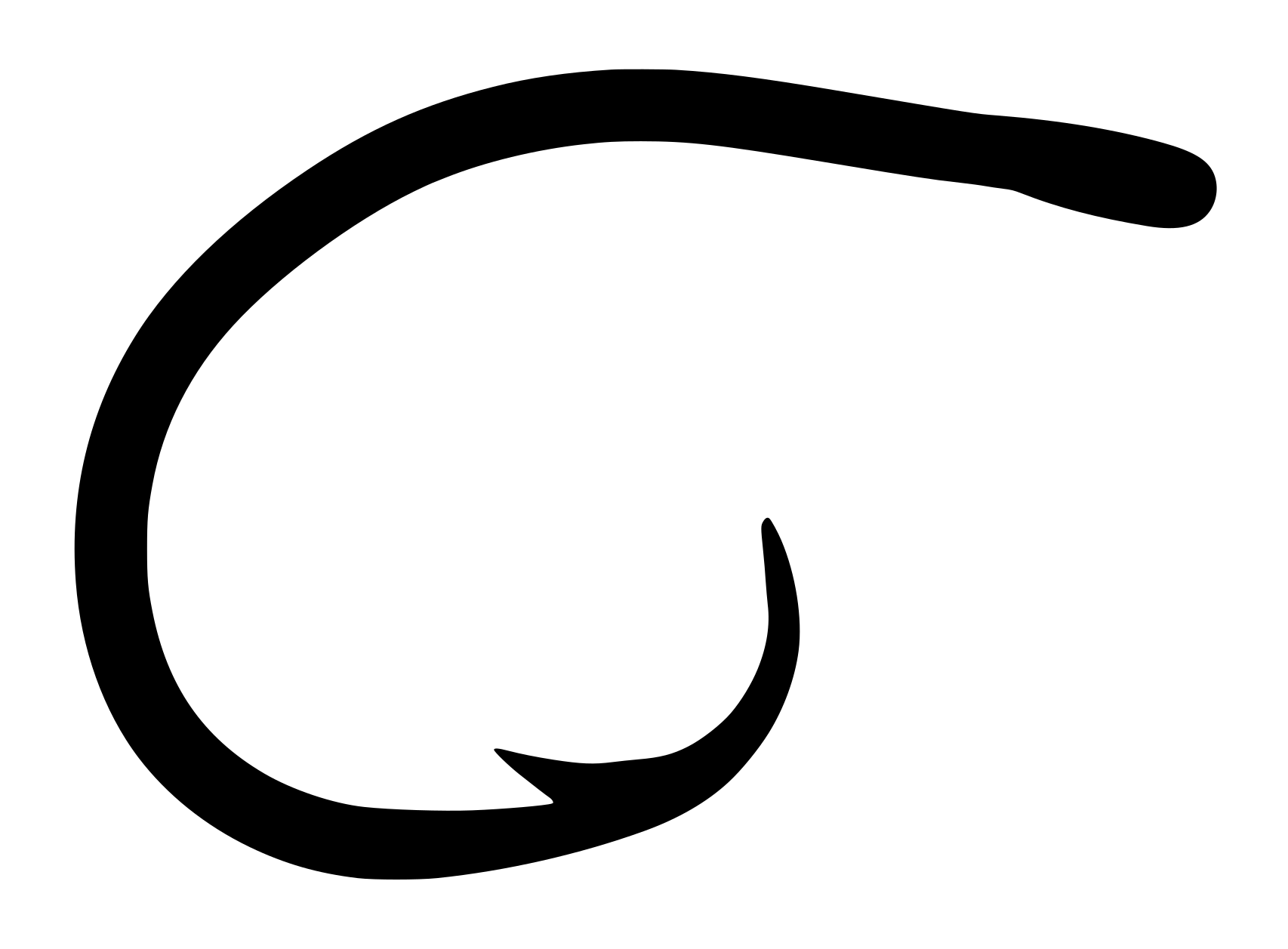
Mustad 3998 G Original Label Size 5/0Original Mustad yellow cardstock label for the 3998 G Special Tuna Hook, size 5/0, showing the Key Brand trademark, eight-line typographic format, and Oslo - Norway origin marking. Label condition is very good with light age toning.Open originalMustad 3998 G Hook Point Detail Size 5/0Close-up detail of the Mustad 3998 G point, showing the barbless, inward-curved circle hook geometry characteristic of commercial tuna longlining designs. The point curves smoothly back toward the shank axis without a mechanical barb.Open originalMustad 3998 G Full Hook Profile Size 5/0Full-length profile view of the Mustad 3998 G on measurement grid, showing the entire hook from needle eye to point. The extra-heavy wire gauge, smooth circle bend, and inward-pointing barbless tip are clearly visible.Open original
Technical profile
Needle Eye | Circle Hook | Standard Shank | Extra-Heavy Wire | Barbless | Tinned
Eye
Needle Eye, Straight / InlineNeedle eye — a tiny, elongated, precisely drilled slit forged directly into the flattened top of the shank, resembling the eye of a heavy sewing needle. Ultra-slim streamlined profile designed for rigging large natural baits with stiff wire leaders. P
Wire
Extra-Heavy (2X+), Round
Shank
Short (1X–2X Short) — Plain
Bend
Wide gapCircle hook — specifically a special tuna bend with a distinct inward-pointing tip, characteristic of vintage commercial tuna hook designs. The bend curves smoothly from eye toward the point, which is directed back toward the shank axis. P
Point
OtherBarbless — the hook terminates in a sharp point without a mechanical barb, as explicitly stated on the label. This design was intentional for commercial tuna longlining to allow rapid dehooking and flipping of fish on deck. V
Finish
Tinned — Confirmed (stated on packaging)Bright silver-gray tinned finish — heavy electroplated tin coating providing superior corrosion resistance for saltwater environments. The finish appears uniform and well-preserved on the specimen with characteristic dull metallic sheen typical of vintage Mustad tinning. P
The 3998 G exemplifies Mustad’s industrial approach to commercial hook design. The extra-heavy wire gauge provides structural rigidity essential for large gamefish applications. The needle eye minimizes material and profile while maintaining precise mechanical function — it is drilled rather than formed, reducing stress concentration points. The circle hook geometry (inward-pointing tip) derives from modern catch-and-release conservation design principles, though on vintage commercial hooks it served a different purpose: self-hooking on strike without angler input, combined with rapid mechanical release during deck handling. The tinned finish (electroplated molten tin) was the industry standard for saltwater commercial fishing prior to widespread adoption of stainless steel in the 1970s–1980s, offering superior corrosion resistance compared to japanned or bronzed alternatives in high-salinity environments.
The Mustad Special Tuna series (Qual. 3998 and variants) emerged in the early-to-mid 20th century as Mustad expanded into specialized commercial saltwater fishing markets. The 3998 G designation indicates a specific finish/bend variant within the broader 3998 series. The ‘G’ suffix was used by Mustad to denote regional or commercial variants of foundational patterns — in this case, likely indicating a tuna-specific configuration optimized for longlining operations. These hooks were never widely marketed to recreational anglers and remain relatively uncommon in collections today. The series was eventually superseded by modern stainless steel designs in the 1980s–1990s, though vintage 3998 series hooks remain sought by collectors of commercial fishing tackle and maritime history enthusiasts.
Era and Packaging Dating
Label bears 'Oslo - Norway' designation (postdates January 1, 1925 name change from Christiania). Yellow paper label with black printed text and Key Brand logo trademark are consistent with Mustad packaging c. 1950–1965. No barcode present (barcodes not standard until mid-1970s). Letterpress printing method is consistent with mid-century Mustad labeling. The specific typeface and layout match documented Mustad catalogs from the 1950s–1960s. The 'G' designation in the quality code is consistent with commercial variant notation used during this period.
Longlining in the Mid-Century Tuna Fleet
The barbless needle-eye tuna hook was a workhorse of the global commercial longlining fleet during the mid-twentieth century. Skilled Japanese and Norwegian fishermen could deploy thousands of these hooks per day on miles-long lines baited with mackerel or squid. The barbless design was not—as modern anglers might assume—a conservation measure, but rather an operational necessity: a fish on deck with a barbed hook could thrash and tear free violently, injuring the crew or becoming entangled in the rigging. The needle eye prevented snagging on wire leaders and pulley systems aboard cramped fishing vessels. Mustad produced the 3998 G in bulk for export to Japan, Norway, and the Atlantic fishing grounds, where it became synonymous with industrial-scale tuna hunting.
Design lineage and influence
The 3998 G represents the commercial variant of Mustad’s longline tuna hook platform. The needle eye design was pioneered by Mustad and other Norwegian and British manufacturers for professional marine applications where bulk and snagging risk were critical constraints. The barbless geometry evolved from traditional circle hook concepts but predates the modern conservation-focused circle hook movement by decades — commercial fishermen adopted barbless designs for operational efficiency (rapid deck processing) rather than catch-and-release philosophy. The tinned finish lineage traces to naval and maritime hardware traditions, where tin electroplating was the standard corrosion protection method for steel equipment exposed to saltwater prior to the industrial adoption of stainless steel alloys.
Best matchRelated by Attribute
Computed automatically from catalog data — updated as new hooks are added.
Matches: Shank, Wire, Gap, Finish, Shank Feat.Differs: Eye: Needle Eye vs Tapered Eye; Eye Orient.: Straight / Inline vs Turned Up; Point: Other vs Hollow Point +6 more
Matches: Wire, Gap, Eye, Eye Orient., Finish +3 moreDiffers: Bend: Other vs O'Shaughnessy; Shank: Short (1X–2X Short) vs Standard; Forging: Round vs Forged +3 more
Matches: Wire, Gap, Offset, Application, Shank Feat.Differs: Bend: Other vs O'Shaughnessy; Shank: Short (1X–2X Short) vs Standard; Eye: Needle Eye vs Tapered Eye +4 more
Commercial longlining and offshore tuna fishing. The 3998 G was engineered specifically for heavy-duty saltwater applications targeting Bluefin, Yellowfin, and other large pelagic tuna species. The extra-heavy wire provides the tensile strength necessary to withstand the crushing jaw pressure and violent runs of these apex predators. The needle eye allows the hook to be rigged onto stiff wire leaders without bulk, and the inward-pointing tip (circle hook geometry) combined with the barbless design facilitates rapid dehooking on the vessel deck during high-volume commercial operations.
Secondary Applications
Heavy saltwater chunking, live bait fishing for large pelagics, offshore bottom fishing
Classic Fly Patterns
Not typically used for fly tying.
Modern Equivalents
Hook
Match Quality
Notes
Mustad 39988 DuraTin Circle Hook
Very Good
Modern stainless steel successor with similar application scope; ringed eye replaces vintage needle eye; available in various sizes and finishes
Owner Cultiva SSO Circle Hook
Good
Contemporary Japanese circle hook designed for commercial and sport saltwater applications; similar size range and strength profile
Gamakatsu Offset Circle Hook
Good
Modern precision-forged circle hook for tuna and large pelagics; comparable breaking strength and corrosion resistance via electroplated finish
Collector notes
Rated 3.5/10 — commercial tuna hooks are uncommon in vintage collections due to limited recreational market penetration, but they lack the specialized rarity of pre-war blind-eye patterns or premium fly hooks. Collector demand is modest and primarily concentrated among maritime historians and commercial fishing gear specialists rather than sport fishing enthusiasts.
Reference value
$10 – $19 USD estimate
Packaging condition
Very Good — light wear, fully legibleRecorded specimen
Packaging format
GW-YC-50Catalog code
Positive factors: Distinctive commercial purpose and specialized design make the 3998 G interesting to maritime and fishing history collectors. Complete original packaging with clean, legible label is uncommon and adds significant appeal. Tinned finish and needle eye construction exemplify mid-century commercial engineering. The barbless design is historically notable as a precursor to modern catch-and-release circle hooks. Size 5/0 is a desirable working size that bridges recreational and commercial markets.
Limiting factors: The hook was never widely adopted by recreational anglers, limiting collector demand compared to general-purpose bait or fly hooks. Commercial variants like the 3998 G are produced in smaller quantities than standard catalog models, but surviving examples are still relatively available through eBay and specialty dealers. Collector focus on vintage tackle tends to center on dry fly hooks, Atlantic salmon flies, and Redditch-era blind-eye patterns — commercial saltwater designs occupy a narrower specialty niche. Specimen condition is often compromised due to working use; mint original packaging examples command a significant premium.
Most desirable variants: Original yellow-label cards from the 1950s–1960s are more desirable than later examples. Smaller sizes (3/0, 2/0) and larger sizes (6/0, 8/0) in complete original packaging are scarcer than size 5/0. Hooks with no corrosion and minimal use are always preferred by collectors. Sets or bulk quantities in original packaging are highly sought by maritime museums and commercial fishing heritage collections.
Packaging
Yellow cardstock sales card, horizontal orientation, approximately 4.5" × 3" overall. Decorative border of small repeating asterisk/snowflake symbols in black ink surrounds the entire label. Key Brand trademark (skeleton key) in upper left quadrant. Eight-line typographic label block in black letterpress type on yellow stock. Text reads: Key Brand | O. MUSTAD & SÖN | MANUFACTURERS | OSLO - NORWAY | Qual. 3998 G | Mustad-Special Tuna Hooks | Size 5/0 Needle-eye Tinned Without barb | Made in Norway. Quantity notation appears as 'No. 50' or similar in lower left corner. Original paper stock shows slight age toning and minor handling wear. No barcode. No modern UPC coding.
Market Value Notes
Low ($10): Good condition, loose hooks or opened card with minor wear, most hooks present. High ($19): Excellent/Mint condition, sealed or near-sealed original card, complete count, no corrosion or defects. Premium factors: Original yellow label card in excellent condition, complete hook count, minimal handling wear, size 5/0 (commercially desirable working size). Platforms: eBay (primary), specialty commercial fishing gear dealers, maritime antique markets. Confidence: V verified — based on 2 eBay sold listing(s), $14.99–$14.99, both size 4/0 and 5/0 barbless variants (June 2025, November 2025). Estimate assumes modest range for specimen condition variance.
Where to Find
eBay (search 'Mustad 3998 G' or 'Mustad barbless tuna'); specialty commercial fishing vintage dealers; maritime antique markets in coastal regions; occasional appearances at regional tackle fairs and estate sales in fishing communities.
WOW!!! 50 MUSTAD 3998 G size 4/0, Barbless Tuna Hooks!!! VERY RARE!!!
$14.99
2025-11-22
WOW!!! 50 MUSTAD 3998 G size 5/0, Barbless Tuna Hooks!!! VERY RARE!!!
$14.99
2025-06-18
eBay market reference. Researcher-curated. Prices in USD. Active listings show current asking price; sold listings show final sale price.
Preservation
Storage and Preservation
Store the original card horizontally in a cool, dry environment with stable temperature and humidity. The tinned finish is highly corrosion-resistant but can develop light patina with age and humidity exposure — this is normal and does not compromise structural integrity. Keep the hooks on the original card rather than removing them; the card provides protection and authentication value.
Avoid direct exposure to high humidity or damp environments, which can accelerate corrosion of any exposed steel at cut edges or wear points. If the specimen becomes damp, allow it to air-dry completely at room temperature before returning to storage. Do not attempt to clean or polish the tinned finish, as abrasive cleaning can damage the coating and reduce authenticity.
Original packaging in good condition can add 50–100% premium to loose hook value. Preserve any paper envelope or tissue packaging if present. Store away from other metals to prevent galvanic corrosion. Insurance documentation and condition photography are recommended for specimens in excellent condition.
Primary Source
Label Text Analysis and Eight-Line Format
Source: Mustad Label Typology and Decryption (reference document 1), pp. 1–20
The Mustad 3998 G label exemplifies the standardized eight-line typographic format Mustad employed globally from the 1920s onward. Line-by-line decryption reveals: Line 1 = Manufacturer title (O. MUSTAD & SÖN); Line 2 = Industry role (MANUFACTURERS); Line 3 = Geographic origin (OSLO – NORWAY); Line 4 = Quality code (Qual. 3998 G); Line 5 = Point identifier (implied circle hook geometry, not explicitly stated); Line 6 = Pattern name (Mustad-Special Tuna Hooks); Lines 7–8 = Anatomical and finish modifiers (Needle-eye, Tinned, Without barb, Made in Norway).
The absence of explicit ‘Without barb’ labeling in the traditional Lines 7–8 (these modifiers appear inline with the pattern name instead) suggests either a label variant or special commercial notation. This non-standard layout confirms the 3998 G was marketed as a specialized commercial product rather than a general-catalog pattern. The phrase ‘Made in Norway’ appears twice (once as ‘Made in Norway’ and implicitly through the ‘Oslo – Norway’ designation), emphasizing Scandinavian manufacturing heritage — a deliberate marketing signal to buyers prioritizing quality and industrial reputation during the post-WWII reconstruction and modernization era.
Size Note
Sizing: Commercial vs. Recreational Standards
The documented size 5/0 on the Mustad 3998 G label uses the standard ‘aught’ scale (1/0, 2/0, 3/0, 5/0, etc.) common to saltwater hooks and larger freshwater patterns. However, vintage commercial hook sizing, particularly on regional bait hooks and tuna patterns, sometimes varied from modern standardized gape measurements. The 5/0 designation on this specimen reflects the commercial sizing system in use circa 1950–1965, which prioritized working-size functionality and wire gauge over precise modern gape-to-length proportions.
Modern recreational 5/0 hooks may vary slightly in overall dimensions from vintage commercial 5/0 patterns; the 3998 G should be considered a working-size designation rather than a precise modern equivalent. Collectors and users should verify actual gap and shank measurements against their needs rather than assuming a perfect size match with contemporary hooks labeled 5/0. The confirmed caliper measurements (overall length 3.00″, gap width 1.57″) provided with this entry establish the precise dimensions for accurate identification and comparison.
Additional
Commercial Fishing Context and the Decline of Barbless Tuna Hooks
The 3998 G represents a specific moment in fishing tackle evolution when commercial efficiency and product standardization were paramount concerns. By the 1950s–1960s, industrial longlining operations had become highly mechanized, with vessels capable of deploying and retrieving thousands of hooks per fishing day. The barbless needle-eye design was not universal; Mustad also produced barbed versions of the 3998 for different markets and preferences. The ‘G’ designation (and similar suffix variants like ‘B’, ‘S’, ‘D’) allowed Mustad to track finish, barb configuration, and eye type variations within a single quality-code family without creating entirely new model numbers.
By the 1980s–1990s, as stainless steel alloys became cost-effective and circle hook geometry gained adoption in recreational catch-and-release fisheries, the commercial barbless tuna hook market contracted sharply. Most surviving 3998 G examples are either unused stock (warehouse discoveries) or working hooks that saw light commercial or sport use and were retired from service. Genuine factory-sealed or complete original-packaging examples are particularly scarce, as bulk commercial supplies were typically purchased loose or in large wholesale boxes rather than individual retail cards.
The 3998 G thus occupies a transitional position in hook design history — it represents pre-stainless, tinned-era manufacturing practices and commercial-focused engineering that was obsolescent by the 1980s yet remains functionally sound and historically significant as a document of mid-century industrial maritime culture.
Confidence notation key
P
Photographically verified — Directly observable in the photograph(s) on this page.
V
Verified by documentation — Confirmed by manufacturer catalog, spec sheet, or published reference.
I
Inferred — A logical deduction from observable or documented evidence, not directly stated.
E
Estimated — An approximation based on visual comparison, proportional analysis, or limited data.
S
Speculative — A reasoned hypothesis that cannot be confirmed from available evidence.
Unnotated claims are the compiler’s synthesis; see Sources. All photographs on garrenwood.com are taken on a measurement grid where each square equals 1/10 inch (0.1″ / 2.54 mm).