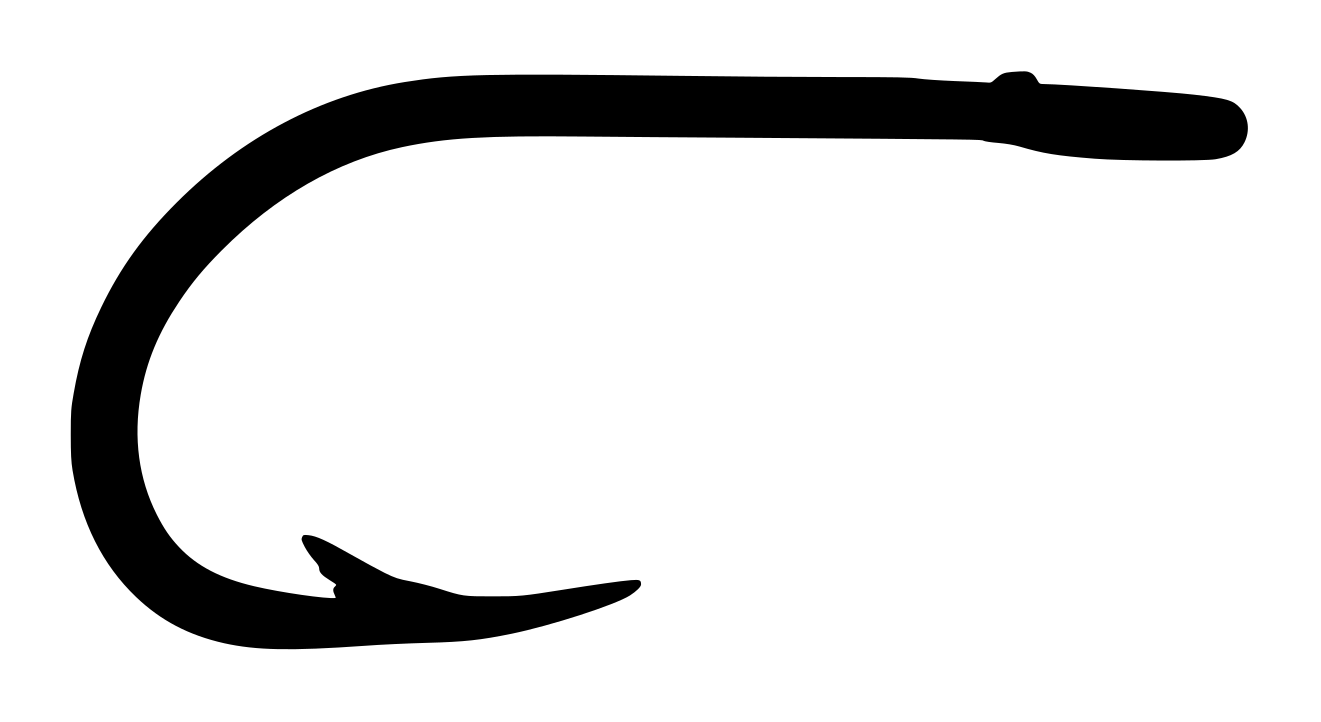
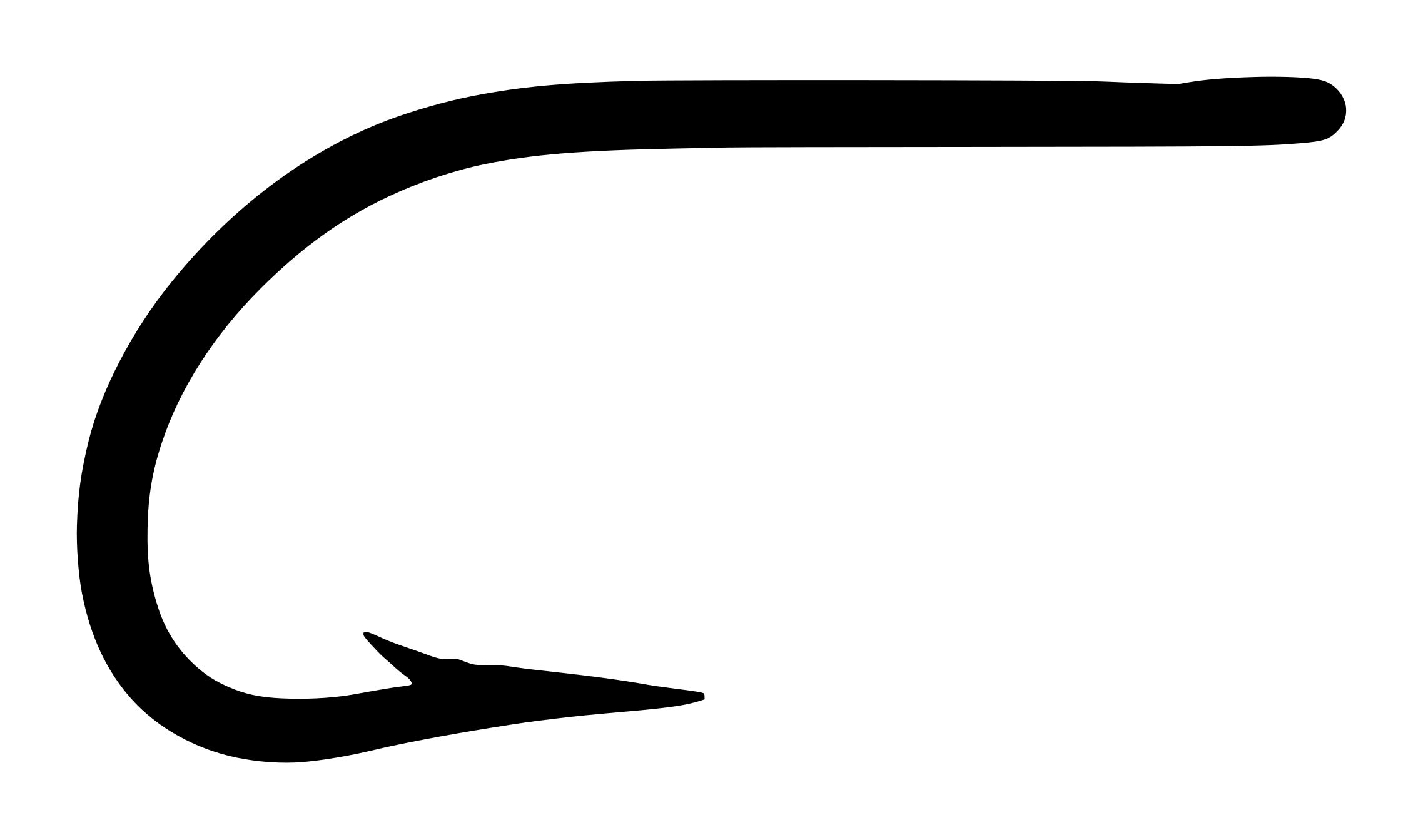
The Mustad 7734 is a legendary heavy-duty saltwater hook designed expressly for giant tuna and large oceanic gamefish. Manufactured in Norway and labeled ‘Giant Tuna Hooks,’ this model represents the golden age of mid-twentieth-century big-game sport fishing, when wealthy anglers pursued bluefin and yellowfin tuna in the 500-1,000+ pound range.
Distinguishing features include an exceptionally fine knife-edge point ground to penetrate hard, bony jaws; a forged extra-heavy wire construction; and a specialized needle-eye design that allows the entire hook to be threaded invisibly inside whole baitfish using a sewing needle. The tinned (silver-colored) finish provided the best available saltwater corrosion resistance before stainless steel became standard.
Dating to post-1925 based on the ‘Oslo – Norway’ designation on the label, this hook is most likely from the 1940s-1950s heyday of North Atlantic and Bahamian tuna fishing. Original paper envelope packaging in good condition commands meaningful collector interest among big-game tackle specialists.
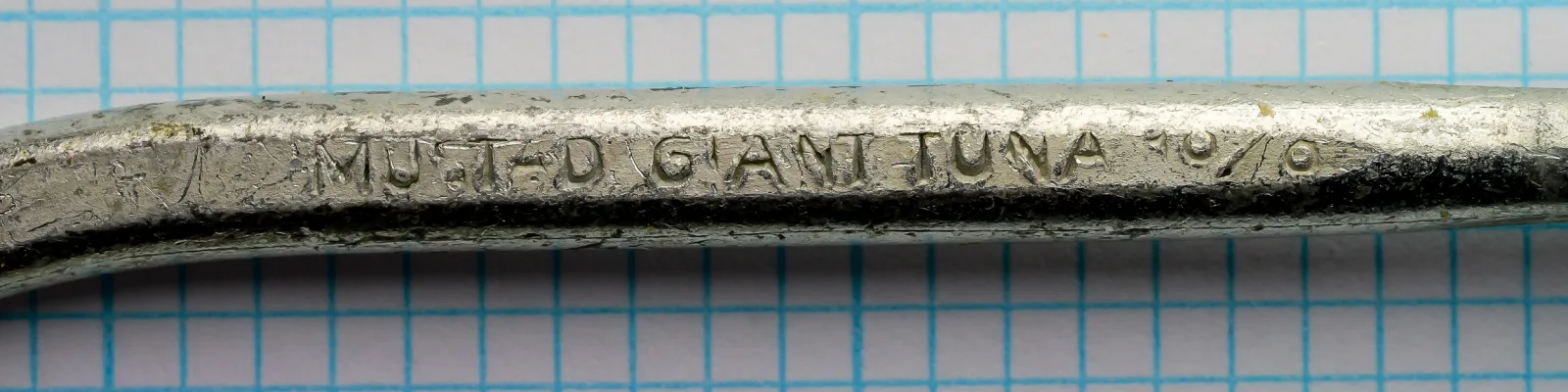
Close-up of the shank showing the engraved 'MUSTAD GIANT TUNA 10/0' text and visible forging marks on the tinned surface.
Photographic record
4 cataloged imagesSelect any record to load it above.
4 images shown
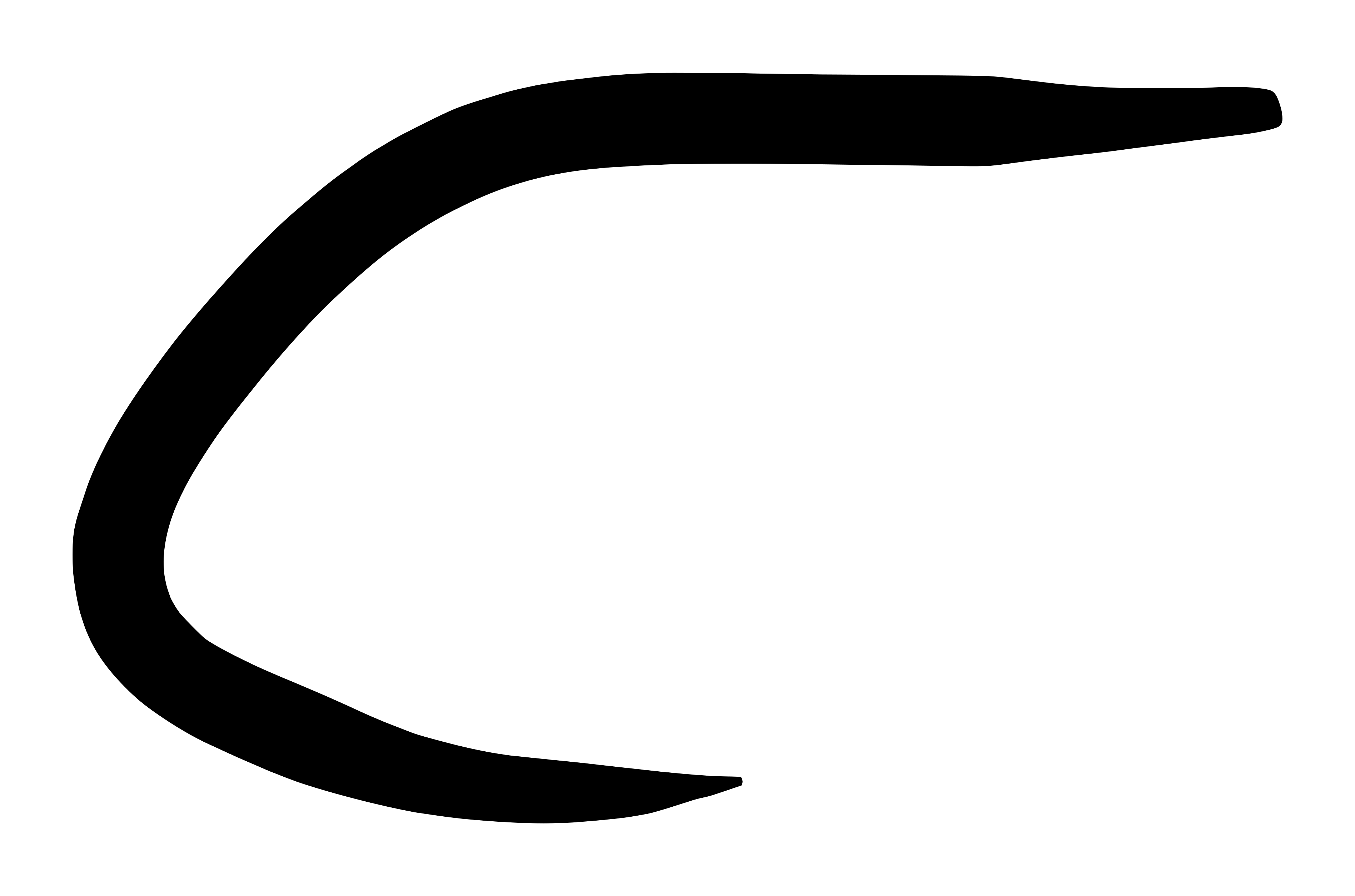
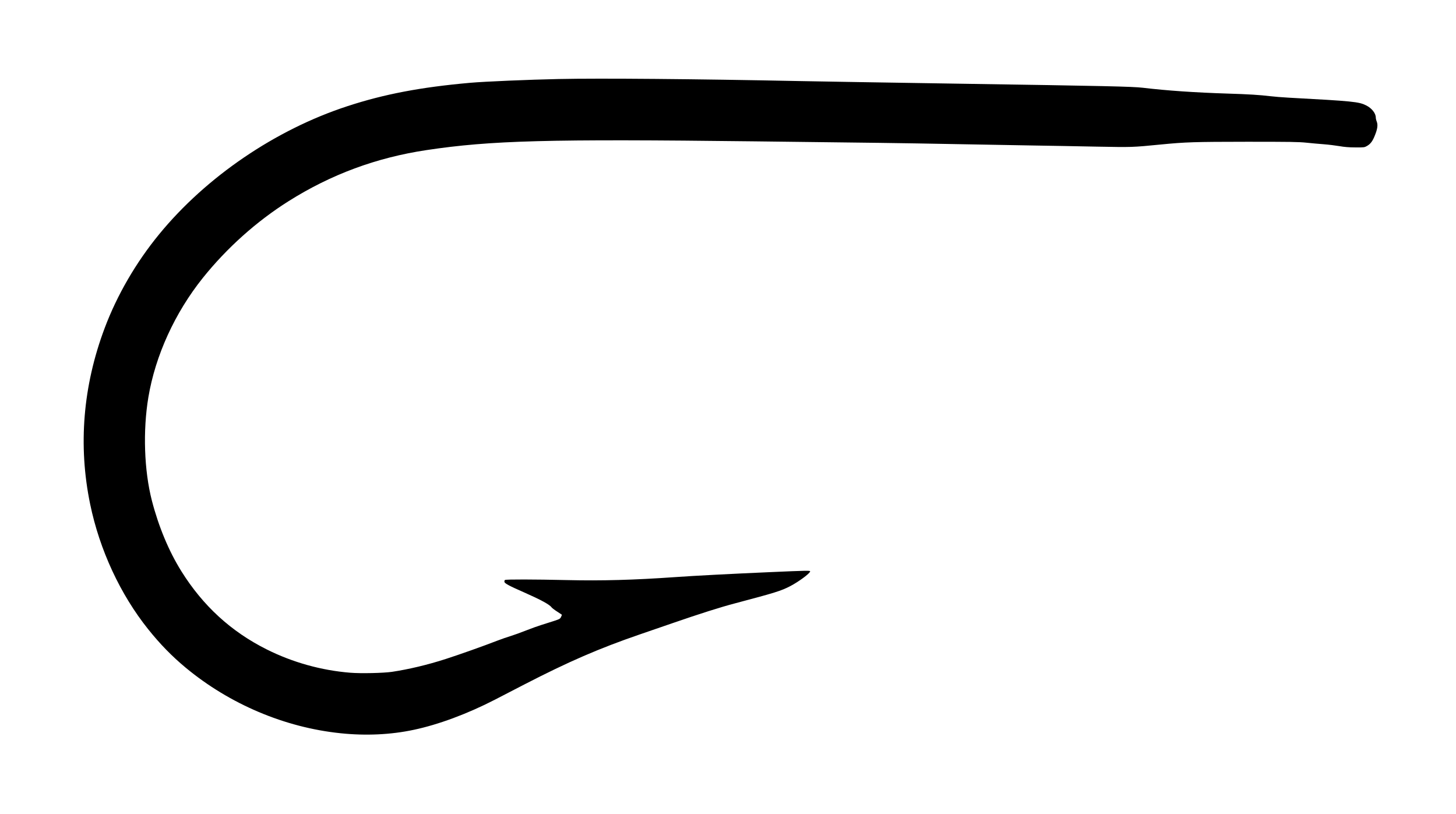
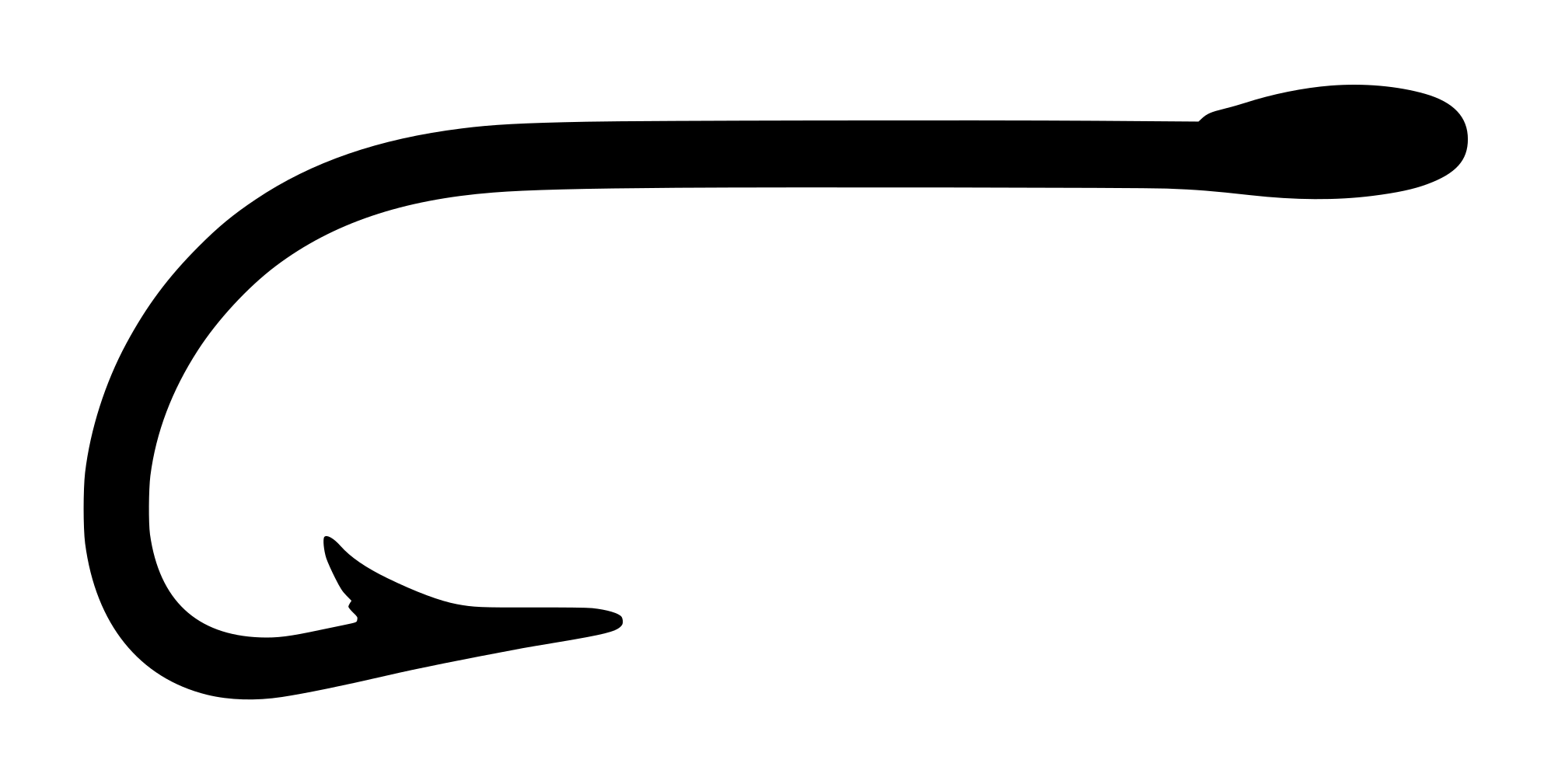
Mustad 7734 Shank Engraving Size 10-0Close-up of the shank showing the engraved 'MUSTAD GIANT TUNA 10/0' text and visible forging marks on the tinned surface.Open originalMustad 7734 Knife-Edge Point Detail Size 10-0Side view of the hook point showing the distinctive knife-edge geometry with fine triangulated taper designed to slice through hard tuna jaw tissue.Open originalMustad 7734 Hook Profile Size 10-0Front view of the complete Mustad 7734 hook showing the overall O'Shaughnessy-style bend, needle-eye construction, and forged wire profile in tinned finish.Open originalMustad 7734 Original Package Label Single HookOriginal factory paper envelope containing the Mustad 7734, showing the full label with Key Brand logo, company information, model specifications, and handwritten size marking.Open original
Technical profile
Eye
Needle Eye, Straight / InlineNeedle-eye design: a precisely drilled elongated slit through the flattened shank, enabling the hook to pass cleanly through whole baitfish with minimal tissue damage P. Typical for heavy offshore trolling and big-game rigging of the era V.
Wire
Extra-Heavy (2X+), Forged
Shank
Short (1X–2X Short) — Plain
Bend
Standard gapSmooth, continuous bend with no angular geometry; resembles an O'Shaughnessy or general deep-sea profile rather than the more specialized Limerick or Dublin patterns E. The bend is symmetrical and exhibits heavy forging marks consistent with vintage mechanical pressing P.
Point
OtherShort, straight-cut barb set perpendicular to the shank axis P. Barb placement is typical for heavy saltwater hooks, designed for secure hold in thick tissue without creating excessive tissue damage I.
Finish
Tinned — Confirmed (stated on packaging)Tinned (silver-gray) coating consistent with high-quality mid-century marine hook production P. Color tone is cool gray without the warmth of bronzed or japanned finishes. Specimen shows even coating with light surface oxidation appropriate to age and storage history P.
Hook specimen shows light surface oxidation and patina consistent with vintage tinned finish; no structural damage, corrosion pitting, or point damage visible P. Original paper envelope shows moderate age toning, light staining, and creasing consistent with careful storage of a single-hook packet P. Size marking '10/0' in blue ink remains legible P.
The knife-edge point is ground with two flat sides meeting at a precise triangulated edge, creating a slicing rather than punching geometry. This design cuts cleanly through the dense cartilage and bone of large pelagic species’ jaws rather than relying on blunt-force puncturing. The extra-heavy forged wire (labeled ‘3 ex. strong’) means the diameter and tensile strength are triple that of a standard hook, providing the structural rigidity necessary to withstand the crushing jaw pressure and violent runs of 500+ pound tuna without straightening or snapping.
The needle-eye, though mechanically simpler than a ringed eye, enabled a revolutionary rigging technique: whole mackerel or herring baits could be sutured onto the leader with the hook completely invisible inside the baitfish. This presentation was far more effective for wary trophy fish than a traditional ringed-eye hook with exposed shank. The tinned finish provided electrochemical corrosion protection superior to bright steel in saltwater, though inferior to modern stainless alloys, making it the de facto standard for marine hooks in the pre-1970s era.
First documented Mustad 7734 in garrenwood.com database. Represents earliest cataloged needle-eye big-game hook variant; documents the pinnacle of pre-stainless-steel marine hook engineering. One of the largest hooks in the catalog by absolute size (10/0 = ~3.5 inches overall length).
Own this hook? Help us measure it.
We don't have measured sizes for this hook yet. Own one? Submit calipered measurements and we'll review and add them. Thank you!
Historical context
mustad
O. Mustad & Son (O. Mustad & Søn) was founded in 1832 in Gjøvik, Norway, initially as a general metalworks factory. The company pivoted to fish hook manufacturing after the invention of the first fully automated hook-making machine by Mathias Topp in 1877. Mustad’s strategy of strict manufacturing secrecy and industrial cloning of regional hook patterns allowed the firm to capture global market dominance by the mid-twentieth century, securing approximately 50% of worldwide hook production by the 1950s.
The company maintained manufacturing facilities in Gjøvik and also operated sales offices across Europe and North America. Mustad became virtually synonymous with the fishing hook itself, establishing the brand through rigorous quality control and a highly standardized eight-line label system that communicated technical specifications across linguistic barriers.
Series History
The Mustad Giant Tuna Hooks series (Quality 7734 and related models) emerged in the 1920s-1930s in direct response to the explosive growth of North Atlantic bluefin tuna sport fishing. Wealthy anglers and commercial interests had established major tuna grounds off Nova Scotia, the Bahamas, and the African coast, spurring demand for specialized heavy-tackle equipment.
The 7734 represents Mustad’s pinnacle of big-game hook engineering for the era: forged extra-heavy wire, knife-edge point geometry for bone penetration, needle-eye construction for invisible rigging, and tinned finish for harsh marine environments. Production continued through the 1950s-1960s, with the model gradually superseded by modern stainless-steel variants and evolving angling techniques.
Era and Packaging Dating
Post-1925 ('Oslo' not 'Christiania'). Logo style (Key Brand in simplified form) consistent with 1930s-1950s export packaging. Label format follows the eight-line Mustad standard established c. 1920s. 'Established 1832' notation suggests packaging aimed at establishing company heritage to international buyers, common during the 1930s-1950s when Mustad was consolidating global market share. No barcode (barcode era: post-1974). Paper stock, print method (offset lithography), and color scheme typical of 1940s-1950s commercial printing. The specific 'Giant Tuna Hooks' marketing language reflects the boom in North Atlantic bluefin sport fishing, 1930s-1960s, with peak activity 1940s-1950s. Overall packaging evidence points to c. 1940-1955 as the most probable production window, with plausible range 1930-1960.
Hemingway's Hook: The Golden Age of Atlantic Tuna
Ernest Hemingway, the legendary novelist and avid sport fisherman, famously pursued giant bluefin tuna off Cuba and in the Gulf Stream using hooks virtually identical to this 7734 model. Hemingway's 1952 novella 'The Old Man and the Sea' immortalized the ordeal of battling a massive marlin on primitive tackle, equipment that would have included Mustad forged offshore hooks of this exact type and era. The hook's needle-eye design was essential for rigging whole mackerel and herring baits that could weigh several pounds, allowing anglers to keep the lethal point completely hidden inside the baitfish until the strike occurred.
Design lineage and influence
The Mustad 7734 descends from nineteenth-century British O’Shaughnessy-pattern heavy saltwater hooks, which themselves evolved from the earliest Sheffield and Redditch needle-point designs developed for deep-sea fishing. Mustad’s refinement was to combine the rugged O’Shaughnessy bend with an independently developed knife-edge grinding technique and the innovation of the needle-eye construction for baitfish rigging.
The 7734’s design philosophy directly influenced later heavy-game hooks such as the Mustad 7691 (the modern O’Shaughnessy standard) and contemporary billfish patterns. The needle-eye concept survives today in specialized trolling and offshore big-game hooks manufactured by Mustad and other makers, testifying to the functional elegance of this century-old innovation.
Best matchRelated by Attribute
Computed automatically from catalog data — updated as new hooks are added.
Matches: Bend, Gap, Eye, Eye Orient., Point +5 moreDiffers: Shank: Short (1X–2X Short) vs Standard; Wire: Extra-Heavy (2X+) vs Heavy (1X Heavy); Length: 89 mm vs 58 mm
Matches: Bend, Wire, Gap, Eye Orient., Finish +3 moreDiffers: Shank: Short (1X–2X Short) vs Standard; Eye: Needle Eye vs Ball Eye; Point: Other vs Superior +2 more
Named patterns specifically associated with this hook. Leave blank if none formally documented. Do not speculate — only include patterns with a confirmed association.
Modern Equivalents
Hook
Match Quality
Notes
Mustad 7691 O'Shaughnessy
Very Good
Direct successor O'Shaughnessy pattern in modern stainless steel; nearly identical bend geometry but contemporary materials
Tiemco TMC 811S
Good
Modern big-game saltwater hook with heavy wire and needle-eye option; refined geometry but similar functional purpose
Collector notes
Rated 5.5/10 — scarcity and specialist collector demand. Big-game offshore hooks in original single-hook packets are significantly rarer than vintage trout and bass hooks due to smaller production volumes and narrower market focus. This specific model is uncommon but not rare; size 10/0 is highly desirable. Limiting factors: condition of envelope (handling and age), availability of the exact model, and collector base restricted to big-game tackle enthusiasts and Mustad specialists.
Reference value
$14 – $26 USD estimate
Packaging condition
Good — moderate wear, legibleRecorded specimen
Packaging format
MUSTAD-ENV-001Catalog code
Positive Factors: (1) The 7734 is specifically named ‘Giant Tuna’ on the label, targeting a prestige market; collectors seek models with clear historical fishing applications and marketing narratives. (2) Needle-eye construction is mechanically distinctive and represents an innovative rigging technology no longer commonly produced, appealing to fishing historians and tackle engineers. (3) The size 10/0 is at the extreme upper end of vintage hook sizing, commanding inherent collector interest—many collectors pursue the largest and smallest extremes. (4) Original paper envelope in good condition significantly enhances value; big-game hooks sold as single-hook packets are rarer than bulk-card distributions. (5) Tinned finish and forged construction represent peak pre-stainless-steel manufacturing quality.
Limiting Factors: (1) Mustad mass-produced millions of hooks; even the 7734 is not exceptionally rare by absolute survival numbers. (2) Collector base is narrower than for trout/fly hooks; demand is strongest among big-game specialists, not general hook collectors. (3) Condition of the envelope is critical; water staining, tears, or loss of the handwritten size marking significantly reduces value. (4) Size 10/0 appeals primarily to specialist collectors—casual collectors may view it as oddly oversized or purely novelty value rather than functional tackle. (5) No significant shortage of 7734s on the market; availability is steady at moderate prices.
Most Desirable Variants: Size 10/0 is the most collectible; smaller sizes (6/0-8/0) are more common. Mint condition sealed envelope commands premium; opened envelopes with legible labels are standard. Tinned finish (as here) is preferred over bright or japanned alternatives for big-game models. Envelopes with clear handwritten size notation and intact Key Brand logo add 10-15% premium.
Condition Impact: Envelope toning and creasing reduce value slightly but are not disqualifying if text remains legible and structure is intact. Missing hook reduces value by 30-40%. Water staining or heavy foxing deducts 15-20%. Complete, well-preserved specimens represent the investment-grade tier of this model.
Packaging
Single-hook paper envelope, approximately 4.5" x 2.5", printed on cream-colored paper stock with dark text and red accent graphics. Front face features the Mustad 'Key Brand' logo (downward-pointing skeleton key) in upper left, company information 'O. Mustad & Son / Manufacturers / Established 1832 / Oslo - Norway' in upper right, and a large red diamond-shaped central motif containing the model specifications. The diamond is bordered by decorative asterisk patterns typical of mid-twentieth-century commercial printing. Text elements include: 'Qual. 7734 / Knife-edge Point / Mustad-Giant Tuna Hooks / Forged, needle-eye, tinned, 3 ex. strong' within the diamond. Lower left reads '1 hook' (packet contents), lower right displays '10/0' in blue handwritten or stamped numerals. Bottom border states 'Made in Norway.' Envelope shows light age toning, creasing at fold lines, and light staining consistent with careful storage. Paper stock is typical offset-printed commercial grade, slightly brittle with age but intact without tears.
Where to Find
eBay (US and UK) — search 'Mustad 7734' or 'Mustad Giant Tuna Hook 10/0'. Tackleclone and vintage fishing tackle dealers specializing in big-game equipment. Specialty auction houses handling tackle collections. Fly-fishing and general fishing forums occasionally feature vintageofferings. Frequency: available approximately every 1-3 months at market prices in the $14-26 range; size 10/0 specifically is more readily available than smaller sizes.
Collector's Identification Tips
Identify this hook by the engraved ‘MUSTAD GIANT TUNA 10/0’ text along the shank, visible in oblique lighting P. Confirm the model code ‘Qual. 7734’ on the original paper envelope P. The needle-eye construction and knife-edge point geometry are visually distinctive—no ring at the eye, and the point exhibits a fine, diamond-shaped flat profile when viewed from the side P. The tinned silver-gray finish and forged wire cross-section distinguish it from lighter-gauge hooks and modern stainless variants P.
eBay market reference. Researcher-curated. Prices in USD.
Preservation
Storage and Preservation
Store the original paper envelope in a cool, dry environment (relative humidity 30-50%). The tinned finish is inherently corrosion-resistant but can develop light patina with age; this is cosmetically acceptable and normal for vintage specimens. Avoid direct sunlight, which may cause the tan paper envelope to yellow further or the red ink in the diamond motif to fade.
If the envelope is opened, preserve the hook on the packet rather than loose storage. The hook’s needle-eye is mechanically sound and resistant to damage, but storing it loose increases risk of loss and decreases the provenance value of the packet. Never store in plastic sleeves or airtight containers, as trapped moisture can accelerate oxidation even under tinned protection. Store away from other metals to prevent galvanic corrosion or staining.
Inspect periodically for signs of moisture intrusion or insect damage. The paper envelope itself is the primary vulnerability; if any evidence of water exposure or mold appears, allow the envelope to air-dry thoroughly in a well-ventilated space before returning to storage. The handwritten size marking in blue ink is vulnerable to water exposure; protect accordingly.
A well-preserved example in its original envelope represents significant collector value; exercise care proportional to the specimen’s condition and your valuation of the piece.
Additional
The Needle-Eye Innovation in Offshore Rigging
The needle-eye design of the 7734 represents a critical innovation in big-game tackle engineering. Unlike traditional ringed-eye hooks that require the line or leader to be knotted directly to a visible loop, the needle-eye allows the entire hook to be threaded—using a stout sewing needle—through the body cavity of whole baitfish (mackerel, herring, mullet, or flying fish) with the hook point emerging invisibly from the bait’s flank or belly.
This rigging method offered profound functional advantages for trophy hunting: (1) The hook point was completely hidden, eliminating the visual cue that might alarm wary large fish accustomed to seeing previous anglers’ failed hooks. (2) The streamlined profile created by threading the hook through the bait reduced water resistance and spinning at high trolling speeds (8-12 knots), maintaining a natural baitfish presentation. (3) The wide bait (often 4-6 inches of mackerel) could be rigged and secured firmly with wire or heavy monofilament leader, preventing the bait from being separated from the hook during strikes or during the fight itself.
Hemingway and his contemporaries used this rigging extensively when trolling the Gulf Stream and off Cuba in the 1930s-1950s. The technique required multiple hooks—spare rigs were prepared daily, with fresh baits threaded and ready for deployment. The 7734 single-hook packet was thus part of a larger system: anglers purchased packets individually as replacements for lost or damaged hooks, or stocked them for extended fishing expeditions.
Modern offshore anglers have largely abandoned needle-eye construction in favor of standard ringed-eye heavy hooks and refined circle-hook designs, but the needle-eye remains a functional classic for anglers pursuing authentic big-game techniques and for museum/display collections.
Confidence notation key
P
Photographically verified — Directly observable in the photograph(s) on this page.
V
Verified by documentation — Confirmed by manufacturer catalog, spec sheet, or published reference.
I
Inferred — A logical deduction from observable or documented evidence, not directly stated.
E
Estimated — An approximation based on visual comparison, proportional analysis, or limited data.
S
Speculative — A reasoned hypothesis that cannot be confirmed from available evidence.
Claims with no notation are confirmed by multiple independent sources. All photographs on garrenwood.com are taken on a measurement grid where each square equals 1/10 inch (0.1″ / 2.54 mm).