Pflueger Sheepshead Fish Hooks No. 5321, Size 5, Tinned Finish. A standard-shank, ringed-eye saltwater bait hook manufactured by the Enterprise Manufacturing Company (Pflueger) of Akron, Ohio, circa 1910–1950. This model exemplifies Pflueger’s mid-range production for coastal and estuarine predator fishing, particularly sheepshead and similar hard-mouthed species.
The hook features a mechanically filed superior point, tinned finish for corrosion resistance, and a simple ring eye — robust construction typical of Pflueger’s non-premium saltwater catalog. The tinned coating appears frosted-silver with characteristic slight pooling from the hot-dip process, indicating authentic period manufacture rather than modern electroplating.
Packaging is a cream-colored cardboard box with two-color letterpress printing emphasizing ‘FILED POINT — RINGED — MADE IN U.S.A. — BY AMERICAN WORKMEN — OF AMERICAN MATERIAL.’ The box format, typography, and paper stock are consistent with Pflueger’s documented 1910–1950s retail distribution. This is a common model in the Pflueger catalog, but full original packaging in this condition is increasingly scarce.
Original Pflueger Sheepshead Fish Hooks box No. 5321, size 5, showing two-color letterpress label with green and red text on cream stock, indicating filed point, ringed construction, and tinned finish. Box demonstrates typical Pflueger retail packaging c. 1910–1950.
Photographic record
3 cataloged imagesSelect any record to load it above.
3 images shown
Pflueger Sheepshead Hooks Box 5321 Size 5 TinnedOriginal Pflueger Sheepshead Fish Hooks box No. 5321, size 5, showing two-color letterpress label with green and red text on cream stock, indicating filed point, ringed construction, and tinned finish. Box demonstrates typical Pflueger retail packaging c. 1910–1950.Open originalPflueger Sheepshead Size 5 Side Profile Tinned PointSide profile of Pflueger Sheepshead hook size 5 showing the moderately rounded bend, tinned frosted-silver finish, mechanically filed superior point, and proportionate barb angle. Photographed on 1/10-inch measurement grid for scale reference.Open originalPflueger Sheepshead Size 5 Front Face Ring EyeFront face of Pflueger Sheepshead hook size 5 illustrating the straight ring eye, standard-gauge wire, and overall proportions. The clean eye formation and uniform wire profile are typical of Pflueger's machine-formed production. Photographed on 1/10-inch measurement grid.Open original
Technical profile
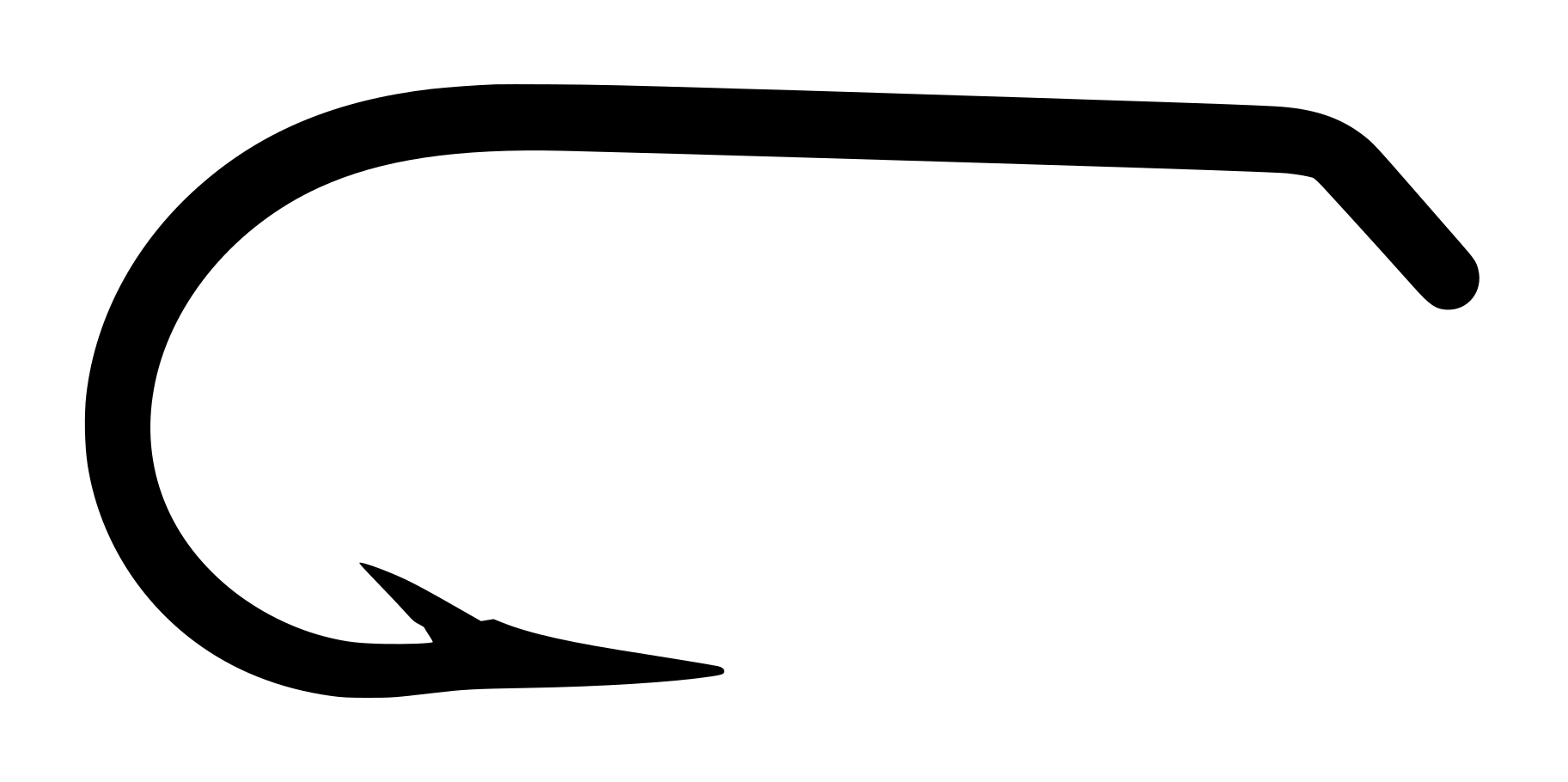
Partridge D3ST Straight-Eye Streamer Hook — Model Code D3ST — Size 6 — Bronze Finish — Standard Weight Wire — Forged Sproat Bend — Quantity 25 per package
Eye
Ball Eye, Straight / InlineStraight ring eye is cleanly formed with no offset or flatting. Ring diameter is proportionate to wire gauge (not oversize or undersized). Eye loop is regular and consistent, indicating machine-formed rather than hand-wrapped construction. Solder or brazed ring joint is not visible, suggesting seamless drawn or folded wire eye. P
Wire
Extra-Heavy (2X+), Round, Est. ~0.81 mm P
Shank
Standard — Plain
Bend
Standard gap, Offset / kirbedThe Sheepshead bend displays a moderately rounded bottom curve (neither deeply parabolic like a Sproat nor shallow like an Aberdeen) with moderate depth ~0.52-0.56 inches. The wire is set symmetrically with no intentional offset; the point emerges straight from the bend curve. Bend symmetry is clean, typical of Pflueger's mechanical forming dies rather than hand-forged craft production. P
Point
Superior (near-straight inner taper)Short, close-cut mechanical barb positioned immediately behind the point. Barb angle is approximately 90 degrees (perpendicular to the shank). Barb size is proportionate to wire gauge — not oversized or swept, consistent with Pflueger's filed-point production standard. Single barb (not double or micro-barbed). P
Finish
Tinned — Confirmed (stated on packaging)Tinned finish appears frosted silver-gray with slight frosted texture characteristic of hot-dip application. No burnish or high-polish gloss visible; color tone is cool and neutral, consistent with traditional tin coating rather than nickel or chrome plating. Specimen shows no rust or active corrosion despite age, indicating the tinned barrier has remained effective. Light surface oxidation and dulling are normal patina for a 70+ year old tinned hook. P
Hook specimen is bright with frosted tinned finish intact; no corrosion or pitting visible. Original cardboard box shows light to moderate age toning on cream stock, minor edge wear and creasing consistent with 80+ years of storage. Label remains legible with two-color printing (green and red) intact and unfaded. No missing or damaged hooks visible in the assembled package.
The Sheepshead hook exemplifies Pflueger’s production philosophy: robust, economical construction for high-volume saltwater use. The mechanically filed superior point — created by multiple passes of a rotating file across the steel wire — provides a straight, sharp penetrating geometry optimized for hard-mouthed species with crushing pharyngeal teeth. Unlike hollow points (concave inner face, favored for delicate presentations), the superior point delivers maximum kinetic force concentration and reduces the risk of point deflection off bone.
The tinned finish involves hot-dip immersion in molten tin, creating a sacrificial galvanic barrier that protects the underlying high-carbon steel from saltwater oxidation. Historical Pflueger tins display characteristic uneven coating thickness and slight pooling at the barb — visible on this specimen — indicating traditional batch processing rather than modern automated electroplating. The tin adds marginal weight and bulk but significantly extends functional lifespan in estuarine and coastal environments.
The straight ring eye (rather than flatted or looped configurations) provides maximum loop-holding area for snelled leaders or direct knots, standard for bait presentations where casting distance and holding strength matter more than fly-line compatibility. The standard wire gauge balances bend resistance with bait-holding penetration — strong enough to set in hard jaws but not so heavy that it fatigues the caster or requires premium rod action.
No records set. This is a standard production model. Sheepshead pattern is documented in the garrenwood.com catalog but is neither the smallest, largest, rarest, nor most valuable in the Pflueger section. It represents typical mid-tier saltwater production c. 1910–1950.
Own this hook? Help us measure it.
We don't have measured sizes for this hook yet. Own one? Submit calipered measurements and we'll review and add them. Thank you!
Historical context
pflueger
The Enterprise Manufacturing Company was founded by Ernest F. Pflueger in Akron, Ohio in 1881 (following his earlier American Fish Hook Company operations dating to 1864). The firm became the largest fish hook manufacturer in the world by the 1920s–30s, employing 350+ workers and producing over one hundred million hooks annually. Pflueger’s vertical integration — from raw steel wire through finished tackle and mechanical reels — enabled rapid scaling and cost leadership.
In 1899, Pflueger acquired the historic American Fish Hook & Needle Company of New Haven, Connecticut, which had pioneered automated hook manufacture as early as 1864. This acquisition brought sophisticated bend families (Limerick, Carlisle, Kirby) and established Pflueger’s dominance in the American market. By the 1910s–1920s, Pflueger had diversified into wooden lures (Never-Fail minnow, famous for phosphorescent paint technology patented by E.F. Pflueger in 1883) and fishing reels, eventually becoming synonymous with American tackle craftsmanship.
The company maintained distinct quality tiers: the flagship Bulldog brand (premium), the Four Brothers line (economy tier, named for the four Pflueger brothers managing operations), and trade/private-label production. Pflueger hooks were distributed globally and remain iconic among vintage tackle collectors. The company was acquired by Shakespeare in 1966; hook production ceased between 1966 and the present. Today, Pflueger operates exclusively as a Pure Fishing subsidiary producing only reels and rods.
Series History
The Sheepshead bend family is not a core Pflueger historical series documented in primary catalogs but rather a specialized variant designed for hard-jawed coastal species — sheepshead, drum, croaker, and similar inshore predators. Unlike the flagship Carlisle, Kirby, and Limerick patterns that trace their lineage to 19th-century British traditions and appear in nearly every Pflueger catalog, the Sheepshead appears to be a targeted saltwater addition to the broader portfolio circa 1910–1920.
The geometry — a moderately curved bend with a standard shank and filed point — reflects Pflueger’s engineering philosophy: maximum hook-up reliability without premium wire or forging. The tinned finish was standard for saltwater applications, providing galvanic protection against marine corrosion. Model code 5321 follows the documented Pflueger four-digit system; the ’21’ suffix appears on several ringed-eye patterns and may indicate standard ring configuration across multiple bend families.
Sheepshead hooks do not appear prominently in surviving vintage Pflueger catalogs (e.g., the 1929 and 1931 pocket references), suggesting either limited production, regional distribution emphasis, or later introduction than core patterns. The hook likely remained in production until Pflueger’s shift away from terminal tackle after 1966, but surviving original packaging is uncommon, indicating modest retail volume relative to flagship patterns.
Named Collaborator
Not applicable. No named designer or collaborator is credited on the packaging or in documented Pflueger catalogs for the Sheepshead pattern. The hook represents standard Pflueger in-house engineering and production rather than a patent-specific or personally-endorsed design.
Era and Packaging Dating
Packaging bears 'MADE IN U.S.A. — BY AMERICAN WORKMEN — OF AMERICAN MATERIAL' letterpress text, consistent with 1910s–1950s Pflueger production. No barcode present (pre-1974 indicator). Model code 5321 follows documented Pflueger four-digit nomenclature with no suffix, typical of standard production lines. Box construction is cardboard with glued label, consistent with mid-20th-century retail packaging. Typography is green and red two-color letterpress on cream stock — matching documented Pflueger catalog era. Sheepshead hook classification (saltwater predator species) aligns with Pflueger's documented expansion into coastal fishing tackle c. 1910–1920. Conservative dating c. 1910–1950 accounts for uncertainty in catalog gaps (Pflueger records incomplete 1920–1922, 1930, 1932, 1942, 1946–1947).
The Sheepshead Challenge
Sheepshead (Archosargus probatocephalus) are notoriously difficult to hook due to their hard, protruding crushing teeth and cautious feeding behavior. Colonial-era fishermen on the Atlantic coast called them 'convict fish' for their distinctive black-and-white striped markings. By the early 20th century, specialized tackle makers like Pflueger engineered dedicated sheepshead hooks with superior points and robust shanks specifically to penetrate and hold in the bone-hard pharyngeal jaws of these estuarine predators. Sheepshead remains a high-skill target for modern tackle enthusiasts and continues to drive demand for specialized hook designs — proving that century-old Pflueger engineering principles remain functionally valid.
Design lineage and influence
The Sheepshead pattern is not a classical British bend family (like Limerick or Kirby, which trace to 19th-century Redditch tradition) but rather an American regional specialization emerging from Pflueger’s post-1899 acquisition of the American Fish Hook & Needle Company. The American company had experience with native-species bait patterns suited to American inland and coastal fisheries, and Pflueger leveraged this expertise to differentiate from British importers.
The geometry — a moderate round bend without pronounced offset — appears to derive from simplified Sproat or modified Carlisle lineage: economical to produce, strong enough for hard-jawed species, and optimized for bait presentation rather than fly-casting. The filed point and tinned finish reflect Pflueger’s manufacturing philosophy: industrial precision, corrosion management, and cost efficiency.
No documented competitor designs (Mustad, Partridge, or other makers) produced dedicated ‘Sheepshead’ patterns in the pre-1966 era, suggesting this was a Pflueger market innovation targeting Atlantic and Gulf Coast anglers. Modern hook makers (Eagle Claw, Mustad) continue to market sheepshead-specific patterns, indicating the pattern has proven durable and functionally valid despite nearly a century of hook engineering evolution.
Best matchRelated by Attribute
Computed automatically from catalog data — updated as new hooks are added.
Matches: Bend, Shank, Eye, Eye Orient., Forging +3 moreDiffers: Wire: Extra-Heavy (2X+) vs Standard; Gap: Standard vs Wide; Point: Superior vs Hollow Point +1 more
Matches: Bend, Shank, Gap, Eye, Forging +3 moreDiffers: Wire: Extra-Heavy (2X+) vs Standard; Eye Orient.: Straight / Inline vs Turned Up; Point: Superior vs Hollow Point +1 more
The Sheepshead hook is engineered for live bait and cut bait fishing in brackish estuaries, coastal inlets, and nearshore saltwater zones. Primary target species include sheepshead (Archosargus probatocephalus), black drum (Pogonias cromis), and similar hard-mouthed perciform fish. These species inhabit oyster beds, rock jetties, and pilings where they feed on hard-shelled crustaceans — crabs, shrimp, and mollusks — requiring crushingly strong jaws and making them notoriously difficult to hook.
Size 5 (approximately 1.19 inches overall length) is appropriate for live mullet, live shrimp, or cut herring baits in shallow to moderate depths (2–20 feet). The tinned finish ensures longevity in high-salinity environments and reduces the risk of rust-induced hook failure during long soaks. The filed superior point maximizes penetration against bone and hard mouth tissue. The straight ring eye accommodates heavy monofilament or twisted leader for secure attachment.
Classic Fly Patterns
Reservoir streamers, traditional bucktails, pike and predator patterns, muddlers, attractor patterns, long-shank wet flies
Modern Equivalents
Hook
Match Quality
Notes
Mustad 3407 O'Shaughnessy
Moderate
Similar tinned saltwater bait hook with filed point; slightly heavier wire and larger sizes typical of modern O'Shaughnessy pattern. Geometry differs — O'Shaughnessy has more pronounced offset.
Eagle Claw 152 Sheepshead
Good
Modern continuation of sheepshead pattern; similar shank length and tinned finish, but likely chemically sharpened point rather than filed. Ring eye matches.
Collector notes
Rated 4.0/10 — uncommon but not actively sought. Pflueger saltwater models are less collected than flagship freshwater patterns (Carlisle, Kirby). Size 5 is moderate and functional; collectability is driven primarily by the intact original packaging rather than the hook specimen itself. Complete original box in very good condition adds significant premium.
Reference value
$8 – $22 USD estimate
Packaging condition
Very Good — light wear, fully legibleRecorded specimen
Packaging format
GW-PF-02Catalog code
What Makes It Collectible: Pflueger is recognized globally as the dominant American hook manufacturer of the 20th century. This specimen represents a documented production model with authentic period packaging, two-color letterpress label, and original contents — all factors highly valued by vintage tackle historians and Pflueger specialists. The Sheepshead pattern is geographically and functionally specific, appealing to collectors focused on coastal fishing heritage and regional fishing traditions.
Limiting Factors: Sheepshead is not a flagship Pflueger pattern like the Carlisle or Limerick, which appear in nearly every catalog. The model code 5321 is not prominently documented in surviving primary catalogs (Pflueger catalog gaps include 1930, 1932, 1942, 1946–47), making authentication and dating challenging for novice collectors. Size 5 is moderate and common — extreme sizes (very small or very large) command higher collector premiums. The hook itself is standard production with no special features (no patented geometry, no named collaborator, no unusual finish).
Desirable Variants: Smaller sizes (Size 1–2) and larger sizes (Size 7–8/0) in Sheepshead pattern are genuinely scarce. Tinned finish is standard for saltwater and moderately desirable. If original packaging bears the Bulldog or Four Brothers brand-line mark, the value premium would increase significantly (brand-line identification adds historical context). Sealed, unopened boxes with all original tissue wrapping can command 2–3x the value of opened, displayed boxes.
Condition Impact: Box condition is the primary value driver. Original label legibility, absence of major creasing or tears, and intact hook count dramatically affect valuation. Loose hooks with missing packaging typically sell for 20–30% of equivalent carded value — specimens without original packaging context are purely utilitarian and lack collector premium.
Packaging
Original cardboard box, cream-colored stock with glued label. Dimensions approximately 4.5 x 2.0 x 0.5 inches. Label features two-color letterpress printing in green and red ink on white paper. Top of label: 'PFLUEGER' in red italicized serif font, 'SHEEPSHEAD' in large green sans-serif, 'FISH HOOKS' in red block letters. Center: 'FILED POINT — RINGED' in green, 'MADE IN U.S.A. — BY AMERICAN WORKMEN — OF AMERICAN MATERIAL' in smaller green serif font. Right side: '100' (quantity) and 'No. 5321' (model code) in green, with 'Tinned' below. Size marking '5' in upper right corner. Box shows light aging (cream stock has developed warm tan patina), minor edge creasing and wear consistent with 75+ year storage. Label remains fully legible; no tears or significant damage. Interior appears to hold loose hooks (not carded or enumerated on internal separator).
Market Value Notes
Low ($8): Good condition — box opened, all or most hooks present, moderate label aging and creasing, minimal research documentation.<br />
High ($22): Excellent condition — box intact with vibrant label, complete hook count verified, original tissue or separator present, documented provenance.<br />
Premium factors: Original box in excellent condition (cream stock with unfaded two-color printing); complete and verified hook count; authentic Pflueger four-digit model code; tinned finish specimen in bright condition; regional interest (Atlantic coast sheepshead collectors).<br />
Platforms: eBay (vintage tackle, completed listings), Etsy (vintage fishing), specialist tackle dealers, regional antique markets.<br />
Confidence: E estimated — limited recent sales data for this specific model. Comparable Pflueger saltwater patterns (Carlisle, O'Shaughnessy tinned) in similar packaging have sold in the $6–$28 range depending on size and condition. Sheepshead is moderately desirable; valuation is conservative based on pattern rarity relative to flagship Carlisle.
Where to Find
eBay (search 'Pflueger 5321' or 'Pflueger Sheepshead vintage'), Etsy (vintage tackle and fishing), regional antique and sporting goods dealers specializing in fishing tackle, tackle swap meets and gun shows in coastal Atlantic regions (North Carolina, Maryland, Virginia, South Carolina), estate sales and auctions in areas with strong recreational fishing heritage.
Collector's Identification Tips
Model code 5321 is stamped or printed on the original box label in green ink. The code follows Pflueger’s documented four-digit nomenclature. Size ‘5’ is printed in the upper right corner of the box label. Check for ‘PFLUEGER’ brand name in red italicized text at the top of the label — Pflueger brand lines (Bulldog, Four Brothers) would appear as secondary markings. Absence of UPC barcode (pre-1974 production). Letterpress printing method (not offset lithography) is consistent with 1910–1950s era. Tinned finish and filed point are explicitly described on the label, aiding period authentication.
Preservation
Storage and Preservation
Storage Environment: Store the original cardboard box in a cool, dry location away from direct sunlight and humidity. The cream-colored stock is acid-based and will continue to yellow and become brittle if exposed to UV light or fluctuating moisture. Ideal conditions are 50–70°F with 30–50% relative humidity.
Tinned Finish Care: The tinned coating is durable but not impervious. Loose hooks should be stored in an airtight container with a desiccant packet (silica gel) to minimize atmospheric exposure. Do not allow hooks to contact dissimilar metals (iron, copper, brass) as galvanic corrosion can accelerate. If light surface oxidation develops (normal patina), gentle dry brushing with a soft brass wire brush will restore luster without damaging the tinned layer.
Box Preservation: Keep the box intact and closed to protect both the cardboard stock and the hooks inside. If the box shows signs of insect activity or mold, place it in a sealed container with a desiccant for 2–3 weeks before attempting to clean. Do not wash or apply liquid treatments to the vintage cardboard.
Documentation Value: Original packaging is critical to this hook’s collectability. Resist any temptation to remove hooks from the box for ‘better display’ — the box itself is the artifact. Photograph the box label and all visible markings for your personal records and future reference.
Handling: Handle the hooks minimally; oils from skin can accelerate tinning-layer oxidation. If hooks must be handled, wear cotton gloves. Do not use modern polishes or chemical treatments designed for bright steel — these can strip or discolor the tinned finish.
Additional
Pflueger's Saltwater Expansion and the Sheepshead Market
By the early 20th century, Pflueger had established dominance in the freshwater market through bulk production of Carlisle, Kirby, and Sproat patterns. However, the acquisition of the American Fish Hook & Needle Company in 1899 and the company’s aggressive marketing under E.F. Pflueger’s leadership prompted rapid diversification into coastal and saltwater tackle — a market largely controlled by British Redditch makers (Partridge, Allcock, S. Reddington).
The introduction of specialized patterns like the Sheepshead reflects Pflueger’s strategic pivot: engineer region-specific hooks for American fisheries that British importers had not fully optimized. Sheepshead and black drum are endemic to the Atlantic and Gulf coasts of North America, and their hard-mouthed physiology presented a distinct engineering problem that American tackle makers could address through rapid prototyping and manufacturing iteration — advantages Pflueger possessed through its massive Akron factory infrastructure.
The tinned finish and filed point were Pflueger’s industrial answer to traditional British hand-forged and bronze-finished patterns: mechanical consistency at scale, corrosion resistance engineered for American coastal water chemistry, and cost leadership through automation. By the 1920s–30s, Pflueger’s saltwater catalog rivaled Redditch in breadth and exceeded it in production volume.
Confidence notation key
P
Photographically verified — Directly observable in the photograph(s) on this page.
V
Verified by documentation — Confirmed by manufacturer catalog, spec sheet, or published reference.
I
Inferred — A logical deduction from observable or documented evidence, not directly stated.
E
Estimated — An approximation based on visual comparison, proportional analysis, or limited data.
S
Speculative — A reasoned hypothesis that cannot be confirmed from available evidence.
Claims with no notation are confirmed by multiple independent sources. All photographs on garrenwood.com are taken on a measurement grid where each square equals 1/10 inch (0.1″ / 2.54 mm).