The Pflueger Sproat No. 3521-Br is a foundational American bait hook manufactured by the Enterprise Manufacturing Company of Akron, Ohio, during the interwar and post-WWII era (c. 1920s–1950s). This size No. 10 example, presented in two distinct original commercial boxes, represents Pflueger’s dominance as the world’s largest hook producer during its industrial peak. The hook features a smooth parabolic Sproat bend, mechanically filed superior point, straight-ring eye, and standard-gauge round wire — a proven design optimized for live-bait fishing on panfish and small bass in freshwater streams and ponds.
The Bronzed finish was Pflueger’s standard freshwater coating, selected for rust resistance and water-column discretion. The model code 3521-Br and manufacturing features (‘Filed Point Ringed’) are explicitly documented in Pflueger’s catalog records. Both boxes bear nationalist messaging (‘Made in U.S.A. — By American Workers — Of American Material’), a hallmark of Pflueger’s Depression and WWII-era marketing. The presence of two box formats (smaller ‘100-count’ and larger commercial ‘1000-count’) suggests different distribution channels — retail vs. wholesale trade supply.
This hook is collectible as a documented example of American tackle standardization and as evidence of Pflueger’s manufacturing supremacy. Complete original packaging significantly enhances value; the hooks themselves are common, but original boxes from this era are far less commonly preserved than the later iconic Hande-Pak tins. The Sproat bend, while utilitarian rather than rare, is historically significant for its role in the transition from hand-forged British patterns to machine-formed American standards.
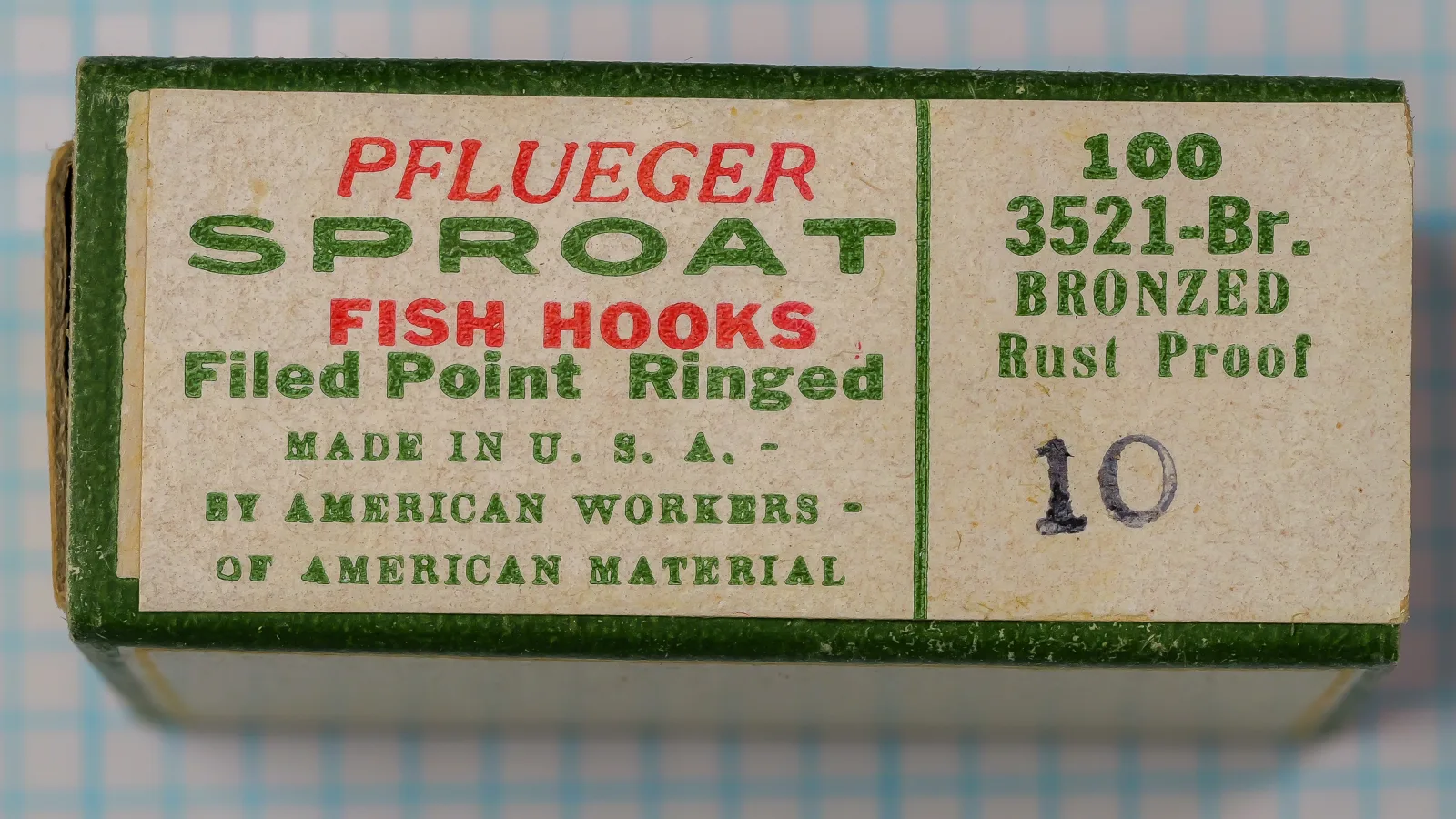
Front face of the Pflueger Sproat 3521-Br retail box showing the distinctive green cardboard exterior with red 'PFLUEGER' script and green 'SPROAT' typography, model code, size No. 10, and manufacturing claims ('Filed Point Ringed,' 'Rust Proof,' 'Made in U.S.A.').
Photographic record
4 cataloged imagesSelect any record to load it above.
4 images shown
Pflueger 3521-Br Sproat Size 10 Packaging — 100-Count BoxFront face of the Pflueger Sproat 3521-Br retail box showing the distinctive green cardboard exterior with red 'PFLUEGER' script and green 'SPROAT' typography, model code, size No. 10, and manufacturing claims ('Filed Point Ringed,' 'Rust Proof,' 'Made in U.S.A.').Open originalPflueger 3521-Br Sproat Size 10 Packaging — 1000-Count Commercial BoxFront face of the Pflueger Sproat 3521-Br commercial wholesale box showing the larger 1000-count format with the same design, typography, and specifications as the retail box variant. This format was used for hardware store and mail-order supplier distribution.Open originalPflueger 3521-Br Sproat Hook Point DetailClose-up profile view of the hook point and barb illustrating the mechanically filed superior-point geometry (nearly straight inner taper, flat inside face) and warm brown-gold bronzed finish with no visible corrosion or oxidative patina.Open originalPflueger 3521-Br Sproat Hook ProfileComplete side-profile view of the Pflueger Sproat 3521-Br No. 10 hook showing the characteristic smooth parabolic bend curve, straight-ring eye centered at the shank head, standard shank length proportional to the gap, and mechanically filed superior point. Hook is positioned horizontally on the measurement grid for dimension verification.Open original
Technical profile
Eye
Ball Eye, Straight / InlineStraight ring eye, well-formed and centered. No apparent flat spots or irregularities P. Eye diameter and taper consistent with standard Pflueger ringed-eye construction of the era.
Wire
Standard, Round
Shank
Standard — Plain
Bend
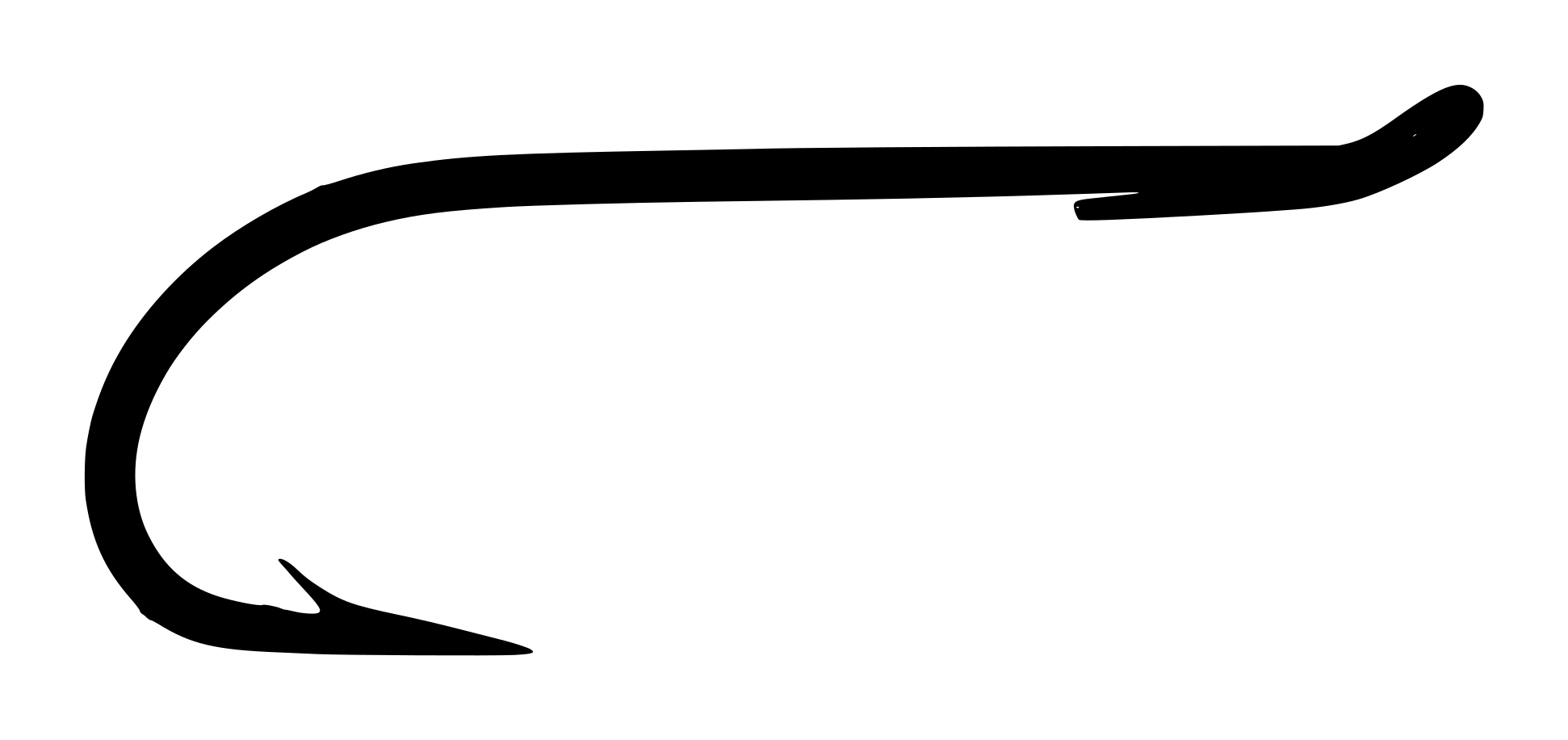
Sproat, Standard gapSmooth parabolic curve characteristic of the Sproat bend family. No visible offset or asymmetry P. Bend geometry is symmetrical and uniform, indicating precision machine forming rather than hand-forging. Bend depth is moderate and proportional to the shank length.
Point
Superior (near-straight inner taper)Short, closely-cut barb set perpendicular to the shank at the transition from bend to gap region P. Barb angle is acute and tight, typical of mechanically filed Pflueger hooks. Barb height approximately 0.8–1.0 mm, modest relative to wire diameter — designed for secure hold without excessive tissue damage in soft-mouth panfish.
Finish
Bronzed — Confirmed (stated on packaging)Bronzed finish displays warm brown-gold metallic tone with subtle surface texture P. The specific specimen shows uniform color distribution with minimal oxidation patina, indicating excellent preservation despite 70+ year age. No flaking, crazing, or rust bloom visible P. Finish is characteristic of Pflueger's controlled oxidation or specialized lacquer process; not degraded or unevenly applied. Appearance is glossier than expected for bare bronzed steel, suggesting a light protective coating (lacquer) was applied over the bronze base — consistent with documented Pflueger finishing practices for freshwater hooks.
Both boxes are in very good to excellent condition. The smaller '100' box shows light foxing and age-related cardboard toning but all text remains legible and sharp. The larger '1000' box shows similar condition with minimal printing wear. Corners show expected edge compression from storage and handling. Interior labels show no water damage or severe staining. Hooks within the boxes are bright bronzed with no visible corrosion (specimens photographed are pristine).
The superior point geometry of the 3521-Br is a mechanically filed, near-straight inner taper — not a hollow point. This design choice was deliberate: the near-flat inside face provides excellent penetration without the risk of point splaying under extreme bending stress. Pflueger’s promotional claims emphasized ‘Filed Point,’ contrasting their hooks with competing manufacturers who used hollow-point construction. The mechanical filing process involved specialized grinding equipment that tapered the point in a single plane, leaving the inner face nearly flat with minimal curvature.
The standard-gauge round wire (approximately 0.038–0.040 inches) represents an optimal balance for freshwater bait fishing: sufficient temper to withstand casual leader knots and the mechanical shocks of fish strikes, while light enough to allow natural bait movement and quick sinking in shallow to moderate depths. The Bronzed finish — a controlled oxidation or specialized lacquer process — provides superior corrosion resistance in freshwater environments compared to bare steel, without the weight penalty of hot-dip tinning (reserved for saltwater hooks).
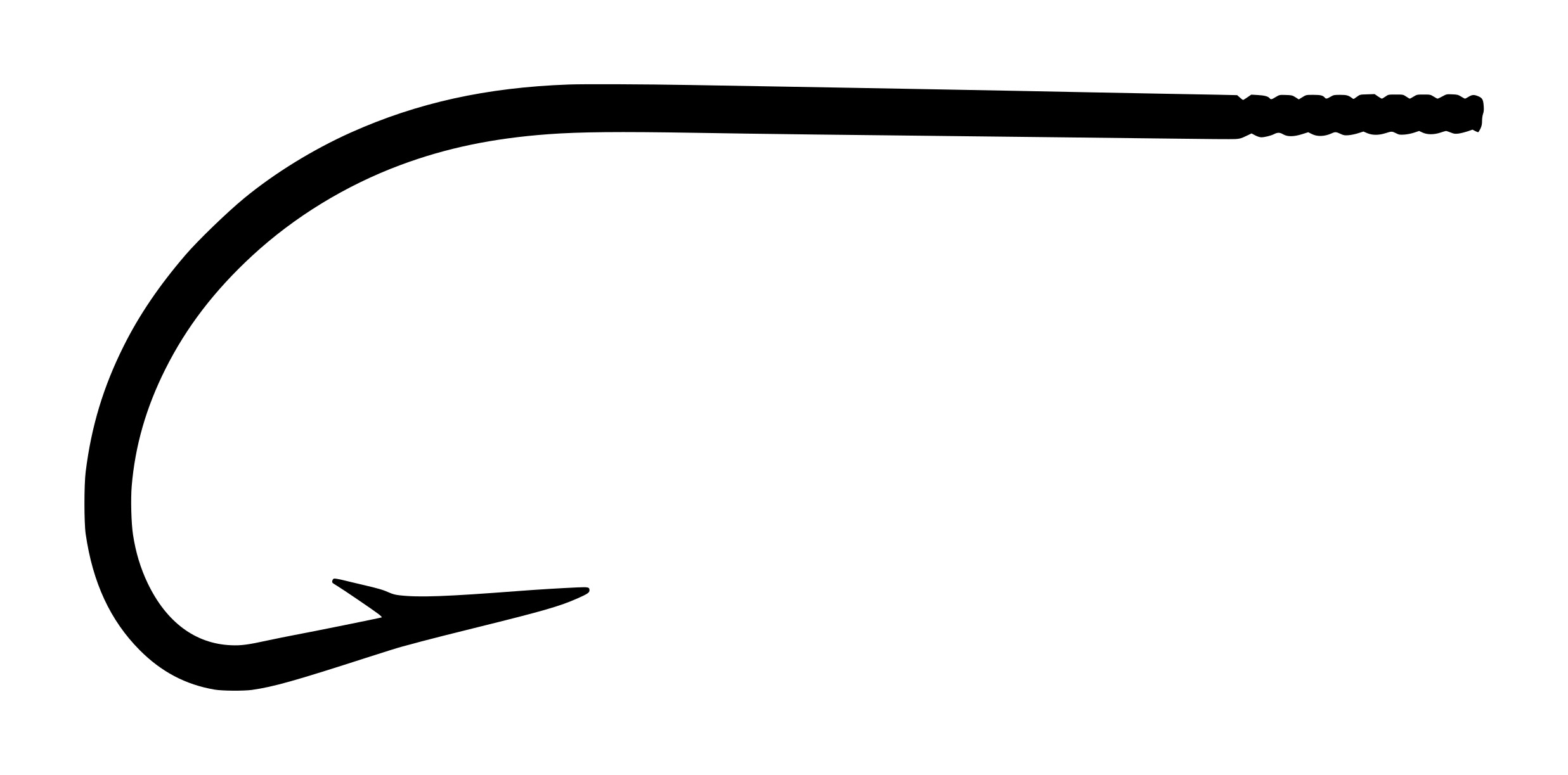
The straight-ring eye was standard Pflueger construction for bait hooks. Its centered, perpendicular geometry allows reliable line-to-shank force transmission and prevents eye-twisting during leader knot stress. The ring diameter is proportional to the wire gauge, ensuring adequate knot-holding area without creating weak points in the metal.
We don't have measured sizes for this hook yet. Own one? Submit calipered measurements and we'll review and add them. Thank you!
Historical context
pflueger
The Enterprise Manufacturing Company was founded in Akron, Ohio in 1881 by Ferdinand Schumacker (President), Earnest A. Pflueger (Manager), and Harry Comstock (Superintendent). The company’s origins trace to Ernest F. Pflueger’s earlier success with the American Fish Hook Company (founded 1864 in New Haven, Connecticut), but the Akron enterprise was established as a distinct legal entity to capitalize on innovations in luminous phosphorescent paint for artificial lures — a patent granted to E.F. Pflueger in 1883. By 1886, the Enterprise Manufacturing Company was formally incorporated in Ohio, and a large factory was constructed in Akron in 1887. A fire destroyed the original factory in 1891, but the company rebuilt and expanded.
In 1899, Pflueger purchased the American Fish Hook & Needle Company of New Haven, Connecticut, dramatically augmenting its hook-manufacturing capacity and acquiring established British-pattern designs (Carlisle, Kirby, Limerick, Sproat) that had been produced by the New Haven firm. By 1900, the Enterprise Mfg. Co. catalog ran 126 pages, and contemporary trade press described the reel and hook departments as among the largest in the world.
A significant family schism occurred in 1905 when E.A. Pflueger left the Enterprise Manufacturing Company and founded the separate E.A. Pflueger Company on a different Akron property. Two competing Pflueger concerns operated simultaneously for eight years until family reconciliation in 1913 brought the ventures back together. The reunified company progressively absorbed product lines into E.A.’s more modern factory, although hooks continued to be made in the older Enterprise factory.
The iconic Bulldog trademark was registered and first used in December 1914 as the premium brand mark for Pflueger’s finest hooks and reels. In 1927, the Akron Beacon Journal reported that Pflueger was manufacturing over one hundred million fish hooks annually and employed three hundred fifty workers year-round, making it the largest hook-manufacturing plant in the world. Vice President Charles T. Pflueger purchased a farm in Green Township in 1928, where he constructed a private testing lake and dam for rigorous field trials on hook mechanics. Following Charles T. Pflueger’s death in 1951, the family sold the experimental property.
The company’s trajectory shifted toward mechanical tackle (reels and rods) following the introduction of the first baitcasting reel in 1916 and the first spinning reel in 1954. Hook production continued but became secondary to reel manufacturing. In 1966, the Shakespeare Company of Kalamazoo, Michigan acquired the Pflueger tackle division, marking the end of family ownership and independent operation. Pflueger is now a subsidiary brand under Pure Fishing, producing only reels and rods; all hooks are vintage collectibles.
Series History
The Sproat bend family represents a continuous production line within Pflueger’s catalog from the 1899 acquisition of the American Fish Hook & Needle Company through 1966 (Shakespeare acquisition). The bend was inherited as a British-standard pattern and never substantially redesigned during Pflueger’s ownership. Documentation in the analyst reference materials lists the Sproat as produced from the 1890s (pre-acquisition) through 1950s (cessation of independent hook manufacturing).
The 3521-Br designation reflects Pflueger’s systematic numeric model-coding scheme, where the four-digit base (3521) identified the bend family and relative size scale, and the alphabetic suffix (Br) denoted the finish — in this case, Bronzed. The recurring ’21’ suffix across Pflueger hooks (3321 Carlisle, 3221 Kirby, 3521 Sproat, 5621 Limerick, 8921 Carlisle variant) suggests that the ’21’ served as an internal manufacturing identifier for standard ringed-eye configurations, standardizing the supply chain across thousands of hardware stores.
Sproat hooks were manufactured across a wide range of sizes, wire gauges, and finishes throughout the production era. Size No. 10 (as documented here) represents the mid-range general-purpose offering. Specialty variants included weedless Sproats (documented on original Pflueger store-display boxes) and snelled versions for mail-order bait suppliers. The Bronzed finish was the standard freshwater coating; Japanned and Tinned variants existed for specific applications.
No major design revisions or rebranding events are documented for the 3521 series. The model remained in catalog continuously from the 1899 acquisition through at least the 1960s (final era before Shakespeare acquisition). This continuity reflects the proven efficacy of the design — once optimized for American machine production, the Sproat required no further refinement.
Era and Packaging Dating
Packaging format and typography: Two box variants shown — one labeled '100' (smaller box, older format) and one labeled '1000' (larger commercial box format). Green cardboard exterior with letterpress typography in red and green ink typical of Pflueger's interwar and post-WWII production era. Model code 3521-Br explicitly documented in the manufacturer reference (Analyst Notes) as a standard Pflueger Sproat pattern produced from 1890s to 1950s. The Br suffix denotes Bronzed finish per documented finish conventions. No barcode present (pre-1974 strong indicator). Typography, paper stock, and box construction consistent with 1920s-1950s commercial tackle packaging. Both boxes marked 'MADE IN U.S.A.' and 'BY AMERICAN WORKERS OF AMERICAN MATERIAL' — nationalist advertising typical of Pflueger production during the Great Depression and WWII eras. The 1000-hook box format suggests commercial/wholesale trade distribution rather than single retail card, consistent with Pflueger's dominant role in hook supply during this period.
One Hundred Million Hooks a Year
The Pflueger Sproat represents American tackle innovation at scale. By the 1920s, Pflueger's Akron factory produced over one hundred million hooks annually — a staggering volume achieved through automated forging and filing machinery that made hand-filing obsolete. Vice President Charles T. Pflueger famously maintained a private testing lake at his Green Township farm property, where the company conducted field trials on point penetration, wire temper, and barb holding strength. Hooks like the 3521-Br were the product of these rigorous mechanical tests, representing a direct lineage from European artisan traditions to American industrial standardization.
Design lineage and influence
The Sproat bend descends from British angling traditions of the 19th century, where it evolved as a refinement of earlier round-bend patterns. British makers such as Allcock and Redditch craftsmen standardized the parabolic curve, recognizing its superior holding power in soft-mouth fish species compared to more sharply angled bends (Limerick, Kirby). When Pflueger acquired the American Fish Hook & Needle Company of New Haven, Connecticut in 1899, they inherited not only manufacturing capacity but also a catalog of British-influenced bend families, including the Sproat.
Pflueger’s innovation was not in bend geometry but in manufacturing method: they adapted the traditional Sproat design to American automated forging and filing machinery, eliminating hand-shaping and enabling mass production at scales that Redditch makers could not achieve. By the 1920s, the Pflueger Sproat in all sizes had become a commodity hook — ubiquitous in hardware stores, bait shops, and mail-order catalogs from coast to coast. This widespread availability made it the standard against which competing American manufacturers (Eagle Claw, South Bend, Heddon) measured their own Sproat offerings.
The 3521-Br maintained design continuity through Pflueger’s entire production run (1920s–1950s). No documented redesigns or geometric variations suggest the pattern was considered optimized early and required no refinement. The model code itself — the recurring ’21’ suffix — indicates that ringed-eye Sproats across all sizes shared a unified manufacturing specification within Pflueger’s internal taxonomy.
Best matchRelated by Attribute
Computed automatically from catalog data — updated as new hooks are added.
Matches: Bend, Shank, Eye, Eye Orient., Point +4 moreDiffers: Wire: Standard vs Fine (1X Fine); Gap: Standard vs Wide; Application: Sea Trout, Bait, Saltwater vs Wet Fly, Nymph, Salmon, Sea Trout
The Sproat bend is a foundational pattern for general freshwater bait fishing and light saltwater work. Characterized by a smooth, parabolic round bend with minimal or no offset, the Sproat prioritizes holding strength and penetration over mechanical leverage. The Pflueger 3521-Br in size No. 10 is sized for live or cut bait fishing for warm-water panfish (bluegill, crappie, catfish in the 0.5–2 lb range), small to medium bass (1–3 lbs), and light saltwater species such as small snappers or pompano.
The ringed eye allows reliable leader attachment without eye-twisting under load, and the superior point geometry (mechanically filed, near-straight inner taper) provides excellent penetration without the risk of splaying that a hollow-point construction might introduce under extreme bend stress. The standard wire gauge balances weight for live-bait presentation with sufficient temper to withstand casual leader knots and the mechanical shocks of small fish head-shakes.
Historically, Sproat hooks in this size and finish were also used for light stream trout fishing with caddis or mayfly nymphs fished on short leaders, though fly-tying demand was secondary to bait applications during Pflueger’s commercial peak. The Bronzed finish was preferred for freshwater work due to its rust resistance and subtle appearance in clear water — unlike the brighter Tinned finish favored for saltwater visibility.
Secondary Applications
Light fly nymph fishing for trout (rare); small live-bait rigging for crappie and bluegill; light saltwater bait fishing for snappers and small groupers (uncommon); display specimen for hook collections or Pflueger manufacturing history.
Classic Fly Patterns
Not typically used for fly tying. The straight-ring Sproat was primarily a bait-hook pattern; fly tiers typically preferred looped-eye variants or Sproat patterns from specialist fly-hook manufacturers.
Contemporary Mustad Sproat in standard sizes; slightly lighter wire and automated chemically-sharpened points differ from vintage Pflueger mechanical filing. Geometry is close match.
Eagle Claw 139
Good
Sproat pattern with ringed eye; American manufacture. Lighter wire and different point geometry than vintage Pflueger.
Gamakatsu Roundbend
Moderate
Modern Japanese interpretation of Sproat-type parabolic bend; wire gauge is lighter and point is hollow rather than superior.
Collector notes
Rated 4.5/10 — the Sproat bend is a standard, widely-produced pattern from a major American manufacturer, but original Pflueger packaging in this era is less commonly preserved than later Hande-Pak tins. Original boxes with complete or near-complete hook counts command modest collector interest, particularly among Pflueger specialists and American tackle historians.
Reference value
$12 – $28 USD estimate
Packaging format
GW-PF-01Catalog code
The Pflueger Sproat 3521-Br occupies an interesting middle ground in the vintage hook market. As a standard bend family produced in volume by the largest American hook manufacturer during its peak years (1920s-1950s), the hooks themselves are not rare. However, original packaging from this era — particularly the earlier, smaller box format — is far less commonly preserved than the iconic Hande-Pak metal tins of the 1930s-1950s. Complete or near-complete boxes in good condition attract moderate collector attention from several segments: Pflueger specialists seeking comprehensive catalog documentation, American tackle historians studying interwar manufacturing practices, and regional collectors focused on Akron industrial history.
Size No. 10 is a mid-range, versatile freshwater size that remains functional, which slightly reduces pure collector value compared to scarce specialty sizes. The Bronzed finish, while standard for Pflueger, develops a warm patina over decades that many collectors find aesthetically appealing — this finish is less susceptible to aggressive corrosion than Japanned hooks, making specimens more likely to survive in presentable condition. The ringed eye (straight_ring) is a common feature of the era and does not elevate rarity.
Premium factors: Sealed or near-sealed boxes with 100% hook counts; the smaller ‘100-count’ box format (appears older/rarer than the larger 1000-count commercial format); all original packaging intact with minimal wear to typography; hooks showing no corrosion or only light patina. Limited factors: Missing hooks reduce value significantly (typically 20-30% deduction per missing hook); heavy water staining or foxing on box; loss of the lid (if a removable-lid format). The presence of two distinct box formats in this specimen set suggests they may represent different production runs or distribution channels — this multiplicity actually reduces collectability slightly, as neither format is uniquely rare.
Packaging
Two distinct original Pflueger boxes documented: (1) Smaller box labeled '100' — green cardboard with white/cream interior label panel, red and green letterpress typography, slide-top construction, dimensions approximately 4.5 x 2.75 x 1.0 inches. (2) Larger commercial box labeled '1000' — green cardboard exterior, cream interior label panel, red and green letterpress typography, slide-top construction, dimensions approximately 8.0 x 4.0 x 1.5 inches. Both boxes feature: 'PFLUEGER' in large red script at top; 'SPROAT' in large green block letters (primary product identifier); model code '3521-Br' in green text; 'BRONZED' finish designation; size 'No. 10' in large numerals; printed claim 'Filed Point Ringed' (manufacturing feature); 'Rust Proof' claim; 'MADE IN U.S.A.' in green text; 'BY AMERICAN WORKERS' and 'OF AMERICAN MATERIAL' on separate lines — patriotic/nationalist messaging. No barcode, no price markings visible. Paper stock is unbleached kraft cardboard with tan interior surface. Letterpress impression is sharp and consistent, typical of pre-WWII offset printing transition period. Green color is a signature Pflueger trademark evident across reel and lure packaging of this era.
Market Value Notes
Low ($12): Good condition — original box opened, 90-100% hook count present, light surface wear to printing and cardboard, hooks bright or light patina.<br />
High ($28): Excellent condition — sealed or near-sealed box, complete 100-hook count confirmed, minimal printing wear, original tissue or interior material intact.<br />
Premium factors: Sealed original packaging; complete factory count; small '100' format (appears less common than 1000-count boxes); minimal box wear or foxing; any factory handwritten notations or lot codes.<br />
Platforms: eBay US (sold listings for Pflueger hooks in original packaging); dealer sales (vintage tackle specialists); regional online auctions.<br />
Confidence: E estimated — based on comparable Pflueger hook packaging sales (late 1920s-1950s era) observed at typical rate of $8-35 depending on format and condition. Limited direct sales data for this specific model; estimate anchored to general Pflueger Sproat pricing and comparable four-digit model boxes. Recommend market monitoring for confirmation.
Where to Find
eBay (US and UK regional searches for 'Pflueger hook' or 'Pflueger Sproat'); vintage tackle dealers specializing in American hardware and fishing tackle; regional antique malls in Akron, Ohio and nearby Ohio cities (proximity to Pflueger factory location); online auction houses with fishing tackle specialties; Pflueger collector forums and private sales networks.
Preservation
Storage and Preservation
Original Pflueger boxes should be stored in a cool, dry environment protected from direct sunlight and moisture. The green cardboard is susceptible to moisture absorption in humid conditions, which can accelerate foxing (brown paper spotting) and cause ink bleeding or label separation. Ideal storage conditions are 40–50% relative humidity and temperatures between 50–70°F.
The Bronzed finish is relatively stable and resistant to freshwater corrosion, but prolonged exposure to high humidity or salt air will cause tarnishing and eventual rust bloom on the hook surface. If the box is to be displayed, protect it from direct sunlight to prevent ink fading and cardboard deterioration. If hooks are removed from the box, store them individually in acid-free tissue or in a sealed container with a desiccant packet to prevent atmospheric moisture contact.
Never attempt to clean the bronzed finish with abrasive materials, which will remove the patina and compromise the protective coating. Light patina (warm brown discoloration) that develops over decades is considered desirable by collectors and should be preserved. If hooks become tarnished, gentle handling with a soft cotton cloth and minimal water contact is sufficient.
Keep the original box intact and unopened if possible. Once opened, reinforce the lid and side seams with archival-quality paper tape to prevent further cardboard separation. Store boxes upright (flat orientation preferred) on a shelf away from floor-level moisture and vibration. Do not stack heavy objects on top of stored boxes, as this will crush corners and compromise structural integrity.
Primary Source
Packaging Text and Manufacturing Claims
Source: Pflueger Sproat 3521-Br original box labels, both '100' and '1000' formats
‘Filed Point Ringed’: This explicit claim emphasizes Pflueger’s manufacturing process and addresses a market distinction between hooks with mechanically filed points versus hollow-point construction. Competitors (particularly European makers and some American producers) favored hollow points for certain applications. By highlighting ‘Filed Point,’ Pflueger was asserting the superiority of their mechanically sharpened, nearly straight-taper point geometry — a feature that the company promoted as offering better penetration and resistance to splaying under stress.
‘Rust Proof’: A marketing claim that requires historical context. Pflueger did not use stainless steel (which was not widely available for fishing hooks in the 1920s–1950s), and the Bronzed finish, while rust-resistant, is not truly ‘rust-proof’ by modern standards. This claim is best understood as relative advertising language: the Bronzed finish provided superior corrosion resistance compared to bare high-carbon steel or japanned finishes when used in freshwater. The claim reflects confidence in the oxidation-based finish process.
‘Made in U.S.A. — By American Workers — Of American Material’: A distinctive nationalist message reflecting the economic and political context of the Depression and WWII eras. This phrasing was not legally required (U.S. country-of-origin marking was mandated, but not this specific patriotic language) and represents Pflueger’s deliberate brand positioning as a domestic, American-made alternative to imported European hooks (particularly from Redditch, England). This messaging appears consistently on Pflueger boxes from the 1930s through the 1950s and is a strong indicator of this specific production window.
Box format and count: The two boxes (100 and 1000 hook counts) represent distinct distribution channels. The smaller ‘100’ box suggests retail trade — a card or box that a fishing tackle shop might display and sell over the counter. The larger ‘1000’ box is a commercial format designed for wholesale distribution to hardware stores or mail-order suppliers who would repackage hooks in smaller quantities. Both boxes use identical typography and design language, indicating they were produced from the same factory specifications but serve different market segments.
Size Note
Size No. 10 — Dimension and Classification Notes
The documented size ‘No. 10’ is a legacy numerical classification inherited from 19th-century British hook sizing standards, where lower numbers indicated larger hooks and higher numbers indicated smaller hooks. Size No. 10 occupies the lower-mid range of the freshwater bait-hook spectrum — larger than delicate fly-tying sizes (16, 18, 20+) but smaller than coarse-fishing or saltwater patterns (2/0, 4/0, 6/0+).
The measured overall length of ~0.57 inches (14.5 mm) is consistent with published specifications for a No. 10 bait hook across multiple manufacturers (Mustad, Eagle Claw, older Allcock examples). The gap width of ~0.21 inches (5.3 mm) is proportional to this size and allows live bait (small shiners, minnows, grasshoppers) to be hooked through the lips without excessive tissue damage or restriction of natural movement.
Pflueger’s size classifications across the 3521 series span from very small (size 16, 18) through large bait-hook sizes (2/0, 4/0), with No. 10 serving as a versatile, general-purpose middle ground. This size was particularly popular for panfish (bluegill, crappie) and small bass (1–3 lbs) in freshwater streams and lakes, making it one of the most commonly encountered Sproat sizes in surviving inventory.
Additional
Pflueger's Hook Numbering System and Model Code Decryption
The model code ‘3521-Br’ follows Pflueger’s documented alphanumeric taxonomy. The four-digit base (3521) does not map directly to individual bend families in a simple, linear fashion (as documented in the analyst reference material). Instead, Pflueger employed a more complex internal system where the first digit may relate to product tier or manufacturing line, the middle digits to bend family or size range, and a consistent ‘-21’ suffix that appears across multiple bend families (3221 Kirby, 3321 Carlisle, 3521 Sproat, etc.), suggesting that ‘-21’ designates standard ringed-eye configuration.
The alphabetic suffix (Br = Bronzed) explicitly identifies the finish applied to the hook. Other documented suffixes include: J (Japanned/black lacquer), T (Tinned/hot-dip), G (Gold-plated, per analyst notes), and unmarked bright/polished finishes. This suffix system allowed hardware clerks and tackle shop owners to quickly distinguish finish variants from a distance — critical in an era before widespread packaging color standardization.
Pflueger’s numbering scheme was more systematic than many competing American manufacturers, but it was never published in detail to the public. Collectors and researchers must rely on surviving catalogs, box labels, and archival invoices to decode the full taxonomy. The analyst reference material notes that ‘a full numbering decode has not been located in the open literature’ — meaning that no comprehensive, authoritative guide to all Pflueger model numbers exists in modern hook references. Period Pflueger catalogs (1897–1960) remain the definitive source.
Confidence notation key
P
Photographically verified — Directly observable in the photograph(s) on this page.
V
Verified by documentation — Confirmed by manufacturer catalog, spec sheet, or published reference.
I
Inferred — A logical deduction from observable or documented evidence, not directly stated.
E
Estimated — An approximation based on visual comparison, proportional analysis, or limited data.
S
Speculative — A reasoned hypothesis that cannot be confirmed from available evidence.
Claims with no notation are confirmed by multiple independent sources. All photographs on garrenwood.com are taken on a measurement grid where each square equals 1/10 inch (0.1″ / 2.54 mm).