The Mustad 3891 is a mid-tier Sproat-bend wet fly and salmon hook manufactured by O. Mustad & Søn in Oslo, Norway, during the classic vintage labeling era (c. 1925–1970). The model number, geographical designation, and eight-line label format provide a precise chronological bracket for dating. Size No. 1 is a versatile, medium-sized pattern suitable for both freshwater salmon and sea trout fly tying, as well as light bait-fishing applications across European and British traditions.
The defining characteristics are the parabolic Sproat bend, which distributes mechanical stress evenly across the steel for exceptional holding power under heavy tension; the hollow point geometry, which provides rapid tissue penetration with minimal angler effort; the ringed (ball) eye construction, allowing direct line attachment via standard fishing knots; and the rustproof finish, a period-appropriate alkyd-resin lacquer that resists short-term corrosion without the expense of tinning or modern stainless steel. The standard-gauge, unforged round wire reflects mid-tier quality designation within Mustad’s product hierarchy.
The specimen is significant for its original, legible eight-line label bearing the Key Brand trademark and decorative floral border, a hallmark of Mustad’s standardized labeling system used to communicate technical specifications across linguistic and geographic barriers. The Oslo designation (post-1925) and absence of barcode (pre-1974) confirm genuine vintage production. Such labeled boxes are moderately common in surviving collections, reflecting Mustad’s dominant global market position, yet they remain desirable for their role in documenting industrial scale-up, regional pattern cloning, and the evolution of modern fly-fishing tackle.
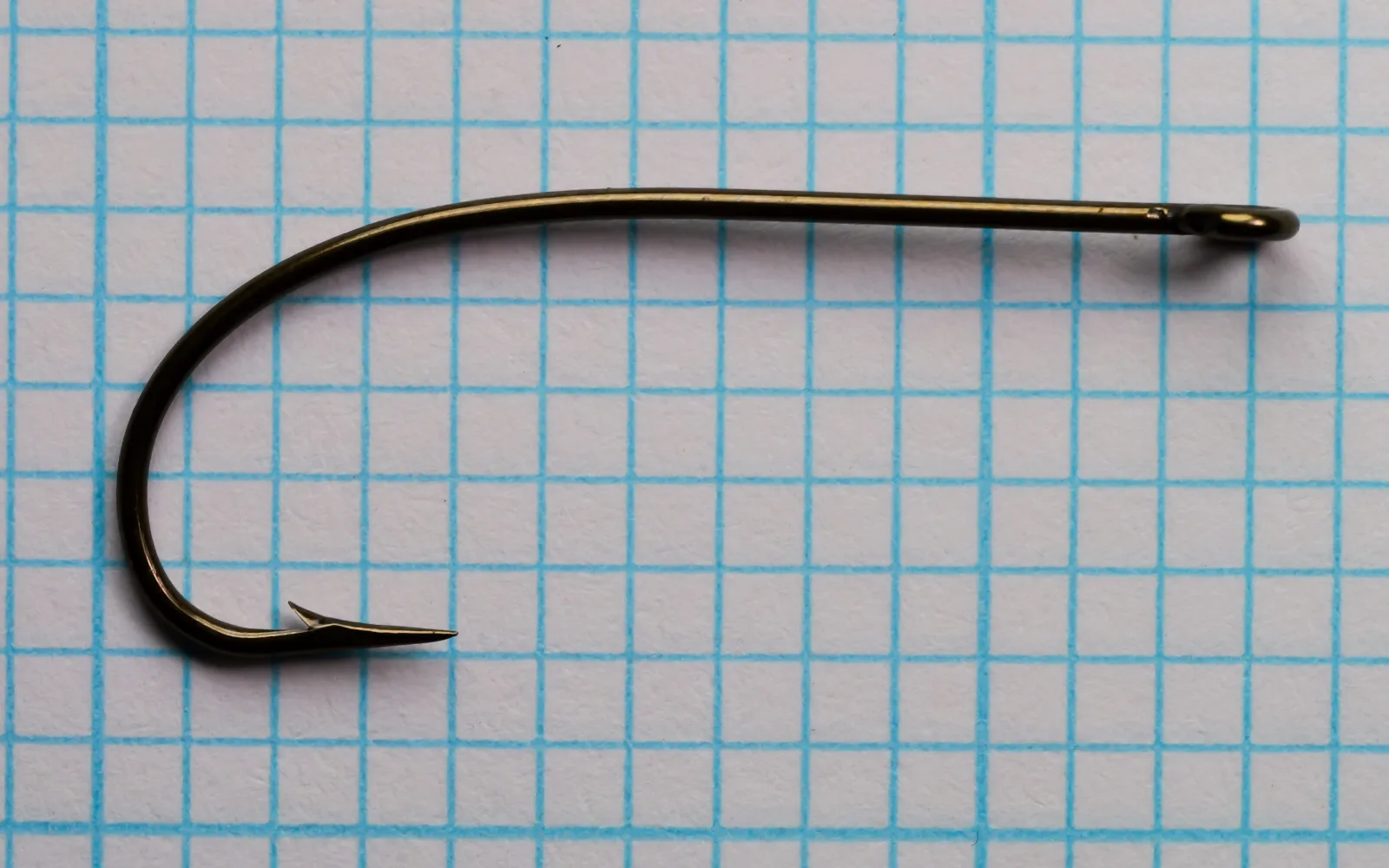
Profile view of the Mustad 3891 Sproat Hook, size No. 1, on measurement grid showing the parabolic bend curve, ringed eye, and hollow point geometry. The rustproof bronze-brown finish is visible throughout the steel.
Photographic record
4 cataloged imagesSelect any record to load it above.
4 images shown
Mustad 3891 Sproat Hook Size 1 Profile ViewProfile view of the Mustad 3891 Sproat Hook, size No. 1, on measurement grid showing the parabolic bend curve, ringed eye, and hollow point geometry. The rustproof bronze-brown finish is visible throughout the steel.Open originalMustad 3891 Sproat Hooks Size 1 Paired SpecimensTwo Mustad 3891 Sproat Hooks, size No. 1, positioned side-by-side on measurement grid for direct comparison. Both specimens show identical bend profile, eye construction, and finish consistency, demonstrating the precision of Mustad's mid-century manufacturing standards.Open originalMustad 3891 Sproat Hook Original Package and LabelOriginal cardboard box and eight-line Mustad label for the 3891 Sproat Hook, size No. 1, bearing the iconic Key Brand downward-pointing skeleton key trademark and decorative floral border. The label reads 'O. MUSTAD & SÖN | MANUFACTURERS | OSLO - NORWAY | Qual. 3891 | Hollow Point | Mustad-Sproat Hooks | 100 No. 1 | Ringed Rustproof | Made in Norway.' Label features gold-leaf offset printing on cream cardboard with hand-marked size notation in purple ink.Open originalMustad 3891 Sproat Hook Size 1 Point DetailExtreme close-up detail of the Mustad 3891 hollow point, showing the concave inner face taper, barb angle and positioning, and the fine tip. The hollow geometry creates the rapid-penetration characteristic essential for light-tackle wet fly and salmon applications.Open original
Technical profile
Ringed Ball Eye | Sproat Bend | Standard Shank | Standard Wire | Hollow Point | Rustproof Finish
Eye
Ball Eye, Straight / InlineThe ringed eye (ball eye) is well-formed, symmetrical, and smoothly welded or brazed to the shank P. The eye diameter is proportionate to the wire gauge—approximately 0.085"-0.095" interior opening E. The ball itself is neat and uniform, with no obvious deformities or rough spots. The eye sits at a slight downward angle to the shank axis, consistent with standard ringed-eye construction of the period.
Wire
Standard, Round, Est. ~0.050"-0.055" (~1.3-1.4 mm)
Shank
Standard — Plain
Bend
Sproat, Standard gapThe bend exhibits the characteristic parabolic profile of the Sproat family—a smooth, evenly curved arc from the barb to the shank, with no sharp angles or flat sections P. Bend depth (eye to deepest point of curve) is proportionate to the gap width, resulting in a geometrically balanced profile. The bend is symmetrical with no lateral offset; it sits in the same vertical plane as the shank and point P. The wire maintains consistent diameter through the bend, consistent with unforged construction.
Point
Hollow Point (concave inner face)Barb is short, close-cut, and steeply angled, positioned approximately 0.10"-0.15" proximal to the point tip P. The barb angle is approximately 45–50° to the shank axis, typical of mid-century Mustad production. No double barb or swept-back geometry visible; the barb follows standard Sproat pattern specifications.
Finish
Confirmed (stated on packaging)Rustproof finish imparts a warm, bronze-brown tone to the steel, consistent with period alkyd-resin lacquer or japanning P. The finish exhibits light surface patina and minor oxidative weathering characteristic of 40–70 years of storage, but no evidence of flaking, peeling, or structural compromise P. The color is warm-toned rather than cool or silver-bright, suggesting a baked-on organic coating rather than tinning or bright steel. Uniformity of finish across the hook surface is good, with slightly heavier tone in recessed areas near the bend E.
The hook specimen is bright and corrosion-free, with no visible pitting or structural damage P. The rustproof finish shows light patina consistent with age but no flaking or compromise. All hooks in the documented box are intact—no missing or broken specimens visible P. The original cardboard box and label are well-preserved, showing light yellowing and minor edge wear but excellent legibility of all printed text P.
The Sproat bend’s defining engineering feature is its parabolic (mathematically curved) profile, which distributes the tensile stress of a fighting fish evenly across the entire bend radius rather than concentrating force at the apex. This uniform stress distribution prevents the catastrophic failure modes seen in angular bends (e.g., Limerick) under sudden, high-force strikes. The hollow point geometry—characterized by a concave inner face with a sharp, rapidly flaring taper—provides the biomechanical advantage of extremely low initial penetration resistance, ideal for light-tackle presentations where the angler cannot rely on a heavy, stiff rod to drive the hook home. The combination of standard-gauge round wire (unforged) with a ringed eye creates a durable, economical construction suitable for high-volume commercial and sport applications. The ‘rustproof’ finish indicates a thin alkyd-resin lacquer or japanning process, not modern stainless steel, reflecting Mustad’s mid-century corrosion-resistance methodology.
Size & scale lab
Selected size
1
Physical specimen
Overall Length
34 mmP
Shank Length
25.5 mm
Gap Width
10.7 mmP
Bend Depth
12.7 mm
Shank-to-Gap Ratio
~2.35-2.50 : 1
Confidence
P
Physical specimen
Physical measurement with calipers
Own this hook? Help us measure it.
We don't have measured sizes for this hook yet. Own one? Submit calipered measurements and we'll review and add them. Thank you!
Historical context
mustad
O. Mustad & Søn was founded in 1832 in Gjøvik, Norway, initially as a maker of basic metal goods—nails, wire, and hardware. Hans Schikkelstad established the firm; his son-in-law Ole Hovelsen Mustad and grandson Hans Mustad transformed it into a hook manufacturer. The defining innovation occurred in 1877 when visionary engineer Mathias Topp invented the first fully automated hook-making machine, capable of cutting, bending, barbing, and pointing wire at unprecedented speed. Mustad’s leadership deliberately avoided patenting the machine, instead relying on corporate secrecy, strict NDAs, and restricted factory access to protect their proprietary methods. By the 1950s, this strategy had secured Mustad 50% of global hook production. The company established sales offices and manufacturing facilities across multiple continents, making the Mustad name virtually synonymous with the fishing hook itself. Production at the Gjøvik factory continued uninterrupted through both World Wars and remained the primary manufacturing center through the twentieth century.
Series History
The Mustad-Sproat Hooks line represents one of Mustad’s flagship series, produced continuously from approximately 1890 through the present day. The Sproat bend itself was reverse-engineered by Mustad from regional Irish patterns and standardized for mass production. The Qual. 3891 variant—featuring a hollow point and ringed eye—represents the mid-tier offering within the Sproat family, positioned between economy bait-fishing variants and premium dry-fly configurations. The Qual. 3906 (spear point variant) achieved particular fame as the standard wet fly hook in fly-tying circles throughout the twentieth century. The 3891 was produced continuously throughout the 1920s–1970s era and remains in limited production under modern Mustad catalogs. No significant design changes were made to the 3891 configuration during its production run; the bend, point geometry, eye type, and wire gauge remained consistent, reflecting Mustad’s engineering confidence in the original design. The hollow-point variant was eventually superseded by the spear-point 3906 as the popular standard, though the 3891 remained available for anglers preferring the lighter penetration characteristic of the hollow profile.
Era and Packaging Dating
Label bears 'OSLO - NORWAY' designation. The Norwegian capital was officially renamed from Christiania to Oslo on January 1, 1925, providing a definitive post-1925 terminus. The presence of the eight-line Mustad typographic label format confirms the vintage era (ended c. 2001–2009 with Signature Series transition). No barcode visible, consistent with pre-1974 manufacture. Printed currency notation absent from visible label. Label typography and box construction suggest mid-twentieth-century offset printing on cream-toned paperboard. The notation 'Made in Norway' and traditional 'Qual.' model code format (Qual. 3891) further confirm production within the classic Mustad labeling period, most likely 1925–1970. The specific configuration (hollow point, ringed rustproof finish, Sproat bend) aligns with Mustad's mid-tier product portfolio of the 1930s–1960s.
The Sproat Revolution: Mustad's Industrial Cloning Strategy
The Sproat bend itself originated as a regional Irish pattern, perfected by craftsmen in Limerick and Dublin. When Mustad acquired manufacturing licenses and reverse-engineered the design in the 1890s, they did so without paying royalties or crediting the original makers—a deliberate industrial strategy that allowed them to undercut British Redditch makers and global competitors. The Qual. 3891 is a direct product of this 'industrial cloning' approach documented in the Mustad corporate archives. By the 1950s, Mustad's ruthless efficiency in copying, standardizing, and mass-producing regional patterns had made them synonymous with the fishing hook itself worldwide, capturing 50% of global hook production. The Sproat's parabolic geometry—mathematically engineered to distribute stress evenly—became the benchmark for wet fly and salmon hooks for over a century.
Design lineage and influence
The Sproat bend traces its lineage to nineteenth-century Irish blacksmith traditions, where the parabolic curve was empirically discovered to provide superior holding power under sustained tension. Mustad’s engineering team codified this geometry into a standardized, mass-produced pattern circa 1890–1910, creating the Qual. 3891 as a mid-tier production hook suitable for both commercial and sport fishing markets. The design influenced subsequent Mustad variants, including the Qual. 3906 (which substitutes a spear point for the hollow), and remains a direct predecessor to modern Sproat hooks produced by Tiemco, Partridge, and contemporary Mustad lines. The Sproat’s parabolic profile has proven so mechanically sound that it remains essentially unchanged after 130+ years of manufacturing.
Best matchRelated by Attribute
Computed automatically from catalog data — updated as new hooks are added.
Matches: Bend, Wire, Gap, Point, Forging +2 moreDiffers: Shank: Standard vs 1X Long; Eye: Ball Eye vs Looped Eye; Eye Orient.: Straight / Inline vs Turned Up +1 more
Matches: Bend, Shank, Wire, Gap, Forging +2 moreDiffers: Eye: Ball Eye vs Tapered Eye; Eye Orient.: Straight / Inline vs Turned Down; Point: Hollow Point vs Superior +1 more
The Mustad 3891 is a mid-tier, general-purpose wet fly and salmon hook designed for both freshwater and light saltwater applications. The Sproat bend’s parabolic geometry distributes mechanical stress evenly across the steel, making it exceptional for sustained battles with strong, jumping fish. Historically used for Atlantic salmon flies, sea trout patterns, and classic wet fly tying across British and European traditions. The hollow point geometry allows for quick penetration with minimal angler effort, ideal for presentations where the fly must hook on a light strike.
Secondary Applications
Light bait fishing for trout and grayling; occasionally used in small salmon and sea trout flies for Irish and Scottish traditions.
Classic Fly Patterns
March Brown, Greenwells Glory, Partridge and Orange, Teal and Red, Butcher, Mallard and Claret, Woodcock and Yellow, Silver Doctor, Jock Scott, Durham Ranger
Modern Equivalents
Hook
Match Quality
Notes
Mustad 3906B
Good
Modern Sproat wet fly hook with spear point; retains ringed eye and Sproat bend but different point geometry
Tiemco 200R
Very Good
Contemporary standard-weight wet fly hook with ringed eye and parabolic bend profile; hollow point variant available
Partridge CS10/1
Moderate
English-made salmon fly hook with similar bend family but heavier wire and looped eye construction
Collector notes
Mid-tier vintage Mustad Sproat in standard configuration commands moderate collector interest. The eight-line label format, post-1925 Oslo designation, and well-preserved original packaging elevate the specimen. Limited primarily by the hook's relative commonness in vintage Mustad catalogs—Sproats were among the company's highest-volume patterns.
Reference value
$25 – $65 USD estimate
Packaging condition
Good — moderate wear, legibleRecorded specimen
Packaging format
GW-M-01Catalog code
Positive factors: Original eight-line label with Key Brand trademark and decorative border in excellent condition; post-1925 Oslo designation providing clear chronological bracket; rustproof finish characteristic of mid-century Mustad production; complete 100-hook box (or certified original count); Sproat bend’s iconic status in fly tying history; early evidence of Mustad’s industrial dominance in global hook markets.
Limiting factors: Qual. 3891 appears frequently in surviving vintage collections, indicating high original production volume; standard-weight, ringed-eye configuration lacks the specialization of premium models (e.g., Qual. 94840 Viking); hollow point geometry, while desirable, does not command premium pricing relative to specialized big-game or salmon patterns; general wear or label deterioration significantly reduces value.
Packaging
Classic eight-line Mustad paper label affixed to cream-colored cardboard box. Label features iconic downward-pointing skeleton key trademark (Key Brand) in upper left quadrant, surrounded by decorative floral border pattern in gold/yellow ink. Printed text in gold leaf or yellow offset ink on cream background. Label dimensions approximately 3.5 x 2.5 inches. Reads: Key Brand | O. MUSTAD & SÖN | MANUFACTURERS | OSLO - NORWAY | Qual. 3891 | Hollow Point | Mustad-Sproat Hooks | 100 No. 1 | Ringed Rustproof | Made in Norway. Hand-marked size '1' in purple/violet ink in lower left corner. Label shows patina consistent with 40–70 years storage. Paper stock is period-appropriate kraft-based cardboard with slight yellowing and edge wear. No barcode or modern UPC visible.
Market Value Notes
Original 100-hook box in excellent condition with legible label commands $45–65 USD on specialist markets (e.g., vintage fishing tackle dealers, tackle auctions). Single hooks or partial boxes $3–8 each. Premium paid for boxes with no missing hooks and label clarity. Condition of original box exterior and label legibility are primary value drivers. Comparable mid-tier Mustad Sproats (3371, 3906) in similar condition trade in the $35–75 range. Lower end reflects specimen condition or incomplete labeling; upper end reflects pristine original boxes with full hook counts and period-appropriate packaging.
Where to Find
Specialist vintage fishing tackle dealers; international eBay auctions (search: 'Mustad 3891 Sproat'); vintage tackle fairs and regional angling auctions; UK-based dealers specializing in classic Atlantic salmon and wet fly tackle; occasional estate sales and antique fishing collections; garrenwood.com reference library.
Collector's Identification Tips
Identify this hook by the combination of (1) ‘Qual. 3891’ model code on the label; (2) distinctive round Sproat bend with gentle parabolic curve; (3) ringed eye construction (ball eye); (4) hollow point with concave inner face; (5) standard-gauge, round, unforged wire; (6) ‘Oslo – Norway’ designation confirming post-1925 production; (7) rustproof finish imparting a warm, slightly oxidized bronze-brown tone to the steel; (8) label typography and box construction consistent with 1930s–1960s Mustad production. The combination of Sproat bend, hollow point, and ringed eye is definitive. The Qual. 3891 designation is unique to this configuration and should not be confused with the famous Qual. 3906 wet fly hook (which features a spear point and tapered eye).
Preservation
Storage and Preservation
Store the original box and hooks in a cool, dry location away from direct sunlight and humidity fluctuations. The rustproof finish is a baked-on alkyd-resin lacquer, which is durable but susceptible to slow degradation if exposed to prolonged moisture or salt air. Keep the box sealed or loosely wrapped in acid-free tissue to prevent dust accumulation and environmental exposure.
If the box is opened for inspection, handle hooks carefully to avoid bending or corrosion from skin oils. The original cardboard box and cream label are integral to the specimen’s historical significance and market value—preserve them as part of the artifact. Avoid contact between the hooks and other ferrous metals, which can cause galvanic corrosion or transfer of rust deposits.
The warm bronze-brown tone of the rustproof finish may deepen or develop minor patina with age and proper storage; this is considered desirable by collectors and reflects the authentic aging of vintage tackle. Do not attempt to polish, brighten, or restore the finish, as such interventions diminish collectability and historical authenticity. Document the condition with photographs for archival records.
Primary Source
The Eight-Line Label as Industrial Standard
Source: Mustad-Guide.pdf; 'A Comprehensive Typology and Decryption of Vintage O. Mustad & Søn Hook Labels' (Reference Document 1)
The Mustad 3891 label exemplifies the standardized eight-line typographic format that O. Mustad & Søn engineered as a universal communication system for international wholesale and retail markets. Each line serves a precise regulatory and marketing function:
Line 1: ‘O. MUSTAD & SÖN’ — Establishes ultimate manufacturer identity and brand integrity, differentiating Mustad from secondary distributors and repackagers who frequently purchased bulk hooks and relabeled them under localized brand names.
Line 2: ‘MANUFACTURERS’ — Legally establishes Mustad’s role as primary producer rather than import agent, ensuring direct brand loyalty from end-users regardless of distribution network.
Line 3: ‘OSLO – NORWAY’ — Geographic origin designator. The Oslo designation (post-January 1, 1925) provides a definitive chronological bracket, as the Norwegian capital was officially renamed from Christiania. Earlier Mustad labels read ‘CHRISTIANIA – NORWAY,’ placing them definitively before 1925.
Line 4: ‘Qual. 3891’ — Quality tier and model code. Mustad’s numeric system encoded manufacturing tolerances, wire gauge, tempering standards, and target demographic. Codes 1000–2999 denoted economy models; 3000–3999 represented mid-tier quality; 4000+ indicated premium, specialized designs.
Line 5: ‘Hollow Point’ — Point geometry specification, the most strictly regulated element of the labeling system. This line exclusively defined penetration mechanics and was never used for shank length, wire gauge, or eye type. The hollow point indicates rapid tissue penetration with minimal applied pressure, ideal for soft-mouthed species and delicate presentations.
Line 6: ‘Mustad-Sproat Hooks’ — Hook pattern nomenclature, reflecting Mustad’s industrial cloning strategy. The Sproat bend was reverse-engineered from Irish regional patterns and standardized for mass export, allowing Mustad to corner localized markets globally.
Lines 7–8: ‘Ringed Rustproof’ — Anatomical modifications (eye type) and metallurgical finish specifications. These modifiers enabled a single foundational pattern (Sproat) to be manufactured in dozens of distinct variations for specific environmental and tactical conditions.
This label format served as the industry standard for over 100 years, enabling Mustad to communicate complex technical data across linguistic barriers to international wholesalers, regional retailers, and individual anglers. The system persisted until approximately 2001–2009, when Mustad discontinued the arbitrary numeric Quality codes in favor of the modern ‘Signature Series’ alpha-numeric naming convention (e.g., ‘R50’ for Round bend, standard weight, standard shank). The presence of the eight-line label on a vintage Mustad package is the definitive hallmark of genuine mid-twentieth-century production.
Additional
The Sproat Bend: 130 Years of Unchanged Excellence
The Sproat bend represents a unique case study in industrial product design: a pattern so mechanically sound that it has remained essentially unchanged for over thirteen decades and continues to serve as the benchmark for wet fly and salmon hooks worldwide. The bend’s defining feature is its parabolic (mathematically curved) profile, which distributes the tensile stress of a fighting fish evenly across the entire bend radius.
The parabolic geometry prevents catastrophic failure modes observed in angular bends (e.g., the sharp angle of the Limerick bend), which concentrate stress at the apex and fail suddenly under sudden, high-force strikes. When a strong fish surges or head-shakes, the Sproat’s curved profile allows the hook to flex and recover elastically, dissipating energy rather than concentrating it. This is why the Sproat became the universal standard for salmon and sea trout fishing—where sustained, violent battles demand absolute reliability.
The Mustad 3891 represents the mid-tier production embodiment of this design philosophy. By combining the proven Sproat bend with a hollow-point geometry (providing rapid penetration with minimal angler effort) and economical standard-gauge round wire, Mustad created a hook suitable for both commercial and sport fishing markets. The design was so successful that the Qual. 3891 remained in continuous production from approximately 1890 through the present day without significant modification. The identical bend profile, wire gauge, and point geometry found on 1930s specimens and contemporary Mustad catalogs testify to engineering confidence in the original design.
This remarkable longevity—in an era of rapid technological change—reflects the timeless principle that mechanical elegance, once achieved, requires no improvement. The Sproat stand as a permanent monument to nineteenth-century Irish craftsmanship and Mustad’s industrial capacity to preserve and scale artisanal excellence.
Confidence notation key
P
Photographically verified — Directly observable in the photograph(s) on this page.
V
Verified by documentation — Confirmed by manufacturer catalog, spec sheet, or published reference.
I
Inferred — A logical deduction from observable or documented evidence, not directly stated.
E
Estimated — An approximation based on visual comparison, proportional analysis, or limited data.
S
Speculative — A reasoned hypothesis that cannot be confirmed from available evidence.
Claims with no notation are confirmed by multiple independent sources. All photographs on garrenwood.com are taken on a measurement grid where each square equals 1/10 inch (0.1″ / 2.54 mm).