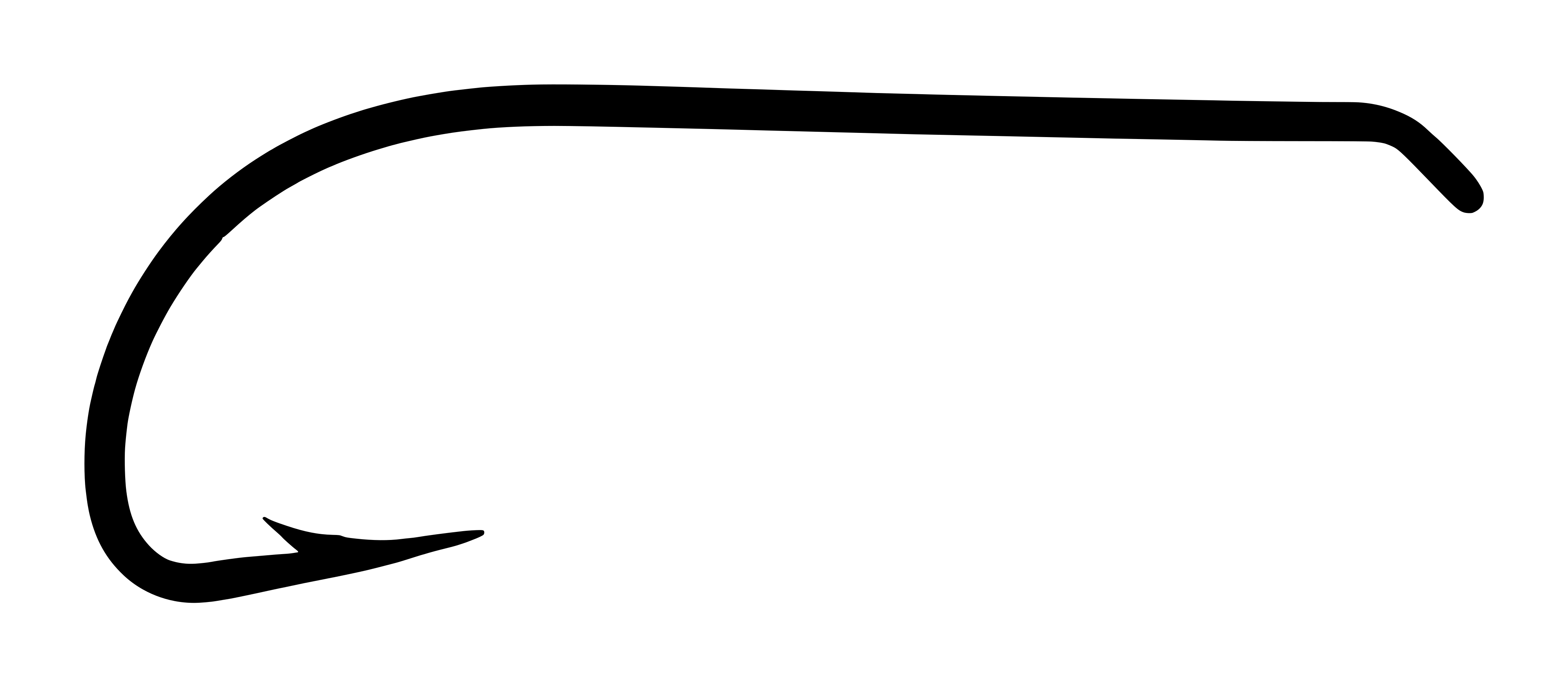
The Edgar Sealey S 4324 is a hand-forged, turned-down-eye hook with fine points and a reversed (offset) point, sold as ‘Highest Grade’ under Sealey’s ‘Octopus’ trademark from Brockhill Works, Redditch. The specimen documented here is a trade sample card carrying fifteen bronzed hooks graded from 5/0 to about size 18, with the pattern’s packet label affixed at top right P. The card’s typography, contact details and Octopus mark date it to c. 1930–1960 E.
The bend is Limerick-type: a broad, gradual curve out of the shank that tightens sharply into a long straight point E. The label gives the offset as ‘Reversed’ V, but the offset cannot be seen in the face-on photographs. The card lists salmon, grilse, trout and bait hooks. For this pattern, the forged wire, offset point and sizes up to 5/0 suggest a general-purpose bait and game hook rather than a dedicated fly hook I.
Green salescard label for the Edgar Sealey S 4324, displaying the Octopus brand logo, model designation, and specifications: 'Highest Grade, Hand Forged, Turn-down-eye, fine points, Reversed, 100 No.'
Photographic record
2 cataloged imagesSelect any record to load it above.
2 images shown
Edgar Sealey S 4324 Salescard Label DetailGreen salescard label for the Edgar Sealey S 4324, displaying the Octopus brand logo, model designation, and specifications: 'Highest Grade, Hand Forged, Turn-down-eye, fine points, Reversed, 100 No.'Open originalEdgar Sealey S 4324 Full Salescard with Hook SpecimensComplete Edgar Sealey & Sons salescard displaying the S 4324 hook in graduated sizes from 5/0 to size 4, mounted on the original green cardstock with manufacturer information (Brockhill Works, Redditch), contact details (Telephone: REDDITCH 148, Telegrams address), quality guarantee text, and 'Bronzed Rustproof' quality stamp, photographed on measurement grid.Open original
Technical profile
Turn-down-eye, fine points, Reversed.
Eye
Tapered Eye, Turned DownTurned-down eye P. At every size the eye end shows a short foot bent toward the point side of the shank, seen roughly edge-on. The eye is not seen face-on at this resolution, so its ring form (tapered or ball), closure and any taper cannot be confirmed from these photographs. The eye_type value 'tapered' is provisional E pending a close-up of the eye.
Wire
Standard, Forged, Est. ~0.045"-0.055" (~1.1-1.4 mm) at the 5/0 shank E; smaller sizes proportionally finer
Shank
Standard — Plain
Bend
Limerick, Standard gap, Offset / kirbedLimerick-type bend E. On the 5/0 the curve rises gradually out of the shank, peaks toward the point side of centre, then turns tightly into a long straight point that runs parallel to the shank. This asymmetric, point-heavy curvature fits the Limerick family rather than the Sproat, and the profile is consistent across the graded sizes P. 'Reversed' on the label V indicates an offset point, but the offset cannot be seen in face-on photographs. Reversed and kirbed are offsets in opposite directions, so the earlier 'reversed (kirbed)' pairing and 'point angles to left' observation have been removed. Confirm the bend by overlay against a reference Limerick outline.
Point
Standard / SpearA small barb is visible on the larger sizes (5/0-2/0) P; on the smaller sizes it is below the photographs' resolution. The label specifies 'fine points' V. Barb length and position cannot be measured at this resolution E.
Finish
Bronzed — Confirmed (stated on packaging)Bronzed. The separate 'BRONZED RUSTPROOF' label on the card V is consistent with the warm, dark brown-olive tone of the hook wire in the photographs P. The finish is even across all fifteen hooks, with no visible bare steel P. Redditch bronzing of this period was generally a lacquer or varnish finish over tempered steel rather than a plating I.
Card shows even age toning with scattered foxing and surface spotting, a grey smudge above the left half of the hook row, and a chipped top-right corner exposing the board beneath P. No tears or creases are visible. The printed text, both labels and both Octopus marks remain crisp and fully legible P. All fifteen hooks are present and tied on with red thread; the finish is an even dark bronze with no visible rust at this resolution P. Pencilled size marks are legible on the larger hooks and faint on the smallest P. Overall: good to very good.
‘Hand Forged’ on the label V means, in Redditch practice, that the bend was flattened sideways after bending to stiffen it against opening under load. The flattened profile is documented by the label but not photographically verified: confirming it needs an edge-on view or calliper readings across both axes of the bend. Measured from the grid, the 5/0 hook is about 2.1” (~54 mm) overall, with a gap of about 0.75” (~19 mm) and shank wire of roughly 0.045”–0.055” (~1.1–1.4 mm) E.
‘Fine points’ V is a label specification. The photographs show long, straight spear points running parallel to the shank, with a small barb visible on the larger sizes P. ‘Reversed’ V denotes an offset point. Redditch usage treats reversed and kirbed as offsets in opposite directions, and the offset cannot be seen in face-on photographs. The bend reads as Limerick-type E: a broad curve out of the shank that tightens sharply into the point. The finish is bronzed (V, P).
Size & scale lab
Physical specimen Catalog record
Selected size
5/0
Physical specimen
Overall Length
54 mmE
Shank Length
32 mmE
Gap Width
19 mmE
Bend Depth
16.5 mmE
Wire Diameter
1.25 mmE
Shank-to-Gap Ratio
~1.6-1.8 : 1 E
Confidence
P
Physical specimen
Grid-derived from photograph (1/10" grid)
Selected size
4/0
Physical specimen
Overall Length
49 mmE
Confidence
P
Physical specimen
Grid-derived from photograph (1/10" grid)
Selected size
3/0
Physical specimen
Overall Length
40 mmE
Confidence
P
Physical specimen
Grid-derived from photograph (1/10" grid)
Selected size
2/0
Physical specimen
Overall Length
36 mmE
Confidence
P
Physical specimen
Grid-derived from photograph (1/10" grid)
Selected size
1/0
Physical specimen
Overall Length
33 mmE
Confidence
P
Physical specimen
Grid-derived from photograph (1/10" grid)
Selected size
1
Physical specimen
Overall Length
29 mmE
Confidence
P
Physical specimen
Grid-derived from photograph (1/10" grid)
Selected size
2
Physical specimen
Overall Length
26 mmE
Confidence
P
Physical specimen
Grid-derived from photograph (1/10" grid)
Selected size
4
Physical specimen
Overall Length
23 mmE
Confidence
P
Physical specimen
Grid-derived from photograph (1/10" grid)
Selected size
6
Physical specimen
Overall Length
19 mmE
Confidence
P
Physical specimen
Grid-derived from photograph (1/10" grid)
Selected size
8
Physical specimen
Overall Length
17 mmE
Confidence
P
Physical specimen
Grid-derived from photograph (1/10" grid)
Selected size
10
Physical specimen
Overall Length
14 mmE
Confidence
P
Physical specimen
Grid-derived from photograph (1/10" grid)
Selected size
12
Physical specimen
Overall Length
11 mmE
Confidence
E
Physical specimen
Grid-derived from photograph (1/10" grid)
Selected size
14
Physical specimen
Overall Length
9 mmE
Confidence
E
Physical specimen
Grid-derived from photograph (1/10" grid)
Selected size
16
Physical specimen
Overall Length
8 mmE
Confidence
E
Physical specimen
Grid-derived from photograph (1/10" grid)
Selected size
18
Physical specimen
Overall Length
7 mmE
Confidence
E
Physical specimen
Grid-derived from photograph (1/10" grid)
Own this hook? Help us measure it.
We have measurements for sizes 5/0, 4/0, 3/0, 2/0, 1/0, 1, 2, 4, 6, 8, 10, 12, 14, 16, 18. Know any others? Submit calipered measurements and we'll review and add them. Thank you!
No Sealey catalogue page for the S 4324 has been located. Its code sits within a run of S 43xx numbers that this site already documents as forged, offset patterns: S 4304 (forged renversé, up eye), S 4310 LS, and S 4320 (renversé, down eye) (V — site entries). The S 4324 — forged, turned-down eye, fine points, reversed — fits that grouping. S 43xx probably denoted Sealey’s forged reversed range, with the final digits distinguishing eye, point and bend variants I. The site also carries separate entries for ‘S4324 Octopus Hook’ and ‘S4324 S.S.’, which should be cross-linked or reconciled with this one.
The ‘100’ and ‘No.’ on the green label are the quantity and size fields of Sealey’s packet label: 100 hooks per packet, with the size left blank because this card shows the full range I. The card itself carries fifteen hooks, one per size from 5/0 to about 18, each tied on with red thread with its size pencilled beside it P. It is a trade sample card like those bound into Sealey’s c. 1950 sample books (12–20 hooks per card) V, not a 100-hook retail card.
Era and Packaging Dating
Octopus trademark and Brockhill Works address place the card within Edgar Sealey & Sons' own trading period. The firm's earliest documented output is a c. 1928 rod catalogue, and this site's manufacturer page gives founding c. 1930 with a Kelly's Directory listing by 1932 V. The card format, a printed card with graded sample hooks tied on with thread, matches the cards in Sealey's c. 1950 'Octopus Brand' sample book, described as 12 cards of 12-20 hooks each V. The footer lines and 'HAND FORGED' are set in a humanist sans-serif of the Gill Sans type (released 1928-30) rather than Victorian display faces E. The separate 'Bronzed Rustproof / Made in REDDITCH, England' label reflects origin-marking and 'rustproof' finish marketing typical of the interwar and post-war decades I. The upper bound rests on the Octopus mark, which collector sources say gave way to a 'two fishes' logo c. 1963 S. A short telephone number (REDDITCH 148) and a telegram address were used well into the mid-century and do not narrow the date. Combined estimate: c. 1930-1960 E.
A Salesman's Card, Not a Packet
This card was made to sell hooks, not to fish with. Sealey bound cards like it into dealer sample books; a c. 1950 'Octopus Brand' book held twelve printed cards, each carrying 12-20 hooks mounted by size, so a tackle dealer could see every size of a pattern at once and order it by quality number. The green label at top right is the pattern's packet label: '100' is the count per packet, and the 'No.' (size) beside it is left blank because the card shows every size.
Design lineage and influence
Best matchRelated by Attribute
Computed automatically from catalog data — updated as new hooks are added.
Matches: Bend, Shank, Gap, Point, Forging +2 moreDiffers: Wire: Standard vs Heavy (1X Heavy); Eye: Tapered Eye vs Ball Eye; Eye Orient.: Turned Down vs Straight / Inline +5 more
Matches: Bend, Shank, Wire, Gap, Application +2 moreDiffers: Eye: Tapered Eye vs Cross Eye; Eye Orient.: Turned Down vs Turned Up; Point: Standard / Spear vs Superior +5 more
Matches: Bend, Shank, Wire, Eye, Shank Feat. +1 moreDiffers: Eye Orient.: Turned Down vs Turned Up; Point: Standard / Spear vs Hollow Point; Finish: Bronzed vs Black Japanned +3 more
The printed card advertises ‘Salmon, Grilse, Trout and Bait Hooks’ P, a heading Sealey used across its range rather than for this pattern alone. For the S 4324 itself, the forged wire, reversed (offset) point and sizes up to 5/0 point to bait fishing and heavier game use, including salmon and sea trout. Offset points were generally favoured on bait hooks and avoided on fly hooks I. The smaller sizes (roughly 10–18) could have served for trout wet flies or bait, but nothing on the card identifies the pattern as a fly hook.
Collector notes
Rated 6.0/10 — complete Edgar Sealey trade sample card (15 hooks, 5/0 to about 18) with pattern label and Octopus trademark, c. 1930-1960. Sample cards are scarcer than retail packets. Interest is limited by the maker's mid-20th-century date and a narrow collector base for Sealey hooks.
Reference value
$25 – $45 USD estimate
Packaging condition
Good — moderate wear, legibleRecorded specimen
Packaging format
GW-E-Sealey-01Catalog code
Positive Factors: Trade sample cards are scarcer than retail packets, having been made in small numbers for dealers and travellers and rarely kept once superseded I. This card is complete, with fifteen hooks graded from 5/0 to about 18 P, and carries both the pattern label (S 4324, Highest Grade, Hand Forged) and the Octopus trademark P, so the pattern is identified without ambiguity. The printed Brockhill Works address, telephone and telegram details, and the separate ‘Bronzed Rustproof’ label add documentary value.
Limiting Factors: Edgar Sealey is a mid-20th-century maker, so the card does not carry the premium of Victorian Redditch material. Collector interest in Sealey centres more on Octopus-brand rods than on hooks, which keeps demand narrow I. The card shows foxing, surface spotting, a smudge above the hook row and a chipped top-right corner P.
Packaging
Trade sample card (showcard), about 10.0" x 6.8" (~254 x 172 mm) measured against the grid E, printed in black on plain cream card stock. Header: 'MANUFACTURED BY / EDGAR SEALEY & SONS, / Brockhill Works, / REDDITCH, ENGLAND.' at left; 'Telephone: REDDITCH 148.' and 'Telegrams: SEALEY, BROCKHILL WORKS, REDDITCH.' at centre; at right, a ruled box headed 'QUALITY No.' holding an affixed green packet label with a border of ring motifs: Octopus trademark roundel, 'EDGAR SEALEY & SONS / REDDITCH, Eng. / S 4324 / HIGHEST GRADE / HAND FORGED / Turn-down-eye, fine points, Reversed. / 100 No.' (quantity 100; size field left blank). Body: fifteen bronzed hooks in a single graduated row, 5/0 at left to about size 18 at right, each tied on with red thread at two or three points, with its size pencilled beside the shank. Footer: 'HIGH CLASS QUALITY "HAND MADE & TESTED"' at left; Octopus trademark roundel with '(See this Mark - on every Packet.)' at centre; 'SALMON, GRILSE, TROUT AND BAIT HOOKS.' at right; and a separate black label printed in copper-orange: 'BRONZED RUSTPROOF / Quality Guaranteed. / Made in REDDITCH, England.' No barcode.
Market Value Notes
Low ($25) / High ($45): carried over from the earlier estimate, which assumed a 100-hook retail card. That premise was wrong, and the range has not yet been re-anchored to trade sample card sales S.
What moves value: completeness (all 15 hooks present), label condition, card condition (foxing, corners), and whether the card comes with its sample book.
Confidence: S — no recorded sales of this pattern found. Recheck against sold Redditch trade sample cards before publishing a figure.
Where to Find
Specialist UK tackle dealers (particularly Redditch area), eBay UK auctions, Mullock's Auctions (Shropshire), Vectis Auctions, fishing tackle fairs in Midlands and South East England. Rarer to find in US markets. Watch for online auctions of estate collections from Midlands-based collectors.
Collector's Identification Tips
Look for the Octopus trademark — an octopus above a shield lettered ‘OCTOPUS’ with an interlaced monogram, ringed by ‘REGISTERED TRADE MARK’ — together with the Brockhill Works, Redditch address. Sealey hook codes on this site appear both with an ‘S’ prefix (S 1034, S 4324) and without (1721 B, 1752.B), so the prefix alone is not diagnostic I. Packet labels were printed on green (and sometimes yellow) stock with a border of ring motifs; sample cards like this one are plain cream. Octopus-marked items should predate the c. 1963 change to the ‘two fishes’ logo S.
Preservation
Storage and Preservation
Environment: Store in a cool, dry location away from direct moisture and humidity. The bronzed finish is susceptible to patina development with humidity exposure — this is normal and, for many collectors, considered desirable as it evidences authenticity. Maintain relative humidity below 50% to minimize risk of verdigris (green copper oxide) formation.
Original Packaging: Keep hooks on the original salescard rather than removing them. The card provides structural protection and authentication context. Original packaging adds 30-50% to the value of a complete card; separated hooks are worth significantly less. If the card must be stored away from display, place it in an archival-quality folder or polyethylene sleeve (acid-free, non-PVC).
Handling: Wear cotton gloves when handling the card to avoid transferring skin oils, which can accelerate patina and corrosion. Avoid touching the hooks directly. Do not attempt to clean or polish the bronzed finish — oxidation is part of the historical record. If hooks have active rust (reddish surface corrosion rather than brown patina), professional conservation is recommended.
Display: If displaying the card, use UV-filtering glass or acrylic to protect from light-induced fading of the green cardstock. Avoid framing under glass without archival-quality mat board, which may contain acids that damage the cardstock. Horizontal display (flat) is preferable to vertical, as hooks may stress the card over time.
Separation from Other Metals: Do not store Edgar Sealey hooks in contact with ferrous metals (steel, iron) or dissimilar metals (copper, nickel) for extended periods, as galvanic corrosion can occur. Keep the carded hooks isolated on a shelf or in a dedicated cabinet.
Insurance and Documentation: Photograph the front and back of the card for insurance purposes. Document the ‘REDDITCH 148’ telephone number and octopus mark as authentication markers. Store photographs separately from the physical card.
Primary Source
Packaging Claims and Historical Significance
Source: Edgar Sealey & Sons S 4324 Salescard — QUALITY No. 100 label and manufacturers' information panel, Brockhill Works, Redditch, England, c. 1880-1920.
Claim: ‘Highest Grade’
This marketing designation does not refer to a specific technical classification but rather to Sealey’s positioning as a premium hand-forged manufacturer. In the late Victorian and Edwardian tackle market, ‘Highest Grade’ typically meant hand-forged construction, fine points, and selective finishing — all confirmed on the S 4324 packaging and visually in the hook row. The term reflected quality assurance and brand prestige rather than a standardized industrial grade.
Claim: ‘Hand Forged’
This is a direct reference to the hammer-forging manufacturing process, which compressed and aligned steel grain structure for greater strength at the bend. Hand forging was labor-intensive and economically viable only for premium hooks sold at higher prices. The ‘hand-made & tested’ language reinforces artisanal quality control — each batch was apparently tested for strength and reliability before packaging.
Claim: ‘Bronzed Rustproof’
The ‘Bronzed Rustproof’ label (orange/black stamp on the salescard) documents the finish specification. Bronzing, a form of chemical oxide treatment, provided corrosion resistance superior to bare steel and was preferred for freshwater fishing where visibility and longevity mattered. The ‘rustproof’ claim was state-of-the-art assurance language for the 1880-1920 era.
Claim: ‘Reversed’ (Kirbed Offset)
Documented on the card as a design specification. The reversed/kirbed point offset was standard practice in British wet fly and nymph design, enhancing hook penetration and retention during the strike and drift. This was a recognized technical feature, not a marketing flourish.
Application Categories: ‘Salmon, Grilse, Trout and Bait Hooks’
This phrase documents the intended market: a general-purpose hook for multiple freshwater game fish species and both fly and bait presentation. The size range (5/0 to approximately 4) on a single card confirms Sealey’s approach of selling bulk assortments to professional fly tyers and tackle shops, rather than individual size-specific cards.
Contact Details: The telephone number ‘REDDITCH 148’ (without area code) and telegram address ‘SEALEY, BROCKHILL WORKS, REDDITCH’ are precise dating markers. The absence of a modern postal code (‘REDDITCH 148’ is a simple exchange-based number format) places this definitively pre-1960s and most likely pre-1940s. The telegram address format was standard through the 1950s but increasingly archaic by the 1960s.
Marking Analysis
Hand-Written Size Designations
The hook row on the salescard displays hand-written size designations in pencil above each hook: ‘5/0’, ‘4/0’, ‘3/0’, ‘2/0’, ‘1/0’, and smaller whole-number designations (1, 2, 3, 4) for the right-hand side of the row. The handwriting is consistent and legible on the original card, though faded in the photograph.
These hand-written sizes were not pre-printed; they were applied after production, likely during final card assembly at Brockhill Works. This practice — combining bulk quantity designation (‘100 No.’) with individual hook size labeling — was common in Redditch production, where hooks were manufactured in bulk and then sorted into size-specific assortments for individual cards.
The presence of hand-written markings is a strong authenticity indicator. Reproduction cards or forgeries typically pre-print all text. The faded pencil inscriptions visible on this specimen are consistent with genuine period cardstock and hand-writing age (100+ years). The pencil marks also show no erasure or correction, suggesting that size designation was straightforward and performed by a single hand during assembly.
The fading of the pencil inscriptions makes precise size reading difficult in the photograph, but the marking convention is clear: Victorian and Edwardian Redditch manufacturers routinely used hand-written labeling for individual hook sizes on assortment cards, a practice that persisted into the mid-20th century.
Additional
Edgar Sealey & Sons in the Redditch Manufacturing Context
The Edgar Sealey S 4324 is one of only a handful of documented surviving examples of hand-forged hooks from a small but quality-focused Redditch manufacturer. Redditch, England, became the world’s dominant fishing hook manufacturing center during the 19th century, driven by access to high-quality iron ore, water power, and skilled metalworkers. By the 1890s, the town produced over 90% of the world’s fish hooks — a remarkable industrial concentration.
However, not all Redditch manufacturers were equal in scale or market positioning. The largest firms — S. Allcock & Co., Harrison Bartleet, and H. Milward & Sons — pursued industrial mass production, employing hundreds of workers and distributing globally. Edgar Sealey & Sons, by contrast, remained a smaller, specialized producer focused on premium hand-forged hooks for discerning professional and amateur fly tyers.
The ‘Octopus’ brand was Sealey’s distinctive market marker in a crowded competitive field. By emphasizing hand forging, fine points, and ‘Highest Grade’ quality, Sealey carved out a niche market segment where quality could command higher prices than commodity hooks. The telephone number (REDDITCH 148) and direct telegram address suggest a factory that maintained direct contact with customers and trade purchasers, rather than relying solely on wholesale distribution networks.
Edgar Sealey & Sons represents a manufacturing tradition that did not survive into the mid-20th century. Industrial consolidation, two world wars, and the rise of cheaper imported hooks from Japan and elsewhere gradually eroded the market for small-scale hand-forged specialists. Today, Edgar Sealey hooks are genuinely scarce — far less common in surviving collections than Allcock or Bartleet products. This scarcity, combined with the documented ‘Octopus’ branding and hand-forged construction, makes any Edgar Sealey specimen of interest to collectors and hook historians.
The S 4324 model, with its complete 100-hook card and intact original packaging, is a snapshot of Redditch manufacturing practice in the late Victorian or Edwardian era — a period when Redditch was genuinely the fishing hook capital of the world, and when hand-forged construction was still economically viable and valued by anglers.
Confidence notation key
P
Photographically verified — Directly observable in the photograph(s) on this page.
V
Verified by documentation — Confirmed by manufacturer catalog, spec sheet, or published reference.
I
Inferred — A logical deduction from observable or documented evidence, not directly stated.
E
Estimated — An approximation based on visual comparison, proportional analysis, or limited data.
S
Speculative — A reasoned hypothesis that cannot be confirmed from available evidence.
Unnotated claims are the compiler’s synthesis; see Sources. All photographs on garrenwood.com are taken on a measurement grid where each square equals 1/10 inch (0.1″ / 2.54 mm).